By
Paul Marsden
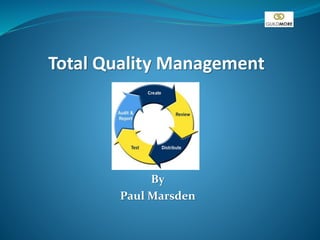
Total Quality Management
For Guildmore, ‘quality’ is not about ‘luxury’ or
‘Rolls Royce perfection’.
Construction quality is:
• Conformance to specification within
budget
• Client satisfaction
• Fitness for purpose
Past
• Quality is the factory floor
problem
• Hide defects from customers
• Few records
• Defects lead to blame
• Closely supervise workers
• Improved Quality costs more
Present
• Everyone’s responsibility
• Open ‘corrective action’
• Document system and problems
• Defects lead to solutions
• Train and trust
• Quality saves money &
increases business
Past
• Inspection
• Individual input
• Sequential engineering
• Short term-ism
• People as a burden
• Purchase on price only
• Customers as the ‘problem’
Present
• Defect prevention
& Continuous improvement
• Teamwork
• Parallel engineering
• Strategic planning
• Human resource assets
• Purchase on total cost minimisation
• Customer satisfaction
Quality Inspection – sort ‘good’ products
from ‘bad’
Quality Control – product quality
measurement
Quality Assurance – the ‘cost of quality’ and
avoiding sub-standard quality
Total Quality Management – customer
satisfaction, systems to manage quality,
strategic across company, improvement
1900
2000
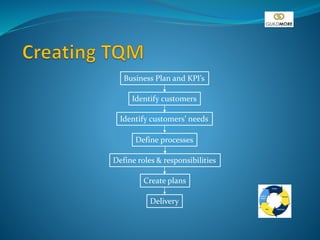
Business Plan and KPI’s
Identify customers
Identify customers’ needs
Define processes
Create plans
Define roles & responsibilities
Delivery
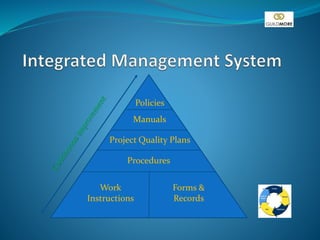
Policies
Manuals
Procedures
Work
Instructions
Forms &
Records
Project Quality Plans
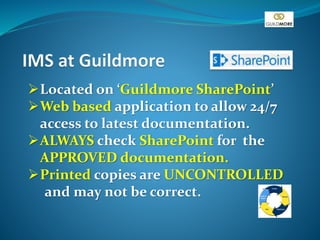
Located on ‘Guildmore SharePoint’
Web based application to allow 24/7
access to latest documentation.
ALWAYS check SharePoint for the
APPROVED documentation.
Printed copies are UNCONTROLLED
and may not be correct.
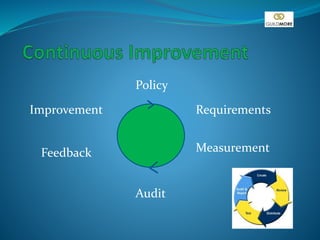
Policy
Requirements
Audit
MeasurementFeedback
Improvement
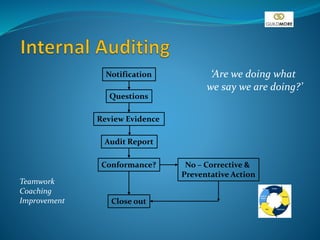
Notification
Questions
Review Evidence
‘Are we doing what
we say we are doing?’
Conformance? No – Corrective &
Preventative Action
Audit Report
Close out
Teamwork
Coaching
Improvement
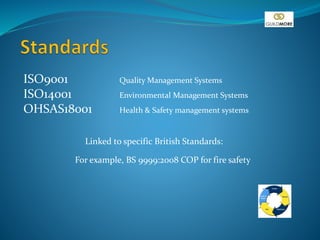
ISO9001 Quality Management Systems
ISO14001 Environmental Management Systems
OHSAS18001 Health & Safety management systems
Linked to specific British Standards:
For example, BS 9999:2008 COP for fire safety
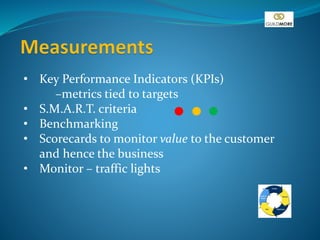
• Key Performance Indicators (KPIs)
–metrics tied to targets
• S.M.A.R.T. criteria
• Benchmarking
• Scorecards to monitor value to the customer
and hence the business
• Monitor – traffic lights
Will include :-
• Contract drawings
• Contract specifications, schedules
• Checklists
• Inspection & Test reports
• Internal Audit reports
• Minutes of quality control meetings
• Corrective and Preventative Action Notices (CPANs)
• Calibration records for equipment
Must be maintained and accessible
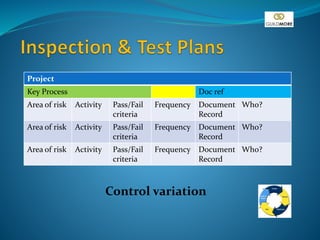
Project
Key Process Doc ref
Area of risk Activity Pass/Fail
criteria
Frequency Document
Record
Who?
Area of risk Activity Pass/Fail
criteria
Frequency Document
Record
Who?
Area of risk Activity Pass/Fail
criteria
Frequency Document
Record
Who?
Control variation
Remember this is YOUR system
Use it and Improve it
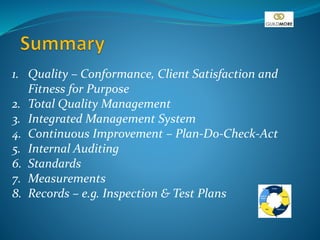
1. Quality – Conformance, Client Satisfaction and
Fitness for Purpose
2. Total Quality Management
3. Integrated Management System
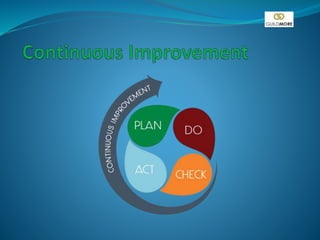
4. Continuous Improvement – Plan-Do-Check-Act
5. Internal Auditing
6. Standards
7. Measurements
8. Records – e.g. Inspection & Test Plans

Presentation Guildmore TQM Feb 2014

  • 1.
  • 2.
    For Guildmore, ‘quality’is not about ‘luxury’ or ‘Rolls Royce perfection’. Construction quality is: • Conformance to specification within budget • Client satisfaction • Fitness for purpose
  • 3.
    Past • Quality isthe factory floor problem • Hide defects from customers • Few records • Defects lead to blame • Closely supervise workers • Improved Quality costs more Present • Everyone’s responsibility • Open ‘corrective action’ • Document system and problems • Defects lead to solutions • Train and trust • Quality saves money & increases business
  • 4.
    Past • Inspection • Individualinput • Sequential engineering • Short term-ism • People as a burden • Purchase on price only • Customers as the ‘problem’ Present • Defect prevention & Continuous improvement • Teamwork • Parallel engineering • Strategic planning • Human resource assets • Purchase on total cost minimisation • Customer satisfaction
  • 5.
    Quality Inspection –sort ‘good’ products from ‘bad’ Quality Control – product quality measurement Quality Assurance – the ‘cost of quality’ and avoiding sub-standard quality Total Quality Management – customer satisfaction, systems to manage quality, strategic across company, improvement 1900 2000
  • 6.
    Business Plan andKPI’s Identify customers Identify customers’ needs Define processes Create plans Define roles & responsibilities Delivery
  • 7.
  • 8.
    Located on ‘GuildmoreSharePoint’ Web based application to allow 24/7 access to latest documentation. ALWAYS check SharePoint for the APPROVED documentation. Printed copies are UNCONTROLLED and may not be correct.
  • 9.
  • 11.
    Notification Questions Review Evidence ‘Are wedoing what we say we are doing?’ Conformance? No – Corrective & Preventative Action Audit Report Close out Teamwork Coaching Improvement
  • 12.
    ISO9001 Quality ManagementSystems ISO14001 Environmental Management Systems OHSAS18001 Health & Safety management systems Linked to specific British Standards: For example, BS 9999:2008 COP for fire safety
  • 13.
    • Key PerformanceIndicators (KPIs) –metrics tied to targets • S.M.A.R.T. criteria • Benchmarking • Scorecards to monitor value to the customer and hence the business • Monitor – traffic lights
  • 14.
    Will include :- •Contract drawings • Contract specifications, schedules • Checklists • Inspection & Test reports • Internal Audit reports • Minutes of quality control meetings • Corrective and Preventative Action Notices (CPANs) • Calibration records for equipment Must be maintained and accessible
  • 15.
    Project Key Process Docref Area of risk Activity Pass/Fail criteria Frequency Document Record Who? Area of risk Activity Pass/Fail criteria Frequency Document Record Who? Area of risk Activity Pass/Fail criteria Frequency Document Record Who? Control variation
  • 16.
    Remember this isYOUR system Use it and Improve it
  • 17.
    1. Quality –Conformance, Client Satisfaction and Fitness for Purpose 2. Total Quality Management 3. Integrated Management System 4. Continuous Improvement – Plan-Do-Check-Act 5. Internal Auditing 6. Standards 7. Measurements 8. Records – e.g. Inspection & Test Plans