Tennis Elbow & Golfer’s Elbow,
Cumulative trauma disorder of Elbow
Presented By- Suparna Bandyopadhyay Moderator- Dr. Tanushree Basak (PT)
MPT (Neurology) , 2nd year Associate professor NIHS, Kolkata
Even a cricket player may have a Tennis Elbow.
▪ Cumulative trauma disorder (CTD) is a term for various injuries of the musculoskeletal
and nervous systems that are caused by repetitive tasks, forceful exertions, vibrations,
mechanical compression, or sustained postures.
▪ Examples: Tennis elbow
Golfer’s Elbow
Bursitis
▪ Risk factors of CTD:
Any occupation involving work-related repetitive stress and micro-trauma (like meat
packers, sewing machine operators, buffers/ grinders) may result in Cumulative trauma
disorder .
It encompasses lateral, medial, and posterior painful elbow symptoms
Classical tennis elbow
Pain in the medial
epicondyle(golfer’s
elbow) (10%)
Posterior painful
elbow(pain around the
olecranon process)(8%)
Pain in the lateral
muscle mass (7%)
Painful Elbow Syndrome
Pain and tenderness on the
lateral side of the elbow
(75%)
Overuse injury secondary to an eccentric overload of the Common EXTENSOR Tendon at the
origin of the EXTENSOR CARPI RADIALIS BREVIS (ECRB) tendon.
Tennis elbow primarily results from repetitive gripping or any activity involving repetitive wrist
extension, radial deviation, and forearm supination.
Epidemiology:
 Despite the condition being commonly referred to as tennis elbow, tennis players make up
only 10% of the patient population
 Half of all tennis players develop pain around the elbow, of which 75% represent true tennis
elbow
 Men and women are equally affected
 The natural course of the condition is favorable, with spontaneous recovery within one to two
years in 80% to 90% percent of the patients
Contributing factors
• Little playing experience.
• Poor stroke techniques: Consistent missing of “SWEET SPOT” while
hitting & use of arm instead of body.
• Poor power or flexibility.
• Heavy stiff racket, large handle size, too tight racket stringing.
• Heavy-duty wet balls.
• Playing surface—balls bounce quicker off the cement court
Sweet Spot
Forehand stroke (23%) ▪ Serve (25%)
(Strokes)
Tennis elbow is seen in All levels of tennis players.
In world class players “SERVE” appears to be the main cause.
▪ More than one-third of tennis players all over the world are affected by
this problem over 35 years of age.
▪ Playing several games per week
Activities other than tennis that lead to tennis elbow:
— Tightening a screw
— Using a wrench
— Wringing washed clothes
— Vigorous handshake
 The common extensor origin consists of the tendons of origin of the ECRB, ECRL,
ECU, EDC . The pathologic process begins with the microscopic disruption of the
tendon fibers, which is a degenerative process. Next, the tendon is invaded by
fibroblasts, vascular granulation tissue, and myofibroblasts. This degeneration and repair
process is termed Angio-fibroblastic hyperplasia. The ordinary arrangement of the
tendon fibers is disrupted.
Because of this absence of inflammatory cells, several authors have referred to the
condition as a “Tendinosis” as opposed to “Tendonitis.”
The arcade of Frohse is located just beneath the extensor carpi radialis brevis (ECRB)
tendon and Radial Tunnel Syndrome may be associated with chronic lateral epicondylitis
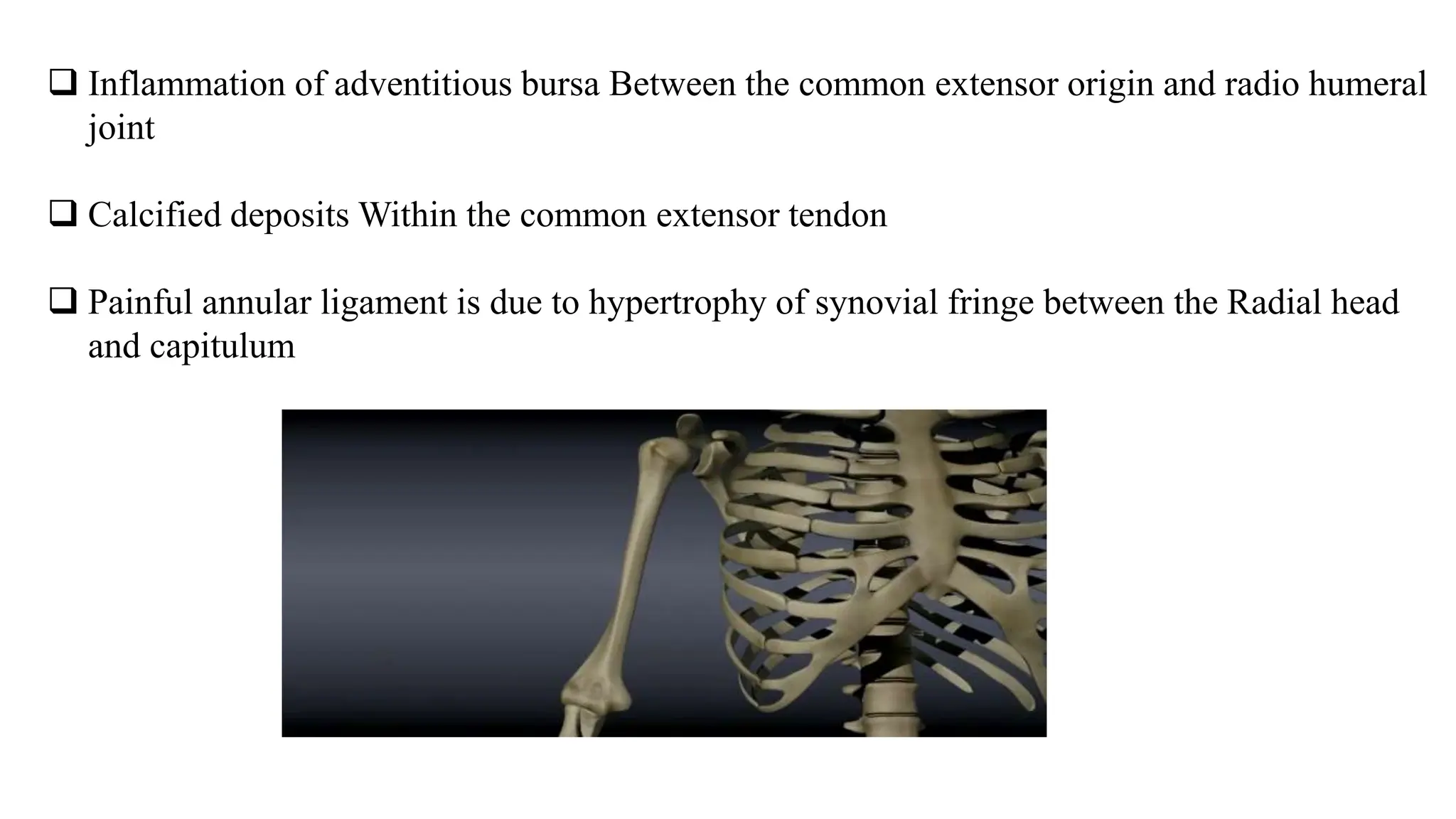
 Inflammation of adventitious bursa Between the common extensor origin and radio humeral
joint
 Calcified deposits Within the common extensor tendon
 Painful annular ligament is due to hypertrophy of synovial fringe between the Radial head
and capitulum
 Stage I There is acute inflammation but no angioblastic invasion. The
patient complains of pain during activity.
 Stage II This is the stage of chronic inflammation. There is some
angioblastic invasion. The patient complains of pain both during
activity and at rest
 Stage III Chronic inflammation with extensive angioblastic invasion.
The patient complains of pain at rest, night pains, and pain during
daily activities
Patients complain of
▪ sharp pain localized to the lateral aspect of the elbow, exacerbated by
activities such as lifting, heavy gripping, or forearm supination and
pronation.
▪ Chronic conditions may find associated tenderness over the arcade of
Frohse, located two finger breadths distal to the lateral epicondyle.
This may indicate the presence of associated radial tunnel syndrome,
often confused with chronic lateral epicondylitis
Cozen’s test Maudsley's Lateral Epicondylitis Test Mill’s test
Can you give the
differential diagnosis of
elbow pain?
Golfer’s Elbow
Golfer’s elbow is tendinopathy of the medial common flexor tendon of the elbow due to
overload or overuse. It may also be referred to as tendinosis or epicondylalgia
Pronator teres and flexor carpi radialis (FCR) are commonly involved, with less common
involvement of other tendons. Histology is very similar to lateral epicondylitis, representing a
tendinosis with angio-fibroblastic hyperplastic changes present
-
 Medial epicondylitis, while less common than lateral epicondylitis, accounts for 10% to 20%
of all epicondylitis
 Three out of four cases are in the Dominant Arm
 Males are more commonly affected
 In women, obesity, Diabetes is associated with increased risk
Signs & symptoms
 Pain/swelling over medial epicondyle
 Discomfort with resisted wrist flexion
Clinical tests
Management
Conservative
Management
Surgical
Management
 Rest
 Activity Modification
 Physiotherapy management
 NSAIDS
 Intralesional Steroids
 Severe pain for 6 weeks at least.
 Marked and localized
tenderness over condyle.
 Failure to respond to restricted
activity or immobilization for at
least 2 weeks.
Indication
Surgical Procedure
o Percutaneous release of epicondylar muscles.
o Bosworth technique of excision of the proximal portion of the annular ligament
▪ Elimination of painful activities
▪ Repeated supination pronation and lifting
heavy objects should be restricted
▪ Controlled supination lifting instead of
pronation gripping.
▪ Use both arms to lift the object
Activity Modification
Pronation Gripping Supination Lifting
▪ Correction of hitting techniques
▪ Use of counterforce bracing splint to offload tendon origin
▪ Racquet string tension, weight modification
▪ Grip size modification
Intervention for Phase I
Rest And elbow splint Thermotherapy
Rehabilitation goal (0-2 weeks)
Cryotherapy
Reduce pain & swelling
Immobilization & Joint protection
Activity Modification
Independent home exercise
Movement with mobilization
Soft tissue Mobilization
Neural mobilization
Rehabilitation goal (2-4 weeks)
Progressive loading & strength
training
Achieve full ROM
DTFM
Resisted exercise
Rehabilitation goal (4-6 weeks)
Eccentric & concentric loading Sports agility training (plyometrics program )
Recent advancement
Mills maneuver Maitland Mobilization
Kinesio taping Dry needling
TheraBand exercise
Protocol I (SEVERE) Protocol II (MILD-MODERATE) Protocol III
(RESOLVED)
Resolution of pain at rest Resolution of pain during activity
and stretching
Prevent recurrence
Improve PROM Achieve full ROM Return to activity
Rest , cryotherapy Rest, cryotherapy Technique and equipment
modification
Return to activity
PROM or Active assisted ROM Active ROM Exercise Pre-activity Flexibility
training
Electrotherapy(UST,HVGS) Electrotherapy(UST,HVGS) Electrotherapy (whirlpool
bath and post-exercise
Icing)
Static stretching, soft tissue manipulation DTFM DTFM
Isometric exercise ( strength training) Progressive loading Concentric and eccentric
strength training
Goal
Rehab
Positioning
of the limb
in a sling
Control
edema and
inflammation
Gentle hand,
wrist PROM
(Pain-free
range)
Active ROM
of shoulder
joints
Post-surgical rehab
Removal of
sling
Active
assisted ROM
Isometric
exercise
D1 and D2
shoulder PNF
Gentle massage
• Counter force bracing
• ROM exercise on end range,
passive over pressure
Progressive resistance
exercise
• Functional training
• Post exercise ice application for
20 minutes
Post-surgical rehab
Task specific
functional training
Plyometrics
exercise
Return to sports
TENNIS ELBOW GOLFERS ELBOW.pptx

TENNIS ELBOW GOLFERS ELBOW.pptx

  • 1.
    Tennis Elbow &Golfer’s Elbow, Cumulative trauma disorder of Elbow Presented By- Suparna Bandyopadhyay Moderator- Dr. Tanushree Basak (PT) MPT (Neurology) , 2nd year Associate professor NIHS, Kolkata
  • 2.
    Even a cricketplayer may have a Tennis Elbow.
  • 3.
    ▪ Cumulative traumadisorder (CTD) is a term for various injuries of the musculoskeletal and nervous systems that are caused by repetitive tasks, forceful exertions, vibrations, mechanical compression, or sustained postures. ▪ Examples: Tennis elbow Golfer’s Elbow Bursitis ▪ Risk factors of CTD: Any occupation involving work-related repetitive stress and micro-trauma (like meat packers, sewing machine operators, buffers/ grinders) may result in Cumulative trauma disorder .
  • 4.
    It encompasses lateral,medial, and posterior painful elbow symptoms Classical tennis elbow Pain in the medial epicondyle(golfer’s elbow) (10%) Posterior painful elbow(pain around the olecranon process)(8%) Pain in the lateral muscle mass (7%) Painful Elbow Syndrome Pain and tenderness on the lateral side of the elbow (75%)
  • 5.
    Overuse injury secondaryto an eccentric overload of the Common EXTENSOR Tendon at the origin of the EXTENSOR CARPI RADIALIS BREVIS (ECRB) tendon. Tennis elbow primarily results from repetitive gripping or any activity involving repetitive wrist extension, radial deviation, and forearm supination. Epidemiology:  Despite the condition being commonly referred to as tennis elbow, tennis players make up only 10% of the patient population  Half of all tennis players develop pain around the elbow, of which 75% represent true tennis elbow  Men and women are equally affected  The natural course of the condition is favorable, with spontaneous recovery within one to two years in 80% to 90% percent of the patients
  • 6.
    Contributing factors • Littleplaying experience. • Poor stroke techniques: Consistent missing of “SWEET SPOT” while hitting & use of arm instead of body. • Poor power or flexibility. • Heavy stiff racket, large handle size, too tight racket stringing. • Heavy-duty wet balls. • Playing surface—balls bounce quicker off the cement court Sweet Spot
  • 7.
    Forehand stroke (23%)▪ Serve (25%) (Strokes) Tennis elbow is seen in All levels of tennis players. In world class players “SERVE” appears to be the main cause.
  • 8.
    ▪ More thanone-third of tennis players all over the world are affected by this problem over 35 years of age. ▪ Playing several games per week
  • 9.
    Activities other thantennis that lead to tennis elbow: — Tightening a screw — Using a wrench — Wringing washed clothes — Vigorous handshake
  • 10.
     The commonextensor origin consists of the tendons of origin of the ECRB, ECRL, ECU, EDC . The pathologic process begins with the microscopic disruption of the tendon fibers, which is a degenerative process. Next, the tendon is invaded by fibroblasts, vascular granulation tissue, and myofibroblasts. This degeneration and repair process is termed Angio-fibroblastic hyperplasia. The ordinary arrangement of the tendon fibers is disrupted. Because of this absence of inflammatory cells, several authors have referred to the condition as a “Tendinosis” as opposed to “Tendonitis.” The arcade of Frohse is located just beneath the extensor carpi radialis brevis (ECRB) tendon and Radial Tunnel Syndrome may be associated with chronic lateral epicondylitis
  • 11.
     Inflammation ofadventitious bursa Between the common extensor origin and radio humeral joint  Calcified deposits Within the common extensor tendon  Painful annular ligament is due to hypertrophy of synovial fringe between the Radial head and capitulum
  • 12.
     Stage IThere is acute inflammation but no angioblastic invasion. The patient complains of pain during activity.  Stage II This is the stage of chronic inflammation. There is some angioblastic invasion. The patient complains of pain both during activity and at rest  Stage III Chronic inflammation with extensive angioblastic invasion. The patient complains of pain at rest, night pains, and pain during daily activities
  • 13.
    Patients complain of ▪sharp pain localized to the lateral aspect of the elbow, exacerbated by activities such as lifting, heavy gripping, or forearm supination and pronation. ▪ Chronic conditions may find associated tenderness over the arcade of Frohse, located two finger breadths distal to the lateral epicondyle. This may indicate the presence of associated radial tunnel syndrome, often confused with chronic lateral epicondylitis
  • 14.
    Cozen’s test Maudsley'sLateral Epicondylitis Test Mill’s test
  • 15.
    Can you givethe differential diagnosis of elbow pain?
  • 16.
    Golfer’s Elbow Golfer’s elbowis tendinopathy of the medial common flexor tendon of the elbow due to overload or overuse. It may also be referred to as tendinosis or epicondylalgia Pronator teres and flexor carpi radialis (FCR) are commonly involved, with less common involvement of other tendons. Histology is very similar to lateral epicondylitis, representing a tendinosis with angio-fibroblastic hyperplastic changes present -  Medial epicondylitis, while less common than lateral epicondylitis, accounts for 10% to 20% of all epicondylitis  Three out of four cases are in the Dominant Arm  Males are more commonly affected  In women, obesity, Diabetes is associated with increased risk
  • 17.
    Signs & symptoms Pain/swelling over medial epicondyle  Discomfort with resisted wrist flexion Clinical tests
  • 18.
    Management Conservative Management Surgical Management  Rest  ActivityModification  Physiotherapy management  NSAIDS  Intralesional Steroids  Severe pain for 6 weeks at least.  Marked and localized tenderness over condyle.  Failure to respond to restricted activity or immobilization for at least 2 weeks. Indication Surgical Procedure o Percutaneous release of epicondylar muscles. o Bosworth technique of excision of the proximal portion of the annular ligament
  • 19.
    ▪ Elimination ofpainful activities ▪ Repeated supination pronation and lifting heavy objects should be restricted ▪ Controlled supination lifting instead of pronation gripping. ▪ Use both arms to lift the object Activity Modification Pronation Gripping Supination Lifting
  • 20.
    ▪ Correction ofhitting techniques ▪ Use of counterforce bracing splint to offload tendon origin ▪ Racquet string tension, weight modification ▪ Grip size modification
  • 21.
    Intervention for PhaseI Rest And elbow splint Thermotherapy Rehabilitation goal (0-2 weeks) Cryotherapy Reduce pain & swelling Immobilization & Joint protection Activity Modification Independent home exercise
  • 22.
  • 23.
  • 24.
    Rehabilitation goal (2-4weeks) Progressive loading & strength training Achieve full ROM DTFM Resisted exercise Rehabilitation goal (4-6 weeks) Eccentric & concentric loading Sports agility training (plyometrics program )
  • 25.
    Recent advancement Mills maneuverMaitland Mobilization
  • 26.
    Kinesio taping Dryneedling TheraBand exercise
  • 27.
    Protocol I (SEVERE)Protocol II (MILD-MODERATE) Protocol III (RESOLVED) Resolution of pain at rest Resolution of pain during activity and stretching Prevent recurrence Improve PROM Achieve full ROM Return to activity Rest , cryotherapy Rest, cryotherapy Technique and equipment modification Return to activity PROM or Active assisted ROM Active ROM Exercise Pre-activity Flexibility training Electrotherapy(UST,HVGS) Electrotherapy(UST,HVGS) Electrotherapy (whirlpool bath and post-exercise Icing) Static stretching, soft tissue manipulation DTFM DTFM Isometric exercise ( strength training) Progressive loading Concentric and eccentric strength training Goal Rehab
  • 28.
    Positioning of the limb ina sling Control edema and inflammation Gentle hand, wrist PROM (Pain-free range) Active ROM of shoulder joints Post-surgical rehab Removal of sling Active assisted ROM Isometric exercise D1 and D2 shoulder PNF
  • 29.
    Gentle massage • Counterforce bracing • ROM exercise on end range, passive over pressure Progressive resistance exercise • Functional training • Post exercise ice application for 20 minutes Post-surgical rehab Task specific functional training Plyometrics exercise Return to sports