1
Cost-Volume-Profit
Analysis
Presented By:
(Under Guidance of Dr Vibha Jain)
Dhiraj Gaur (15) Sujit Dash (51)
Umesh Raheja (59) Phanindra Y (33)
Adarsh Shrivastava (3)
2
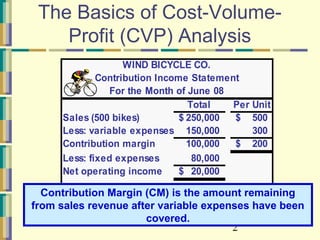
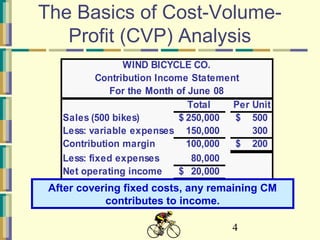
Total Per Unit
Sales (500 bikes) 250,000$ 500$
Less: variable expenses 150,000 300
Contribution margin 100,000 200$
Less: fixed expenses 80,000
Net operating income 20,000$
WIND BICYCLE CO.
Contribution Income Statement
For the Month of June 08
The Basics of Cost-Volume-
Profit (CVP) Analysis
Contribution Margin (CM) is the amount remaining
from sales revenue after variable expenses have been
covered.
3
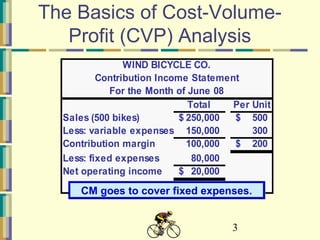
Total Per Unit
Sales (500 bikes) 250,000$ 500$
Less: variable expenses 150,000 300
Contribution margin 100,000 200$
Less: fixed expenses 80,000
Net operating income 20,000$
WIND BICYCLE CO.
Contribution Income Statement
For the Month of June 08
The Basics of Cost-Volume-
Profit (CVP) Analysis
CM goes to cover fixed expenses.CM goes to cover fixed expenses.
4
Total Per Unit
Sales (500 bikes) 250,000$ 500$
Less: variable expenses 150,000 300
Contribution margin 100,000 200$
Less: fixed expenses 80,000
Net operating income 20,000$
WIND BICYCLE CO.
Contribution Income Statement
For the Month of June 08
The Basics of Cost-Volume-
Profit (CVP) Analysis
After covering fixed costs, any remaining CM
contributes to income.
5
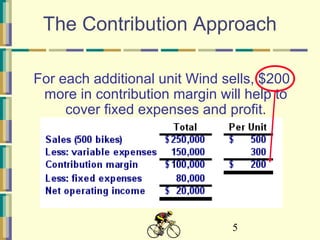
The Contribution Approach
For each additional unit Wind sells, $200
more in contribution margin will help to
cover fixed expenses and profit.
6
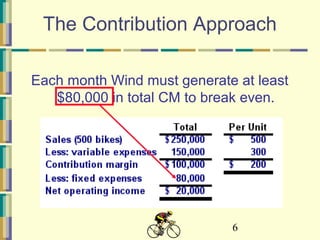
The Contribution Approach
Each month Wind must generate at least
$80,000 in total CM to break even.
7
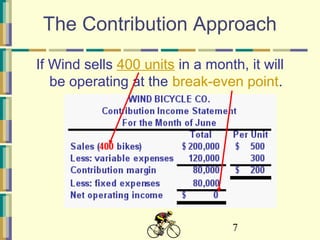
The Contribution Approach
If Wind sells 400 units in a month, it will
be operating at the break-even point.
8
Total Per Unit
Sales (401 bikes) 200,500$ 500$
Less: variable expenses 120,300 300
Contribution margin 80,200 200$
Less: fixed expenses 80,000
Net operating income 200$
WIND BICYCLE CO.
Contribution Income Statement
For the Month of June
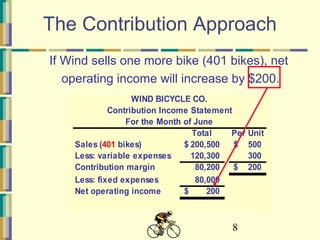
The Contribution Approach
If Wind sells one more bike (401 bikes), net
operating income will increase by $200.
9
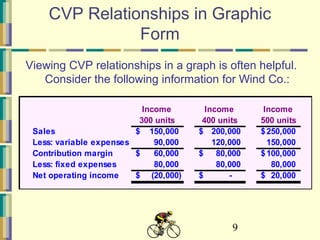
CVP Relationships in Graphic
Form
Viewing CVP relationships in a graph is often helpful.
Consider the following information for Wind Co.:
Income
300 units
Income
400 units
Income
500 units
Sales 150,000$ 200,000$ 250,000$
Less: variable expenses 90,000 120,000 150,000
Contribution margin 60,000$ 80,000$ 100,000$
Less: fixed expenses 80,000 80,000 80,000
Net operating income (20,000)$ -$ 20,000$
10
-
50,000
100,000
150,000
200,000
250,000
300,000
350,000
400,000
450,000
- 100 200 300 400 500 600 700 800
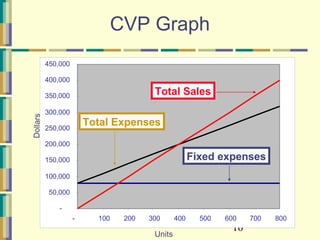
CVP Graph
Fixed expenses
Units
Dollars
Total Expenses
Total Sales
11
-
50,000
100,000
150,000
200,000
250,000
300,000
350,000
400,000
450,000
- 100 200 300 400 500 600 700 800
Units
Dollars
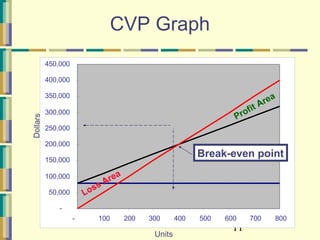
CVP Graph
Break-even point
Profit Area
Loss Area
12
Contribution Margin Ratio
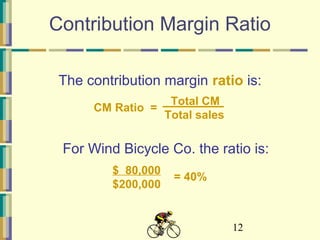
The contribution margin ratio is:
For Wind Bicycle Co. the ratio is:
$ 80,000
$200,000
= 40%
Total CM
Total sales
CM Ratio =
13
Contribution Margin Ratio
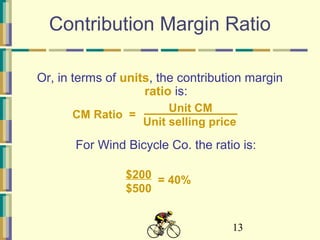
Or, in terms of units, the contribution margin
ratio is:
For Wind Bicycle Co. the ratio is:
$200
$500
= 40%
Unit CM
Unit selling price
CM Ratio =
14
Contribution Margin Ratio
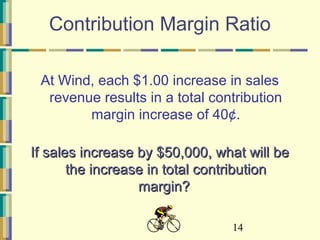
At Wind, each $1.00 increase in sales
revenue results in a total contribution
margin increase of 40¢.
If sales increase by $50,000, what will beIf sales increase by $50,000, what will be
the increase in total contributionthe increase in total contribution
margin?margin?
15
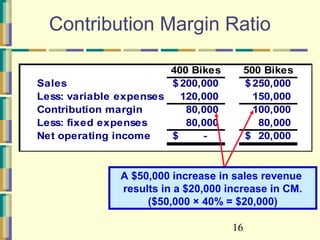
Contribution Margin Ratio
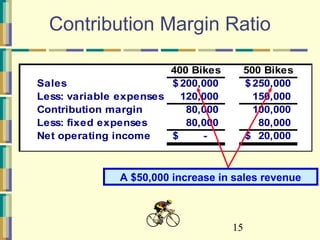
400 Bikes 500 Bikes
Sales 200,000$ 250,000$
Less: variable expenses 120,000 150,000
Contribution margin 80,000 100,000
Less: fixed expenses 80,000 80,000
Net operating income -$ 20,000$
A $50,000 increase in sales revenue
16
400 Bikes 500 Bikes
Sales 200,000$ 250,000$
Less: variable expenses 120,000 150,000
Contribution margin 80,000 100,000
Less: fixed expenses 80,000 80,000
Net operating income -$ 20,000$
Contribution Margin Ratio
A $50,000 increase in sales revenue
results in a $20,000 increase in CM.
($50,000 × 40% = $20,000)
17
Break-Even Analysis
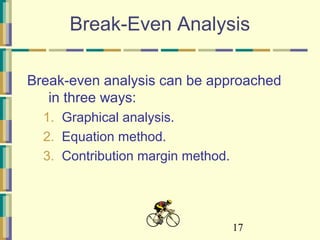
Break-even analysis can be approached
in three ways:
1. Graphical analysis.
2. Equation method.
3. Contribution margin method.
18
Equation Method
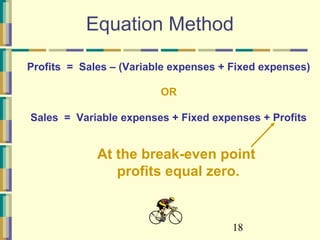
Profits = Sales – (Variable expenses + Fixed expenses)
Sales = Variable expenses + Fixed expenses + Profits
OR
At the break-even point
profits equal zero.
19
Break-Even Analysis
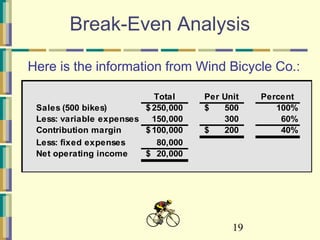
Here is the information from Wind Bicycle Co.:
Total Per Unit Percent
Sales (500 bikes) 250,000$ 500$ 100%
Less: variable expenses 150,000 300 60%
Contribution margin 100,000$ 200$ 40%
Less: fixed expenses 80,000
Net operating income 20,000$
20
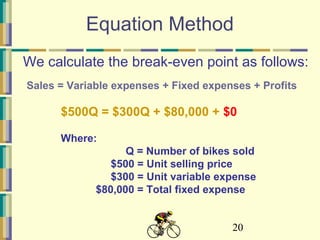
Equation Method
We calculate the break-even point as follows:
Sales = Variable expenses + Fixed expenses + Profits
$500Q = $300Q + $80,000 + $0
Where:
Q = Number of bikes sold
$500 = Unit selling price
$300 = Unit variable expense
$80,000 = Total fixed expense
21
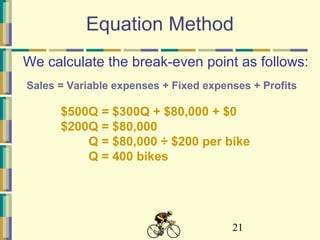
Equation Method
We calculate the break-even point as follows:
Sales = Variable expenses + Fixed expenses + Profits
$500Q = $300Q + $80,000 + $0
$200Q = $80,000
Q = $80,000 ÷ $200 per bike
Q = 400 bikes
22
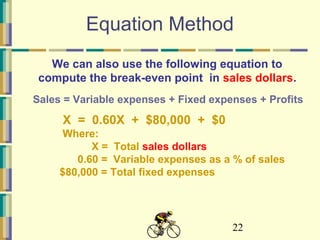
Equation Method
We can also use the following equation to
compute the break-even point in sales dollars.
Sales = Variable expenses + Fixed expenses + Profits
X = 0.60X + $80,000 + $0
Where:
X = Total sales dollars
0.60 = Variable expenses as a % of sales
$80,000 = Total fixed expenses
23
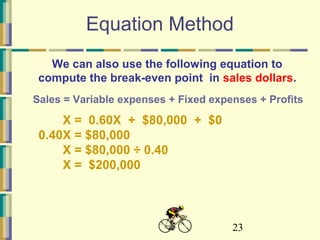
Equation Method
X = 0.60X + $80,000 + $0
0.40X = $80,000
X = $80,000 ÷ 0.40
X = $200,000
We can also use the following equation to
compute the break-even point in sales dollars.
Sales = Variable expenses + Fixed expenses + Profits
24
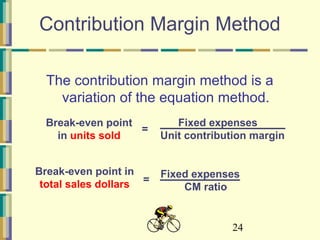
Contribution Margin Method
The contribution margin method is a
variation of the equation method.
Fixed expenses
Unit contribution margin
=
Break-even point
in units sold
Fixed expenses
CM ratio
=
Break-even point in
total sales dollars
25
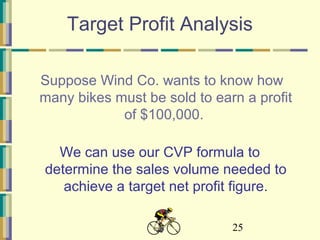
Target Profit Analysis
Suppose Wind Co. wants to know how
many bikes must be sold to earn a profit
of $100,000.
We can use our CVP formula to
determine the sales volume needed to
achieve a target net profit figure.
26
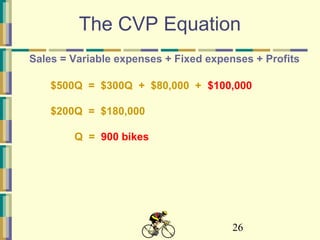
The CVP Equation
Sales = Variable expenses + Fixed expenses + Profits
$500Q = $300Q + $80,000 + $100,000
$200Q = $180,000
Q = 900 bikes
27
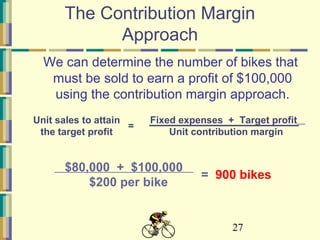
The Contribution Margin
Approach
We can determine the number of bikes that
must be sold to earn a profit of $100,000
using the contribution margin approach.
Fixed expenses + Target profit
Unit contribution margin
=
Unit sales to attain
the target profit
$80,000 + $100,000
$200 per bike
= 900 bikes
28
The Margin of Safety
Excess of budgeted (or actual) sales over
the break-even volume of sales. The
amount by which sales can drop before
losses begin to be incurred.
Margin of safety = Total sales - Break-even sales
Let’s calculate the margin of safety for Wind.
29
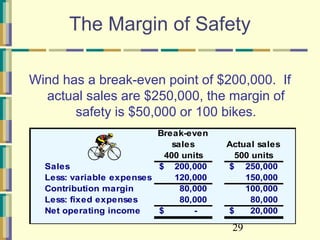
The Margin of Safety
Wind has a break-even point of $200,000. If
actual sales are $250,000, the margin of
safety is $50,000 or 100 bikes.
Break-even
sales
400 units
Actual sales
500 units
Sales 200,000$ 250,000$
Less: variable expenses 120,000 150,000
Contribution margin 80,000 100,000
Less: fixed expenses 80,000 80,000
Net operating income -$ 20,000$
30
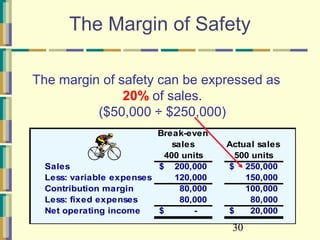
The Margin of Safety
The margin of safety can be expressed as
20% of sales.
($50,000 ÷ $250,000)
Break-even
sales
400 units
Actual sales
500 units
Sales 200,000$ 250,000$
Less: variable expenses 120,000 150,000
Contribution margin 80,000 100,000
Less: fixed expenses 80,000 80,000
Net operating income -$ 20,000$
31
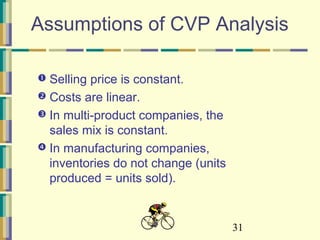
Assumptions of CVP Analysis
 Selling price is constant.
 Costs are linear.
 In multi-product companies, the
sales mix is constant.
 In manufacturing companies,
inventories do not change (units
produced = units sold).
32
Thank You
Questions ?

Presentation cvp analysis 140908

  • 1.
    1 Cost-Volume-Profit Analysis Presented By: (Under Guidanceof Dr Vibha Jain) Dhiraj Gaur (15) Sujit Dash (51) Umesh Raheja (59) Phanindra Y (33) Adarsh Shrivastava (3)
  • 2.
    2 Total Per Unit Sales(500 bikes) 250,000$ 500$ Less: variable expenses 150,000 300 Contribution margin 100,000 200$ Less: fixed expenses 80,000 Net operating income 20,000$ WIND BICYCLE CO. Contribution Income Statement For the Month of June 08 The Basics of Cost-Volume- Profit (CVP) Analysis Contribution Margin (CM) is the amount remaining from sales revenue after variable expenses have been covered.
  • 3.
    3 Total Per Unit Sales(500 bikes) 250,000$ 500$ Less: variable expenses 150,000 300 Contribution margin 100,000 200$ Less: fixed expenses 80,000 Net operating income 20,000$ WIND BICYCLE CO. Contribution Income Statement For the Month of June 08 The Basics of Cost-Volume- Profit (CVP) Analysis CM goes to cover fixed expenses.CM goes to cover fixed expenses.
  • 4.
    4 Total Per Unit Sales(500 bikes) 250,000$ 500$ Less: variable expenses 150,000 300 Contribution margin 100,000 200$ Less: fixed expenses 80,000 Net operating income 20,000$ WIND BICYCLE CO. Contribution Income Statement For the Month of June 08 The Basics of Cost-Volume- Profit (CVP) Analysis After covering fixed costs, any remaining CM contributes to income.
  • 5.
    5 The Contribution Approach Foreach additional unit Wind sells, $200 more in contribution margin will help to cover fixed expenses and profit.
  • 6.
    6 The Contribution Approach Eachmonth Wind must generate at least $80,000 in total CM to break even.
  • 7.
    7 The Contribution Approach IfWind sells 400 units in a month, it will be operating at the break-even point.
  • 8.
    8 Total Per Unit Sales(401 bikes) 200,500$ 500$ Less: variable expenses 120,300 300 Contribution margin 80,200 200$ Less: fixed expenses 80,000 Net operating income 200$ WIND BICYCLE CO. Contribution Income Statement For the Month of June The Contribution Approach If Wind sells one more bike (401 bikes), net operating income will increase by $200.
  • 9.
    9 CVP Relationships inGraphic Form Viewing CVP relationships in a graph is often helpful. Consider the following information for Wind Co.: Income 300 units Income 400 units Income 500 units Sales 150,000$ 200,000$ 250,000$ Less: variable expenses 90,000 120,000 150,000 Contribution margin 60,000$ 80,000$ 100,000$ Less: fixed expenses 80,000 80,000 80,000 Net operating income (20,000)$ -$ 20,000$
  • 10.
    10 - 50,000 100,000 150,000 200,000 250,000 300,000 350,000 400,000 450,000 - 100 200300 400 500 600 700 800 CVP Graph Fixed expenses Units Dollars Total Expenses Total Sales
  • 11.
    11 - 50,000 100,000 150,000 200,000 250,000 300,000 350,000 400,000 450,000 - 100 200300 400 500 600 700 800 Units Dollars CVP Graph Break-even point Profit Area Loss Area
  • 12.
    12 Contribution Margin Ratio Thecontribution margin ratio is: For Wind Bicycle Co. the ratio is: $ 80,000 $200,000 = 40% Total CM Total sales CM Ratio =
  • 13.
    13 Contribution Margin Ratio Or,in terms of units, the contribution margin ratio is: For Wind Bicycle Co. the ratio is: $200 $500 = 40% Unit CM Unit selling price CM Ratio =
  • 14.
    14 Contribution Margin Ratio AtWind, each $1.00 increase in sales revenue results in a total contribution margin increase of 40¢. If sales increase by $50,000, what will beIf sales increase by $50,000, what will be the increase in total contributionthe increase in total contribution margin?margin?
  • 15.
    15 Contribution Margin Ratio 400Bikes 500 Bikes Sales 200,000$ 250,000$ Less: variable expenses 120,000 150,000 Contribution margin 80,000 100,000 Less: fixed expenses 80,000 80,000 Net operating income -$ 20,000$ A $50,000 increase in sales revenue
  • 16.
    16 400 Bikes 500Bikes Sales 200,000$ 250,000$ Less: variable expenses 120,000 150,000 Contribution margin 80,000 100,000 Less: fixed expenses 80,000 80,000 Net operating income -$ 20,000$ Contribution Margin Ratio A $50,000 increase in sales revenue results in a $20,000 increase in CM. ($50,000 × 40% = $20,000)
  • 17.
    17 Break-Even Analysis Break-even analysiscan be approached in three ways: 1. Graphical analysis. 2. Equation method. 3. Contribution margin method.
  • 18.
    18 Equation Method Profits =Sales – (Variable expenses + Fixed expenses) Sales = Variable expenses + Fixed expenses + Profits OR At the break-even point profits equal zero.
  • 19.
    19 Break-Even Analysis Here isthe information from Wind Bicycle Co.: Total Per Unit Percent Sales (500 bikes) 250,000$ 500$ 100% Less: variable expenses 150,000 300 60% Contribution margin 100,000$ 200$ 40% Less: fixed expenses 80,000 Net operating income 20,000$
  • 20.
    20 Equation Method We calculatethe break-even point as follows: Sales = Variable expenses + Fixed expenses + Profits $500Q = $300Q + $80,000 + $0 Where: Q = Number of bikes sold $500 = Unit selling price $300 = Unit variable expense $80,000 = Total fixed expense
  • 21.
    21 Equation Method We calculatethe break-even point as follows: Sales = Variable expenses + Fixed expenses + Profits $500Q = $300Q + $80,000 + $0 $200Q = $80,000 Q = $80,000 ÷ $200 per bike Q = 400 bikes
  • 22.
    22 Equation Method We canalso use the following equation to compute the break-even point in sales dollars. Sales = Variable expenses + Fixed expenses + Profits X = 0.60X + $80,000 + $0 Where: X = Total sales dollars 0.60 = Variable expenses as a % of sales $80,000 = Total fixed expenses
  • 23.
    23 Equation Method X =0.60X + $80,000 + $0 0.40X = $80,000 X = $80,000 ÷ 0.40 X = $200,000 We can also use the following equation to compute the break-even point in sales dollars. Sales = Variable expenses + Fixed expenses + Profits
  • 24.
    24 Contribution Margin Method Thecontribution margin method is a variation of the equation method. Fixed expenses Unit contribution margin = Break-even point in units sold Fixed expenses CM ratio = Break-even point in total sales dollars
  • 25.
    25 Target Profit Analysis SupposeWind Co. wants to know how many bikes must be sold to earn a profit of $100,000. We can use our CVP formula to determine the sales volume needed to achieve a target net profit figure.
  • 26.
    26 The CVP Equation Sales= Variable expenses + Fixed expenses + Profits $500Q = $300Q + $80,000 + $100,000 $200Q = $180,000 Q = 900 bikes
  • 27.
    27 The Contribution Margin Approach Wecan determine the number of bikes that must be sold to earn a profit of $100,000 using the contribution margin approach. Fixed expenses + Target profit Unit contribution margin = Unit sales to attain the target profit $80,000 + $100,000 $200 per bike = 900 bikes
  • 28.
    28 The Margin ofSafety Excess of budgeted (or actual) sales over the break-even volume of sales. The amount by which sales can drop before losses begin to be incurred. Margin of safety = Total sales - Break-even sales Let’s calculate the margin of safety for Wind.
  • 29.
    29 The Margin ofSafety Wind has a break-even point of $200,000. If actual sales are $250,000, the margin of safety is $50,000 or 100 bikes. Break-even sales 400 units Actual sales 500 units Sales 200,000$ 250,000$ Less: variable expenses 120,000 150,000 Contribution margin 80,000 100,000 Less: fixed expenses 80,000 80,000 Net operating income -$ 20,000$
  • 30.
    30 The Margin ofSafety The margin of safety can be expressed as 20% of sales. ($50,000 ÷ $250,000) Break-even sales 400 units Actual sales 500 units Sales 200,000$ 250,000$ Less: variable expenses 120,000 150,000 Contribution margin 80,000 100,000 Less: fixed expenses 80,000 80,000 Net operating income -$ 20,000$
  • 31.
    31 Assumptions of CVPAnalysis  Selling price is constant.  Costs are linear.  In multi-product companies, the sales mix is constant.  In manufacturing companies, inventories do not change (units produced = units sold).
  • 32.