Executive Management Programme
(EMP: Apr 2008)
Term: IX (5 Apr – 27 Jun, 2010)
Management Development Institute - Gurgaon
Operations Strategy
Case-02
Changing lanes of Transport
Ecosystem
IDID NameName
11 02 Achal Garg
22 14 Ashok Pershad
33 15 Dhiraj Gaur
44 18 Gaurav Grewal
55 22 Manoj Agarwal
66 51 Umesh Raheja
OS
Case Presentation
Presentation Date: 29 April 2010Presentation Date: 29 April 2010
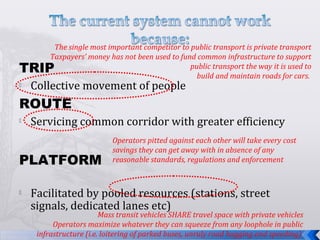
TRIP
 (Mass) transit journey is too tiring
ROUTE
 Transit routes are very complicated
PLATFORM
 Transit points are not accessible
TRIP
 Collective movement of people
ROUTE
 Servicing common corridor with greater efficiency
PLATFORM
 Facilitated by pooled resources (stations, street
signals, dedicated lanes etc)
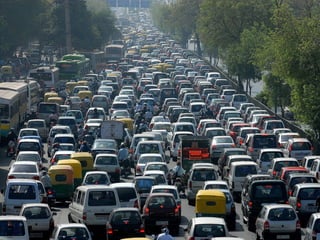
The single most important competitor to public transport is private transport
Taxpayers’ money has not been used to fund common infrastructure to support
public transport the way it is used to
build and maintain roads for cars.
Operators pitted against each other will take every cost
savings they can get away with in absence of any
reasonable standards, regulations and enforcement
Mass transit vehicles SHARE travel space with private vehicles
Operators maximize whatever they can squeeze from any loophole in public
infrastructure (i.e. loitering of parked buses, unruly road hogging and speeding)
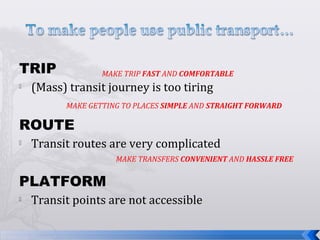
TRIP
 (Mass) transit journey is too tiring
ROUTE
 Transit routes are very complicated
PLATFORM
 Transit points are not accessible
MAKE TRIP FAST AND COMFORTABLE
MAKE GETTING TO PLACES SIMPLE AND STRAIGHT FORWARD
MAKE TRANSFERS CONVENIENT AND HASSLE FREE
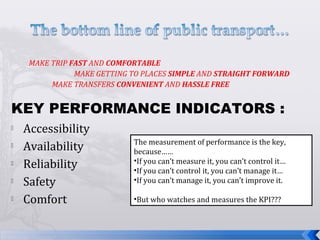
KEY PERFORMANCE INDICATORS :
 Accessibility
 Availability
 Reliability
 Safety
 Comfort
The measurement of performance is the key,
because……
•If you can’t measure it, you can’t control it…
•If you can’t control it, you can’t manage it…
•If you can’t manage it, you can’t improve it.
•But who watches and measures the KPI???
MAKE TRIP FAST AND COMFORTABLE
MAKE GETTING TO PLACES SIMPLE AND STRAIGHT FORWARD
MAKE TRANSFERS CONVENIENT AND HASSLE FREE
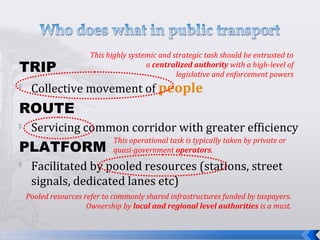
TRIP

Collective movement of people
ROUTE

Servicing common corridor with greater efficiency
PLATFORM

Facilitated by pooled resources (stations, street
signals, dedicated lanes etc)
This highly systemic and strategic task should be entrusted to
a centralized authority with a high-level of
legislative and enforcement powers
This operational task is typically taken by private or
quasi-government operators.
Pooled resources refer to commonly shared infrastructures funded by taxpayers.
Ownership by local and regional level authorities is a must.
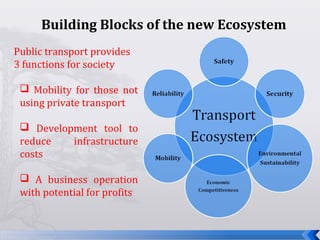
Public transport provides
3 functions for society
 Mobility for those not
using private transport
 Development tool to
reduce infrastructure
costs
 A business operation
with potential for profits
Building Blocks of the new Ecosystem
 Transformation from auto companies to mobility
solution providers
 Integration of Various forms of transportation
system
 Unified access by way of technology
 Service design to meet supply chain constraints
 Re-engineering infrastructure to accommodate
scalability requirements
 Transportation system as a seamless system in which travelers can
conveniently shift between modes and operators to complete trips
that meet their individual and business needs.
 Ticketless systems
 Octopus – Hong Kong
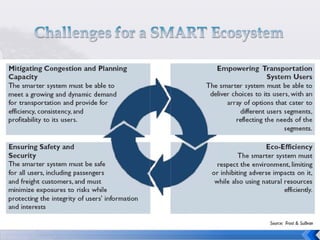
 Predicting Demand and optimizing capacity, assets and
infrastructure
 Improving end-to-end mobility experience
 Reducing the environmental impact
 Assuring safety and security

Various private equity players and venture
capitalists has shown interest in mobility solutions
 DLF is designing Rapid Transit System (RTS) a medium
metro rail in Gurgaon which will connect to the Delhi
metro
 DLF wants an RTS in some of its major project like
10,000 acre township in Bangalore
 Infusion of Radio Taxis by V-Link
 Web-based Indmoto has organised car pooling system
by enabling commuters to find matches based on city,
time and pincode
 Bus Rapid Transit (BRT) has reorganised urban
traffic and ensured equity in road space
allocation. BRT is described as bus priority
corridor
 Authority  provides & owns all vital
infrastructure (incl. routes)
 Operators  contracted to the Local or Regional
Authority for a 3-5 year period
 Contract  through open tender and KPI
 Operators are paid a contract fee for services
provided with additional incentives for
meeting/exceeding KPI
 Feedback from passengers becomes vital
 Public Transport is a “rakyat issue”
 The people must be engaged to use, support, and
keep watch in public transport
 A Centralized Authority will:
 Create national standards for public transport
 Integrate planning with National Physical Plan
 Determine funding needs and provide funds
 Invest in critical improvements to infrastructure
 Local / Regional Authorities are empowered to
carry out the regulation of public transport with
public/user feedback
 Local / Regional Authorities would be integrated with
economic growth regions
 Focus on local and regional planning as identified in the
National Physical Plan
 Ownership of crucial public transport infrastructure
 Provision of investment capital and funding
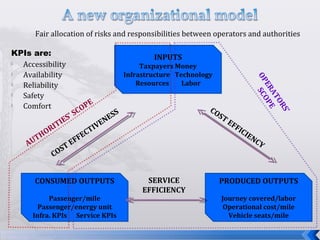
KPIs are:
 Accessibility
 Availability
 Reliability
 Safety
 Comfort
INPUTS
Taxpayers Money
Infrastructure Technology
Resources Labor
CONSUMED OUTPUTS
Passenger/mile
Passenger/energy unit
Infra. KPIs Service KPIs
PRODUCED OUTPUTS
Journey covered/labor
Operational cost/mile
Vehicle seats/mile
COST EFFECTIVENESS COST EFFICIENCY
SERVICE
EFFICIENCY
OPERATORS’
SCOPE
AUTHORITIES’ SCOPE
Fair allocation of risks and responsibilities between operators and authorities
20
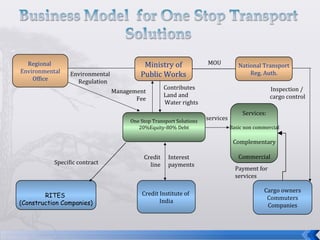
Ministry of
Public Works
One Stop Transport Solutions
20%Equity-80% Debt
Cargo owners
Commuters
Companies
Credit
line
Credit Institute of
India
National Transport
Reg. Auth.
Contributes
Land and
Water rights
Payment for
services
Interest
payments
Regional
Environmental
Office
services
Services:
Basic non commercial
Complementary
Commercial
RITES
(Construction Companies)
Specific contract
MOU
Inspection /
cargo control
Environmental
Regulation
Management
Fee
21
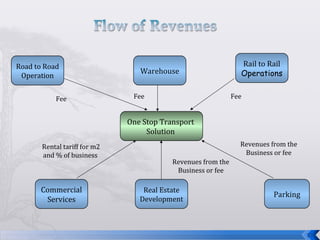
One Stop Transport
Solution
Parking
Real Estate
Development
Commercial
Services
Road to Road
Operation
Warehouse
Rail to Rail
Operations
Revenues from the
Business or fee
Revenues from the
Business or fee
Rental tariff for m2
and % of business
Fee Fee Fee
 New York City Transport Masterplan 2030
https://www.nysdot.gov/portal/page/portal/main/transportation-
plan/repository/masterplan-111406.pdf
 IBM Case Paper on Smart Transports
http://www.ibm.com/smarterplanet/global/files/uk__en_uk__rail__smarter_sy
stem_trasportation.pdf?
ca=content_body&met=uk_smarterplanet_rail_examples&re=spc
 Bangalore Transportation – Research & Reports
http://www.praja.in/en/gyan/bangalore-transportation-research-and-
reports
THANK YOU

Hid operations strategy

  • 1.
    Executive Management Programme (EMP:Apr 2008) Term: IX (5 Apr – 27 Jun, 2010) Management Development Institute - Gurgaon Operations Strategy Case-02 Changing lanes of Transport Ecosystem IDID NameName 11 02 Achal Garg 22 14 Ashok Pershad 33 15 Dhiraj Gaur 44 18 Gaurav Grewal 55 22 Manoj Agarwal 66 51 Umesh Raheja OS Case Presentation Presentation Date: 29 April 2010Presentation Date: 29 April 2010
  • 3.
    TRIP  (Mass) transitjourney is too tiring ROUTE  Transit routes are very complicated PLATFORM  Transit points are not accessible
  • 4.
    TRIP  Collective movementof people ROUTE  Servicing common corridor with greater efficiency PLATFORM  Facilitated by pooled resources (stations, street signals, dedicated lanes etc) The single most important competitor to public transport is private transport Taxpayers’ money has not been used to fund common infrastructure to support public transport the way it is used to build and maintain roads for cars. Operators pitted against each other will take every cost savings they can get away with in absence of any reasonable standards, regulations and enforcement Mass transit vehicles SHARE travel space with private vehicles Operators maximize whatever they can squeeze from any loophole in public infrastructure (i.e. loitering of parked buses, unruly road hogging and speeding)
  • 5.
    TRIP  (Mass) transitjourney is too tiring ROUTE  Transit routes are very complicated PLATFORM  Transit points are not accessible MAKE TRIP FAST AND COMFORTABLE MAKE GETTING TO PLACES SIMPLE AND STRAIGHT FORWARD MAKE TRANSFERS CONVENIENT AND HASSLE FREE
  • 6.
    KEY PERFORMANCE INDICATORS:  Accessibility  Availability  Reliability  Safety  Comfort The measurement of performance is the key, because…… •If you can’t measure it, you can’t control it… •If you can’t control it, you can’t manage it… •If you can’t manage it, you can’t improve it. •But who watches and measures the KPI??? MAKE TRIP FAST AND COMFORTABLE MAKE GETTING TO PLACES SIMPLE AND STRAIGHT FORWARD MAKE TRANSFERS CONVENIENT AND HASSLE FREE
  • 7.
    TRIP  Collective movement ofpeople ROUTE  Servicing common corridor with greater efficiency PLATFORM  Facilitated by pooled resources (stations, street signals, dedicated lanes etc) This highly systemic and strategic task should be entrusted to a centralized authority with a high-level of legislative and enforcement powers This operational task is typically taken by private or quasi-government operators. Pooled resources refer to commonly shared infrastructures funded by taxpayers. Ownership by local and regional level authorities is a must.
  • 8.
    Public transport provides 3functions for society  Mobility for those not using private transport  Development tool to reduce infrastructure costs  A business operation with potential for profits Building Blocks of the new Ecosystem
  • 11.
     Transformation fromauto companies to mobility solution providers  Integration of Various forms of transportation system  Unified access by way of technology  Service design to meet supply chain constraints  Re-engineering infrastructure to accommodate scalability requirements
  • 12.
     Transportation systemas a seamless system in which travelers can conveniently shift between modes and operators to complete trips that meet their individual and business needs.  Ticketless systems  Octopus – Hong Kong  Predicting Demand and optimizing capacity, assets and infrastructure  Improving end-to-end mobility experience  Reducing the environmental impact  Assuring safety and security
  • 13.
     Various private equityplayers and venture capitalists has shown interest in mobility solutions  DLF is designing Rapid Transit System (RTS) a medium metro rail in Gurgaon which will connect to the Delhi metro  DLF wants an RTS in some of its major project like 10,000 acre township in Bangalore  Infusion of Radio Taxis by V-Link  Web-based Indmoto has organised car pooling system by enabling commuters to find matches based on city, time and pincode
  • 14.
     Bus RapidTransit (BRT) has reorganised urban traffic and ensured equity in road space allocation. BRT is described as bus priority corridor
  • 15.
     Authority provides & owns all vital infrastructure (incl. routes)  Operators  contracted to the Local or Regional Authority for a 3-5 year period  Contract  through open tender and KPI  Operators are paid a contract fee for services provided with additional incentives for meeting/exceeding KPI  Feedback from passengers becomes vital
  • 16.
     Public Transportis a “rakyat issue”  The people must be engaged to use, support, and keep watch in public transport  A Centralized Authority will:  Create national standards for public transport  Integrate planning with National Physical Plan  Determine funding needs and provide funds  Invest in critical improvements to infrastructure
  • 17.
     Local /Regional Authorities are empowered to carry out the regulation of public transport with public/user feedback  Local / Regional Authorities would be integrated with economic growth regions  Focus on local and regional planning as identified in the National Physical Plan  Ownership of crucial public transport infrastructure  Provision of investment capital and funding
  • 18.
    KPIs are:  Accessibility Availability  Reliability  Safety  Comfort INPUTS Taxpayers Money Infrastructure Technology Resources Labor CONSUMED OUTPUTS Passenger/mile Passenger/energy unit Infra. KPIs Service KPIs PRODUCED OUTPUTS Journey covered/labor Operational cost/mile Vehicle seats/mile COST EFFECTIVENESS COST EFFICIENCY SERVICE EFFICIENCY OPERATORS’ SCOPE AUTHORITIES’ SCOPE Fair allocation of risks and responsibilities between operators and authorities
  • 19.
    20 Ministry of Public Works OneStop Transport Solutions 20%Equity-80% Debt Cargo owners Commuters Companies Credit line Credit Institute of India National Transport Reg. Auth. Contributes Land and Water rights Payment for services Interest payments Regional Environmental Office services Services: Basic non commercial Complementary Commercial RITES (Construction Companies) Specific contract MOU Inspection / cargo control Environmental Regulation Management Fee
  • 20.
    21 One Stop Transport Solution Parking RealEstate Development Commercial Services Road to Road Operation Warehouse Rail to Rail Operations Revenues from the Business or fee Revenues from the Business or fee Rental tariff for m2 and % of business Fee Fee Fee
  • 21.
     New YorkCity Transport Masterplan 2030 https://www.nysdot.gov/portal/page/portal/main/transportation- plan/repository/masterplan-111406.pdf  IBM Case Paper on Smart Transports http://www.ibm.com/smarterplanet/global/files/uk__en_uk__rail__smarter_sy stem_trasportation.pdf? ca=content_body&met=uk_smarterplanet_rail_examples&re=spc  Bangalore Transportation – Research & Reports http://www.praja.in/en/gyan/bangalore-transportation-research-and- reports
  • 22.

Editor's Notes

  • #21 Concessionaire’s sources of revenues: Tolls: US$1.5+IGV / 100 Km. Quarterly payment for Operation & Maintenance (PAMO) for 20 years. The amount paid is the difference between Toll revenues and the required PAMO Semi-annual payment for construction (PAO) for 10 years Minimum equity contribution: US$25 mil.
  • #22 Concessionaire’s sources of revenues: Tolls: US$1.5+IGV / 100 Km. Quarterly payment for Operation & Maintenance (PAMO) for 20 years. The amount paid is the difference between Toll revenues and the required PAMO Semi-annual payment for construction (PAO) for 10 years Minimum equity contribution: US$25 mil.