5-1
Cost-Volume-Profit Relationships
By: Sir Taj Mohammad “Tamkeen””
Lecturer economics Rokhan university
taj_tamkeen@yahoo.com
0093788889195
5-2
Key Assumptions of CVP Analysis
1. Selling price is constant.
2. Costs are linear and can be accurately
divided into variable (constant per unit) and
fixed (constant in total) elements.
3. In multiproduct companies, the sales mix is
constant.
4. In manufacturing companies, inventories do
not change (units produced = units sold).
5-3
Learning Objective 1
Explain how changes in
activity affect
contribution margin and
net operating income.
5-4
Basics of Cost-Volume-Profit Analysis
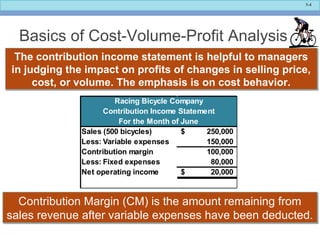
Contribution Margin (CM) is the amount remaining from
sales revenue after variable expenses have been deducted.
Contribution Margin (CM) is the amount remaining from
sales revenue after variable expenses have been deducted.
Sales (500 bicycles) 250,000$
Less: Variable expenses 150,000
Contribution margin 100,000
Less: Fixed expenses 80,000
Net operating income 20,000$
Racing Bicycle Company
Contribution Income Statement
For the Month of June
The contribution income statement is helpful to managers
in judging the impact on profits of changes in selling price,
cost, or volume. The emphasis is on cost behavior.
The contribution income statement is helpful to managers
in judging the impact on profits of changes in selling price,
cost, or volume. The emphasis is on cost behavior.
5-5
Basics of Cost-Volume-Profit Analysis
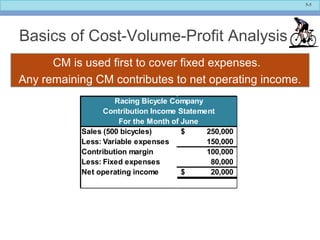
CM is used first to cover fixed expenses.
Any remaining CM contributes to net operating income.
CM is used first to cover fixed expenses.
Any remaining CM contributes to net operating income.
Sales (500 bicycles) 250,000$
Less: Variable expenses 150,000
Contribution margin 100,000
Less: Fixed expenses 80,000
Net operating income 20,000$
Racing Bicycle Company
Contribution Income Statement
For the Month of June
5-6
Total Per Unit
Sales (500 bicycles) 250,000$ 500$
Less: Variable expenses 150,000 300
Contribution margin 100,000 200$
Less: Fixed expenses 80,000
Net operating income 20,000$
Racing Bicycle Company
Contribution Income Statement
For the Month of June
The Contribution Approach
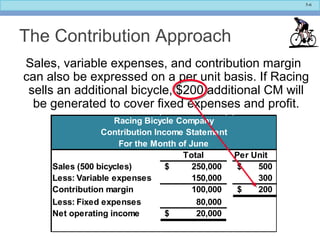
Sales, variable expenses, and contribution margin
can also be expressed on a per unit basis. If Racing
sells an additional bicycle, $200 additional CM will
be generated to cover fixed expenses and profit.
5-7
Total Per Unit
Sales (500 bicycles) 250,000$ 500$
Less: Variable expenses 150,000 300
Contribution margin 100,000 200$
Less: Fixed expenses 80,000
Net operating income 20,000$
Racing Bicycle Company
Contribution Income Statement
For the Month of June
The Contribution Approach
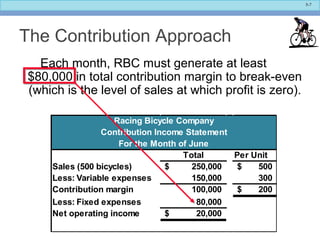
Each month, RBC must generate at least
$80,000 in total contribution margin to break-even
(which is the level of sales at which profit is zero).
5-8
Total Per Unit
Sales (400 bicycles) 200,000$ 500$
Less: Variable expenses 120,000 300
Contribution margin 80,000 200$
Less: Fixed expenses 80,000
Net operating income -$
Racing Bicycle Company
Contribution Income Statement
For the Month of June
The Contribution Approach
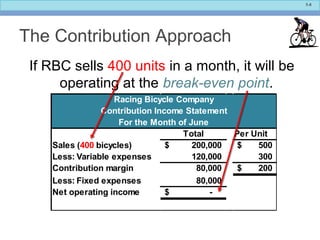
If RBC sells 400 units in a month, it will be
operating at the break-even point.
5-9
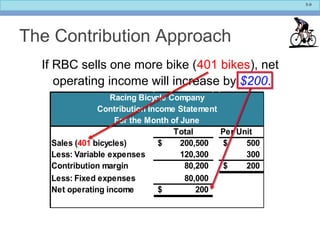
Total Per Unit
Sales (401 bicycles) 200,500$ 500$
Less: Variable expenses 120,300 300
Contribution margin 80,200 200$
Less: Fixed expenses 80,000
Net operating income 200$
Racing Bicycle Company
Contribution Income Statement
For the Month of June
The Contribution Approach
If RBC sells one more bike (401 bikes), net
operating income will increase by $200.
5-10
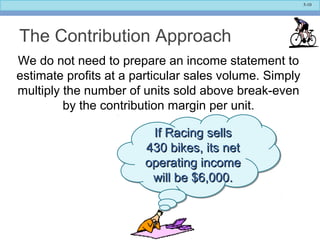
The Contribution Approach
We do not need to prepare an income statement to
estimate profits at a particular sales volume. Simply
multiply the number of units sold above break-even
by the contribution margin per unit.
If Racing sellsIf Racing sells
430 bikes, its net430 bikes, its net
operating incomeoperating income
will be $6,000.will be $6,000.
If Racing sellsIf Racing sells
430 bikes, its net430 bikes, its net
operating incomeoperating income
will be $6,000.will be $6,000.
5-11
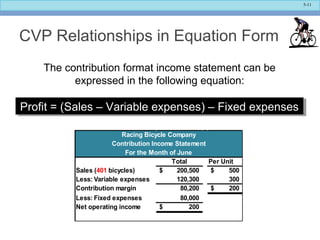
CVP Relationships in Equation Form
The contribution format income statement can be
expressed in the following equation:
Profit = (Sales – Variable expenses) – Fixed expensesProfit = (Sales – Variable expenses) – Fixed expenses
Total Per Unit
Sales (401 bicycles) 200,500$ 500$
Less: Variable expenses 120,300 300
Contribution margin 80,200 200$
Less: Fixed expenses 80,000
Net operating income 200$
Racing Bicycle Company
Contribution Income Statement
For the Month of June
5-12
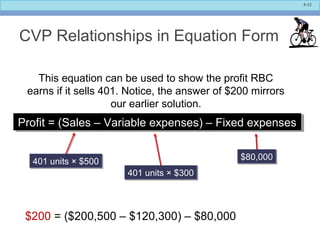
CVP Relationships in Equation Form
This equation can be used to show the profit RBC
earns if it sells 401. Notice, the answer of $200 mirrors
our earlier solution.
Profit = (Sales – Variable expenses) – Fixed expensesProfit = (Sales – Variable expenses) – Fixed expenses
401 units × $500401 units × $500
401 units × $300401 units × $300
$80,000$80,000
Profit = ($200,500 – Variable expenses) – FixedProfit = ($200,500 – $120,300) – Fixed expensesProfit = ($200,500 – $120,300) – $80,000$200 = ($200,500 – $120,300) – $80,000
5-13
CVP Relationships in Equation Form
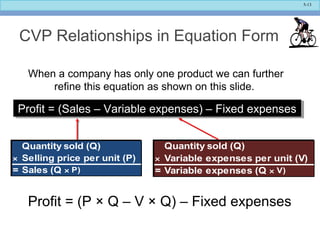
When a company has only one product we can further
refine this equation as shown on this slide.
Profit = (Sales – Variable expenses) – Fixed expensesProfit = (Sales – Variable expenses) – Fixed expenses
Quantity sold (Q)
× Selling price per unit (P)
= Sales (Q × P)
Quantity sold (Q)
× Variable expenses per unit (V)
= Variable expenses (Q × V)
Profit = (P × Q – V × Q) – Fixed expenses
5-14
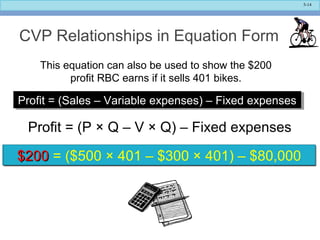
CVP Relationships in Equation Form
This equation can also be used to show the $200
profit RBC earns if it sells 401 bikes.
Profit = (Sales – Variable expenses) – Fixed expensesProfit = (Sales – Variable expenses) – Fixed expenses
Profit = (P × Q – V × Q) – Fixed expenses
Profit = ($500 × 401 – $300 × 401) – $80,000Profit = ($500 × 401 – $300 × 401) – $80,000$200$200 = ($500 × 401 – $300 × 401) – $80,000$200$200 = ($500 × 401 – $300 × 401) – $80,000
5-15
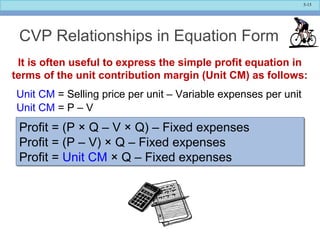
CVP Relationships in Equation Form
Unit CM = Selling price per unit – Variable expenses per unit
It is often useful to express the simple profit equation in
terms of the unit contribution margin (Unit CM) as follows:
Profit = (P × Q – V × Q) – Fixed expenses
Profit = (P – V) × Q – Fixed expenses
Profit = Unit CM × Q – Fixed expenses
Profit = (P × Q – V × Q) – Fixed expenses
Profit = (P – V) × Q – Fixed expenses
Profit = Unit CM × Q – Fixed expenses
Unit CM = P – V
5-16
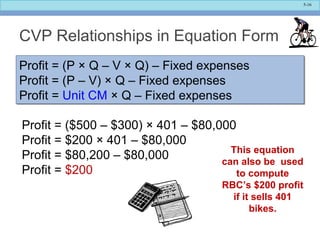
CVP Relationships in Equation Form
Profit = (P × Q – V × Q) – Fixed expenses
Profit = (P – V) × Q – Fixed expenses
Profit = Unit CM × Q – Fixed expenses
Profit = (P × Q – V × Q) – Fixed expenses
Profit = (P – V) × Q – Fixed expenses
Profit = Unit CM × Q – Fixed expenses
Profit = ($500 – $300) × 401 – $80,000
Profit = $200 × 401 – $80,000
Profit = $80,200 – $80,000
Profit = $200
This equation
can also be used
to compute
RBC’s $200 profit
if it sells 401
bikes.
5-17
Learning Objective 2
Prepare and interpret a
cost-volume-profit (CVP)
graph and a profit graph.
5-18
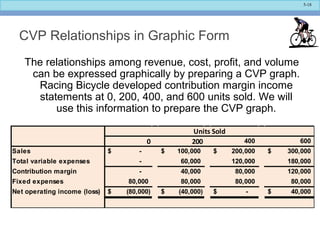
CVP Relationships in Graphic Form
The relationships among revenue, cost, profit, and volume
can be expressed graphically by preparing a CVP graph.
Racing Bicycle developed contribution margin income
statements at 0, 200, 400, and 600 units sold. We will
use this information to prepare the CVP graph.
0 200 400 600
Sales -$ 100,000$ 200,000$ 300,000$
Total variable expenses - 60,000 120,000 180,000
Contribution margin - 40,000 80,000 120,000
Fixed expenses 80,000 80,000 80,000 80,000
Net operating income (loss) (80,000)$ (40,000)$ -$ 40,000$
Units Sold
5-19
Preparing the CVP Graph
Units
Dollars
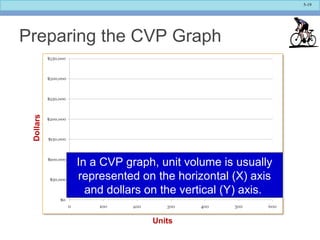
In a CVP graph, unit volume is usually
represented on the horizontal (X) axis
and dollars on the vertical (Y) axis.
In a CVP graph, unit volume is usually
represented on the horizontal (X) axis
and dollars on the vertical (Y) axis.
5-20
Preparing the CVP Graph
Units
Dollars

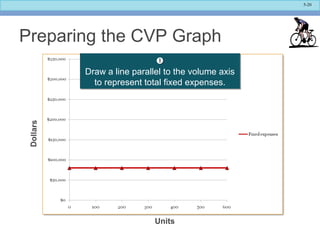
Draw a line parallel to the volume axis
to represent total fixed expenses.

Draw a line parallel to the volume axis
to represent total fixed expenses.
5-21
Preparing the CVP Graph
Units
Dollars
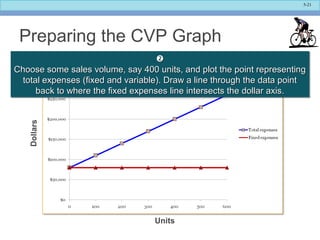

Choose some sales volume, say 400 units, and plot the point representingChoose some sales volume, say 400 units, and plot the point representing
total expenses (fixed and variable). Draw a line through the data pointtotal expenses (fixed and variable). Draw a line through the data point
back to where the fixed expenses line intersects the dollar axis.back to where the fixed expenses line intersects the dollar axis.

Choose some sales volume, say 400 units, and plot the point representingChoose some sales volume, say 400 units, and plot the point representing
total expenses (fixed and variable). Draw a line through the data pointtotal expenses (fixed and variable). Draw a line through the data point
back to where the fixed expenses line intersects the dollar axis.back to where the fixed expenses line intersects the dollar axis.
5-22
Preparing the CVP Graph
Units
Dollars
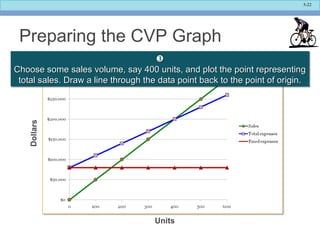

Choose some sales volume, say 400 units, and plot the point representingChoose some sales volume, say 400 units, and plot the point representing
total sales. Draw a line through the data point back to the point of origin.total sales. Draw a line through the data point back to the point of origin.

Choose some sales volume, say 400 units, and plot the point representingChoose some sales volume, say 400 units, and plot the point representing
total sales. Draw a line through the data point back to the point of origin.total sales. Draw a line through the data point back to the point of origin.
5-23
Preparing the CVP Graph
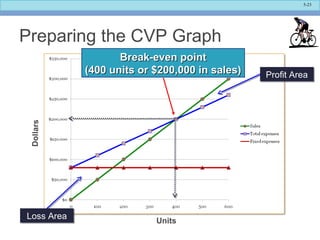
Break-even pointBreak-even point
(400 units or $200,000 in sales)(400 units or $200,000 in sales)
Break-even pointBreak-even point
(400 units or $200,000 in sales)(400 units or $200,000 in sales)
Units
Dollars
Loss AreaLoss Area
Profit AreaProfit Area
5-24
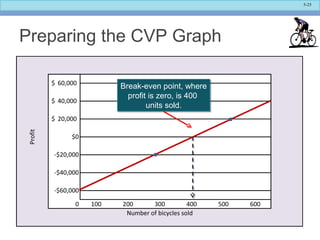
0 100 200 300 400 500 600
-$60,000
Number of bicycles sold
Profit
60,000$
40,000$
20,000$
$0
-$20,000
-$40,000
Preparing the CVP Graph
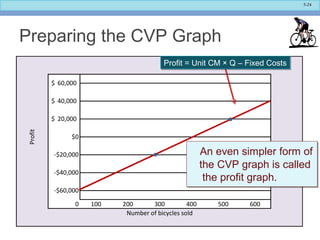
Profit = Unit CM × Q – Fixed CostsProfit = Unit CM × Q – Fixed Costs
An even simpler form of
the CVP graph is called
the profit graph.
An even simpler form of
the CVP graph is called
the profit graph.
5-25
0 100 200 300 400 500 600
-$60,000
Number of bicycles sold
Profit
60,000$
40,000$
20,000$
$0
-$20,000
-$40,000
Preparing the CVP Graph
Break-even point, where
profit is zero, is 400
units sold.
Break-even point, where
profit is zero, is 400
units sold.
5-26
Learning Objective 3
Use the contribution
margin ration (CM ratio)
to compute changes in
contribution margin and
net operating income
resulting from changes
in sales volume.
5-27
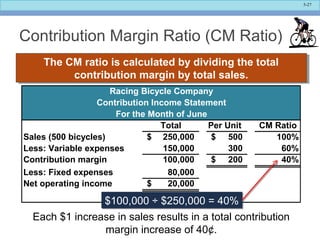
Contribution Margin Ratio (CM Ratio)
Total Per Unit CM Ratio
Sales (500 bicycles) 250,000$ 500$ 100%
Less: Variable expenses 150,000 300 60%
Contribution margin 100,000 200$ 40%
Less: Fixed expenses 80,000
Net operating income 20,000$
Racing Bicycle Company
Contribution Income Statement
For the Month of June
$100,000 ÷ $250,000 = 40%$100,000 ÷ $250,000 = 40%
The CM ratio is calculated by dividing the total
contribution margin by total sales.
The CM ratio is calculated by dividing the total
contribution margin by total sales.
Each $1 increase in sales results in a total contribution
margin increase of 40¢.
5-28
Contribution Margin Ratio (CM Ratio)
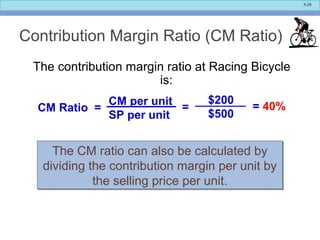
The contribution margin ratio at Racing Bicycle
is:
The CM ratio can also be calculated by
dividing the contribution margin per unit by
the selling price per unit.
The CM ratio can also be calculated by
dividing the contribution margin per unit by
the selling price per unit.
CM per unit
SP per unit
CM Ratio = = 40%
$200
$500
=
5-29
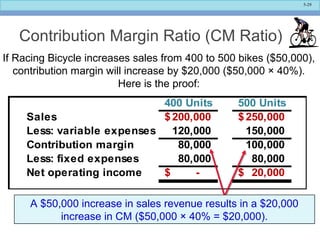
400 Units 500 Units
Sales 200,000$ 250,000$
Less: variable expenses 120,000 150,000
Contribution margin 80,000 100,000
Less: fixed expenses 80,000 80,000
Net operating income -$ 20,000$
Contribution Margin Ratio (CM Ratio)
A $50,000 increase in sales revenue results in a $20,000
increase in CM ($50,000 × 40% = $20,000).
A $50,000 increase in sales revenue results in a $20,000
increase in CM ($50,000 × 40% = $20,000).
If Racing Bicycle increases sales from 400 to 500 bikes ($50,000),
contribution margin will increase by $20,000 ($50,000 × 40%).
Here is the proof:
5-30
Contribution Margin Ratio (CM Ratio)
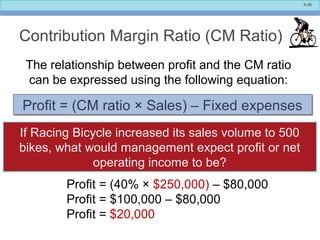
The relationship between profit and the CM ratio
can be expressed using the following equation:
Profit = (CM ratio × Sales) – Fixed expensesProfit = (CM ratio × Sales) – Fixed expenses
Profit = (40% × $250,000) – $80,000
Profit = $100,000 – $80,000
Profit = $20,000
If Racing Bicycle increased its sales volume to 500
bikes, what would management expect profit or net
operating income to be?
5-31
Learning Objective 4
Show the effects on net
operating income of
changes in variable
costs, fixed costs,
selling price, and
volume.
5-32
The Variable Expense Ratio
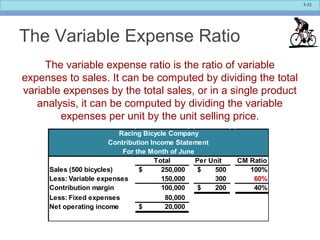
The variable expense ratio is the ratio of variable
expenses to sales. It can be computed by dividing the total
variable expenses by the total sales, or in a single product
analysis, it can be computed by dividing the variable
expenses per unit by the unit selling price.
Total Per Unit CM Ratio
Sales (500 bicycles) 250,000$ 500$ 100%
Less: Variable expenses 150,000 300 60%
Contribution margin 100,000 200$ 40%
Less: Fixed expenses 80,000
Net operating income 20,000$
Racing Bicycle Company
Contribution Income Statement
For the Month of June
5-33
Changes in Fixed Costs and Sales
Volume
What is the profit impact if Racing Bicycle
can increase unit sales from 500 to 540 by
increasing the monthly advertising budget
by $10,000?
5-34
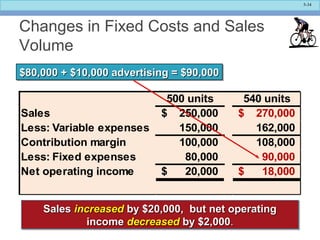
500 units 540 units
Sales 250,000$ 270,000$
Less: Variable expenses 150,000 162,000
Contribution margin 100,000 108,000
Less: Fixed expenses 80,000 90,000
Net operating income 20,000$ 18,000$
Changes in Fixed Costs and Sales
Volume
$80,000 + $10,000 advertising = $90,000$80,000 + $10,000 advertising = $90,000$80,000 + $10,000 advertising = $90,000$80,000 + $10,000 advertising = $90,000
SalesSales increasedincreased by $20,000, but net operatingby $20,000, but net operating
incomeincome decreaseddecreased by $2,000by $2,000..
SalesSales increasedincreased by $20,000, but net operatingby $20,000, but net operating
incomeincome decreaseddecreased by $2,000by $2,000..
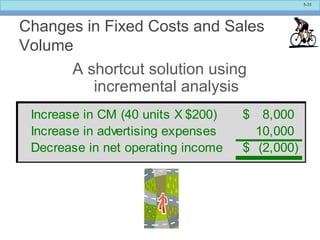
5-35
Changes in Fixed Costs and Sales
Volume
A shortcut solution using
incremental analysis
Increase in CM (40 units X $200) 8,000$
Increase in advertising expenses 10,000
Decrease in net operating income (2,000)$
5-36
Change in Variable Costs and Sales
Volume
What is the profit impact if Racing
Bicycle can use higher quality raw
materials, thus increasing variable costs
per unit by $10, to generate an increase
in unit sales from 500 to 580?
5-37
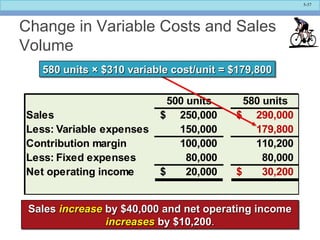
500 units 580 units
Sales 250,000$ 290,000$
Less: Variable expenses 150,000 179,800
Contribution margin 100,000 110,200
Less: Fixed expenses 80,000 80,000
Net operating income 20,000$ 30,200$
Change in Variable Costs and Sales
Volume
580 units580 units ×× $310 variable cost/unit = $179,800$310 variable cost/unit = $179,800580 units580 units ×× $310 variable cost/unit = $179,800$310 variable cost/unit = $179,800
SalesSales increaseincrease by $40,000 and net operating incomeby $40,000 and net operating income
increasesincreases by $10,200by $10,200..
SalesSales increaseincrease by $40,000 and net operating incomeby $40,000 and net operating income
increasesincreases by $10,200by $10,200..
5-38
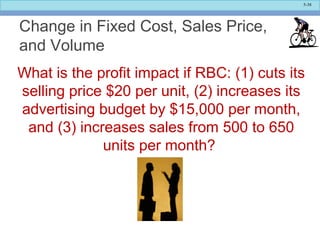
Change in Fixed Cost, Sales Price,
and Volume
What is the profit impact if RBC: (1) cuts its
selling price $20 per unit, (2) increases its
advertising budget by $15,000 per month,
and (3) increases sales from 500 to 650
units per month?
5-39
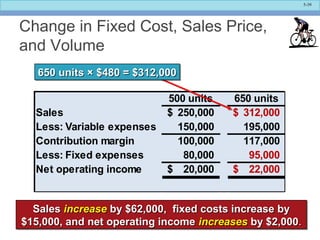
SalesSales increaseincrease by $62,000, fixed costs increase byby $62,000, fixed costs increase by
$15,000, and net operating income$15,000, and net operating income increasesincreases by $2,000by $2,000..
SalesSales increaseincrease by $62,000, fixed costs increase byby $62,000, fixed costs increase by
$15,000, and net operating income$15,000, and net operating income increasesincreases by $2,000by $2,000..
Change in Fixed Cost, Sales Price,
and Volume
500 units 650 units
Sales 250,000$ 312,000$
Less: Variable expenses 150,000 195,000
Contribution margin 100,000 117,000
Less: Fixed expenses 80,000 95,000
Net operating income 20,000$ 22,000$
650 units650 units ×× $480 = $312,000$480 = $312,000650 units650 units ×× $480 = $312,000$480 = $312,000
5-40
Change in Variable Cost, Fixed Cost,
and Sales Volume
What is the profit impact if RBC: (1) pays a
$15 sales commission per bike sold instead
of paying salespersons flat salaries that
currently total $6,000 per month, and (2)
increases unit sales from 500 to 575 bikes?
5-41
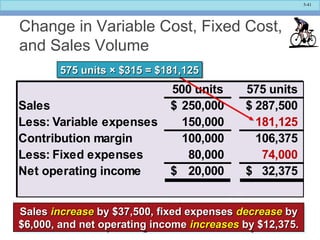
Change in Variable Cost, Fixed Cost,
and Sales Volume
SalesSales increaseincrease by $37,500, fixed expensesby $37,500, fixed expenses decreasedecrease byby
$6,000, and net operating income$6,000, and net operating income increasesincreases by $12,375.by $12,375.
SalesSales increaseincrease by $37,500, fixed expensesby $37,500, fixed expenses decreasedecrease byby
$6,000, and net operating income$6,000, and net operating income increasesincreases by $12,375.by $12,375.
500 units 575 units
Sales 250,000$ 287,500$
Less: Variable expenses 150,000 181,125
Contribution margin 100,000 106,375
Less: Fixed expenses 80,000 74,000
Net operating income 20,000$ 32,375$
575 units575 units ×× $315 = $181,125$315 = $181,125575 units575 units ×× $315 = $181,125$315 = $181,125
5-42
Change in Regular Sales Price
If RBC has an opportunity to sell 150
bikes to a wholesaler without disturbing
sales to other customers or fixed
expenses, what price would it quote to
the wholesaler if it wants to increase
monthly profits by $3,000?
5-43
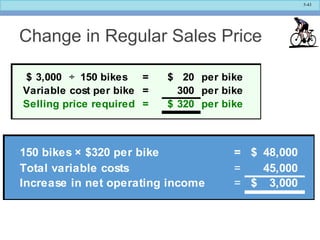
Change in Regular Sales Price
3,000$ ÷ 150 bikes = 20$ per bike
Variable cost per bike = 300 per bike
Selling price required = 320$ per bike
150 bikes × $320 per bike = 48,000$
Total variable costs = 45,000
Increase in net operating income = 3,000$
5-44
Learning Objective 5
Determine the break-
even point.
5-45
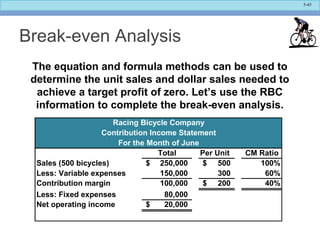
Break-even Analysis
The equation and formula methods can be used to
determine the unit sales and dollar sales needed to
achieve a target profit of zero. Let’s use the RBC
information to complete the break-even analysis.
Total Per Unit CM Ratio
Sales (500 bicycles) 250,000$ 500$ 100%
Less: Variable expenses 150,000 300 60%
Contribution margin 100,000 200$ 40%
Less: Fixed expenses 80,000
Net operating income 20,000$
Racing Bicycle Company
Contribution Income Statement
For the Month of June
5-46
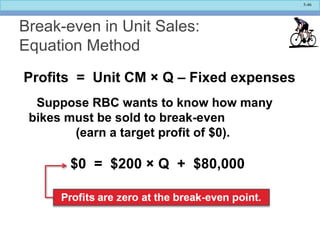
Break-even in Unit Sales:
Equation Method
$0 = $200 × Q + $80,000
Profits = Unit CM × Q – Fixed expenses
Suppose RBC wants to know how many
bikes must be sold to break-even
(earn a target profit of $0).
5-47
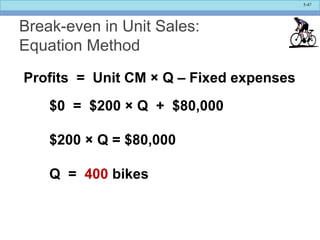
Break-even in Unit Sales:
Equation Method
$0 = $200 × Q + $80,000
$200 × Q = $80,000
Q = 400 bikes
Profits = Unit CM × Q – Fixed expenses
5-48
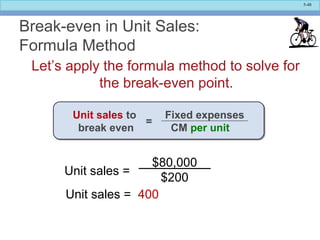
Break-even in Unit Sales:
Formula Method
Let’s apply the formula method to solve for
the break-even point.
Unit sales = 400
$80,000
$200
Unit sales =
Fixed expenses
CM per unit
=
Unit sales to
break even
5-49
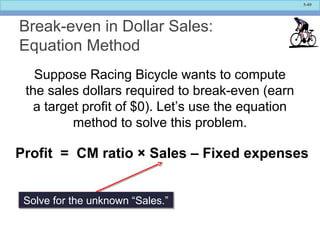
Break-even in Dollar Sales:
Equation Method
Suppose Racing Bicycle wants to compute
the sales dollars required to break-even (earn
a target profit of $0). Let’s use the equation
method to solve this problem.
Profit = CM ratio × Sales – Fixed expenses
Solve for the unknown “Sales.”Solve for the unknown “Sales.”
5-50
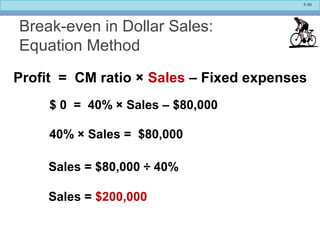
Break-even in Dollar Sales:
Equation Method
Profit = CM ratio × Sales – Fixed expenses
$ 0 = 40% × Sales – $80,000
40% × Sales = $80,000
Sales = $80,000 ÷ 40%
Sales = $200,000
5-51
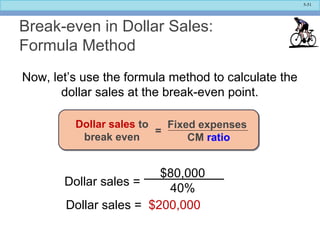
Break-even in Dollar Sales:
Formula Method
Now, let’s use the formula method to calculate the
dollar sales at the break-even point.
Dollar sales = $200,000
$80,000
40%
Dollar sales =
Fixed expenses
CM ratio
=
Dollar sales to
break even
5-52
Learning Objective 6
Determine the level of
sales needed to achieve
a desired target profit.
5-53
Target Profit Analysis
We can compute the number of units
that must be sold to attain a target
profit using either:
(1) Equation method, or
(2) Formula method.
5-54
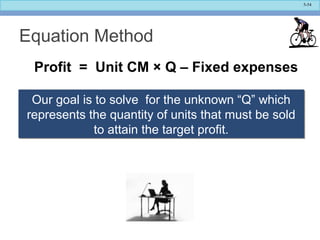
Equation Method
Profit = Unit CM × Q – Fixed expenses
Our goal is to solve for the unknown “Q” which
represents the quantity of units that must be sold
to attain the target profit.
Our goal is to solve for the unknown “Q” which
represents the quantity of units that must be sold
to attain the target profit.
5-55
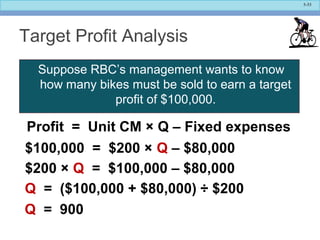
Target Profit Analysis
Suppose RBC’s management wants to know
how many bikes must be sold to earn a target
profit of $100,000.
Profit = Unit CM × Q – Fixed expenses
$100,000 = $200 × Q – $80,000
$200 × Q = $100,000 – $80,000
Q = ($100,000 + $80,000) ÷ $200
Q = 900
5-56
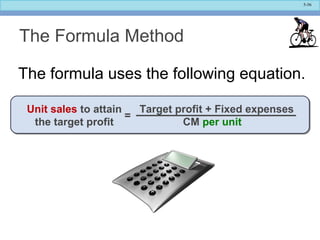
The Formula Method
The formula uses the following equation.
Target profit + Fixed expenses
CM per unit
=
Unit sales to attain
the target profit
5-57
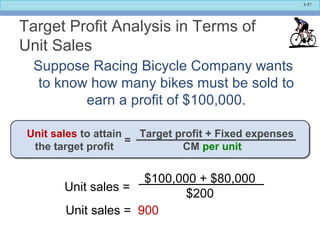
Target Profit Analysis in Terms of
Unit Sales
Suppose Racing Bicycle Company wants
to know how many bikes must be sold to
earn a profit of $100,000.
Target profit + Fixed expenses
CM per unit
=
Unit sales to attain
the target profit
Unit sales = 900
$100,000 + $80,000
$200
Unit sales =
5-58
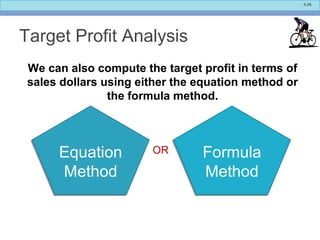
Target Profit Analysis
We can also compute the target profit in terms of
sales dollars using either the equation method or
the formula method.
Equation
Method
Equation
Method
Formula
Method
Formula
Method
OR
5-59
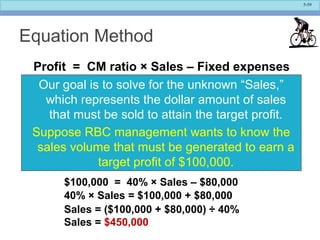
Equation Method
Profit = CM ratio × Sales – Fixed expenses
Our goal is to solve for the unknown “Sales,”
which represents the dollar amount of sales
that must be sold to attain the target profit.
Suppose RBC management wants to know the
sales volume that must be generated to earn a
target profit of $100,000.
$100,000 = 40% × Sales – $80,000
40% × Sales = $100,000 + $80,000
Sales = ($100,000 + $80,000) ÷ 40%
Sales = $450,000
5-60
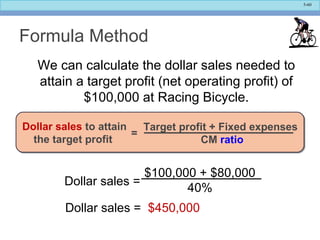
Formula Method
We can calculate the dollar sales needed to
attain a target profit (net operating profit) of
$100,000 at Racing Bicycle.
Target profit + Fixed expenses
CM ratio
=
Dollar sales to attain
the target profit
Dollar sales = $450,000
$100,000 + $80,000
40%
Dollar sales =
5-61
Learning Objective 7
Compute the margin of
safety and explain its
significance.
5-62
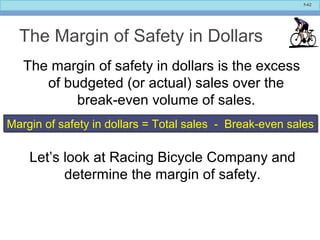
The Margin of Safety in Dollars
The margin of safety in dollars is the excess
of budgeted (or actual) sales over the
break-even volume of sales.
Margin of safety in dollars = Total sales - Break-even salesMargin of safety in dollars = Total sales - Break-even sales
Let’s look at Racing Bicycle Company and
determine the margin of safety.
5-63
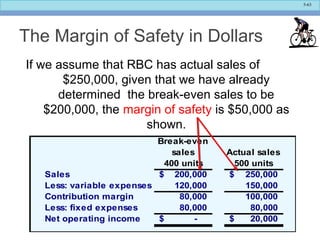
The Margin of Safety in Dollars
If we assume that RBC has actual sales of
$250,000, given that we have already
determined the break-even sales to be
$200,000, the margin of safety is $50,000 as
shown.
Break-even
sales
400 units
Actual sales
500 units
Sales 200,000$ 250,000$
Less: variable expenses 120,000 150,000
Contribution margin 80,000 100,000
Less: fixed expenses 80,000 80,000
Net operating income -$ 20,000$
5-64
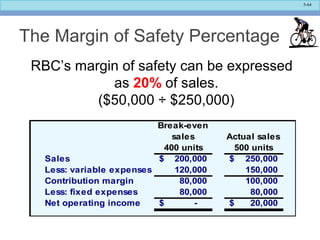
The Margin of Safety Percentage
RBC’s margin of safety can be expressed
as 20% of sales.
($50,000 ÷ $250,000)
Break-even
sales
400 units
Actual sales
500 units
Sales 200,000$ 250,000$
Less: variable expenses 120,000 150,000
Contribution margin 80,000 100,000
Less: fixed expenses 80,000 80,000
Net operating income -$ 20,000$
5-65
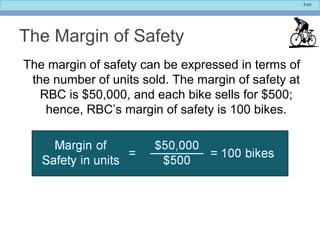
The Margin of Safety
The margin of safety can be expressed in terms of
the number of units sold. The margin of safety at
RBC is $50,000, and each bike sells for $500;
hence, RBC’s margin of safety is 100 bikes.
5-66
Thanks for your attention
5-67
Questions.

Cvp analysis by Taj Mohammad Tamkeen

  • 1.
    5-1 Cost-Volume-Profit Relationships By: SirTaj Mohammad “Tamkeen”” Lecturer economics Rokhan university taj_tamkeen@yahoo.com 0093788889195
  • 2.
    5-2 Key Assumptions ofCVP Analysis 1. Selling price is constant. 2. Costs are linear and can be accurately divided into variable (constant per unit) and fixed (constant in total) elements. 3. In multiproduct companies, the sales mix is constant. 4. In manufacturing companies, inventories do not change (units produced = units sold).
  • 3.
    5-3 Learning Objective 1 Explainhow changes in activity affect contribution margin and net operating income.
  • 4.
    5-4 Basics of Cost-Volume-ProfitAnalysis Contribution Margin (CM) is the amount remaining from sales revenue after variable expenses have been deducted. Contribution Margin (CM) is the amount remaining from sales revenue after variable expenses have been deducted. Sales (500 bicycles) 250,000$ Less: Variable expenses 150,000 Contribution margin 100,000 Less: Fixed expenses 80,000 Net operating income 20,000$ Racing Bicycle Company Contribution Income Statement For the Month of June The contribution income statement is helpful to managers in judging the impact on profits of changes in selling price, cost, or volume. The emphasis is on cost behavior. The contribution income statement is helpful to managers in judging the impact on profits of changes in selling price, cost, or volume. The emphasis is on cost behavior.
  • 5.
    5-5 Basics of Cost-Volume-ProfitAnalysis CM is used first to cover fixed expenses. Any remaining CM contributes to net operating income. CM is used first to cover fixed expenses. Any remaining CM contributes to net operating income. Sales (500 bicycles) 250,000$ Less: Variable expenses 150,000 Contribution margin 100,000 Less: Fixed expenses 80,000 Net operating income 20,000$ Racing Bicycle Company Contribution Income Statement For the Month of June
  • 6.
    5-6 Total Per Unit Sales(500 bicycles) 250,000$ 500$ Less: Variable expenses 150,000 300 Contribution margin 100,000 200$ Less: Fixed expenses 80,000 Net operating income 20,000$ Racing Bicycle Company Contribution Income Statement For the Month of June The Contribution Approach Sales, variable expenses, and contribution margin can also be expressed on a per unit basis. If Racing sells an additional bicycle, $200 additional CM will be generated to cover fixed expenses and profit.
  • 7.
    5-7 Total Per Unit Sales(500 bicycles) 250,000$ 500$ Less: Variable expenses 150,000 300 Contribution margin 100,000 200$ Less: Fixed expenses 80,000 Net operating income 20,000$ Racing Bicycle Company Contribution Income Statement For the Month of June The Contribution Approach Each month, RBC must generate at least $80,000 in total contribution margin to break-even (which is the level of sales at which profit is zero).
  • 8.
    5-8 Total Per Unit Sales(400 bicycles) 200,000$ 500$ Less: Variable expenses 120,000 300 Contribution margin 80,000 200$ Less: Fixed expenses 80,000 Net operating income -$ Racing Bicycle Company Contribution Income Statement For the Month of June The Contribution Approach If RBC sells 400 units in a month, it will be operating at the break-even point.
  • 9.
    5-9 Total Per Unit Sales(401 bicycles) 200,500$ 500$ Less: Variable expenses 120,300 300 Contribution margin 80,200 200$ Less: Fixed expenses 80,000 Net operating income 200$ Racing Bicycle Company Contribution Income Statement For the Month of June The Contribution Approach If RBC sells one more bike (401 bikes), net operating income will increase by $200.
  • 10.
    5-10 The Contribution Approach Wedo not need to prepare an income statement to estimate profits at a particular sales volume. Simply multiply the number of units sold above break-even by the contribution margin per unit. If Racing sellsIf Racing sells 430 bikes, its net430 bikes, its net operating incomeoperating income will be $6,000.will be $6,000. If Racing sellsIf Racing sells 430 bikes, its net430 bikes, its net operating incomeoperating income will be $6,000.will be $6,000.
  • 11.
    5-11 CVP Relationships inEquation Form The contribution format income statement can be expressed in the following equation: Profit = (Sales – Variable expenses) – Fixed expensesProfit = (Sales – Variable expenses) – Fixed expenses Total Per Unit Sales (401 bicycles) 200,500$ 500$ Less: Variable expenses 120,300 300 Contribution margin 80,200 200$ Less: Fixed expenses 80,000 Net operating income 200$ Racing Bicycle Company Contribution Income Statement For the Month of June
  • 12.
    5-12 CVP Relationships inEquation Form This equation can be used to show the profit RBC earns if it sells 401. Notice, the answer of $200 mirrors our earlier solution. Profit = (Sales – Variable expenses) – Fixed expensesProfit = (Sales – Variable expenses) – Fixed expenses 401 units × $500401 units × $500 401 units × $300401 units × $300 $80,000$80,000 Profit = ($200,500 – Variable expenses) – FixedProfit = ($200,500 – $120,300) – Fixed expensesProfit = ($200,500 – $120,300) – $80,000$200 = ($200,500 – $120,300) – $80,000
  • 13.
    5-13 CVP Relationships inEquation Form When a company has only one product we can further refine this equation as shown on this slide. Profit = (Sales – Variable expenses) – Fixed expensesProfit = (Sales – Variable expenses) – Fixed expenses Quantity sold (Q) × Selling price per unit (P) = Sales (Q × P) Quantity sold (Q) × Variable expenses per unit (V) = Variable expenses (Q × V) Profit = (P × Q – V × Q) – Fixed expenses
  • 14.
    5-14 CVP Relationships inEquation Form This equation can also be used to show the $200 profit RBC earns if it sells 401 bikes. Profit = (Sales – Variable expenses) – Fixed expensesProfit = (Sales – Variable expenses) – Fixed expenses Profit = (P × Q – V × Q) – Fixed expenses Profit = ($500 × 401 – $300 × 401) – $80,000Profit = ($500 × 401 – $300 × 401) – $80,000$200$200 = ($500 × 401 – $300 × 401) – $80,000$200$200 = ($500 × 401 – $300 × 401) – $80,000
  • 15.
    5-15 CVP Relationships inEquation Form Unit CM = Selling price per unit – Variable expenses per unit It is often useful to express the simple profit equation in terms of the unit contribution margin (Unit CM) as follows: Profit = (P × Q – V × Q) – Fixed expenses Profit = (P – V) × Q – Fixed expenses Profit = Unit CM × Q – Fixed expenses Profit = (P × Q – V × Q) – Fixed expenses Profit = (P – V) × Q – Fixed expenses Profit = Unit CM × Q – Fixed expenses Unit CM = P – V
  • 16.
    5-16 CVP Relationships inEquation Form Profit = (P × Q – V × Q) – Fixed expenses Profit = (P – V) × Q – Fixed expenses Profit = Unit CM × Q – Fixed expenses Profit = (P × Q – V × Q) – Fixed expenses Profit = (P – V) × Q – Fixed expenses Profit = Unit CM × Q – Fixed expenses Profit = ($500 – $300) × 401 – $80,000 Profit = $200 × 401 – $80,000 Profit = $80,200 – $80,000 Profit = $200 This equation can also be used to compute RBC’s $200 profit if it sells 401 bikes.
  • 17.
    5-17 Learning Objective 2 Prepareand interpret a cost-volume-profit (CVP) graph and a profit graph.
  • 18.
    5-18 CVP Relationships inGraphic Form The relationships among revenue, cost, profit, and volume can be expressed graphically by preparing a CVP graph. Racing Bicycle developed contribution margin income statements at 0, 200, 400, and 600 units sold. We will use this information to prepare the CVP graph. 0 200 400 600 Sales -$ 100,000$ 200,000$ 300,000$ Total variable expenses - 60,000 120,000 180,000 Contribution margin - 40,000 80,000 120,000 Fixed expenses 80,000 80,000 80,000 80,000 Net operating income (loss) (80,000)$ (40,000)$ -$ 40,000$ Units Sold
  • 19.
    5-19 Preparing the CVPGraph Units Dollars In a CVP graph, unit volume is usually represented on the horizontal (X) axis and dollars on the vertical (Y) axis. In a CVP graph, unit volume is usually represented on the horizontal (X) axis and dollars on the vertical (Y) axis.
  • 20.
    5-20 Preparing the CVPGraph Units Dollars  Draw a line parallel to the volume axis to represent total fixed expenses.  Draw a line parallel to the volume axis to represent total fixed expenses.
  • 21.
    5-21 Preparing the CVPGraph Units Dollars  Choose some sales volume, say 400 units, and plot the point representingChoose some sales volume, say 400 units, and plot the point representing total expenses (fixed and variable). Draw a line through the data pointtotal expenses (fixed and variable). Draw a line through the data point back to where the fixed expenses line intersects the dollar axis.back to where the fixed expenses line intersects the dollar axis.  Choose some sales volume, say 400 units, and plot the point representingChoose some sales volume, say 400 units, and plot the point representing total expenses (fixed and variable). Draw a line through the data pointtotal expenses (fixed and variable). Draw a line through the data point back to where the fixed expenses line intersects the dollar axis.back to where the fixed expenses line intersects the dollar axis.
  • 22.
    5-22 Preparing the CVPGraph Units Dollars  Choose some sales volume, say 400 units, and plot the point representingChoose some sales volume, say 400 units, and plot the point representing total sales. Draw a line through the data point back to the point of origin.total sales. Draw a line through the data point back to the point of origin.  Choose some sales volume, say 400 units, and plot the point representingChoose some sales volume, say 400 units, and plot the point representing total sales. Draw a line through the data point back to the point of origin.total sales. Draw a line through the data point back to the point of origin.
  • 23.
    5-23 Preparing the CVPGraph Break-even pointBreak-even point (400 units or $200,000 in sales)(400 units or $200,000 in sales) Break-even pointBreak-even point (400 units or $200,000 in sales)(400 units or $200,000 in sales) Units Dollars Loss AreaLoss Area Profit AreaProfit Area
  • 24.
    5-24 0 100 200300 400 500 600 -$60,000 Number of bicycles sold Profit 60,000$ 40,000$ 20,000$ $0 -$20,000 -$40,000 Preparing the CVP Graph Profit = Unit CM × Q – Fixed CostsProfit = Unit CM × Q – Fixed Costs An even simpler form of the CVP graph is called the profit graph. An even simpler form of the CVP graph is called the profit graph.
  • 25.
    5-25 0 100 200300 400 500 600 -$60,000 Number of bicycles sold Profit 60,000$ 40,000$ 20,000$ $0 -$20,000 -$40,000 Preparing the CVP Graph Break-even point, where profit is zero, is 400 units sold. Break-even point, where profit is zero, is 400 units sold.
  • 26.
    5-26 Learning Objective 3 Usethe contribution margin ration (CM ratio) to compute changes in contribution margin and net operating income resulting from changes in sales volume.
  • 27.
    5-27 Contribution Margin Ratio(CM Ratio) Total Per Unit CM Ratio Sales (500 bicycles) 250,000$ 500$ 100% Less: Variable expenses 150,000 300 60% Contribution margin 100,000 200$ 40% Less: Fixed expenses 80,000 Net operating income 20,000$ Racing Bicycle Company Contribution Income Statement For the Month of June $100,000 ÷ $250,000 = 40%$100,000 ÷ $250,000 = 40% The CM ratio is calculated by dividing the total contribution margin by total sales. The CM ratio is calculated by dividing the total contribution margin by total sales. Each $1 increase in sales results in a total contribution margin increase of 40¢.
  • 28.
    5-28 Contribution Margin Ratio(CM Ratio) The contribution margin ratio at Racing Bicycle is: The CM ratio can also be calculated by dividing the contribution margin per unit by the selling price per unit. The CM ratio can also be calculated by dividing the contribution margin per unit by the selling price per unit. CM per unit SP per unit CM Ratio = = 40% $200 $500 =
  • 29.
    5-29 400 Units 500Units Sales 200,000$ 250,000$ Less: variable expenses 120,000 150,000 Contribution margin 80,000 100,000 Less: fixed expenses 80,000 80,000 Net operating income -$ 20,000$ Contribution Margin Ratio (CM Ratio) A $50,000 increase in sales revenue results in a $20,000 increase in CM ($50,000 × 40% = $20,000). A $50,000 increase in sales revenue results in a $20,000 increase in CM ($50,000 × 40% = $20,000). If Racing Bicycle increases sales from 400 to 500 bikes ($50,000), contribution margin will increase by $20,000 ($50,000 × 40%). Here is the proof:
  • 30.
    5-30 Contribution Margin Ratio(CM Ratio) The relationship between profit and the CM ratio can be expressed using the following equation: Profit = (CM ratio × Sales) – Fixed expensesProfit = (CM ratio × Sales) – Fixed expenses Profit = (40% × $250,000) – $80,000 Profit = $100,000 – $80,000 Profit = $20,000 If Racing Bicycle increased its sales volume to 500 bikes, what would management expect profit or net operating income to be?
  • 31.
    5-31 Learning Objective 4 Showthe effects on net operating income of changes in variable costs, fixed costs, selling price, and volume.
  • 32.
    5-32 The Variable ExpenseRatio The variable expense ratio is the ratio of variable expenses to sales. It can be computed by dividing the total variable expenses by the total sales, or in a single product analysis, it can be computed by dividing the variable expenses per unit by the unit selling price. Total Per Unit CM Ratio Sales (500 bicycles) 250,000$ 500$ 100% Less: Variable expenses 150,000 300 60% Contribution margin 100,000 200$ 40% Less: Fixed expenses 80,000 Net operating income 20,000$ Racing Bicycle Company Contribution Income Statement For the Month of June
  • 33.
    5-33 Changes in FixedCosts and Sales Volume What is the profit impact if Racing Bicycle can increase unit sales from 500 to 540 by increasing the monthly advertising budget by $10,000?
  • 34.
    5-34 500 units 540units Sales 250,000$ 270,000$ Less: Variable expenses 150,000 162,000 Contribution margin 100,000 108,000 Less: Fixed expenses 80,000 90,000 Net operating income 20,000$ 18,000$ Changes in Fixed Costs and Sales Volume $80,000 + $10,000 advertising = $90,000$80,000 + $10,000 advertising = $90,000$80,000 + $10,000 advertising = $90,000$80,000 + $10,000 advertising = $90,000 SalesSales increasedincreased by $20,000, but net operatingby $20,000, but net operating incomeincome decreaseddecreased by $2,000by $2,000.. SalesSales increasedincreased by $20,000, but net operatingby $20,000, but net operating incomeincome decreaseddecreased by $2,000by $2,000..
  • 35.
    5-35 Changes in FixedCosts and Sales Volume A shortcut solution using incremental analysis Increase in CM (40 units X $200) 8,000$ Increase in advertising expenses 10,000 Decrease in net operating income (2,000)$
  • 36.
    5-36 Change in VariableCosts and Sales Volume What is the profit impact if Racing Bicycle can use higher quality raw materials, thus increasing variable costs per unit by $10, to generate an increase in unit sales from 500 to 580?
  • 37.
    5-37 500 units 580units Sales 250,000$ 290,000$ Less: Variable expenses 150,000 179,800 Contribution margin 100,000 110,200 Less: Fixed expenses 80,000 80,000 Net operating income 20,000$ 30,200$ Change in Variable Costs and Sales Volume 580 units580 units ×× $310 variable cost/unit = $179,800$310 variable cost/unit = $179,800580 units580 units ×× $310 variable cost/unit = $179,800$310 variable cost/unit = $179,800 SalesSales increaseincrease by $40,000 and net operating incomeby $40,000 and net operating income increasesincreases by $10,200by $10,200.. SalesSales increaseincrease by $40,000 and net operating incomeby $40,000 and net operating income increasesincreases by $10,200by $10,200..
  • 38.
    5-38 Change in FixedCost, Sales Price, and Volume What is the profit impact if RBC: (1) cuts its selling price $20 per unit, (2) increases its advertising budget by $15,000 per month, and (3) increases sales from 500 to 650 units per month?
  • 39.
    5-39 SalesSales increaseincrease by$62,000, fixed costs increase byby $62,000, fixed costs increase by $15,000, and net operating income$15,000, and net operating income increasesincreases by $2,000by $2,000.. SalesSales increaseincrease by $62,000, fixed costs increase byby $62,000, fixed costs increase by $15,000, and net operating income$15,000, and net operating income increasesincreases by $2,000by $2,000.. Change in Fixed Cost, Sales Price, and Volume 500 units 650 units Sales 250,000$ 312,000$ Less: Variable expenses 150,000 195,000 Contribution margin 100,000 117,000 Less: Fixed expenses 80,000 95,000 Net operating income 20,000$ 22,000$ 650 units650 units ×× $480 = $312,000$480 = $312,000650 units650 units ×× $480 = $312,000$480 = $312,000
  • 40.
    5-40 Change in VariableCost, Fixed Cost, and Sales Volume What is the profit impact if RBC: (1) pays a $15 sales commission per bike sold instead of paying salespersons flat salaries that currently total $6,000 per month, and (2) increases unit sales from 500 to 575 bikes?
  • 41.
    5-41 Change in VariableCost, Fixed Cost, and Sales Volume SalesSales increaseincrease by $37,500, fixed expensesby $37,500, fixed expenses decreasedecrease byby $6,000, and net operating income$6,000, and net operating income increasesincreases by $12,375.by $12,375. SalesSales increaseincrease by $37,500, fixed expensesby $37,500, fixed expenses decreasedecrease byby $6,000, and net operating income$6,000, and net operating income increasesincreases by $12,375.by $12,375. 500 units 575 units Sales 250,000$ 287,500$ Less: Variable expenses 150,000 181,125 Contribution margin 100,000 106,375 Less: Fixed expenses 80,000 74,000 Net operating income 20,000$ 32,375$ 575 units575 units ×× $315 = $181,125$315 = $181,125575 units575 units ×× $315 = $181,125$315 = $181,125
  • 42.
    5-42 Change in RegularSales Price If RBC has an opportunity to sell 150 bikes to a wholesaler without disturbing sales to other customers or fixed expenses, what price would it quote to the wholesaler if it wants to increase monthly profits by $3,000?
  • 43.
    5-43 Change in RegularSales Price 3,000$ ÷ 150 bikes = 20$ per bike Variable cost per bike = 300 per bike Selling price required = 320$ per bike 150 bikes × $320 per bike = 48,000$ Total variable costs = 45,000 Increase in net operating income = 3,000$
  • 44.
  • 45.
    5-45 Break-even Analysis The equationand formula methods can be used to determine the unit sales and dollar sales needed to achieve a target profit of zero. Let’s use the RBC information to complete the break-even analysis. Total Per Unit CM Ratio Sales (500 bicycles) 250,000$ 500$ 100% Less: Variable expenses 150,000 300 60% Contribution margin 100,000 200$ 40% Less: Fixed expenses 80,000 Net operating income 20,000$ Racing Bicycle Company Contribution Income Statement For the Month of June
  • 46.
    5-46 Break-even in UnitSales: Equation Method $0 = $200 × Q + $80,000 Profits = Unit CM × Q – Fixed expenses Suppose RBC wants to know how many bikes must be sold to break-even (earn a target profit of $0).
  • 47.
    5-47 Break-even in UnitSales: Equation Method $0 = $200 × Q + $80,000 $200 × Q = $80,000 Q = 400 bikes Profits = Unit CM × Q – Fixed expenses
  • 48.
    5-48 Break-even in UnitSales: Formula Method Let’s apply the formula method to solve for the break-even point. Unit sales = 400 $80,000 $200 Unit sales = Fixed expenses CM per unit = Unit sales to break even
  • 49.
    5-49 Break-even in DollarSales: Equation Method Suppose Racing Bicycle wants to compute the sales dollars required to break-even (earn a target profit of $0). Let’s use the equation method to solve this problem. Profit = CM ratio × Sales – Fixed expenses Solve for the unknown “Sales.”Solve for the unknown “Sales.”
  • 50.
    5-50 Break-even in DollarSales: Equation Method Profit = CM ratio × Sales – Fixed expenses $ 0 = 40% × Sales – $80,000 40% × Sales = $80,000 Sales = $80,000 ÷ 40% Sales = $200,000
  • 51.
    5-51 Break-even in DollarSales: Formula Method Now, let’s use the formula method to calculate the dollar sales at the break-even point. Dollar sales = $200,000 $80,000 40% Dollar sales = Fixed expenses CM ratio = Dollar sales to break even
  • 52.
    5-52 Learning Objective 6 Determinethe level of sales needed to achieve a desired target profit.
  • 53.
    5-53 Target Profit Analysis Wecan compute the number of units that must be sold to attain a target profit using either: (1) Equation method, or (2) Formula method.
  • 54.
    5-54 Equation Method Profit =Unit CM × Q – Fixed expenses Our goal is to solve for the unknown “Q” which represents the quantity of units that must be sold to attain the target profit. Our goal is to solve for the unknown “Q” which represents the quantity of units that must be sold to attain the target profit.
  • 55.
    5-55 Target Profit Analysis SupposeRBC’s management wants to know how many bikes must be sold to earn a target profit of $100,000. Profit = Unit CM × Q – Fixed expenses $100,000 = $200 × Q – $80,000 $200 × Q = $100,000 – $80,000 Q = ($100,000 + $80,000) ÷ $200 Q = 900
  • 56.
    5-56 The Formula Method Theformula uses the following equation. Target profit + Fixed expenses CM per unit = Unit sales to attain the target profit
  • 57.
    5-57 Target Profit Analysisin Terms of Unit Sales Suppose Racing Bicycle Company wants to know how many bikes must be sold to earn a profit of $100,000. Target profit + Fixed expenses CM per unit = Unit sales to attain the target profit Unit sales = 900 $100,000 + $80,000 $200 Unit sales =
  • 58.
    5-58 Target Profit Analysis Wecan also compute the target profit in terms of sales dollars using either the equation method or the formula method. Equation Method Equation Method Formula Method Formula Method OR
  • 59.
    5-59 Equation Method Profit =CM ratio × Sales – Fixed expenses Our goal is to solve for the unknown “Sales,” which represents the dollar amount of sales that must be sold to attain the target profit. Suppose RBC management wants to know the sales volume that must be generated to earn a target profit of $100,000. $100,000 = 40% × Sales – $80,000 40% × Sales = $100,000 + $80,000 Sales = ($100,000 + $80,000) ÷ 40% Sales = $450,000
  • 60.
    5-60 Formula Method We cancalculate the dollar sales needed to attain a target profit (net operating profit) of $100,000 at Racing Bicycle. Target profit + Fixed expenses CM ratio = Dollar sales to attain the target profit Dollar sales = $450,000 $100,000 + $80,000 40% Dollar sales =
  • 61.
    5-61 Learning Objective 7 Computethe margin of safety and explain its significance.
  • 62.
    5-62 The Margin ofSafety in Dollars The margin of safety in dollars is the excess of budgeted (or actual) sales over the break-even volume of sales. Margin of safety in dollars = Total sales - Break-even salesMargin of safety in dollars = Total sales - Break-even sales Let’s look at Racing Bicycle Company and determine the margin of safety.
  • 63.
    5-63 The Margin ofSafety in Dollars If we assume that RBC has actual sales of $250,000, given that we have already determined the break-even sales to be $200,000, the margin of safety is $50,000 as shown. Break-even sales 400 units Actual sales 500 units Sales 200,000$ 250,000$ Less: variable expenses 120,000 150,000 Contribution margin 80,000 100,000 Less: fixed expenses 80,000 80,000 Net operating income -$ 20,000$
  • 64.
    5-64 The Margin ofSafety Percentage RBC’s margin of safety can be expressed as 20% of sales. ($50,000 ÷ $250,000) Break-even sales 400 units Actual sales 500 units Sales 200,000$ 250,000$ Less: variable expenses 120,000 150,000 Contribution margin 80,000 100,000 Less: fixed expenses 80,000 80,000 Net operating income -$ 20,000$
  • 65.
    5-65 The Margin ofSafety The margin of safety can be expressed in terms of the number of units sold. The margin of safety at RBC is $50,000, and each bike sells for $500; hence, RBC’s margin of safety is 100 bikes.
  • 66.
  • 67.