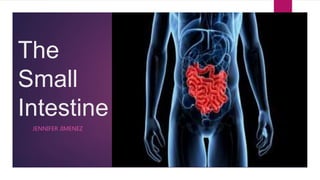
The
Small
Intestine
JENNIFER JIMENEZ
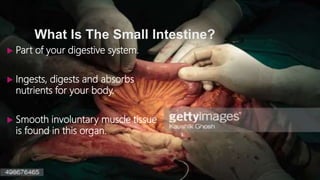
What Is The Small Intestine?
 Part of your digestive system.
 Ingests, digests and absorbs
nutrients for your body.
 Smooth involuntary muscle tissue
is found in this organ.
Where?
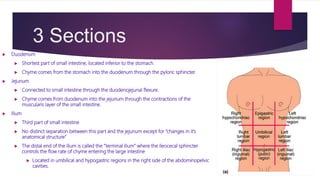
 The small intestine can be found in the abdominal region of the body, more specifically in the
abdominopelvic cavities. The small intestine is lined covered by a layered membrane called the
peritoneum. The outer part of the layer is called the parietal peritoneum and the inner layer
that surrounds the viscera is called the visceral peritoneum.
 Found in both the:
 Abdominal cavity
 Pelvic cavity
 The abdomen can be divided into 4 quadrants, the small intestine covers all 4 quadrants of the
abdominopelvic cavity.
Digestion In The Small Intestine
 The gallbladder has ducts that connect to the wall of the duodenum providing bile to
break down fat and aid in digestion.
 The enzymes, pancreatic lipase (digests fats) and pancreatic amylase (digests
carbohydrates) aid in digestion.
 Bicarbonate secreted by the pancreas neutralizes acidic chyme from the stomach and
into the small intestine.
 The small intestine starts by being connected to the stomach then it is “sectioned”
into three parts, the duodenum, jejunum and the ileum, the last end connects to the
large intestine.
 About 90% of digestion occurs in the small intestine, most of it completed by the
time it passes through the jejunum into the ileum.
Inside The Small Intestine
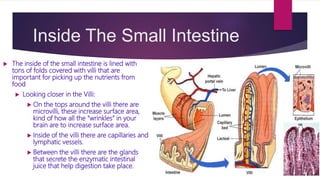
 The inside of the small intestine is lined with
tons of folds covered with villi that are
important for picking up the nutrients from
food
 Looking closer in the Villi:
 On the tops around the villi there are
microvilli, these increase surface area,
kind of how all the “wrinkles” in your
brain are to increase surface area.
 Inside of the villi there are capillaries and
lymphatic vessels.
 Between the villi there are the glands
that secrete the enzymatic intestinal
juice that help digestion take place.
Specifically…
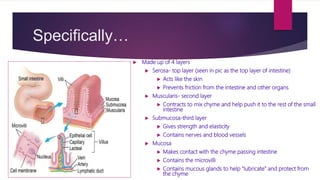
 Made up of 4 layers
 Serosa- top layer (seen in pic as the top layer of intestine)
 Acts like the skin
 Prevents friction from the intestine and other organs
 Muscularis- second layer
 Contracts to mix chyme and help push it to the rest of the small
intestine
 Submucosa-third layer
 Gives strength and elasticity
 Contains nerves and blood vessels
 Mucosa
 Makes contact with the chyme passing intestine
 Contains the microvilli
 Contains mucous glands to help “lubricate” and protect from
the chyme
3 Sections
 Duodenum
 Shortest part of small intestine, located inferior to the stomach.
 Chyme comes from the stomach into the duodenum through the pyloric sphincter.
 Jejunum
 Connected to small intestine through the duodenojejunal flexure.
 Chyme comes from duodenum into the jejunum through the contractions of the
muscularis layer of the small intestine.
 Ilium
 Third part of small intestine
 No distinct separation between this part and the jejunum except for “changes in it’s
anatomical structure”
 The distal end of the ilium is called the “terminal ilium” where the ileocecal sphincter
controls the flow rate of chyme entering the large intestine
 Located in umbilical and hypogastric regions in the right side of the abdominopelvic
cavities.
Interesting Website to Explore Further
 http://www.innerbody.com/image_digeov/dige10-new3.html
 Explore through the small intestine tabs to view 3D structure and
click on sides to read into the parts of the small intestine
Celiac’s Disease
 Disease in the small intestine
 When people can’t eat gluten
 Genetic
 Doctors believe an immune system response acts by inflaming the small intestine when
gluten is consumed making the villi flat. This can lead to big damage in the small
intestine and since villi are flat it will affect the absorption of nutrients
 Can lead to many deficiencies and anemia because nutrients aren’t being properly
absorbed.
 A lot of people have made not eating gluten a cultural thing and it has become popular
such as when people become vegan when in fact there are some people who actually
have a disease preventing them from consuming the gluten.
Terminology
 “abdomin/o” is “abdomen” and ”-al” is “pertaining to” forming “abdominal region” where the
gastrointestinal system is.
 The small intestine is part of the “gastrointestinal system” “gastr/o” meaning “stomach”. “-al”
meaning “pertaining to” and “-logy” meaning “study of”.
 “Enter/o” means small intestine
 “Peri-” is around
 ”Pariet/o” is cavity wall
 “Viscer/o” is internal organ
Fun Facts
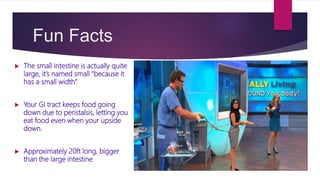
 The small intestine is actually quite
large, it’s named small “because it
has a small width”
 Your GI tract keeps food going
down due to peristalsis, letting you
eat food even when your upside
down.
 Approximately 20ft long, bigger
than the large intestine
THE END
 Thank you
Works Cited
 "Home." Celiac Disease | Diseases of the Small Intestine | MUSC DDC. Medical University of
South Carolina, n.d. Web. 14 June 2017.
 Baidya, Sankalan. "30 Amazing Small Intestine Facts." Facts Legend. Facts Legend, 17
June 2016. Web. 14 June 2017.
 Fremgen, Bonnie F., and Suzanne S. Frucht. Medical terminology: a living language.
6th ed. Boston: Pearson, 2016. Print.
 Taylor, Tim. "Small Intestine." InnerBody. HOWTOMEDIA incorporated, n.d. Web.
14 June 2017.
Links To Find Sources
 Medical Terminology Book
 https://www.google.com/url?sa=i&rct=j&q=&esrc=s&source=images&cd=&cad=rja&uact=8&ved=0ahUKEwi9jpevwLvUAhWj5YMKHStGDBUQjRwIBw&url=htt
p%3A%2F%2Fwww.livescience.com%2F52048-small-intestine.html&psig=AFQjCNHqY1ciaIjNhfbNI7HA2VzLPkIRFA&ust=1497466680511675 (picture)
 http://cephalicvein.com/wp-content/uploads/2016/08/abdominal-regions-nhspe-abdominopelvic-cavity-diagrams.png (picture)
 http://biology4isc.weebly.com/uploads/9/0/8/0/9080078/2707366_orig.jpg (picture)
 https://online.science.psu.edu/sites/default/files/biol011/Fig-10-15-Small-Intestine.jpg (picture)
 http://www.gettyimages.com/detail/photo/human-intestine-during-surgical-operation-royalty-free-image/498676465?esource=SEO_GIS_CDN_Redirect
(picture)
 https://o.aolcdn.com/images/dims?thumbnail=600%2C338&image_uri=http%3A%2F%2Fimg.vidible.tv%2Fprod%2F2015-
05%2F06%2F5549907ee4b0f61941d89855_cv1.jpg&client=cbc79c14efcebee57402&signature=456249883bf7c47551041f45238f41e20a3cc14b (picture)
 https://pics.me.me/tapewormsetsup-home-in-small-intestine-tape-worm-sets-up-home-14530770.png (picture)
 http://factslegend.org/30-amazing-small-intestine-facts/
 http://ddc.musc.edu/public/diseases/small-intestine/celiac-disease.html
 University of Illinois at Chicago HN196 Chapter lecture slides
 https://uic.blackboard.com/bbcswebdav/pid-5133277-dt-content-rid-54514598_2/courses/2017.spring.hn.196.37028/Hn%20196%202-
Food%20choices%2C%20digestion%202014.swf

Presentation Bios120 WW5 disc02

  • 1.
  • 2.
    What Is TheSmall Intestine?  Part of your digestive system.  Ingests, digests and absorbs nutrients for your body.  Smooth involuntary muscle tissue is found in this organ.
  • 3.
    Where?  The smallintestine can be found in the abdominal region of the body, more specifically in the abdominopelvic cavities. The small intestine is lined covered by a layered membrane called the peritoneum. The outer part of the layer is called the parietal peritoneum and the inner layer that surrounds the viscera is called the visceral peritoneum.  Found in both the:  Abdominal cavity  Pelvic cavity  The abdomen can be divided into 4 quadrants, the small intestine covers all 4 quadrants of the abdominopelvic cavity.
  • 4.
    Digestion In TheSmall Intestine  The gallbladder has ducts that connect to the wall of the duodenum providing bile to break down fat and aid in digestion.  The enzymes, pancreatic lipase (digests fats) and pancreatic amylase (digests carbohydrates) aid in digestion.  Bicarbonate secreted by the pancreas neutralizes acidic chyme from the stomach and into the small intestine.  The small intestine starts by being connected to the stomach then it is “sectioned” into three parts, the duodenum, jejunum and the ileum, the last end connects to the large intestine.  About 90% of digestion occurs in the small intestine, most of it completed by the time it passes through the jejunum into the ileum.
  • 5.
    Inside The SmallIntestine  The inside of the small intestine is lined with tons of folds covered with villi that are important for picking up the nutrients from food  Looking closer in the Villi:  On the tops around the villi there are microvilli, these increase surface area, kind of how all the “wrinkles” in your brain are to increase surface area.  Inside of the villi there are capillaries and lymphatic vessels.  Between the villi there are the glands that secrete the enzymatic intestinal juice that help digestion take place.
  • 6.
    Specifically…  Made upof 4 layers  Serosa- top layer (seen in pic as the top layer of intestine)  Acts like the skin  Prevents friction from the intestine and other organs  Muscularis- second layer  Contracts to mix chyme and help push it to the rest of the small intestine  Submucosa-third layer  Gives strength and elasticity  Contains nerves and blood vessels  Mucosa  Makes contact with the chyme passing intestine  Contains the microvilli  Contains mucous glands to help “lubricate” and protect from the chyme
  • 7.
    3 Sections  Duodenum Shortest part of small intestine, located inferior to the stomach.  Chyme comes from the stomach into the duodenum through the pyloric sphincter.  Jejunum  Connected to small intestine through the duodenojejunal flexure.  Chyme comes from duodenum into the jejunum through the contractions of the muscularis layer of the small intestine.  Ilium  Third part of small intestine  No distinct separation between this part and the jejunum except for “changes in it’s anatomical structure”  The distal end of the ilium is called the “terminal ilium” where the ileocecal sphincter controls the flow rate of chyme entering the large intestine  Located in umbilical and hypogastric regions in the right side of the abdominopelvic cavities.
  • 8.
    Interesting Website toExplore Further  http://www.innerbody.com/image_digeov/dige10-new3.html  Explore through the small intestine tabs to view 3D structure and click on sides to read into the parts of the small intestine
  • 9.
    Celiac’s Disease  Diseasein the small intestine  When people can’t eat gluten  Genetic  Doctors believe an immune system response acts by inflaming the small intestine when gluten is consumed making the villi flat. This can lead to big damage in the small intestine and since villi are flat it will affect the absorption of nutrients  Can lead to many deficiencies and anemia because nutrients aren’t being properly absorbed.  A lot of people have made not eating gluten a cultural thing and it has become popular such as when people become vegan when in fact there are some people who actually have a disease preventing them from consuming the gluten.
  • 10.
    Terminology  “abdomin/o” is“abdomen” and ”-al” is “pertaining to” forming “abdominal region” where the gastrointestinal system is.  The small intestine is part of the “gastrointestinal system” “gastr/o” meaning “stomach”. “-al” meaning “pertaining to” and “-logy” meaning “study of”.  “Enter/o” means small intestine  “Peri-” is around  ”Pariet/o” is cavity wall  “Viscer/o” is internal organ
  • 11.
    Fun Facts  Thesmall intestine is actually quite large, it’s named small “because it has a small width”  Your GI tract keeps food going down due to peristalsis, letting you eat food even when your upside down.  Approximately 20ft long, bigger than the large intestine
  • 12.
  • 13.
    Works Cited  "Home."Celiac Disease | Diseases of the Small Intestine | MUSC DDC. Medical University of South Carolina, n.d. Web. 14 June 2017.  Baidya, Sankalan. "30 Amazing Small Intestine Facts." Facts Legend. Facts Legend, 17 June 2016. Web. 14 June 2017.  Fremgen, Bonnie F., and Suzanne S. Frucht. Medical terminology: a living language. 6th ed. Boston: Pearson, 2016. Print.  Taylor, Tim. "Small Intestine." InnerBody. HOWTOMEDIA incorporated, n.d. Web. 14 June 2017.
  • 14.
    Links To FindSources  Medical Terminology Book  https://www.google.com/url?sa=i&rct=j&q=&esrc=s&source=images&cd=&cad=rja&uact=8&ved=0ahUKEwi9jpevwLvUAhWj5YMKHStGDBUQjRwIBw&url=htt p%3A%2F%2Fwww.livescience.com%2F52048-small-intestine.html&psig=AFQjCNHqY1ciaIjNhfbNI7HA2VzLPkIRFA&ust=1497466680511675 (picture)  http://cephalicvein.com/wp-content/uploads/2016/08/abdominal-regions-nhspe-abdominopelvic-cavity-diagrams.png (picture)  http://biology4isc.weebly.com/uploads/9/0/8/0/9080078/2707366_orig.jpg (picture)  https://online.science.psu.edu/sites/default/files/biol011/Fig-10-15-Small-Intestine.jpg (picture)  http://www.gettyimages.com/detail/photo/human-intestine-during-surgical-operation-royalty-free-image/498676465?esource=SEO_GIS_CDN_Redirect (picture)  https://o.aolcdn.com/images/dims?thumbnail=600%2C338&image_uri=http%3A%2F%2Fimg.vidible.tv%2Fprod%2F2015- 05%2F06%2F5549907ee4b0f61941d89855_cv1.jpg&client=cbc79c14efcebee57402&signature=456249883bf7c47551041f45238f41e20a3cc14b (picture)  https://pics.me.me/tapewormsetsup-home-in-small-intestine-tape-worm-sets-up-home-14530770.png (picture)  http://factslegend.org/30-amazing-small-intestine-facts/  http://ddc.musc.edu/public/diseases/small-intestine/celiac-disease.html  University of Illinois at Chicago HN196 Chapter lecture slides  https://uic.blackboard.com/bbcswebdav/pid-5133277-dt-content-rid-54514598_2/courses/2017.spring.hn.196.37028/Hn%20196%202- Food%20choices%2C%20digestion%202014.swf