Kok Jun Yi (12) Ong Sim Hao (17) Trevor Tan Yi Shin (22)
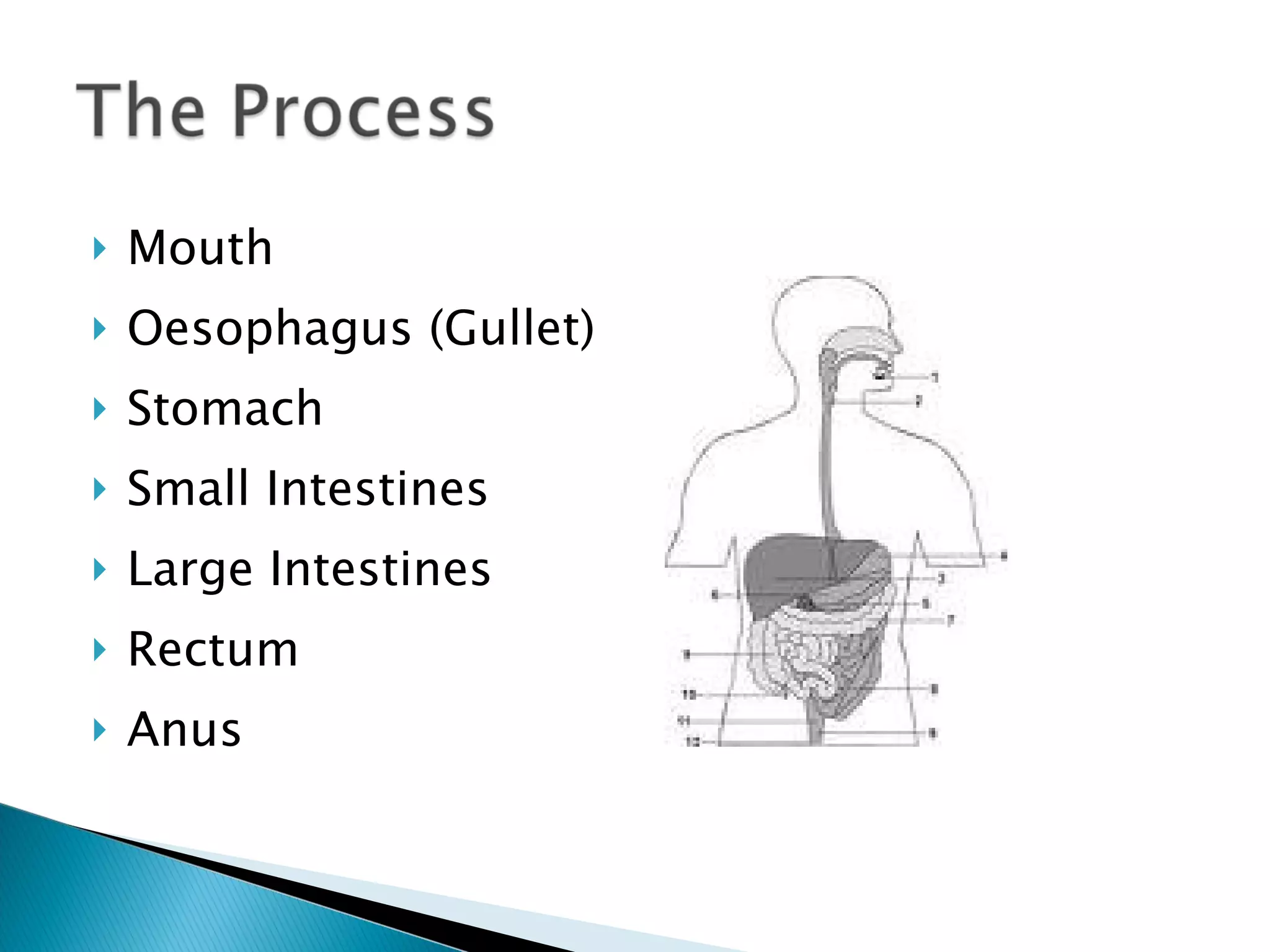
Mouth Oesophagus (Gullet) Stomach Small Intestines Large Intestines Rectum Anus
The food that we eat are  not in a form  that the body can use as  nourishment Food and liquid need to be  broken down  (mechanically and chemically) into very  small molecules of nutrients  before they can be  absorbed into the blood  and  carried to cells  throughout the body.
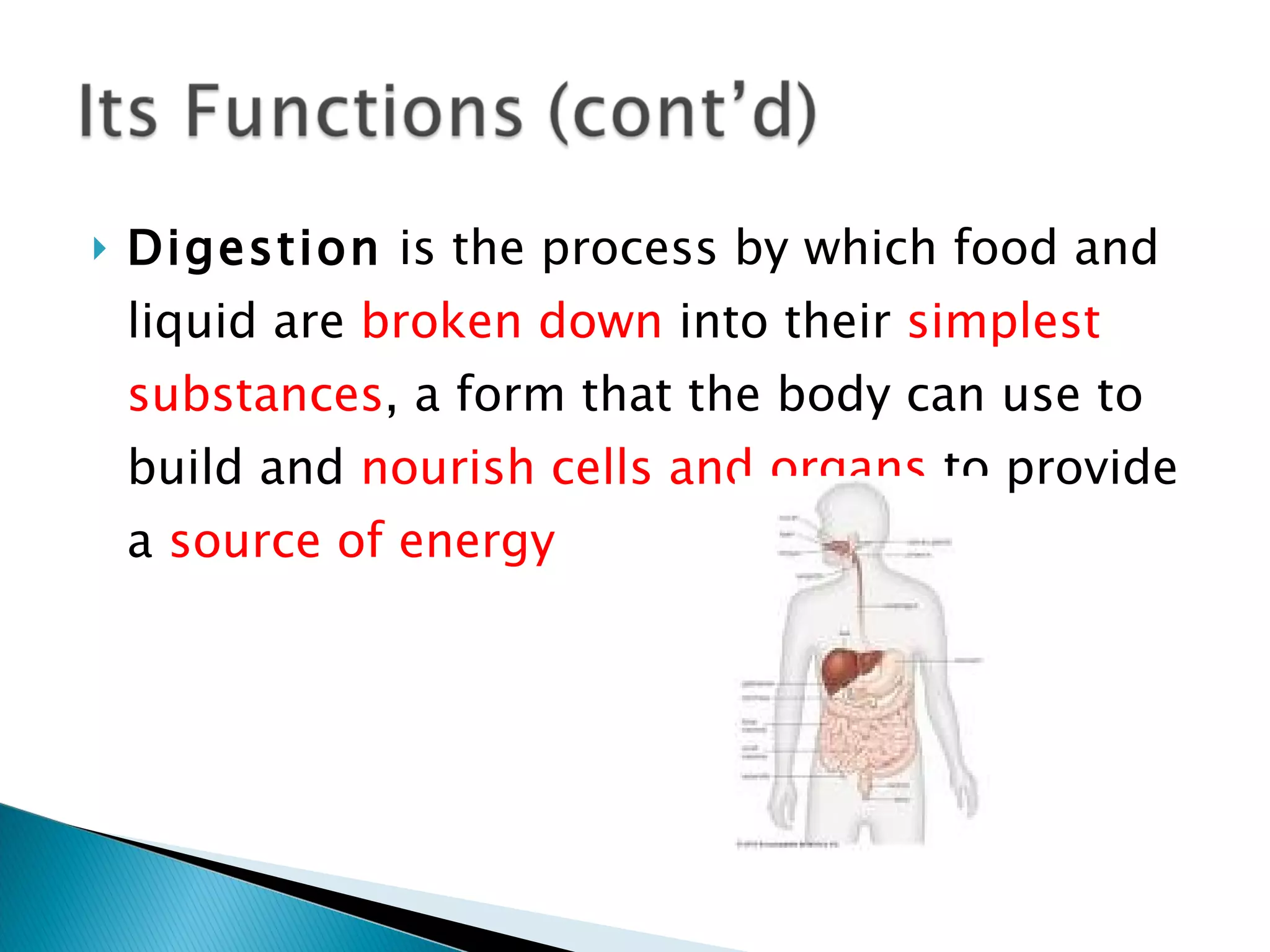
Digestion  is the process by which food and liquid are  broken down  into their  simplest substances , a form that the body can use to build and  nourish cells and organs  to provide a  source of energy
The collection and  elimination of waste products  are also important parts of digestion.  Indigestible parts of foods  (like fibre) and  some water  are  eliminated  from the body as  faeces . Thus, it is very important to maintain a  healthy digestive system  for our general health and well-being.
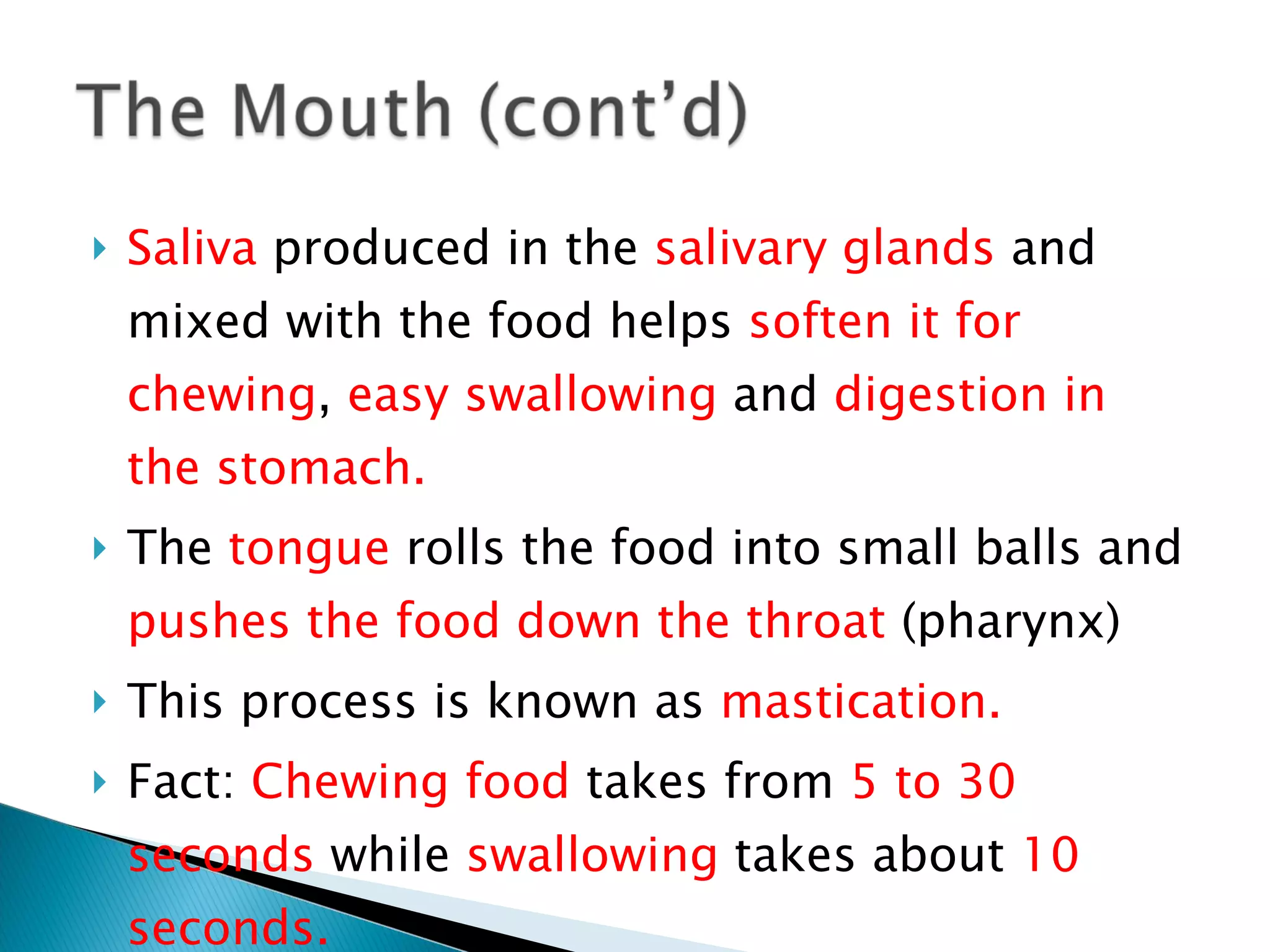
The mouth is  normally moist , and is lined with a  mucous membrane . Digestion begin s when we put food in our mouth and  begin to chew . Our  teeth  help to  break the food  into s maller pieces  by chewing.
Saliva  produced in the  salivary glands  and mixed with the food helps  soften it for chewing ,  easy swallowing  and  digestion in the stomach. The  tongue  rolls the food into small balls and  pushes the food down the throat  (pharynx) This process is known as  mastication. Fact:  Chewing food  takes from  5 to 30 seconds  while  swallowing  takes about  10 seconds.
The  oesophagus  is an  organ  which consists of a  muscular tube  through which  food  passes  from the pharynx to the stomach .  During swallowing,  food  passes from the mouth  through the pharynx  into the oesophagus and travels via  peristalsis  to the  stomach . Usually about  25-30cm long
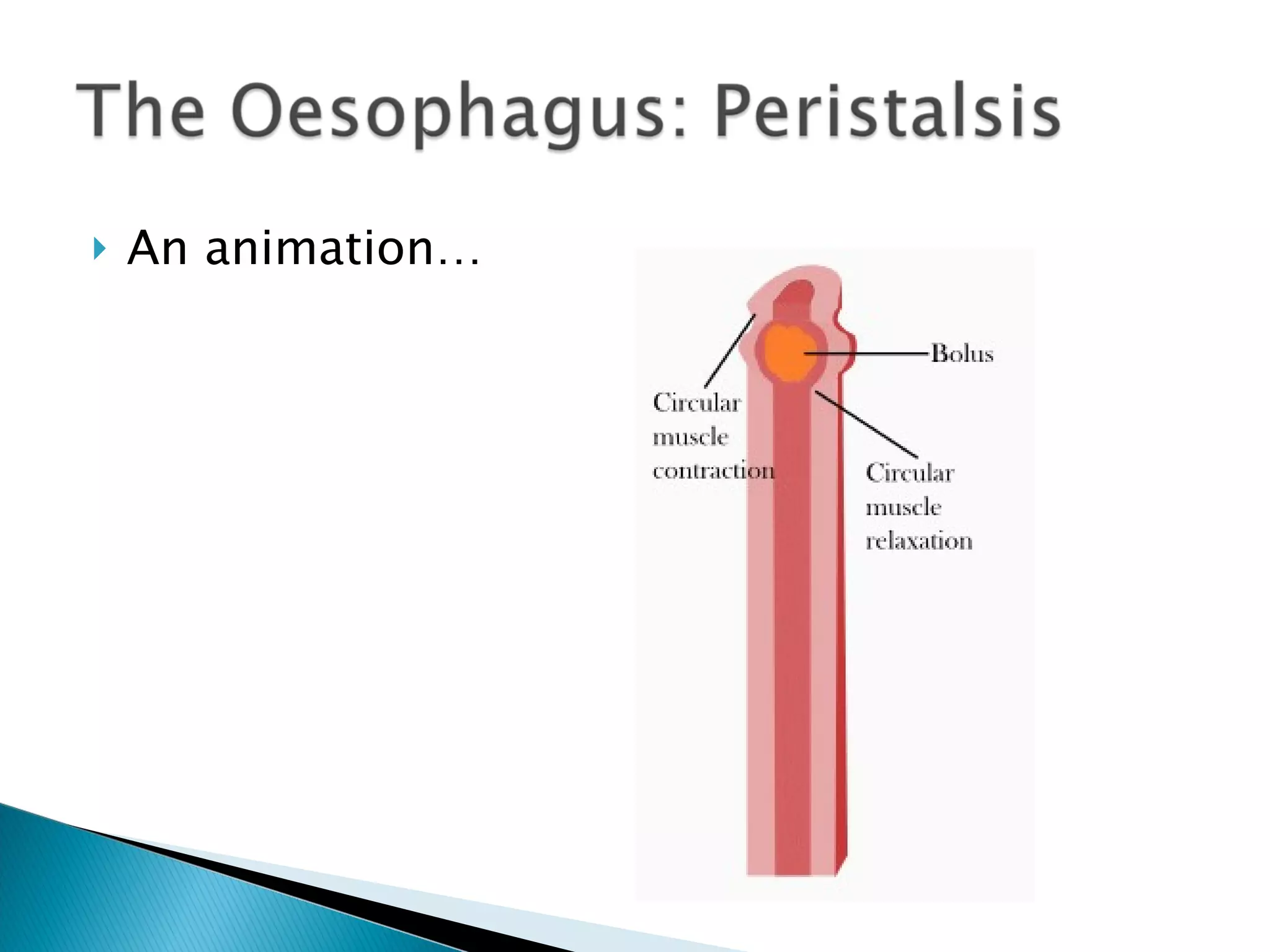
Peristaltic  movement is initiated by circular  smooth muscles contracting  behind the chewed material to  prevent it from moving back into the mouth , followed by a  contraction  of  longitudinal smooth muscles  which  pushes the digested food forward .
An animation…
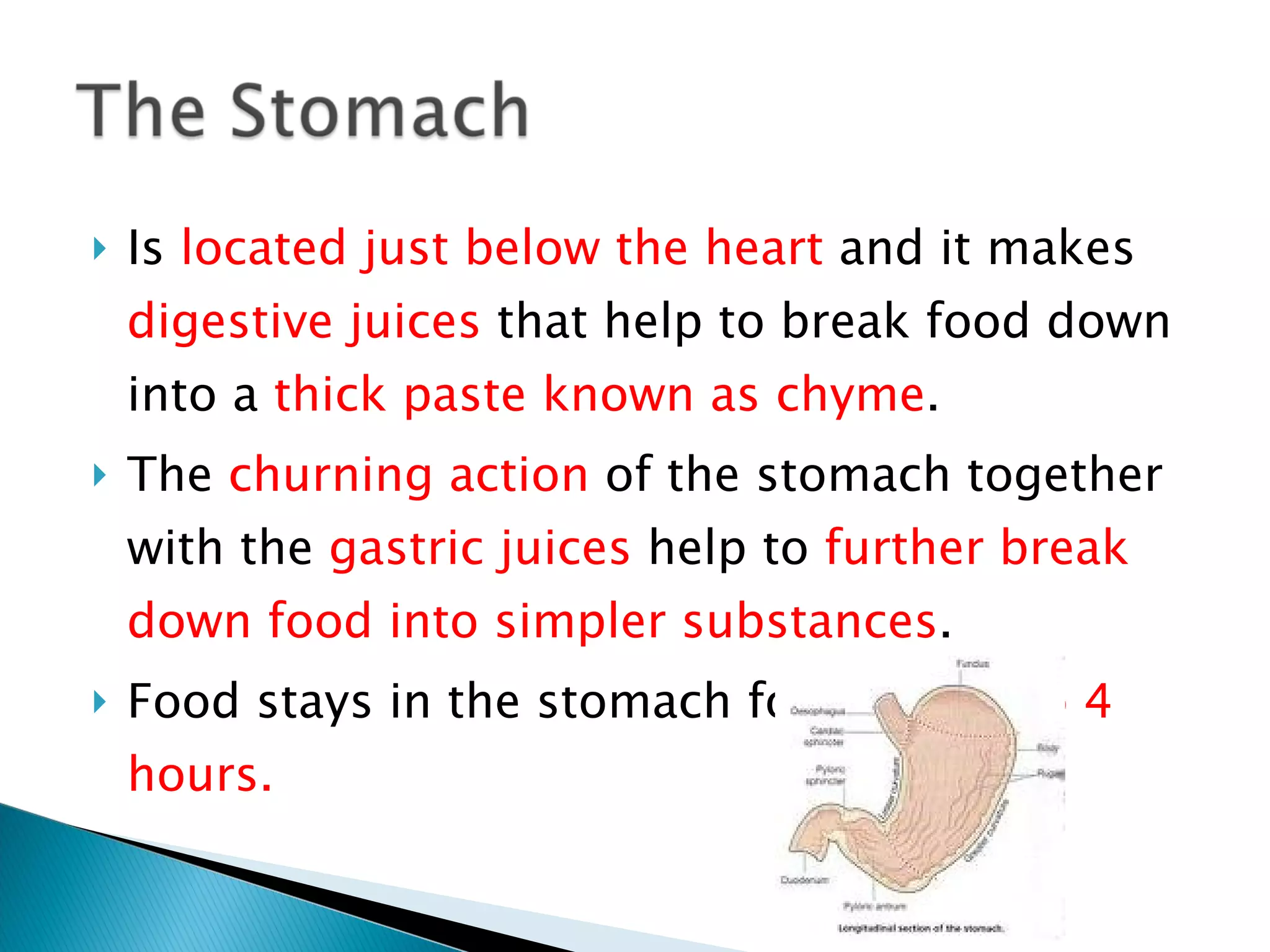
Is  located just  below the heart  and it makes  digestive juices  that help to break food down into a  thick paste known as chyme . The  churning action  of the stomach together with the  gastric juices  help to  further break down food into simpler substances . Food stays in the stomach for about  3 to 4 hours.
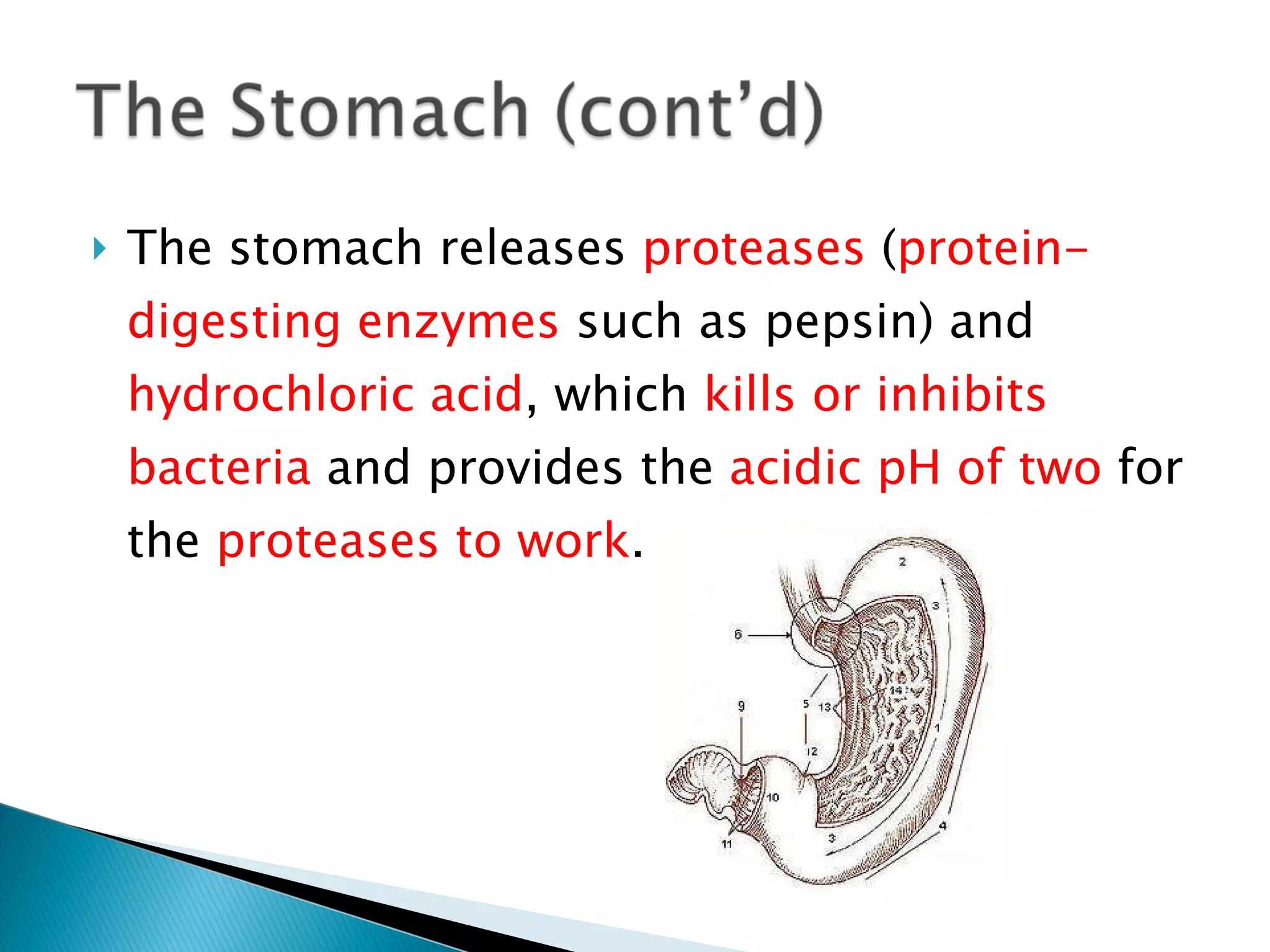
The stomach releases  proteases  ( protein-digesting enzymes  such as pepsin) and  hydrochloric acid , which  kills or inhibits bacteria  and provides the  acidic pH of two  for the  proteases to work .
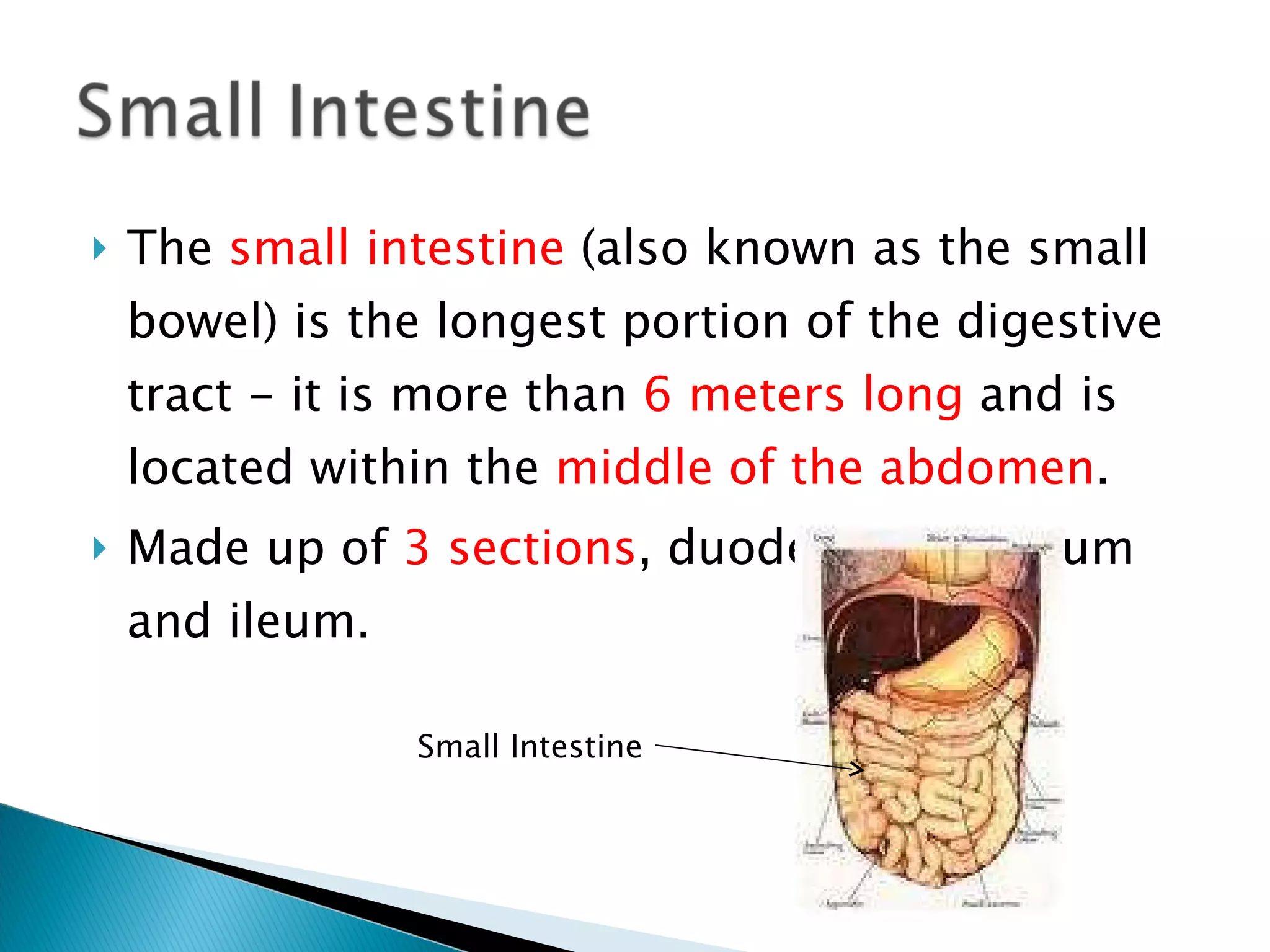
The  small intestine  (also known as the small bowel) is the longest portion of the digestive tract - it is more than  6 meters long  and is located within the  middle of the abdomen . Made up of  3 sections ,   duodenum, jejunum and ileum. Small Intestine
Much of the small intestine is  coiled and suspended  in a  thin layer of fat  - which gives the intestine a lot of  flexibility and mobility . This is where the  major part of digestion  and the  absorption of nutrients take place . More  digestive juices  are added to  break the chyme  further down for  absorption .
Located at the junction of the stomach and the small intestine, the  duodenum  is the  first part of the small intestine . It is  C-shaped and about 25 cm long . The duodenum receives the  thick liquid mixture  of partly-digested food and acid from the stomach. This  acid  is quickly  neutralised in the alkaline environment of the duodenum .
The duodenum also  receives bile  from the  gallbladder , and other  digestive enzymes  from the  pancreas . These  enter the duodenum  through  small ducts or tubes . Other glands  produce  mucus  that  coats the digestive mixture  to help  ease its passage .
The  food mixes  with bile, mucus, and pancreatic and other  digestive enzymes . The  bulk of the digestion  of proteins, fats and carbohydrates  takes place in the duodenum  before the material travels further into the small intestine
The  jejunum  is the  1-2 m long , coiled  mid-section  of the small intestine. The  ileum is the final portion of the small intestine , which leads into the large intestine. The  ileum measures 2-4 m in length .
The inner linings of the  jejunum and ileum contain very small finger-like bumps called 'villi' .  The presence of these tiny bumps on the inside of the small intestine means that the  surface area is much larger than if the lining were just a flat surface .  This  increased surface area  improves the small intestine's ability to  absorb nutrients into the bloodstream .
The  nutrient components  found after digestion: smaller molecules (e.g.  glucose  from carbohydrates;  amino acids  from proteins;  fatty acids  and  cholesterol  from fats) vitamins minerals salts water
Digestion ends here . All digested nutrients  pass through the intestinal walls into the bloodstream , where the  circulatory system  transports the nutrients to  cells throughout the body  to  provide energy .
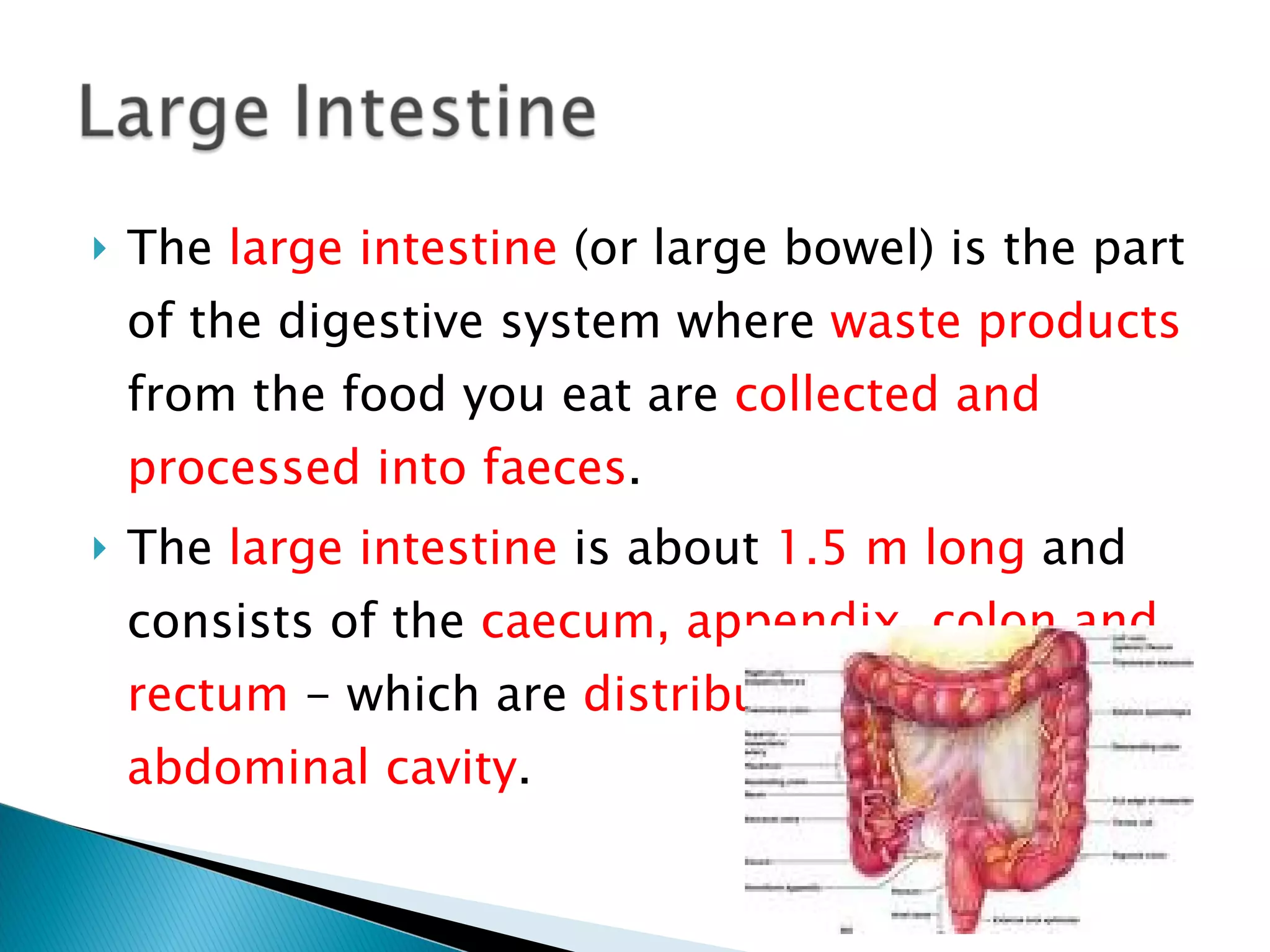
The  large intestine  (or large bowel) is the part of the digestive system where  waste products  from the food you eat are  collected and processed into faeces . The  large intestine  is about  1.5 m long  and consists of the  caecum, appendix, colon and rectum  - which are  distributed in the abdominal cavity .
The large intestine performs the  following functions : reabsorbs wate r and  maintains the fluid balance  of the body absorbs certain  vitamins processes  undigested material  (fibre) stores waste  before it is eliminated
The  caecum  is the  first part of the large intestine . It is  shaped like a small pouch  and located in the right lower abdomen, it is the  connection between the small intestine and the colon . The caecum  accepts and stores processed material  from the small intestine and  moves it towards the colon .
As the processed food  approaches the end  of the small intestine, a  valve separating the small and large intestines opens , the caecum expands and the  material enters .  At this stage, the mixture  normally contains : undigested food  (fibre) a little bit of  water some  vitamins some  minerals  or  salts
The  appendix  is a  small projection  emerging from the caecum. In human beings, the appendix has  no known function  and is  thought to be a remnant  from a previous time in  human evolution . In some people, the  appendix becomes infected or inflamed  (a condition known as  'appendicitis' ), and the appendix needs to be removed (via surgery).
Shaped like an inverted 'U' , the  colon  is the  longest part  of the  large intestine . The colon has  four sections  that are located in the abdominal cavity. Ascending colon   -  starts at the caecum  at the bottom right hand side of the abdomen and  ascends  (i.e. goes upwards)  towards the liver . Transverse colon   - transverse means 'across'. This part of the colon  extends across the abdomen from right to left .
Descending colon   -  descends  (goes downwards) on the  left hand side of the abdomen . Sigmoid colon   - it is the  last part of the large intestine , and is located on the bottom left hand side of the abdomen. It is the  S-shaped connection  between the  descending colon  and the  rectum .
Within the colon, the  mixture  of fibre, small amounts of water and vitamins etc.  mixes with mucus and with bacteria  that live in the large intestine - and  starts to form faeces . As faeces travels through the colon, the  lining of the colon absorbs most of the water and some vitamins and minerals
The  bacteria in the colon  chemically  break down  some of the  fibre  to  produce nutrients  for their own survival and to  nourish the cells lining the colon . Thus, the  fibre in your diet  is extremely important to  maintain the long-term health of the colon . Through  muscular movements  of the colon,  faeces is pushed along  until finally, the  walls of the sigmoid colon contract , causing the  faeces to move into the rectum.
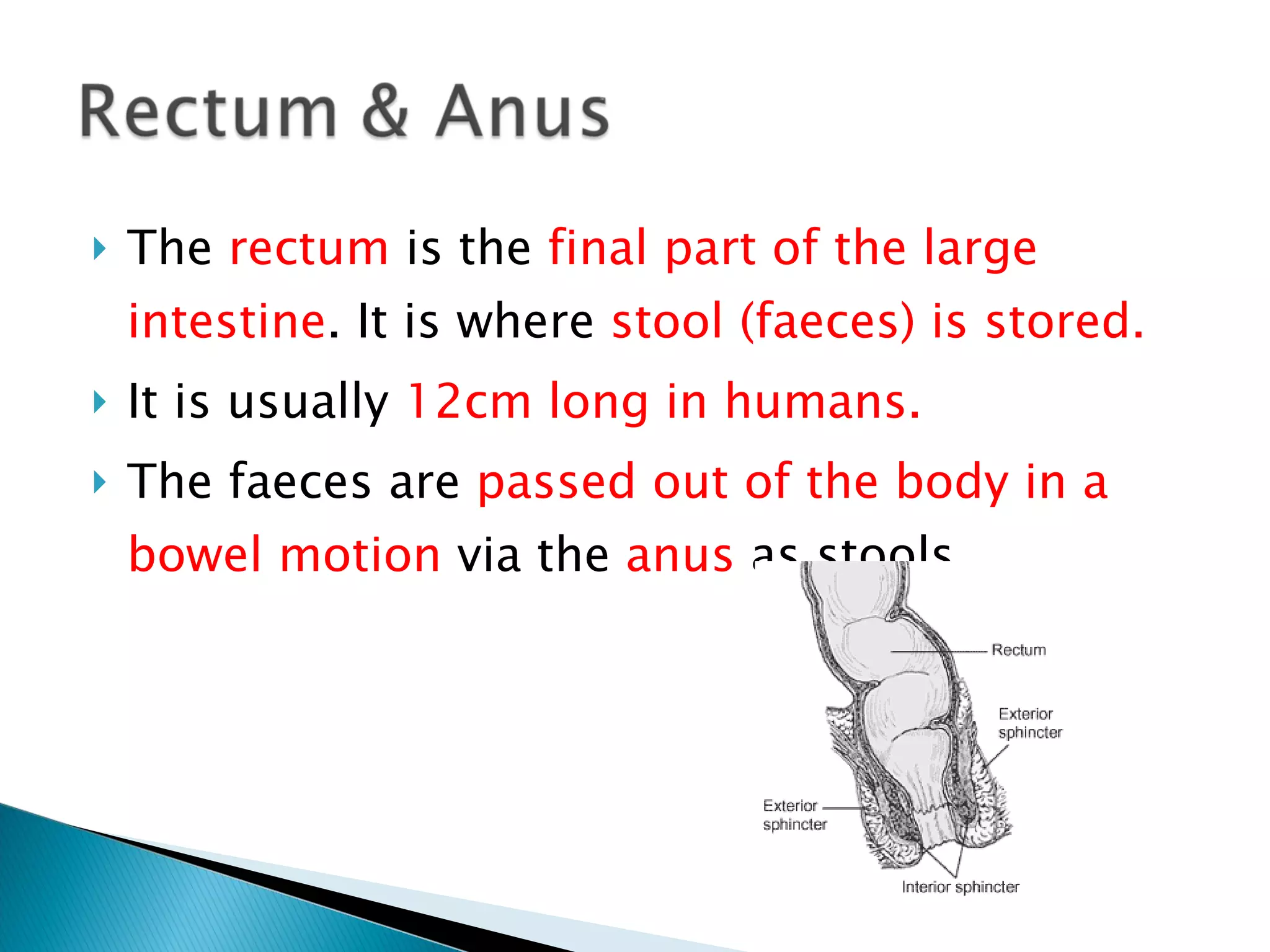
The  rectum  is the  final part of the large intestine . It is where  stool (faeces) is stored.  It is usually  12cm long in humans. The faeces are  passed out of the body in a bowel motion  via the  anus  as stools.
 

Digestive system 2

  • 1.
    Kok Jun Yi(12) Ong Sim Hao (17) Trevor Tan Yi Shin (22)
  • 2.
    Mouth Oesophagus (Gullet)Stomach Small Intestines Large Intestines Rectum Anus
  • 3.
    The food thatwe eat are not in a form that the body can use as nourishment Food and liquid need to be broken down (mechanically and chemically) into very small molecules of nutrients before they can be absorbed into the blood and carried to cells throughout the body.
  • 4.
    Digestion isthe process by which food and liquid are broken down into their simplest substances , a form that the body can use to build and nourish cells and organs to provide a source of energy
  • 5.
    The collection and elimination of waste products are also important parts of digestion. Indigestible parts of foods (like fibre) and some water are eliminated from the body as faeces . Thus, it is very important to maintain a healthy digestive system for our general health and well-being.
  • 6.
    The mouth is normally moist , and is lined with a mucous membrane . Digestion begin s when we put food in our mouth and begin to chew . Our teeth help to break the food into s maller pieces by chewing.
  • 7.
    Saliva producedin the salivary glands and mixed with the food helps soften it for chewing , easy swallowing and digestion in the stomach. The tongue rolls the food into small balls and pushes the food down the throat (pharynx) This process is known as mastication. Fact: Chewing food takes from 5 to 30 seconds while swallowing takes about 10 seconds.
  • 8.
    The oesophagus is an organ which consists of a muscular tube through which food passes from the pharynx to the stomach . During swallowing, food passes from the mouth through the pharynx into the oesophagus and travels via peristalsis to the stomach . Usually about 25-30cm long
  • 9.
    Peristaltic movementis initiated by circular smooth muscles contracting behind the chewed material to prevent it from moving back into the mouth , followed by a contraction of longitudinal smooth muscles which pushes the digested food forward .
  • 10.
  • 11.
    Is locatedjust below the heart and it makes digestive juices that help to break food down into a thick paste known as chyme . The churning action of the stomach together with the gastric juices help to further break down food into simpler substances . Food stays in the stomach for about 3 to 4 hours.
  • 12.
    The stomach releases proteases ( protein-digesting enzymes such as pepsin) and hydrochloric acid , which kills or inhibits bacteria and provides the acidic pH of two for the proteases to work .
  • 13.
    The smallintestine (also known as the small bowel) is the longest portion of the digestive tract - it is more than 6 meters long and is located within the middle of the abdomen . Made up of 3 sections , duodenum, jejunum and ileum. Small Intestine
  • 14.
    Much of thesmall intestine is coiled and suspended in a thin layer of fat - which gives the intestine a lot of flexibility and mobility . This is where the major part of digestion and the absorption of nutrients take place . More digestive juices are added to break the chyme further down for absorption .
  • 15.
    Located at thejunction of the stomach and the small intestine, the duodenum is the first part of the small intestine . It is C-shaped and about 25 cm long . The duodenum receives the thick liquid mixture of partly-digested food and acid from the stomach. This acid is quickly neutralised in the alkaline environment of the duodenum .
  • 16.
    The duodenum also receives bile from the gallbladder , and other digestive enzymes from the pancreas . These enter the duodenum through small ducts or tubes . Other glands produce mucus that coats the digestive mixture to help ease its passage .
  • 17.
    The foodmixes with bile, mucus, and pancreatic and other digestive enzymes . The bulk of the digestion of proteins, fats and carbohydrates takes place in the duodenum before the material travels further into the small intestine
  • 18.
    The jejunum is the 1-2 m long , coiled mid-section of the small intestine. The ileum is the final portion of the small intestine , which leads into the large intestine. The ileum measures 2-4 m in length .
  • 19.
    The inner liningsof the jejunum and ileum contain very small finger-like bumps called 'villi' . The presence of these tiny bumps on the inside of the small intestine means that the surface area is much larger than if the lining were just a flat surface . This increased surface area improves the small intestine's ability to absorb nutrients into the bloodstream .
  • 20.
    The nutrientcomponents found after digestion: smaller molecules (e.g. glucose from carbohydrates; amino acids from proteins; fatty acids and cholesterol from fats) vitamins minerals salts water
  • 21.
    Digestion ends here. All digested nutrients pass through the intestinal walls into the bloodstream , where the circulatory system transports the nutrients to cells throughout the body to provide energy .
  • 22.
    The largeintestine (or large bowel) is the part of the digestive system where waste products from the food you eat are collected and processed into faeces . The large intestine is about 1.5 m long and consists of the caecum, appendix, colon and rectum - which are distributed in the abdominal cavity .
  • 23.
    The large intestineperforms the following functions : reabsorbs wate r and maintains the fluid balance of the body absorbs certain vitamins processes undigested material (fibre) stores waste before it is eliminated
  • 24.
    The caecum is the first part of the large intestine . It is shaped like a small pouch and located in the right lower abdomen, it is the connection between the small intestine and the colon . The caecum accepts and stores processed material from the small intestine and moves it towards the colon .
  • 25.
    As the processedfood approaches the end of the small intestine, a valve separating the small and large intestines opens , the caecum expands and the material enters . At this stage, the mixture normally contains : undigested food (fibre) a little bit of water some vitamins some minerals or salts
  • 26.
    The appendix is a small projection emerging from the caecum. In human beings, the appendix has no known function and is thought to be a remnant from a previous time in human evolution . In some people, the appendix becomes infected or inflamed (a condition known as 'appendicitis' ), and the appendix needs to be removed (via surgery).
  • 27.
    Shaped like aninverted 'U' , the colon is the longest part of the large intestine . The colon has four sections that are located in the abdominal cavity. Ascending colon - starts at the caecum at the bottom right hand side of the abdomen and ascends (i.e. goes upwards) towards the liver . Transverse colon - transverse means 'across'. This part of the colon extends across the abdomen from right to left .
  • 28.
    Descending colon - descends (goes downwards) on the left hand side of the abdomen . Sigmoid colon - it is the last part of the large intestine , and is located on the bottom left hand side of the abdomen. It is the S-shaped connection between the descending colon and the rectum .
  • 29.
    Within the colon,the mixture of fibre, small amounts of water and vitamins etc. mixes with mucus and with bacteria that live in the large intestine - and starts to form faeces . As faeces travels through the colon, the lining of the colon absorbs most of the water and some vitamins and minerals
  • 30.
    The bacteriain the colon chemically break down some of the fibre to produce nutrients for their own survival and to nourish the cells lining the colon . Thus, the fibre in your diet is extremely important to maintain the long-term health of the colon . Through muscular movements of the colon, faeces is pushed along until finally, the walls of the sigmoid colon contract , causing the faeces to move into the rectum.
  • 31.
    The rectum is the final part of the large intestine . It is where stool (faeces) is stored. It is usually 12cm long in humans. The faeces are passed out of the body in a bowel motion via the anus as stools.
  • 32.