Small intestine
• The small intestine has a beginning section, a middle section and an end section. Although there is no real separation
between the parts, they do have slightly different characteristics and roles to play.
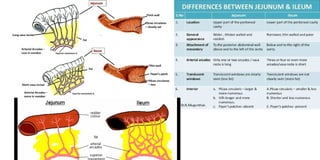
• Duodenum
• The duodenum is the first part of the small intestine that the stomach feeds into. It’s a short, descending chute (about
10 inches long) that curves around the pancreas in a “C” shape before connecting to the rest of the coiled intestines.
• Jejunum
• The remaining small intestine lays in many coils inside the lower abdominal cavity. Its middle section, called the
jejunum, makes up a little less than half of this remaining length. The jejunum is characterized by many blood vessels,
which give it a deep red color.
• Ileum
• The ileum is the last and longest section of the small intestine. Here the walls of the small intestine begin to thin and
narrow, and blood supply is reduced. Food spends the most time in the ileum, where the most water and nutrients are
absorbed.
• All three parts are covered with the greater omentum anteriorly.
• The duodenum has both intraperitoneal and retroperitoneal parts, while the jejunum and ileum are entirely intraperitoneal organs.
• Blood supply
• Arteries: celiac trunk, superior mesenteric artery
Veins: hepatic portal vein, superior mesenteric vein
• The duodenum is supplied by the branches of the celiac trunk & superior mesenteric artery (SMA); the superior, middle & inferior pancreaticoduodenal arteries.
• The jejunum and ileum are supplied by 15-18 branches of the SMA called the jejunal and ileal arteries. They anastomose with each other to form arterial
arcades which send numerous straight arteries (vasa recta) to the jejunum and ileum.
• The small intestines drain into the hepatic portal vein. The lymph of the small intestine is drained into the superior mesenteric lymph nodes.
• Innervation
• Parasympathetic: vagus nerve (CN X) (through the submucosal (Meissner’s) and myenteric (Auerbach’s) nervous plexuses)
• Sympathetic: Thoracic splanchnic nerves
• The small intestine is innervated by branches of the vagus nerve (CN X) and thoracic splanchnic nerves. Their nerve branches extend throughout the entire
length of the small intestine in the form of two plexuses:
• Submucosal plexus (of Meissner) found in the submucosa of the small intestine and contains only parasympathetic input from the vagus nerve (CN X)
• Myenteric plexus (of Auerbach) located in the muscularis externa of the small intestine, contains both sympathetic and parasympathetic nerve fibers
• Learn to differentiate between these layers really easily using a mnemonic! Just memorise 'SMP & MAPS', which stands for:
• Submucosal
• Meissner's
• Parasympathetic
• Myenteric
• Auerbach's
• Parasympathetic
• Sympathetic
• Duodenum
• To help break food down, the small intestine receives digestive juices from other organs in your digestive system, including your liver, gallbladder and pancreas.
Ducts from these organs feed into the duodenum. Hormone glands in the lining of the duodenum signal these organs to release their chemicals when food is
present.
• The duodenum by definition is the first part of the small intestine. It extends from the pyloric sphincter of the stomach, wraps around the head of the pancreas
in a C-shape and ends at duodenojejunal flexure. This flexure is attached to the posterior abdominal wall by a peritoneal fold called the suspensory muscle
(ligament) of duodenum, also called the ligament of Treitz.
• The duodenum has four parts: superior (duodenal bulb/ampulla), descending, horizontal and ascending. Among several features of the duodenum, we’ll list
the two most important:
• The superior part (duodenal bulb/ampulla) is the only intraperitoneal part, as the hepatoduodenal ligament and greater omentum attach to it.
• The descending part of the duodenum has an opening called the major duodenal papilla (tubercle of Vater). The papilla contains the hepatopancreatic sphincter
(sphincter of Oddi, Glissons’ sphincter) which regulates the emptying of the bile from the hepatopancreatic ampulla.
• Jejunum
• After chemical digestion in the duodenum, food moves into the jejunum, where the muscle work of digestion picks up. Nerves in the intestinal walls trigger its
muscles to churn food back and forth (segmentation), mixing it with digestive juices. Other muscle movements (peristalsis) keep the food moving gradually
forward.
• Mucosa
• The walls of the small intestine are lined with a dense mucosa with many glands that both secrete and absorb. In the jejunum and the ileum, the mucosa
secretes small amounts of digestive enzymes and lubricating mucus while absorbing nutrients from your food. Each section is designed to absorb different
nutrients, as well as water. The thick mucosa has so many folds and projections that its surface area is about 100 times as broad as the surface area of your skin.
This is why 95% of the carbohydrates and protein you consume are absorbed in the small intestine. It also absorbs about 90% of the water that it receives during
digestion. The rest will be absorbed in your large intestine.
• Ileum
• In the ileum, segmentation slows down and peristalsis takes over, moving food waste gradually toward the large intestine. The ileocecal valve separates the
ileum from the large intestine. Nerves and hormones signal the valve to open to let food pass through and close to keep bacteria out. Special immune cells line
the ileum to protect against bacteria.
• From internal to external, they are mucosa, submucosa, muscularis externa, and serosa. These layers are easy to remember
using the mnemonic M.S.M.S. There are several unique features in the small intestine, which act to significantly increase its
absorptive surface:
• Circular folds (valves of Kerckring, plicae circulares) are the transverse folds of mucosa found predominantly in the distal
duodenum and proximal jejunum
• Intestinal villi are fingerlike extensions of intestinal mucosa which project into the lumen of the small intestine. Between the
villi are intestinal glands (crypts of Lieberkuhn) which secrete intestinal juice rich in digestive enzymes.
• Microvilli are projections found on the apical surface of each intestinal cell (enterocyte)
• There are also features of the small intestine which are segment-specific:
• Peyer's patches are part of gastrointestinal associated lymphoid tissue (GALT). They are found in ileum.
• Brunner glands are found in the submucosa of the duodenum. They produce mucus rich in alkalines which protects the
duodenum from the corrosive effects of gastric acid.
• Concerning absorption, carbohydrates and proteins are absorbed in the duodenum and jejunum respectively. The jejunum
also functions to absorb most fats. The ileum function involves absorption of vitamin B12, bile salts and all digestion products
which were not absorbed in duodenum and jejunum. All three small intestine segments absorb water and electrolytes.
• The small intestine plays an important role in the metabolism of plasma lipoproteins, as it is the main site of synthesis of high-
density, low-density and very low-density lipoproteins (HDL, LDL, VLDL). These particles transport most of the absorbed
dietary fat to the systemic circulation via the lymph. The small bowel also synthesises intestinal hormones such as glucagon-
like peptides GLP-1 and 2, peptide YY and motilin, which interact with the enteric nervous system to modulate intestinal
function, growth and differentiation.
• What medical tests can check on the health of my small intestine?
• Small bowel X-ray series.
• CT scan.
• Endoscopic ultrasound.
• Video capsule endoscopy.
• Enteroscopy.
• Biopsy.
• Breath test for H. pylori infection.
• Breath test for SIBO.
• What medical procedures treat the small bowel?
• Endoscopic mucosal resection.
• Small bowel resection.
• Surgical bypass.
• Ileostomy.
INFLAMMATORY BOWEL DISEASE
• By definition, the term ‘inflammatory bowel disease’ is reserved for conditions characterised by the presence of idiopathic intestinal
inflammation, while conditions such as infective or ischaemic enteritis are excluded.
• Crohn’s disease (CD) is the only known ‘inflammatory bowel disease’ affecting the small intestine. Crohn’s disease (regional
enteritis)
• The label ‘Crohn’s disease’ (CD) became attached to a chronic inflammatory disease of the ileum following a key publication by Crohn
and colleagues in 1932.
• CD is characterised by a chronic full-thickness inflammatory process that can affect any part of the gastrointestinal tract from the
lips to the anal margin. It is most common in North America and Northern Europe with an annual incidence of 8 per 100000.
Prevalence rates of around 145 per 100000 have been reported in the UK. Over the last four decades, the incidence appears to have
increased three-fold, thought to possibly be a consequence of environmental factors, improved diagnostic modalities, or both.
• It is slightly more common in women than in men, and is most commonly diagnosed between the ages of 25 and 40 years. There is
a second peak of incidence around the age of 70 years. In those countries with high prevalence of CD, the groups with the highest
prevalence seem to be Caucasian, notably American Whites and Northern Europeans, whereas it is less common, even in high
prevalence countries, in those originating from Central Europe and less prevalent still in those originating from South America, Asia
and Africa.
• CD seems to be especially prevalent (three- to five-fold higher) in the Ashkenazi Jewish population, although interestingly, the
prevalence of CD in the Jewish population in Israel is lower than that in Europe or the United States, suggesting that environmental
factors are also important.
• Aetiology The aetiology of CD is incompletely understood but is thought to involve a complex interplay of genetic and
environmental factors. Although CD shares some features with chronic
• infection, no causative organism has ever been demonstrated.
• An intriguing similarity to Johne’s disease of cattle, a chronic inflammatory enteropathy resulting from infection with Mycobacterium paratuberculosis, suggests that CD in
man may share a similar aetiology. Some studies of tissue affected by CD have identified mycobacterial DNA more frequently in patients with CD than in controls, but others
have been less conclusive and, importantly, randomised controlled trials have failed to show a significant therapeutic benefit of treating CD with antituberculous drugs. A wide
variety of foods have been implicated, in particular a diet high in refined foodstuffs, but none conclusively. An association with high levels of sanitation in childhood has been
suggested. Smoking increases the relative risk of CD three-fold and is certainly an exacerbating factor after diagnosis, contrary to the protective effect seen in ulcerative colitis
(UC). Smoking cessation has a beneficial effect on disease activity that is comparable to that of very strong medical therapies, such as the antitumour necrosis factor drugs, and
is therefore an essential component in the management of CD. Genetic factors are also clearly extremely important.. The NOD2/ CARD15 gene has excited particular interest as
variants of this gene have been shown to have strong associations with CD. It should be noted, however, that the vast majority of individuals with CD have no abnormalities of
these genes
• Pathogenesis
• As in UC, increased gut mucosal permeability appears to develop at a relatively early stage of the disease. This may lead to increased passage of luminal antigens, which
then induce a cell-mediated inflammatory response. This results in the release of proinflammatory cytokines, such as interleukin-2 and tumour necrosis factor, which
coordinate local and systemic inflammatory responses.
• It has been suggested that CD is associated with a defect in suppressor T-cells, which usually act to prevent escalation of the inflammatory process. As in UC, however, it
remains unclear whether the proposed increase in intestinal permeability is a cause or consequence of the disease process.
• Pathology
• The terminal ileum is most commonly involved (65%), either in isolation or in combination with colonic disease. Colitis alone occurs in up to a one-third of cases and the
remainder are patients with more proximal small bowel involvement. The stomach and duodenum are affected in around 5%, but perianal lesions are common, affecting up
to 50–75% of patients. Perianal disease occurs in 25% per cent of patients with small bowel disease, but in 75% of patients with Crohn’s colitis.
• Macroscopically, resection specimens show fibrotic thickening of the intestinal wall with narrowing of the lumen and fat wrapping (encroachment of mesenteric fat around the
bowel, Figure 69.2). There is usually dilated bowel just proximal to the stricture and deep mucosal ulcerations with linear or snake-like patterns in the strictured area itself.
Oedema in between the ulcers gives rise to a cobblestone appearance of the mucosa. The transmural inflammation (which is a characteristic feature of CD) may lead to
segments of bowel becoming adherent to each other and to surrounding structures, inflammatory masses with mesenteric abscesses and fistulae into adjacent organs. The
serosa is usually opaque, with thickening of the mesentery and enlarged mesenteric lymph nodes. CD is characteristically discontinuous, with inflamed areas separated by
normal intestine, so-called ‘skip’ lesions.
• Microscopically, there are focal areas of chronic inflammation involving all layers of the intestinal wall with lymphoid aggregates. Non-caseating giant cell granulomas are found
in 60% of patients and when present clearly allow a confident diagnosis of CD. They are most common in anorectal disease.
• Multifocal arterial occlusions are found in the muscularis propria, which is thickened. There may be nerve cell
hyperplasia and there is deep, fissuring ulceration within affected areas. Characteristically, and unlike in UC,
there may be completely normal areas immediately next to areas of severe inflammation.
• Clinical features
• Presentation depends on the pattern of disease. Occasionally, CD presents acutely with ileal inflammation and
symptoms and signs resembling those of acute appendicitis, or even with free perforation of the small
intestine, resulting in a local or diffuse peritonitis. CD may present with fulminant colitis but this is
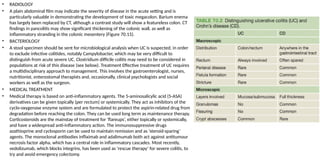
considerably less common than in UC. Differences between ulcerative colitis (UC) and Crohn’s disease (CD)
• ● UC affects the colon; CD can affect any part of the gastrointestinal tract, but particularly the small and large
bowel
• ● UC is a mucosal disease, whereas CD affects the full thickness of the bowel wall
• ● UC produces confluent disease in the colon and rectum, whereas CD is characterised by skip lesions
• ● CD more commonly causes stricturing and fistulation
• ● Granulomas may be found on histology in CD, but not in UC
• ● CD is often associated with perianal disease, whereas this is unusual in UC
• ● CD affecting the terminal ileum may produce symptoms mimicking appendicitis, but this does not occur in UC
• ● Resection of the colon and rectum cures the patient with UC, whereas recurrence is common after resection
in CD
• CD more commonly presents with features of chronicity.
• Small bowel CD is often characterised by abdominal colicky pain, which may be postprandial(after a meal), and mild diarrhoea extending over many
months occurring in bouts. A tender mass may be palpable in the right iliac fossa. Intermittent fevers, secondary anaemia and weight loss are common.
After months of repeated attacks characterised by acute inflammation, the affected area of intestine begins to narrow with fibrosis, causing more
chronic obstructive symptoms. Children developing the illness before puberty may have retarded growth and sexual development. With progression of
the disease, adhesions and transmural fissuring, intra-abdominal abscesses and fistulae may develop.
• Fistulation may occur into adjacent loops of bowel (enteroenteric or interloop fistulae). Occasionally, the (healthy) sigmoid loop may become adherent
to the affected terminal ileum, resulting in ileosigmoid fistulation. The fistula tracks in such cases are usually small and the profuse diarrhoea that
results from ileosigmoid fistulation is due primarily to bacterial overgrowth (attributable to colonisation of the small bowel with colonic flora) rather
than passage of small bowel content into the colon. Fistulation may also occur into the bladder (ileovesical) or the female genital tract and,
lesscommonly, the duodenum. Fistulation into the abdominal wall (enterocutaneous fistulation) may also develop spontaneously, but it far more
commonly occurs as a complication of abdominal surgery (see below).
• Colonic CD presents with symptoms of colitis and proctitis(proctitis is inflammation of the lining of the rectum, the lower end of the large intestine
leading to the anus) as described for UC (Chapter 70), although toxic megacolon is much less common. Many patients with CD present with perianal
problems. In the presence of active disease, the perianal skin appears bluish. Superficial ulcers with undermined edges are relatively painless and can
heal with bridging of epithelium. Deep cavitating ulcers are usually found in the upper anal canal; they can be painful and cause perianal abscesses and
fistulae, discharging around the anus and sometimes forwards into the genitalia.
• Fistulation through the posterior wall of the vagina may lead to rectovaginal fistula and continuous leakage of gas and/or faeces per vaginam. The
rectal mucosa is often spared in CD and may feel normal on rectal examination. If it is involved, however, it will feel thickened, nodular and irregular.
Perianal disease is frequently associated with dense, fibrous stricturing at the anorectal junction. Incontinence may develop as a result of destruction
of the anal sphincter musculature because of inflammation, abscess formation, fibrotic change and repeated episodes of surgical drainage. In severe
cases, the perineum may become densely fibrotic, rigid and covered with multiple discharging openings (watering-can perineum).
• Each patient with CD should have their disease phenotype (manifestations) classified according to the Montreal classification. This is important as it
allows an overview of disease progression in the individual patient over time, and it enables group comparisons and evaluations. The Montreal
classification specifies age of onset, location and behaviour. As discussed above, the behaviour of CD can be dominated by inflammation without
stricturing or penetration, stricturing or penetration (causing phlegmons, abscesses and fistulae).
• EXTRAINTESTINAL MANIFESTATIONS
• The extraintestinal manifestations of CD are similar to those that occur in UC and are outlined in Summary box 69.3. Primary sclerosing cholangitis is relatively rare in CD, compared with
UC. Gallstones are common, as an inflamed or excised terminal ileum leads to reduced absorption of bile salts. Amyloidosis is common at postmortem examination, but is rarely
symptomatic. ‘Metastatic’ CD can occur in the vagina and/or skin with nodular ulcers, which demonstrate non-caseating granulomas when biopsied. Such ‘cutaneous’ CD can be
virtually indistinguishable macroscopically from hidradenitis suppurativa
• Investigations
• LABORATORY A full blood count should be performed, as anaemia is common and usually multifactorial. It may result from the anaemia of chronic disease, or from iron deficiency as a
result of blood loss or malabsorption. Vitamin B12 deficiency may occur as a consequence of terminal ileal disease or resection. Folate deficiency may also result from diffuse small bowel
disease orresection. Active inflammatory disease is usually associated with a fall in serum albumin, magnesium, zinc and selenium. Acute phase protein measurements (C-reactive
protein and orosomucoid) and the erythrocyte sedimentation rate may correlate with disease activity. Finding an elevated concentration in the stools of calprotectin, a specific marker of
inflammation, may support a diagnosis of CD in patients with new onset of persistent gastrointestinal symptoms. It can also be used to monitor disease activity in the long-term
management of established CD.
• ENDOSCOPY Colonoscopic examination may be normal or show patchy inflammation. Characteristically, there are areas of normal mucosa in between areas of inflammation that are
irregular and ulcerated, with a mucopurulent exudate. The earliest findings are of aphthous ulcers surrounded by a rim of erythematous mucosa. These become larger and deeper with
increasing severity of disease. There may be stricturing, and it is important to exclude malignancy at these sites by multiple and often repeated mucosal biopsies. An irregular Crohn’s
stricture with polypoid mucosa may be almost macroscopically indistinguishable from malignancy. The terminal ileum may be ulcerated and strictured. In patients who have had previous
ileocaecal resection and anastomosis, recurrent disease usually presents first with aphthous ulceration just proximal to the anastomosis. Interval colonoscopy is therefore important in
the follow-up after surgery for CD. Upper gastrointestinal symptoms may require upper gastrointestinal endoscopy, which may reveal deep longitudinal ulcers and cobblestoning of
mucosa in the duodenum, stomach or, rarely, in the oesophagus. Enteroscopy may reveal jejunal ulceration and stricturing. Capsule endoscopy should not be undertaken where there is
a suspicion of stricture, because of the possibility of the capsule becoming stuck in the narrow segment. A biodegradable test capsule can be used if this is a source of concern. Capsule
endoscopy has a useful role in those patients with evidence of chronic gastrointestinal symptoms or blood loss where no evidence of ulceration can be found with more conventional
endoscopic assessment.
• IMAGING
• High-resolution ultrasound in expert hands can demonstrate inflamed and thickened bowel loops, as well as fluid collections and abscesses. The small intestine is traditionally imaged by a
small bowel enema (Figure 69.3). This is performed by instilling contrast into the small bowel via a nasoduodenal tube, and will show up areas of stricturing and prestenotic dilatation. The
involved areas tend to be narrowed, irregular and, sometimes, when a length of terminal ileum is involved, there may be the ‘string sign’ of Kantor (Figure 69.3). Computed tomography
(CT) scans with oral contrast are widely used in the investigation of abdominal symptoms and can demonstrate fistulae, intra-abdominal abscesses and bowel thickening or dilatation.
Magnetic resonance imaging (MRI) is useful in assessing complex perianal disease and, more recently, has been shown to be an excellent method for investigating the small bowel. MR
enterography (oral contrast) or enteroclysis (contrast administered via nasoduodenal tube) is particularly effective at demonstrating small bowel stricturing and avoids the need for
repeated exposure to large
• doses of ionising radiation in young patients (Figure 69.4). A labelled white cell scan is occasionally of value to determine whether or not a segment of bowel is actively inflamed and guide decisions on
medical treatment. In patients with enterocutaneous fistulae, fistulography will be required to demonstrate the anatomy and complexity of the fistulae and allow adequate planning for future surgery.
• Treatment
• MEDICAL TREATMENT
• Steroids
• Steroids are the traditional method for inducing remission in CD, and remain important when rapid remission is required. They induce remission in 70–80% of cases with moderate to severe disease. They
should be used in short courses only and tapered when a response has been achieved. They reduce inflammation and are therefore ineffective in fibrostenotic disease, where the symptoms relate mainly
to obstruction. Steroids can also be used as topical agents in the rectum where the benefits include reduced systemic bioavailability, but long-term use can still cause adrenal suppression. More recently,
oral steroid formulations such as budesonide have been devised, to ensure that the steroid moiety is removed in the portal circulation, reducing systemic side effects. Steroids should not be used for
maintenance therapy for CD and are usually replaced with immunomodulatory agents (see below) in order to minimise the risk of side effects associated with long-term steroid use.
• Aminosalicylates
• Colonic symptoms can be treated by 5-ASA agents in a similar manner to that in UC. These agents have limited efficacy in small bowel CD.
• Antibiotics
• Metronidazole and ciprofloxacin may be used, particularly for periods of a few weeks at a time, especially in perianal disease. Long-term use of metronidazole is to be especially avoided, as there is a risk
of peripheral neuropathy. Ciprofloxacin also has significant side effects when used in the long term, such as Achilles tendinitis and tendon rupture. Antibiotics may also be used to decrease systemic
symptoms resulting from an inflammatory mass or an abscess. In general, however, a confirmed abscess should be treated by percutaneous drainage and/or surgery as antibiotics alone will not treat a
Crohn’s mass effectively.
• Immunomodulatory agents
• Azathioprine is used for its additive and steroid-sparing effects and currently represents standard maintenance therapy. It is a purine analogue, which is metabolised to 6-mercaptopurine (6-MP) and works
by inhibiting cell-mediated immune responses. 6-MP may be given directly for the same effects. Approximately 10% of people have deficient thiopurine methyltransferase (TPMT) and 1 in 300 people have
no enzyme activity, causing inefficient metabolism of 6-MP. The resulting supra-pharmacological concentrations may cause severe adverse effects such as myelosuppression. Testing TPMT activity is usually
undertaken before commencing treatment. Cyclosporin also acts by inhibiting cell-mediated immunity. Short-course intravenous cyclosporin treatment is associated with 80% remission; however, there is
relapse after completion of treatment in many cases.
• Monoclonal antibody therapy
• Several commercially available agents have been developed based on monoclonal antibodies targeting tumour necrosis factor alpha and other key pro-inflammatory mediators. Infliximab, a murine
chimeric monoclonal antibody, was the first available monoclonal antibody for the treatment of CD. This needs to be administered as an intravenous infusion and is typically given every 8 weeks for
maintenance of remission. Adalimumab, an entirely human monoclonal antibody, is an alternative to infliximab. This is administered subcutaneously every 1–2 weeks, depending on response, and most
patients can self-administer this agent. Third-generation monoclonal antibody therapies include integrin antibodies vedulizumab and etrolizumab. Both prevent leucocyte migration preferentially in the
gastrointestinal tract and may therefore have fewer side effects than the earlier monoclonal antibodies, although they are both currently in limited use. The roles of monoclonal antibodies have expanded
from initially being used exclusively in the most severe cases of CD when other therapies failed, to having a more central role in the management of moderate to severe CD. They are currently widely used
for induction and maintenance of remission. Furthermore, there is evidence that early and aggressive use of these agents in patients at high risk for early recrudescent disease after surgery (for example,
penetrating phenotype, early mucosal inflammation or aphthous ulceration at follow-up colonoscopy) may reduce the need for subsequent surgery. These agents also appear to be effective treatments for
perianal disease. Recent studies have suggested, however, that while they may reduce the inflammation associated with
• the process of fistulation and can achieve healing of fistula openings, the fistula tracks may remain patent and cessation of therapy is usually associated with a
high risk of reactivation of the fistulae. Overall, monoclonal antibodies are expensive forms of treatment that are associated with a small but definable risk of
overwhelming bacterial infection and specific malignancies over the long term. Active infection, tuberculosis and a past history of malignancy are specific
contraindications.
• Nutritional support
• It is essential that nutritional status is evaluated in all patients with CD. Nutritional support is frequently required. Patients with moderate nutritional
impairment will require nutritional supplementation and severely malnourished patients may require enteral tube or even intravenous feeding. Anaemia,
hypoproteinaemia and electrolyte, vitamin and metabolic bone problems must all be addressed. Elemental diet or parenteral nutrition can induce remission in
up to 80% of patients, an effect comparable to steroids. However, almost all patients relapse rapidly after cessation of therapy.
• ENDOSCOPIC DILATATION IN CROHN’S DISEASE Although penetrating disease will often require surgical resection (see below under Surgery), stricturing may be
amenable to endoscopic treatment, provided the strictures can be reached with an endoscope and negotiated with a guidewire. This may be accomplished by
enteroscopy or colonoscopy, depending on the site of the stricture. Dilatation of an inflamed or ulcerated stricture is contraindicated because of the risks of
perforation, but balloon dilatation of fibrostenotic disease may result in substantial symptomatic improvement and obviate the need for surgery in selected
cases.
• INDICATIONS FOR SURGERY
• Surgical resection will not cure CD. Surgery therefore focuses on managing the complications of the disease. As many of these indications for surgery may be
relative, joint management by an aggressive physician and a conservative surgeon is ideal (see Summary box 69.4). CD is a complicated condition and decisions
regarding management are best made jointly by members of a multidisciplinary team.
• Complications or manifestations of CD for which surgery is usually appropriate include the following:
• recurrent intestinal obstruction;
• ● persistent or, less commonly, massive acute bleeding;
• ● free perforation of the bowel;
• ● failure of medical therapy;
• ● steroid dependent disease;
• ● intestinal fistula;
● perianal disease (abscess, fistula, stenosis);
● malignant change (notably in the colon and less commonly as a complication of small bowel disease).
• TOP-DOWN APPROACH TO MANAGEMENT OF CROHN’S DISEASE Traditionally, active Crohn’s disease is treated in a ‘step-up’ approach where newer, more aggressive therapies are
added only when more established and less toxic therapies have failed. Thus, active ileocolic CD may be treated initially with a thiopurine, adding steroids and then a monoclonal
antibody only if and when required. Some centres instead advocate a top-down approach, where rapid remission is obtained by initiating therapy with a monoclonal antibody agent
(unless contraindicated), often in combination with a thiopurine. Studies suggest advantages mainly in the form of rapid remission, steroid sparing and increased rates of mucosal
healing. Whether surgical resection should be part of a top-down approach is currently being debated. While surgery carries perioperative risks, these have been reduced during the
past decades with the development of perioperative enhancedrecovery protocols and laparoscopic surgery. It has been suggested that the balance of risk and benefit between
surgical resection and non-operative treatment, typically involving long-term medical therapy, is finely balanced and requires more detailed evaluation.
• SURGERY FOR CROHN’S DISEASE
• Population-based studies show that roughly 70% of patients with CD will require a bowel resection in the first decade after diagnosis, and 40% will require a further resection in the
decade following their index resection. Recent population-based data in the era of monoclonal antibodies suggest that the incidence of surgery may be falling, but nevertheless still
remains substantial. Since surgery does not cure CD, the fundamental principle is to preserve healthy gut and to maintain adequate function. The whole of the gastrointestinal tract
should be examined carefully at surgery and intestinal resection kept to the minimum required to treat the local consequences of disease. In laparoscopic surgery, it may be difficult
to fully assess the full length of the small intestine. Up-to-date and accurate preoperative small bowel imaging is therefore paramount, particularly in laparoscopic surgery for CD.
Occasionally, unsuspected ileitis is diagnosed during the course of an operation for suspected appendicitis. Determining whether to resect the ileum in this situation is a complex
clinical decision that should be made by a senior surgeon. This decision involves an assessment of the likelihood that the ileitis is an expression of CD rather than of another
aetiology such as Yersinia infection; an assessment of the likelihood of remission with medical therapy rather than surgery; and an assessment of the rest of the small bowel for
presence of additional sites of inflammation. Thus, it would be advisable to surgically resect a mass caused by penetrating CD of the terminal ileum, as such complex disease is
unlikely to resolve with medical therapy. On the other hand, it would be controversial in the current era of monoclonal therapy to resect uncomplicated terminal ileitis found during
an emergency procedure for suspected appendicitis, as uncomplicated Crohn’s ileitis is likely to respond to medical therapy. Many cases fall in between these two extremes,
requiring a considered decision. A further consideration is whether to perform an appendicectomy when terminal ileitis is found. There is a risk of fistulation in the setting of CD, so
unless the appendix itself is grossly inflamed with a healthy base, isolated appendicectomy should be avoided in this setting. The course of CD after surgery is unpredictable, but
recrudescence (a better term than ‘recurrence’, as surgery never cures CD) is common. Symptomatic recrudescence does not seem to be related to the presence of disease at the
resection line. The cumulative probability of recrudescence requiring surgery for ileal disease is approximately 20, 40, 60 and 80% at 5, 10, 15 and 20 years, respectively, after a
previous resection.
• Surgery for CD is technically demanding as the involved mesentery is thickened and oedematous and healing may be impaired. The patient may be malnourished,
immunosuppressed or suffer from sepsis (and potentially all three). Decision-making regarding the timing and nature of surgery to be undertaken is the key to satisfactory outcome
of surgical treatment, and frequently requires experience and considerable discussion with other health professional and, most importantly, the patient. A key decision has to be
made whether to anastomose the apparently healthy bowel ends after macroscopically apparent disease has been resected, as anastomotic leaks and fistulation represent a
considerable problem after surgery for CD. Intra-abdominal septic complications are more common if one or more of the following risk factors are present: ● current high-dose
steroid therapy (≥10mg prednisolone for ≥4 weeks before surgery); ● current preoperative monoclonal antibody therapy; ● preoperative significant weight loss (>10% premorbid
weight); ● pre-existing abdominal sepsis (notably abscess or fistula); ● serum albumin
CONNECTIVE TISSUE DISORDERS
• Intestinal diverticulae
• Diverticulae (hollow out-pouchings) are a common structural abnormality that can occur from the oesophagus to the rectosigmoid junction (but not usually in
the rectum).
• Small bowel diverticulae may be congenital or acquired.
• In congenital diverticulae, all three coats of the bowel are present in the wall of the diverticulum (e.g. Meckel’s diverticulum).
• Acquired diverticulae These invariably develop in the jejunum and arise from the mesenteric side of the bowel as a result of mucosal herniation at the point
of entry of the blood vessels. There is thus no muscularis layer present in the wall. Jejunal diverticulae can vary in size and are frequently multiple. They are
commonly asymptomatic and present as an incidental finding at surgery or on radiological imaging (Figure 69.10). However, they can result in malabsorption,
as a result of bacterial stasis, or present as an acute abdominal emergency if they become inflamed or perforate. Bleeding from a jejunal diverticulum is a rare
complication (compared with sigmoid diverticular disease). Elective resection of an affected small bowel segment that is causing malabsorption can be effective,
provided there is only a limited amount of jejunum affected by the condition.
• If perforated jejunal diverticulitis is found at emergency laparotomy, a small bowel resection should be performed and a decision made between
anastomosis and stoma formation. This will depend on the degree of contamination, physiological stability and local resources for managing a patient with a
high output jejunostomy. Complications resulting from extensive jejunal diverticulosis can be extremely difficult to treat. In severe cases, much of the proximal
small intestine may be involved, effectively precluding resection. Prolonged antibiotic therapy for bacterial overgrowth may be preferable, and antibiotics
(metronidazole, ciprofloxacin, rifaximin) are frequently rotated in an attempt to avoid the development of antibiotic resistance. Limited resection, leaving
remaining segments of affected jejunum, may be feasible, but may also fail to deal adequately with bacterial overgrowth, recurrent attacks of inflammation or
bleeding.
• Meckel’s diverticulum A Meckel’s diverticulum is a persistent remnant of the vitellointestinal(yolk sac)duct and is present in about 2% of the population. It
is found on the antimesenteric side of the ileum, commonly approximately 60cm from the ileocaecal valve and is classically 5cm long (Figure 69.11). A Meckel’s
diverticulum is a congenital diverticulum. It contains all three coats of the bowel wall and has its own blood supply. It may be vulnerable to obstruction and
inflammation in the same way as the appendix; indeed, when a normal appendix is found at surgery for suspected appendicitis, a Meckel’s diverticulum should
be looked for by examining the small bowel, particularly if free fluid or pus is found. In approximately 20% of cases, the mucosa of a Meckel’s diverticulum
contains heterotopic epithelium of gastric, colonic or pancreatic type. The presence of heterotopic mucosa may predispose to the development of
complications. The vast majority of Meckel’s diverticulae are asymptomatic and Meckel’s diverticulum is notoriously difficult to see with contrast radiology.
• Meckel’s diverticulum may, however, present clinically in the following ways:
• ● Haemorrhage. If gastric mucosa is present, peptic ulceration can occur and present as painless dark rectal bleeding or melaena. If the stomach, duodenum and
colon are excluded as a source of bleeding by endoscopy, radioisotope scanning with technetium-99m may demonstrate a Meckel’s diverticulum.
• ● Diverticulitis. Meckel’s diverticulitis presents like appendicitis, although if perforation occurs the presentation may resemble a perforated duodenal ulcer.
• ● Intussusception. A Meckel’s diverticulum can be the lead point for ileoileal or ileocolic intussusception. a serious condition in which part of the intestine
slides into an adjacent part of the intestine.
• ● Chronic ulceration. Pain is felt around the umbilicus, as the site of the diverticulum is midgut in origin.
• ● Intestinal obstruction. A band between the apex of the diverticulum and the umbilicus (also part of the vitellointestinal duct) may cause obstruction directly,
or by predisposing to the development of a volvulus around it.
• ● Perforation. (Figure 69.12). When found in the course of abdominal surgery, a Meckel’s diverticulum can safely be left alone, provided it has a wide mouth and
is not thickened. When there is doubt, it can be resected.
• The finding of a Meckel’s diverticulum in an inguinal or femoral hernia has been described as ‘Littre’s hernia’.
• Meckel’s diverticulectomy
• A broad-based Meckel’s diverticulum should not be amputated at its base and invaginated (as for an appendix), as there is the risk of stricture and of leaving
heterotopic epithelium behind. It is safer simply to excise the diverticulum, either by resecting it and suturing the defect at its base, or with a linear stapler-
cutter.
• If the base of the diverticulum is indurated, it is on balance more logical to perform a limited small bowel resection of the involved segment followed by an
anastomosis.
• Features of Meckel’s diverticulum
• ● Remnant of vitellointestinal duct
• ● Occurs in 2% of patients, 2 inches (5 cm) long, 2 feet (60 cm) from the ileocaecal valve, 20% heterotopic epithelium
• ● Should be looked for when a normal appendix is found at surgery for suspected appendicitis
• ● If a Meckel’s is found incidentally at surgery, it can be left provided it has a wide mouth and is not thickened
• ● Can be source of gastrointestinal bleeding if it contains ectopic gastric mucosa
• ENTEROCUTANEOUS FISTULA
• An abnormal connection between the small intestine and the skin can occur as a result of fistulating CD, radiotherapy or abdominal trauma, but the
condition most commonly follows a surgical complication – either a leak from an anastomosis or an inadvertent enterotomy during dissection.
• At least 50% of small bowel enterocutaneous fistulae develop after surgery in which no small bowel has been resected, as a result of injury to the
intestine following division of adhesions. The frequency of this complication has been shown to increase with the number of previous laparotomies.
• Management of patients with enterocutaneous fistulae can be very challenging, especially when the fistula output is high (usually defined as >500mL of
effluent/day). The majority of fistulae can be expected to heal spontaneously, provided there is no distal obstruction or disease at the fistula site.
• Reasons for failure of spontaneous healing also include epithelial continuity between the gut and the skin and an associated complex abscess.
• The management of fistulas is based on well-established principles (‘SNAP’, see Summary box 69.10). An early return to theatre to try and treat the problem
definitively in a septic, malnourished patient is doomed to failure
• Infected collections are best identified at CT (Figure 69.16) and can be drained percutaneously.
• Skin protection is important, as small bowel effluent is caustic.
• Nutritional support must include fluid and electrolytes, which can be lost in high quantities from a proximal fistula, as well as carbohydrates, protein, fat
and vitamins.
• Judgements have to be made between enteral and parenteral feeding – enteral feeding has advantages but if the fistula is proximal or high output, total
parenteral nutrition will be required.
• Defining anatomy is best done after careful discussion with the radiologist – a sequence of contrast studies (follow-through, fistulogram and enema) may
well be required to define bowel length and plan a surgical strategy.
• Surgery can be extremely technically demanding, and an anastomosis should not be fashioned in the presence of continuing intra-abdominal sepsis or when
the patient is hypoalbuminaemic
• (Principles of management of enterocutaneous fistulae (SNAP)
• ● S, elimination of Sepsis and skin protection
• ● N, Nutrition – a period of parenteral nutrition may well be required
● A, Anatomical assessment
● P, definitive Planned surgery
Large intestine
• Parts
• Cecum, appendix, ascending colon, transverse colon, descending colon, sigmoid colon, rectum, anal canal
• Functions
• Absorption of electrolytes and water, propulsion of intestinal contents, formation and temporary storage of feces, and
defecation
• Blood supply
• Midgut: superior mesenteric artery
Hindgut: inferior mesenteric artery
• Adjacent branches anastomose so there is usually a complete vascular supply along the colon, named the marginal
artery of Drummond.
• Innervation
• Enteric nervous system: submucosal (Meissner) and myenteric (Auerbach) plexuses
Sympathetic & parasympathetic: aortic, celiac, superior mesenteric, inferior mesenteric, hypogastric nervous plexuses
• The large intestine has several distinct anatomical characteristics; the omental appendices, teniae coli and haustra.
• Omental or epiploic appendages are fat filled pouches of peritoneum that are attached externally to the walls of the
large intestine.
• Teniae coli are three longitudinal bands of smooth muscle located underneath the peritoneum that extend along
certain sections of the large intestine. Their contractions facilitate the peristaltic action of the large intestine,
propelling the fecal matter and forming the haustra.
• Haustra are sacculations that occur along the large intestine, providing it with its characteristic ‘baggy’ aspect.
• They are created by semilunar folds on the internal surface of the large intestine.
• Mnemonic
• There is a very simple way to remember these features specific to the large intestine. The mnemonic
' Eva Has Ten Socks' stands for:
• Epiploic appendages
• Haustra (Sacculation)
• Tenia coli
• Semilunar folds
• PHYSIOLOGY OF THE LARGE INTESTINE
• The principle function of the colon is absorption of water; 1000mL of ileal content enters the caecum every 24
hours, of which only approximately 200mL is excreted as faeces.
• Sodium absorption is efficiently accomplished by an active transport system, while chloride and water are
absorbed passively.
• Fermentation of dietary fibre in the colon by the normal colonic microflora leads to the generation of short chain
fatty acids, which are an important metabolic fuel for the colonic mucosa.
• Diversion of the faecal stream may lead to inflammatory changes in the colon downstream (diversion colitis).
• Absorption of nutrients including glucose, fatty acids, amino acids and vitamins can also take place in the colon.
• Colonic motility is variable.
• In general, faecal residue reaches the caecum 4 hours after a meal and the rectum after 24 hours. Passage of
stool is not orderly because of mixing within the colon, so it is not uncommon for residue from a single meal to
still be passed 4 days later
TUMOURS OF THE LARGE INTESTINE
• Benign
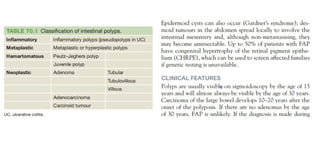
• The term ‘polyp’ is a clinical description of any protrusion of the mucosa. It encompasses a variety of histologically different tumours (Table
70.1). Polyps can occur singly, synchronously in small numbers or as part of a polyposis syndrome.
• Adenomatous polyps
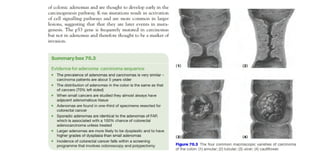
• Adenomatous polyps vary from a tubular adenoma (Figure 70.1), rather like a berry on a stalk, to the villous adenoma, a flat spreading
lesion. Villous tumours can cause diarrhoea, mucus discharge and, occasionally hypokalaemia and hypoalbuminaemia. The risk of
malignancy developing in an adenoma increases with size; there is a 10% risk of cancer in a 1-cm diameter tubular adenoma, whereas
almost one-third of large (>3cm) colonic adenomas will have an area of invasive malignancy within them. Adenomas larger than 5mm in
diameter are usually excised because of their malignant potential. Snare polypectomy is usually possible for colonic polyps but larger sessile
polyps may require endoscopic mucosal resection after infiltration of a solution containing dilute adrenaline. Larger rectal adenomas may
require transanal resection or, where the adenoma is too high, transanal endoscopic microsurgery or resection via transanal placement of
laparoscopic instruments. Extensive villous lesions of the rectum may require argon beam ablation when the patient is frail but symptomatic.
• Familial adenomatous polyposis
• Familial adenomatous polyposis (FAP) is defined clinically by the presence of more than 100 colorectal adenomas, but is also characterised
by duodenal adenomas and multiple extraintestinal manifestations (Summary box 70.1). Over 80% of cases come from patients with a
positive family history. The remainder arise as a result of new mutations in the adenomatous polyposis coli (APC) gene on the short arm of
chromosome 5. FAP is inherited as an autosomal dominant condition and is consequently equally likely in men and women. The lifetime risk
of colorectal cancer is 100% in patients with FAP. FAP can also be associated with benign mesodermal tumours such as desmoid tumours and
osteomas.
• adolescence, surgery is usually deferred to the age of 17 or 18 years unless symptoms develop. Malignant change is rare before the age of 20 years. Examination of blood relatives,
including cousins, nephews and nieces, is essential; a family tree should be constructed and a register of affected families maintained. Referral to a medical geneticist is essential. If
over 100 adenomas are present at colonoscopy, the diagnosis can be made confidently (Figure 70.2).
• TREATMENT
• The aim of surgery in FAP is to prevent the development of colorectal cancer. The surgical options are: 1 colectomy with ileorectal anastomosis (IRA); 2 restorative proctocolectomy
with an ileal pouch–anal anastomosis (RPC); 3 total proctectomy and end ileostomy. The patient is almost always young and likely to prefer to avoid a permanent stoma and so the
choice is normally between the first two options. The advantage of an IRA is that it avoids the temporary stoma frequently required for an RPC and avoids the potential compromise to
sexual function accompanying proctectomy. It is also has a lower morbidity and mortality. However, the rectum requires regular surveillance. Even with optimal surveillance of the
rectal remnant, up to 10% of patients will develop invasive malignancy within a 30-year follow up period. Restorative proctocolectomy has the advantage of removing the whole colon
and rectum. However, there is a pouch failure rate of approximately 10%. In addition, and particularly where a stapled anastomosis has been created, there remains a small but definite
incidence of cancer developing in the small strip of rectal mucosa between the pouch and the dentate line. Some advocate complete mucosectomy of the residual cuff and a transanal
anastomosis, although this may result in worse function. In experienced hands a laparoscopic approach to these operations can be successful, with swifter recovery and improved
cosmesis.
• POSTOPERATIVE SURVEILLANCE
• Because of the risk of further tumour formation, follow-up is important and takes the form of rectal/pouch surveillance, with biopsy of the cuff recommended yearly. Gastroscopies are
also carried out to detect upper gastrointestinal tumours (notably duodenal adenomas). Despite this, lifespan is reduced because of the development of duodenal and ampullary
cancers and complications of desmoid tumours. Hereditary non-polyposis colorectal cancer (Lynch syndrome) Hereditary non-polyposis colorectal cancer (HNPCC) is characterised by
an increased risk of colorectal cancer and also cancers of the endometrium, ovary, stomach and small intestine. It is an autosomal dominant condition caused by a mutation in one of
the DNA mismatch repair genes. The most commonly affected genes are MLH1 and MSH2. The lifetime risk of developing colorectal cancer is 80%, and the mean age of diagnosis is 45
years. Most cancers develop in the proximal colon. Females have a 30–50% lifetime risk of developing endometrial cancer.
• DIAGNOSIS
• HNPCC can be diagnosed by genetic testing or by the Amsterdam II criteria:
• ● three or more family members with an HNPCC-related cancer (colorectal, endometrial, small bowel, ureter, renal pelvis), one of whom is a first-degree relative of the other two;
• ● two successive affected generations;
• ● at least one colorectal cancer diagnosed before the age of 50 years;
• ● FAP excluded;
• ● tumours verified by pathological examination. Patients with HNPCC are offered regular endoscopic surveillance.
• The small intestine may also be radiologically assessed but this is of unproven benefit.
Malignant – colorectal cancer
• Epidemiology
• In the UK, colorectal cancer is the second most common cause of cancer death. Approximately 35 000 patients are diagnosed with colorectal cancer every year in the
UK. Approximately one-third of these tumours are in the rectum and two-thirds in the colon. The burden of disease is similar in men and women. Colorectal cancer
occurs less frequently in the resource-poor world than in resource-rich countries. Carcinoma of the colon typically occurs in patients over 50 years of age and is most
common in the 8th decade of life.
• Aetiology
• The accepted model of colorectal cancer development is that it arises from adenomatous polyps after a sequence of genetic mutations influenced by environmental
factors.
• a complicated array of multiple genetic alterations, ultimately resulting in an invasive tumour. Mutations of the adenomatous polyposis coli (APC) gene occur in two-
thirds of colonic adenomas and are thought to develop early in the carcinogenesis pathway.
• K-ras mutations result in activation of cell signalling pathways and are more common in larger lesions, suggesting that that they are later events in mutagenesis.
• The p53 gene is frequently mutated in carcinomas but not in adenomas and therefore thought to be a marker of invasion.
• There has been much interest in the association between diet and colon cancer. Worldwide, the prevalence of colorectal cancer is closely associated with intake of red
meat and particularly processed meat products (haem and N-nitroso compounds). These adversely affect DNA in the colorectal mucosa. A protective effect of dietary
fibre is also suggested by epidemiological studies. The hypothesis is that increased roughage is associated with reduced colonic transit times, and this in turn reduces
the exposure of the mucosa to dietary carcinogens. Increased risk for colorectal cancer has also been associated with dietary animal fat, smoking and alcohol.
Cholecystectomy may marginally increase the risk of rightsided colon cancer and inflammatory bowel disease is a wellrecognized risk factor (see below).
• Pathology
• The annular variety tends to give rise to obstructive symptoms, whereas the others present more commonly with bleeding.
• Most large bowel cancers arise from the left colon, notably the rectum (38%), sigmoid (21%), and descending colon (4%).
• Cancer of the caecum (12%) and ascending colon (5%) are less common, but may be gradually increasing in incidence.
• Cancer of the transverse colon (5.5%), flexures (2–3%) and appendix (0.5%) are relatively uncommon.
• Microscopically, the neoplasm is a columnar cell adenocarcinoma. Origin from a benign polyp may be evident in early cases, before the benign
architecture is destroyed by malignant infiltration.
Spread
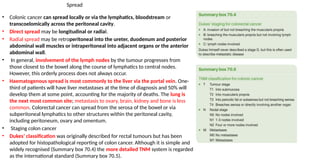
• Colonic cancer can spread locally or via the lymphatics, bloodstream or
transcoelomically across the peritoneal cavity.
• Direct spread may be longitudinal or radial.
• Radial spread may be retroperitoneal into the ureter, duodenum and posterior
abdominal wall muscles or intraperitoneal into adjacent organs or the anterior
abdominal wall.
• In general, involvement of the lymph nodes by the tumour progresses from
those closest to the bowel along the course of lymphatics to central nodes.
However, this orderly process does not always occur.
• Haematogenous spread is most commonly to the liver via the portal vein. One-
third of patients will have liver metastases at the time of diagnosis and 50% will
develop them at some point, accounting for the majority of deaths. The lung is
the next most common site; metastasis to ovary, brain, kidney and bone is less
common. Colorectal cancer can spread from the serosa of the bowel or via
subperitoneal lymphatics to other structures within the peritoneal cavity,
including peritoneum, ovary and omentum.
• Staging colon cancer
• Dukes’ classification was originally described for rectal tumours but has been
adopted for histopathological reporting of colon cancer. Although it is simple and
widely recognised (Summary box 70.4) the more detailed TNM system is regarded
as the international standard (Summary box 70.5).
• Clinical features
• ]A careful family history should be taken. Those with first-degree relatives who have developed colorectal cancer before the age of 45 years may be part of
one of the colorectal cancer familial syndromes.
• Tumours of the left side(distal ) of the colon usually present with a change in bowel habit or rectal bleeding,
• while proximal lesions typically present later, with iron deficiency anaemia or a mass (Figure 70.4). Patients commonly present with metastatic disease.
• Lesions of the flexures may present with vague upper abdominal symptoms for many months before symptoms suggestive of colonic disease appear.
• Investigation of colon cancer
• SCREENING
• In the UK, a screening programme has been introduced based on faecal occult blood testing of people aged 60–69 years, followed by colonoscopy in those
who test positive.
• A guaiac-based test is used, which detects peroxidase-like activity of faecal haematin. Studies have suggested a 15–20% reduction in colorectal cancer
specific mortality in the screened population. Flexible sigmoidoscopy can also be used as the initial screening tool, with a similar reduction in colorectal
cancer specific mortality.
• ENDOSCOPY
• The 60-cm, fibreoptic, flexible sigmoidoscope is increasingly being used in ‘one-stop’ rectal bleeding clinics.
• The patient is prepared with an enema and sedation is not usually necessary.
• It is usually possible to assess the bowel up to the splenic flexure, which will detect up to 70% of cancers and almost all that cause fresh rectal bleeding
(Figure 70.5).
• Colonoscopy is the investigation of choice if colorectal cancer is suspected, provided the patient is fit enough to undergo the mechanical bowel
preparation required. It has the advantage of not only picking up a primary cancer but also having the ability to detect synchronous polyps or other
carcinomas, which occur in 3–5% of cases.
• There is a small risk of perforation (1:1000).
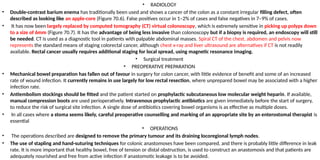
• RADIOLOGY
• Double-contrast barium enema has traditionally been used and shows a cancer of the colon as a constant irregular filling defect, often
described as looking like an apple-core (Figure 70.6). False positives occur in 1–2% of cases and false negatives in 7–9% of cases.
• It has now been largely replaced by computed tomography (CT) virtual colonoscopy, which is extremely sensitive in picking up polyps down
to a size of 6mm (Figure 70.7). It has the advantage of being less invasive than colonoscopy but if a biopsy is required, an endoscopy will still
be needed. CT is used as a diagnostic tool in patients with palpable abdominal masses. Spiral CT of the chest, abdomen and pelvis now
represents the standard means of staging colorectal cancer, although chest x-ray and liver ultrasound are alternatives if CT is not readily
available. Rectal cancer usually requires additional staging for local spread, using magnetic resonance imaging.
• Surgical treatment
• PREOPERATIVE PREPARATION
• Mechanical bowel preparation has fallen out of favour in surgery for colon cancer, with little evidence of benefit and some of an increased
rate of wound infection. It currently remains in use largely for low rectal resection, where unprepared bowel may be associated with a higher
infection rate.
• Antiembolism stockings should be fitted and the patient started on prophylactic subcutaneous low molecular weight heparin. If available,
manual compression boots are used perioperatively. Intravenous prophylactic antibiotics are given immediately before the start of surgery,
to reduce the risk of surgical site infection. A single dose of antibiotics covering bowel organisms is as effective as multiple doses.
• In all cases where a stoma seems likely, careful preoperative counselling and marking of an appropriate site by an enterostomal therapist is
essential
• OPERATIONS
• The operations described are designed to remove the primary tumour and its draining locoregional lymph nodes.
• The use of stapling and hand-suturing techniques for colonic anastomoses have been compared, and there is probably little difference in leak
rate. It is more important that healthy bowel, free of tension or distal obstruction, is used to construct an anastomosis and that patients are
adequately nourished and free from active infection if anastomotic leakage is to be avoided.
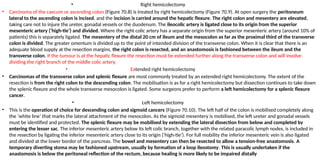
• Right hemicolectomy
• Carcinoma of the caecum or ascending colon (Figure 70.8) is treated by right hemicolectomy (Figure 70.9). At open surgery the peritoneum
lateral to the ascending colon is incised, and the incision is carried around the hepatic flexure. The right colon and mesentery are elevated,
taking care not to injure the ureter, gonadal vessels or the duodenum. The ileocolic artery is ligated close to its origin from the superior
mesenteric artery (‘high-tie’) and divided. Where the right colic artery has a separate origin from the superior mesenteric artery (around 10% of
patients) this is separately ligated. The mesentery of the distal 20 cm of ileum and the mesocolon as far as the proximal third of the transverse
colon is divided. The greater omentum is divided up to the point of intended division of the transverse colon. When it is clear that there is an
adequate blood supply at the resection margins, the right colon is resected, and an anastomosis is fashioned between the ileum and the
transverse colon. If the tumour is at the hepatic flexure the resection must be extended further along the transverse colon and will involve
dividing the right branch of the middle colic artery.
• Extended right hemicolectomy
• Carcinomas of the transverse colon and splenic flexure are most commonly treated by an extended right hemicolectomy. The extent of the
resection is from the right colon to the descending colon. The mobilisation is as for a right hemicolectomy but dissection continues to take down
the splenic flexure and the whole transverse mesocolon is ligated. Some surgeons prefer to perform a left hemicolectomy for a splenic flexure
cancer.
• Left hemicolectomy
• This is the operation of choice for descending colon and sigmoid cancers (Figure 70.10). The left half of the colon is mobilised completely along
the ‘white line’ that marks the lateral attachment of the mesocolon. As the sigmoid mesentery is mobilised, the left ureter and gonadal vessels
must be identified and protected. The splenic flexure may be mobilised by extending the lateral dissection from below and completed by
entering the lesser sac. The inferior mesenteric artery below its left colic branch, together with the related paracolic lymph nodes, is included in
the resection by ligating the inferior mesenteric artery close to its origin (‘high-tie’). For full mobility the inferior mesenteric vein is also ligated
and divided at the lower border of the pancreas. The bowel and mesentery can then be resected to allow a tension-free anastomosis. A
temporary diverting stoma may be fashioned upstream, usually by formation of a loop ileostomy. This is usually undertaken if the
anastomosis is below the peritoneal reflection of the rectum, because healing is more likely to be impaired distally
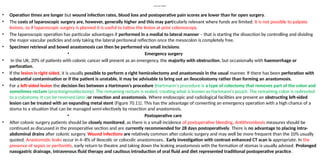
Laparoscopic surgery
• Operation times are longer but wound infection rates, blood loss and postoperative pain scores are lower than for open surgery.
• The costs of laparoscopic surgery are, however, generally higher and this may particularly relevant where funds are limited. It is not possible to palpate
lesions, so if laparoscopic surgery is planned it is useful to tattoo the lesion at prior colonoscopy.
• The laparoscopic operation has particular advantages if performed in a medial to lateral manner – that is starting the dissection by controlling and dividing
the major vascular pedicles and only taking the lateral peritoneal reflection once the mesocolon is completely free.
• Specimen retrieval and bowel anastomosis can then be performed via small incisions.
• Emergency surgery
• In the UK, 20% of patients with colonic cancer will present as an emergency, the majority with obstruction, but occasionally with haemorrhage or
perforation.
• If the lesion is right sided, it is usually possible to perform a right hemicolectomy and anastomosis in the usual manner. If there has been perforation with
substantial contamination or if the patient is unstable, it may be advisable to bring out an ileocolostomy rather than forming an anastomosis.
• For a left-sided lesion the decision lies between a Hartmann’s procedure (Hartmann's procedure is a type of colectomy that removes part of the colon and
sometimes rectum (proctosigmoidectomy). The remaining rectum is sealed, creating what is known as Hartmann's pouch. The remaining colon is redirected
to a colostomy. It can be reversed later.)or resection and anastomosis. Where endoscopic and radiological facilities are present an obstructing left-sided
lesion can be treated with an expanding metal stent (Figure 70.11). This has the advantage of converting an emergency operation with a high chance of a
stoma to a situation that can be managed semi-electively by resection and anastomosis.
• Postoperative care
• After colonic surgery patients should be closely monitored, as there is a small incidence of postoperative bleeding. Antithrombosis measures should be
continued as discussed in the preoperative section and are currently recommended for 28 days postoperatively. There is no advantage to placing intra-
abdominal drains after colonic surgery. Wound infections are relatively common after colonic surgery and may well be more frequent than the 10% usually
quoted. Anastomotic leaks occur in 4–8% of ileocolic or colocolic anastomoses.. Early investigation with contrast enhanced CT scan is appropriate. In the
presence of sepsis or peritonitis, early return to theatre and taking down the leaking anastomosis with the formation of stomas is usually advised. Prolonged
nasogastric drainage, intravenous fluid therapy and cautious introduction of oral fluid and diet represented traditional postoperative practice.
• Adjuvant therapy
• In most patients with colon cancer there is little clear benefit of preoperative chemotherapy, There is evidence that adjuvant chemotherapy
improves outcome after surgery in patients with node-positive disease (Dukes C).
• Metastatic disease
• Hepatic metastases can be resected and series have demonstrated 5-year survival of over 30% in resectable disease. Liver surgeons are increasingly
aggressive in treatment and the only absolute limitation on what can be resected relates to leaving behind sufficient functioning liver, although this
clearly has to be moderated by patient factors. It is important not to biopsy potentially resectable hepatic metastases as this may cause tumour
dissemination. Imaging will usually correctly identify colorectal metastases and assess patients suitable for liver resection (Figure 70.12)..
• Isolated lung metastases may occasionally be suitable for resection but they are more commonly accompanied by metastases elsewhere. In
patients with widespread disease, palliative chemotherapy is offered alongside symptomatic treatment and support by a palliative care team.
• Prognosis
• Overall 5-year survival for colorectal cancer is approximately 50%.
• The most important determinant of prognosis is tumour stage and, in particular, lymph node status. Patients with disease confined to the bowel
wall (Dukes stage A) will usually have cure by surgical resection alone and over 90% will have disease-free survival at 5 years. Spread beyond the
bowel wall (Dukes B) reduces 5-year survival to approximately 60–70%. Patients with lymph node metastases (Dukes C) have a 5-year survival of
30%, while fewer than 10% of patients presenting with metastatic disease at the outset will be alive 5 years later.
• Colorectal cancer follow-up
• Since the advent of safe liver resection for metastases the outcome benefit of follow-up has been clearly demonstrated. Follow-up aims to identify
synchronous bowel tumours (present in 3%) that were not picked up at the time of original diagnosis due to emergency presentation or incomplete
assessment. Similarly, 3% of patients will develop a metachronous (at a different time) colonic cancer and surveillance colonoscopy is designed to
diagnose these. Up to a half of all patients with colorectal cancer will develop liver metastases at some point and regular imaging of the liver (by
ultrasound and CT scan) and measurement of carcinoembryonic antigen (CEA) is designed to diagnose this early, in order to allow curative
metastectomy. Trials of the optimum follow-up pathway have suggested that CEA measurement alone can be as effective as regular imaging.
INFLAMMATORY BOWEL DISEASE
• The term ‘inflammatory bowel disease’ is reserved for conditions characterised by the presence of idiopathic intestinal inflammation (i.e. ulcerative colitis [UC] and Crohn’s disease [CD]. Although the availability of
population genetics andmolecular biology has contributed to our understanding of the pathogenesis of inflammatory bowel disease, the aetiology remains unclear. Ulcerative colitis UC is a disease of the rectum
and colon with extraintestinal manifestations. The incidence is 10 per 100000 per year in the UK with a prevalence of 160 per 100000 population. UC affects men and women equally in early life, although it is said
to be more common in males in later life. It is most commonly diagnosed between the ages of 20 and 40. UC is far more common in the USA and Western Europe but relatively rare in the Far East and tropics.
Asians who spent their childhood before the age of 14 in Asia have a much lower incidence of UC than Asians born and raised in the UK, suggesting an important effect of environmental exposure in childhood.
• Aetiology
• The cause of UC is unknown. There is clearly a genetic contribution, as 10–20% of patients have a first-degree relative with inflammatory bowel disease. Patients with severe colitis have a reduction in the number
of anaerobic bacteria and in the variability of bacterial strains in the colon, but no causative link with any specific organism has been identified. Unlike CD, smoking seems to have a protective effect in UC and has
even been the basis of therapeutic trials of nicotine. Relapses are occasionally said to be associated with periods of stress, but personality and psychiatric profiles in patients with UC are the same as those of the
normal population.
• Pathology
• In virtually all cases the disease starts in the rectum and extends proximally in continuity. Colonic inflammation is diffuse, confluent and superficial, primarily affecting the mucosa and superficial submucosa.
‘Pseudopolyposis’ occurs in almost one-quarter of cases. Stricturing in UC is very unusual (unlike CD) and should prompt urgent assessment because of the possibility of coexisting carcinoma. A small proportion of
patients develop irregular mucosal swellings (dysplasiaassociated lesions or mass [DALMs]), which are highly predictive of coexisting carcinoma. Histological examination reveals an increase in inflammatory cells
in the lamina propria and the crypts of Lieberkuhn and there are ‘crypt abscesses’. There is depletion of goblet cell mucin. With time, precancerous changes can develop (dysplasia). High-grade dysplasia is
regarded as an indication for surgery as 40% of colectomy specimens in which highgrade dysplasia was detected will have evidence of a colorectal cancer. In contrast, optimum management of low-grade dysplasia
is currently controversial. Ten to twenty per cent of patients with low-grade dysplasia will have a cancer at colectomy. The progression rate of low-grade dysplasia to invasive cancer is unclear and many cancers in
patients with low-grade dysplasia probably develop without high-grade dysplasia.
• Symptoms
• Clinical presentation depends in large part on the extent of disease. If confined to the rectum (proctitis), there is usually no systemic upset and extra-alimentary manifestations are rare. The main symptoms are
rectal bleeding, tenesmus and mucous discharge. The disease remains confined to the rectum in 90% of cases but proctitis may extend proximally. Colitis is almost always associated with bloody diarrhoea and
urgency. Severe and/or extensive colitis may result in anaemia, hypoproteinaemia and electrolyte disturbances. Pain is unusual. Children with poorly controlled colitis may have impaired growth. The more
extensive the disease the more likely extraintestinal manifestations are to occur. Extensive colitis is also associated with systemic illness, characterised by malaise, loss of appetite, and fever. Classification of colitis
severity The assessment of severity of UC is determined by frequency of bowel action and the presence of systemic signs of illness:
• ● Mild disease is characterized by fewer than four stools daily, with or without bleeding. There are no systemic signs of toxicity
• . ● Moderate disease corresponds to more than four stools daily, but with few signs of systemic illness. There may be mild anaemia. Abdominal pain may occur. Inflammatory markers, including erythrocyte
sedimentation rate and C-reactive protein, are often raised.
• ● Severe disease corresponds to more than six bloody stools a day and evidence of systemic illness, with fever, tachycardia, anaemia and raised inflammatory markers. Hypoalbuminaemia is common and an
ominous finding
• . ● Fulminant disease is associated with more than 10 bowel movements daily, fever, tachycardia, continuous bleeding, anaemia, hypoalbuminaemia, abdominal tenderness and distension, the need for blood
transfusion and, in the most severe cases, progressive colonic dilation (‘toxic megacolon’). This is a very significant finding, suggestive of disintegrative colitis, and an indication for emergency surgery if colonic
perforation is to be avoided.
• Extraintestinal manifestations
• Arthritis occurs in around 15% of patients and is typically a large joint polyarthropathy, affecting knees, ankles, elbows and wrists. Sacroiliitis and ankylosing spondylitis are
20 times more common in patients with UC than the general population and are associated with the HLA-B27 genotype. Sclerosing cholangitis is associated with UC and
can progress to cirrhosis and hepatocellular failure. Patients with UC and sclerosing cholangitis are also at a significantly greater risk of development of large bowel cancer.
Cholangiocarcinoma is an extremely rare association and its frequency is not influenced by colectomy. The skin lesions erythema nodosum and pyoderma gangrenosum are
associated with UC and both normally resolve with good colitis control. The eyes can also be affected by uveitis and episcleritis.
• Acute colitis
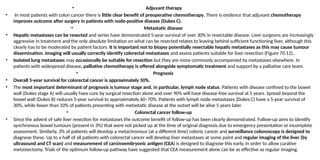
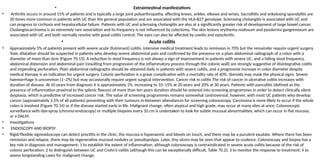
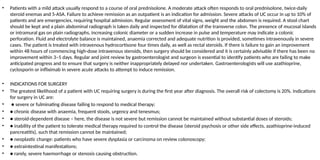
• Approximately 5% of patients present with severe acute (fulminant) colitis. Intensive medical treatment leads to remission in 70% but the remainder require urgent surgery.
Toxic dilatation should be suspected in patients who develop severe abdominal pain and confirmed by the presence on a plain abdominal radiograph of a colon with a
diameter of more than 6cm (Figure 70.13). A reduction in stool frequency is not always a sign of improvement in patients with severe UC, and a falling stool frequency,
abdominal distension and abdominal pain (resulting from progression of the inflammatory process through the colonic wall) are strongly suggestive of disintegrative colitis
and impending perforation. Plain abdominal radiographs should be obtained daily in patients with severe colitis, and a progressive increase in colon diameter despite
medical therapy is an indication for urgent surgery. Colonic perforation is a grave complication with a mortality rate of 40%. Steroids may mask the physical signs. Severe
haemorrhage is uncommon (1–2%) but may occasionally require urgent surgical intervention. Cancer risk in colitis The risk of cancer in ulcerative colitis increases with
duration of disease. At 10 years from diagnosis it is approximately 1%, increasing to 10–15% at 20 years and 20% at 30 years. Patients with pancolitis (defined as the
presence of inflammation proximal to the splenic flexure) of more than ten years duration should be entered into screening programmes in order to detect clinically silent
dysplasia, which is predictive of increased cancer risk. The value of screening programmes remains somewhat controversial, however, with most UC patients who develop
cancer (approximately 3.5% of all patients) presenting with their tumours in-between attendances for screening colonoscopy. Carcinoma is more likely to occur if the whole
colon is involved (Figure 70.14) or if the disease started early in life. Malignant change, often atypical and high grade, may occur at many sites at once. Colonoscopic
surveillance with dye-spray (chromo-endoscopy) or multiple biopsies every 10 cm is undertaken to look for subtle mucosal abnormalities, which can occur in flat mucosa,
or a DALM.
• Investigations
• ENDOSCOPY AND BIOPSY
• Rigid/flexible sigmoidoscopy can detect proctitis in the clinic; the mucosa is hyperaemic and bleeds on touch, and there may be a purulent exudate. Where there has been
remission and relapse, there may be regenerative mucosal nodules or pseudopolyps. Later, tiny ulcers may be seen that appear to coalesce. Colonoscopy and biopsy has a
key role in diagnosis and management: 1 to establish the extent of inflammation, although colonoscopy is contraindicated in severe acute colitis because of the risk of
colonic perforation; 2 to distinguish between UC and Crohn’s colitis (although this can be exceptionally difficult, Table 70.2); 3 to monitor the response to treatment; 4 to
assess longstanding cases for malignant change.
• RADIOLOGY
• A plain abdominal film may indicate the severity of disease in the acute setting and is
particularly valuable in demonstrating the development of toxic megacolon. Barium enema
has largely been replaced by CT, although a contrast study will show a featureless colon. CT
findings in pancolitis may show significant thickening of the colonic wall, as well as
inflammatory stranding in the colonic mesentery (Figure 70.15).
• BACTERIOLOGY
• A stool specimen should be sent for microbiological analysis when UC is suspected, in order
to exclude infective colitides, notably Campylobacter, which may be very difficult to
distinguish from acute severe UC. Clostridium difficile colitis may need to be considered in
populations at risk of this disease (see below). Treatment Effective treatment of UC requires
a multidisciplinary approach to management. This involves the gastroenterologist, nurses,
nutritionist, enterostomal therapists and, occasionally, clinical psychologists and social
workers as well as the surgeon.
• MEDICAL TREATMENT
• Medical therapy is based on anti-inflammatory agents. The 5-aminosalicylic acid (5-ASA)
derivatives can be given topically (per rectum) or systemically. They act as inhibitors of the
cyclo-oxygenase enzyme system and are formulated to protect the aspirin-related drug from
degradation before reaching the colon. They can be used long term as maintenance therapy.
Corticosteroids are the mainstay of treatment for ‘flareups’, either topically or systemically,
and have a widespread anti-inflammatory action. The immunosuppressive drugs
azathioprine and cyclosporin can be used to maintain remission and as ‘steroid-sparing’
agents. The monoclonal antibodies infliximab and adalimumab both act against antitumour
necrosis factor alpha, which has a central role in inflammatory cascades. Most recently,
vedolizumab, which blocks integrins, has been used as ‘rescue therapy’ for severe colitis, to
try and avoid emergency colectomy.
• Patients with a mild attack usually respond to a course of oral prednisolone. A moderate attack often responds to oral prednisolone, twice-daily
steroid enemas and 5-ASA. Failure to achieve remission as an outpatient is an indication for admission. Severe attacks of UC occur in up to 10% of
patients and are emergencies, requiring hospital admission. Regular assessment of vital signs, weight and the abdomen is required. A stool chart
should be kept and a plain abdominal radiograph is taken daily and inspected for dilatation of the transverse colon. The presence of mucosal islands
or intramural gas on plain radiographs, increasing colonic diameter or a sudden increase in pulse and temperature may indicate a colonic
perforation. Fluid and electrolyte balance is maintained, anaemia corrected and adequate nutrition is provided, sometimes intravenously in severe
cases. The patient is treated with intravenous hydrocortisone four times daily, as well as rectal steroids. If there is failure to gain an improvement
within 48 hours of commencing high-dose intravenous steroids, then surgery should be considered and it is certainly advisable if there has been no
improvement within 3–5 days. Regular and joint review by gastroenterologist and surgeon is essential to identify patients who are failing to make
anticipated progress and to ensure that surgery is neither inappropriately delayed nor undertaken. Gastroenterologists will use azathioprine,
cyclosporin or infliximab in severe acute attacks to attempt to induce remission.
• INDICATIONS FOR SURGERY
• The greatest likelihood of a patient with UC requiring surgery is during the first year after diagnosis. The overall risk of colectomy is 20%. Indications
for surgery in UC are:
• ● severe or fulminating disease failing to respond to medical therapy;
• ● chronic disease with anaemia, frequent stools, urgency and tenesmus;
• ● steroid-dependent disease – here, the disease is not severe but remission cannot be maintained without substantial doses of steroids;
• ● inability of the patient to tolerate medical therapy required to control the disease (steroid psychosis or other side effects, azathioprine-induced
pancreatitis), such that remission cannot be maintained;
• ● neoplastic change: patients who have severe dysplasia or carcinoma on review colonoscopy;
• ● extraintestinal manifestations;
• ● rarely, severe haemorrhage or stenosis causing obstruction.
OPERATIVE TREATMENT FOR UC
• Emergency In the emergency situation, (or for a patient who is malnourished or on steroids), the ‘first aid’ procedure is a subtotal colectomy and end ileostomy.
The rectosigmoid stump is left long and can either be brought out as a mucous fistula or closed just beneath the skin. This operation has the advantages that the
patient avoids a pelvic operation while unwell, that colonic histology can be assessed and restorative surgery can be contemplated at a later date when the patient
is no longer on steroids and has fully recovered. The mesentery is divided close to the bowel and the omentum should be preserved if possible. Dissection of the
left colon is continued to divide the sigmoid at a level that will comfortably reach the skin as a mucous fistula. The temptation to close the rectal stump and leave
it stapled off in the pelvis should be avoided if at all possible. The diseased rectum may disintegrate, causing a pelvic abscess and severe sepsis, with potentially
fatal consequences. Allowing the rectal remnant to discharge through the mucous fistula not only minimises the risk of this serious complication but may also
allow the delivery of a high-dose topical steroid or 5-ASA compound, via the mucous fistula, into the isolated rectum. An emergency subtotal colectomy can be
performed laparoscopically, provided the surgeon and theatre team has adequate experience. Elective surgery The indications for elective surgery include: 1
failure of medical therapy/steroid dependence; 2 growth retardation in the young; 3 extraintestinal disease (polyarthropathy and pyoderma gangrenosum respond
to colectomy); 4 malignant change. In the elective setting four operations are available – all of these can be successfully performed laparoscopically in experienced
hands: 1 subtotal colectomy and ileostomy (as in an emergency); 2 proctocolectomy and permanent end ileostomy; 3 restorative proctocolectomy with ileoanal
pouch; 4 subtotal colectomy and ileorectal anastomosis. Segmental resections are not recommended as even when the right side is not obviously involved there is
a high recurrence rate in the remaining colon. Subtotal colectomy with ileostomy is performed electively for a frail patient, a patient who cannot be weaned from
steroids and when there is doubt as to whether the colitis may represent CD. A pouch, a completion proctectomy and even an ileorectal anastomosis can be
considered at a future date.
• Proctocolectomy and ileostomy
• This operation removes all the colon and rectum, removing any risk of colorectal neoplasia or colitic symptoms, but it leaves a permanent stoma. It has a lower
complication rate compared with a pouch procedure, although the perineal wound can be problematic (10% fail to heal) and stoma problems are common. It is
indicated for patients who are not candidates for restorative surgery due to sphincter problems or patient preference. The colectomy is performed as above.
Provided there is no concern regarding rectal cancer, a close rectal dissection may be performed to minimise damage to the pelvic nerves, avoiding erectile and
bladder dysfunction. An intersphincteric excision of the anus is undertaken, which results in a smaller perineal wound and fewer healing problems. A permanent
end ileostomy is formed. The position of the ileostomy should be carefully chosen by the patient with the help of a stoma care nurse specialist. Restorative
proctocolectomy with an ileoanal pouch (Parks) In this operation, a pouch is made out of ileum (Figure 70.16) as a substitute for the rectum and sewn or stapled
to the anal canal. This avoids a permanent stoma. It is reserved for patients with adequate anal sphincters and
• should be avoided if CD is a possibility. Various pouch designs have been described, but the ‘J’ is the most popular and the most easily made using staplers (Figure 70.17). There is some controversy over
the correct technique for ileoanal anastomosis. In the earliest operations, the mucosa from the dentate line up to mid-rectum was stripped off the underlying muscle, but it is now known that a long
muscle cuff is not needed. Although mucosectomy of the upper anal canal with an anastomosis at the dentate line is claimed to remove all of the at-risk mucosa and any problem of subsequent cancer, it
may also increase the risk of incontinence with nocturnal seepage. The alternative is an anastomosis double-stapled to the top of the anal canal, preserving the upper anal mucosa. Continence appears to
be better, but there is a theoretical risk of leaving inflamed mucosa behind. The procedure can be carried out in stages and a covering loop ileostomy is virtually always used. Complications include pelvic
infection (usually resulting from a leak at the ileoanal anastomosis or, in a J pouch, from the top of the ‘J’), postoperative small bowel obstruction (which may occur in as many as 10–15% of patients) and
pouch vaginal fistula. Frequency of evacuation is determined by pouch volume, completeness of emptying, reservoir inflammation and intrinsic small bowel motility, but is typically between three and eight
evacuations in each 24-hour period. Increased frequency, urgency and faecal incontinence are common (20%, 5% and 5%, respectively), but usually reduce with time. Approximately 50% of patients with
ileoanal pouches have a very good quality of life, whereas 35% of patients are less satisfied but choose to retain their pouches. Pouch function is so poor in 15% that the pouch is removed. The main
reasons for failure are pelvic infection (50%), poor function (30%) and pouchitis or inflammation of the pouch (10%). It is also important for women of reproductive age to be advised that they may suffer
from reduced fertility, as well as vaginal dryness, due to denervation of the secretory glands of the vaginal mucosa. Women who have not completed their families may elect for a colectomy with ileostomy
and a pouch later. Pouchitis describes an inflammatory condition, which may affect 30% of patients with an ileoanal pouch for colitis. It is characterised not only by the presence of inflammation in the
pouch (which is common and frequently asymptomatic) but also by symptoms of pouch dysfunction (increased frequency, tenesmus, bleeding, purulent discharge) and systemic illness (malaise, fever,
raised inflammatory markers). The cause of pouchitis is unknown but it appears to relate to inflammatory bowel disease (pouchitis does not usually occur in pouches created for other indications).
Alterations in bacteria flora may be relevant as pouchitis usually responds to a short course of antibiotic therapy, notably with metronidazole or ciprofloxacin and can be followed by maintenance with
probiotics. Colectomy and ileorectal anastomosis This procedure is occasionally performed in UC if there is minimal rectal inflammation. A very considerable percentage (at least 50%) of patients with a
quiescent rectum after total colectomy will develop significant mucosal inflammation in the rectum once the faecal stream has been re-established. Although rectal inflammation can be controlled with
medical treatment, functional results may be disappointing. If the rectum is preserved, then annual rectal inspection is advocated. Although this procedure has the advantage of avoiding a stoma and the
risk to sexual function associated with rectal dissection, it has largely fallen out of favour due to the ongoing risk of persisting inflammation and malignancy in the retained rectum. Indeterminate colitis Ten
percent of patients with colitis present with histological features that make their disease difficult to characterise. Such patients may be said to have an ‘indeterminate colitis’. Indeterminate colitis is,
therefore, an indication by a pathologist that the nature of the underlying colitis (and therefore the likely course of the illness) is unclear. While the clinical history may suggest the diagnosis in some cases
(for example, a history of recurrent perianal sepsis and fistulation would make a diagnosis of CD more likely), in others it may remain unclear whether a patient has UC or CD. In such cases, it may still be
appropriate to offer a pouch after detailed informed consent, but the risks of pouch failure appear to be significantly higher (up to 25–30%) and patients should be advised accordingly. Crohn’s disease of
the colon CD affecting the small bowel is discussed in Chapter 69. Colonic involvement is found in 30% of patients with CD, frequently in association with perianal disease and it may coexist with small
bowel pathology. Colonic CD presents with symptoms of colitis and proctitis as described for UC, although toxic megacolon is much less common (Figure 70.18). Colonic strictures may form just as are seen
in small bowel CD. Endoscopic dilatation may be performed in expert hands as an alternative to surgical resection. Distinguishing between CD and UC is often difficult and requires clinical and pathological
patterns to be combined. The presence of skip lesions, rectal sparing, non-caseating granulomas or perianal disease will point to CD. Colonoscopic examination may be normal or show patchy
inflammation. There will be areas of normal colon or rectum in between areas of inflamed mucosa that are irregular and ulcerated, with a mucopurulent exudate. The earliest appearances are aphthous
ulcers surrounded by a rim of erythematous mucosa. These become larger and deeper with increasing severity of disease. There may be stricturing, and it is important to exclude malignancy in these sites.
An irregular Crohn’s stricture with polypoid mucosa may be almost indistinguishable from malignancy. Treatment There is great overlap in the treatment of Crohn’s colitis and UC. Disease activity can be
controlled with 5-ASA compounds and flare-ups treated with steroids. Rectal agents can be particularly effective if the disease activity is localised to the rectum. Immunomodulatory agents are frequently
used, particularly if there is evidence of CD activity in large and small bowel. Although CD is usually regarded as a contraindication to pouch surgery, the other options (panproctocolectomy or total
colectomy with ileorectal anastomosis) are frequently appropriate and there may be considerable rectal sparing in CD, justifying the latter. Where the diagnosis of CD is firmly established, segmental rather
than total colectomy may be appropriate.
Colonic diverticula
• Diverticula (hollow out-pouchings) are a common structural abnormality. They can be classified as:
• 1 Congenital. All three coats of the bowel are present in the wall of the diverticulum (e.g. Meckel’s diverticulum).
• 2 Acquired. There is no muscularis layer present in the diverticulum (e.g. sigmoid diverticular disease).
• Diverticula are found in the left colon in around 75% of over 70 year olds in the Western world. The condition is overwhelmingly found in the sigmoid
but can affect the whole colon. Interestingly, in South-East Asia right-sided diverticular disease is more common. Diverticula are most often
asymptomatic (diverticulosis) and found incidentally, but they can present clinically with sepsis or haemorrhage.
• Aetiology
• Epidemiological studies indicate that diverticular disease is a consequence of a refined Western diet, deficient in dietary fibre. The combination of
altered collagen structure with ageing, disordered motility and increased intraluminal pressure, most notably in the narrow sigmoid colon, results in
herniation of mucosa through the circular muscle at the points where blood vessels penetrate the bowel wall. The rectum has a complete muscular coat
and a wider lumen and is thus very rarely affected. Diverticular disease is rare in Africa and Asia where the diet is high in natural fibre.
• Complications of diverticular disease
• The majority of patients with diverticula are asymptomatic but historical studies suggest that somewhere between 10 and 30% will have symptomatic
complications (Summary box 70.9).
• These complications are:
• Pain and inflammation (diverticulitis).
• 2 Perforation: most often contained leading to pericolic abscess formation but occasionally leading to generalised peritonitis.
• 3 Intestinal obstruction: progressive fibrosis can cause stenosis of the sigmoid and large bowel obstruction or loops of small intestine can adhere to an
inflamed sigmoid, resulting in small bowel obstruction.
• 4 Haemorrhage: diverticular disease may present with profuse and recurrent) colonic haemorrhage due to erosion of vessels adjacent to a diverticulum.
• 5 Fistula formation (colovesical, colovaginal, enterocolic, colocutaneous): occurs in 5% of cases, colovesical fistulation is most commonly seen.
• Clinical features
• In mild cases, symptoms such as distension, flatulence and a sensation of heaviness in the lower abdomen may be indistinguishable from those of
irritable bowel syndrome. These symptoms are thought to result from a combination of increased luminal pressure affecting wall tension and increased
visceral hypersensitivity. Surgical treatment is rarely, if ever appropriate for diverticular disease in the absence of complications. Diverticulitis typically
presents as persistent lower abdominal pain, usually in the left iliac fossa. There may be accompanying diarrhoea or constipation. The lower abdomen
is tender, especially on the left, but occasionally also in the right iliac fossa if the sigmoid loop lies across the midline. The sigmoid colon may be tender
and thickened on palpation and rectal examination may reveal a tender mass if an abscess has formed. Distinguishing between diverticulitis and
abscess formation is difficult on clinical grounds alone and radiological imaging is essential. Generalised peritonitis as a result of free perforation
presents in the typical manner with systemic upset and generalised tenderness and guarding. Haemorrhage from colonic diverticula is typically painless
and profuse. Bleeding from the sigmoid will be bright red with clots, whereas right-sided bleeding will be darker. Torrential bleeding is fortunately rare
and, in fact, more commonly due to angiodysplasia, but diverticular bleeding may persist or recur requiring transfusion and resection. The presentation
of a fistula resulting from diverticular disease depends on the site. The most common colovesical fistula results in recurrent urinary tract infections and
pneumaturia (flatus in the urine) or even faeces in the urine. Colovaginal fistulae are more common after hysterectomy. Colocutaneous fistulation is
rare in the absence of prior intervention (e.g. radiological drainage). Rarely, diverticular disease may perforate into the retroperitoneum, leading to a
psoas abscess, and even groin fistulation.
• Classification of contamination
• The degree of infection has a major impact on outcome in acute diverticulitis. Patients with inflammatory masses have a lower mortality than those
with perforation (3% versus. 33%). Classification systems have been developed for acute diverticulitis to try and rationalise the literature, the most
commonly used being the Hinchey classification (Table 70.3).
• Radiology
• Plain radiographs can demonstrate a pneumoperitoneum. Spiral CT has excellent sensitivity and specificity for identifying bowel wall thickening,
abscess formation and extraluminal disease and has revolutionised the assessment of complicated diverticular disease (Figure 70.20). On identification
of abscesses in stable patients, drainage may be carried out percutaneously, avoiding the need for laparotomy/laparoscopy. Contrast studies and
endoscopy are usually avoided for 6 weeks after an acute attack for fear of causing perforation. They are used subsequently, however, to exclude a
coexisting carcinoma and assess the extent of diverticular disease. Contrast examination or CT can demonstrate a fistula.
• Colonoscopy
• Endoscopic assessment may demonstrate the necks of diverticula within the bowel lumen (Figure 70.21). A narrowed area of diverticular disease may
be impassable because of the severity of disease and there is a significant risk of endoscopic perforation. Colonoscopy in these circumstances requires
judgement and experience. Biopsies may be taken if possible and corroboration with barium enema or CT virtual colonoscopy is required. Excluding a
carcinoma may not always be possible and may represent an indication for resection.
• ‘Management
• Patients are frequently recommended to take a high-fibre diet and bulk-forming laxatives, although the evidence for their effectiveness in diverticulosis
or after an attack of diverticulitis is limited. Antispasmodics may have a role if recurrent pain is a problem. Acute diverticulitis is treated by intravenous
antibiotics (to cover gram-negative bacilli and anaerobes) alongside appropriate resuscitation and analgesia. Nil by mouth to ‘rest the bowel’ and
catheterisation to reduce the risk of colovesical fistulation are often advocated, but there is little evidence to support these practices. A CT scan can
confirm the diagnosis and assess for complications. After the acute attack has subsided the bowel should be investigated by endoscopy, barium enema
or CT virtual colonoscopy. Some pericolic abscesses can be drained percutaneously. A diameter of 5cm is frequently regarded as the cut off between an
abscess likely to settle with antibiotics and one likely to require intervention.
• Operative procedures for diverticular disease
• The aim of emergency surgery is to control peritoneal infection; indications are generalised peritonitis and failure to respond to optimum medical
management. Laparotomy for diverticular disease in the acute setting has considerable risk with mortality in most series of 15% and, in the case of
faecal peritonitis, mortality approaches 50%. Alongside operative technique, resuscitation, anaesthesia and postoperative management should be
optimised. Laparotomy and thorough washout of contamination are performed and then a choice has to be made between a Hartmann’s procedure
(sigmoid resection with formation of left iliac fossa colostomy and closure of the rectal stump) and resection with colonic washout and anastomosis
(with consideration of a defunctioning loop ileostomy). Primary anastomosis should be used selectively but is appealing in a young fit patient without
gross contamination or overwhelming sepsis. However, this is a relatively rare scenario and the majority of emergency operations for perforated
diverticular disease are Hartmann’s procedures (Figure 70.22). There is good evidence that simple defunctioning with a proximal stoma is associated
with higher mortality than a resection. There may be a role for emergency laparoscopy in diverticular disease with washout if there is no faecal
contamination (i.e. Hinchey grade III or less), allowing sigmoid resection to be avoided, but this remains somewhat controversial as some trials have
suggested a higher mortality.
• Elective surgery is usually undertaken for management of complications. Diverticular fistulae can only be cured by resecting the
affected bowel, although a defunctioning stoma can ameliorate symptoms. In colovesical fistula the sigmoid can often be pinched off
the bladder and the sigmoid resected. If an anastomosis is performed, it is wise to place an omental pedicle between the bowel and
bladder to prevent recurrent fistulation. These procedures can be technically challenging and ureteric stents are commonly required
to reduce the risk of ureteric injury. Partial cystectomy may be required and assistance from a urological surgeon is often very helpful
• Haemorrhage from diverticular disease should be distinguished from angiodysplasia. It usually responds to conservative
management and only occasionally requires resection. Where available, angiography is helpful to localise bleeding points. On-table
lavage and colonoscopy may be necessary to localise the bleeding site. If the source cannot be located, then subtotal colectomy and
ileostomy may be the safest option. Indications for surgery in an elective setting, in the absence of complications of the disease, are
controversial. There are undoubtedly a small number of patients with recurrent attacks who should be offered an elective sigmoid
colectomy (with anastomosis). This could be performed laparoscopically in experienced hands with a likely swifter recovery as well
as improved cosmesis. Cohort studies suggest that in patients under 50 years old admitted with diverticulitis, 25% will have a further
episode. This may be used as an argument for offering elective resection but equally suggests that 75% will not get another severe
attack. Many surgeons would discuss the pros and cons of elective surgery after two emergency admissions, although general health
must be carefully considered. There has been an increasing tendency, in recent years, to treat even patients with recurrent attacks of
diverticulitis conservatively in the absence of complications.

surgery- small and large intestine.pptx

  • 1.
  • 2.
    • The smallintestine has a beginning section, a middle section and an end section. Although there is no real separation between the parts, they do have slightly different characteristics and roles to play. • Duodenum • The duodenum is the first part of the small intestine that the stomach feeds into. It’s a short, descending chute (about 10 inches long) that curves around the pancreas in a “C” shape before connecting to the rest of the coiled intestines. • Jejunum • The remaining small intestine lays in many coils inside the lower abdominal cavity. Its middle section, called the jejunum, makes up a little less than half of this remaining length. The jejunum is characterized by many blood vessels, which give it a deep red color. • Ileum • The ileum is the last and longest section of the small intestine. Here the walls of the small intestine begin to thin and narrow, and blood supply is reduced. Food spends the most time in the ileum, where the most water and nutrients are absorbed.
  • 3.
    • All threeparts are covered with the greater omentum anteriorly. • The duodenum has both intraperitoneal and retroperitoneal parts, while the jejunum and ileum are entirely intraperitoneal organs. • Blood supply • Arteries: celiac trunk, superior mesenteric artery Veins: hepatic portal vein, superior mesenteric vein • The duodenum is supplied by the branches of the celiac trunk & superior mesenteric artery (SMA); the superior, middle & inferior pancreaticoduodenal arteries. • The jejunum and ileum are supplied by 15-18 branches of the SMA called the jejunal and ileal arteries. They anastomose with each other to form arterial arcades which send numerous straight arteries (vasa recta) to the jejunum and ileum. • The small intestines drain into the hepatic portal vein. The lymph of the small intestine is drained into the superior mesenteric lymph nodes. • Innervation • Parasympathetic: vagus nerve (CN X) (through the submucosal (Meissner’s) and myenteric (Auerbach’s) nervous plexuses) • Sympathetic: Thoracic splanchnic nerves • The small intestine is innervated by branches of the vagus nerve (CN X) and thoracic splanchnic nerves. Their nerve branches extend throughout the entire length of the small intestine in the form of two plexuses: • Submucosal plexus (of Meissner) found in the submucosa of the small intestine and contains only parasympathetic input from the vagus nerve (CN X) • Myenteric plexus (of Auerbach) located in the muscularis externa of the small intestine, contains both sympathetic and parasympathetic nerve fibers • Learn to differentiate between these layers really easily using a mnemonic! Just memorise 'SMP & MAPS', which stands for: • Submucosal • Meissner's • Parasympathetic • Myenteric • Auerbach's • Parasympathetic • Sympathetic
  • 4.
    • Duodenum • Tohelp break food down, the small intestine receives digestive juices from other organs in your digestive system, including your liver, gallbladder and pancreas. Ducts from these organs feed into the duodenum. Hormone glands in the lining of the duodenum signal these organs to release their chemicals when food is present. • The duodenum by definition is the first part of the small intestine. It extends from the pyloric sphincter of the stomach, wraps around the head of the pancreas in a C-shape and ends at duodenojejunal flexure. This flexure is attached to the posterior abdominal wall by a peritoneal fold called the suspensory muscle (ligament) of duodenum, also called the ligament of Treitz. • The duodenum has four parts: superior (duodenal bulb/ampulla), descending, horizontal and ascending. Among several features of the duodenum, we’ll list the two most important: • The superior part (duodenal bulb/ampulla) is the only intraperitoneal part, as the hepatoduodenal ligament and greater omentum attach to it. • The descending part of the duodenum has an opening called the major duodenal papilla (tubercle of Vater). The papilla contains the hepatopancreatic sphincter (sphincter of Oddi, Glissons’ sphincter) which regulates the emptying of the bile from the hepatopancreatic ampulla. • Jejunum • After chemical digestion in the duodenum, food moves into the jejunum, where the muscle work of digestion picks up. Nerves in the intestinal walls trigger its muscles to churn food back and forth (segmentation), mixing it with digestive juices. Other muscle movements (peristalsis) keep the food moving gradually forward. • Mucosa • The walls of the small intestine are lined with a dense mucosa with many glands that both secrete and absorb. In the jejunum and the ileum, the mucosa secretes small amounts of digestive enzymes and lubricating mucus while absorbing nutrients from your food. Each section is designed to absorb different nutrients, as well as water. The thick mucosa has so many folds and projections that its surface area is about 100 times as broad as the surface area of your skin. This is why 95% of the carbohydrates and protein you consume are absorbed in the small intestine. It also absorbs about 90% of the water that it receives during digestion. The rest will be absorbed in your large intestine. • Ileum • In the ileum, segmentation slows down and peristalsis takes over, moving food waste gradually toward the large intestine. The ileocecal valve separates the ileum from the large intestine. Nerves and hormones signal the valve to open to let food pass through and close to keep bacteria out. Special immune cells line the ileum to protect against bacteria.
  • 6.
    • From internalto external, they are mucosa, submucosa, muscularis externa, and serosa. These layers are easy to remember using the mnemonic M.S.M.S. There are several unique features in the small intestine, which act to significantly increase its absorptive surface: • Circular folds (valves of Kerckring, plicae circulares) are the transverse folds of mucosa found predominantly in the distal duodenum and proximal jejunum • Intestinal villi are fingerlike extensions of intestinal mucosa which project into the lumen of the small intestine. Between the villi are intestinal glands (crypts of Lieberkuhn) which secrete intestinal juice rich in digestive enzymes. • Microvilli are projections found on the apical surface of each intestinal cell (enterocyte) • There are also features of the small intestine which are segment-specific: • Peyer's patches are part of gastrointestinal associated lymphoid tissue (GALT). They are found in ileum. • Brunner glands are found in the submucosa of the duodenum. They produce mucus rich in alkalines which protects the duodenum from the corrosive effects of gastric acid. • Concerning absorption, carbohydrates and proteins are absorbed in the duodenum and jejunum respectively. The jejunum also functions to absorb most fats. The ileum function involves absorption of vitamin B12, bile salts and all digestion products which were not absorbed in duodenum and jejunum. All three small intestine segments absorb water and electrolytes. • The small intestine plays an important role in the metabolism of plasma lipoproteins, as it is the main site of synthesis of high- density, low-density and very low-density lipoproteins (HDL, LDL, VLDL). These particles transport most of the absorbed dietary fat to the systemic circulation via the lymph. The small bowel also synthesises intestinal hormones such as glucagon- like peptides GLP-1 and 2, peptide YY and motilin, which interact with the enteric nervous system to modulate intestinal function, growth and differentiation.
  • 7.
    • What medicaltests can check on the health of my small intestine? • Small bowel X-ray series. • CT scan. • Endoscopic ultrasound. • Video capsule endoscopy. • Enteroscopy. • Biopsy. • Breath test for H. pylori infection. • Breath test for SIBO. • What medical procedures treat the small bowel? • Endoscopic mucosal resection. • Small bowel resection. • Surgical bypass. • Ileostomy.
  • 8.
    INFLAMMATORY BOWEL DISEASE •By definition, the term ‘inflammatory bowel disease’ is reserved for conditions characterised by the presence of idiopathic intestinal inflammation, while conditions such as infective or ischaemic enteritis are excluded. • Crohn’s disease (CD) is the only known ‘inflammatory bowel disease’ affecting the small intestine. Crohn’s disease (regional enteritis) • The label ‘Crohn’s disease’ (CD) became attached to a chronic inflammatory disease of the ileum following a key publication by Crohn and colleagues in 1932. • CD is characterised by a chronic full-thickness inflammatory process that can affect any part of the gastrointestinal tract from the lips to the anal margin. It is most common in North America and Northern Europe with an annual incidence of 8 per 100000. Prevalence rates of around 145 per 100000 have been reported in the UK. Over the last four decades, the incidence appears to have increased three-fold, thought to possibly be a consequence of environmental factors, improved diagnostic modalities, or both. • It is slightly more common in women than in men, and is most commonly diagnosed between the ages of 25 and 40 years. There is a second peak of incidence around the age of 70 years. In those countries with high prevalence of CD, the groups with the highest prevalence seem to be Caucasian, notably American Whites and Northern Europeans, whereas it is less common, even in high prevalence countries, in those originating from Central Europe and less prevalent still in those originating from South America, Asia and Africa. • CD seems to be especially prevalent (three- to five-fold higher) in the Ashkenazi Jewish population, although interestingly, the prevalence of CD in the Jewish population in Israel is lower than that in Europe or the United States, suggesting that environmental factors are also important. • Aetiology The aetiology of CD is incompletely understood but is thought to involve a complex interplay of genetic and environmental factors. Although CD shares some features with chronic
  • 9.
    • infection, nocausative organism has ever been demonstrated. • An intriguing similarity to Johne’s disease of cattle, a chronic inflammatory enteropathy resulting from infection with Mycobacterium paratuberculosis, suggests that CD in man may share a similar aetiology. Some studies of tissue affected by CD have identified mycobacterial DNA more frequently in patients with CD than in controls, but others have been less conclusive and, importantly, randomised controlled trials have failed to show a significant therapeutic benefit of treating CD with antituberculous drugs. A wide variety of foods have been implicated, in particular a diet high in refined foodstuffs, but none conclusively. An association with high levels of sanitation in childhood has been suggested. Smoking increases the relative risk of CD three-fold and is certainly an exacerbating factor after diagnosis, contrary to the protective effect seen in ulcerative colitis (UC). Smoking cessation has a beneficial effect on disease activity that is comparable to that of very strong medical therapies, such as the antitumour necrosis factor drugs, and is therefore an essential component in the management of CD. Genetic factors are also clearly extremely important.. The NOD2/ CARD15 gene has excited particular interest as variants of this gene have been shown to have strong associations with CD. It should be noted, however, that the vast majority of individuals with CD have no abnormalities of these genes • Pathogenesis • As in UC, increased gut mucosal permeability appears to develop at a relatively early stage of the disease. This may lead to increased passage of luminal antigens, which then induce a cell-mediated inflammatory response. This results in the release of proinflammatory cytokines, such as interleukin-2 and tumour necrosis factor, which coordinate local and systemic inflammatory responses. • It has been suggested that CD is associated with a defect in suppressor T-cells, which usually act to prevent escalation of the inflammatory process. As in UC, however, it remains unclear whether the proposed increase in intestinal permeability is a cause or consequence of the disease process. • Pathology • The terminal ileum is most commonly involved (65%), either in isolation or in combination with colonic disease. Colitis alone occurs in up to a one-third of cases and the remainder are patients with more proximal small bowel involvement. The stomach and duodenum are affected in around 5%, but perianal lesions are common, affecting up to 50–75% of patients. Perianal disease occurs in 25% per cent of patients with small bowel disease, but in 75% of patients with Crohn’s colitis. • Macroscopically, resection specimens show fibrotic thickening of the intestinal wall with narrowing of the lumen and fat wrapping (encroachment of mesenteric fat around the bowel, Figure 69.2). There is usually dilated bowel just proximal to the stricture and deep mucosal ulcerations with linear or snake-like patterns in the strictured area itself. Oedema in between the ulcers gives rise to a cobblestone appearance of the mucosa. The transmural inflammation (which is a characteristic feature of CD) may lead to segments of bowel becoming adherent to each other and to surrounding structures, inflammatory masses with mesenteric abscesses and fistulae into adjacent organs. The serosa is usually opaque, with thickening of the mesentery and enlarged mesenteric lymph nodes. CD is characteristically discontinuous, with inflamed areas separated by normal intestine, so-called ‘skip’ lesions. • Microscopically, there are focal areas of chronic inflammation involving all layers of the intestinal wall with lymphoid aggregates. Non-caseating giant cell granulomas are found in 60% of patients and when present clearly allow a confident diagnosis of CD. They are most common in anorectal disease.
  • 10.
    • Multifocal arterialocclusions are found in the muscularis propria, which is thickened. There may be nerve cell hyperplasia and there is deep, fissuring ulceration within affected areas. Characteristically, and unlike in UC, there may be completely normal areas immediately next to areas of severe inflammation. • Clinical features • Presentation depends on the pattern of disease. Occasionally, CD presents acutely with ileal inflammation and symptoms and signs resembling those of acute appendicitis, or even with free perforation of the small intestine, resulting in a local or diffuse peritonitis. CD may present with fulminant colitis but this is considerably less common than in UC. Differences between ulcerative colitis (UC) and Crohn’s disease (CD) • ● UC affects the colon; CD can affect any part of the gastrointestinal tract, but particularly the small and large bowel • ● UC is a mucosal disease, whereas CD affects the full thickness of the bowel wall • ● UC produces confluent disease in the colon and rectum, whereas CD is characterised by skip lesions • ● CD more commonly causes stricturing and fistulation • ● Granulomas may be found on histology in CD, but not in UC • ● CD is often associated with perianal disease, whereas this is unusual in UC • ● CD affecting the terminal ileum may produce symptoms mimicking appendicitis, but this does not occur in UC • ● Resection of the colon and rectum cures the patient with UC, whereas recurrence is common after resection in CD
  • 11.
    • CD morecommonly presents with features of chronicity. • Small bowel CD is often characterised by abdominal colicky pain, which may be postprandial(after a meal), and mild diarrhoea extending over many months occurring in bouts. A tender mass may be palpable in the right iliac fossa. Intermittent fevers, secondary anaemia and weight loss are common. After months of repeated attacks characterised by acute inflammation, the affected area of intestine begins to narrow with fibrosis, causing more chronic obstructive symptoms. Children developing the illness before puberty may have retarded growth and sexual development. With progression of the disease, adhesions and transmural fissuring, intra-abdominal abscesses and fistulae may develop. • Fistulation may occur into adjacent loops of bowel (enteroenteric or interloop fistulae). Occasionally, the (healthy) sigmoid loop may become adherent to the affected terminal ileum, resulting in ileosigmoid fistulation. The fistula tracks in such cases are usually small and the profuse diarrhoea that results from ileosigmoid fistulation is due primarily to bacterial overgrowth (attributable to colonisation of the small bowel with colonic flora) rather than passage of small bowel content into the colon. Fistulation may also occur into the bladder (ileovesical) or the female genital tract and, lesscommonly, the duodenum. Fistulation into the abdominal wall (enterocutaneous fistulation) may also develop spontaneously, but it far more commonly occurs as a complication of abdominal surgery (see below). • Colonic CD presents with symptoms of colitis and proctitis(proctitis is inflammation of the lining of the rectum, the lower end of the large intestine leading to the anus) as described for UC (Chapter 70), although toxic megacolon is much less common. Many patients with CD present with perianal problems. In the presence of active disease, the perianal skin appears bluish. Superficial ulcers with undermined edges are relatively painless and can heal with bridging of epithelium. Deep cavitating ulcers are usually found in the upper anal canal; they can be painful and cause perianal abscesses and fistulae, discharging around the anus and sometimes forwards into the genitalia. • Fistulation through the posterior wall of the vagina may lead to rectovaginal fistula and continuous leakage of gas and/or faeces per vaginam. The rectal mucosa is often spared in CD and may feel normal on rectal examination. If it is involved, however, it will feel thickened, nodular and irregular. Perianal disease is frequently associated with dense, fibrous stricturing at the anorectal junction. Incontinence may develop as a result of destruction of the anal sphincter musculature because of inflammation, abscess formation, fibrotic change and repeated episodes of surgical drainage. In severe cases, the perineum may become densely fibrotic, rigid and covered with multiple discharging openings (watering-can perineum). • Each patient with CD should have their disease phenotype (manifestations) classified according to the Montreal classification. This is important as it allows an overview of disease progression in the individual patient over time, and it enables group comparisons and evaluations. The Montreal classification specifies age of onset, location and behaviour. As discussed above, the behaviour of CD can be dominated by inflammation without stricturing or penetration, stricturing or penetration (causing phlegmons, abscesses and fistulae).
  • 12.
    • EXTRAINTESTINAL MANIFESTATIONS •The extraintestinal manifestations of CD are similar to those that occur in UC and are outlined in Summary box 69.3. Primary sclerosing cholangitis is relatively rare in CD, compared with UC. Gallstones are common, as an inflamed or excised terminal ileum leads to reduced absorption of bile salts. Amyloidosis is common at postmortem examination, but is rarely symptomatic. ‘Metastatic’ CD can occur in the vagina and/or skin with nodular ulcers, which demonstrate non-caseating granulomas when biopsied. Such ‘cutaneous’ CD can be virtually indistinguishable macroscopically from hidradenitis suppurativa • Investigations • LABORATORY A full blood count should be performed, as anaemia is common and usually multifactorial. It may result from the anaemia of chronic disease, or from iron deficiency as a result of blood loss or malabsorption. Vitamin B12 deficiency may occur as a consequence of terminal ileal disease or resection. Folate deficiency may also result from diffuse small bowel disease orresection. Active inflammatory disease is usually associated with a fall in serum albumin, magnesium, zinc and selenium. Acute phase protein measurements (C-reactive protein and orosomucoid) and the erythrocyte sedimentation rate may correlate with disease activity. Finding an elevated concentration in the stools of calprotectin, a specific marker of inflammation, may support a diagnosis of CD in patients with new onset of persistent gastrointestinal symptoms. It can also be used to monitor disease activity in the long-term management of established CD. • ENDOSCOPY Colonoscopic examination may be normal or show patchy inflammation. Characteristically, there are areas of normal mucosa in between areas of inflammation that are irregular and ulcerated, with a mucopurulent exudate. The earliest findings are of aphthous ulcers surrounded by a rim of erythematous mucosa. These become larger and deeper with increasing severity of disease. There may be stricturing, and it is important to exclude malignancy at these sites by multiple and often repeated mucosal biopsies. An irregular Crohn’s stricture with polypoid mucosa may be almost macroscopically indistinguishable from malignancy. The terminal ileum may be ulcerated and strictured. In patients who have had previous ileocaecal resection and anastomosis, recurrent disease usually presents first with aphthous ulceration just proximal to the anastomosis. Interval colonoscopy is therefore important in the follow-up after surgery for CD. Upper gastrointestinal symptoms may require upper gastrointestinal endoscopy, which may reveal deep longitudinal ulcers and cobblestoning of mucosa in the duodenum, stomach or, rarely, in the oesophagus. Enteroscopy may reveal jejunal ulceration and stricturing. Capsule endoscopy should not be undertaken where there is a suspicion of stricture, because of the possibility of the capsule becoming stuck in the narrow segment. A biodegradable test capsule can be used if this is a source of concern. Capsule endoscopy has a useful role in those patients with evidence of chronic gastrointestinal symptoms or blood loss where no evidence of ulceration can be found with more conventional endoscopic assessment. • IMAGING • High-resolution ultrasound in expert hands can demonstrate inflamed and thickened bowel loops, as well as fluid collections and abscesses. The small intestine is traditionally imaged by a small bowel enema (Figure 69.3). This is performed by instilling contrast into the small bowel via a nasoduodenal tube, and will show up areas of stricturing and prestenotic dilatation. The involved areas tend to be narrowed, irregular and, sometimes, when a length of terminal ileum is involved, there may be the ‘string sign’ of Kantor (Figure 69.3). Computed tomography (CT) scans with oral contrast are widely used in the investigation of abdominal symptoms and can demonstrate fistulae, intra-abdominal abscesses and bowel thickening or dilatation. Magnetic resonance imaging (MRI) is useful in assessing complex perianal disease and, more recently, has been shown to be an excellent method for investigating the small bowel. MR enterography (oral contrast) or enteroclysis (contrast administered via nasoduodenal tube) is particularly effective at demonstrating small bowel stricturing and avoids the need for repeated exposure to large
  • 13.
    • doses ofionising radiation in young patients (Figure 69.4). A labelled white cell scan is occasionally of value to determine whether or not a segment of bowel is actively inflamed and guide decisions on medical treatment. In patients with enterocutaneous fistulae, fistulography will be required to demonstrate the anatomy and complexity of the fistulae and allow adequate planning for future surgery. • Treatment • MEDICAL TREATMENT • Steroids • Steroids are the traditional method for inducing remission in CD, and remain important when rapid remission is required. They induce remission in 70–80% of cases with moderate to severe disease. They should be used in short courses only and tapered when a response has been achieved. They reduce inflammation and are therefore ineffective in fibrostenotic disease, where the symptoms relate mainly to obstruction. Steroids can also be used as topical agents in the rectum where the benefits include reduced systemic bioavailability, but long-term use can still cause adrenal suppression. More recently, oral steroid formulations such as budesonide have been devised, to ensure that the steroid moiety is removed in the portal circulation, reducing systemic side effects. Steroids should not be used for maintenance therapy for CD and are usually replaced with immunomodulatory agents (see below) in order to minimise the risk of side effects associated with long-term steroid use. • Aminosalicylates • Colonic symptoms can be treated by 5-ASA agents in a similar manner to that in UC. These agents have limited efficacy in small bowel CD. • Antibiotics • Metronidazole and ciprofloxacin may be used, particularly for periods of a few weeks at a time, especially in perianal disease. Long-term use of metronidazole is to be especially avoided, as there is a risk of peripheral neuropathy. Ciprofloxacin also has significant side effects when used in the long term, such as Achilles tendinitis and tendon rupture. Antibiotics may also be used to decrease systemic symptoms resulting from an inflammatory mass or an abscess. In general, however, a confirmed abscess should be treated by percutaneous drainage and/or surgery as antibiotics alone will not treat a Crohn’s mass effectively. • Immunomodulatory agents • Azathioprine is used for its additive and steroid-sparing effects and currently represents standard maintenance therapy. It is a purine analogue, which is metabolised to 6-mercaptopurine (6-MP) and works by inhibiting cell-mediated immune responses. 6-MP may be given directly for the same effects. Approximately 10% of people have deficient thiopurine methyltransferase (TPMT) and 1 in 300 people have no enzyme activity, causing inefficient metabolism of 6-MP. The resulting supra-pharmacological concentrations may cause severe adverse effects such as myelosuppression. Testing TPMT activity is usually undertaken before commencing treatment. Cyclosporin also acts by inhibiting cell-mediated immunity. Short-course intravenous cyclosporin treatment is associated with 80% remission; however, there is relapse after completion of treatment in many cases. • Monoclonal antibody therapy • Several commercially available agents have been developed based on monoclonal antibodies targeting tumour necrosis factor alpha and other key pro-inflammatory mediators. Infliximab, a murine chimeric monoclonal antibody, was the first available monoclonal antibody for the treatment of CD. This needs to be administered as an intravenous infusion and is typically given every 8 weeks for maintenance of remission. Adalimumab, an entirely human monoclonal antibody, is an alternative to infliximab. This is administered subcutaneously every 1–2 weeks, depending on response, and most patients can self-administer this agent. Third-generation monoclonal antibody therapies include integrin antibodies vedulizumab and etrolizumab. Both prevent leucocyte migration preferentially in the gastrointestinal tract and may therefore have fewer side effects than the earlier monoclonal antibodies, although they are both currently in limited use. The roles of monoclonal antibodies have expanded from initially being used exclusively in the most severe cases of CD when other therapies failed, to having a more central role in the management of moderate to severe CD. They are currently widely used for induction and maintenance of remission. Furthermore, there is evidence that early and aggressive use of these agents in patients at high risk for early recrudescent disease after surgery (for example, penetrating phenotype, early mucosal inflammation or aphthous ulceration at follow-up colonoscopy) may reduce the need for subsequent surgery. These agents also appear to be effective treatments for perianal disease. Recent studies have suggested, however, that while they may reduce the inflammation associated with
  • 14.
    • the processof fistulation and can achieve healing of fistula openings, the fistula tracks may remain patent and cessation of therapy is usually associated with a high risk of reactivation of the fistulae. Overall, monoclonal antibodies are expensive forms of treatment that are associated with a small but definable risk of overwhelming bacterial infection and specific malignancies over the long term. Active infection, tuberculosis and a past history of malignancy are specific contraindications. • Nutritional support • It is essential that nutritional status is evaluated in all patients with CD. Nutritional support is frequently required. Patients with moderate nutritional impairment will require nutritional supplementation and severely malnourished patients may require enteral tube or even intravenous feeding. Anaemia, hypoproteinaemia and electrolyte, vitamin and metabolic bone problems must all be addressed. Elemental diet or parenteral nutrition can induce remission in up to 80% of patients, an effect comparable to steroids. However, almost all patients relapse rapidly after cessation of therapy. • ENDOSCOPIC DILATATION IN CROHN’S DISEASE Although penetrating disease will often require surgical resection (see below under Surgery), stricturing may be amenable to endoscopic treatment, provided the strictures can be reached with an endoscope and negotiated with a guidewire. This may be accomplished by enteroscopy or colonoscopy, depending on the site of the stricture. Dilatation of an inflamed or ulcerated stricture is contraindicated because of the risks of perforation, but balloon dilatation of fibrostenotic disease may result in substantial symptomatic improvement and obviate the need for surgery in selected cases. • INDICATIONS FOR SURGERY • Surgical resection will not cure CD. Surgery therefore focuses on managing the complications of the disease. As many of these indications for surgery may be relative, joint management by an aggressive physician and a conservative surgeon is ideal (see Summary box 69.4). CD is a complicated condition and decisions regarding management are best made jointly by members of a multidisciplinary team. • Complications or manifestations of CD for which surgery is usually appropriate include the following: • recurrent intestinal obstruction; • ● persistent or, less commonly, massive acute bleeding; • ● free perforation of the bowel; • ● failure of medical therapy; • ● steroid dependent disease; • ● intestinal fistula; ● perianal disease (abscess, fistula, stenosis); ● malignant change (notably in the colon and less commonly as a complication of small bowel disease).
  • 15.
    • TOP-DOWN APPROACHTO MANAGEMENT OF CROHN’S DISEASE Traditionally, active Crohn’s disease is treated in a ‘step-up’ approach where newer, more aggressive therapies are added only when more established and less toxic therapies have failed. Thus, active ileocolic CD may be treated initially with a thiopurine, adding steroids and then a monoclonal antibody only if and when required. Some centres instead advocate a top-down approach, where rapid remission is obtained by initiating therapy with a monoclonal antibody agent (unless contraindicated), often in combination with a thiopurine. Studies suggest advantages mainly in the form of rapid remission, steroid sparing and increased rates of mucosal healing. Whether surgical resection should be part of a top-down approach is currently being debated. While surgery carries perioperative risks, these have been reduced during the past decades with the development of perioperative enhancedrecovery protocols and laparoscopic surgery. It has been suggested that the balance of risk and benefit between surgical resection and non-operative treatment, typically involving long-term medical therapy, is finely balanced and requires more detailed evaluation. • SURGERY FOR CROHN’S DISEASE • Population-based studies show that roughly 70% of patients with CD will require a bowel resection in the first decade after diagnosis, and 40% will require a further resection in the decade following their index resection. Recent population-based data in the era of monoclonal antibodies suggest that the incidence of surgery may be falling, but nevertheless still remains substantial. Since surgery does not cure CD, the fundamental principle is to preserve healthy gut and to maintain adequate function. The whole of the gastrointestinal tract should be examined carefully at surgery and intestinal resection kept to the minimum required to treat the local consequences of disease. In laparoscopic surgery, it may be difficult to fully assess the full length of the small intestine. Up-to-date and accurate preoperative small bowel imaging is therefore paramount, particularly in laparoscopic surgery for CD. Occasionally, unsuspected ileitis is diagnosed during the course of an operation for suspected appendicitis. Determining whether to resect the ileum in this situation is a complex clinical decision that should be made by a senior surgeon. This decision involves an assessment of the likelihood that the ileitis is an expression of CD rather than of another aetiology such as Yersinia infection; an assessment of the likelihood of remission with medical therapy rather than surgery; and an assessment of the rest of the small bowel for presence of additional sites of inflammation. Thus, it would be advisable to surgically resect a mass caused by penetrating CD of the terminal ileum, as such complex disease is unlikely to resolve with medical therapy. On the other hand, it would be controversial in the current era of monoclonal therapy to resect uncomplicated terminal ileitis found during an emergency procedure for suspected appendicitis, as uncomplicated Crohn’s ileitis is likely to respond to medical therapy. Many cases fall in between these two extremes, requiring a considered decision. A further consideration is whether to perform an appendicectomy when terminal ileitis is found. There is a risk of fistulation in the setting of CD, so unless the appendix itself is grossly inflamed with a healthy base, isolated appendicectomy should be avoided in this setting. The course of CD after surgery is unpredictable, but recrudescence (a better term than ‘recurrence’, as surgery never cures CD) is common. Symptomatic recrudescence does not seem to be related to the presence of disease at the resection line. The cumulative probability of recrudescence requiring surgery for ileal disease is approximately 20, 40, 60 and 80% at 5, 10, 15 and 20 years, respectively, after a previous resection. • Surgery for CD is technically demanding as the involved mesentery is thickened and oedematous and healing may be impaired. The patient may be malnourished, immunosuppressed or suffer from sepsis (and potentially all three). Decision-making regarding the timing and nature of surgery to be undertaken is the key to satisfactory outcome of surgical treatment, and frequently requires experience and considerable discussion with other health professional and, most importantly, the patient. A key decision has to be made whether to anastomose the apparently healthy bowel ends after macroscopically apparent disease has been resected, as anastomotic leaks and fistulation represent a considerable problem after surgery for CD. Intra-abdominal septic complications are more common if one or more of the following risk factors are present: ● current high-dose steroid therapy (≥10mg prednisolone for ≥4 weeks before surgery); ● current preoperative monoclonal antibody therapy; ● preoperative significant weight loss (>10% premorbid weight); ● pre-existing abdominal sepsis (notably abscess or fistula); ● serum albumin
  • 16.
    CONNECTIVE TISSUE DISORDERS •Intestinal diverticulae • Diverticulae (hollow out-pouchings) are a common structural abnormality that can occur from the oesophagus to the rectosigmoid junction (but not usually in the rectum). • Small bowel diverticulae may be congenital or acquired. • In congenital diverticulae, all three coats of the bowel are present in the wall of the diverticulum (e.g. Meckel’s diverticulum). • Acquired diverticulae These invariably develop in the jejunum and arise from the mesenteric side of the bowel as a result of mucosal herniation at the point of entry of the blood vessels. There is thus no muscularis layer present in the wall. Jejunal diverticulae can vary in size and are frequently multiple. They are commonly asymptomatic and present as an incidental finding at surgery or on radiological imaging (Figure 69.10). However, they can result in malabsorption, as a result of bacterial stasis, or present as an acute abdominal emergency if they become inflamed or perforate. Bleeding from a jejunal diverticulum is a rare complication (compared with sigmoid diverticular disease). Elective resection of an affected small bowel segment that is causing malabsorption can be effective, provided there is only a limited amount of jejunum affected by the condition. • If perforated jejunal diverticulitis is found at emergency laparotomy, a small bowel resection should be performed and a decision made between anastomosis and stoma formation. This will depend on the degree of contamination, physiological stability and local resources for managing a patient with a high output jejunostomy. Complications resulting from extensive jejunal diverticulosis can be extremely difficult to treat. In severe cases, much of the proximal small intestine may be involved, effectively precluding resection. Prolonged antibiotic therapy for bacterial overgrowth may be preferable, and antibiotics (metronidazole, ciprofloxacin, rifaximin) are frequently rotated in an attempt to avoid the development of antibiotic resistance. Limited resection, leaving remaining segments of affected jejunum, may be feasible, but may also fail to deal adequately with bacterial overgrowth, recurrent attacks of inflammation or bleeding. • Meckel’s diverticulum A Meckel’s diverticulum is a persistent remnant of the vitellointestinal(yolk sac)duct and is present in about 2% of the population. It is found on the antimesenteric side of the ileum, commonly approximately 60cm from the ileocaecal valve and is classically 5cm long (Figure 69.11). A Meckel’s diverticulum is a congenital diverticulum. It contains all three coats of the bowel wall and has its own blood supply. It may be vulnerable to obstruction and inflammation in the same way as the appendix; indeed, when a normal appendix is found at surgery for suspected appendicitis, a Meckel’s diverticulum should be looked for by examining the small bowel, particularly if free fluid or pus is found. In approximately 20% of cases, the mucosa of a Meckel’s diverticulum contains heterotopic epithelium of gastric, colonic or pancreatic type. The presence of heterotopic mucosa may predispose to the development of complications. The vast majority of Meckel’s diverticulae are asymptomatic and Meckel’s diverticulum is notoriously difficult to see with contrast radiology.
  • 17.
    • Meckel’s diverticulummay, however, present clinically in the following ways: • ● Haemorrhage. If gastric mucosa is present, peptic ulceration can occur and present as painless dark rectal bleeding or melaena. If the stomach, duodenum and colon are excluded as a source of bleeding by endoscopy, radioisotope scanning with technetium-99m may demonstrate a Meckel’s diverticulum. • ● Diverticulitis. Meckel’s diverticulitis presents like appendicitis, although if perforation occurs the presentation may resemble a perforated duodenal ulcer. • ● Intussusception. A Meckel’s diverticulum can be the lead point for ileoileal or ileocolic intussusception. a serious condition in which part of the intestine slides into an adjacent part of the intestine. • ● Chronic ulceration. Pain is felt around the umbilicus, as the site of the diverticulum is midgut in origin. • ● Intestinal obstruction. A band between the apex of the diverticulum and the umbilicus (also part of the vitellointestinal duct) may cause obstruction directly, or by predisposing to the development of a volvulus around it. • ● Perforation. (Figure 69.12). When found in the course of abdominal surgery, a Meckel’s diverticulum can safely be left alone, provided it has a wide mouth and is not thickened. When there is doubt, it can be resected. • The finding of a Meckel’s diverticulum in an inguinal or femoral hernia has been described as ‘Littre’s hernia’. • Meckel’s diverticulectomy • A broad-based Meckel’s diverticulum should not be amputated at its base and invaginated (as for an appendix), as there is the risk of stricture and of leaving heterotopic epithelium behind. It is safer simply to excise the diverticulum, either by resecting it and suturing the defect at its base, or with a linear stapler- cutter. • If the base of the diverticulum is indurated, it is on balance more logical to perform a limited small bowel resection of the involved segment followed by an anastomosis. • Features of Meckel’s diverticulum • ● Remnant of vitellointestinal duct • ● Occurs in 2% of patients, 2 inches (5 cm) long, 2 feet (60 cm) from the ileocaecal valve, 20% heterotopic epithelium • ● Should be looked for when a normal appendix is found at surgery for suspected appendicitis • ● If a Meckel’s is found incidentally at surgery, it can be left provided it has a wide mouth and is not thickened • ● Can be source of gastrointestinal bleeding if it contains ectopic gastric mucosa
  • 18.
    • ENTEROCUTANEOUS FISTULA •An abnormal connection between the small intestine and the skin can occur as a result of fistulating CD, radiotherapy or abdominal trauma, but the condition most commonly follows a surgical complication – either a leak from an anastomosis or an inadvertent enterotomy during dissection. • At least 50% of small bowel enterocutaneous fistulae develop after surgery in which no small bowel has been resected, as a result of injury to the intestine following division of adhesions. The frequency of this complication has been shown to increase with the number of previous laparotomies. • Management of patients with enterocutaneous fistulae can be very challenging, especially when the fistula output is high (usually defined as >500mL of effluent/day). The majority of fistulae can be expected to heal spontaneously, provided there is no distal obstruction or disease at the fistula site. • Reasons for failure of spontaneous healing also include epithelial continuity between the gut and the skin and an associated complex abscess. • The management of fistulas is based on well-established principles (‘SNAP’, see Summary box 69.10). An early return to theatre to try and treat the problem definitively in a septic, malnourished patient is doomed to failure • Infected collections are best identified at CT (Figure 69.16) and can be drained percutaneously. • Skin protection is important, as small bowel effluent is caustic. • Nutritional support must include fluid and electrolytes, which can be lost in high quantities from a proximal fistula, as well as carbohydrates, protein, fat and vitamins. • Judgements have to be made between enteral and parenteral feeding – enteral feeding has advantages but if the fistula is proximal or high output, total parenteral nutrition will be required. • Defining anatomy is best done after careful discussion with the radiologist – a sequence of contrast studies (follow-through, fistulogram and enema) may well be required to define bowel length and plan a surgical strategy. • Surgery can be extremely technically demanding, and an anastomosis should not be fashioned in the presence of continuing intra-abdominal sepsis or when the patient is hypoalbuminaemic • (Principles of management of enterocutaneous fistulae (SNAP) • ● S, elimination of Sepsis and skin protection • ● N, Nutrition – a period of parenteral nutrition may well be required ● A, Anatomical assessment ● P, definitive Planned surgery
  • 19.
  • 20.
    • Parts • Cecum,appendix, ascending colon, transverse colon, descending colon, sigmoid colon, rectum, anal canal • Functions • Absorption of electrolytes and water, propulsion of intestinal contents, formation and temporary storage of feces, and defecation • Blood supply • Midgut: superior mesenteric artery Hindgut: inferior mesenteric artery • Adjacent branches anastomose so there is usually a complete vascular supply along the colon, named the marginal artery of Drummond. • Innervation • Enteric nervous system: submucosal (Meissner) and myenteric (Auerbach) plexuses Sympathetic & parasympathetic: aortic, celiac, superior mesenteric, inferior mesenteric, hypogastric nervous plexuses
  • 21.
    • The largeintestine has several distinct anatomical characteristics; the omental appendices, teniae coli and haustra. • Omental or epiploic appendages are fat filled pouches of peritoneum that are attached externally to the walls of the large intestine. • Teniae coli are three longitudinal bands of smooth muscle located underneath the peritoneum that extend along certain sections of the large intestine. Their contractions facilitate the peristaltic action of the large intestine, propelling the fecal matter and forming the haustra. • Haustra are sacculations that occur along the large intestine, providing it with its characteristic ‘baggy’ aspect. • They are created by semilunar folds on the internal surface of the large intestine. • Mnemonic • There is a very simple way to remember these features specific to the large intestine. The mnemonic ' Eva Has Ten Socks' stands for: • Epiploic appendages • Haustra (Sacculation) • Tenia coli • Semilunar folds
  • 22.
    • PHYSIOLOGY OFTHE LARGE INTESTINE • The principle function of the colon is absorption of water; 1000mL of ileal content enters the caecum every 24 hours, of which only approximately 200mL is excreted as faeces. • Sodium absorption is efficiently accomplished by an active transport system, while chloride and water are absorbed passively. • Fermentation of dietary fibre in the colon by the normal colonic microflora leads to the generation of short chain fatty acids, which are an important metabolic fuel for the colonic mucosa. • Diversion of the faecal stream may lead to inflammatory changes in the colon downstream (diversion colitis). • Absorption of nutrients including glucose, fatty acids, amino acids and vitamins can also take place in the colon. • Colonic motility is variable. • In general, faecal residue reaches the caecum 4 hours after a meal and the rectum after 24 hours. Passage of stool is not orderly because of mixing within the colon, so it is not uncommon for residue from a single meal to still be passed 4 days later
  • 23.
    TUMOURS OF THELARGE INTESTINE • Benign • The term ‘polyp’ is a clinical description of any protrusion of the mucosa. It encompasses a variety of histologically different tumours (Table 70.1). Polyps can occur singly, synchronously in small numbers or as part of a polyposis syndrome. • Adenomatous polyps • Adenomatous polyps vary from a tubular adenoma (Figure 70.1), rather like a berry on a stalk, to the villous adenoma, a flat spreading lesion. Villous tumours can cause diarrhoea, mucus discharge and, occasionally hypokalaemia and hypoalbuminaemia. The risk of malignancy developing in an adenoma increases with size; there is a 10% risk of cancer in a 1-cm diameter tubular adenoma, whereas almost one-third of large (>3cm) colonic adenomas will have an area of invasive malignancy within them. Adenomas larger than 5mm in diameter are usually excised because of their malignant potential. Snare polypectomy is usually possible for colonic polyps but larger sessile polyps may require endoscopic mucosal resection after infiltration of a solution containing dilute adrenaline. Larger rectal adenomas may require transanal resection or, where the adenoma is too high, transanal endoscopic microsurgery or resection via transanal placement of laparoscopic instruments. Extensive villous lesions of the rectum may require argon beam ablation when the patient is frail but symptomatic. • Familial adenomatous polyposis • Familial adenomatous polyposis (FAP) is defined clinically by the presence of more than 100 colorectal adenomas, but is also characterised by duodenal adenomas and multiple extraintestinal manifestations (Summary box 70.1). Over 80% of cases come from patients with a positive family history. The remainder arise as a result of new mutations in the adenomatous polyposis coli (APC) gene on the short arm of chromosome 5. FAP is inherited as an autosomal dominant condition and is consequently equally likely in men and women. The lifetime risk of colorectal cancer is 100% in patients with FAP. FAP can also be associated with benign mesodermal tumours such as desmoid tumours and osteomas.
  • 25.
    • adolescence, surgeryis usually deferred to the age of 17 or 18 years unless symptoms develop. Malignant change is rare before the age of 20 years. Examination of blood relatives, including cousins, nephews and nieces, is essential; a family tree should be constructed and a register of affected families maintained. Referral to a medical geneticist is essential. If over 100 adenomas are present at colonoscopy, the diagnosis can be made confidently (Figure 70.2). • TREATMENT • The aim of surgery in FAP is to prevent the development of colorectal cancer. The surgical options are: 1 colectomy with ileorectal anastomosis (IRA); 2 restorative proctocolectomy with an ileal pouch–anal anastomosis (RPC); 3 total proctectomy and end ileostomy. The patient is almost always young and likely to prefer to avoid a permanent stoma and so the choice is normally between the first two options. The advantage of an IRA is that it avoids the temporary stoma frequently required for an RPC and avoids the potential compromise to sexual function accompanying proctectomy. It is also has a lower morbidity and mortality. However, the rectum requires regular surveillance. Even with optimal surveillance of the rectal remnant, up to 10% of patients will develop invasive malignancy within a 30-year follow up period. Restorative proctocolectomy has the advantage of removing the whole colon and rectum. However, there is a pouch failure rate of approximately 10%. In addition, and particularly where a stapled anastomosis has been created, there remains a small but definite incidence of cancer developing in the small strip of rectal mucosa between the pouch and the dentate line. Some advocate complete mucosectomy of the residual cuff and a transanal anastomosis, although this may result in worse function. In experienced hands a laparoscopic approach to these operations can be successful, with swifter recovery and improved cosmesis. • POSTOPERATIVE SURVEILLANCE • Because of the risk of further tumour formation, follow-up is important and takes the form of rectal/pouch surveillance, with biopsy of the cuff recommended yearly. Gastroscopies are also carried out to detect upper gastrointestinal tumours (notably duodenal adenomas). Despite this, lifespan is reduced because of the development of duodenal and ampullary cancers and complications of desmoid tumours. Hereditary non-polyposis colorectal cancer (Lynch syndrome) Hereditary non-polyposis colorectal cancer (HNPCC) is characterised by an increased risk of colorectal cancer and also cancers of the endometrium, ovary, stomach and small intestine. It is an autosomal dominant condition caused by a mutation in one of the DNA mismatch repair genes. The most commonly affected genes are MLH1 and MSH2. The lifetime risk of developing colorectal cancer is 80%, and the mean age of diagnosis is 45 years. Most cancers develop in the proximal colon. Females have a 30–50% lifetime risk of developing endometrial cancer. • DIAGNOSIS • HNPCC can be diagnosed by genetic testing or by the Amsterdam II criteria: • ● three or more family members with an HNPCC-related cancer (colorectal, endometrial, small bowel, ureter, renal pelvis), one of whom is a first-degree relative of the other two; • ● two successive affected generations; • ● at least one colorectal cancer diagnosed before the age of 50 years; • ● FAP excluded; • ● tumours verified by pathological examination. Patients with HNPCC are offered regular endoscopic surveillance. • The small intestine may also be radiologically assessed but this is of unproven benefit.
  • 26.
    Malignant – colorectalcancer • Epidemiology • In the UK, colorectal cancer is the second most common cause of cancer death. Approximately 35 000 patients are diagnosed with colorectal cancer every year in the UK. Approximately one-third of these tumours are in the rectum and two-thirds in the colon. The burden of disease is similar in men and women. Colorectal cancer occurs less frequently in the resource-poor world than in resource-rich countries. Carcinoma of the colon typically occurs in patients over 50 years of age and is most common in the 8th decade of life. • Aetiology • The accepted model of colorectal cancer development is that it arises from adenomatous polyps after a sequence of genetic mutations influenced by environmental factors. • a complicated array of multiple genetic alterations, ultimately resulting in an invasive tumour. Mutations of the adenomatous polyposis coli (APC) gene occur in two- thirds of colonic adenomas and are thought to develop early in the carcinogenesis pathway. • K-ras mutations result in activation of cell signalling pathways and are more common in larger lesions, suggesting that that they are later events in mutagenesis. • The p53 gene is frequently mutated in carcinomas but not in adenomas and therefore thought to be a marker of invasion. • There has been much interest in the association between diet and colon cancer. Worldwide, the prevalence of colorectal cancer is closely associated with intake of red meat and particularly processed meat products (haem and N-nitroso compounds). These adversely affect DNA in the colorectal mucosa. A protective effect of dietary fibre is also suggested by epidemiological studies. The hypothesis is that increased roughage is associated with reduced colonic transit times, and this in turn reduces the exposure of the mucosa to dietary carcinogens. Increased risk for colorectal cancer has also been associated with dietary animal fat, smoking and alcohol. Cholecystectomy may marginally increase the risk of rightsided colon cancer and inflammatory bowel disease is a wellrecognized risk factor (see below). • Pathology • The annular variety tends to give rise to obstructive symptoms, whereas the others present more commonly with bleeding. • Most large bowel cancers arise from the left colon, notably the rectum (38%), sigmoid (21%), and descending colon (4%). • Cancer of the caecum (12%) and ascending colon (5%) are less common, but may be gradually increasing in incidence. • Cancer of the transverse colon (5.5%), flexures (2–3%) and appendix (0.5%) are relatively uncommon. • Microscopically, the neoplasm is a columnar cell adenocarcinoma. Origin from a benign polyp may be evident in early cases, before the benign architecture is destroyed by malignant infiltration.
  • 28.
    Spread • Colonic cancercan spread locally or via the lymphatics, bloodstream or transcoelomically across the peritoneal cavity. • Direct spread may be longitudinal or radial. • Radial spread may be retroperitoneal into the ureter, duodenum and posterior abdominal wall muscles or intraperitoneal into adjacent organs or the anterior abdominal wall. • In general, involvement of the lymph nodes by the tumour progresses from those closest to the bowel along the course of lymphatics to central nodes. However, this orderly process does not always occur. • Haematogenous spread is most commonly to the liver via the portal vein. One- third of patients will have liver metastases at the time of diagnosis and 50% will develop them at some point, accounting for the majority of deaths. The lung is the next most common site; metastasis to ovary, brain, kidney and bone is less common. Colorectal cancer can spread from the serosa of the bowel or via subperitoneal lymphatics to other structures within the peritoneal cavity, including peritoneum, ovary and omentum. • Staging colon cancer • Dukes’ classification was originally described for rectal tumours but has been adopted for histopathological reporting of colon cancer. Although it is simple and widely recognised (Summary box 70.4) the more detailed TNM system is regarded as the international standard (Summary box 70.5).
  • 29.
    • Clinical features •]A careful family history should be taken. Those with first-degree relatives who have developed colorectal cancer before the age of 45 years may be part of one of the colorectal cancer familial syndromes. • Tumours of the left side(distal ) of the colon usually present with a change in bowel habit or rectal bleeding, • while proximal lesions typically present later, with iron deficiency anaemia or a mass (Figure 70.4). Patients commonly present with metastatic disease. • Lesions of the flexures may present with vague upper abdominal symptoms for many months before symptoms suggestive of colonic disease appear. • Investigation of colon cancer • SCREENING • In the UK, a screening programme has been introduced based on faecal occult blood testing of people aged 60–69 years, followed by colonoscopy in those who test positive. • A guaiac-based test is used, which detects peroxidase-like activity of faecal haematin. Studies have suggested a 15–20% reduction in colorectal cancer specific mortality in the screened population. Flexible sigmoidoscopy can also be used as the initial screening tool, with a similar reduction in colorectal cancer specific mortality. • ENDOSCOPY • The 60-cm, fibreoptic, flexible sigmoidoscope is increasingly being used in ‘one-stop’ rectal bleeding clinics. • The patient is prepared with an enema and sedation is not usually necessary. • It is usually possible to assess the bowel up to the splenic flexure, which will detect up to 70% of cancers and almost all that cause fresh rectal bleeding (Figure 70.5). • Colonoscopy is the investigation of choice if colorectal cancer is suspected, provided the patient is fit enough to undergo the mechanical bowel preparation required. It has the advantage of not only picking up a primary cancer but also having the ability to detect synchronous polyps or other carcinomas, which occur in 3–5% of cases. • There is a small risk of perforation (1:1000).
  • 30.
    • RADIOLOGY • Double-contrastbarium enema has traditionally been used and shows a cancer of the colon as a constant irregular filling defect, often described as looking like an apple-core (Figure 70.6). False positives occur in 1–2% of cases and false negatives in 7–9% of cases. • It has now been largely replaced by computed tomography (CT) virtual colonoscopy, which is extremely sensitive in picking up polyps down to a size of 6mm (Figure 70.7). It has the advantage of being less invasive than colonoscopy but if a biopsy is required, an endoscopy will still be needed. CT is used as a diagnostic tool in patients with palpable abdominal masses. Spiral CT of the chest, abdomen and pelvis now represents the standard means of staging colorectal cancer, although chest x-ray and liver ultrasound are alternatives if CT is not readily available. Rectal cancer usually requires additional staging for local spread, using magnetic resonance imaging. • Surgical treatment • PREOPERATIVE PREPARATION • Mechanical bowel preparation has fallen out of favour in surgery for colon cancer, with little evidence of benefit and some of an increased rate of wound infection. It currently remains in use largely for low rectal resection, where unprepared bowel may be associated with a higher infection rate. • Antiembolism stockings should be fitted and the patient started on prophylactic subcutaneous low molecular weight heparin. If available, manual compression boots are used perioperatively. Intravenous prophylactic antibiotics are given immediately before the start of surgery, to reduce the risk of surgical site infection. A single dose of antibiotics covering bowel organisms is as effective as multiple doses. • In all cases where a stoma seems likely, careful preoperative counselling and marking of an appropriate site by an enterostomal therapist is essential • OPERATIONS • The operations described are designed to remove the primary tumour and its draining locoregional lymph nodes. • The use of stapling and hand-suturing techniques for colonic anastomoses have been compared, and there is probably little difference in leak rate. It is more important that healthy bowel, free of tension or distal obstruction, is used to construct an anastomosis and that patients are adequately nourished and free from active infection if anastomotic leakage is to be avoided.
  • 31.
    • Right hemicolectomy •Carcinoma of the caecum or ascending colon (Figure 70.8) is treated by right hemicolectomy (Figure 70.9). At open surgery the peritoneum lateral to the ascending colon is incised, and the incision is carried around the hepatic flexure. The right colon and mesentery are elevated, taking care not to injure the ureter, gonadal vessels or the duodenum. The ileocolic artery is ligated close to its origin from the superior mesenteric artery (‘high-tie’) and divided. Where the right colic artery has a separate origin from the superior mesenteric artery (around 10% of patients) this is separately ligated. The mesentery of the distal 20 cm of ileum and the mesocolon as far as the proximal third of the transverse colon is divided. The greater omentum is divided up to the point of intended division of the transverse colon. When it is clear that there is an adequate blood supply at the resection margins, the right colon is resected, and an anastomosis is fashioned between the ileum and the transverse colon. If the tumour is at the hepatic flexure the resection must be extended further along the transverse colon and will involve dividing the right branch of the middle colic artery. • Extended right hemicolectomy • Carcinomas of the transverse colon and splenic flexure are most commonly treated by an extended right hemicolectomy. The extent of the resection is from the right colon to the descending colon. The mobilisation is as for a right hemicolectomy but dissection continues to take down the splenic flexure and the whole transverse mesocolon is ligated. Some surgeons prefer to perform a left hemicolectomy for a splenic flexure cancer. • Left hemicolectomy • This is the operation of choice for descending colon and sigmoid cancers (Figure 70.10). The left half of the colon is mobilised completely along the ‘white line’ that marks the lateral attachment of the mesocolon. As the sigmoid mesentery is mobilised, the left ureter and gonadal vessels must be identified and protected. The splenic flexure may be mobilised by extending the lateral dissection from below and completed by entering the lesser sac. The inferior mesenteric artery below its left colic branch, together with the related paracolic lymph nodes, is included in the resection by ligating the inferior mesenteric artery close to its origin (‘high-tie’). For full mobility the inferior mesenteric vein is also ligated and divided at the lower border of the pancreas. The bowel and mesentery can then be resected to allow a tension-free anastomosis. A temporary diverting stoma may be fashioned upstream, usually by formation of a loop ileostomy. This is usually undertaken if the anastomosis is below the peritoneal reflection of the rectum, because healing is more likely to be impaired distally
  • 32.
    Laparoscopic surgery • Operationtimes are longer but wound infection rates, blood loss and postoperative pain scores are lower than for open surgery. • The costs of laparoscopic surgery are, however, generally higher and this may particularly relevant where funds are limited. It is not possible to palpate lesions, so if laparoscopic surgery is planned it is useful to tattoo the lesion at prior colonoscopy. • The laparoscopic operation has particular advantages if performed in a medial to lateral manner – that is starting the dissection by controlling and dividing the major vascular pedicles and only taking the lateral peritoneal reflection once the mesocolon is completely free. • Specimen retrieval and bowel anastomosis can then be performed via small incisions. • Emergency surgery • In the UK, 20% of patients with colonic cancer will present as an emergency, the majority with obstruction, but occasionally with haemorrhage or perforation. • If the lesion is right sided, it is usually possible to perform a right hemicolectomy and anastomosis in the usual manner. If there has been perforation with substantial contamination or if the patient is unstable, it may be advisable to bring out an ileocolostomy rather than forming an anastomosis. • For a left-sided lesion the decision lies between a Hartmann’s procedure (Hartmann's procedure is a type of colectomy that removes part of the colon and sometimes rectum (proctosigmoidectomy). The remaining rectum is sealed, creating what is known as Hartmann's pouch. The remaining colon is redirected to a colostomy. It can be reversed later.)or resection and anastomosis. Where endoscopic and radiological facilities are present an obstructing left-sided lesion can be treated with an expanding metal stent (Figure 70.11). This has the advantage of converting an emergency operation with a high chance of a stoma to a situation that can be managed semi-electively by resection and anastomosis. • Postoperative care • After colonic surgery patients should be closely monitored, as there is a small incidence of postoperative bleeding. Antithrombosis measures should be continued as discussed in the preoperative section and are currently recommended for 28 days postoperatively. There is no advantage to placing intra- abdominal drains after colonic surgery. Wound infections are relatively common after colonic surgery and may well be more frequent than the 10% usually quoted. Anastomotic leaks occur in 4–8% of ileocolic or colocolic anastomoses.. Early investigation with contrast enhanced CT scan is appropriate. In the presence of sepsis or peritonitis, early return to theatre and taking down the leaking anastomosis with the formation of stomas is usually advised. Prolonged nasogastric drainage, intravenous fluid therapy and cautious introduction of oral fluid and diet represented traditional postoperative practice.
  • 33.
    • Adjuvant therapy •In most patients with colon cancer there is little clear benefit of preoperative chemotherapy, There is evidence that adjuvant chemotherapy improves outcome after surgery in patients with node-positive disease (Dukes C). • Metastatic disease • Hepatic metastases can be resected and series have demonstrated 5-year survival of over 30% in resectable disease. Liver surgeons are increasingly aggressive in treatment and the only absolute limitation on what can be resected relates to leaving behind sufficient functioning liver, although this clearly has to be moderated by patient factors. It is important not to biopsy potentially resectable hepatic metastases as this may cause tumour dissemination. Imaging will usually correctly identify colorectal metastases and assess patients suitable for liver resection (Figure 70.12).. • Isolated lung metastases may occasionally be suitable for resection but they are more commonly accompanied by metastases elsewhere. In patients with widespread disease, palliative chemotherapy is offered alongside symptomatic treatment and support by a palliative care team. • Prognosis • Overall 5-year survival for colorectal cancer is approximately 50%. • The most important determinant of prognosis is tumour stage and, in particular, lymph node status. Patients with disease confined to the bowel wall (Dukes stage A) will usually have cure by surgical resection alone and over 90% will have disease-free survival at 5 years. Spread beyond the bowel wall (Dukes B) reduces 5-year survival to approximately 60–70%. Patients with lymph node metastases (Dukes C) have a 5-year survival of 30%, while fewer than 10% of patients presenting with metastatic disease at the outset will be alive 5 years later. • Colorectal cancer follow-up • Since the advent of safe liver resection for metastases the outcome benefit of follow-up has been clearly demonstrated. Follow-up aims to identify synchronous bowel tumours (present in 3%) that were not picked up at the time of original diagnosis due to emergency presentation or incomplete assessment. Similarly, 3% of patients will develop a metachronous (at a different time) colonic cancer and surveillance colonoscopy is designed to diagnose these. Up to a half of all patients with colorectal cancer will develop liver metastases at some point and regular imaging of the liver (by ultrasound and CT scan) and measurement of carcinoembryonic antigen (CEA) is designed to diagnose this early, in order to allow curative metastectomy. Trials of the optimum follow-up pathway have suggested that CEA measurement alone can be as effective as regular imaging.
  • 35.
    INFLAMMATORY BOWEL DISEASE •The term ‘inflammatory bowel disease’ is reserved for conditions characterised by the presence of idiopathic intestinal inflammation (i.e. ulcerative colitis [UC] and Crohn’s disease [CD]. Although the availability of population genetics andmolecular biology has contributed to our understanding of the pathogenesis of inflammatory bowel disease, the aetiology remains unclear. Ulcerative colitis UC is a disease of the rectum and colon with extraintestinal manifestations. The incidence is 10 per 100000 per year in the UK with a prevalence of 160 per 100000 population. UC affects men and women equally in early life, although it is said to be more common in males in later life. It is most commonly diagnosed between the ages of 20 and 40. UC is far more common in the USA and Western Europe but relatively rare in the Far East and tropics. Asians who spent their childhood before the age of 14 in Asia have a much lower incidence of UC than Asians born and raised in the UK, suggesting an important effect of environmental exposure in childhood. • Aetiology • The cause of UC is unknown. There is clearly a genetic contribution, as 10–20% of patients have a first-degree relative with inflammatory bowel disease. Patients with severe colitis have a reduction in the number of anaerobic bacteria and in the variability of bacterial strains in the colon, but no causative link with any specific organism has been identified. Unlike CD, smoking seems to have a protective effect in UC and has even been the basis of therapeutic trials of nicotine. Relapses are occasionally said to be associated with periods of stress, but personality and psychiatric profiles in patients with UC are the same as those of the normal population. • Pathology • In virtually all cases the disease starts in the rectum and extends proximally in continuity. Colonic inflammation is diffuse, confluent and superficial, primarily affecting the mucosa and superficial submucosa. ‘Pseudopolyposis’ occurs in almost one-quarter of cases. Stricturing in UC is very unusual (unlike CD) and should prompt urgent assessment because of the possibility of coexisting carcinoma. A small proportion of patients develop irregular mucosal swellings (dysplasiaassociated lesions or mass [DALMs]), which are highly predictive of coexisting carcinoma. Histological examination reveals an increase in inflammatory cells in the lamina propria and the crypts of Lieberkuhn and there are ‘crypt abscesses’. There is depletion of goblet cell mucin. With time, precancerous changes can develop (dysplasia). High-grade dysplasia is regarded as an indication for surgery as 40% of colectomy specimens in which highgrade dysplasia was detected will have evidence of a colorectal cancer. In contrast, optimum management of low-grade dysplasia is currently controversial. Ten to twenty per cent of patients with low-grade dysplasia will have a cancer at colectomy. The progression rate of low-grade dysplasia to invasive cancer is unclear and many cancers in patients with low-grade dysplasia probably develop without high-grade dysplasia. • Symptoms • Clinical presentation depends in large part on the extent of disease. If confined to the rectum (proctitis), there is usually no systemic upset and extra-alimentary manifestations are rare. The main symptoms are rectal bleeding, tenesmus and mucous discharge. The disease remains confined to the rectum in 90% of cases but proctitis may extend proximally. Colitis is almost always associated with bloody diarrhoea and urgency. Severe and/or extensive colitis may result in anaemia, hypoproteinaemia and electrolyte disturbances. Pain is unusual. Children with poorly controlled colitis may have impaired growth. The more extensive the disease the more likely extraintestinal manifestations are to occur. Extensive colitis is also associated with systemic illness, characterised by malaise, loss of appetite, and fever. Classification of colitis severity The assessment of severity of UC is determined by frequency of bowel action and the presence of systemic signs of illness: • ● Mild disease is characterized by fewer than four stools daily, with or without bleeding. There are no systemic signs of toxicity • . ● Moderate disease corresponds to more than four stools daily, but with few signs of systemic illness. There may be mild anaemia. Abdominal pain may occur. Inflammatory markers, including erythrocyte sedimentation rate and C-reactive protein, are often raised. • ● Severe disease corresponds to more than six bloody stools a day and evidence of systemic illness, with fever, tachycardia, anaemia and raised inflammatory markers. Hypoalbuminaemia is common and an ominous finding • . ● Fulminant disease is associated with more than 10 bowel movements daily, fever, tachycardia, continuous bleeding, anaemia, hypoalbuminaemia, abdominal tenderness and distension, the need for blood transfusion and, in the most severe cases, progressive colonic dilation (‘toxic megacolon’). This is a very significant finding, suggestive of disintegrative colitis, and an indication for emergency surgery if colonic perforation is to be avoided.
  • 36.
    • Extraintestinal manifestations •Arthritis occurs in around 15% of patients and is typically a large joint polyarthropathy, affecting knees, ankles, elbows and wrists. Sacroiliitis and ankylosing spondylitis are 20 times more common in patients with UC than the general population and are associated with the HLA-B27 genotype. Sclerosing cholangitis is associated with UC and can progress to cirrhosis and hepatocellular failure. Patients with UC and sclerosing cholangitis are also at a significantly greater risk of development of large bowel cancer. Cholangiocarcinoma is an extremely rare association and its frequency is not influenced by colectomy. The skin lesions erythema nodosum and pyoderma gangrenosum are associated with UC and both normally resolve with good colitis control. The eyes can also be affected by uveitis and episcleritis. • Acute colitis • Approximately 5% of patients present with severe acute (fulminant) colitis. Intensive medical treatment leads to remission in 70% but the remainder require urgent surgery. Toxic dilatation should be suspected in patients who develop severe abdominal pain and confirmed by the presence on a plain abdominal radiograph of a colon with a diameter of more than 6cm (Figure 70.13). A reduction in stool frequency is not always a sign of improvement in patients with severe UC, and a falling stool frequency, abdominal distension and abdominal pain (resulting from progression of the inflammatory process through the colonic wall) are strongly suggestive of disintegrative colitis and impending perforation. Plain abdominal radiographs should be obtained daily in patients with severe colitis, and a progressive increase in colon diameter despite medical therapy is an indication for urgent surgery. Colonic perforation is a grave complication with a mortality rate of 40%. Steroids may mask the physical signs. Severe haemorrhage is uncommon (1–2%) but may occasionally require urgent surgical intervention. Cancer risk in colitis The risk of cancer in ulcerative colitis increases with duration of disease. At 10 years from diagnosis it is approximately 1%, increasing to 10–15% at 20 years and 20% at 30 years. Patients with pancolitis (defined as the presence of inflammation proximal to the splenic flexure) of more than ten years duration should be entered into screening programmes in order to detect clinically silent dysplasia, which is predictive of increased cancer risk. The value of screening programmes remains somewhat controversial, however, with most UC patients who develop cancer (approximately 3.5% of all patients) presenting with their tumours in-between attendances for screening colonoscopy. Carcinoma is more likely to occur if the whole colon is involved (Figure 70.14) or if the disease started early in life. Malignant change, often atypical and high grade, may occur at many sites at once. Colonoscopic surveillance with dye-spray (chromo-endoscopy) or multiple biopsies every 10 cm is undertaken to look for subtle mucosal abnormalities, which can occur in flat mucosa, or a DALM. • Investigations • ENDOSCOPY AND BIOPSY • Rigid/flexible sigmoidoscopy can detect proctitis in the clinic; the mucosa is hyperaemic and bleeds on touch, and there may be a purulent exudate. Where there has been remission and relapse, there may be regenerative mucosal nodules or pseudopolyps. Later, tiny ulcers may be seen that appear to coalesce. Colonoscopy and biopsy has a key role in diagnosis and management: 1 to establish the extent of inflammation, although colonoscopy is contraindicated in severe acute colitis because of the risk of colonic perforation; 2 to distinguish between UC and Crohn’s colitis (although this can be exceptionally difficult, Table 70.2); 3 to monitor the response to treatment; 4 to assess longstanding cases for malignant change.
  • 37.
    • RADIOLOGY • Aplain abdominal film may indicate the severity of disease in the acute setting and is particularly valuable in demonstrating the development of toxic megacolon. Barium enema has largely been replaced by CT, although a contrast study will show a featureless colon. CT findings in pancolitis may show significant thickening of the colonic wall, as well as inflammatory stranding in the colonic mesentery (Figure 70.15). • BACTERIOLOGY • A stool specimen should be sent for microbiological analysis when UC is suspected, in order to exclude infective colitides, notably Campylobacter, which may be very difficult to distinguish from acute severe UC. Clostridium difficile colitis may need to be considered in populations at risk of this disease (see below). Treatment Effective treatment of UC requires a multidisciplinary approach to management. This involves the gastroenterologist, nurses, nutritionist, enterostomal therapists and, occasionally, clinical psychologists and social workers as well as the surgeon. • MEDICAL TREATMENT • Medical therapy is based on anti-inflammatory agents. The 5-aminosalicylic acid (5-ASA) derivatives can be given topically (per rectum) or systemically. They act as inhibitors of the cyclo-oxygenase enzyme system and are formulated to protect the aspirin-related drug from degradation before reaching the colon. They can be used long term as maintenance therapy. Corticosteroids are the mainstay of treatment for ‘flareups’, either topically or systemically, and have a widespread anti-inflammatory action. The immunosuppressive drugs azathioprine and cyclosporin can be used to maintain remission and as ‘steroid-sparing’ agents. The monoclonal antibodies infliximab and adalimumab both act against antitumour necrosis factor alpha, which has a central role in inflammatory cascades. Most recently, vedolizumab, which blocks integrins, has been used as ‘rescue therapy’ for severe colitis, to try and avoid emergency colectomy.
  • 38.
    • Patients witha mild attack usually respond to a course of oral prednisolone. A moderate attack often responds to oral prednisolone, twice-daily steroid enemas and 5-ASA. Failure to achieve remission as an outpatient is an indication for admission. Severe attacks of UC occur in up to 10% of patients and are emergencies, requiring hospital admission. Regular assessment of vital signs, weight and the abdomen is required. A stool chart should be kept and a plain abdominal radiograph is taken daily and inspected for dilatation of the transverse colon. The presence of mucosal islands or intramural gas on plain radiographs, increasing colonic diameter or a sudden increase in pulse and temperature may indicate a colonic perforation. Fluid and electrolyte balance is maintained, anaemia corrected and adequate nutrition is provided, sometimes intravenously in severe cases. The patient is treated with intravenous hydrocortisone four times daily, as well as rectal steroids. If there is failure to gain an improvement within 48 hours of commencing high-dose intravenous steroids, then surgery should be considered and it is certainly advisable if there has been no improvement within 3–5 days. Regular and joint review by gastroenterologist and surgeon is essential to identify patients who are failing to make anticipated progress and to ensure that surgery is neither inappropriately delayed nor undertaken. Gastroenterologists will use azathioprine, cyclosporin or infliximab in severe acute attacks to attempt to induce remission. • INDICATIONS FOR SURGERY • The greatest likelihood of a patient with UC requiring surgery is during the first year after diagnosis. The overall risk of colectomy is 20%. Indications for surgery in UC are: • ● severe or fulminating disease failing to respond to medical therapy; • ● chronic disease with anaemia, frequent stools, urgency and tenesmus; • ● steroid-dependent disease – here, the disease is not severe but remission cannot be maintained without substantial doses of steroids; • ● inability of the patient to tolerate medical therapy required to control the disease (steroid psychosis or other side effects, azathioprine-induced pancreatitis), such that remission cannot be maintained; • ● neoplastic change: patients who have severe dysplasia or carcinoma on review colonoscopy; • ● extraintestinal manifestations; • ● rarely, severe haemorrhage or stenosis causing obstruction.
  • 39.
    OPERATIVE TREATMENT FORUC • Emergency In the emergency situation, (or for a patient who is malnourished or on steroids), the ‘first aid’ procedure is a subtotal colectomy and end ileostomy. The rectosigmoid stump is left long and can either be brought out as a mucous fistula or closed just beneath the skin. This operation has the advantages that the patient avoids a pelvic operation while unwell, that colonic histology can be assessed and restorative surgery can be contemplated at a later date when the patient is no longer on steroids and has fully recovered. The mesentery is divided close to the bowel and the omentum should be preserved if possible. Dissection of the left colon is continued to divide the sigmoid at a level that will comfortably reach the skin as a mucous fistula. The temptation to close the rectal stump and leave it stapled off in the pelvis should be avoided if at all possible. The diseased rectum may disintegrate, causing a pelvic abscess and severe sepsis, with potentially fatal consequences. Allowing the rectal remnant to discharge through the mucous fistula not only minimises the risk of this serious complication but may also allow the delivery of a high-dose topical steroid or 5-ASA compound, via the mucous fistula, into the isolated rectum. An emergency subtotal colectomy can be performed laparoscopically, provided the surgeon and theatre team has adequate experience. Elective surgery The indications for elective surgery include: 1 failure of medical therapy/steroid dependence; 2 growth retardation in the young; 3 extraintestinal disease (polyarthropathy and pyoderma gangrenosum respond to colectomy); 4 malignant change. In the elective setting four operations are available – all of these can be successfully performed laparoscopically in experienced hands: 1 subtotal colectomy and ileostomy (as in an emergency); 2 proctocolectomy and permanent end ileostomy; 3 restorative proctocolectomy with ileoanal pouch; 4 subtotal colectomy and ileorectal anastomosis. Segmental resections are not recommended as even when the right side is not obviously involved there is a high recurrence rate in the remaining colon. Subtotal colectomy with ileostomy is performed electively for a frail patient, a patient who cannot be weaned from steroids and when there is doubt as to whether the colitis may represent CD. A pouch, a completion proctectomy and even an ileorectal anastomosis can be considered at a future date. • Proctocolectomy and ileostomy • This operation removes all the colon and rectum, removing any risk of colorectal neoplasia or colitic symptoms, but it leaves a permanent stoma. It has a lower complication rate compared with a pouch procedure, although the perineal wound can be problematic (10% fail to heal) and stoma problems are common. It is indicated for patients who are not candidates for restorative surgery due to sphincter problems or patient preference. The colectomy is performed as above. Provided there is no concern regarding rectal cancer, a close rectal dissection may be performed to minimise damage to the pelvic nerves, avoiding erectile and bladder dysfunction. An intersphincteric excision of the anus is undertaken, which results in a smaller perineal wound and fewer healing problems. A permanent end ileostomy is formed. The position of the ileostomy should be carefully chosen by the patient with the help of a stoma care nurse specialist. Restorative proctocolectomy with an ileoanal pouch (Parks) In this operation, a pouch is made out of ileum (Figure 70.16) as a substitute for the rectum and sewn or stapled to the anal canal. This avoids a permanent stoma. It is reserved for patients with adequate anal sphincters and
  • 40.
    • should beavoided if CD is a possibility. Various pouch designs have been described, but the ‘J’ is the most popular and the most easily made using staplers (Figure 70.17). There is some controversy over the correct technique for ileoanal anastomosis. In the earliest operations, the mucosa from the dentate line up to mid-rectum was stripped off the underlying muscle, but it is now known that a long muscle cuff is not needed. Although mucosectomy of the upper anal canal with an anastomosis at the dentate line is claimed to remove all of the at-risk mucosa and any problem of subsequent cancer, it may also increase the risk of incontinence with nocturnal seepage. The alternative is an anastomosis double-stapled to the top of the anal canal, preserving the upper anal mucosa. Continence appears to be better, but there is a theoretical risk of leaving inflamed mucosa behind. The procedure can be carried out in stages and a covering loop ileostomy is virtually always used. Complications include pelvic infection (usually resulting from a leak at the ileoanal anastomosis or, in a J pouch, from the top of the ‘J’), postoperative small bowel obstruction (which may occur in as many as 10–15% of patients) and pouch vaginal fistula. Frequency of evacuation is determined by pouch volume, completeness of emptying, reservoir inflammation and intrinsic small bowel motility, but is typically between three and eight evacuations in each 24-hour period. Increased frequency, urgency and faecal incontinence are common (20%, 5% and 5%, respectively), but usually reduce with time. Approximately 50% of patients with ileoanal pouches have a very good quality of life, whereas 35% of patients are less satisfied but choose to retain their pouches. Pouch function is so poor in 15% that the pouch is removed. The main reasons for failure are pelvic infection (50%), poor function (30%) and pouchitis or inflammation of the pouch (10%). It is also important for women of reproductive age to be advised that they may suffer from reduced fertility, as well as vaginal dryness, due to denervation of the secretory glands of the vaginal mucosa. Women who have not completed their families may elect for a colectomy with ileostomy and a pouch later. Pouchitis describes an inflammatory condition, which may affect 30% of patients with an ileoanal pouch for colitis. It is characterised not only by the presence of inflammation in the pouch (which is common and frequently asymptomatic) but also by symptoms of pouch dysfunction (increased frequency, tenesmus, bleeding, purulent discharge) and systemic illness (malaise, fever, raised inflammatory markers). The cause of pouchitis is unknown but it appears to relate to inflammatory bowel disease (pouchitis does not usually occur in pouches created for other indications). Alterations in bacteria flora may be relevant as pouchitis usually responds to a short course of antibiotic therapy, notably with metronidazole or ciprofloxacin and can be followed by maintenance with probiotics. Colectomy and ileorectal anastomosis This procedure is occasionally performed in UC if there is minimal rectal inflammation. A very considerable percentage (at least 50%) of patients with a quiescent rectum after total colectomy will develop significant mucosal inflammation in the rectum once the faecal stream has been re-established. Although rectal inflammation can be controlled with medical treatment, functional results may be disappointing. If the rectum is preserved, then annual rectal inspection is advocated. Although this procedure has the advantage of avoiding a stoma and the risk to sexual function associated with rectal dissection, it has largely fallen out of favour due to the ongoing risk of persisting inflammation and malignancy in the retained rectum. Indeterminate colitis Ten percent of patients with colitis present with histological features that make their disease difficult to characterise. Such patients may be said to have an ‘indeterminate colitis’. Indeterminate colitis is, therefore, an indication by a pathologist that the nature of the underlying colitis (and therefore the likely course of the illness) is unclear. While the clinical history may suggest the diagnosis in some cases (for example, a history of recurrent perianal sepsis and fistulation would make a diagnosis of CD more likely), in others it may remain unclear whether a patient has UC or CD. In such cases, it may still be appropriate to offer a pouch after detailed informed consent, but the risks of pouch failure appear to be significantly higher (up to 25–30%) and patients should be advised accordingly. Crohn’s disease of the colon CD affecting the small bowel is discussed in Chapter 69. Colonic involvement is found in 30% of patients with CD, frequently in association with perianal disease and it may coexist with small bowel pathology. Colonic CD presents with symptoms of colitis and proctitis as described for UC, although toxic megacolon is much less common (Figure 70.18). Colonic strictures may form just as are seen in small bowel CD. Endoscopic dilatation may be performed in expert hands as an alternative to surgical resection. Distinguishing between CD and UC is often difficult and requires clinical and pathological patterns to be combined. The presence of skip lesions, rectal sparing, non-caseating granulomas or perianal disease will point to CD. Colonoscopic examination may be normal or show patchy inflammation. There will be areas of normal colon or rectum in between areas of inflamed mucosa that are irregular and ulcerated, with a mucopurulent exudate. The earliest appearances are aphthous ulcers surrounded by a rim of erythematous mucosa. These become larger and deeper with increasing severity of disease. There may be stricturing, and it is important to exclude malignancy in these sites. An irregular Crohn’s stricture with polypoid mucosa may be almost indistinguishable from malignancy. Treatment There is great overlap in the treatment of Crohn’s colitis and UC. Disease activity can be controlled with 5-ASA compounds and flare-ups treated with steroids. Rectal agents can be particularly effective if the disease activity is localised to the rectum. Immunomodulatory agents are frequently used, particularly if there is evidence of CD activity in large and small bowel. Although CD is usually regarded as a contraindication to pouch surgery, the other options (panproctocolectomy or total colectomy with ileorectal anastomosis) are frequently appropriate and there may be considerable rectal sparing in CD, justifying the latter. Where the diagnosis of CD is firmly established, segmental rather than total colectomy may be appropriate.
  • 41.
    Colonic diverticula • Diverticula(hollow out-pouchings) are a common structural abnormality. They can be classified as: • 1 Congenital. All three coats of the bowel are present in the wall of the diverticulum (e.g. Meckel’s diverticulum). • 2 Acquired. There is no muscularis layer present in the diverticulum (e.g. sigmoid diverticular disease). • Diverticula are found in the left colon in around 75% of over 70 year olds in the Western world. The condition is overwhelmingly found in the sigmoid but can affect the whole colon. Interestingly, in South-East Asia right-sided diverticular disease is more common. Diverticula are most often asymptomatic (diverticulosis) and found incidentally, but they can present clinically with sepsis or haemorrhage. • Aetiology • Epidemiological studies indicate that diverticular disease is a consequence of a refined Western diet, deficient in dietary fibre. The combination of altered collagen structure with ageing, disordered motility and increased intraluminal pressure, most notably in the narrow sigmoid colon, results in herniation of mucosa through the circular muscle at the points where blood vessels penetrate the bowel wall. The rectum has a complete muscular coat and a wider lumen and is thus very rarely affected. Diverticular disease is rare in Africa and Asia where the diet is high in natural fibre. • Complications of diverticular disease • The majority of patients with diverticula are asymptomatic but historical studies suggest that somewhere between 10 and 30% will have symptomatic complications (Summary box 70.9). • These complications are: • Pain and inflammation (diverticulitis). • 2 Perforation: most often contained leading to pericolic abscess formation but occasionally leading to generalised peritonitis. • 3 Intestinal obstruction: progressive fibrosis can cause stenosis of the sigmoid and large bowel obstruction or loops of small intestine can adhere to an inflamed sigmoid, resulting in small bowel obstruction. • 4 Haemorrhage: diverticular disease may present with profuse and recurrent) colonic haemorrhage due to erosion of vessels adjacent to a diverticulum. • 5 Fistula formation (colovesical, colovaginal, enterocolic, colocutaneous): occurs in 5% of cases, colovesical fistulation is most commonly seen.
  • 42.
    • Clinical features •In mild cases, symptoms such as distension, flatulence and a sensation of heaviness in the lower abdomen may be indistinguishable from those of irritable bowel syndrome. These symptoms are thought to result from a combination of increased luminal pressure affecting wall tension and increased visceral hypersensitivity. Surgical treatment is rarely, if ever appropriate for diverticular disease in the absence of complications. Diverticulitis typically presents as persistent lower abdominal pain, usually in the left iliac fossa. There may be accompanying diarrhoea or constipation. The lower abdomen is tender, especially on the left, but occasionally also in the right iliac fossa if the sigmoid loop lies across the midline. The sigmoid colon may be tender and thickened on palpation and rectal examination may reveal a tender mass if an abscess has formed. Distinguishing between diverticulitis and abscess formation is difficult on clinical grounds alone and radiological imaging is essential. Generalised peritonitis as a result of free perforation presents in the typical manner with systemic upset and generalised tenderness and guarding. Haemorrhage from colonic diverticula is typically painless and profuse. Bleeding from the sigmoid will be bright red with clots, whereas right-sided bleeding will be darker. Torrential bleeding is fortunately rare and, in fact, more commonly due to angiodysplasia, but diverticular bleeding may persist or recur requiring transfusion and resection. The presentation of a fistula resulting from diverticular disease depends on the site. The most common colovesical fistula results in recurrent urinary tract infections and pneumaturia (flatus in the urine) or even faeces in the urine. Colovaginal fistulae are more common after hysterectomy. Colocutaneous fistulation is rare in the absence of prior intervention (e.g. radiological drainage). Rarely, diverticular disease may perforate into the retroperitoneum, leading to a psoas abscess, and even groin fistulation. • Classification of contamination • The degree of infection has a major impact on outcome in acute diverticulitis. Patients with inflammatory masses have a lower mortality than those with perforation (3% versus. 33%). Classification systems have been developed for acute diverticulitis to try and rationalise the literature, the most commonly used being the Hinchey classification (Table 70.3). • Radiology • Plain radiographs can demonstrate a pneumoperitoneum. Spiral CT has excellent sensitivity and specificity for identifying bowel wall thickening, abscess formation and extraluminal disease and has revolutionised the assessment of complicated diverticular disease (Figure 70.20). On identification of abscesses in stable patients, drainage may be carried out percutaneously, avoiding the need for laparotomy/laparoscopy. Contrast studies and endoscopy are usually avoided for 6 weeks after an acute attack for fear of causing perforation. They are used subsequently, however, to exclude a coexisting carcinoma and assess the extent of diverticular disease. Contrast examination or CT can demonstrate a fistula.
  • 44.
    • Colonoscopy • Endoscopicassessment may demonstrate the necks of diverticula within the bowel lumen (Figure 70.21). A narrowed area of diverticular disease may be impassable because of the severity of disease and there is a significant risk of endoscopic perforation. Colonoscopy in these circumstances requires judgement and experience. Biopsies may be taken if possible and corroboration with barium enema or CT virtual colonoscopy is required. Excluding a carcinoma may not always be possible and may represent an indication for resection. • ‘Management • Patients are frequently recommended to take a high-fibre diet and bulk-forming laxatives, although the evidence for their effectiveness in diverticulosis or after an attack of diverticulitis is limited. Antispasmodics may have a role if recurrent pain is a problem. Acute diverticulitis is treated by intravenous antibiotics (to cover gram-negative bacilli and anaerobes) alongside appropriate resuscitation and analgesia. Nil by mouth to ‘rest the bowel’ and catheterisation to reduce the risk of colovesical fistulation are often advocated, but there is little evidence to support these practices. A CT scan can confirm the diagnosis and assess for complications. After the acute attack has subsided the bowel should be investigated by endoscopy, barium enema or CT virtual colonoscopy. Some pericolic abscesses can be drained percutaneously. A diameter of 5cm is frequently regarded as the cut off between an abscess likely to settle with antibiotics and one likely to require intervention. • Operative procedures for diverticular disease • The aim of emergency surgery is to control peritoneal infection; indications are generalised peritonitis and failure to respond to optimum medical management. Laparotomy for diverticular disease in the acute setting has considerable risk with mortality in most series of 15% and, in the case of faecal peritonitis, mortality approaches 50%. Alongside operative technique, resuscitation, anaesthesia and postoperative management should be optimised. Laparotomy and thorough washout of contamination are performed and then a choice has to be made between a Hartmann’s procedure (sigmoid resection with formation of left iliac fossa colostomy and closure of the rectal stump) and resection with colonic washout and anastomosis (with consideration of a defunctioning loop ileostomy). Primary anastomosis should be used selectively but is appealing in a young fit patient without gross contamination or overwhelming sepsis. However, this is a relatively rare scenario and the majority of emergency operations for perforated diverticular disease are Hartmann’s procedures (Figure 70.22). There is good evidence that simple defunctioning with a proximal stoma is associated with higher mortality than a resection. There may be a role for emergency laparoscopy in diverticular disease with washout if there is no faecal contamination (i.e. Hinchey grade III or less), allowing sigmoid resection to be avoided, but this remains somewhat controversial as some trials have suggested a higher mortality.
  • 45.
    • Elective surgeryis usually undertaken for management of complications. Diverticular fistulae can only be cured by resecting the affected bowel, although a defunctioning stoma can ameliorate symptoms. In colovesical fistula the sigmoid can often be pinched off the bladder and the sigmoid resected. If an anastomosis is performed, it is wise to place an omental pedicle between the bowel and bladder to prevent recurrent fistulation. These procedures can be technically challenging and ureteric stents are commonly required to reduce the risk of ureteric injury. Partial cystectomy may be required and assistance from a urological surgeon is often very helpful • Haemorrhage from diverticular disease should be distinguished from angiodysplasia. It usually responds to conservative management and only occasionally requires resection. Where available, angiography is helpful to localise bleeding points. On-table lavage and colonoscopy may be necessary to localise the bleeding site. If the source cannot be located, then subtotal colectomy and ileostomy may be the safest option. Indications for surgery in an elective setting, in the absence of complications of the disease, are controversial. There are undoubtedly a small number of patients with recurrent attacks who should be offered an elective sigmoid colectomy (with anastomosis). This could be performed laparoscopically in experienced hands with a likely swifter recovery as well as improved cosmesis. Cohort studies suggest that in patients under 50 years old admitted with diverticulitis, 25% will have a further episode. This may be used as an argument for offering elective resection but equally suggests that 75% will not get another severe attack. Many surgeons would discuss the pros and cons of elective surgery after two emergency admissions, although general health must be carefully considered. There has been an increasing tendency, in recent years, to treat even patients with recurrent attacks of diverticulitis conservatively in the absence of complications.