A Course Outline About Computer Networks 
A COURSE OUTLINE ABOUT COMPUTER 
NETWORKS 
Muhammad Adil Raja 
Roaming Researchers, Inc. 
October 14, 2014
A Course Outline About Computer Networks 
OUTLINE 
1 INTRODUCTION 
2 THE PHYSICAL LAYER 
3 THE DATA LINK LAYER 
4 THE MEDIUM ACCESS LAYER CONTROL SUBLAYER 
5 THE NETWORK LAYER 
6 THE TRANSPORT LAYER 
7 THE APPLICATION LAYER 
8 NETWORK SECURITY 
9 CONCLUSIONS
A Course Outline About Computer Networks 
OUTLINE 
1 INTRODUCTION 
2 THE PHYSICAL LAYER 
3 THE DATA LINK LAYER 
4 THE MEDIUM ACCESS LAYER CONTROL SUBLAYER 
5 THE NETWORK LAYER 
6 THE TRANSPORT LAYER 
7 THE APPLICATION LAYER 
8 NETWORK SECURITY 
9 CONCLUSIONS
A Course Outline About Computer Networks 
OUTLINE 
1 INTRODUCTION 
2 THE PHYSICAL LAYER 
3 THE DATA LINK LAYER 
4 THE MEDIUM ACCESS LAYER CONTROL SUBLAYER 
5 THE NETWORK LAYER 
6 THE TRANSPORT LAYER 
7 THE APPLICATION LAYER 
8 NETWORK SECURITY 
9 CONCLUSIONS
A Course Outline About Computer Networks 
OUTLINE 
1 INTRODUCTION 
2 THE PHYSICAL LAYER 
3 THE DATA LINK LAYER 
4 THE MEDIUM ACCESS LAYER CONTROL SUBLAYER 
5 THE NETWORK LAYER 
6 THE TRANSPORT LAYER 
7 THE APPLICATION LAYER 
8 NETWORK SECURITY 
9 CONCLUSIONS
A Course Outline About Computer Networks 
OUTLINE 
1 INTRODUCTION 
2 THE PHYSICAL LAYER 
3 THE DATA LINK LAYER 
4 THE MEDIUM ACCESS LAYER CONTROL SUBLAYER 
5 THE NETWORK LAYER 
6 THE TRANSPORT LAYER 
7 THE APPLICATION LAYER 
8 NETWORK SECURITY 
9 CONCLUSIONS
A Course Outline About Computer Networks 
OUTLINE 
1 INTRODUCTION 
2 THE PHYSICAL LAYER 
3 THE DATA LINK LAYER 
4 THE MEDIUM ACCESS LAYER CONTROL SUBLAYER 
5 THE NETWORK LAYER 
6 THE TRANSPORT LAYER 
7 THE APPLICATION LAYER 
8 NETWORK SECURITY 
9 CONCLUSIONS
A Course Outline About Computer Networks 
OUTLINE 
1 INTRODUCTION 
2 THE PHYSICAL LAYER 
3 THE DATA LINK LAYER 
4 THE MEDIUM ACCESS LAYER CONTROL SUBLAYER 
5 THE NETWORK LAYER 
6 THE TRANSPORT LAYER 
7 THE APPLICATION LAYER 
8 NETWORK SECURITY 
9 CONCLUSIONS
A Course Outline About Computer Networks 
OUTLINE 
1 INTRODUCTION 
2 THE PHYSICAL LAYER 
3 THE DATA LINK LAYER 
4 THE MEDIUM ACCESS LAYER CONTROL SUBLAYER 
5 THE NETWORK LAYER 
6 THE TRANSPORT LAYER 
7 THE APPLICATION LAYER 
8 NETWORK SECURITY 
9 CONCLUSIONS
A Course Outline About Computer Networks 
OUTLINE 
1 INTRODUCTION 
2 THE PHYSICAL LAYER 
3 THE DATA LINK LAYER 
4 THE MEDIUM ACCESS LAYER CONTROL SUBLAYER 
5 THE NETWORK LAYER 
6 THE TRANSPORT LAYER 
7 THE APPLICATION LAYER 
8 NETWORK SECURITY 
9 CONCLUSIONS
A Course Outline About Computer Networks 
Introduction 
INTRODUCTION I 
1 Uses Of Computer Networks. 
1 Business Applications. 
2 Home Applications. 
3 Mobile Users 
4 Social Issues 
2 Network Hardware 
1 Personal Area Networks. 
2 Local Area Networks. 
3 Metropolitan Area Networks. 
4 Wide Area Networks. 
5 Internetworks. 
3 Network Software. 
1 Protocol Hierarchies. 
2 Design Issues for the Layers. 
3 Connection-Oriented Versus Connectionless Service.
A Course Outline About Computer Networks 
Introduction 
INTRODUCTION II 
4 Service Primitives. 
5 The Relationship of Services to Protocols. 
4 Reference Models, 
1 The OSI Reference Model. 
2 The TCP/IP Reference Model. 
3 The Model Used in This Book. 
4 A Comparison of the OSI and TCP/IP Reference Models. 
5 A Critique of the OSI Model and Protocols. 
6 A Critique of the TCP/IP Reference Model. 
5 Example Networks. 
1 The Internet 
2 Third-Generation Mobile Phone Networks. 
3 Wireless LANs: 802.11. 
4 RFID and Sensor Networks. 
6 Network Standardization.
A Course Outline About Computer Networks 
Introduction 
INTRODUCTION III 
1 Who’s Who in the Telecommunications World. 
2 Who’s Who in the International Standards World. 
3 Who’s Who in the Internet Standards World. 
7 Metric Units.
A Course Outline About Computer Networks 
The Physical Layer 
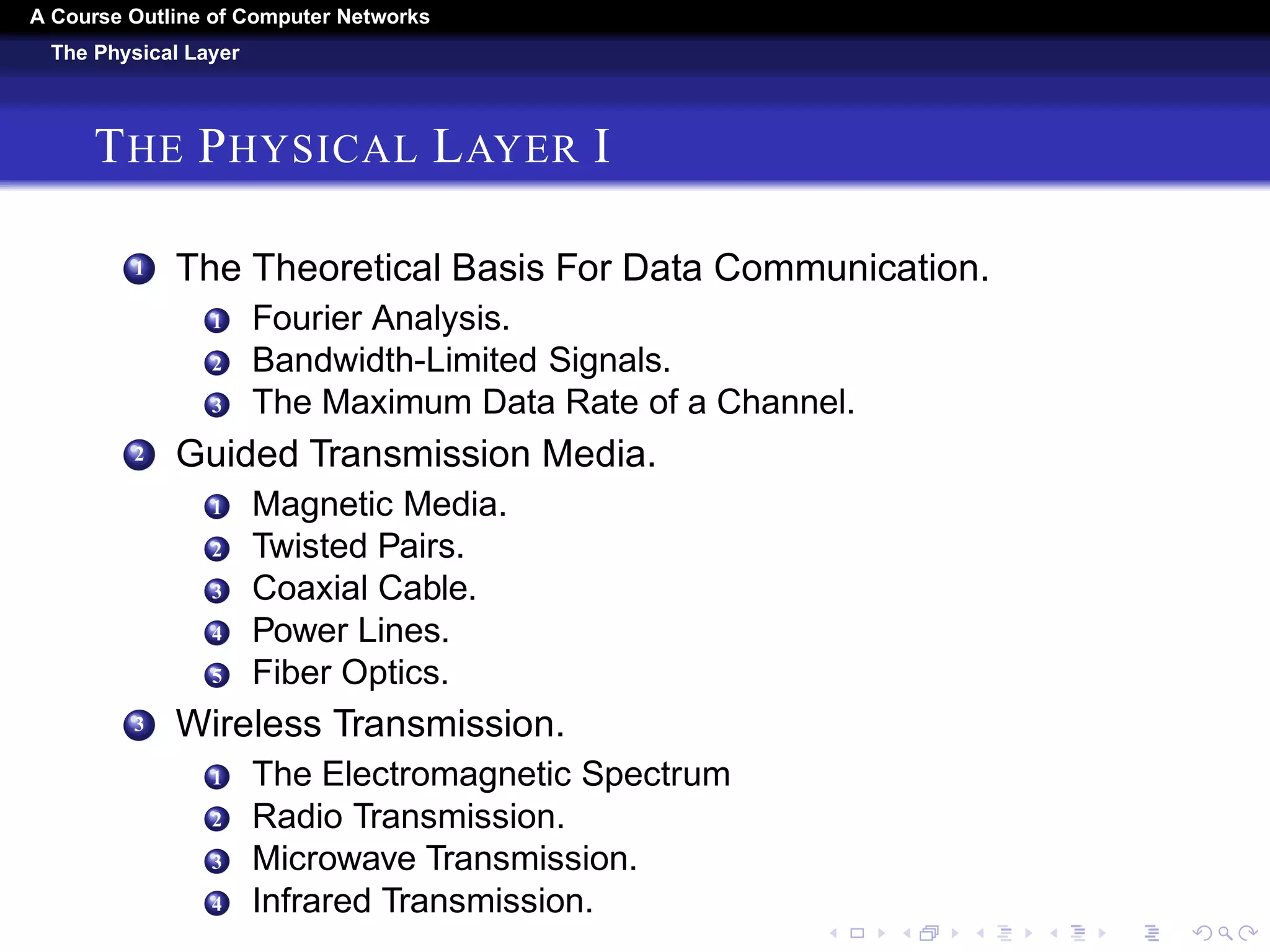
THE PHYSICAL LAYER I 
1 The Theoretical Basis For Data Communication. 
1 Fourier Analysis. 
2 Bandwidth-Limited Signals. 
3 The Maximum Data Rate of a Channel. 
2 Guided Transmission Media. 
1 Magnetic Media. 
2 Twisted Pairs. 
3 Coaxial Cable. 
4 Power Lines. 
5 Fiber Optics. 
3 Wireless Transmission. 
1 The Electromagnetic Spectrum 
2 Radio Transmission. 
3 Microwave Transmission. 
4 Infrared Transmission.
A Course Outline About Computer Networks 
The Physical Layer 
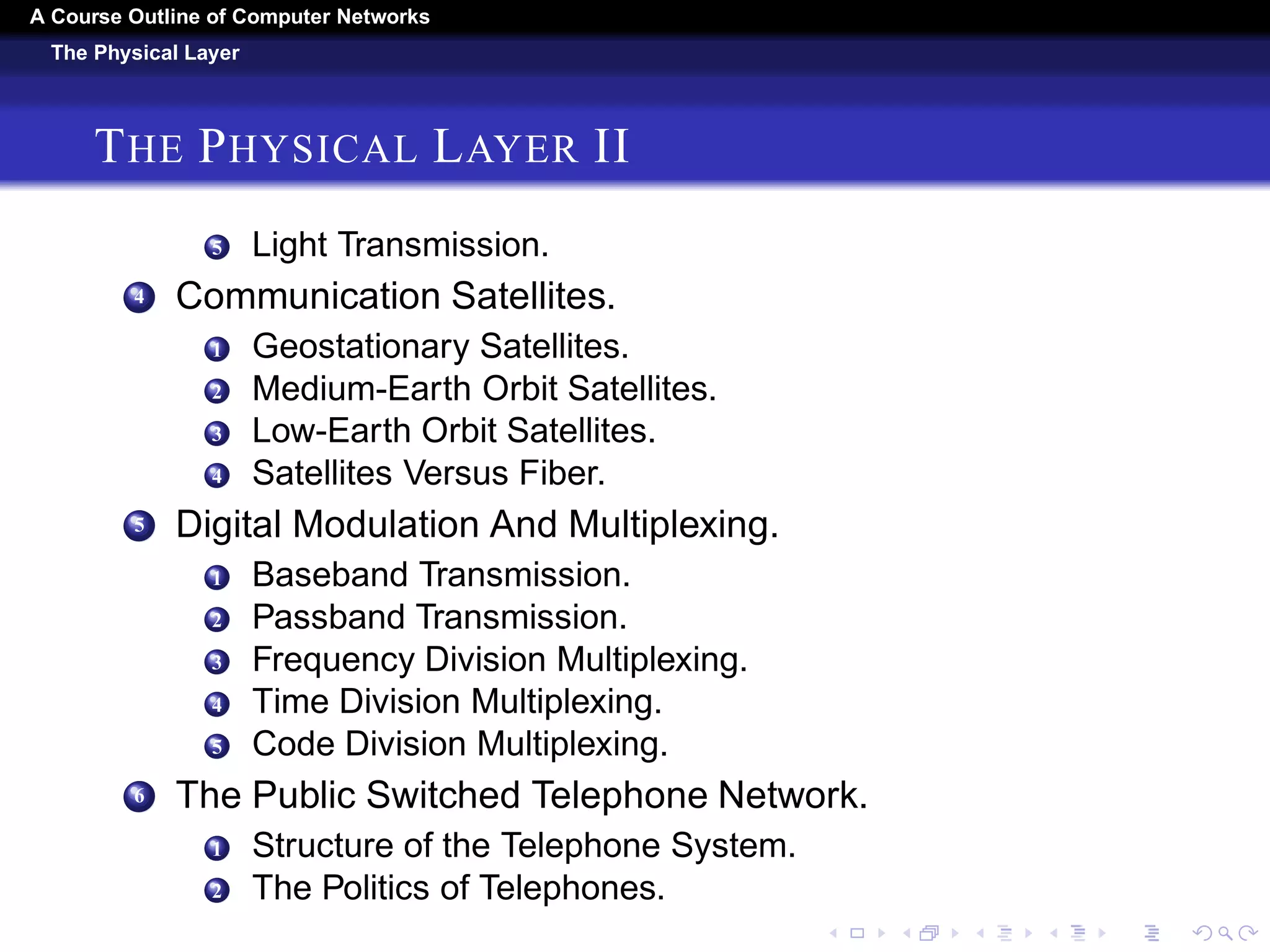
THE PHYSICAL LAYER II 
5 Light Transmission. 
4 Communication Satellites. 
1 Geostationary Satellites. 
2 Medium-Earth Orbit Satellites. 
3 Low-Earth Orbit Satellites. 
4 Satellites Versus Fiber. 
5 Digital Modulation And Multiplexing. 
1 Baseband Transmission. 
2 Passband Transmission. 
3 Frequency Division Multiplexing. 
4 Time Division Multiplexing. 
5 Code Division Multiplexing. 
6 The Public Switched Telephone Network. 
1 Structure of the Telephone System. 
2 The Politics of Telephones.
A Course Outline About Computer Networks 
The Physical Layer 
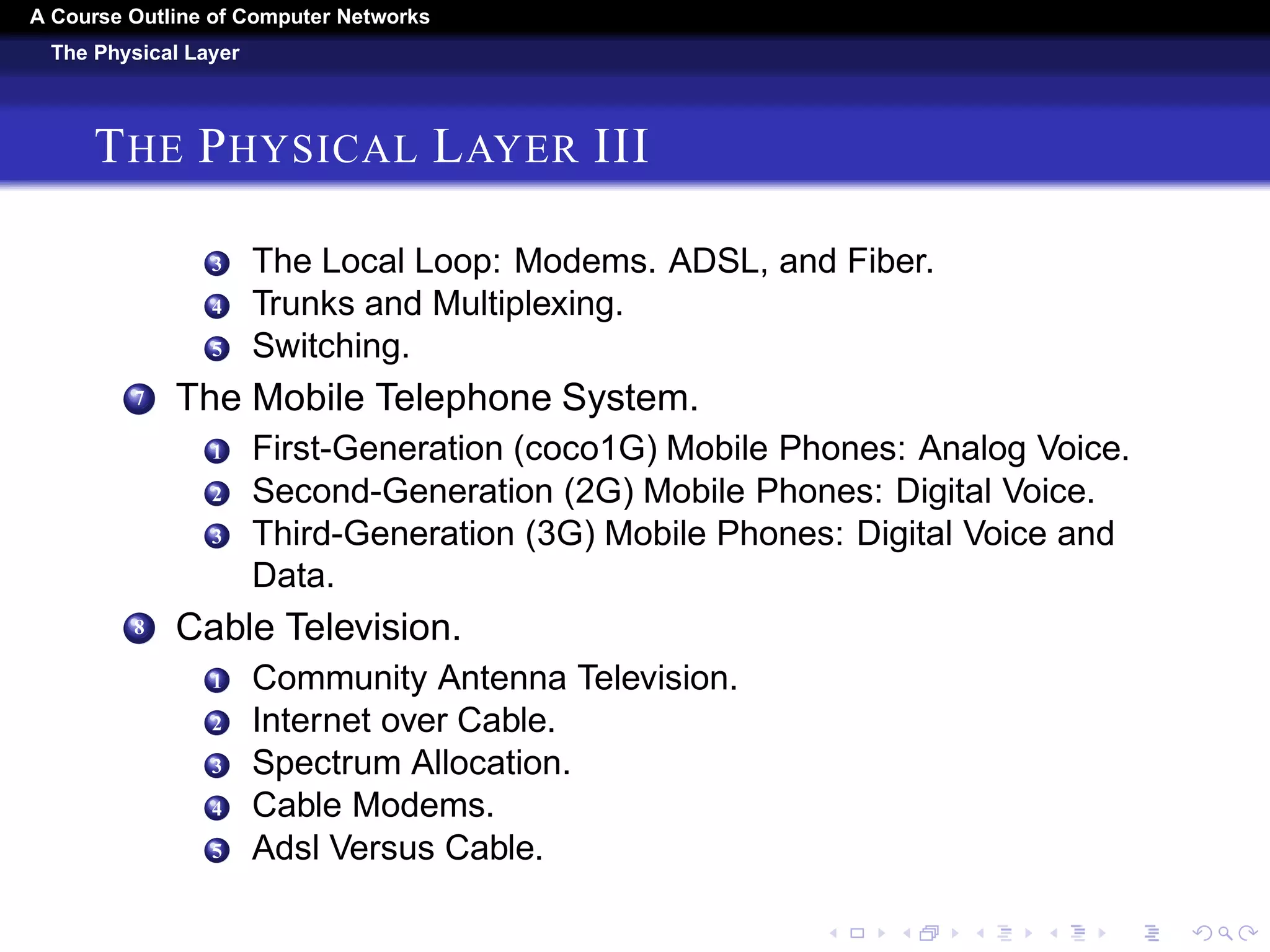
THE PHYSICAL LAYER III 
3 The Local Loop: Modems. ADSL, and Fiber. 
4 Trunks and Multiplexing. 
5 Switching. 
7 The Mobile Telephone System. 
1 First-Generation (coco1G) Mobile Phones: Analog Voice. 
2 Second-Generation (2G) Mobile Phones: Digital Voice. 
3 Third-Generation (3G) Mobile Phones: Digital Voice and 
Data. 
8 Cable Television. 
1 Community Antenna Television. 
2 Internet over Cable. 
3 Spectrum Allocation. 
4 Cable Modems. 
5 Adsl Versus Cable.
A Course Outline About Computer Networks 
The Data Link Layer 
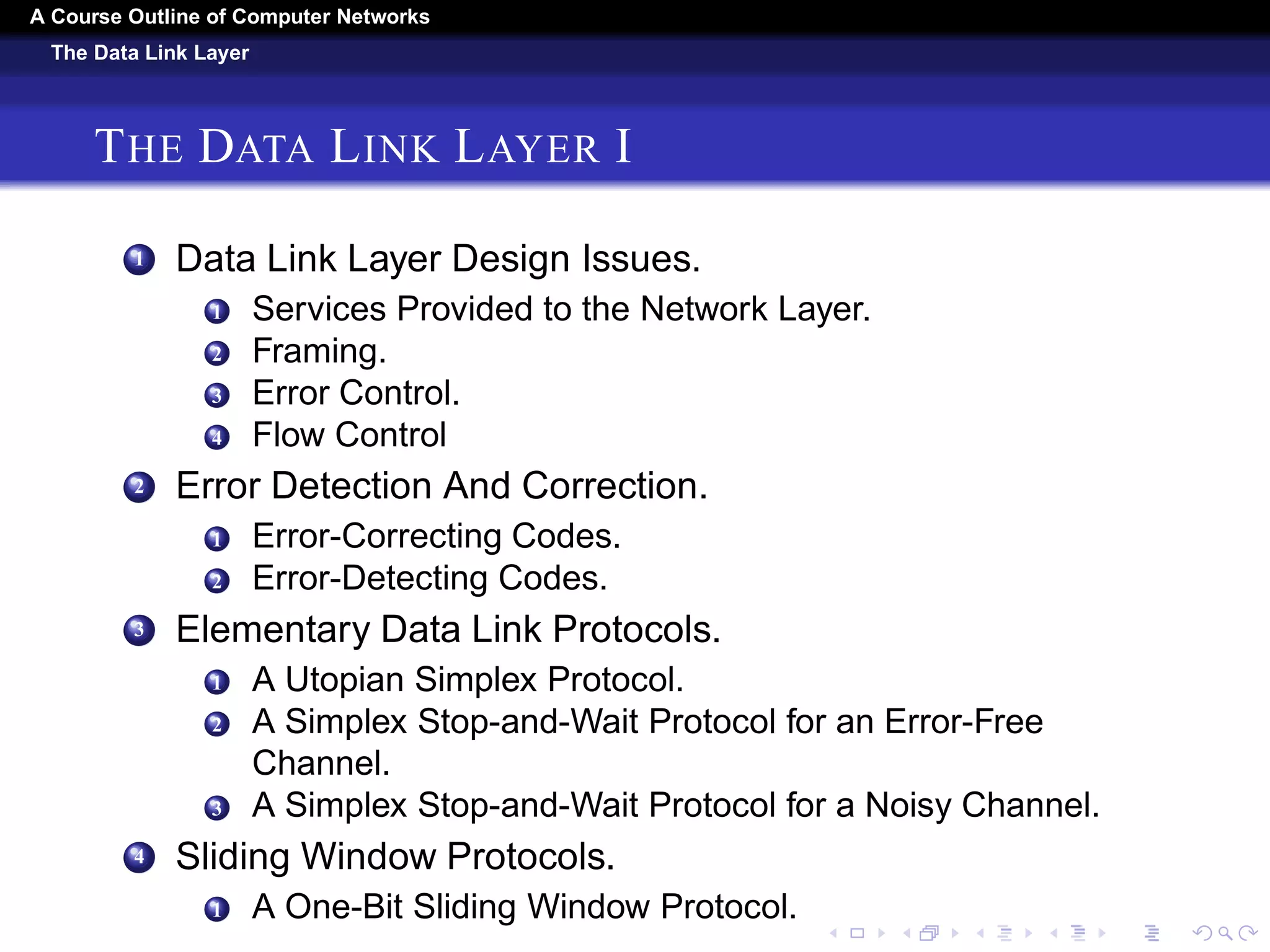
THE DATA LINK LAYER I 
1 Data Link Layer Design Issues. 
1 Services Provided to the Network Layer. 
2 Framing. 
3 Error Control. 
4 Flow Control 
2 Error Detection And Correction. 
1 Error-Correcting Codes. 
2 Error-Detecting Codes. 
3 Elementary Data Link Protocols. 
1 A Utopian Simplex Protocol. 
2 A Simplex Stop-and-Wait Protocol for an Error-Free 
Channel. 
3 A Simplex Stop-and-Wait Protocol for a Noisy Channel. 
4 Sliding Window Protocols. 
1 A One-Bit Sliding Window Protocol.
A Course Outline About Computer Networks 
The Data Link Layer 
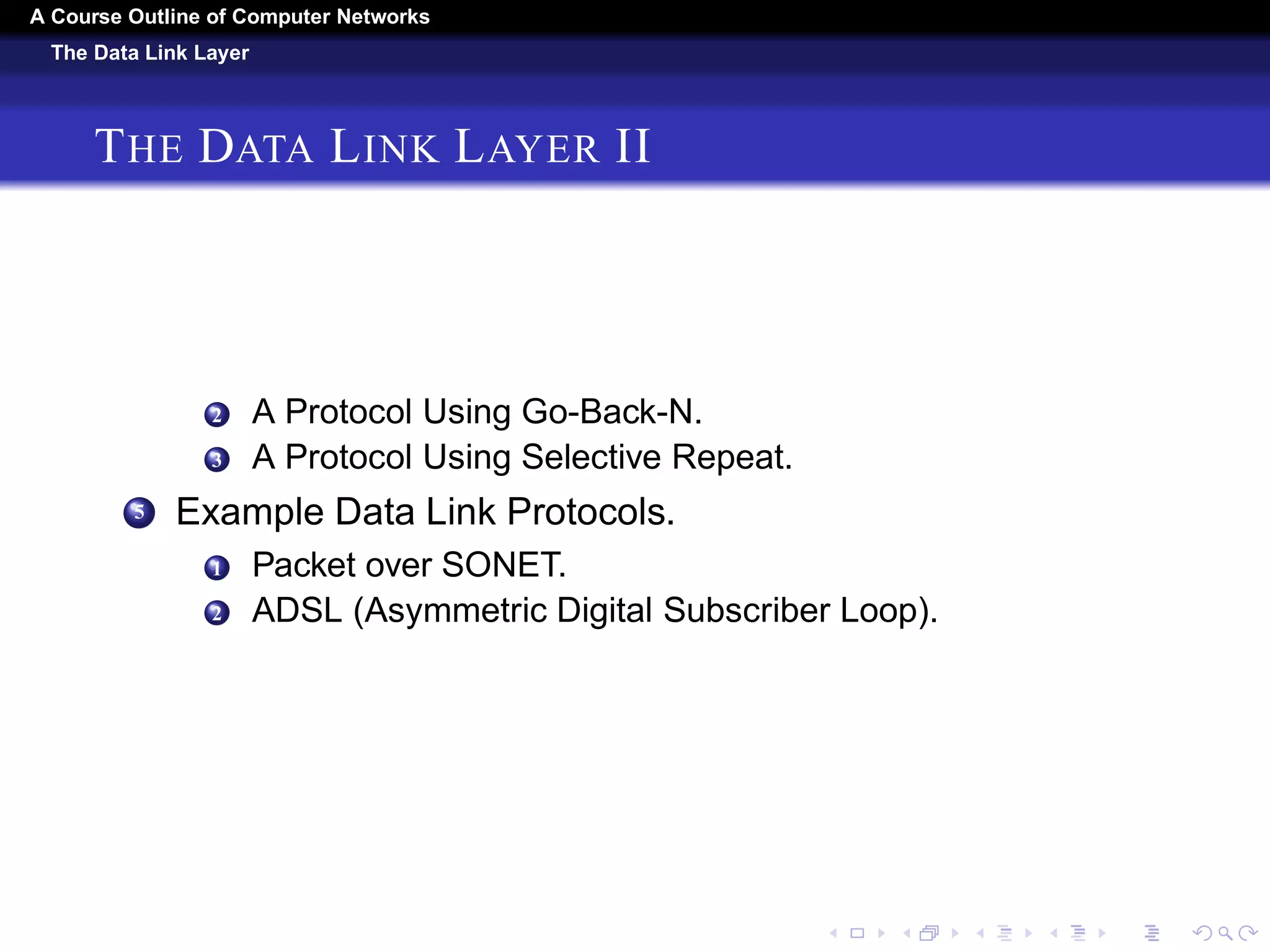
THE DATA LINK LAYER II 
2 A Protocol Using Go-Back-N. 
3 A Protocol Using Selective Repeat. 
5 Example Data Link Protocols. 
1 Packet over SONET. 
2 ADSL (Asymmetric Digital Subscriber Loop).
A Course Outline About Computer Networks 
The Medium Access Layer Control Sublayer 
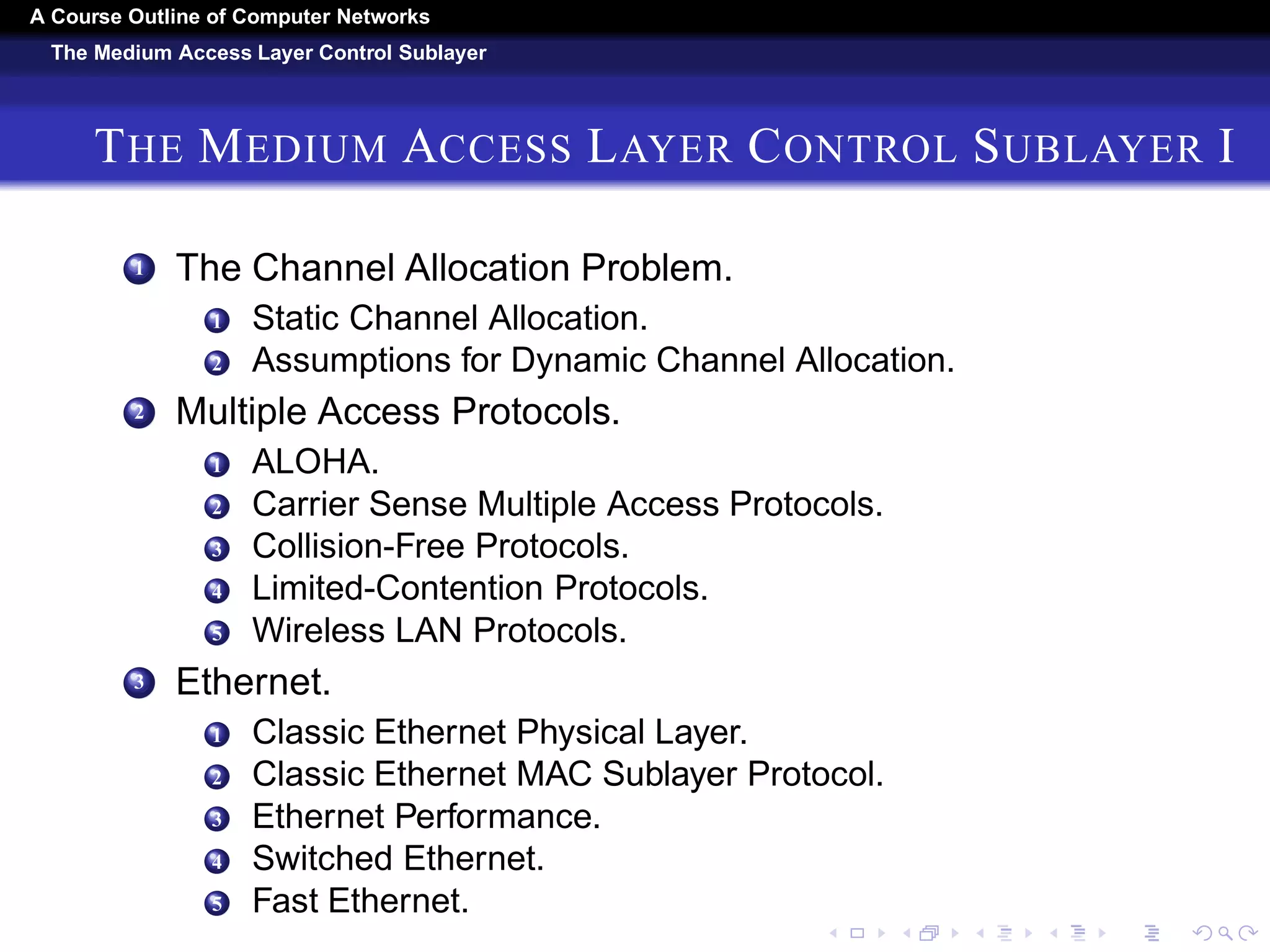
THE MEDIUM ACCESS LAYER CONTROL SUBLAYER I 
1 The Channel Allocation Problem. 
1 Static Channel Allocation. 
2 Assumptions for Dynamic Channel Allocation. 
2 Multiple Access Protocols. 
1 ALOHA. 
2 Carrier Sense Multiple Access Protocols. 
3 Collision-Free Protocols. 
4 Limited-Contention Protocols. 
5 Wireless LAN Protocols. 
3 Ethernet. 
1 Classic Ethernet Physical Layer. 
2 Classic Ethernet MAC Sublayer Protocol. 
3 Ethernet Performance. 
4 Switched Ethernet. 
5 Fast Ethernet.
A Course Outline About Computer Networks 
The Medium Access Layer Control Sublayer 
THE MEDIUM ACCESS LAYER CONTROL SUBLAYER 
II 
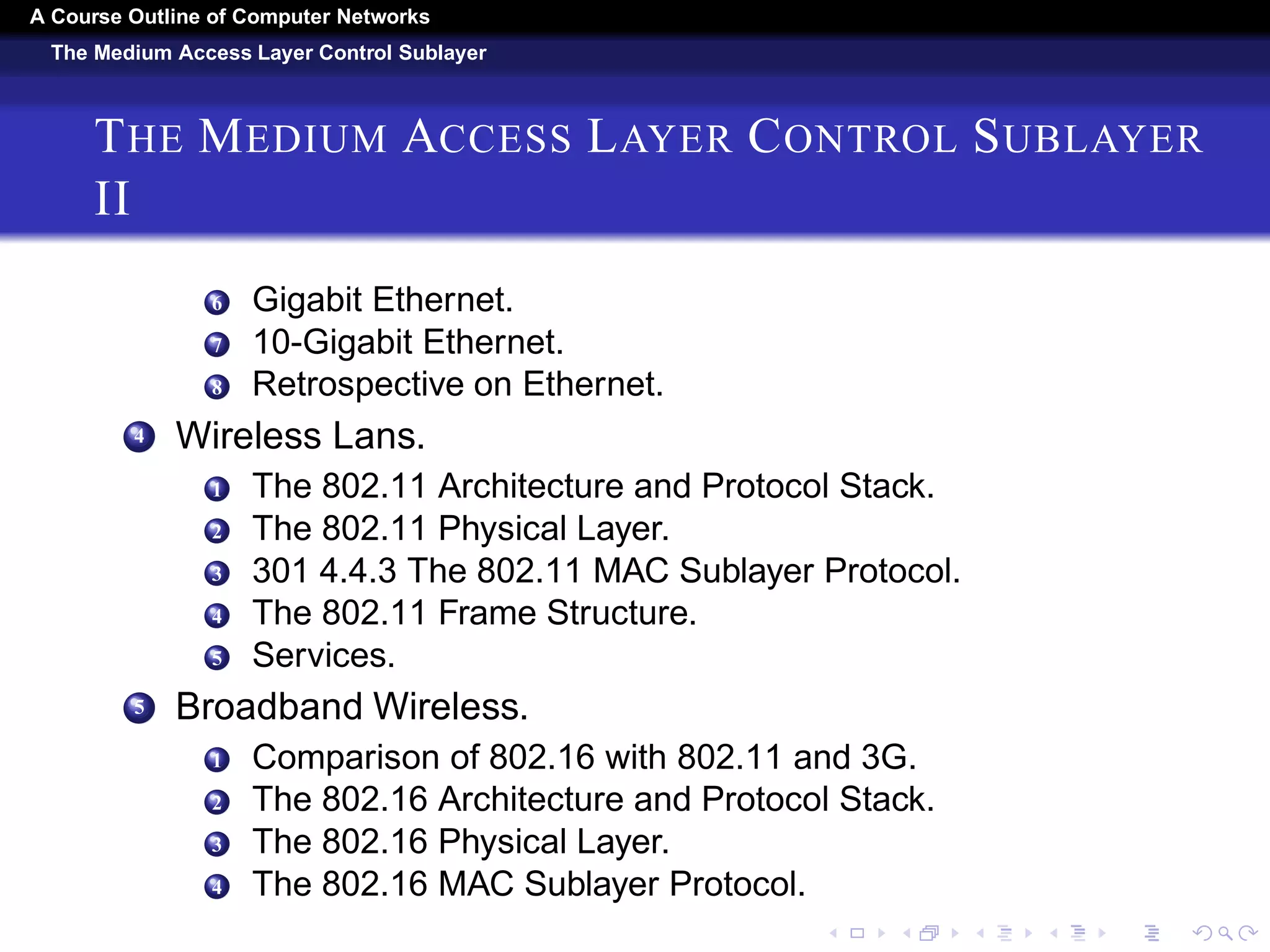
6 Gigabit Ethernet. 
7 10-Gigabit Ethernet. 
8 Retrospective on Ethernet. 
4 Wireless Lans. 
1 The 802.11 Architecture and Protocol Stack. 
2 The 802.11 Physical Layer. 
3 301 4.4.3 The 802.11 MAC Sublayer Protocol. 
4 The 802.11 Frame Structure. 
5 Services. 
5 Broadband Wireless. 
1 Comparison of 802.16 with 802.11 and 3G. 
2 The 802.16 Architecture and Protocol Stack. 
3 The 802.16 Physical Layer. 
4 The 802.16 MAC Sublayer Protocol.
A Course Outline About Computer Networks 
The Medium Access Layer Control Sublayer 
THE MEDIUM ACCESS LAYER CONTROL SUBLAYER 
III 
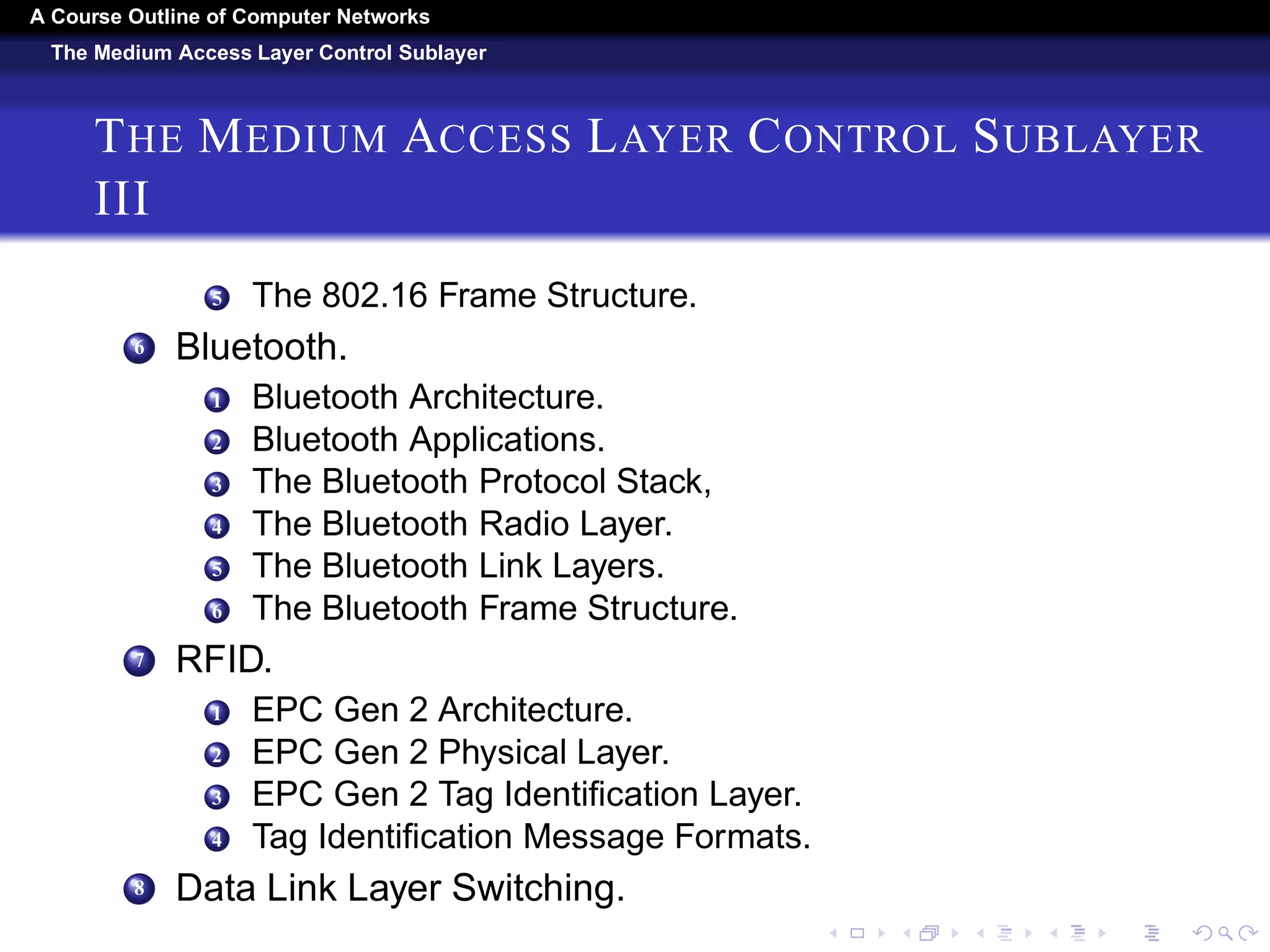
5 The 802.16 Frame Structure. 
6 Bluetooth. 
1 Bluetooth Architecture. 
2 Bluetooth Applications. 
3 The Bluetooth Protocol Stack, 
4 The Bluetooth Radio Layer. 
5 The Bluetooth Link Layers. 
6 The Bluetooth Frame Structure. 
7 RFID. 
1 EPC Gen 2 Architecture. 
2 EPC Gen 2 Physical Layer. 
3 EPC Gen 2 Tag Identification Layer. 
4 Tag Identification Message Formats. 
8 Data Link Layer Switching.
A Course Outline About Computer Networks 
The Medium Access Layer Control Sublayer 
THE MEDIUM ACCESS LAYER CONTROL SUBLAYER 
IV 
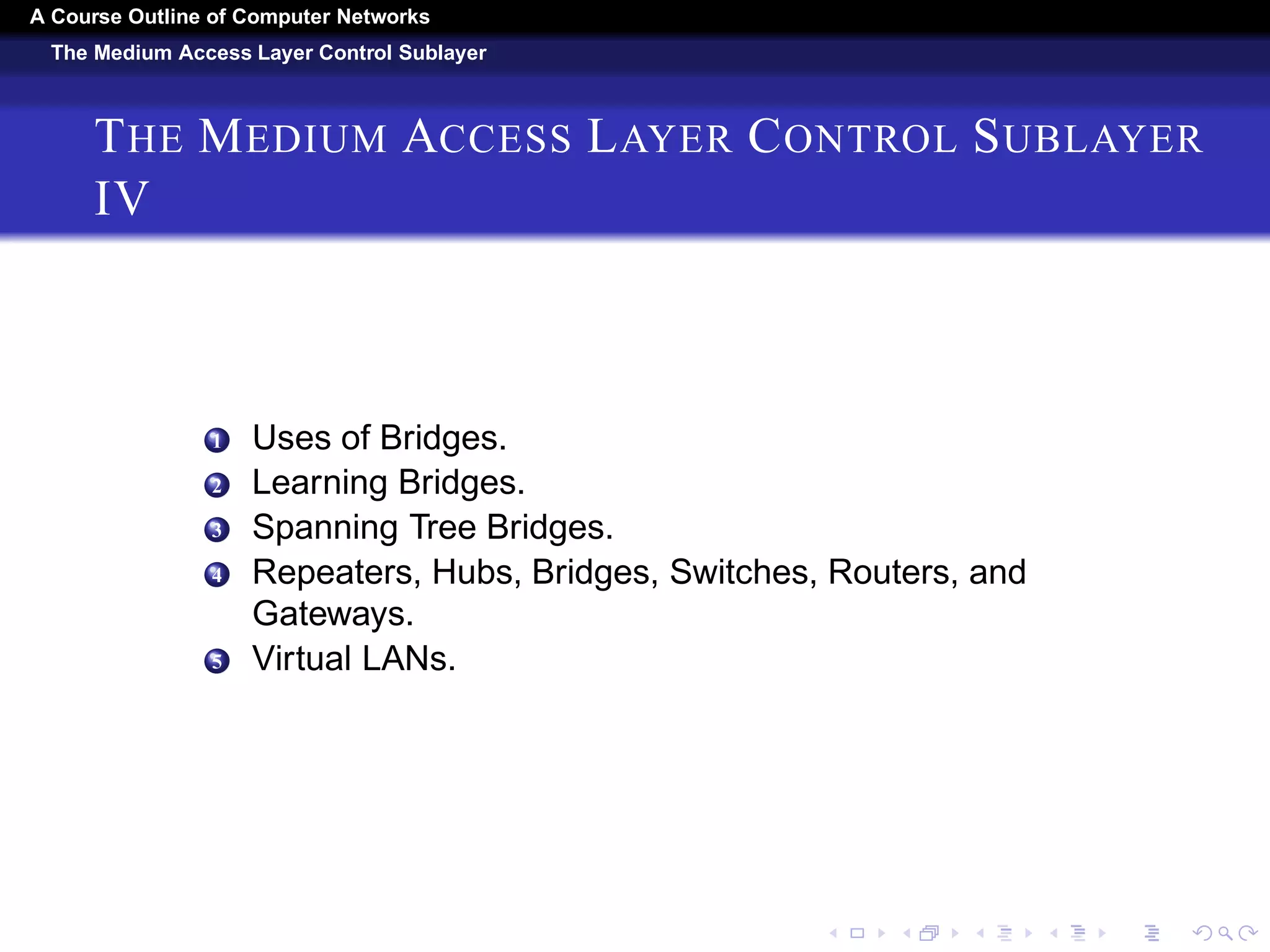
1 Uses of Bridges. 
2 Learning Bridges. 
3 Spanning Tree Bridges. 
4 Repeaters, Hubs, Bridges, Switches, Routers, and 
Gateways. 
5 Virtual LANs.
A Course Outline About Computer Networks 
The Network Layer 
THE NETWORK LAYER I 
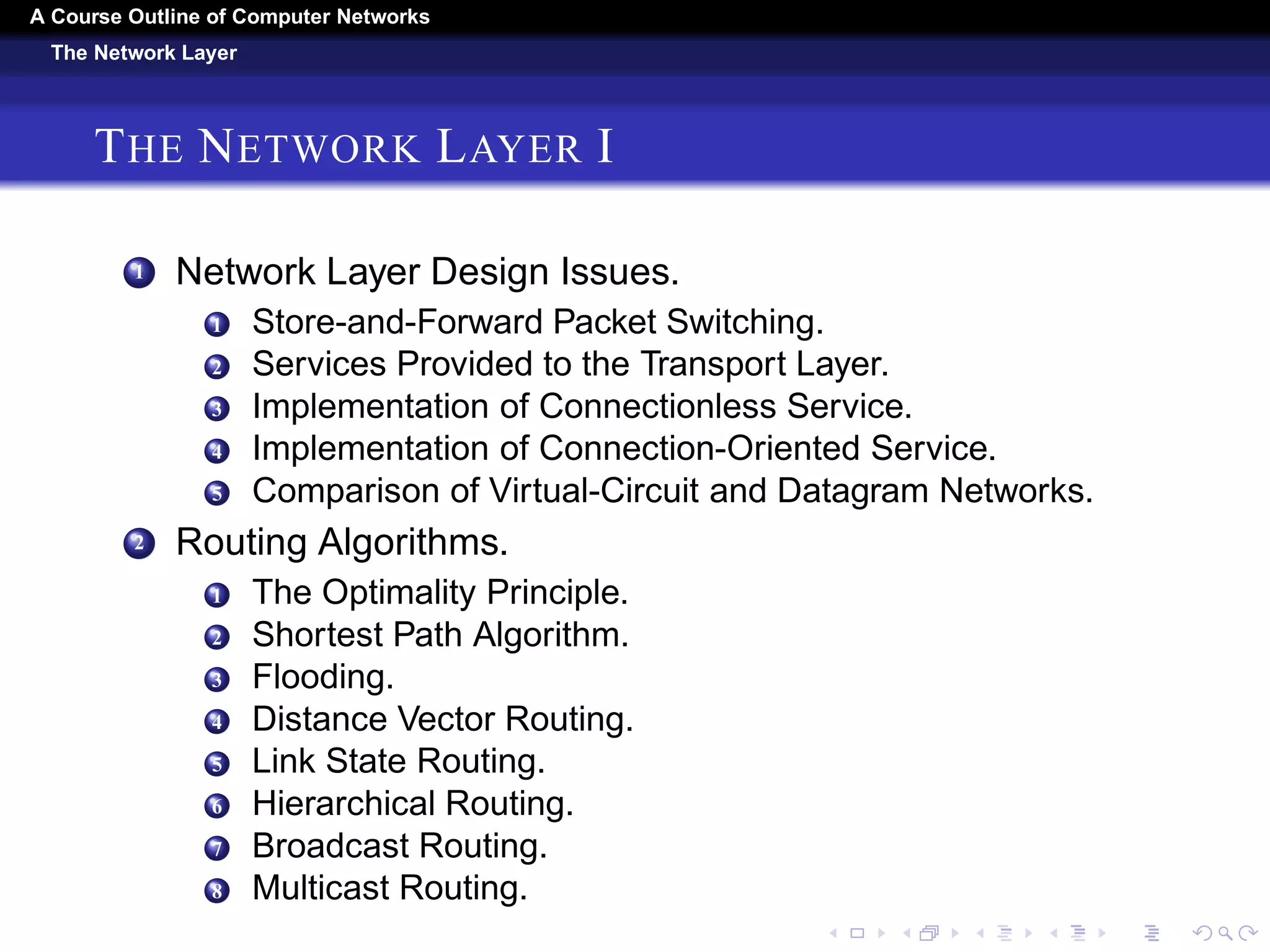
1 Network Layer Design Issues. 
1 Store-and-Forward Packet Switching. 
2 Services Provided to the Transport Layer. 
3 Implementation of Connectionless Service. 
4 Implementation of Connection-Oriented Service. 
5 Comparison of Virtual-Circuit and Datagram Networks. 
2 Routing Algorithms. 
1 The Optimality Principle. 
2 Shortest Path Algorithm. 
3 Flooding. 
4 Distance Vector Routing. 
5 Link State Routing. 
6 Hierarchical Routing. 
7 Broadcast Routing. 
8 Multicast Routing.
A Course Outline About Computer Networks 
The Network Layer 
THE NETWORK LAYER II 
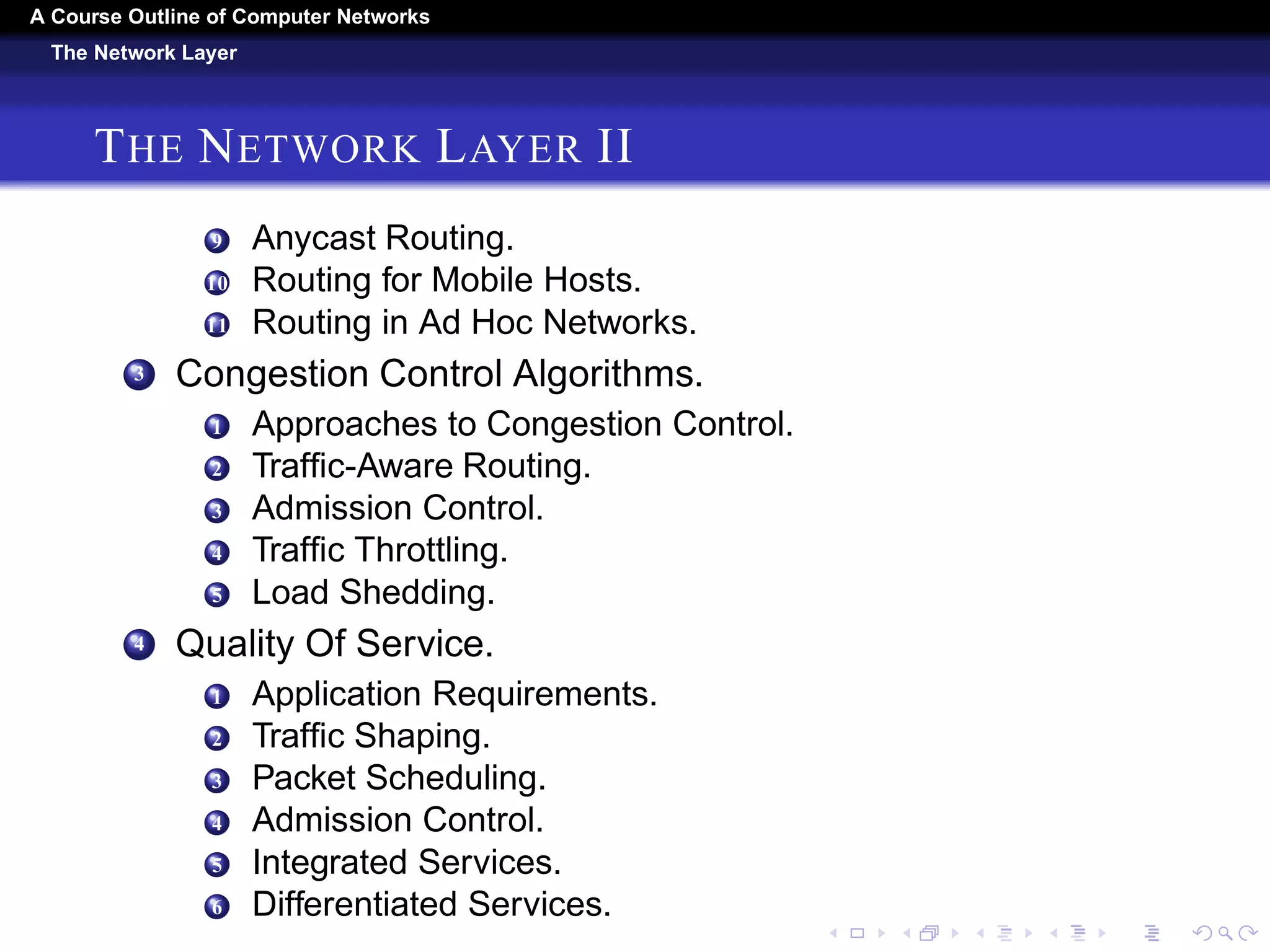
9 Anycast Routing. 
10 Routing for Mobile Hosts. 
11 Routing in Ad Hoc Networks. 
3 Congestion Control Algorithms. 
1 Approaches to Congestion Control. 
2 Traffic-Aware Routing. 
3 Admission Control. 
4 Traffic Throttling. 
5 Load Shedding. 
4 Quality Of Service. 
1 Application Requirements. 
2 Traffic Shaping. 
3 Packet Scheduling. 
4 Admission Control. 
5 Integrated Services. 
6 Differentiated Services.
A Course Outline About Computer Networks 
The Network Layer 
THE NETWORK LAYER III 
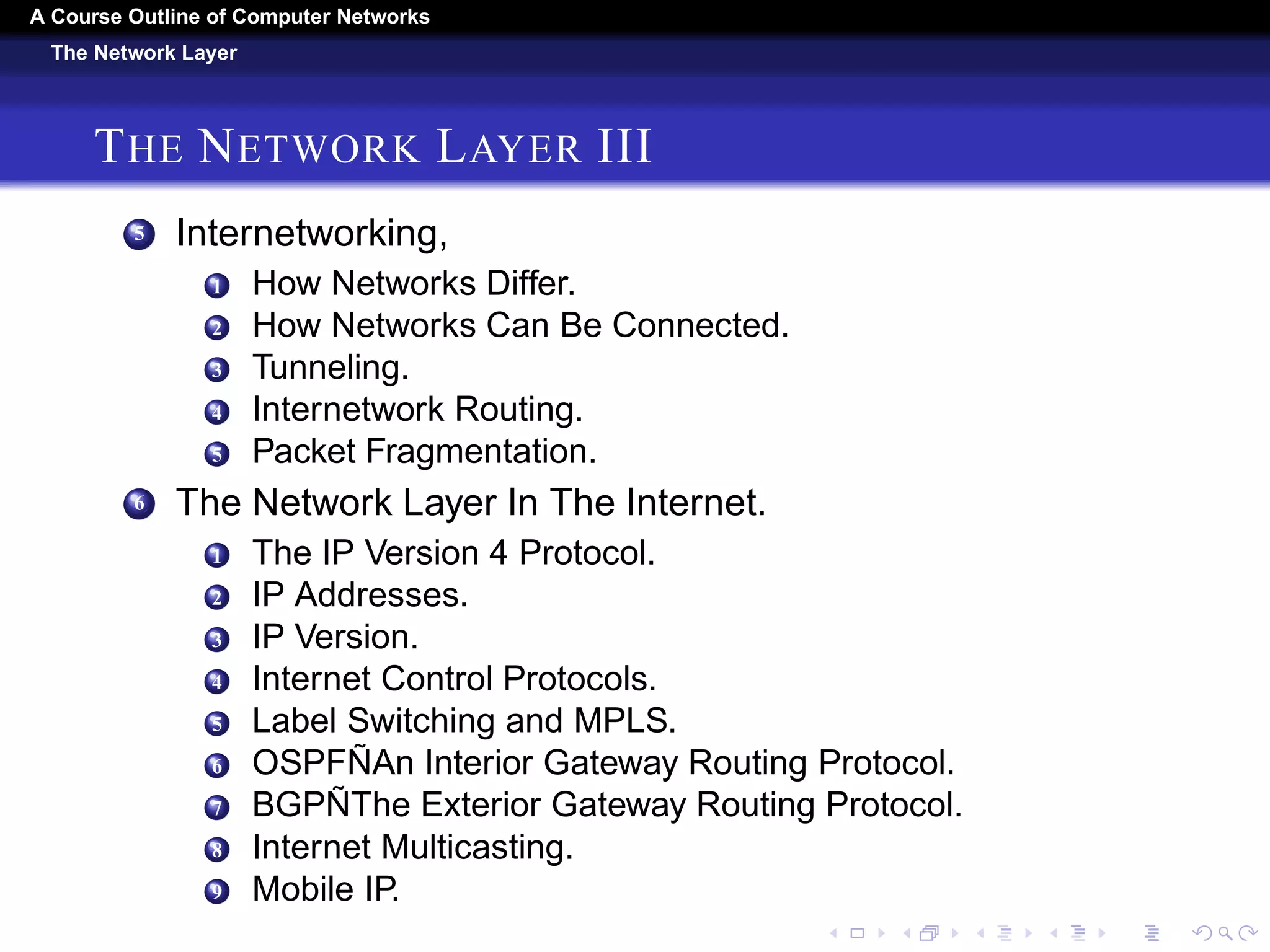
5 Internetworking, 
1 How Networks Differ. 
2 How Networks Can Be Connected. 
3 Tunneling. 
4 Internetwork Routing. 
5 Packet Fragmentation. 
6 The Network Layer In The Internet. 
1 The IP Version 4 Protocol. 
2 IP Addresses. 
3 IP Version. 
4 Internet Control Protocols. 
5 Label Switching and MPLS. 
6 OSPFÑAn Interior Gateway Routing Protocol. 
7 BGPÑThe Exterior Gateway Routing Protocol. 
8 Internet Multicasting. 
9 Mobile IP.
A Course Outline About Computer Networks 
The Transport Layer 
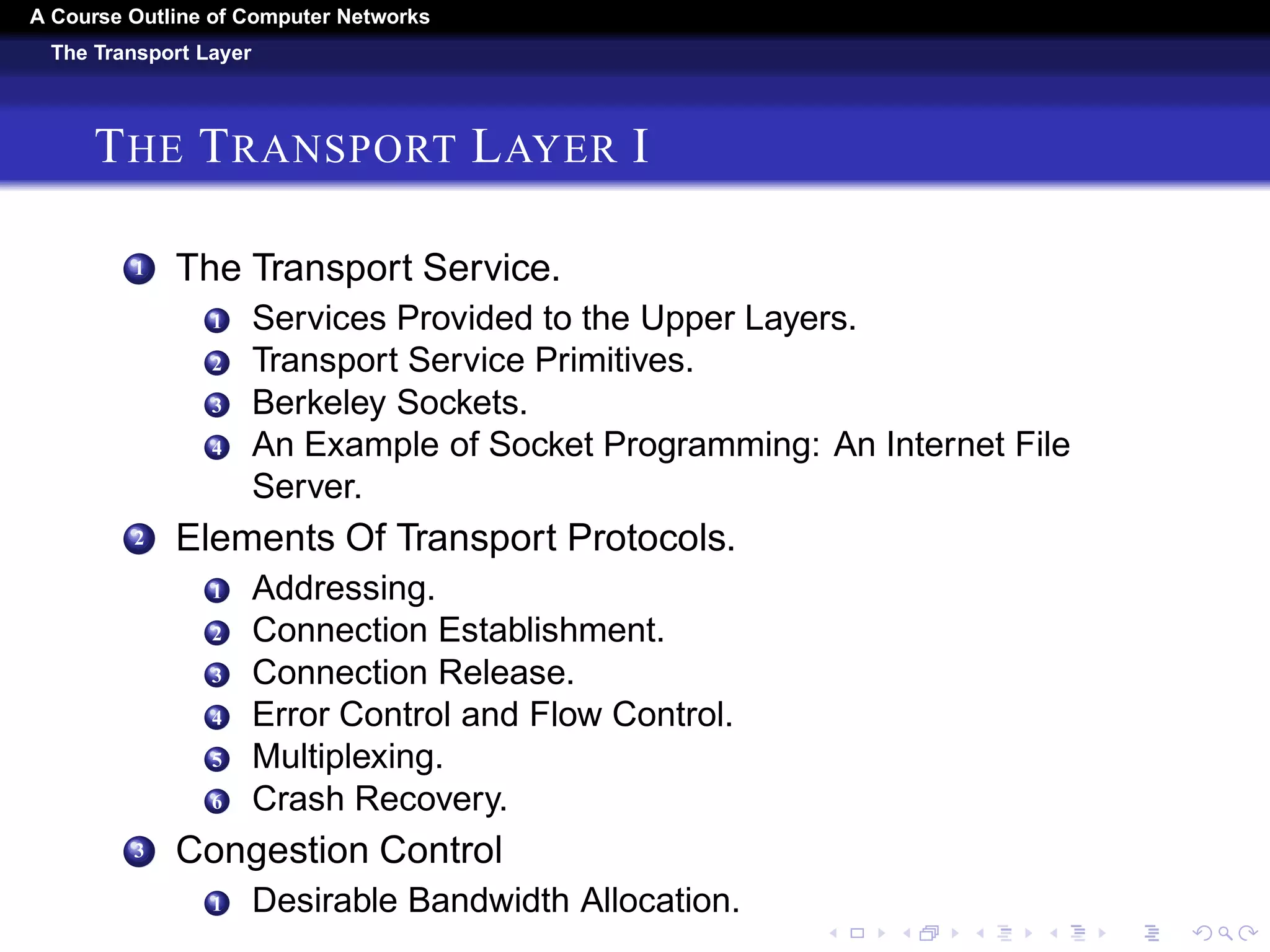
THE TRANSPORT LAYER I 
1 The Transport Service. 
1 Services Provided to the Upper Layers. 
2 Transport Service Primitives. 
3 Berkeley Sockets. 
4 An Example of Socket Programming: An Internet File 
Server. 
2 Elements Of Transport Protocols. 
1 Addressing. 
2 Connection Establishment. 
3 Connection Release. 
4 Error Control and Flow Control. 
5 Multiplexing. 
6 Crash Recovery. 
3 Congestion Control 
1 Desirable Bandwidth Allocation.
A Course Outline About Computer Networks 
The Transport Layer 
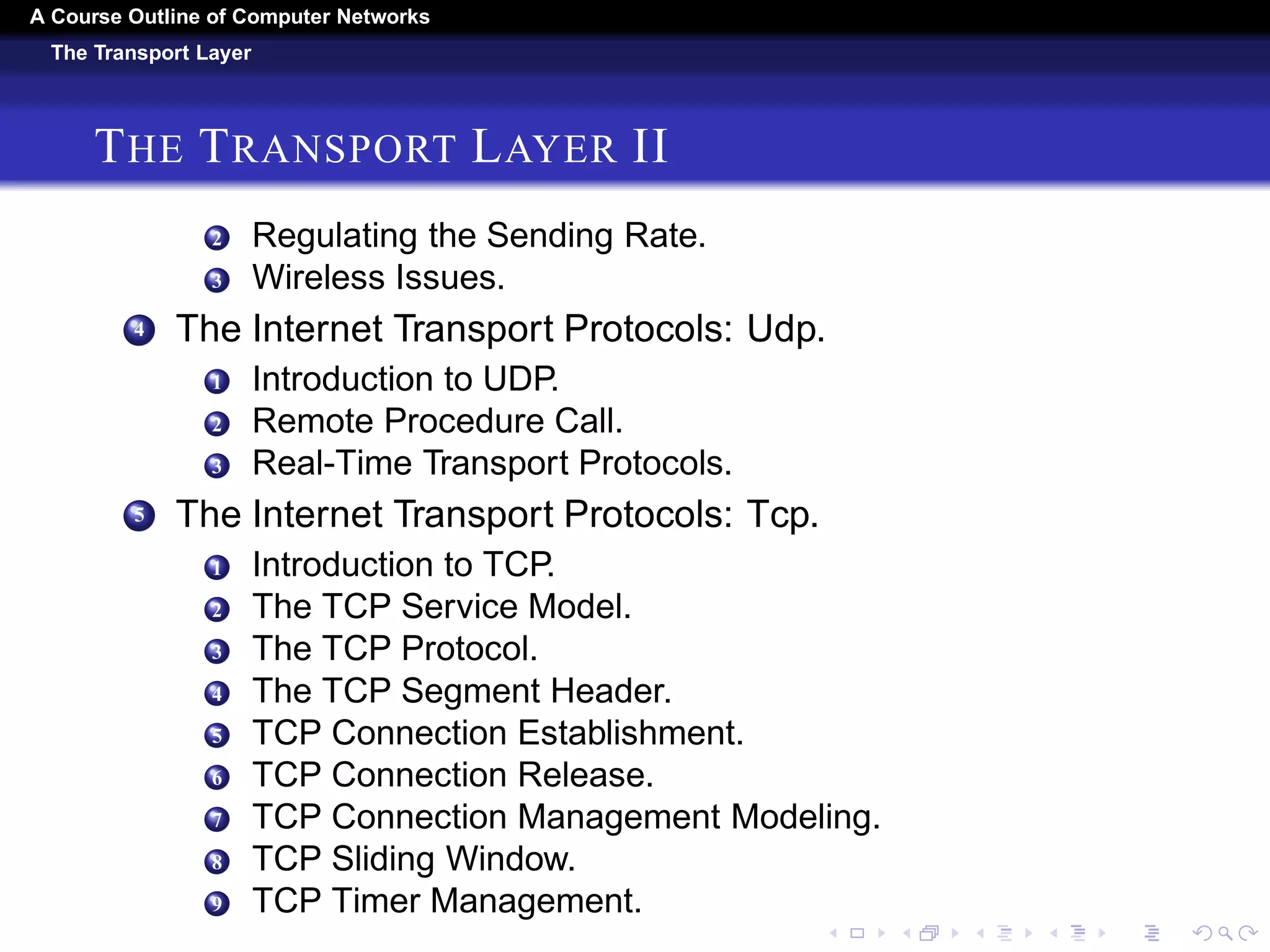
THE TRANSPORT LAYER II 
2 Regulating the Sending Rate. 
3 Wireless Issues. 
4 The Internet Transport Protocols: Udp. 
1 Introduction to UDP. 
2 Remote Procedure Call. 
3 Real-Time Transport Protocols. 
5 The Internet Transport Protocols: Tcp. 
1 Introduction to TCP. 
2 The TCP Service Model. 
3 The TCP Protocol. 
4 The TCP Segment Header. 
5 TCP Connection Establishment. 
6 TCP Connection Release. 
7 TCP Connection Management Modeling. 
8 TCP Sliding Window. 
9 TCP Timer Management.
A Course Outline About Computer Networks 
The Transport Layer 
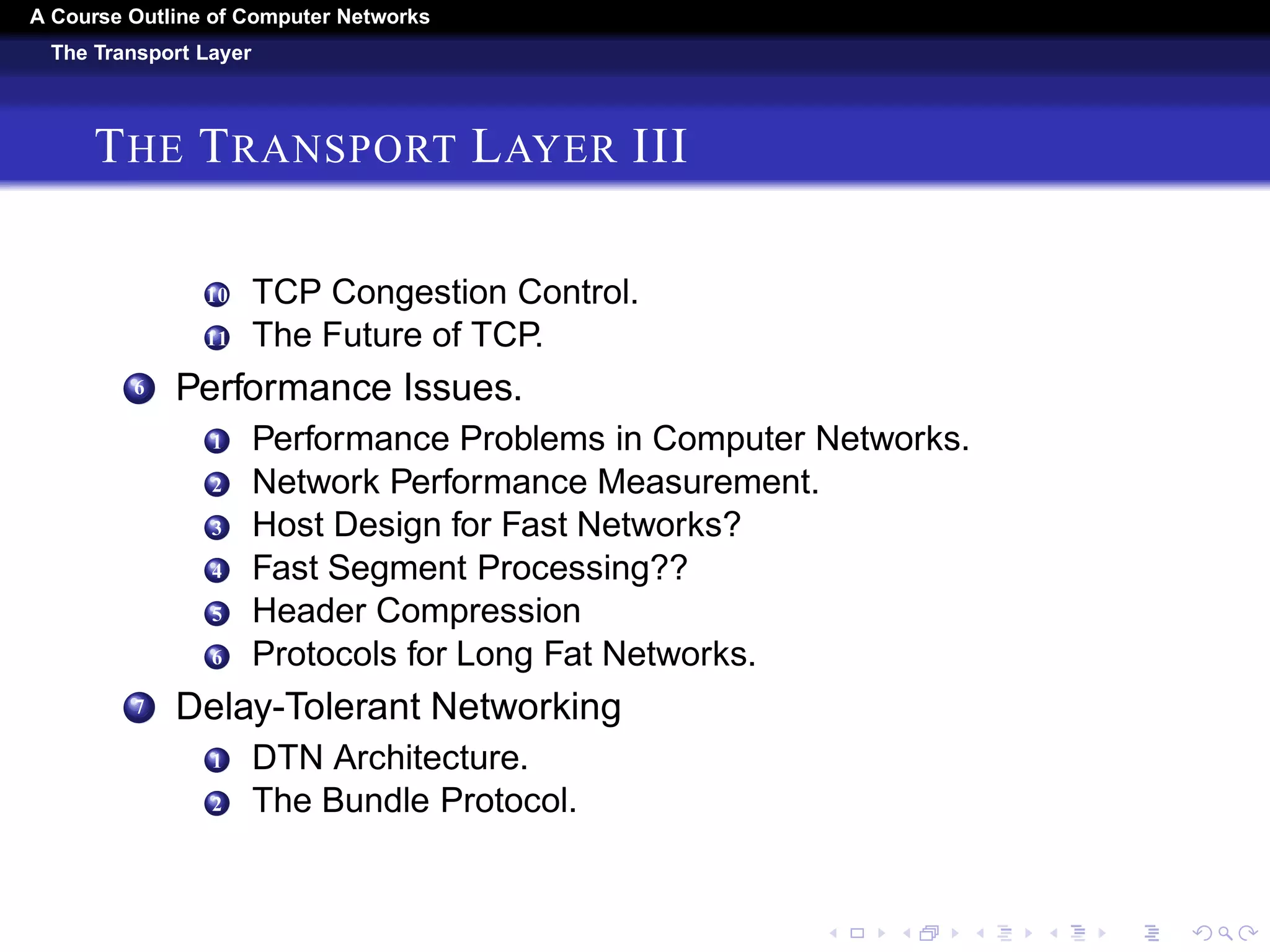
THE TRANSPORT LAYER III 
10 TCP Congestion Control. 
11 The Future of TCP. 
6 Performance Issues. 
1 Performance Problems in Computer Networks. 
2 Network Performance Measurement. 
3 Host Design for Fast Networks? 
4 Fast Segment Processing?? 
5 Header Compression 
6 Protocols for Long Fat Networks. 
7 Delay-Tolerant Networking 
1 DTN Architecture. 
2 The Bundle Protocol.
A Course Outline About Computer Networks 
The Application Layer 
THE APPLICATION LAYER I 
1 DNS – The Domain Name System. 
1 The DNS Name Space. 
2 Domain Resource Records. 
3 Name Servers. 
2 ELECTRONIC MAIL* 
1 Architecture and Services. 
2 The User Agent. 
3 Message Formats. 
4 Message Transfer. 
5 Final Delivery. 
3 The World Wide Web. 
1 Architectural Overview. 
2 Static Web Pages. 
3 Dynamic Web Pages and Web Applications. 
4 HTTP – The HyperText Transfer Protocol.
A Course Outline About Computer Networks 
The Application Layer 
THE APPLICATION LAYER II 
5 The Mobile Web. 
6 Web Search. 
4 Streaming Audio And Video. 
1 Digital Audio. 
2 Digital Video. 
3 Streaming Stored Media. 
4 Streaming Live Media. 
5 Real-Time Conferencing. 
5 Content Delivery. 
1 Content and Internet Traffic. 
2 Server Farms and Web Proxies. 
3 Content Delivery Networks. 
4 Peer-to-Peer Networks.
A Course Outline About Computer Networks 
Network Security 
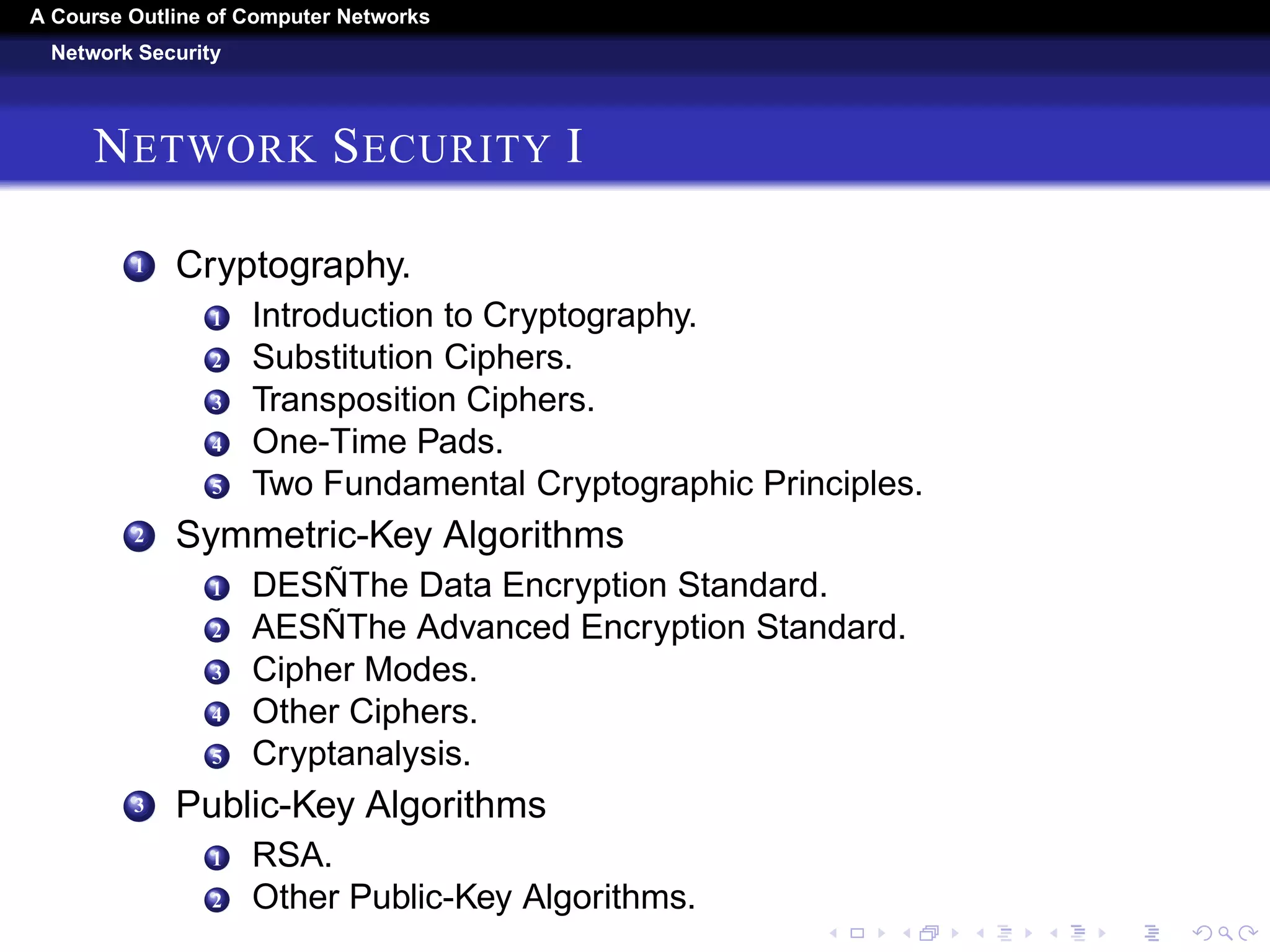
NETWORK SECURITY I 
1 Cryptography. 
1 Introduction to Cryptography. 
2 Substitution Ciphers. 
3 Transposition Ciphers. 
4 One-Time Pads. 
5 Two Fundamental Cryptographic Principles. 
2 Symmetric-Key Algorithms 
1 DESÑThe Data Encryption Standard. 
2 AESÑThe Advanced Encryption Standard. 
3 Cipher Modes. 
4 Other Ciphers. 
5 Cryptanalysis. 
3 Public-Key Algorithms 
1 RSA. 
2 Other Public-Key Algorithms.
A Course Outline About Computer Networks 
Network Security 
NETWORK SECURITY II 
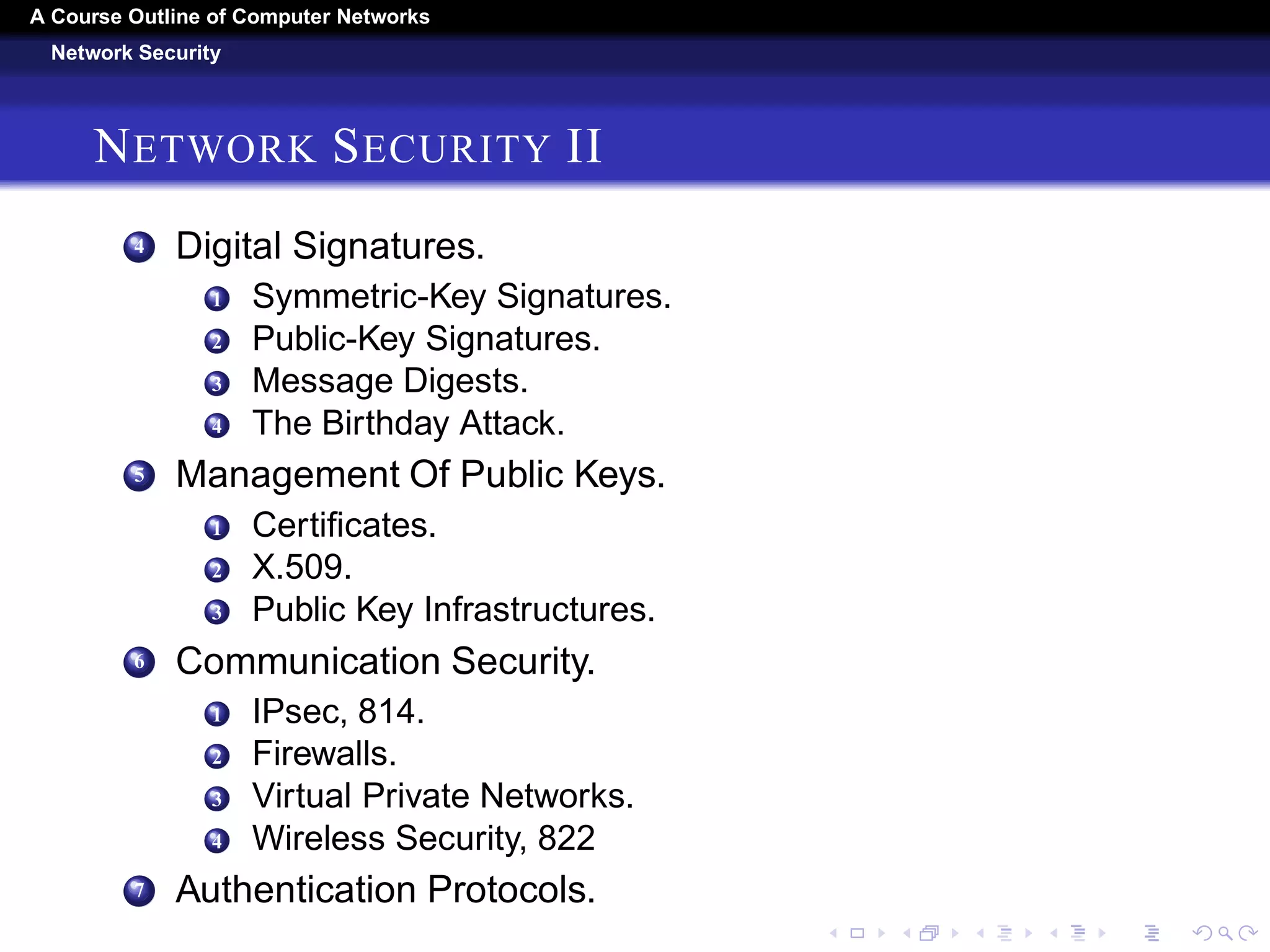
4 Digital Signatures. 
1 Symmetric-Key Signatures. 
2 Public-Key Signatures. 
3 Message Digests. 
4 The Birthday Attack. 
5 Management Of Public Keys. 
1 Certificates. 
2 X.509. 
3 Public Key Infrastructures. 
6 Communication Security. 
1 IPsec, 814. 
2 Firewalls. 
3 Virtual Private Networks. 
4 Wireless Security. 
7 Authentication Protocols.
A Course Outline About Computer Networks 
Network Security 
NETWORK SECURITY III 
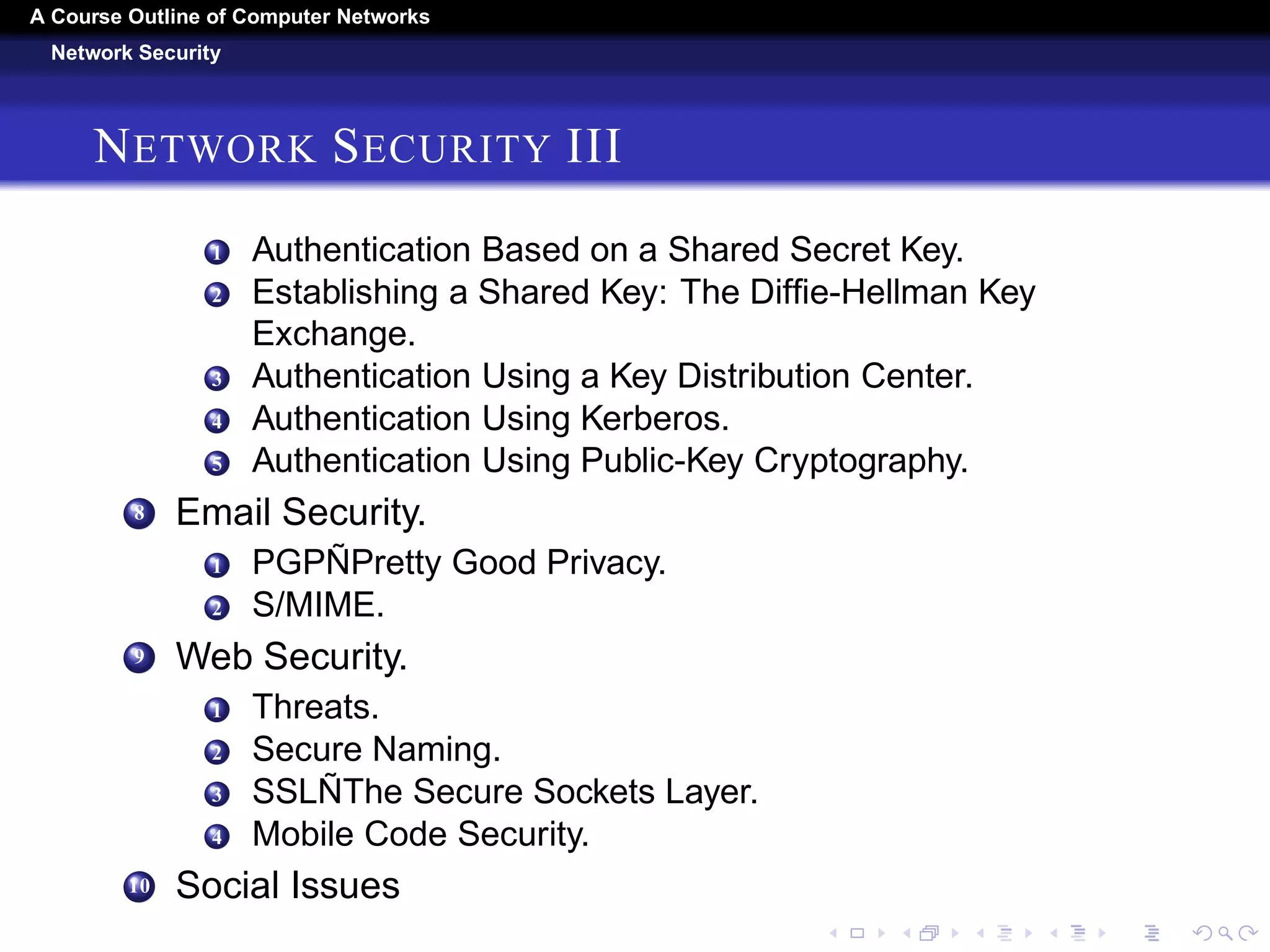
1 Authentication Based on a Shared Secret Key. 
2 Establishing a Shared Key: The Diffie-Hellman Key 
Exchange. 
3 Authentication Using a Key Distribution Center. 
4 Authentication Using Kerberos. 
5 Authentication Using Public-Key Cryptography. 
8 Email Security. 
1 PGPÑPretty Good Privacy. 
2 S/MIME. 
9 Web Security. 
1 Threats. 
2 Secure Naming. 
3 SSLÑThe Secure Sockets Layer. 
4 Mobile Code Security. 
10 Social Issues
A Course Outline About Computer Networks 
Network Security 
NETWORK SECURITY IV 
1 Privacy. 
2 Freedom of Speech. 
3 Copyright.
A Course Outline About Computer Networks 
Conclusions 
CONCLUSIONS I 
1 Computer Networks – Andrew S. Tanenbaum – 5th Edition.

A Course Outline About Computer Networks

  • 1.
    A Course OutlineAbout Computer Networks A COURSE OUTLINE ABOUT COMPUTER NETWORKS Muhammad Adil Raja Roaming Researchers, Inc. October 14, 2014
  • 2.
    A Course OutlineAbout Computer Networks OUTLINE 1 INTRODUCTION 2 THE PHYSICAL LAYER 3 THE DATA LINK LAYER 4 THE MEDIUM ACCESS LAYER CONTROL SUBLAYER 5 THE NETWORK LAYER 6 THE TRANSPORT LAYER 7 THE APPLICATION LAYER 8 NETWORK SECURITY 9 CONCLUSIONS
  • 3.
    A Course OutlineAbout Computer Networks OUTLINE 1 INTRODUCTION 2 THE PHYSICAL LAYER 3 THE DATA LINK LAYER 4 THE MEDIUM ACCESS LAYER CONTROL SUBLAYER 5 THE NETWORK LAYER 6 THE TRANSPORT LAYER 7 THE APPLICATION LAYER 8 NETWORK SECURITY 9 CONCLUSIONS
  • 4.
    A Course OutlineAbout Computer Networks OUTLINE 1 INTRODUCTION 2 THE PHYSICAL LAYER 3 THE DATA LINK LAYER 4 THE MEDIUM ACCESS LAYER CONTROL SUBLAYER 5 THE NETWORK LAYER 6 THE TRANSPORT LAYER 7 THE APPLICATION LAYER 8 NETWORK SECURITY 9 CONCLUSIONS
  • 5.
    A Course OutlineAbout Computer Networks OUTLINE 1 INTRODUCTION 2 THE PHYSICAL LAYER 3 THE DATA LINK LAYER 4 THE MEDIUM ACCESS LAYER CONTROL SUBLAYER 5 THE NETWORK LAYER 6 THE TRANSPORT LAYER 7 THE APPLICATION LAYER 8 NETWORK SECURITY 9 CONCLUSIONS
  • 6.
    A Course OutlineAbout Computer Networks OUTLINE 1 INTRODUCTION 2 THE PHYSICAL LAYER 3 THE DATA LINK LAYER 4 THE MEDIUM ACCESS LAYER CONTROL SUBLAYER 5 THE NETWORK LAYER 6 THE TRANSPORT LAYER 7 THE APPLICATION LAYER 8 NETWORK SECURITY 9 CONCLUSIONS
  • 7.
    A Course OutlineAbout Computer Networks OUTLINE 1 INTRODUCTION 2 THE PHYSICAL LAYER 3 THE DATA LINK LAYER 4 THE MEDIUM ACCESS LAYER CONTROL SUBLAYER 5 THE NETWORK LAYER 6 THE TRANSPORT LAYER 7 THE APPLICATION LAYER 8 NETWORK SECURITY 9 CONCLUSIONS
  • 8.
    A Course OutlineAbout Computer Networks OUTLINE 1 INTRODUCTION 2 THE PHYSICAL LAYER 3 THE DATA LINK LAYER 4 THE MEDIUM ACCESS LAYER CONTROL SUBLAYER 5 THE NETWORK LAYER 6 THE TRANSPORT LAYER 7 THE APPLICATION LAYER 8 NETWORK SECURITY 9 CONCLUSIONS
  • 9.
    A Course OutlineAbout Computer Networks OUTLINE 1 INTRODUCTION 2 THE PHYSICAL LAYER 3 THE DATA LINK LAYER 4 THE MEDIUM ACCESS LAYER CONTROL SUBLAYER 5 THE NETWORK LAYER 6 THE TRANSPORT LAYER 7 THE APPLICATION LAYER 8 NETWORK SECURITY 9 CONCLUSIONS
  • 10.
    A Course OutlineAbout Computer Networks OUTLINE 1 INTRODUCTION 2 THE PHYSICAL LAYER 3 THE DATA LINK LAYER 4 THE MEDIUM ACCESS LAYER CONTROL SUBLAYER 5 THE NETWORK LAYER 6 THE TRANSPORT LAYER 7 THE APPLICATION LAYER 8 NETWORK SECURITY 9 CONCLUSIONS
  • 11.
    A Course OutlineAbout Computer Networks Introduction INTRODUCTION I 1 Uses Of Computer Networks. 1 Business Applications. 2 Home Applications. 3 Mobile Users 4 Social Issues 2 Network Hardware 1 Personal Area Networks. 2 Local Area Networks. 3 Metropolitan Area Networks. 4 Wide Area Networks. 5 Internetworks. 3 Network Software. 1 Protocol Hierarchies. 2 Design Issues for the Layers. 3 Connection-Oriented Versus Connectionless Service.
  • 12.
    A Course OutlineAbout Computer Networks Introduction INTRODUCTION II 4 Service Primitives. 5 The Relationship of Services to Protocols. 4 Reference Models, 1 The OSI Reference Model. 2 The TCP/IP Reference Model. 3 The Model Used in This Book. 4 A Comparison of the OSI and TCP/IP Reference Models. 5 A Critique of the OSI Model and Protocols. 6 A Critique of the TCP/IP Reference Model. 5 Example Networks. 1 The Internet 2 Third-Generation Mobile Phone Networks. 3 Wireless LANs: 802.11. 4 RFID and Sensor Networks. 6 Network Standardization.
  • 13.
    A Course OutlineAbout Computer Networks Introduction INTRODUCTION III 1 Who’s Who in the Telecommunications World. 2 Who’s Who in the International Standards World. 3 Who’s Who in the Internet Standards World. 7 Metric Units.
  • 14.
    A Course OutlineAbout Computer Networks The Physical Layer THE PHYSICAL LAYER I 1 The Theoretical Basis For Data Communication. 1 Fourier Analysis. 2 Bandwidth-Limited Signals. 3 The Maximum Data Rate of a Channel. 2 Guided Transmission Media. 1 Magnetic Media. 2 Twisted Pairs. 3 Coaxial Cable. 4 Power Lines. 5 Fiber Optics. 3 Wireless Transmission. 1 The Electromagnetic Spectrum 2 Radio Transmission. 3 Microwave Transmission. 4 Infrared Transmission.
  • 15.
    A Course OutlineAbout Computer Networks The Physical Layer THE PHYSICAL LAYER II 5 Light Transmission. 4 Communication Satellites. 1 Geostationary Satellites. 2 Medium-Earth Orbit Satellites. 3 Low-Earth Orbit Satellites. 4 Satellites Versus Fiber. 5 Digital Modulation And Multiplexing. 1 Baseband Transmission. 2 Passband Transmission. 3 Frequency Division Multiplexing. 4 Time Division Multiplexing. 5 Code Division Multiplexing. 6 The Public Switched Telephone Network. 1 Structure of the Telephone System. 2 The Politics of Telephones.
  • 16.
    A Course OutlineAbout Computer Networks The Physical Layer THE PHYSICAL LAYER III 3 The Local Loop: Modems. ADSL, and Fiber. 4 Trunks and Multiplexing. 5 Switching. 7 The Mobile Telephone System. 1 First-Generation (coco1G) Mobile Phones: Analog Voice. 2 Second-Generation (2G) Mobile Phones: Digital Voice. 3 Third-Generation (3G) Mobile Phones: Digital Voice and Data. 8 Cable Television. 1 Community Antenna Television. 2 Internet over Cable. 3 Spectrum Allocation. 4 Cable Modems. 5 Adsl Versus Cable.
  • 17.
    A Course OutlineAbout Computer Networks The Data Link Layer THE DATA LINK LAYER I 1 Data Link Layer Design Issues. 1 Services Provided to the Network Layer. 2 Framing. 3 Error Control. 4 Flow Control 2 Error Detection And Correction. 1 Error-Correcting Codes. 2 Error-Detecting Codes. 3 Elementary Data Link Protocols. 1 A Utopian Simplex Protocol. 2 A Simplex Stop-and-Wait Protocol for an Error-Free Channel. 3 A Simplex Stop-and-Wait Protocol for a Noisy Channel. 4 Sliding Window Protocols. 1 A One-Bit Sliding Window Protocol.
  • 18.
    A Course OutlineAbout Computer Networks The Data Link Layer THE DATA LINK LAYER II 2 A Protocol Using Go-Back-N. 3 A Protocol Using Selective Repeat. 5 Example Data Link Protocols. 1 Packet over SONET. 2 ADSL (Asymmetric Digital Subscriber Loop).
  • 19.
    A Course OutlineAbout Computer Networks The Medium Access Layer Control Sublayer THE MEDIUM ACCESS LAYER CONTROL SUBLAYER I 1 The Channel Allocation Problem. 1 Static Channel Allocation. 2 Assumptions for Dynamic Channel Allocation. 2 Multiple Access Protocols. 1 ALOHA. 2 Carrier Sense Multiple Access Protocols. 3 Collision-Free Protocols. 4 Limited-Contention Protocols. 5 Wireless LAN Protocols. 3 Ethernet. 1 Classic Ethernet Physical Layer. 2 Classic Ethernet MAC Sublayer Protocol. 3 Ethernet Performance. 4 Switched Ethernet. 5 Fast Ethernet.
  • 20.
    A Course OutlineAbout Computer Networks The Medium Access Layer Control Sublayer THE MEDIUM ACCESS LAYER CONTROL SUBLAYER II 6 Gigabit Ethernet. 7 10-Gigabit Ethernet. 8 Retrospective on Ethernet. 4 Wireless Lans. 1 The 802.11 Architecture and Protocol Stack. 2 The 802.11 Physical Layer. 3 301 4.4.3 The 802.11 MAC Sublayer Protocol. 4 The 802.11 Frame Structure. 5 Services. 5 Broadband Wireless. 1 Comparison of 802.16 with 802.11 and 3G. 2 The 802.16 Architecture and Protocol Stack. 3 The 802.16 Physical Layer. 4 The 802.16 MAC Sublayer Protocol.
  • 21.
    A Course OutlineAbout Computer Networks The Medium Access Layer Control Sublayer THE MEDIUM ACCESS LAYER CONTROL SUBLAYER III 5 The 802.16 Frame Structure. 6 Bluetooth. 1 Bluetooth Architecture. 2 Bluetooth Applications. 3 The Bluetooth Protocol Stack, 4 The Bluetooth Radio Layer. 5 The Bluetooth Link Layers. 6 The Bluetooth Frame Structure. 7 RFID. 1 EPC Gen 2 Architecture. 2 EPC Gen 2 Physical Layer. 3 EPC Gen 2 Tag Identification Layer. 4 Tag Identification Message Formats. 8 Data Link Layer Switching.
  • 22.
    A Course OutlineAbout Computer Networks The Medium Access Layer Control Sublayer THE MEDIUM ACCESS LAYER CONTROL SUBLAYER IV 1 Uses of Bridges. 2 Learning Bridges. 3 Spanning Tree Bridges. 4 Repeaters, Hubs, Bridges, Switches, Routers, and Gateways. 5 Virtual LANs.
  • 23.
    A Course OutlineAbout Computer Networks The Network Layer THE NETWORK LAYER I 1 Network Layer Design Issues. 1 Store-and-Forward Packet Switching. 2 Services Provided to the Transport Layer. 3 Implementation of Connectionless Service. 4 Implementation of Connection-Oriented Service. 5 Comparison of Virtual-Circuit and Datagram Networks. 2 Routing Algorithms. 1 The Optimality Principle. 2 Shortest Path Algorithm. 3 Flooding. 4 Distance Vector Routing. 5 Link State Routing. 6 Hierarchical Routing. 7 Broadcast Routing. 8 Multicast Routing.
  • 24.
    A Course OutlineAbout Computer Networks The Network Layer THE NETWORK LAYER II 9 Anycast Routing. 10 Routing for Mobile Hosts. 11 Routing in Ad Hoc Networks. 3 Congestion Control Algorithms. 1 Approaches to Congestion Control. 2 Traffic-Aware Routing. 3 Admission Control. 4 Traffic Throttling. 5 Load Shedding. 4 Quality Of Service. 1 Application Requirements. 2 Traffic Shaping. 3 Packet Scheduling. 4 Admission Control. 5 Integrated Services. 6 Differentiated Services.
  • 25.
    A Course OutlineAbout Computer Networks The Network Layer THE NETWORK LAYER III 5 Internetworking, 1 How Networks Differ. 2 How Networks Can Be Connected. 3 Tunneling. 4 Internetwork Routing. 5 Packet Fragmentation. 6 The Network Layer In The Internet. 1 The IP Version 4 Protocol. 2 IP Addresses. 3 IP Version. 4 Internet Control Protocols. 5 Label Switching and MPLS. 6 OSPFÑAn Interior Gateway Routing Protocol. 7 BGPÑThe Exterior Gateway Routing Protocol. 8 Internet Multicasting. 9 Mobile IP.
  • 26.
    A Course OutlineAbout Computer Networks The Transport Layer THE TRANSPORT LAYER I 1 The Transport Service. 1 Services Provided to the Upper Layers. 2 Transport Service Primitives. 3 Berkeley Sockets. 4 An Example of Socket Programming: An Internet File Server. 2 Elements Of Transport Protocols. 1 Addressing. 2 Connection Establishment. 3 Connection Release. 4 Error Control and Flow Control. 5 Multiplexing. 6 Crash Recovery. 3 Congestion Control 1 Desirable Bandwidth Allocation.
  • 27.
    A Course OutlineAbout Computer Networks The Transport Layer THE TRANSPORT LAYER II 2 Regulating the Sending Rate. 3 Wireless Issues. 4 The Internet Transport Protocols: Udp. 1 Introduction to UDP. 2 Remote Procedure Call. 3 Real-Time Transport Protocols. 5 The Internet Transport Protocols: Tcp. 1 Introduction to TCP. 2 The TCP Service Model. 3 The TCP Protocol. 4 The TCP Segment Header. 5 TCP Connection Establishment. 6 TCP Connection Release. 7 TCP Connection Management Modeling. 8 TCP Sliding Window. 9 TCP Timer Management.
  • 28.
    A Course OutlineAbout Computer Networks The Transport Layer THE TRANSPORT LAYER III 10 TCP Congestion Control. 11 The Future of TCP. 6 Performance Issues. 1 Performance Problems in Computer Networks. 2 Network Performance Measurement. 3 Host Design for Fast Networks? 4 Fast Segment Processing?? 5 Header Compression 6 Protocols for Long Fat Networks. 7 Delay-Tolerant Networking 1 DTN Architecture. 2 The Bundle Protocol.
  • 29.
    A Course OutlineAbout Computer Networks The Application Layer THE APPLICATION LAYER I 1 DNS – The Domain Name System. 1 The DNS Name Space. 2 Domain Resource Records. 3 Name Servers. 2 ELECTRONIC MAIL* 1 Architecture and Services. 2 The User Agent. 3 Message Formats. 4 Message Transfer. 5 Final Delivery. 3 The World Wide Web. 1 Architectural Overview. 2 Static Web Pages. 3 Dynamic Web Pages and Web Applications. 4 HTTP – The HyperText Transfer Protocol.
  • 30.
    A Course OutlineAbout Computer Networks The Application Layer THE APPLICATION LAYER II 5 The Mobile Web. 6 Web Search. 4 Streaming Audio And Video. 1 Digital Audio. 2 Digital Video. 3 Streaming Stored Media. 4 Streaming Live Media. 5 Real-Time Conferencing. 5 Content Delivery. 1 Content and Internet Traffic. 2 Server Farms and Web Proxies. 3 Content Delivery Networks. 4 Peer-to-Peer Networks.
  • 31.
    A Course OutlineAbout Computer Networks Network Security NETWORK SECURITY I 1 Cryptography. 1 Introduction to Cryptography. 2 Substitution Ciphers. 3 Transposition Ciphers. 4 One-Time Pads. 5 Two Fundamental Cryptographic Principles. 2 Symmetric-Key Algorithms 1 DESÑThe Data Encryption Standard. 2 AESÑThe Advanced Encryption Standard. 3 Cipher Modes. 4 Other Ciphers. 5 Cryptanalysis. 3 Public-Key Algorithms 1 RSA. 2 Other Public-Key Algorithms.
  • 32.
    A Course OutlineAbout Computer Networks Network Security NETWORK SECURITY II 4 Digital Signatures. 1 Symmetric-Key Signatures. 2 Public-Key Signatures. 3 Message Digests. 4 The Birthday Attack. 5 Management Of Public Keys. 1 Certificates. 2 X.509. 3 Public Key Infrastructures. 6 Communication Security. 1 IPsec, 814. 2 Firewalls. 3 Virtual Private Networks. 4 Wireless Security. 7 Authentication Protocols.
  • 33.
    A Course OutlineAbout Computer Networks Network Security NETWORK SECURITY III 1 Authentication Based on a Shared Secret Key. 2 Establishing a Shared Key: The Diffie-Hellman Key Exchange. 3 Authentication Using a Key Distribution Center. 4 Authentication Using Kerberos. 5 Authentication Using Public-Key Cryptography. 8 Email Security. 1 PGPÑPretty Good Privacy. 2 S/MIME. 9 Web Security. 1 Threats. 2 Secure Naming. 3 SSLÑThe Secure Sockets Layer. 4 Mobile Code Security. 10 Social Issues
  • 34.
    A Course OutlineAbout Computer Networks Network Security NETWORK SECURITY IV 1 Privacy. 2 Freedom of Speech. 3 Copyright.
  • 35.
    A Course OutlineAbout Computer Networks Conclusions CONCLUSIONS I 1 Computer Networks – Andrew S. Tanenbaum – 5th Edition.