Computer Networks
      教材

    台北科技大學電子系

       李仁貴
授課用書
Andrew S. Tanenbaum, “Computer Networks”, Fourth Edition, 2003, 新月圖書。


                                    參考書目
     [1] Computer Networking: A Top Down Approach Featuring the Internet, 2nd edition.
     Jim Kurose, Keith Ross Addison-Wesley, July 2002.

     [2] Computer Networks and Internets with Internet Applications, 3th edition. Douglas E. Comer.
     Prentice Hall, 2001.

     [3] Data Communications and Networks, Achyut S. Godbole, McGraw Hill, 2003. (全華)

                                    相關網站
1.      www.iec.org -- Some PDF files to discuss broadband & IT technologies.
2.      www.cablemodem.com -- CATV broadband technologies.
3.      www.atm.org -- ATM Forum.
4.      www.ietf.org-- RFC protocol for Internet.--
OUTLINE
Chapter 1: Introduction
           Use of Networks, Network Hardware, Network Software
           Reference Models, Example Networks, Standardization
Chapter 2: The Physical Layer
           Transmission Media:Twisted Pair, Coaxial Cable, Fiber Optics,
           Wireless
Chapter 3: The Data Link Layer
           Error Control, Flow Control, Protocol
Chapter 4: The Medium Access Control Sublayer
           Multiple Access, Ethernet, WLAN, Broadband Wireless, Bluetooth
Chapter 5: The Network Layer
           Routing, Congestion Control, QoS, InterNetworking
Chapter 6: The Transport Layer
           TCP , UDP
Chapter 7: Application Layer
           DNS, Mail, WWW, Multimedia
Chapter 8: Network Security
Chapter 1

Introduction
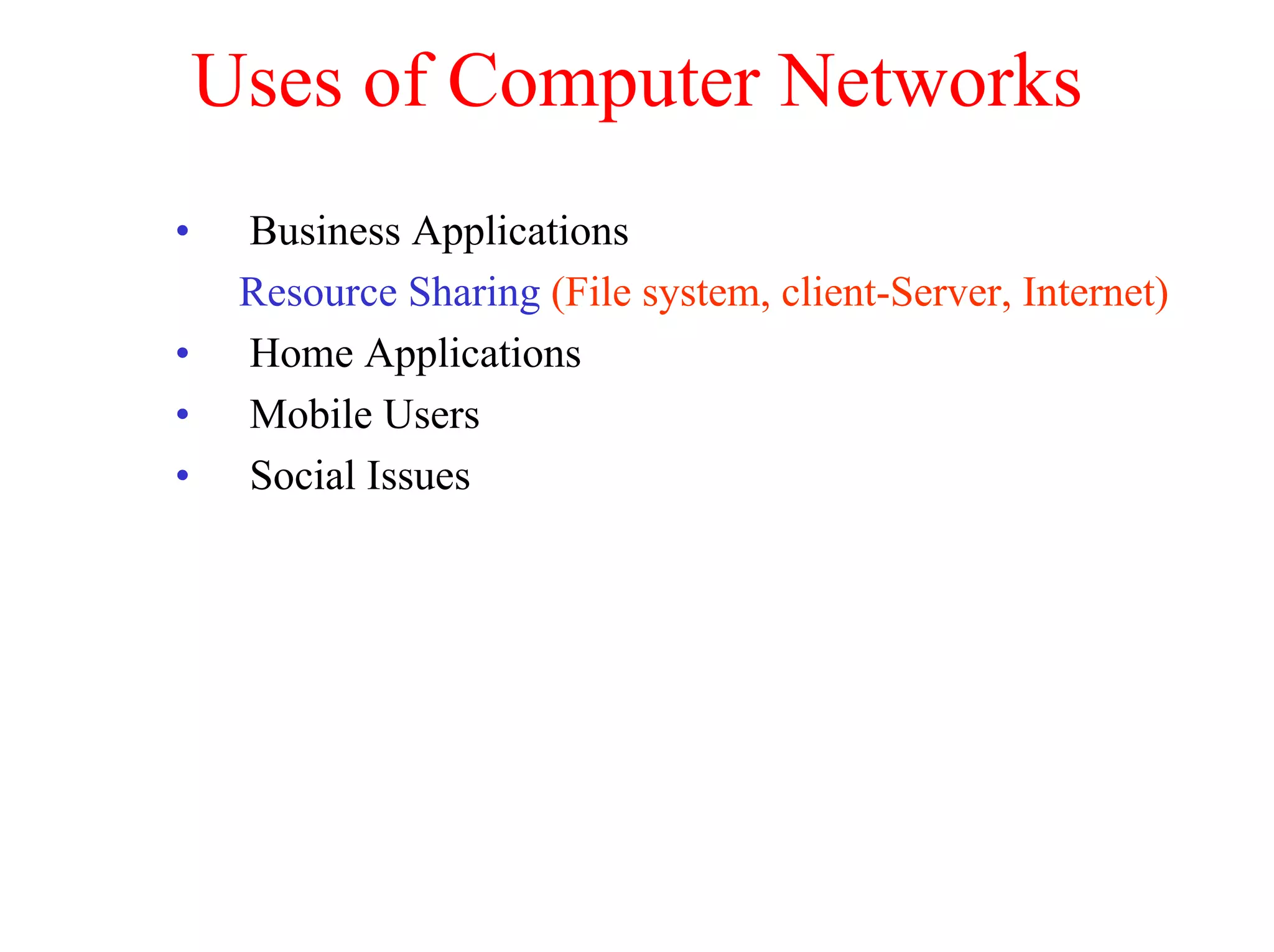
Uses of Computer Networks
•    Business Applications
     Resource Sharing (File system, client-Server, Internet)
•    Home Applications
•    Mobile Users
•    Social Issues
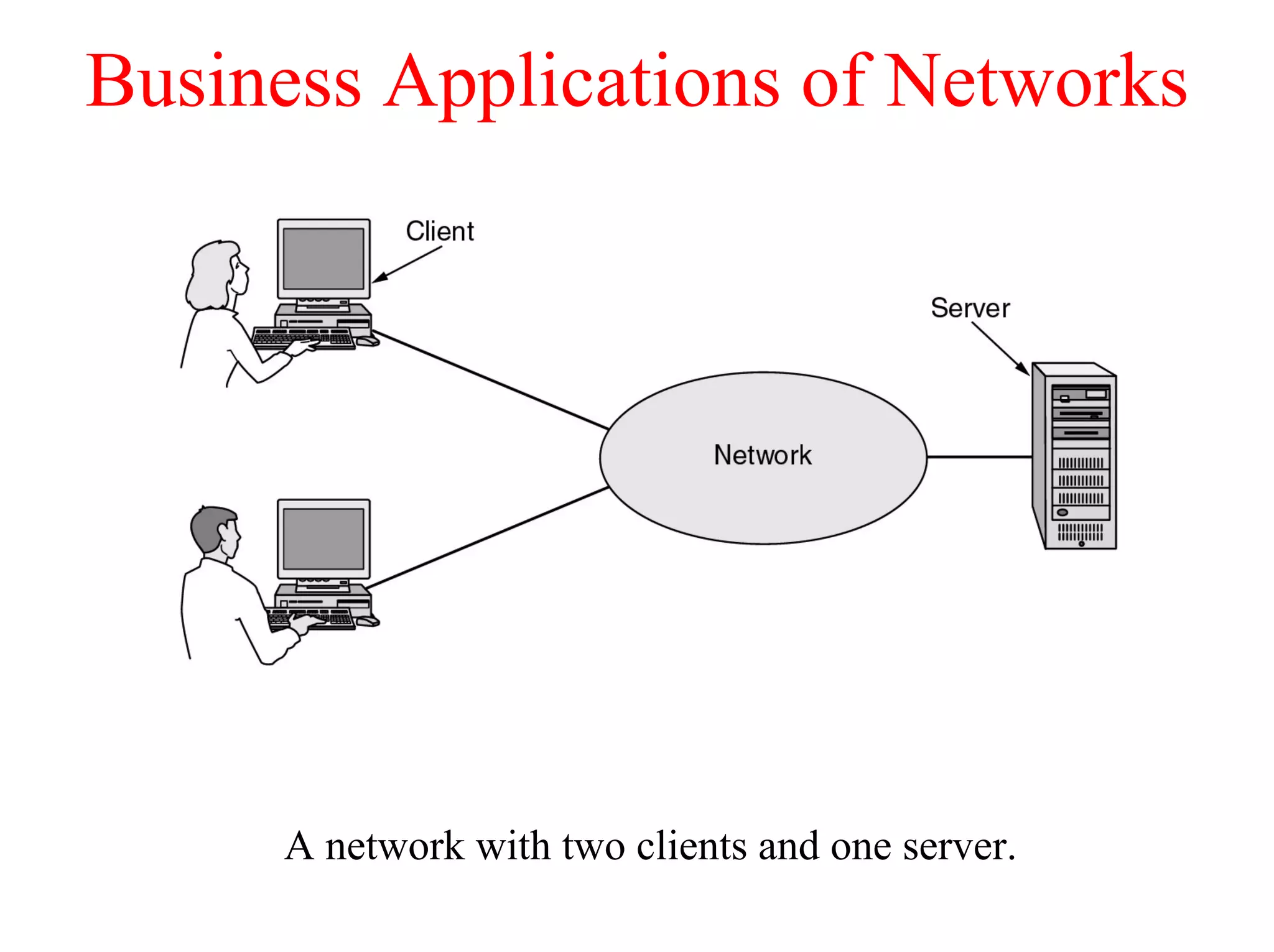
Business Applications of Networks


     A network with two clients and one server.
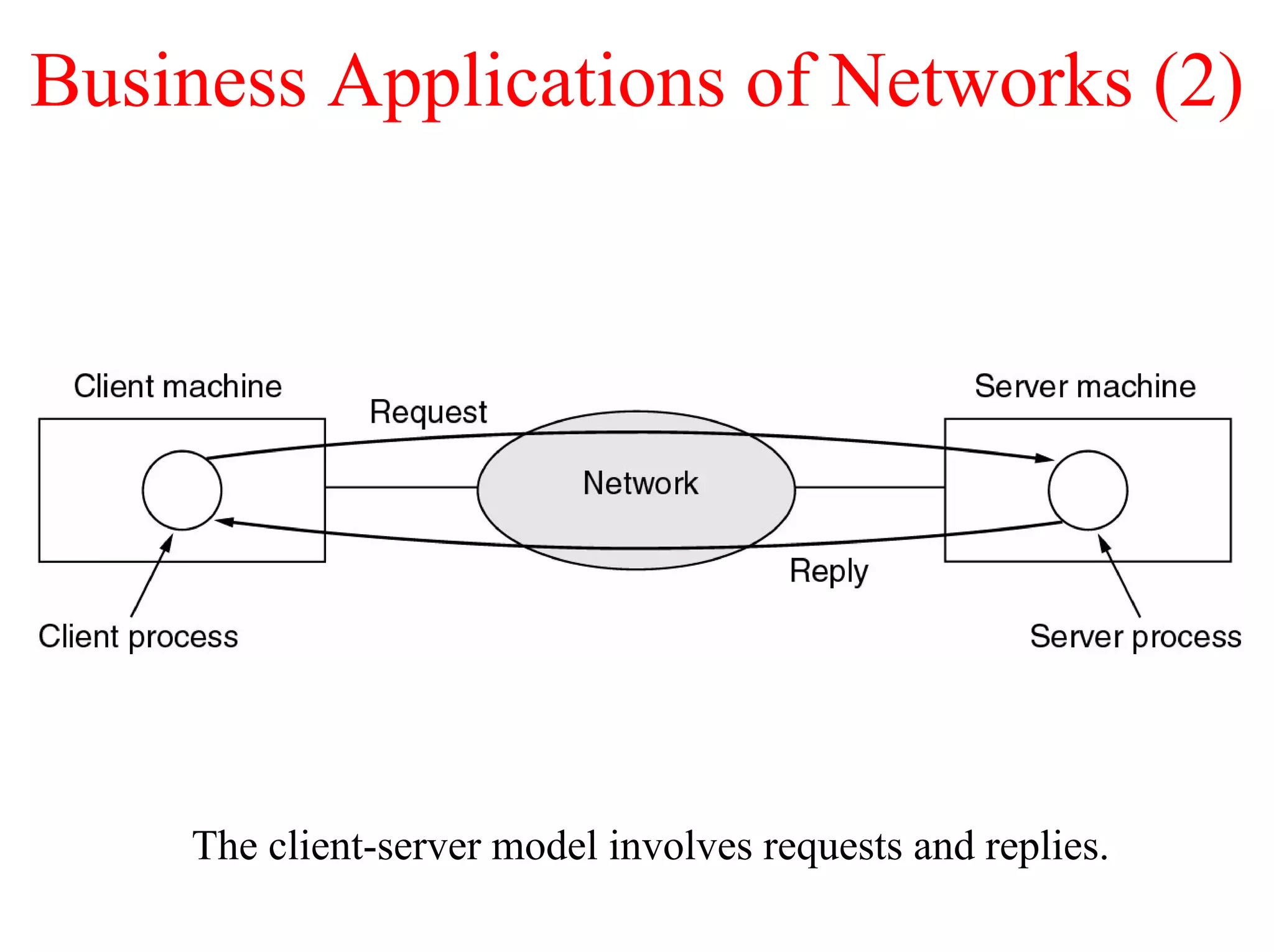
Business Applications of Networks (2)


    The client-server model involves requests and replies.
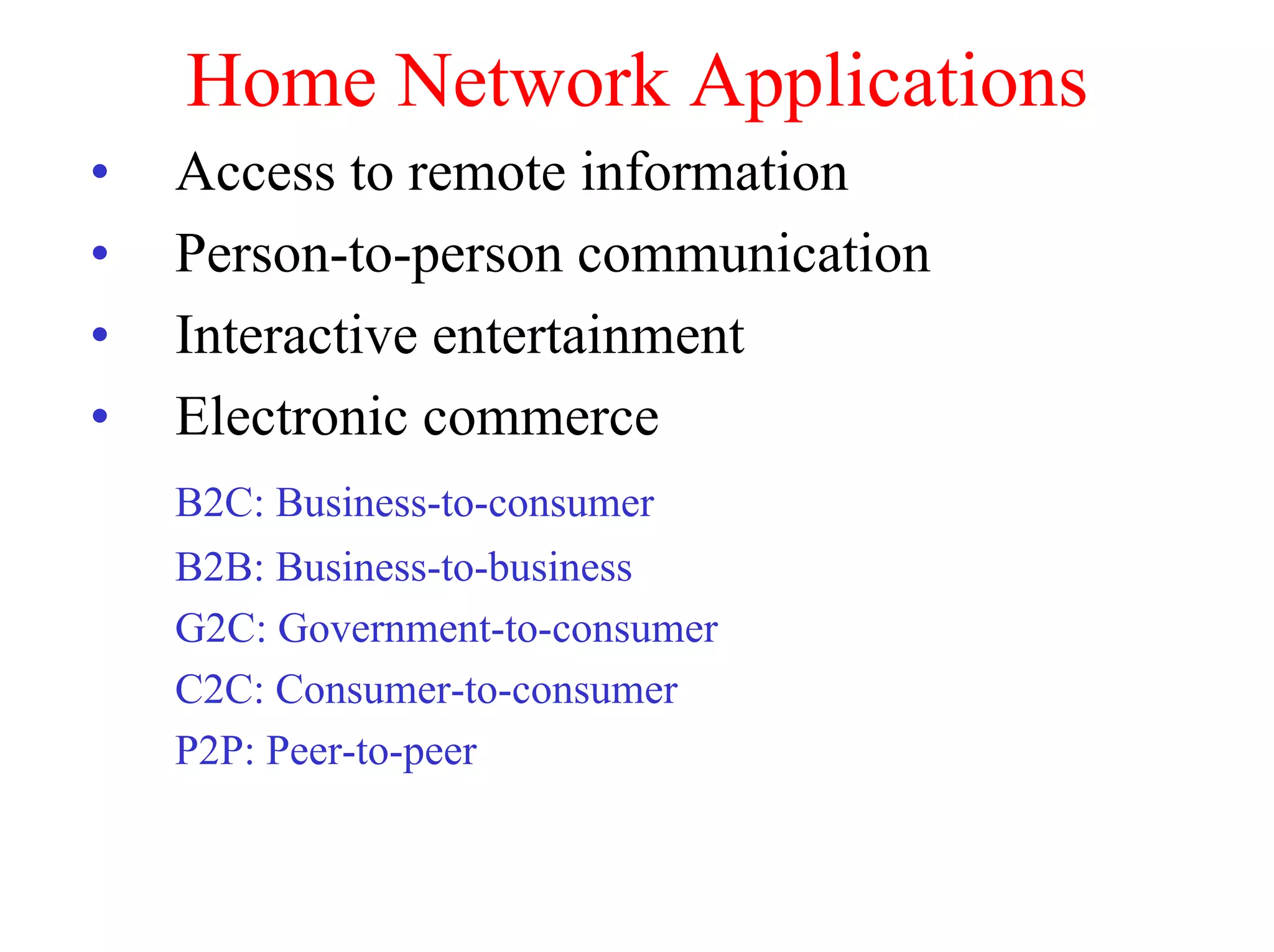
Home Network Applications
•   Access to remote information
•   Person-to-person communication
•   Interactive entertainment
•   Electronic commerce
    B2C: Business-to-consumer
    B2B: Business-to-business
    G2C: Government-to-consumer
    C2C: Consumer-to-consumer
    P2P: Peer-to-peer
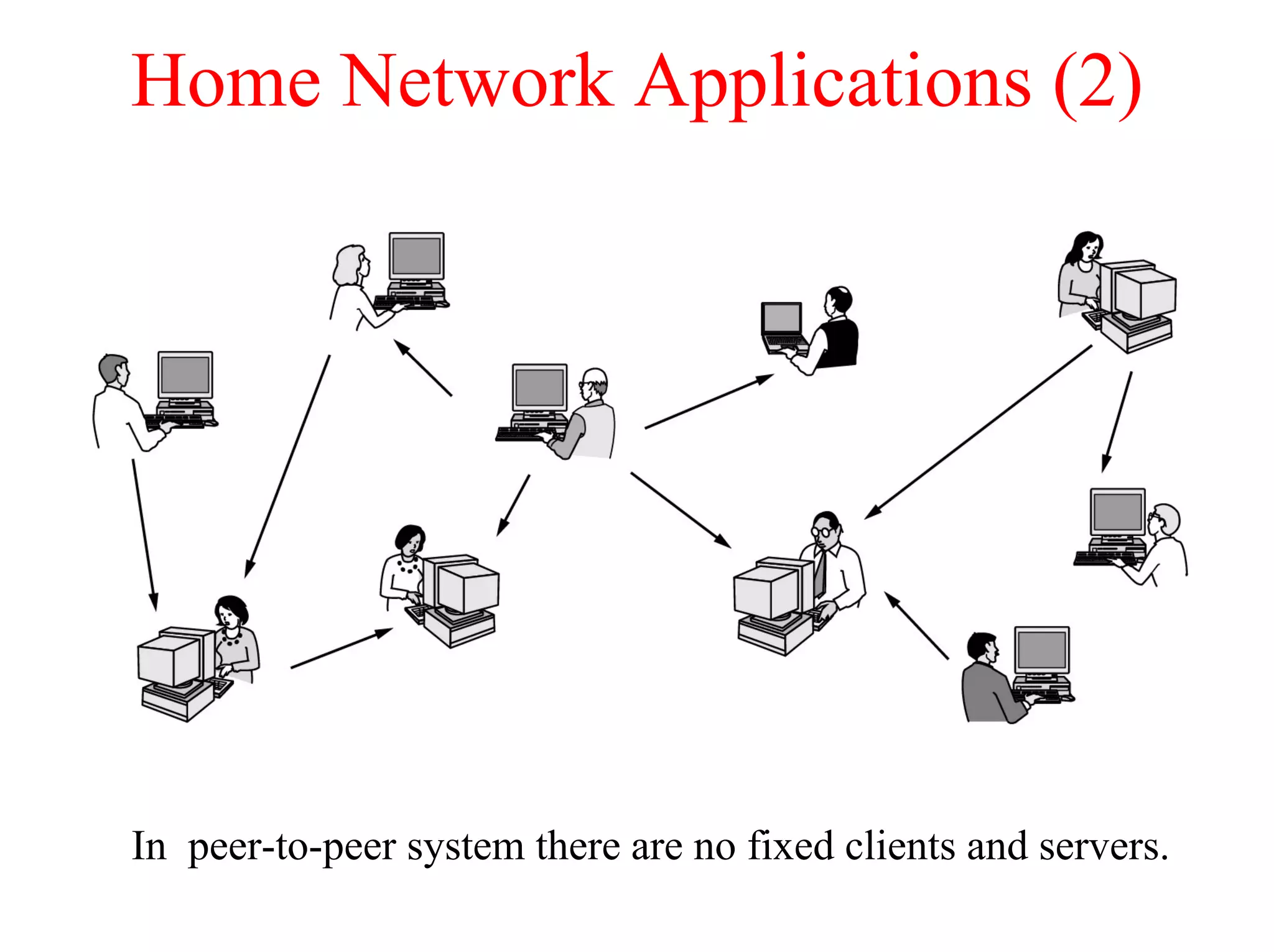
Home Network Applications (2)


In peer-to-peer system there are no fixed clients and servers.
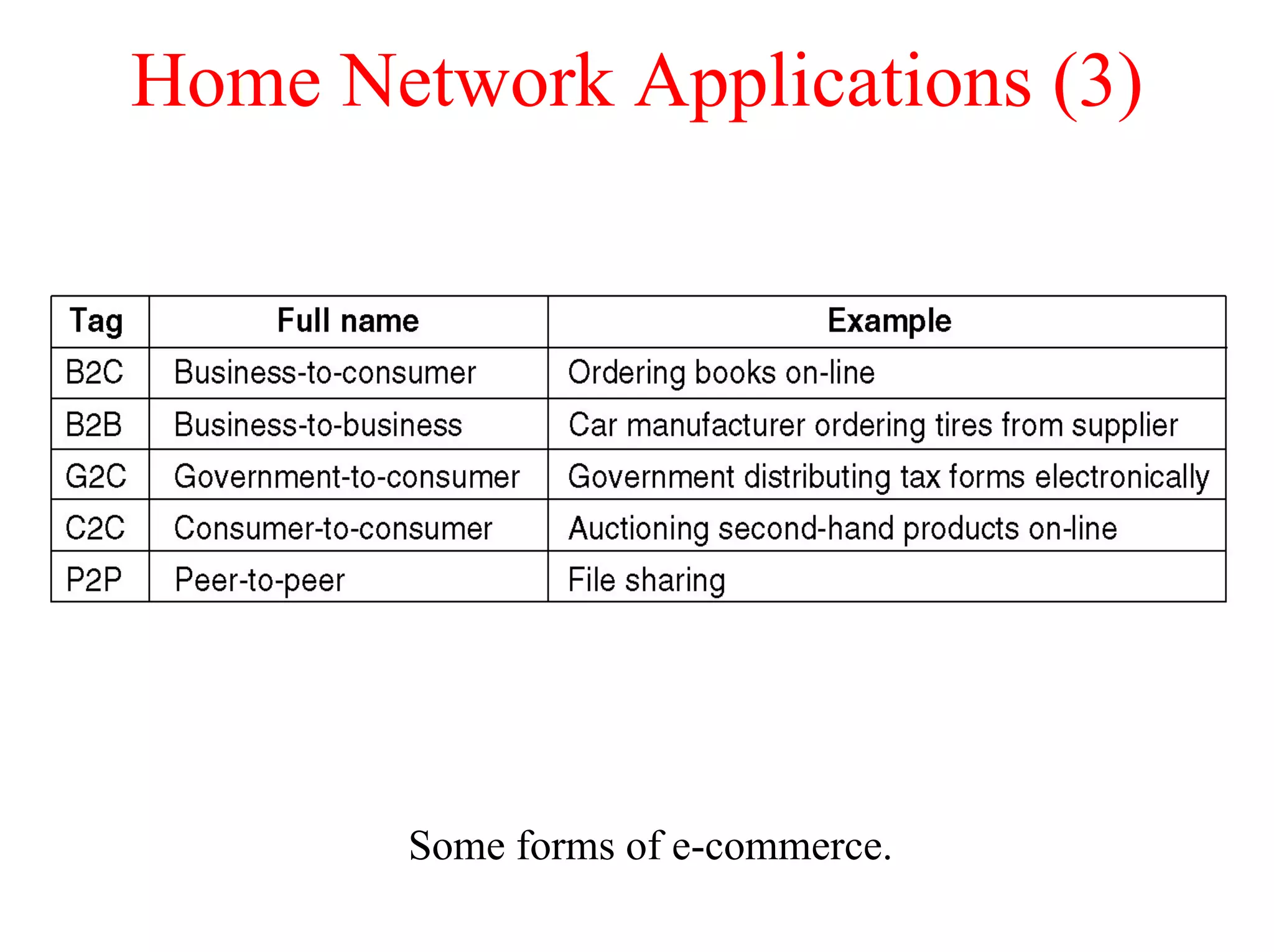
Home Network Applications (3)


       Some forms of e-commerce.
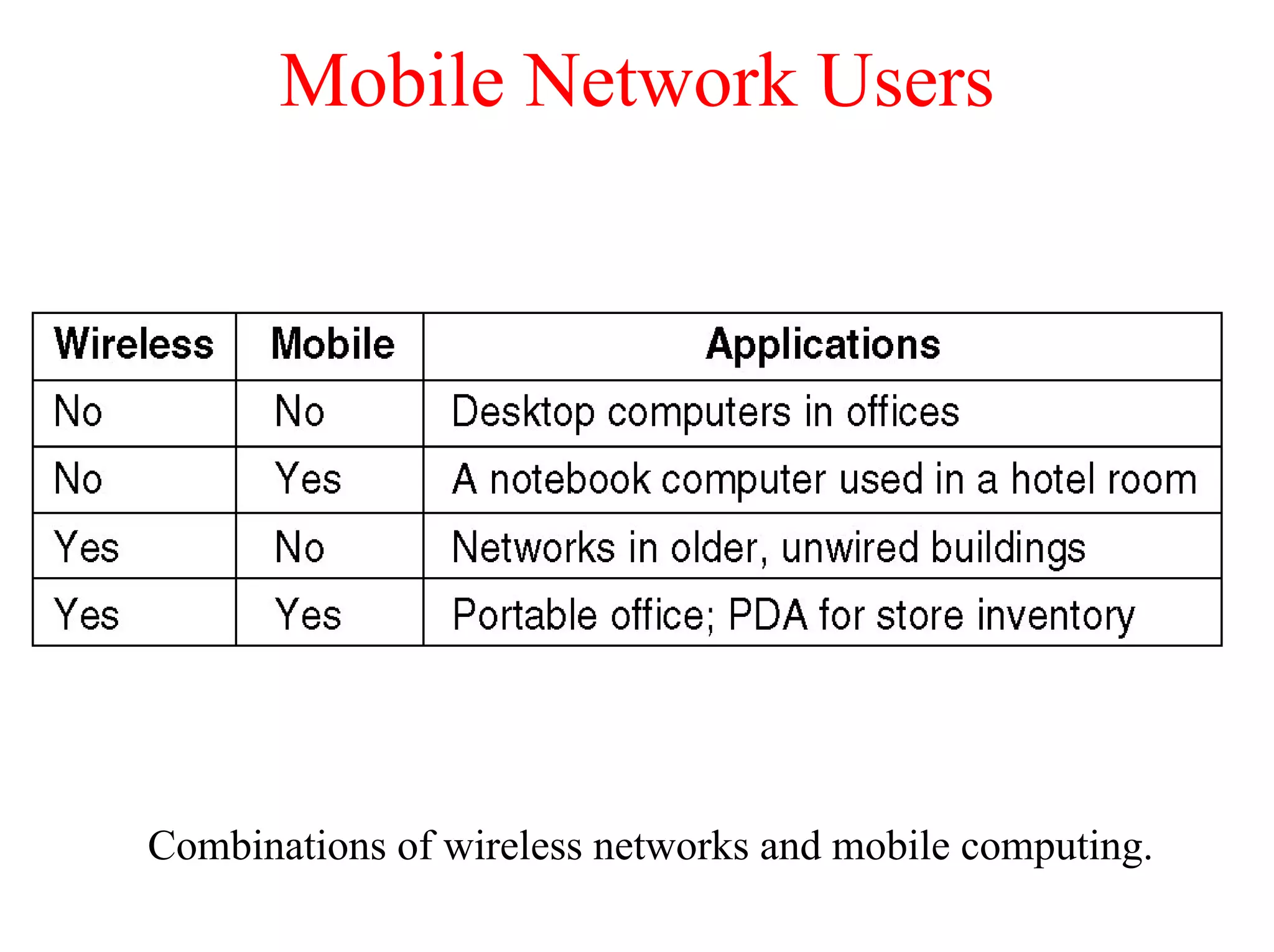
Mobile Network Users


Combinations of wireless networks and mobile computing.
Network Hardware

•   Local Area Networks
•   Metropolitan Area Networks
•   Wide Area Networks
•   Wireless Networks
•   Home Networks
•   Inter-networks
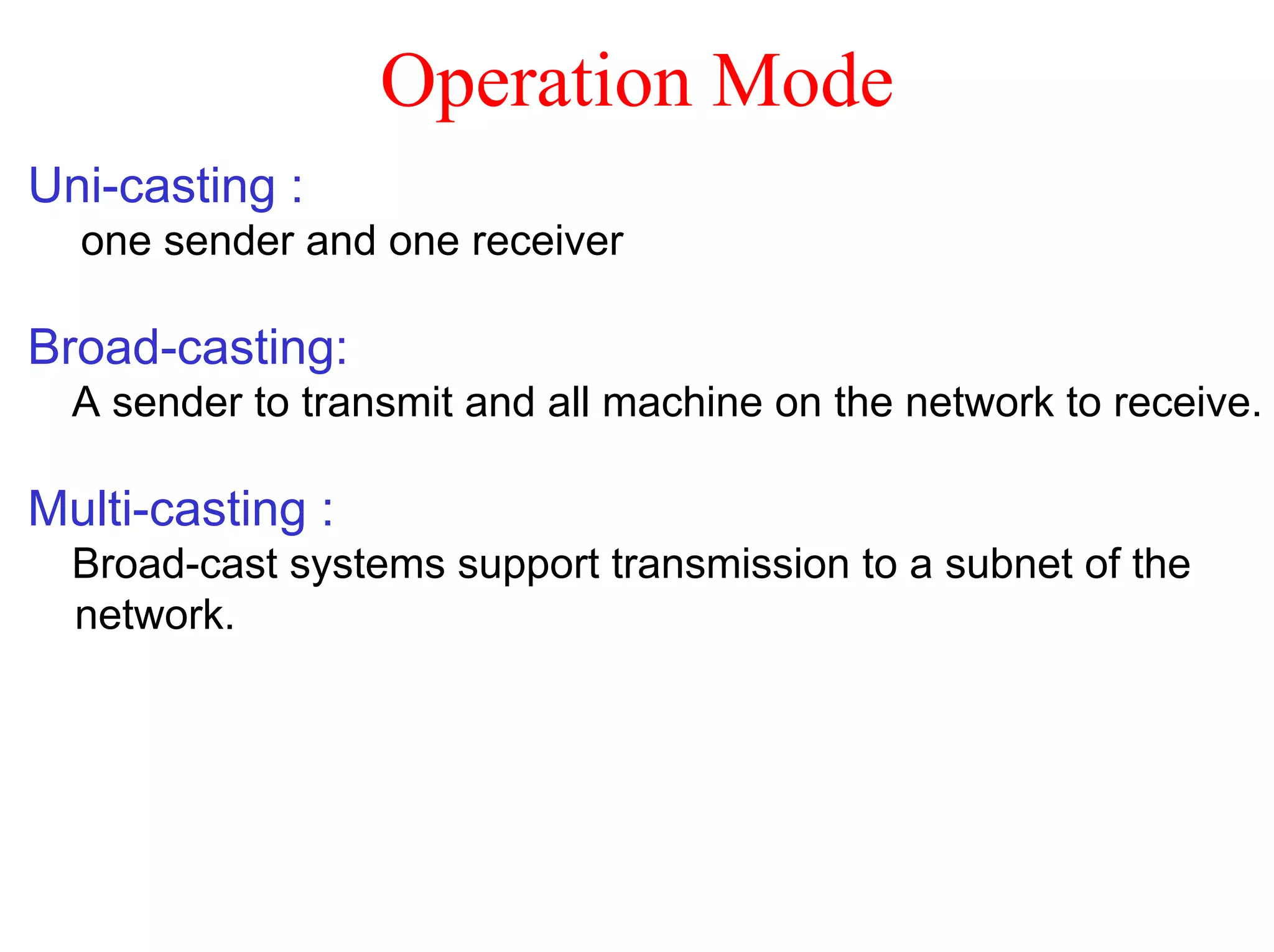
Operation Mode
Uni-casting :
  one sender and one receiver

Broad-casting:
  A sender to transmit and all machine on the network to receive.

Multi-casting :
  Broad-cast systems support transmission to a subnet of the
  network.
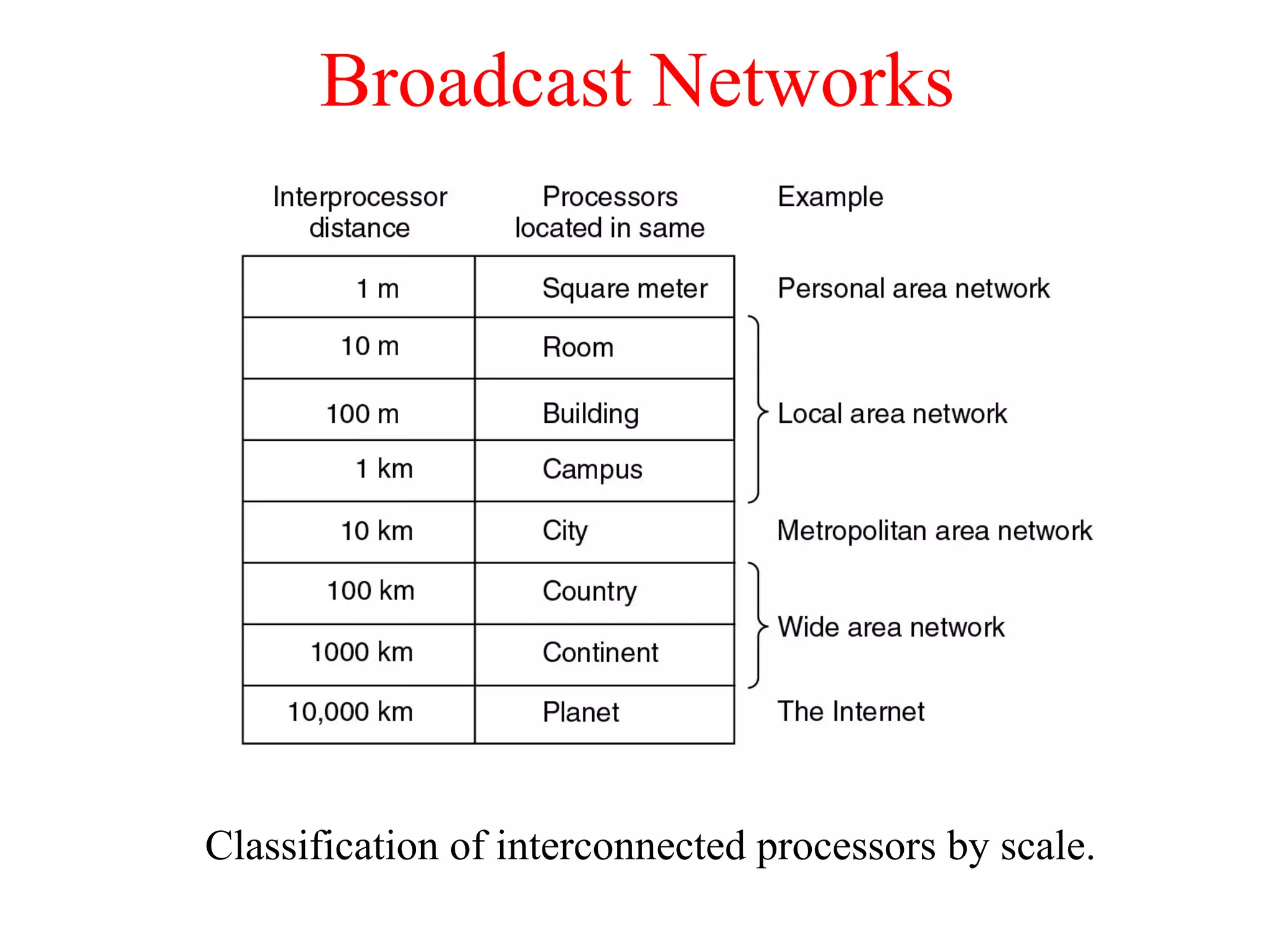
Broadcast Networks


Classification of interconnected processors by scale.
Local Area Networks


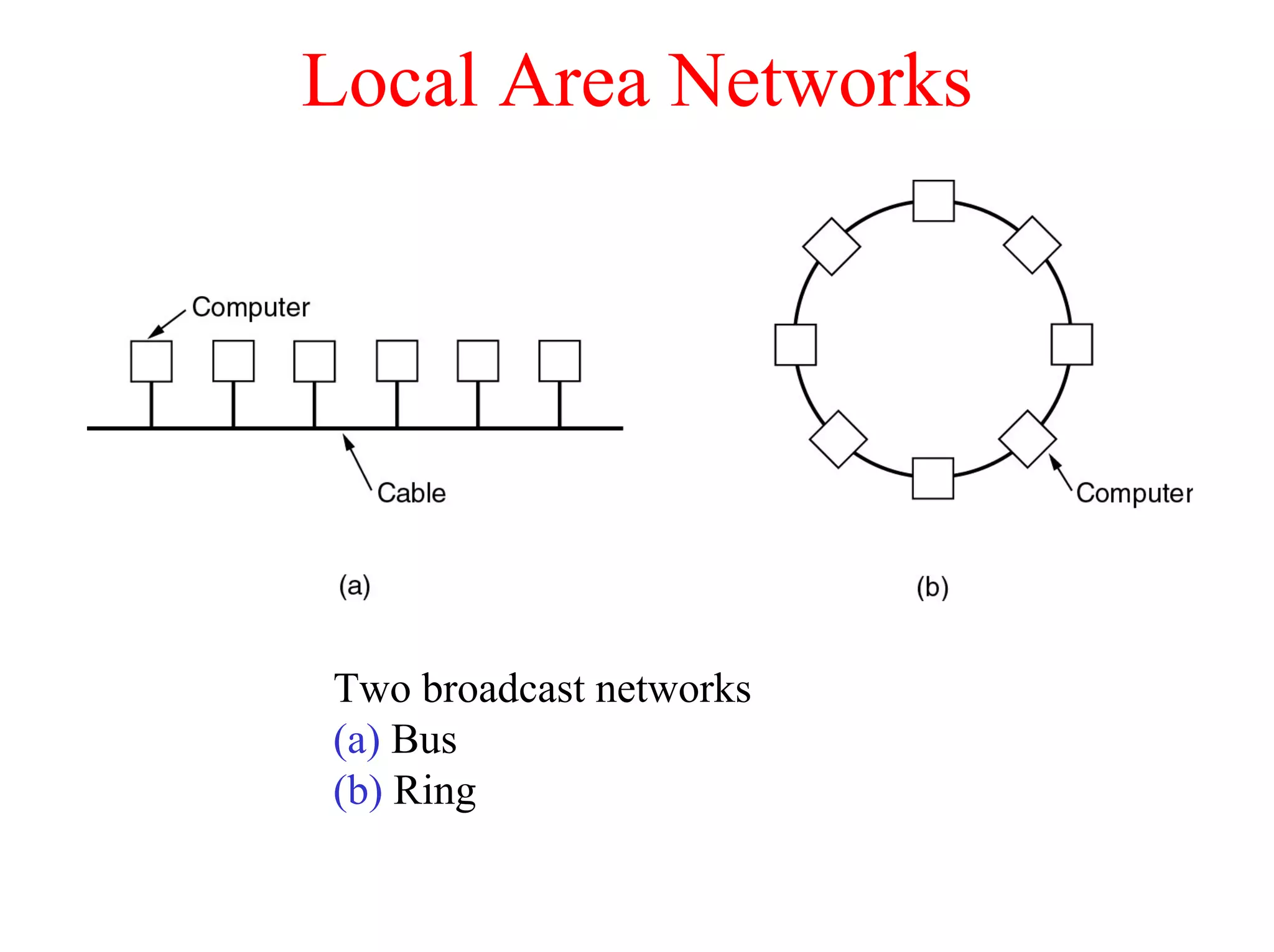
Two broadcast networks
(a) Bus
(b) Ring
Metropolitan Area Networks


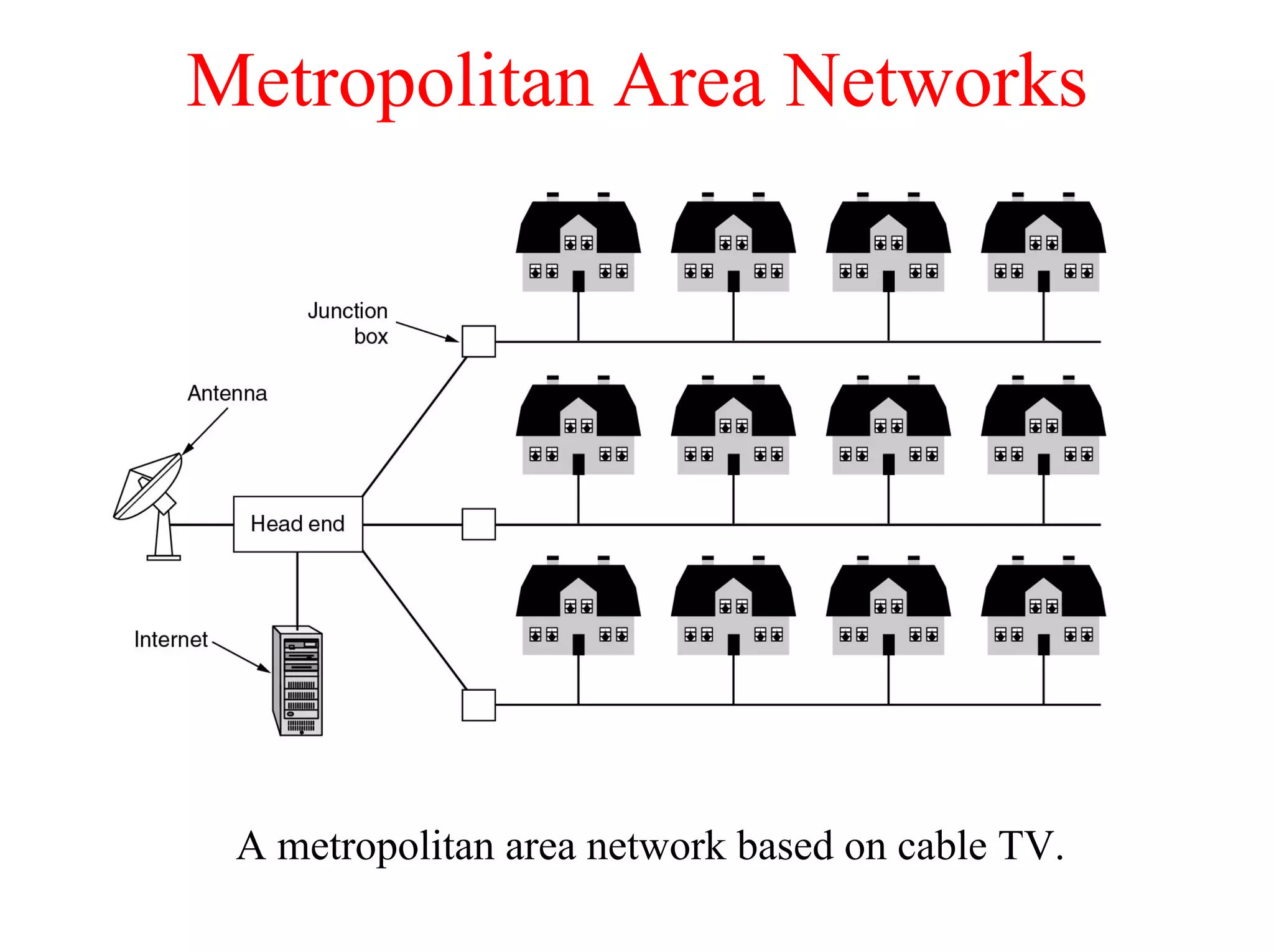
 A metropolitan area network based on cable TV.
Wide Area Networks


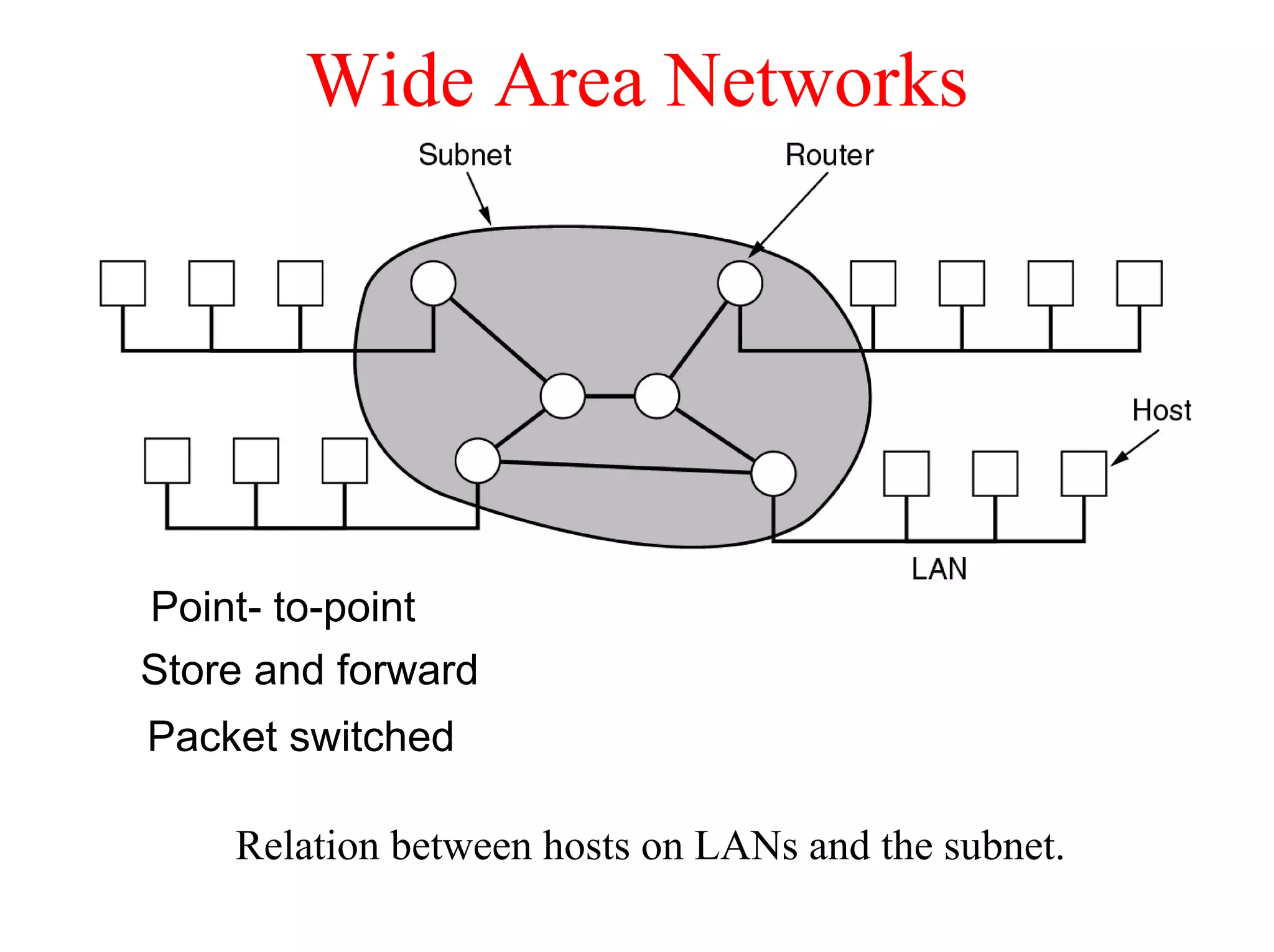
Point- to-point
Store and forward
Packet switched

    Relation between hosts on LANs and the subnet.
Wide Area Networks (2)


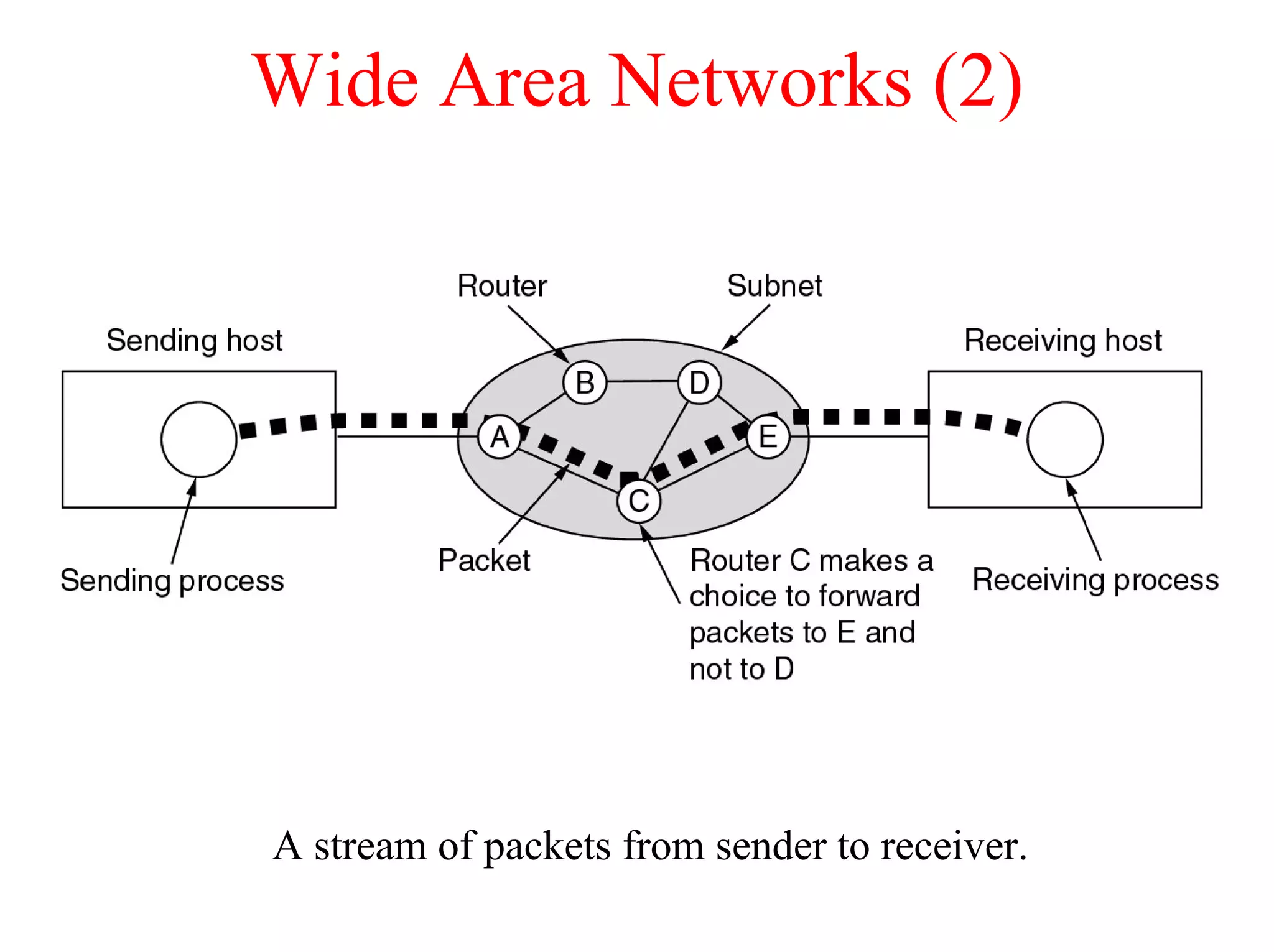
A stream of packets from sender to receiver.
Wireless Networks

Categories of wireless networks:
• System interconnection
• Wireless LANs
• Wireless WANs
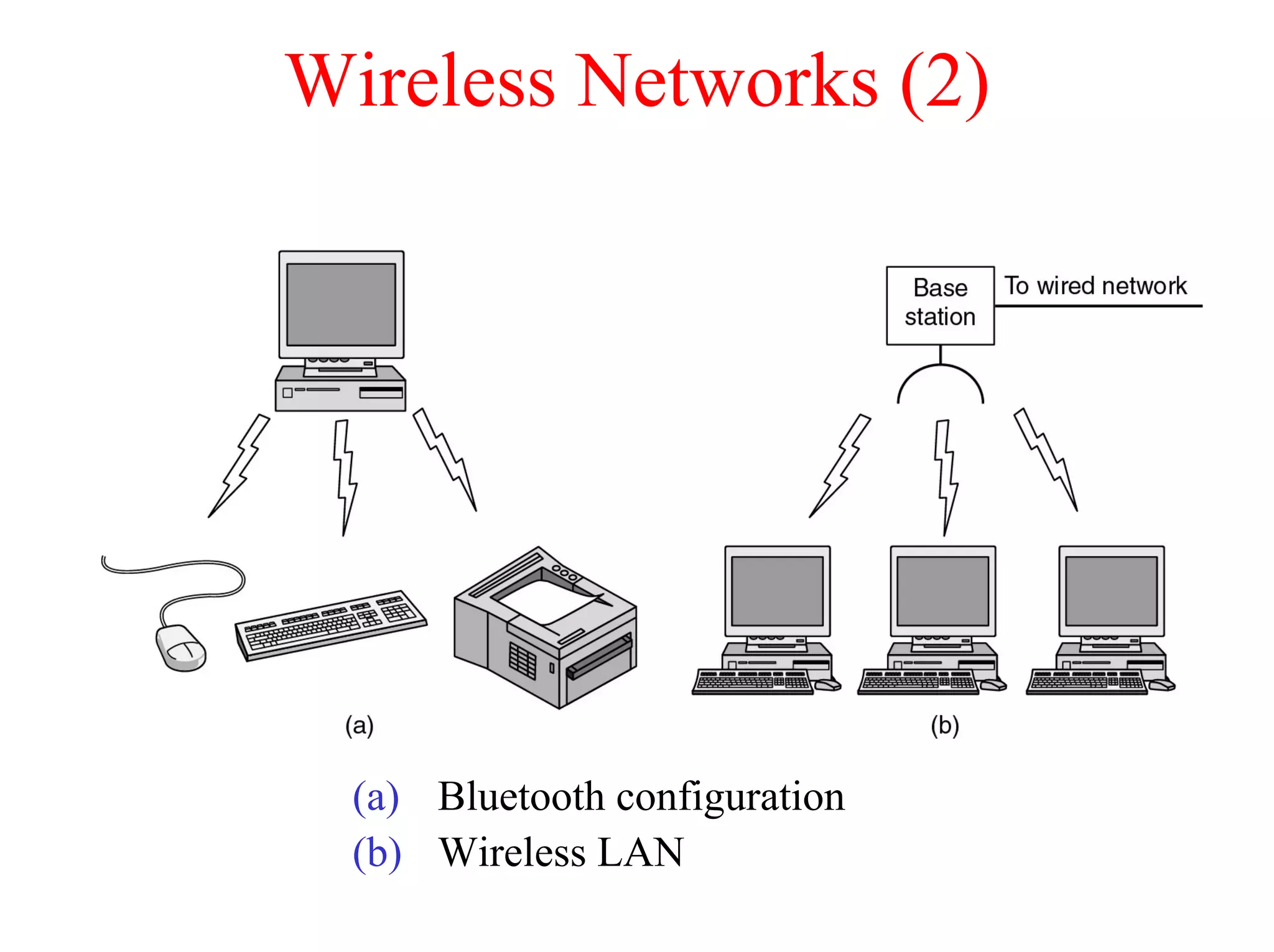
Wireless Networks (2)


  (a) Bluetooth configuration
  (b) Wireless LAN
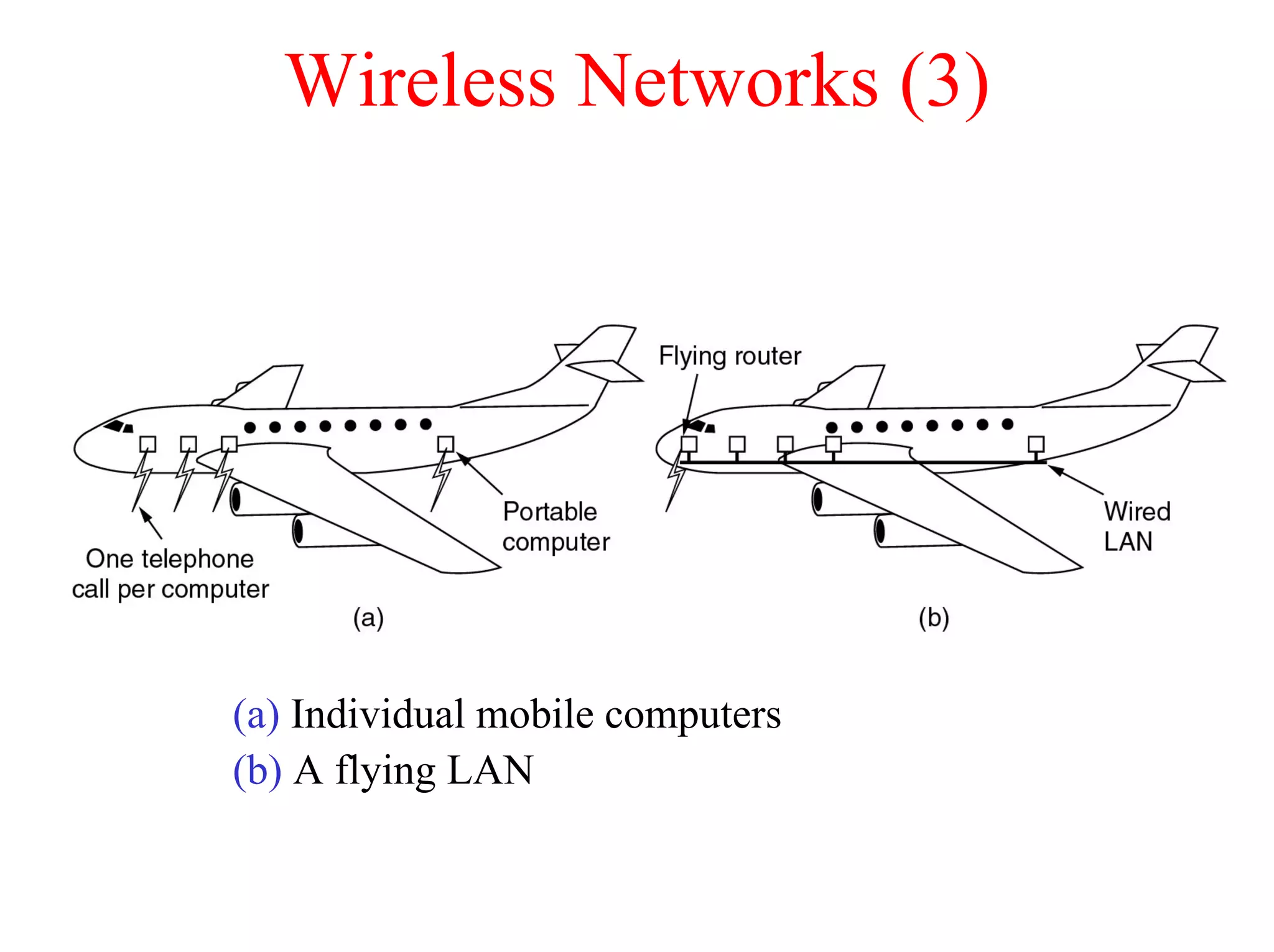
Wireless Networks (3)


(a) Individual mobile computers
(b) A flying LAN
Home Network Categories
•   Computers (desktop PC, PDA, shared peripherals)
•   Entertainment (TV, DVD, VCR, camera, stereo, MP3)
•   Telecomm (telephone, cell phone, intercom, fax)
•   Appliances (microwave, fridge, clock, furnace, airco)
•   Telemetry (utility meter, burglar alarm, babycam).
Network Software
•   Protocol Hierarchies (protocol Stack)
•   Design Issues for the Layers
•   Connection-Oriented and Connectionless Services
•   Service Primitives
•   The Relationship of Services to Protocols
Network Software
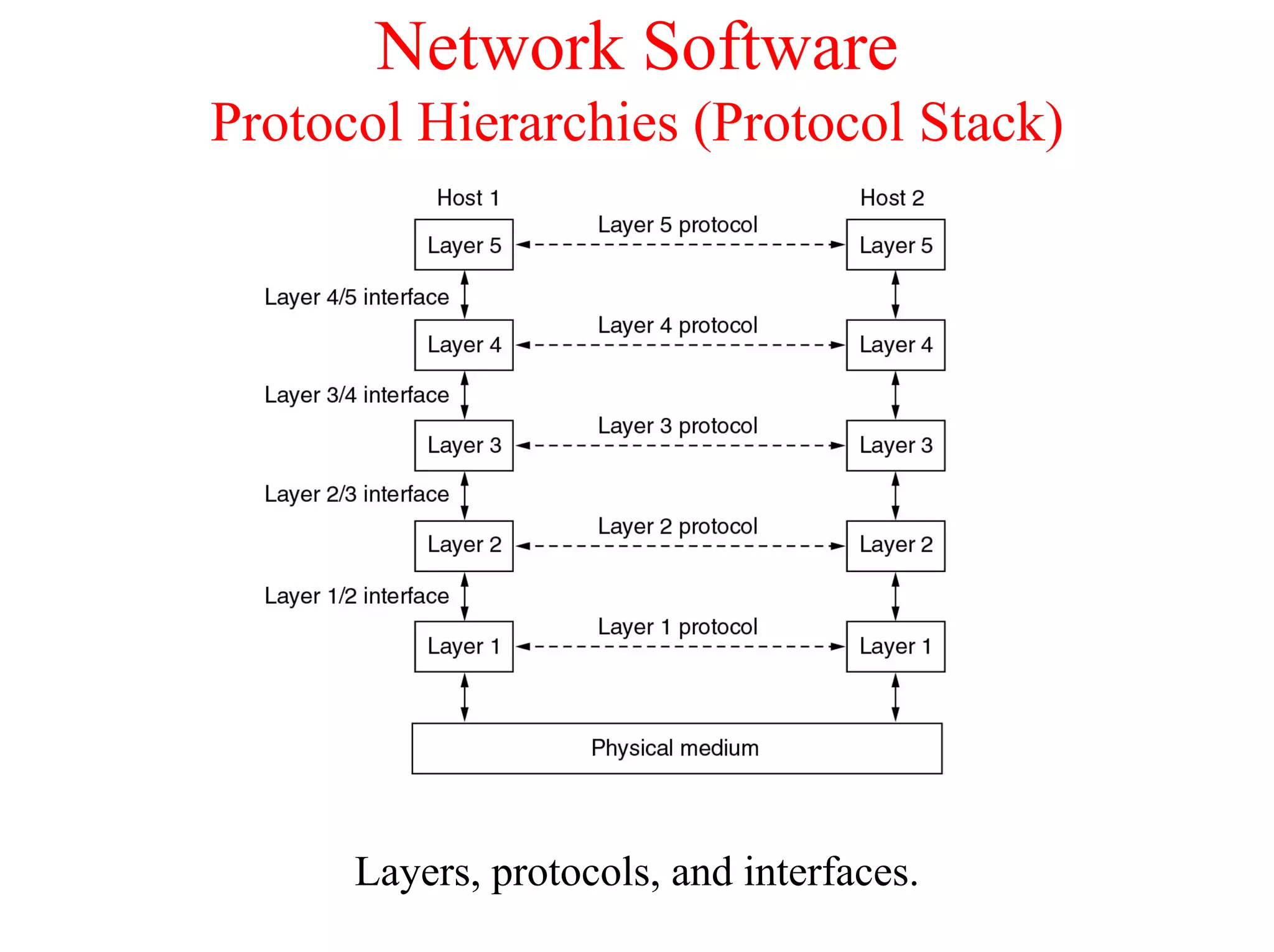
Protocol Hierarchies (Protocol Stack)


      Layers, protocols, and interfaces.
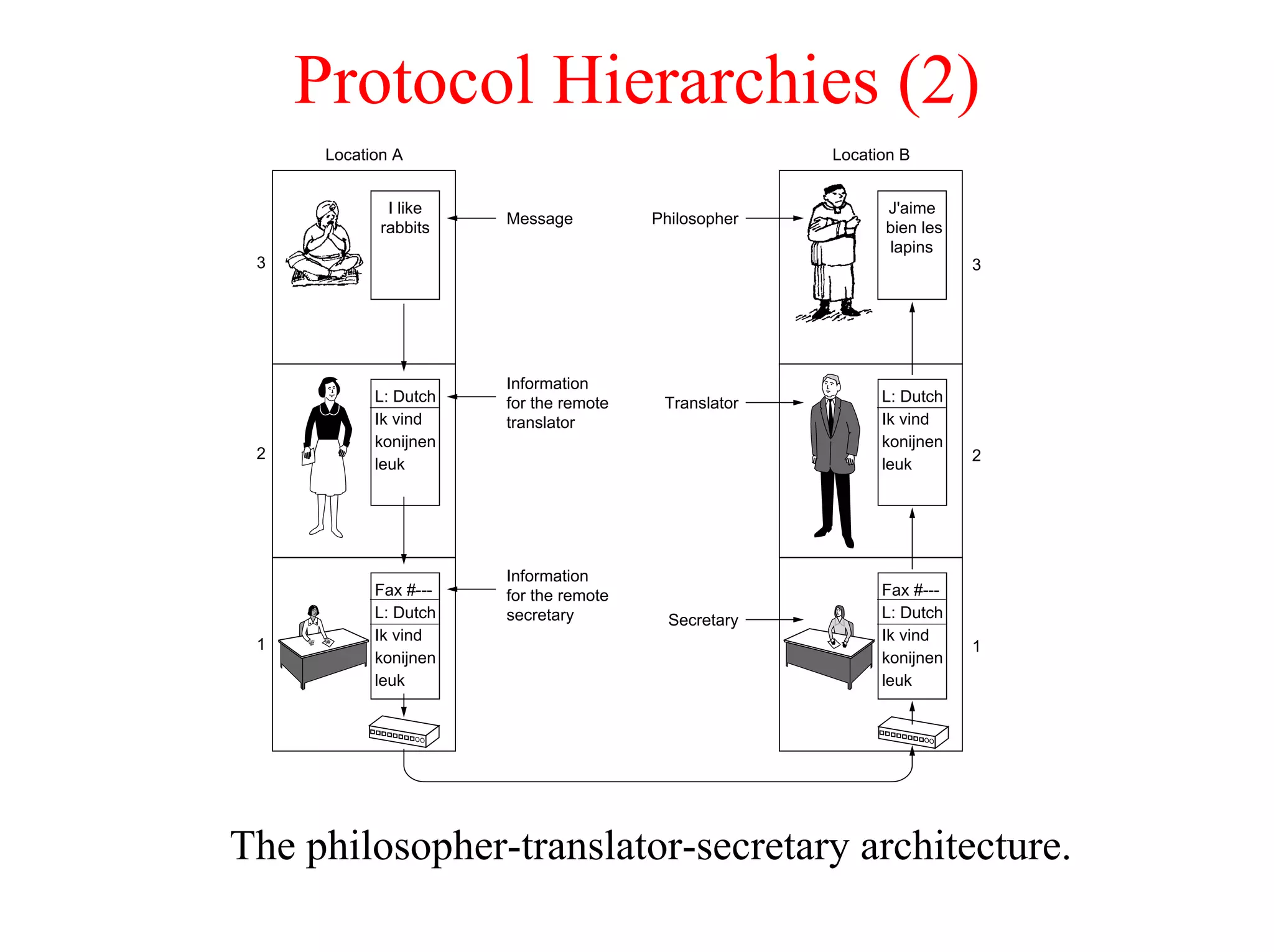
Protocol Hierarchies (2)
      Location A                                      Location B


              I like                                        J'aime
                       Message          Philosopher
             rabbits                                        bien les
                                                            lapins
 3                                                                     3


                       Information
            L: Dutch   for the remote    Translator         L: Dutch
            Ik vind    translator                           Ik vind
            konijnen                                        konijnen
 2                                                                     2
            leuk                                            leuk


                       Information
            Fax #---   for the remote                       Fax #---
            L: Dutch   secretary          Secretary         L: Dutch
            Ik vind                                         Ik vind
 1                                                                     1
            konijnen                                        konijnen
            leuk                                            leuk


The philosopher-translator-secretary architecture.
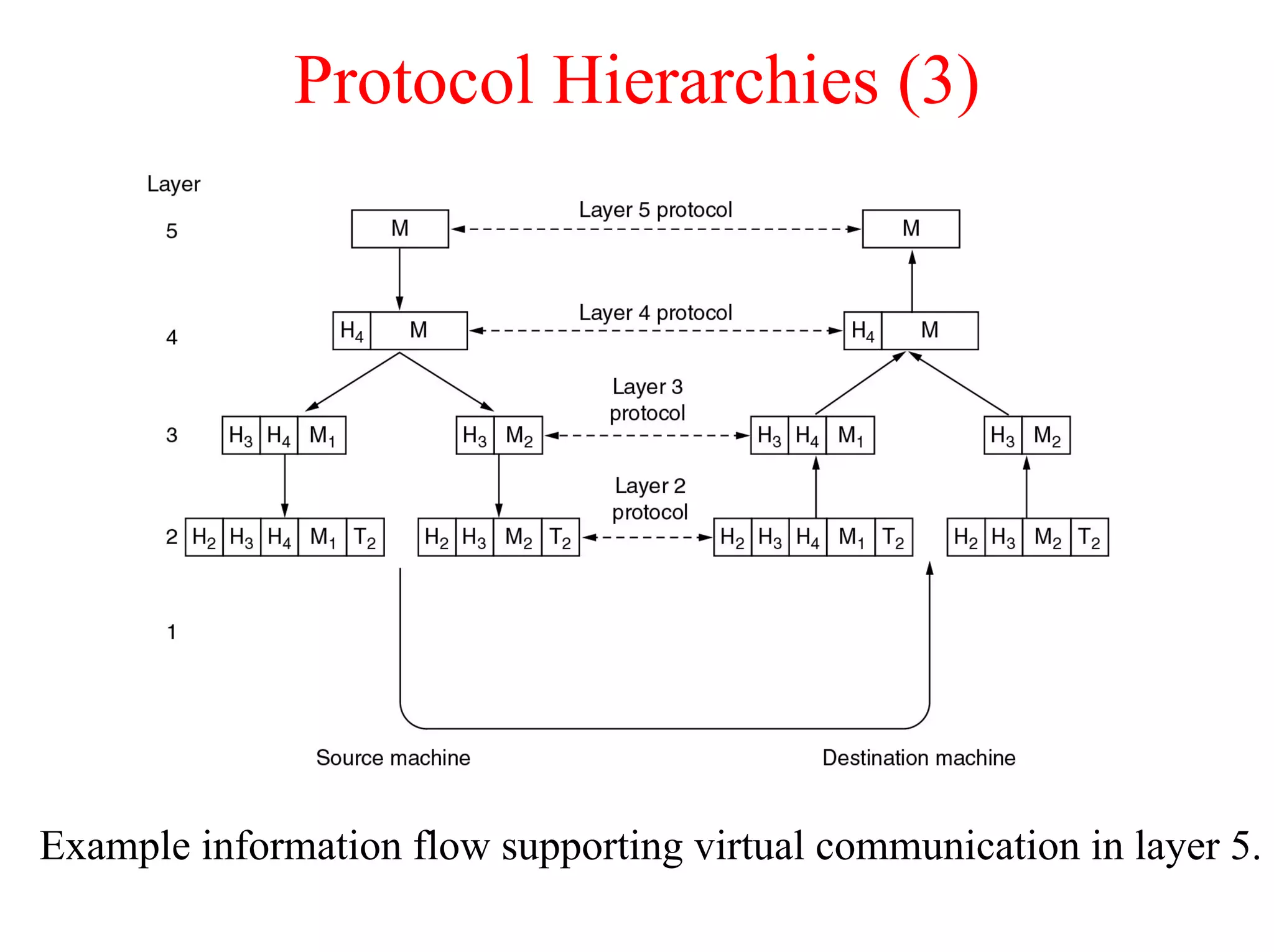
Protocol Hierarchies (3)


Example information flow supporting virtual communication in layer 5.
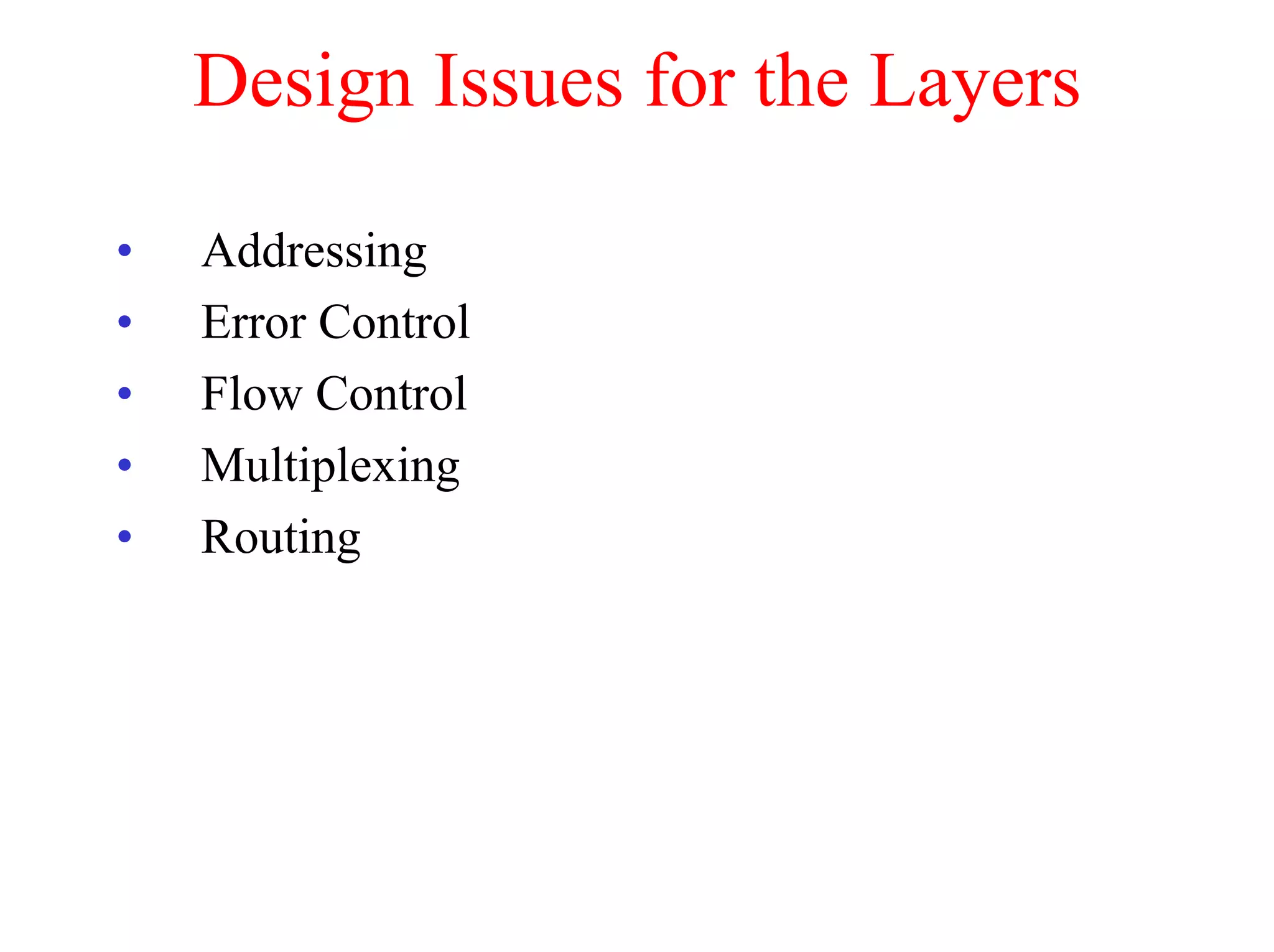
Design Issues for the Layers

•   Addressing
•   Error Control
•   Flow Control
•   Multiplexing
•   Routing
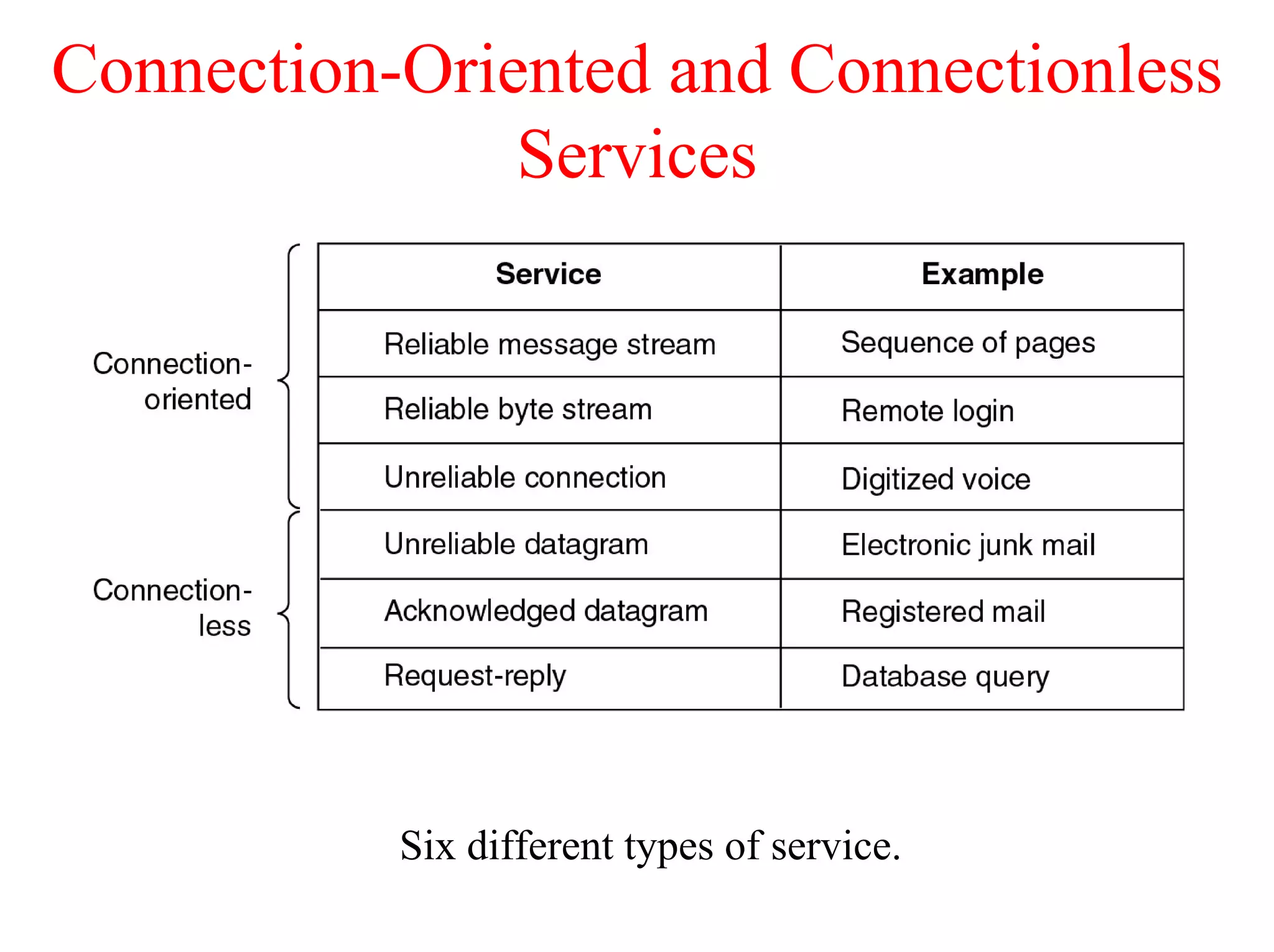
Connection-Oriented and Connectionless
               Services


           Six different types of service.
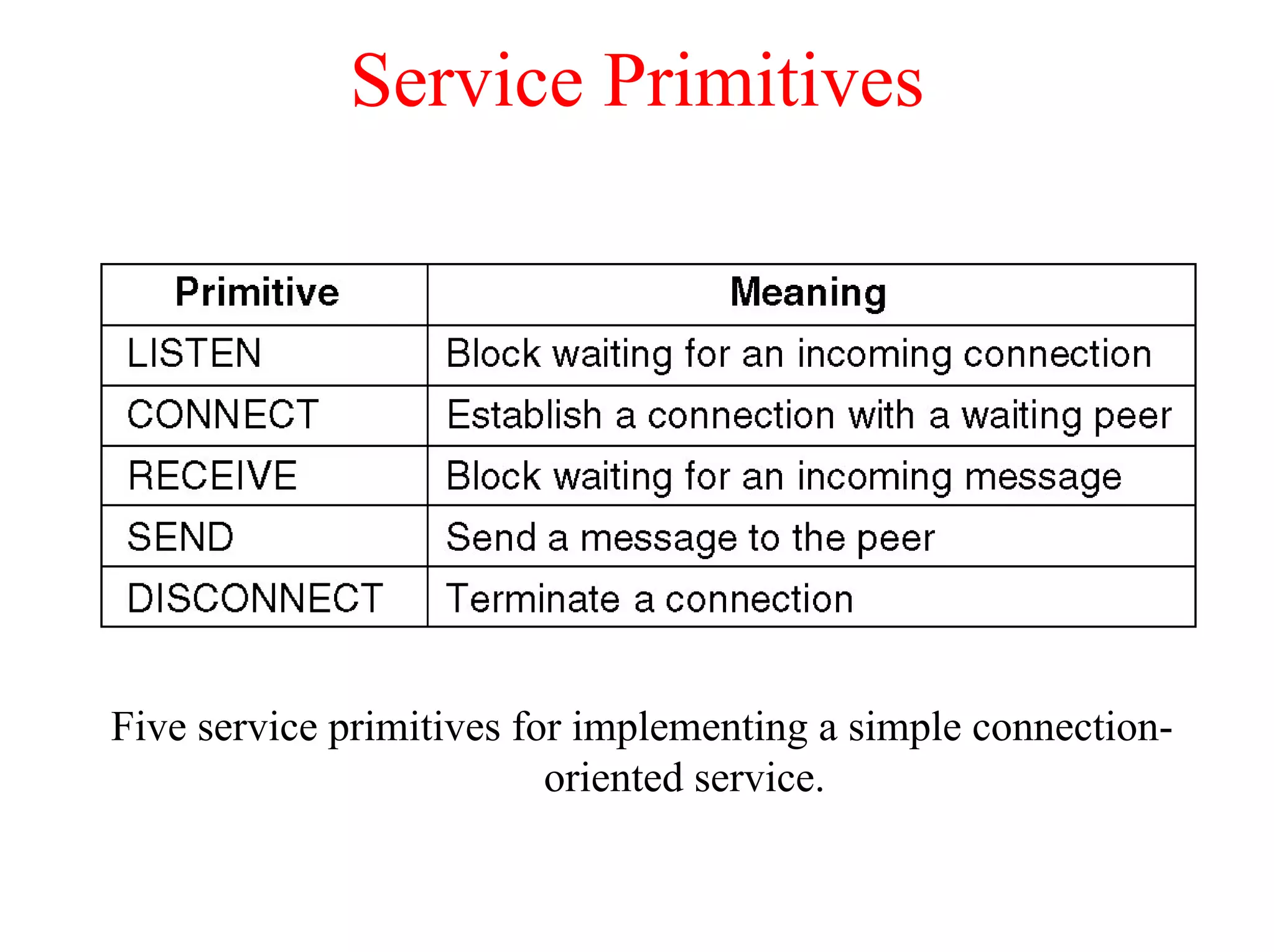
Service Primitives


Five service primitives for implementing a simple connection-
                          oriented service.
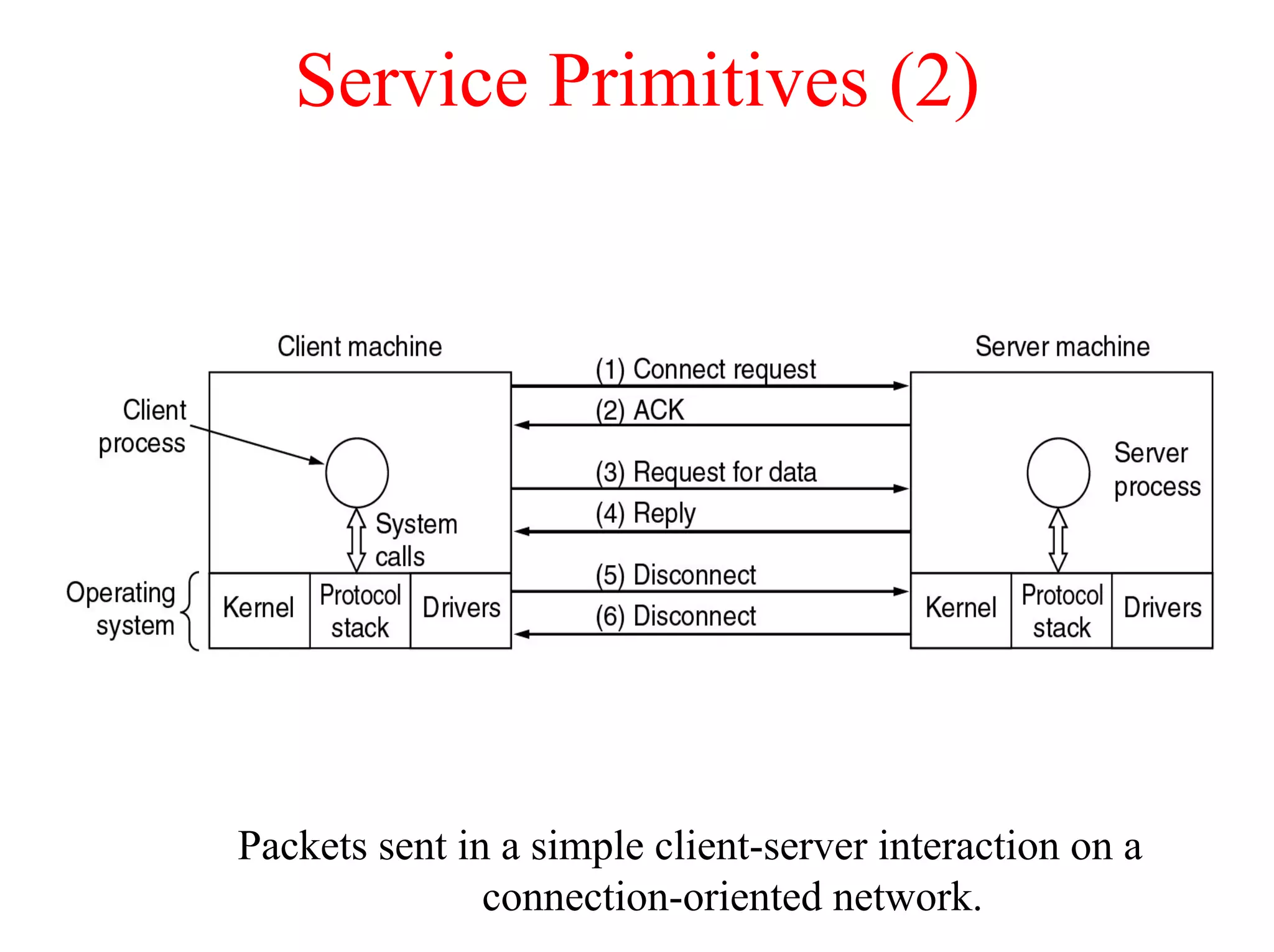
Service Primitives (2)


Packets sent in a simple client-server interaction on a
               connection-oriented network.
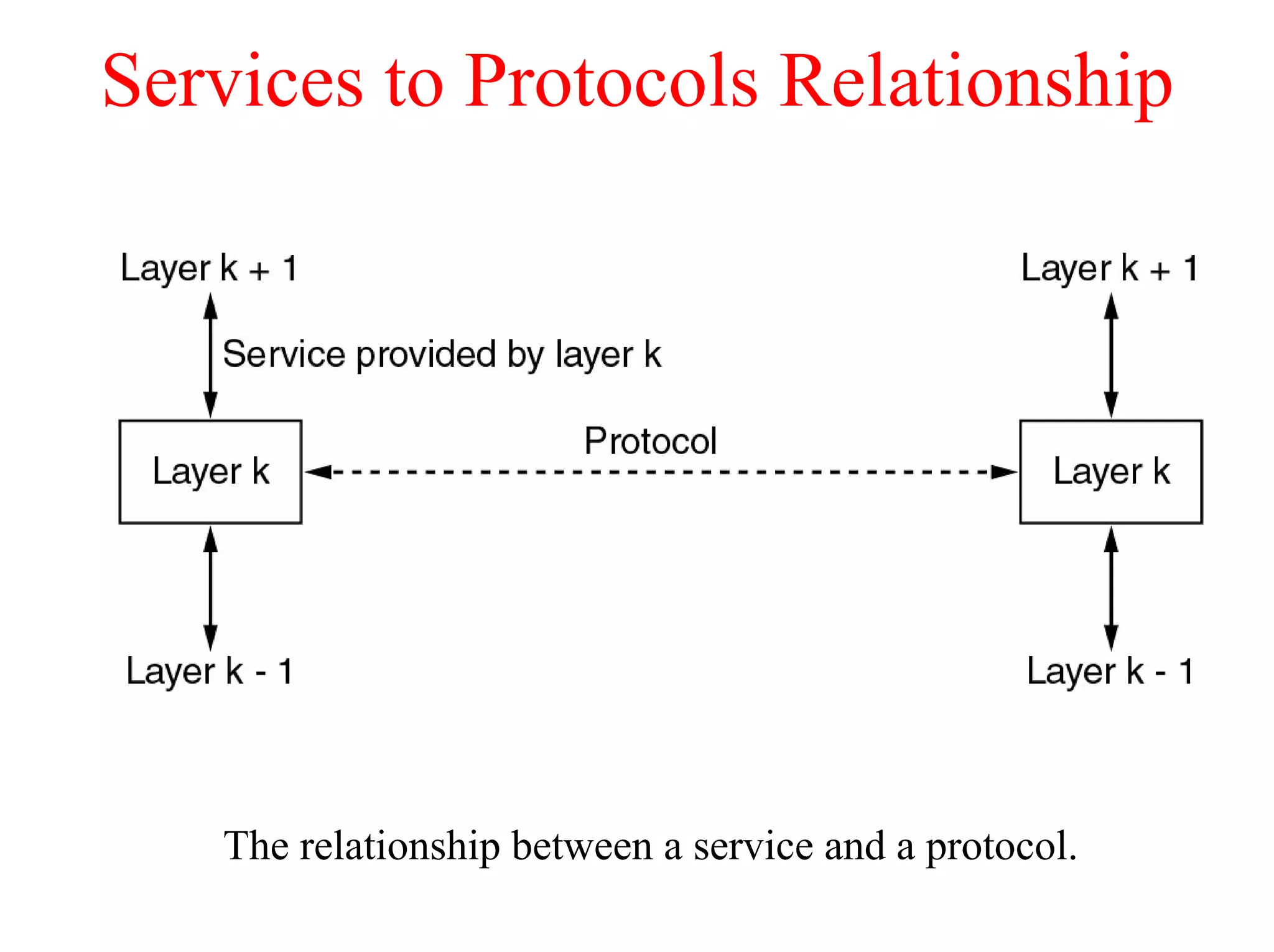
Services to Protocols Relationship


   The relationship between a service and a protocol.
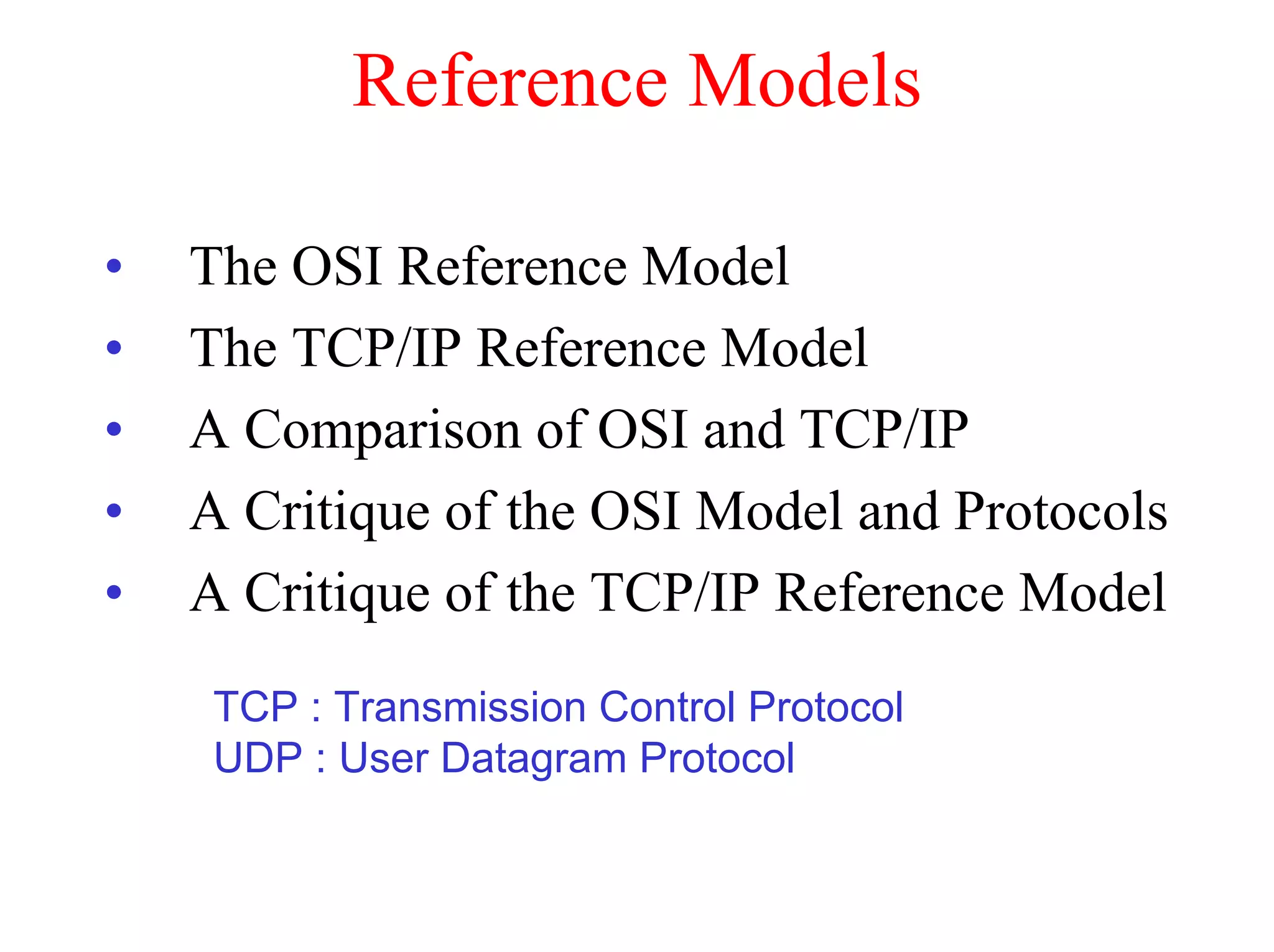
Reference Models

•   The OSI Reference Model
•   The TCP/IP Reference Model
•   A Comparison of OSI and TCP/IP
•   A Critique of the OSI Model and Protocols
•   A Critique of the TCP/IP Reference Model
     TCP : Transmission Control Protocol
     UDP : User Datagram Protocol
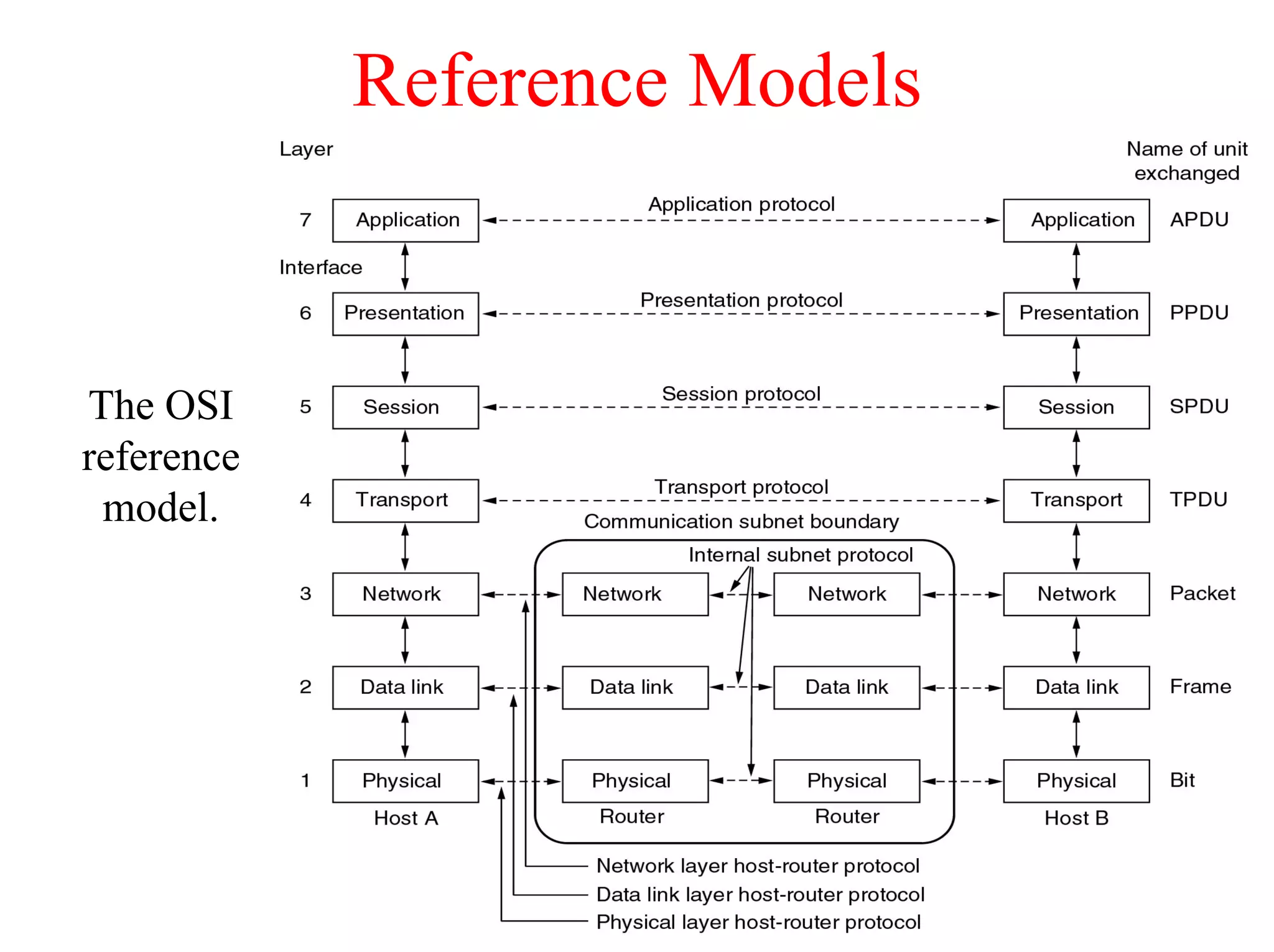
Reference Models


The OSI
reference
 model.
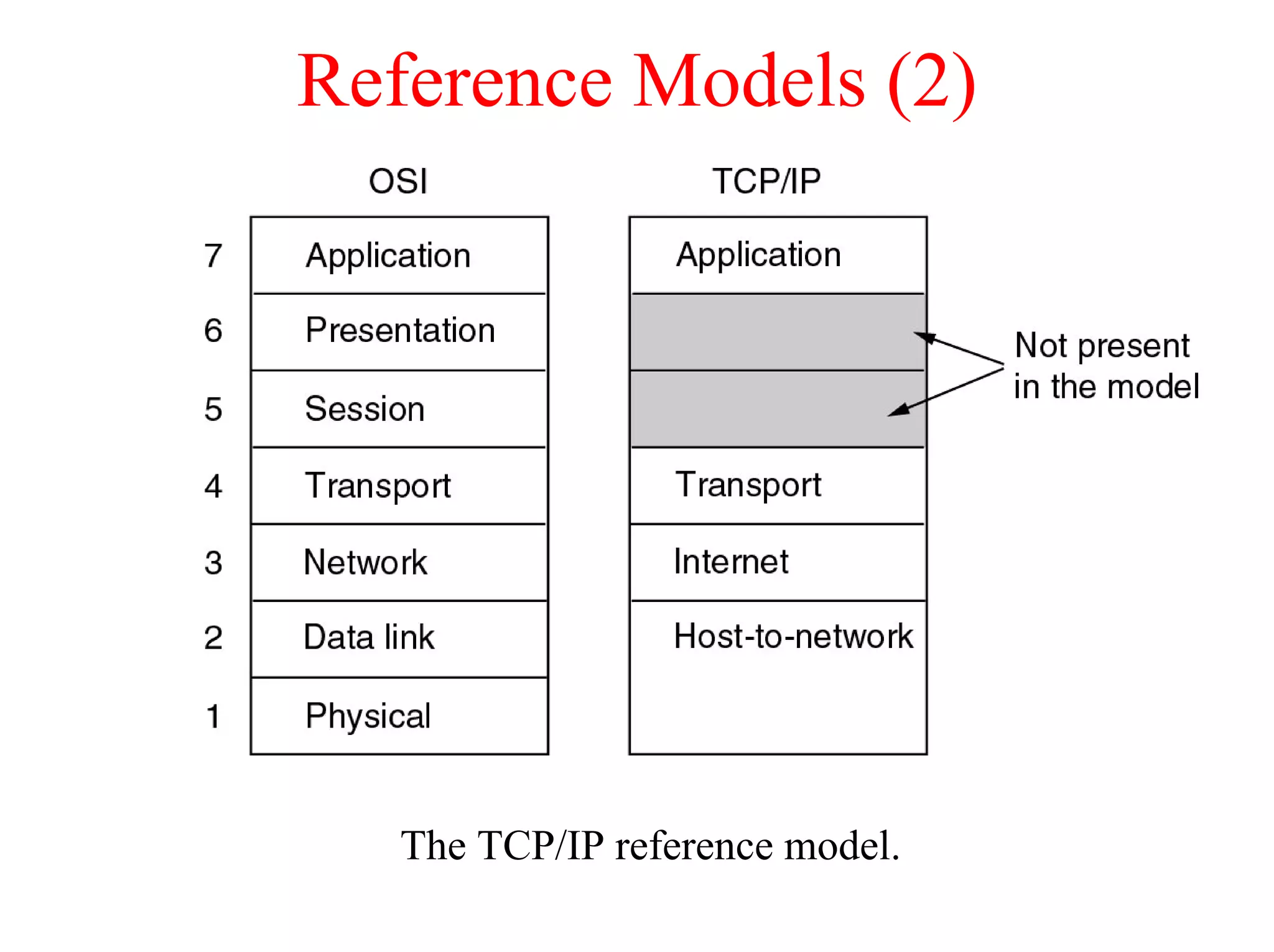
Reference Models (2)


   The TCP/IP reference model.
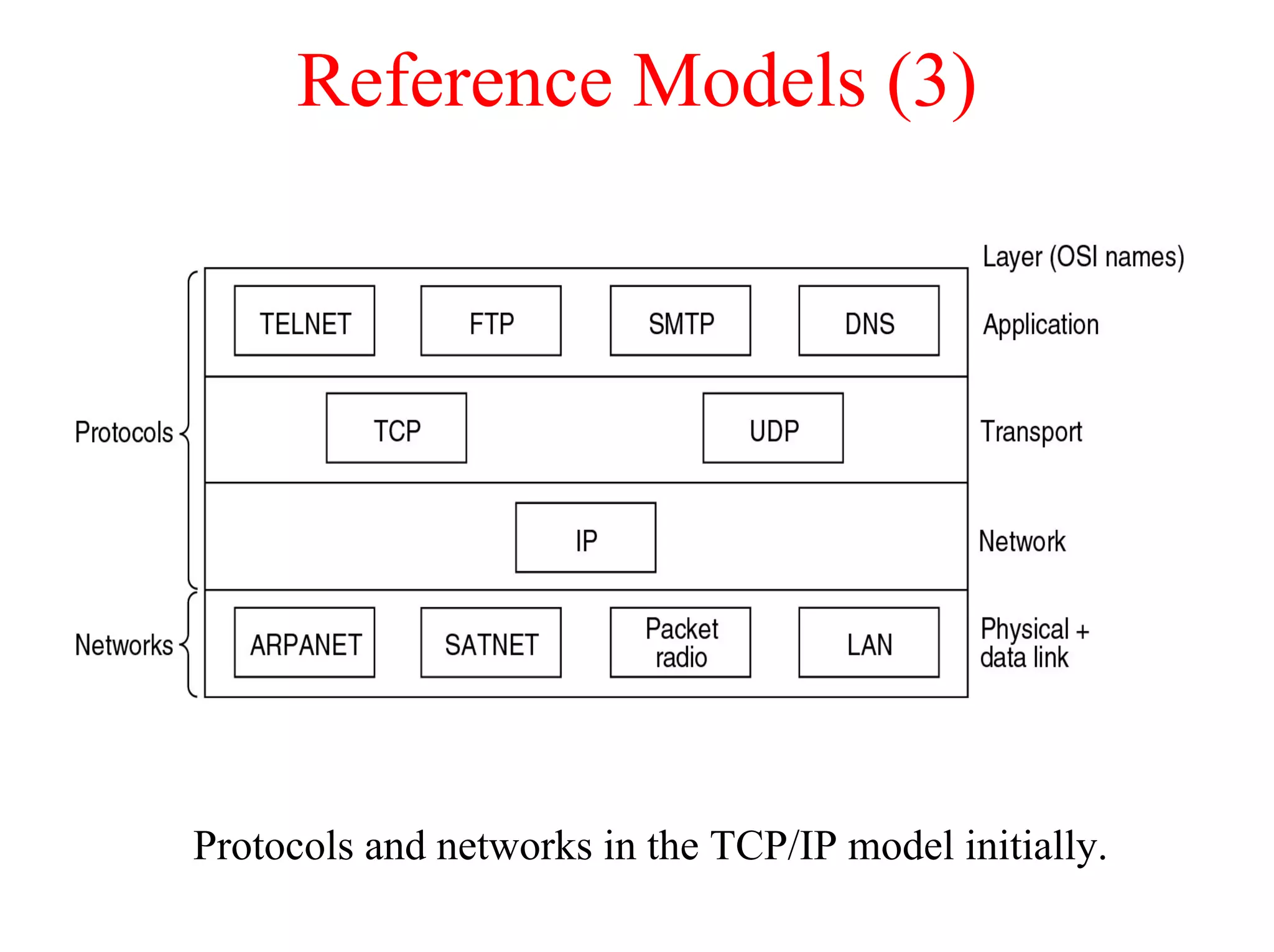
Reference Models (3)


Protocols and networks in the TCP/IP model initially.
Comparing OSI and TCP/IP Models

  Concepts central to the OSI model
  • Services
  • Interfaces
  • Protocols
A Critique of the OSI Model and Protocols

   Why OSI did not take over the world
   • Bad timing
   • Bad technology
   • Bad implementations
   • Bad politics
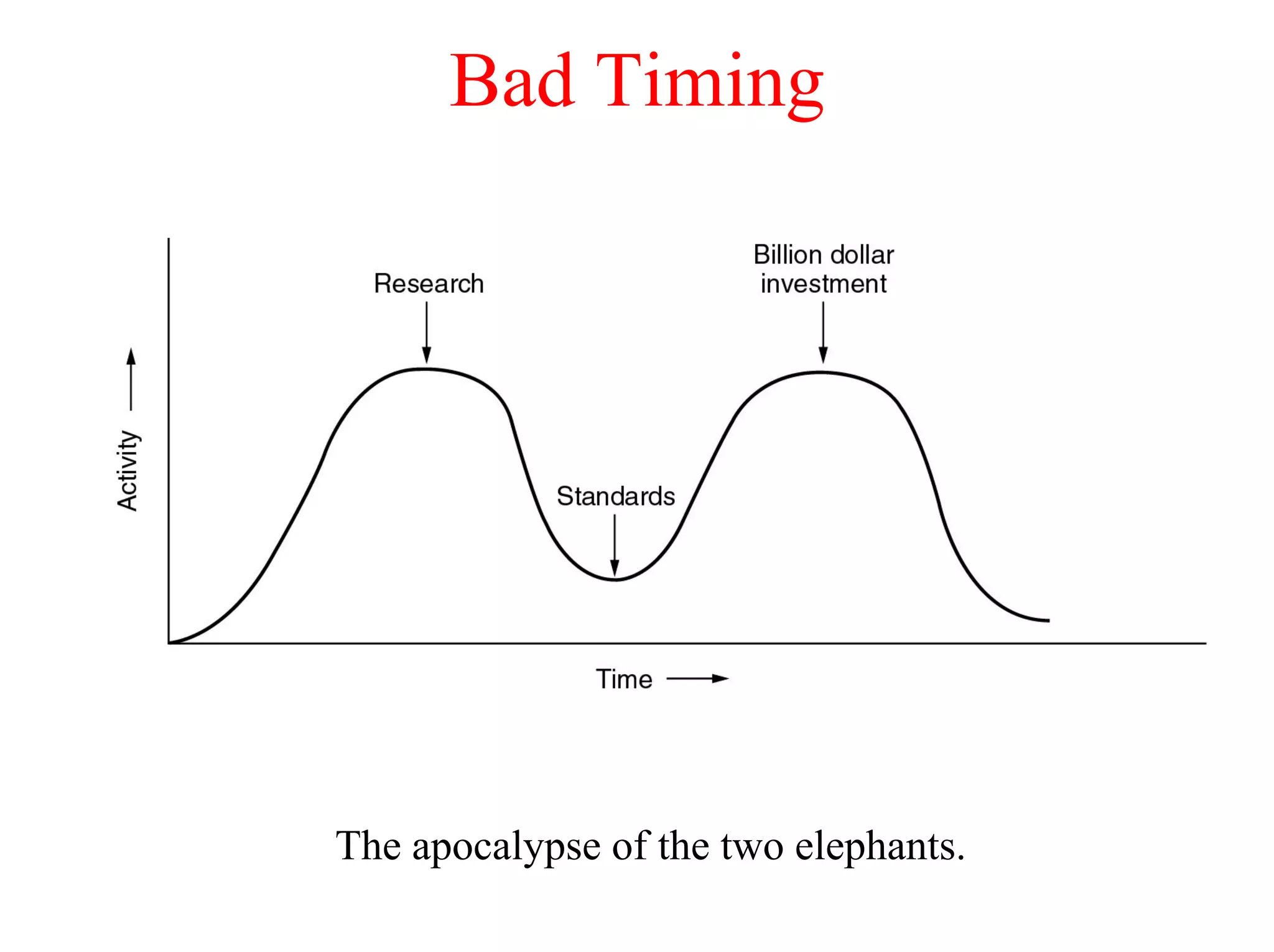
Bad Timing


The apocalypse of the two elephants.
A Critique of the TCP/IP Reference Model
 Problems:
 • Service, interface, and protocol not distinguished
 • Not a general model
 • Host-to-network “layer” not really a layer
 • No mention of physical and data link layers
 • Minor protocols deeply entrenched, hard to replace
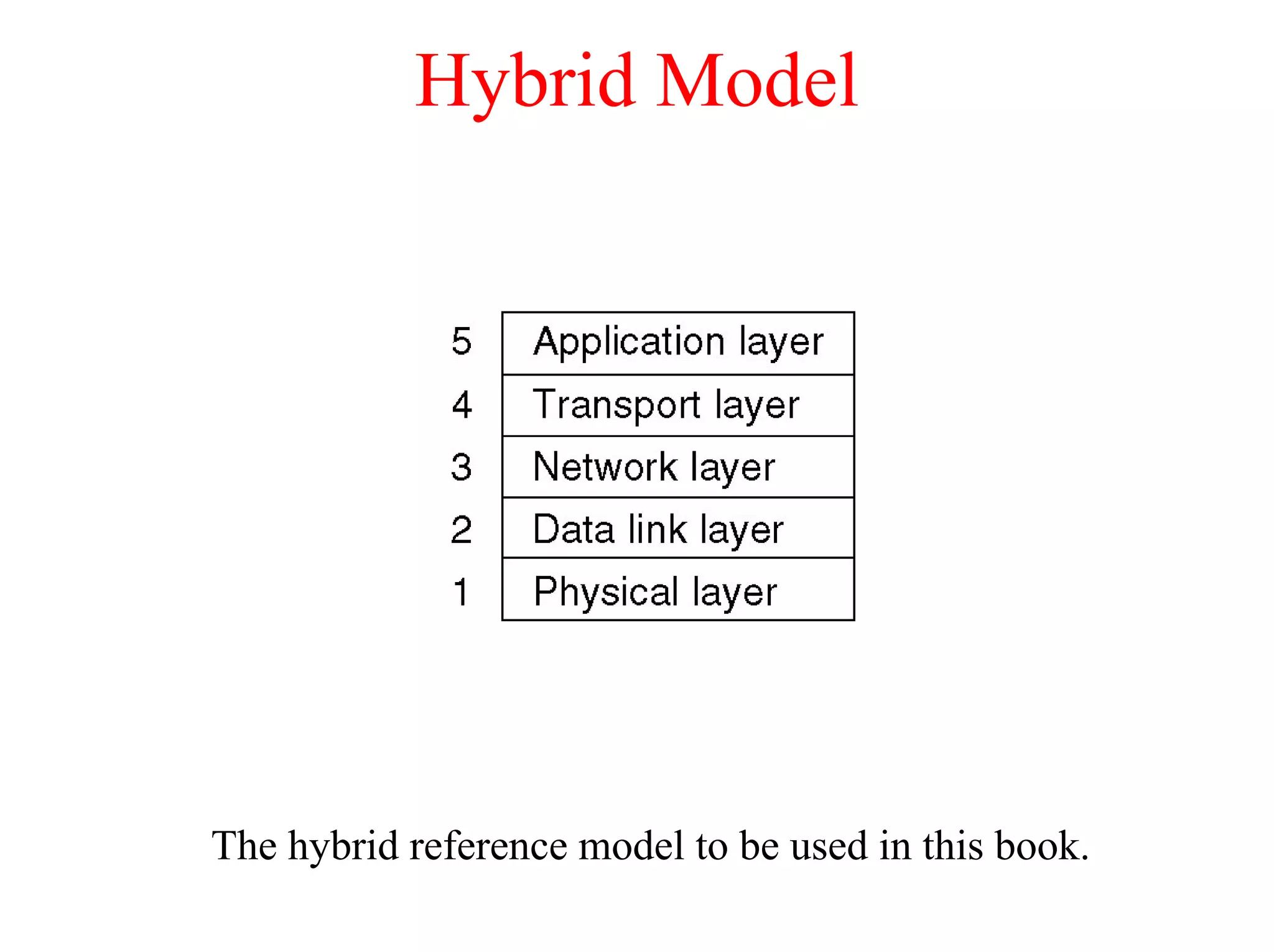
Hybrid Model


The hybrid reference model to be used in this book.
Example Networks
•   The Internet

•   Connection-Oriented Networks:
       X.25, Frame Relay, and ATM

•   Ethernet

•   Wireless LANs: 802:11
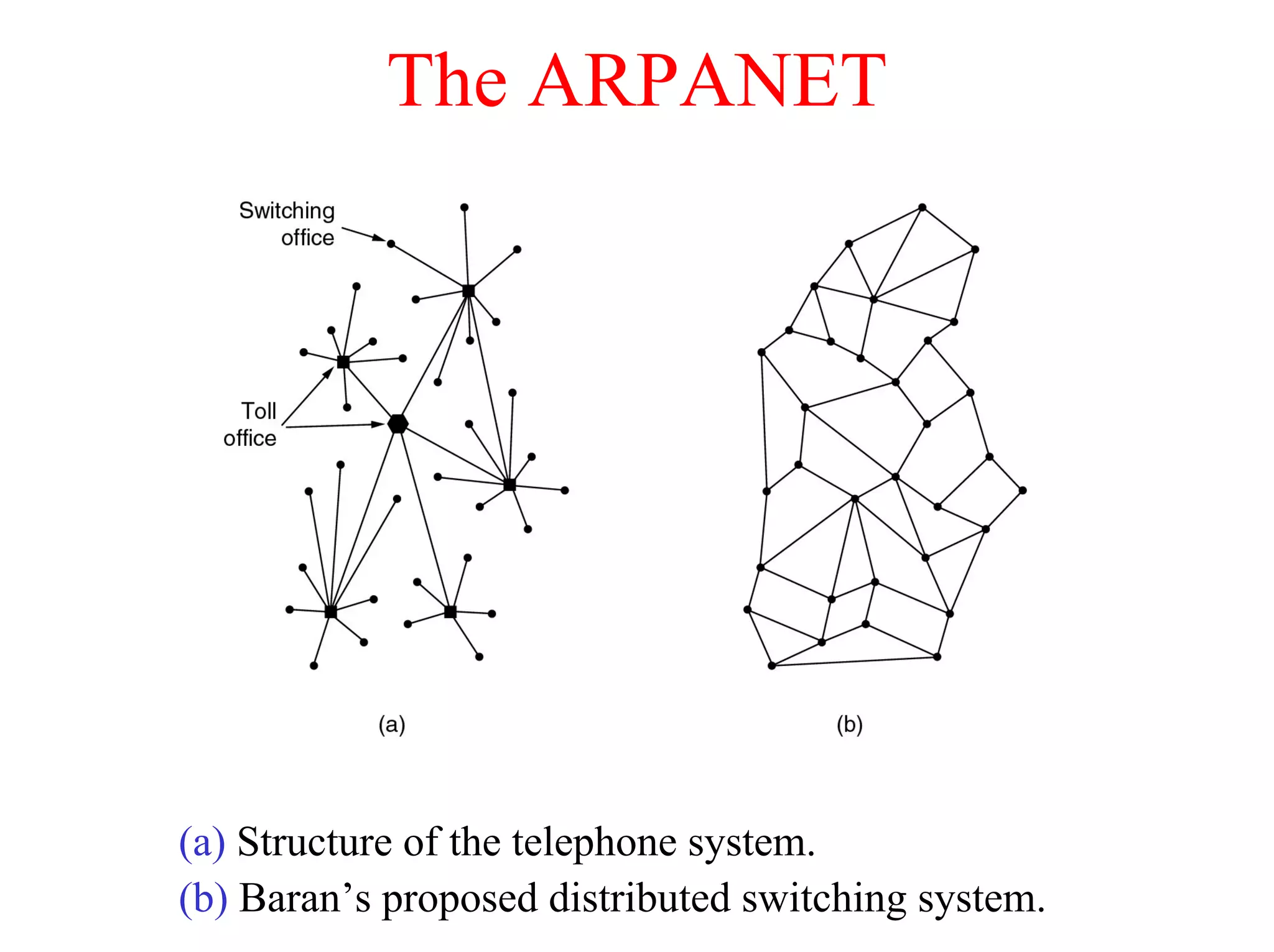
The ARPANET


(a) Structure of the telephone system.
(b) Baran’s proposed distributed switching system.
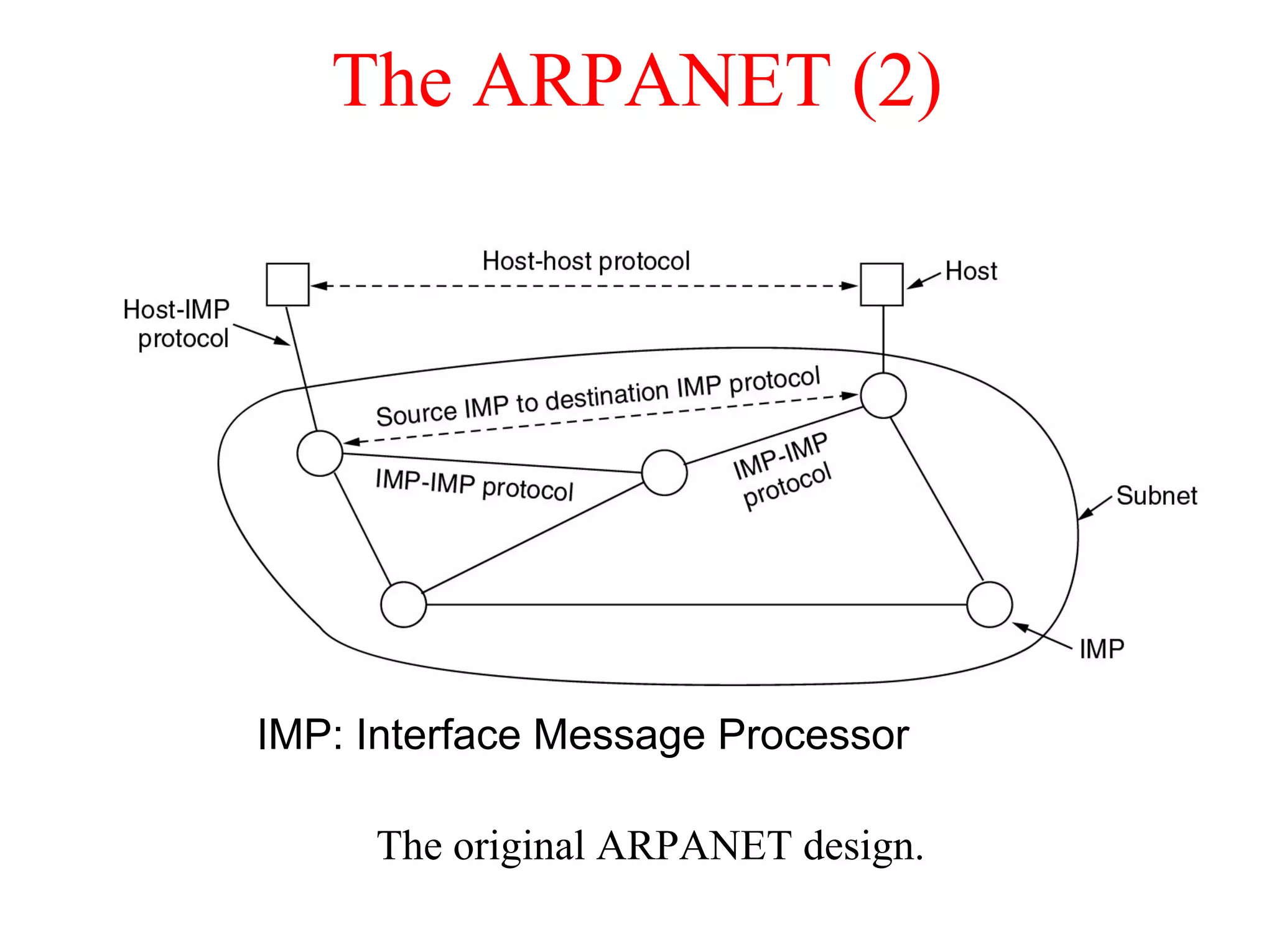
The ARPANET (2)


IMP: Interface Message Processor

     The original ARPANET design.
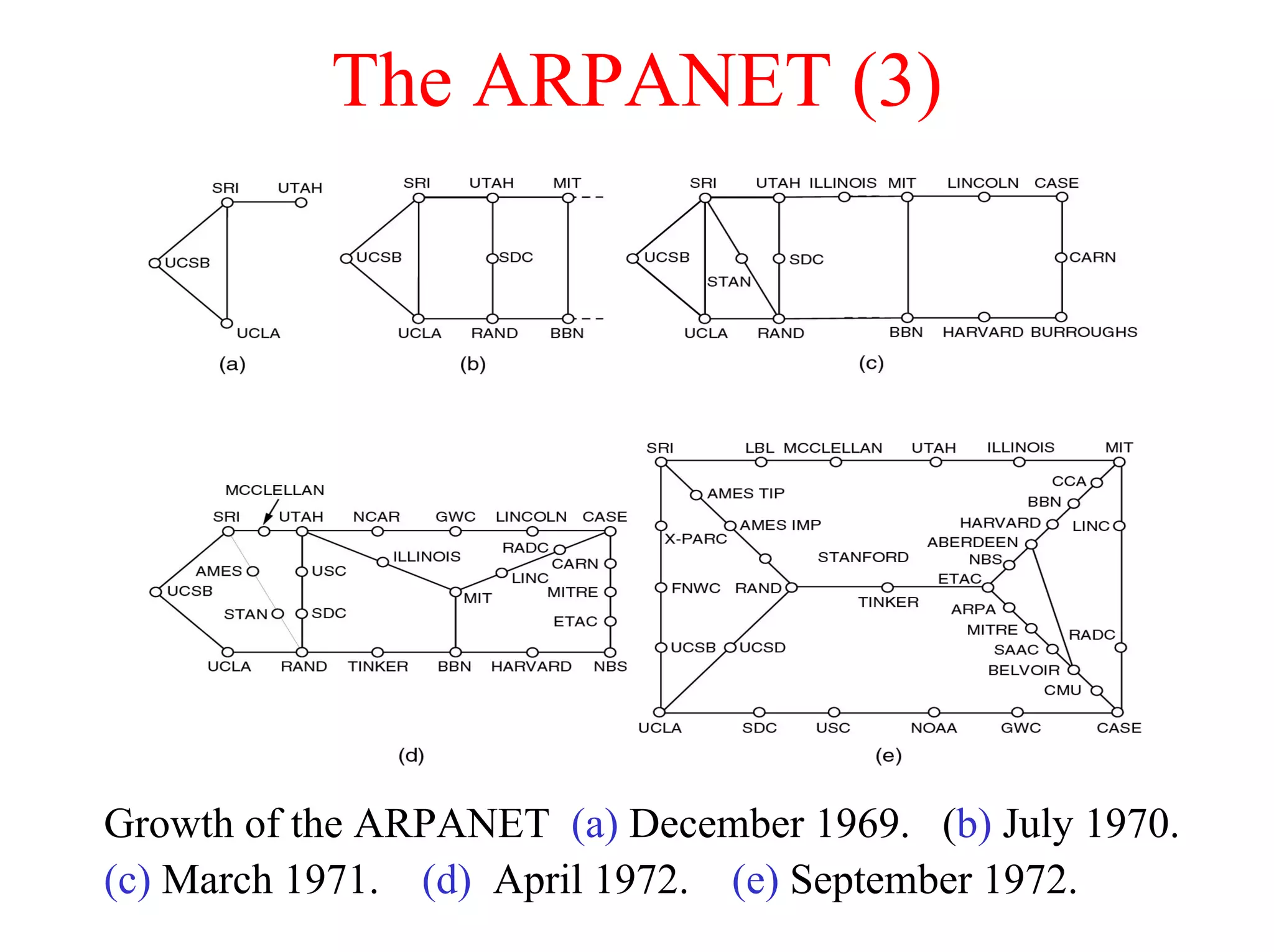
The ARPANET (3)


Growth of the ARPANET (a) December 1969. (b) July 1970.
(c) March 1971. (d) April 1972. (e) September 1972.
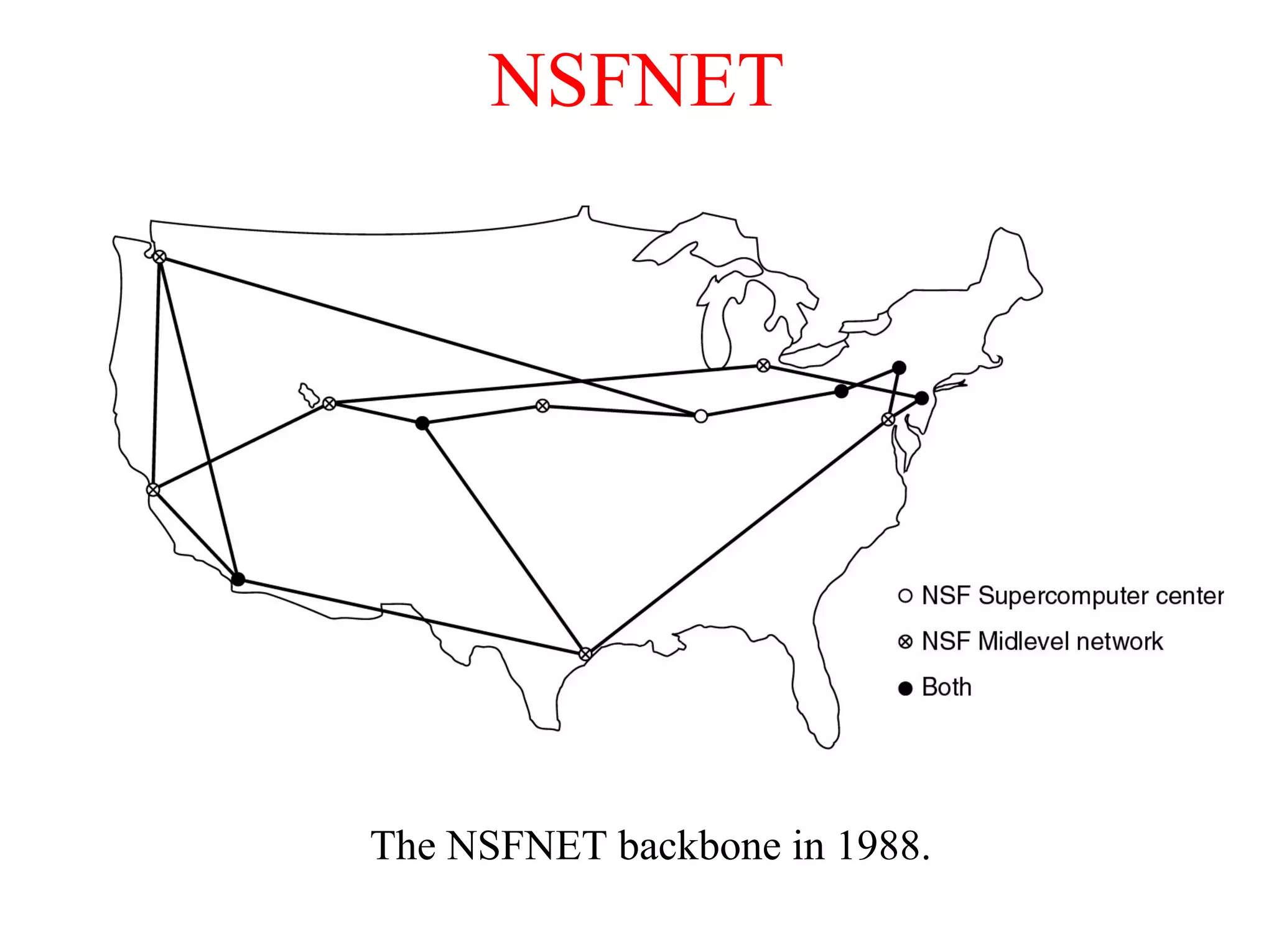
NSFNET


The NSFNET backbone in 1988.
Internet Usage

Traditional applications (1970 – 1990)
• E-mail
• News
• Remote login
• File transfer
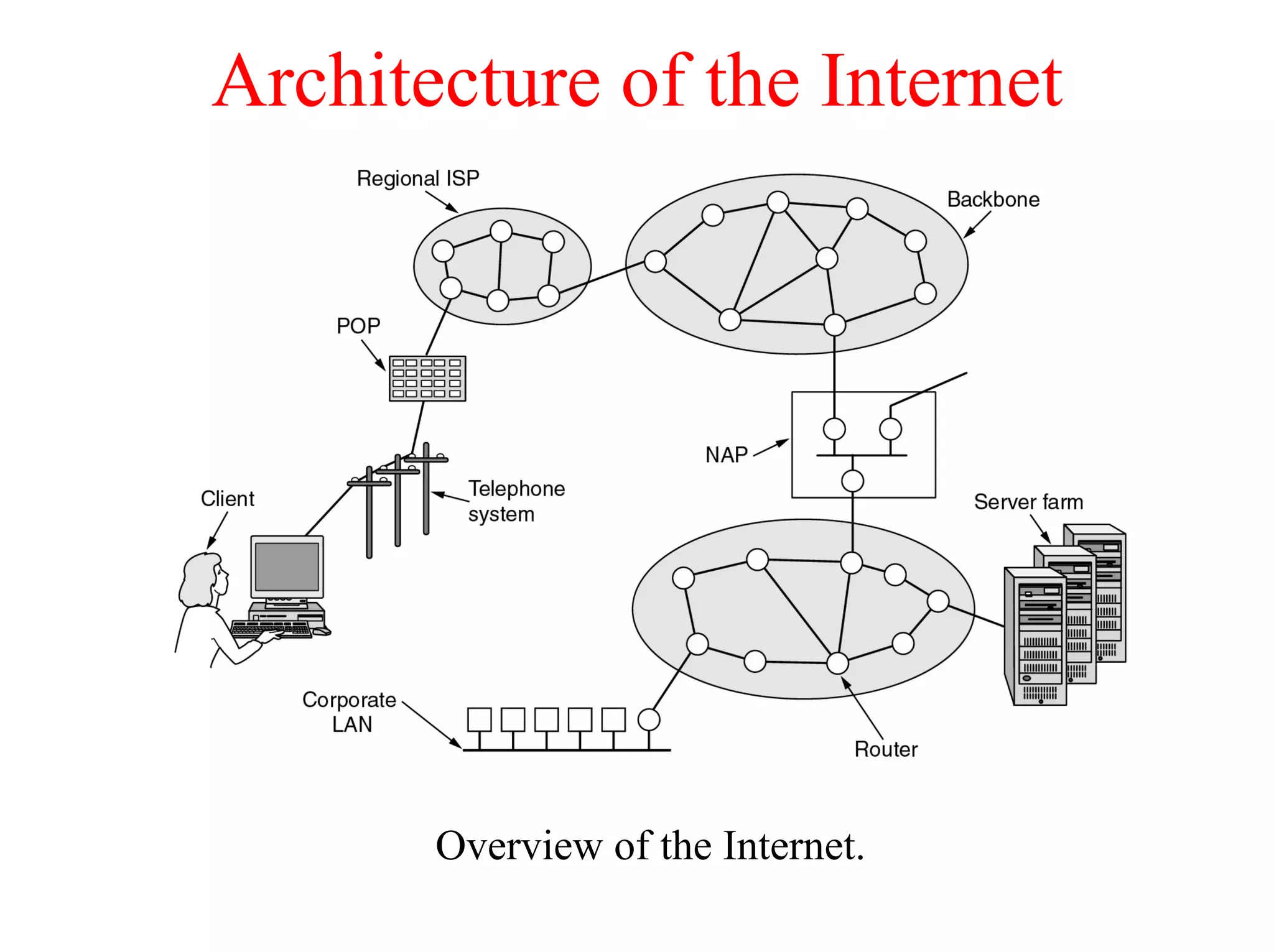
Architecture of the Internet


       Overview of the Internet.
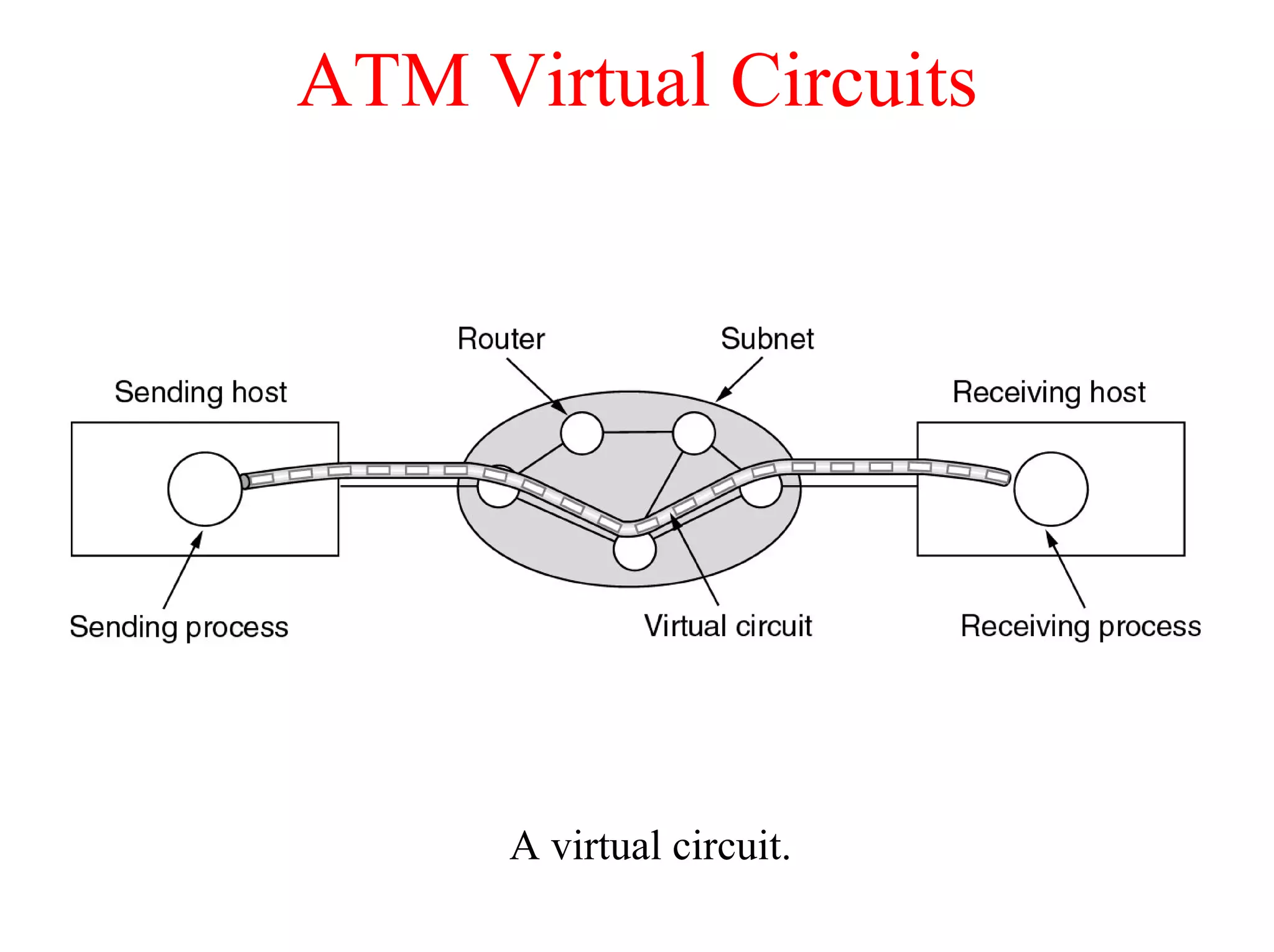
ATM Virtual Circuits


      A virtual circuit.
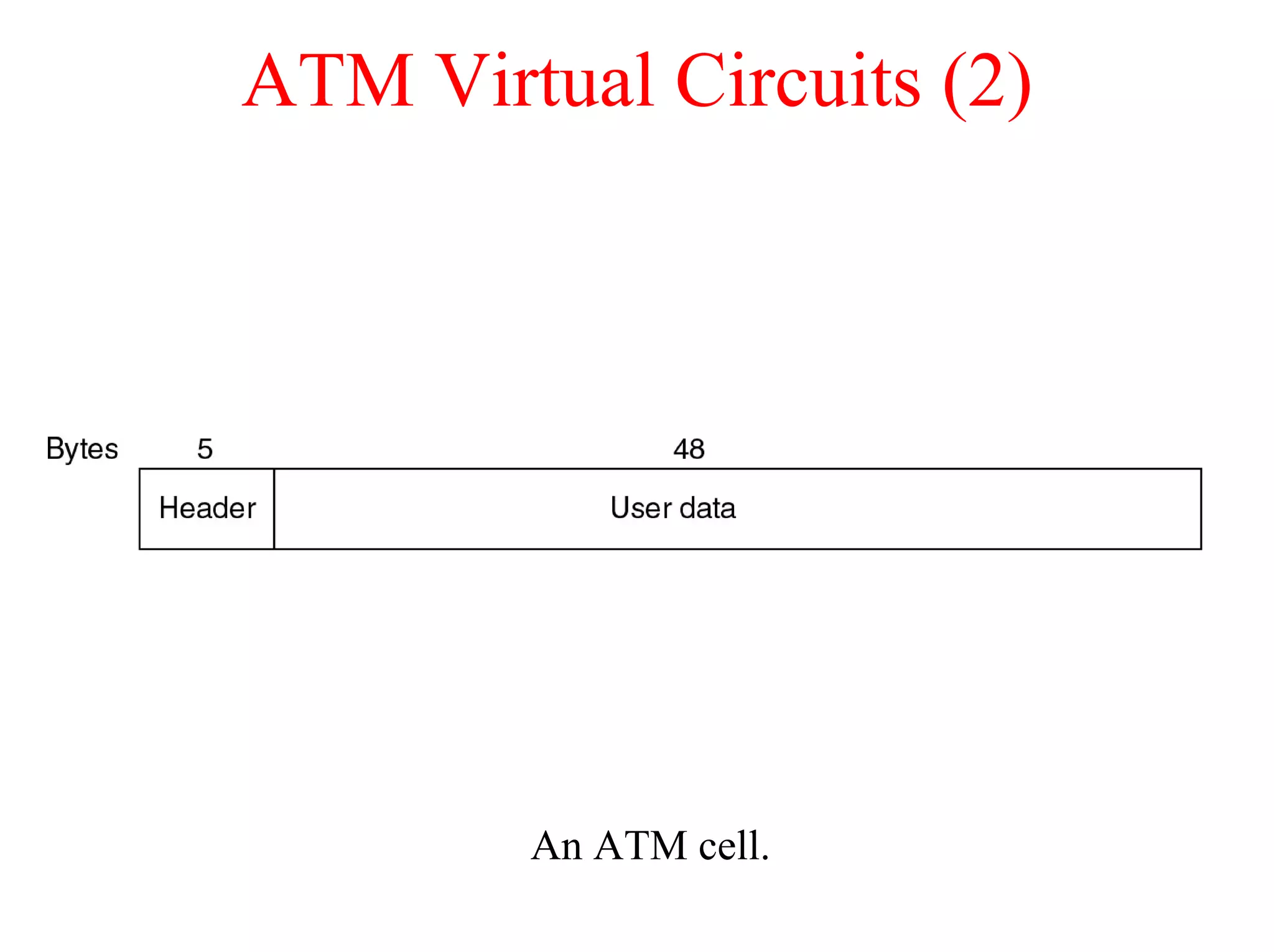
ATM Virtual Circuits (2)


        An ATM cell.
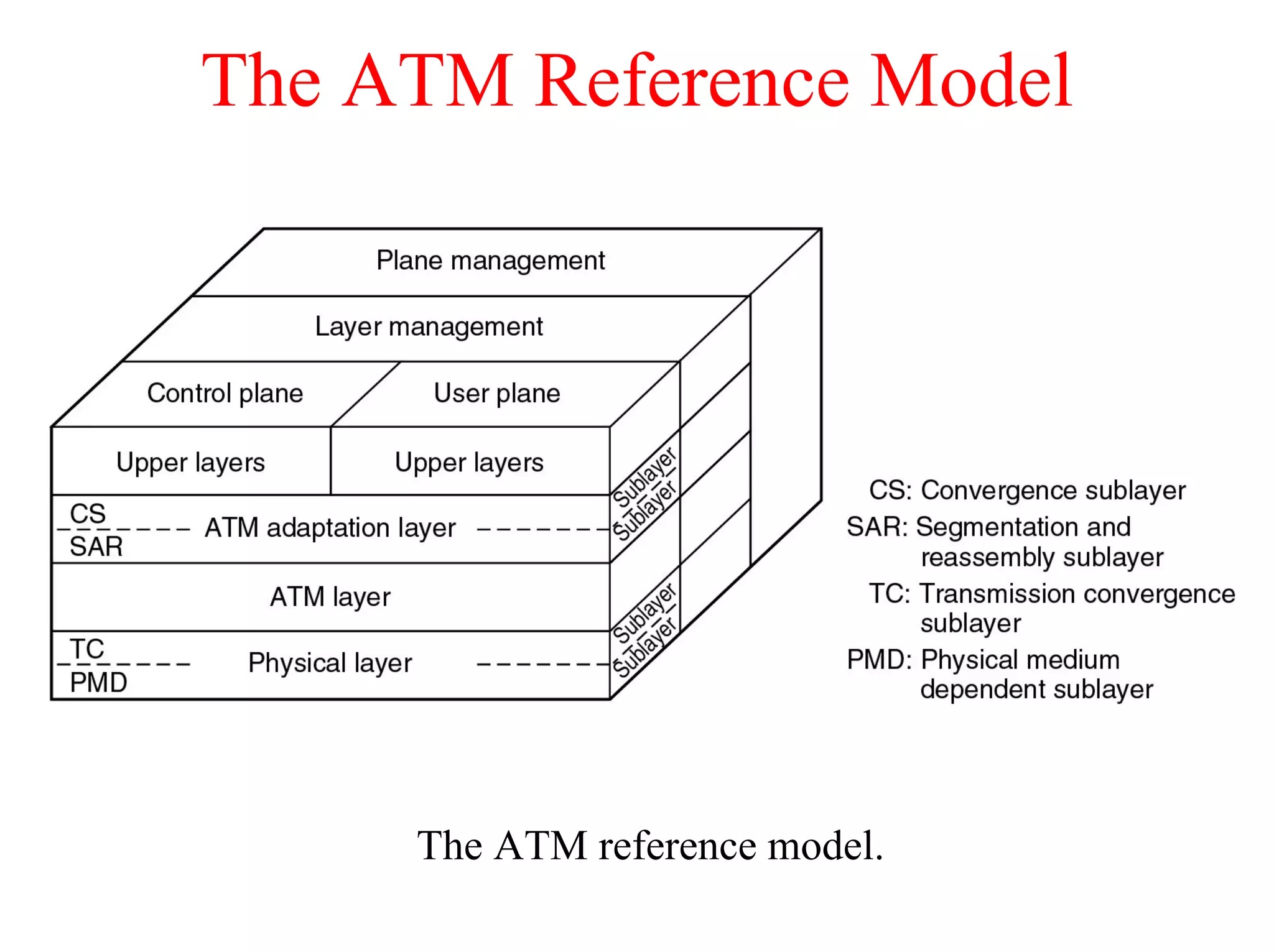
The ATM Reference Model


     The ATM reference model.
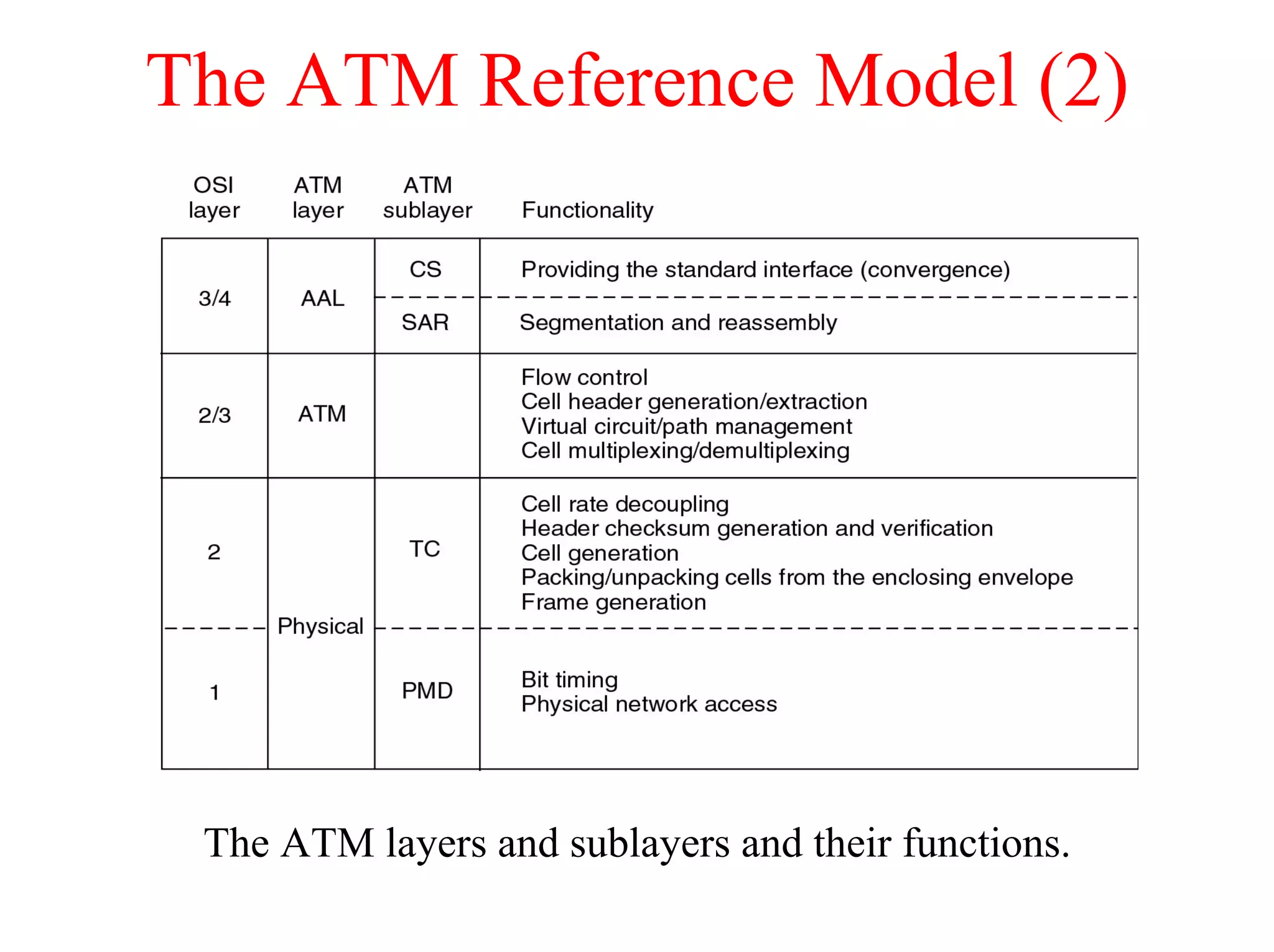
The ATM Reference Model (2)


 The ATM layers and sublayers and their functions.
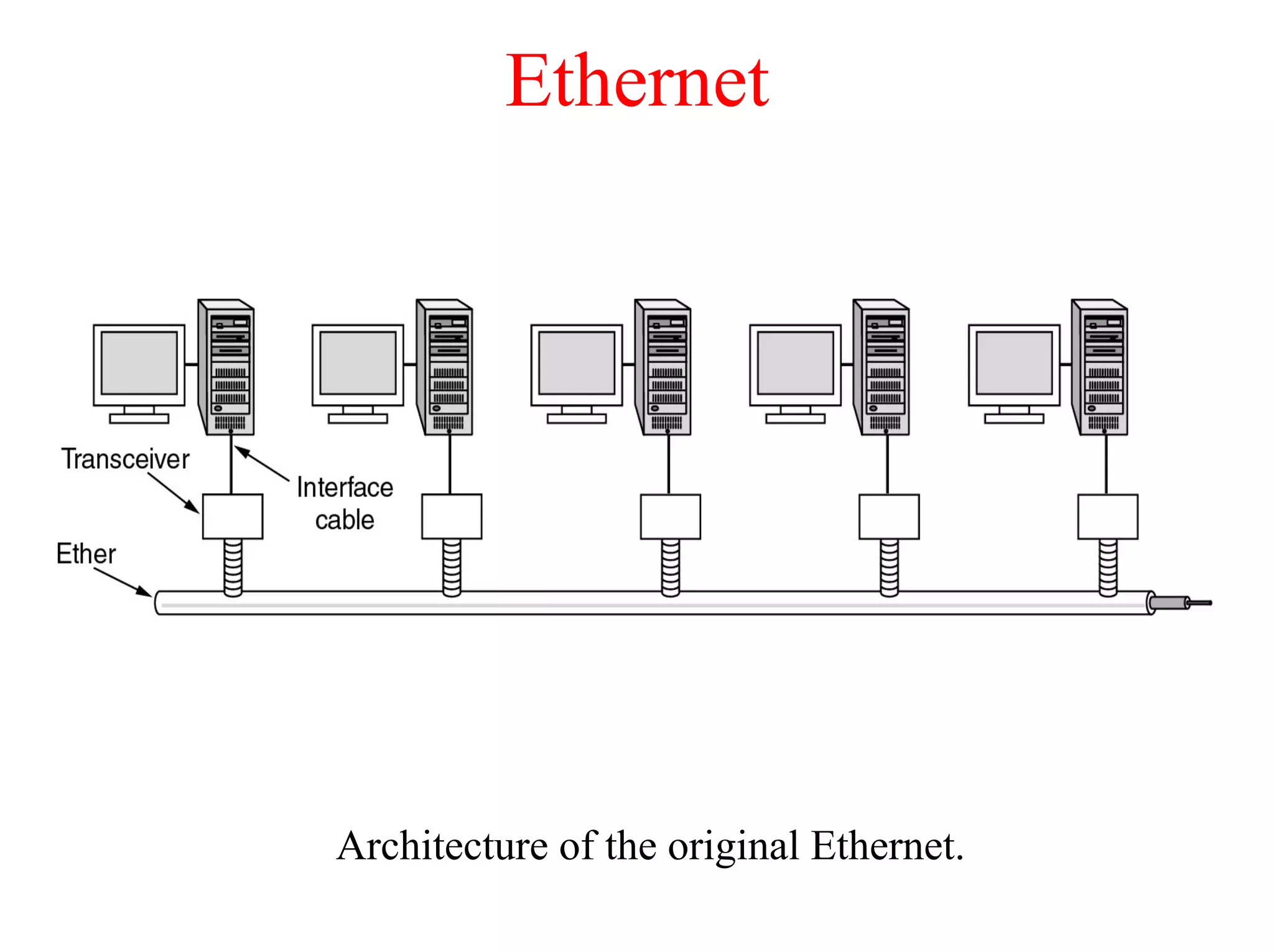
Ethernet


Architecture of the original Ethernet.
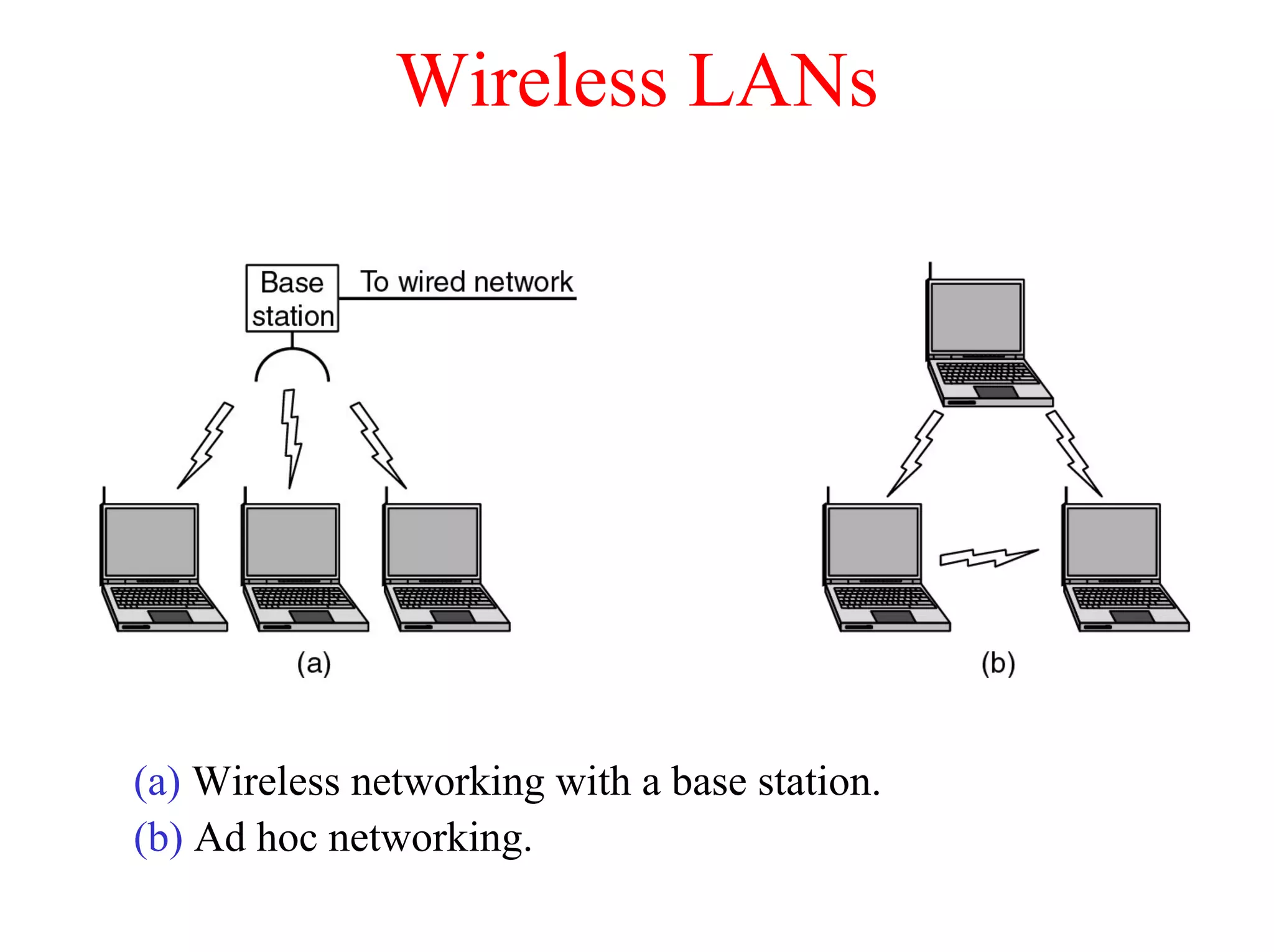
Wireless LANs


(a) Wireless networking with a base station.
(b) Ad hoc networking.
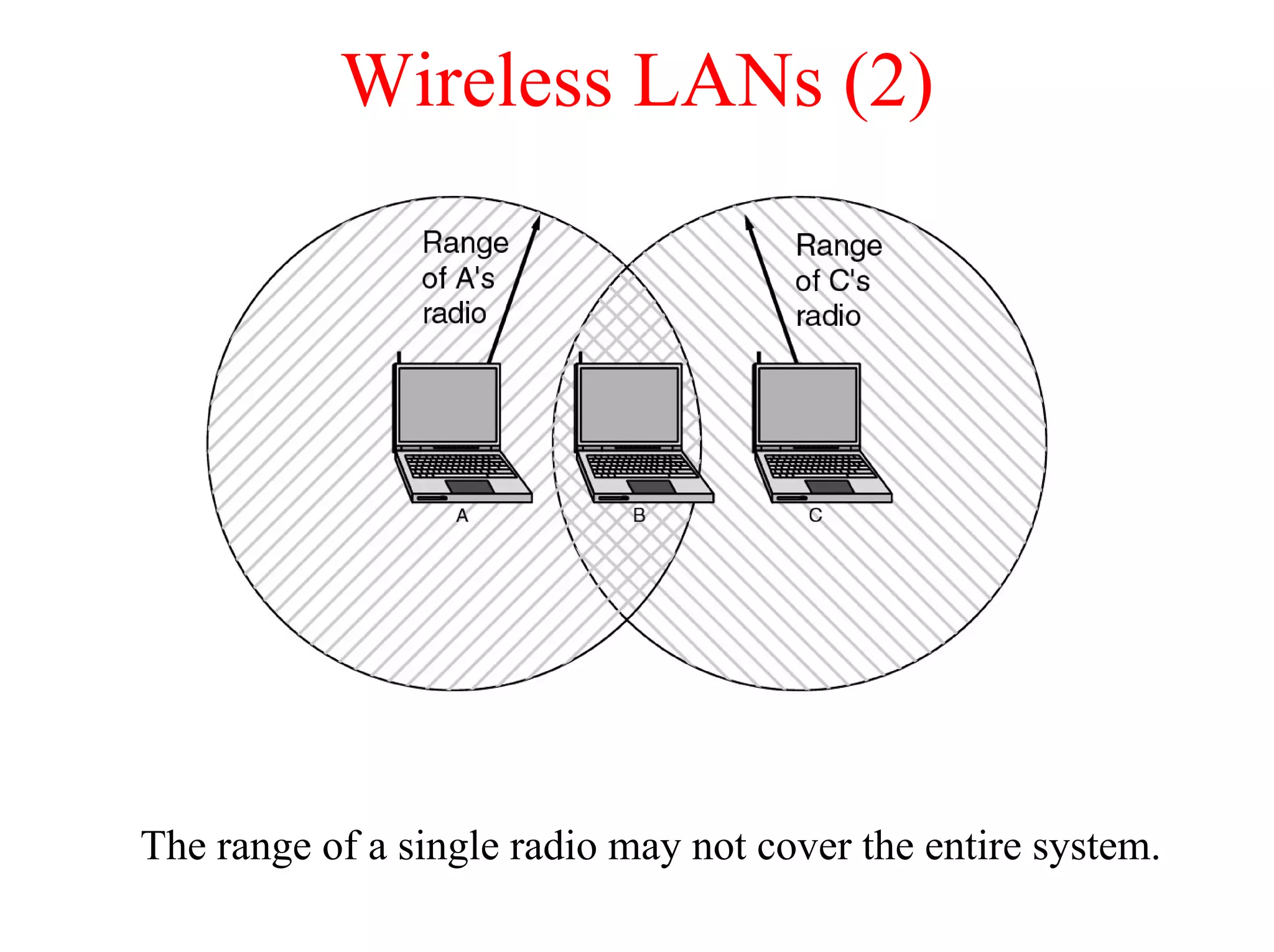
Wireless LANs (2)


The range of a single radio may not cover the entire system.
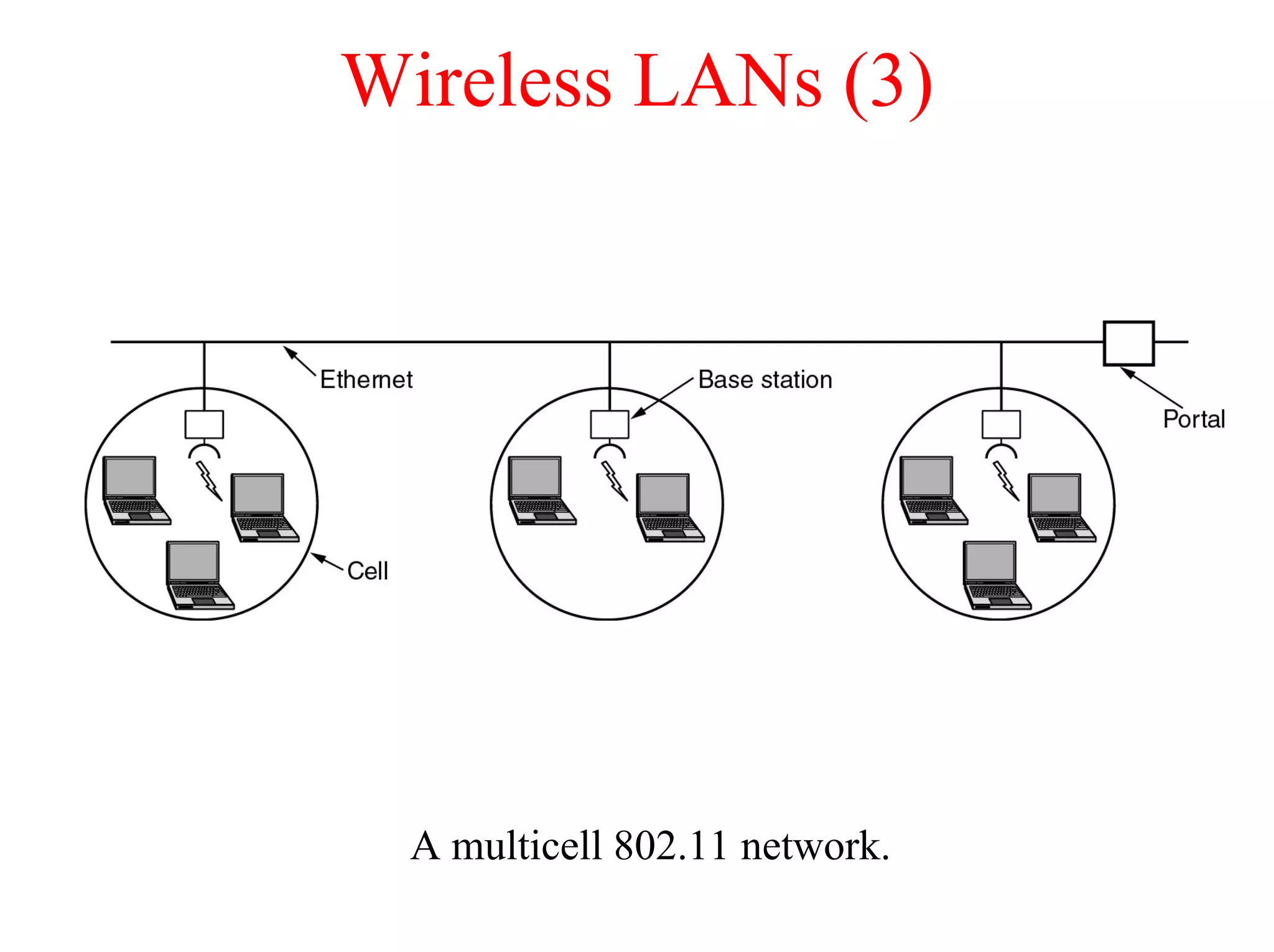
Wireless LANs (3)


  A multicell 802.11 network.
Network Standardization

•   Who’s Who in the Telecommunications World
•   Who’s Who in the International Standards World
•   Who’s Who in the Internet Standards World
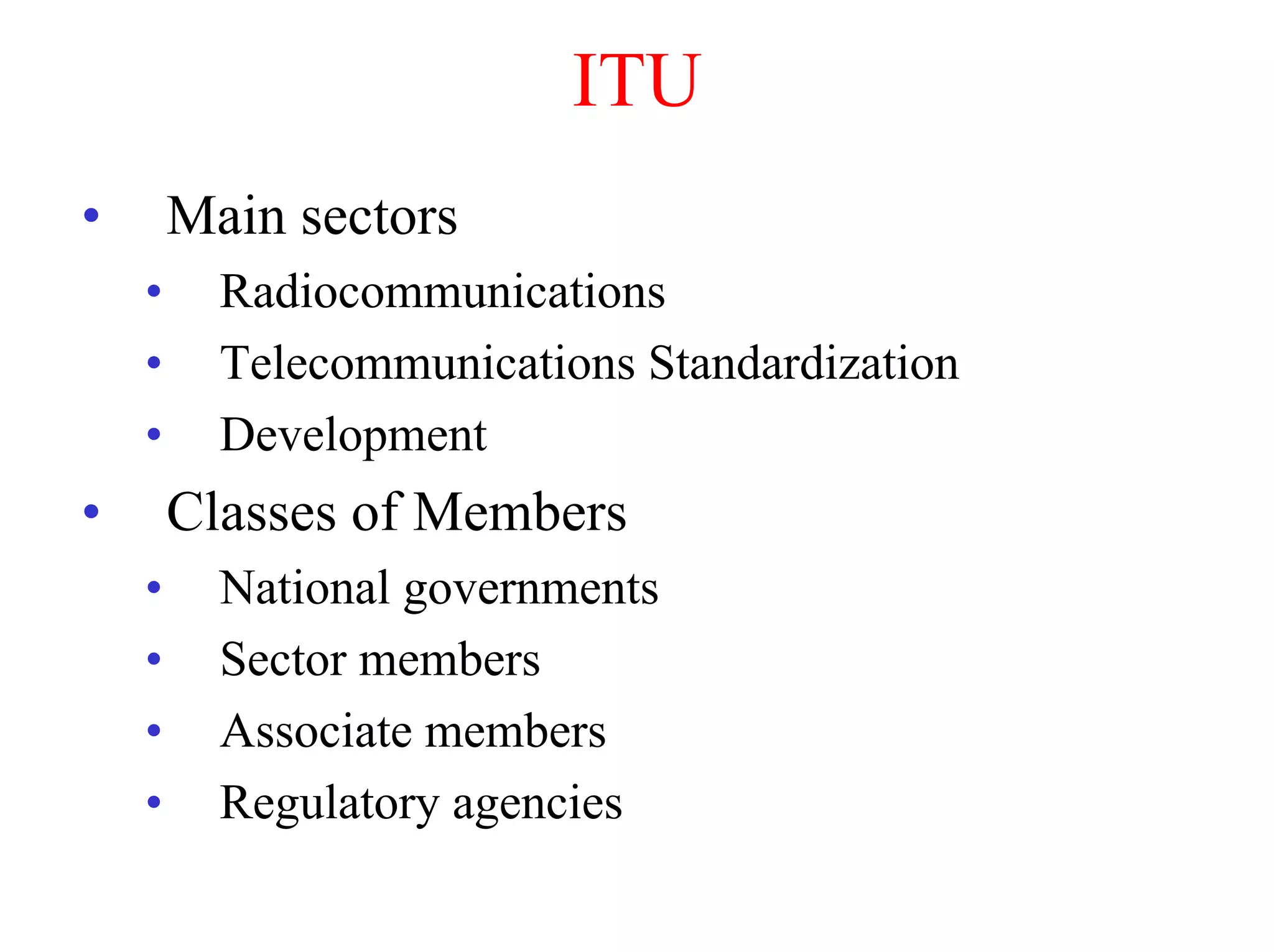
ITU
•       Main sectors
    •     Radiocommunications
    •     Telecommunications Standardization
    •     Development
•       Classes of Members
    •     National governments
    •     Sector members
    •     Associate members
    •     Regulatory agencies
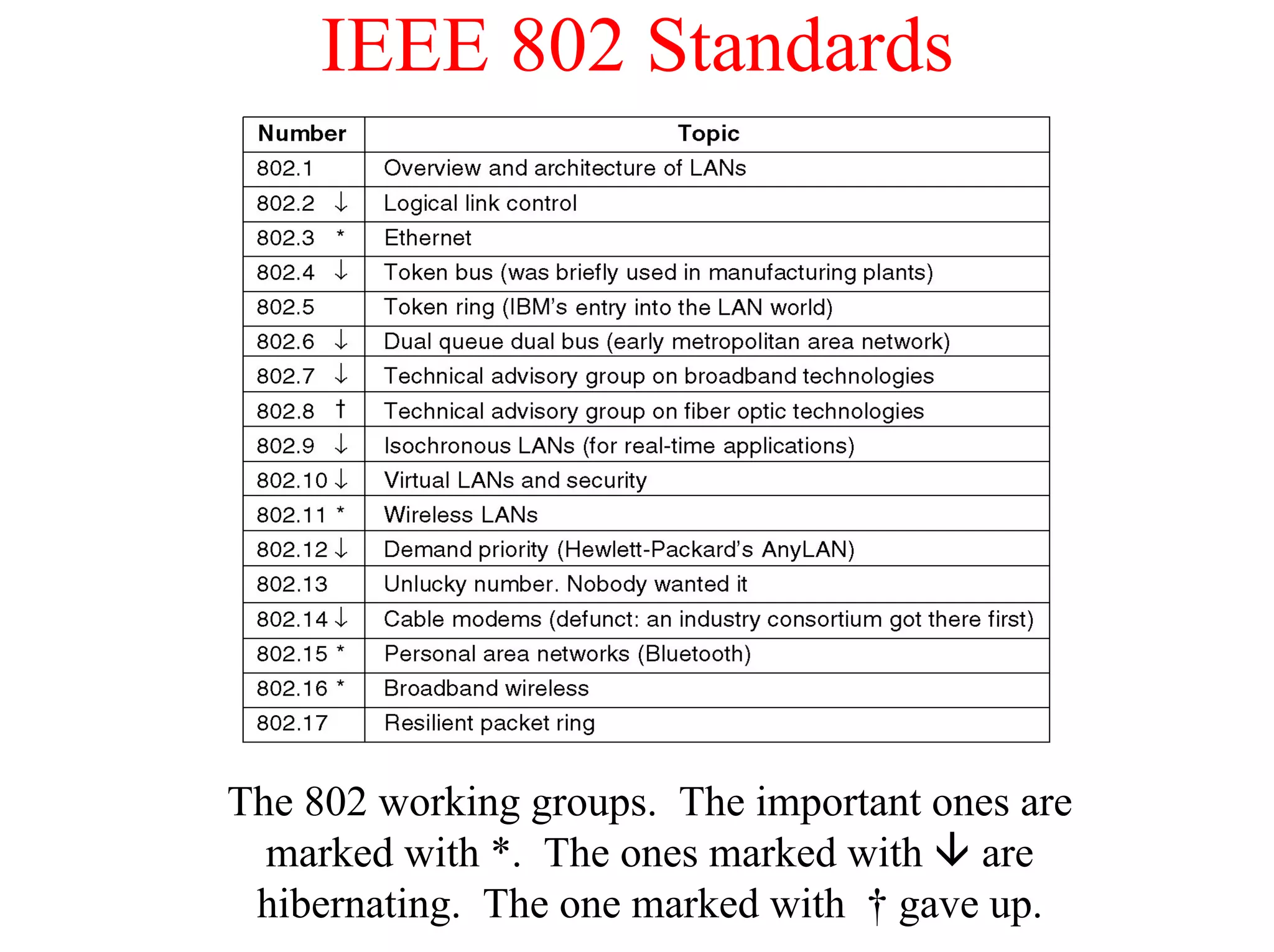
IEEE 802 Standards


The 802 working groups. The important ones are
  marked with *. The ones marked with are
 hibernating. The one marked with † gave up.

Computer networks

  • 1.
    Computer Networks 教材 台北科技大學電子系 李仁貴
  • 2.
    授課用書 Andrew S. Tanenbaum,“Computer Networks”, Fourth Edition, 2003, 新月圖書。 參考書目 [1] Computer Networking: A Top Down Approach Featuring the Internet, 2nd edition. Jim Kurose, Keith Ross Addison-Wesley, July 2002. [2] Computer Networks and Internets with Internet Applications, 3th edition. Douglas E. Comer. Prentice Hall, 2001. [3] Data Communications and Networks, Achyut S. Godbole, McGraw Hill, 2003. (全華) 相關網站 1. www.iec.org -- Some PDF files to discuss broadband & IT technologies. 2. www.cablemodem.com -- CATV broadband technologies. 3. www.atm.org -- ATM Forum. 4. www.ietf.org-- RFC protocol for Internet.--
  • 3.
    OUTLINE Chapter 1: Introduction Use of Networks, Network Hardware, Network Software Reference Models, Example Networks, Standardization Chapter 2: The Physical Layer Transmission Media:Twisted Pair, Coaxial Cable, Fiber Optics, Wireless Chapter 3: The Data Link Layer Error Control, Flow Control, Protocol Chapter 4: The Medium Access Control Sublayer Multiple Access, Ethernet, WLAN, Broadband Wireless, Bluetooth Chapter 5: The Network Layer Routing, Congestion Control, QoS, InterNetworking Chapter 6: The Transport Layer TCP , UDP Chapter 7: Application Layer DNS, Mail, WWW, Multimedia Chapter 8: Network Security
  • 4.
  • 5.
    Uses of ComputerNetworks • Business Applications Resource Sharing (File system, client-Server, Internet) • Home Applications • Mobile Users • Social Issues
  • 6.
    Business Applications ofNetworks A network with two clients and one server.
  • 7.
    Business Applications ofNetworks (2) The client-server model involves requests and replies.
  • 8.
    Home Network Applications • Access to remote information • Person-to-person communication • Interactive entertainment • Electronic commerce B2C: Business-to-consumer B2B: Business-to-business G2C: Government-to-consumer C2C: Consumer-to-consumer P2P: Peer-to-peer
  • 9.
    Home Network Applications(2) In peer-to-peer system there are no fixed clients and servers.
  • 10.
    Home Network Applications(3) Some forms of e-commerce.
  • 11.
    Mobile Network Users Combinationsof wireless networks and mobile computing.
  • 12.
    Network Hardware • Local Area Networks • Metropolitan Area Networks • Wide Area Networks • Wireless Networks • Home Networks • Inter-networks
  • 13.
    Operation Mode Uni-casting : one sender and one receiver Broad-casting: A sender to transmit and all machine on the network to receive. Multi-casting : Broad-cast systems support transmission to a subnet of the network.
  • 14.
    Broadcast Networks Classification ofinterconnected processors by scale.
  • 15.
    Local Area Networks Twobroadcast networks (a) Bus (b) Ring
  • 16.
    Metropolitan Area Networks A metropolitan area network based on cable TV.
  • 17.
    Wide Area Networks Point-to-point Store and forward Packet switched Relation between hosts on LANs and the subnet.
  • 18.
    Wide Area Networks(2) A stream of packets from sender to receiver.
  • 19.
    Wireless Networks Categories ofwireless networks: • System interconnection • Wireless LANs • Wireless WANs
  • 20.
    Wireless Networks (2) (a) Bluetooth configuration (b) Wireless LAN
  • 21.
    Wireless Networks (3) (a)Individual mobile computers (b) A flying LAN
  • 22.
    Home Network Categories • Computers (desktop PC, PDA, shared peripherals) • Entertainment (TV, DVD, VCR, camera, stereo, MP3) • Telecomm (telephone, cell phone, intercom, fax) • Appliances (microwave, fridge, clock, furnace, airco) • Telemetry (utility meter, burglar alarm, babycam).
  • 23.
    Network Software • Protocol Hierarchies (protocol Stack) • Design Issues for the Layers • Connection-Oriented and Connectionless Services • Service Primitives • The Relationship of Services to Protocols
  • 24.
    Network Software Protocol Hierarchies(Protocol Stack) Layers, protocols, and interfaces.
  • 25.
    Protocol Hierarchies (2) Location A Location B I like J'aime Message Philosopher rabbits bien les lapins 3 3 Information L: Dutch for the remote Translator L: Dutch Ik vind translator Ik vind konijnen konijnen 2 2 leuk leuk Information Fax #--- for the remote Fax #--- L: Dutch secretary Secretary L: Dutch Ik vind Ik vind 1 1 konijnen konijnen leuk leuk The philosopher-translator-secretary architecture.
  • 26.
    Protocol Hierarchies (3) Exampleinformation flow supporting virtual communication in layer 5.
  • 27.
    Design Issues forthe Layers • Addressing • Error Control • Flow Control • Multiplexing • Routing
  • 28.
    Connection-Oriented and Connectionless Services Six different types of service.
  • 29.
    Service Primitives Five serviceprimitives for implementing a simple connection- oriented service.
  • 30.
    Service Primitives (2) Packetssent in a simple client-server interaction on a connection-oriented network.
  • 31.
    Services to ProtocolsRelationship The relationship between a service and a protocol.
  • 32.
    Reference Models • The OSI Reference Model • The TCP/IP Reference Model • A Comparison of OSI and TCP/IP • A Critique of the OSI Model and Protocols • A Critique of the TCP/IP Reference Model TCP : Transmission Control Protocol UDP : User Datagram Protocol
  • 33.
  • 34.
    Reference Models (2) The TCP/IP reference model.
  • 35.
    Reference Models (3) Protocolsand networks in the TCP/IP model initially.
  • 36.
    Comparing OSI andTCP/IP Models Concepts central to the OSI model • Services • Interfaces • Protocols
  • 37.
    A Critique ofthe OSI Model and Protocols Why OSI did not take over the world • Bad timing • Bad technology • Bad implementations • Bad politics
  • 38.
    Bad Timing The apocalypseof the two elephants.
  • 39.
    A Critique ofthe TCP/IP Reference Model Problems: • Service, interface, and protocol not distinguished • Not a general model • Host-to-network “layer” not really a layer • No mention of physical and data link layers • Minor protocols deeply entrenched, hard to replace
  • 40.
    Hybrid Model The hybridreference model to be used in this book.
  • 41.
    Example Networks • The Internet • Connection-Oriented Networks: X.25, Frame Relay, and ATM • Ethernet • Wireless LANs: 802:11
  • 42.
    The ARPANET (a) Structureof the telephone system. (b) Baran’s proposed distributed switching system.
  • 43.
    The ARPANET (2) IMP:Interface Message Processor The original ARPANET design.
  • 44.
    The ARPANET (3) Growthof the ARPANET (a) December 1969. (b) July 1970. (c) March 1971. (d) April 1972. (e) September 1972.
  • 45.
  • 46.
    Internet Usage Traditional applications(1970 – 1990) • E-mail • News • Remote login • File transfer
  • 47.
    Architecture of theInternet Overview of the Internet.
  • 48.
    ATM Virtual Circuits A virtual circuit.
  • 49.
    ATM Virtual Circuits(2) An ATM cell.
  • 50.
    The ATM ReferenceModel The ATM reference model.
  • 51.
    The ATM ReferenceModel (2) The ATM layers and sublayers and their functions.
  • 52.
    Ethernet Architecture of theoriginal Ethernet.
  • 53.
    Wireless LANs (a) Wirelessnetworking with a base station. (b) Ad hoc networking.
  • 54.
    Wireless LANs (2) Therange of a single radio may not cover the entire system.
  • 55.
    Wireless LANs (3) A multicell 802.11 network.
  • 56.
    Network Standardization • Who’s Who in the Telecommunications World • Who’s Who in the International Standards World • Who’s Who in the Internet Standards World
  • 57.
    ITU • Main sectors • Radiocommunications • Telecommunications Standardization • Development • Classes of Members • National governments • Sector members • Associate members • Regulatory agencies
  • 58.
    IEEE 802 Standards The802 working groups. The important ones are marked with *. The ones marked with are hibernating. The one marked with † gave up.