VoIP
IP Telephony
Internet Telephony
Digital Phone
Defined
 The Routing of telephonic conversations on
the Internet or any other IP-based network.
 General packet switching as opposed to
traditional circuit switching.
 VoIP Protocols are defined to address
communication.
VoIP Protocols
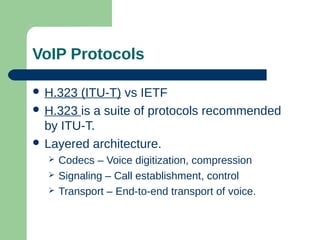
 H.323 (ITU-T) vs IETF
 H.323 is a suite of protocols recommended
by ITU-T.
 Layered architecture.
 Codecs – Voice digitization, compression
 Signaling – Call establishment, control
 Transport – End-to-end transport of voice.
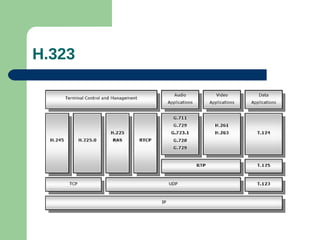
H.323
Codecs
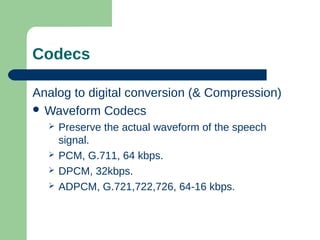
Analog to digital conversion (& Compression)
 Waveform Codecs
 Preserve the actual waveform of the speech
signal.
 PCM, G.711, 64 kbps.
 DPCM, 32kbps.
 ADPCM, G.721,722,726, 64-16 kbps.
Codecs
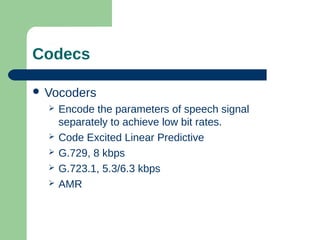
 Vocoders
 Encode the parameters of speech signal
separately to achieve low bit rates.
 Code Excited Linear Predictive
 G.729, 8 kbps
 G.723.1, 5.3/6.3 kbps
 AMR
Transport
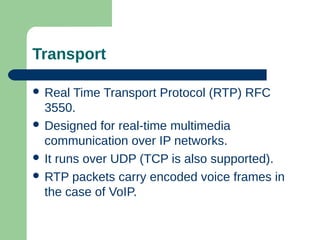
 Real Time Transport Protocol (RTP) RFC
3550.
 Designed for real-time multimedia
communication over IP networks.
 It runs over UDP (TCP is also supported).
 RTP packets carry encoded voice frames in
the case of VoIP.
RTP/RTCP
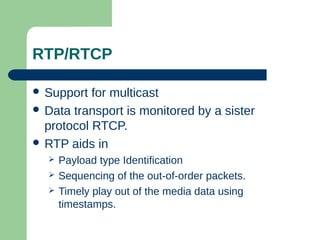
 Support for multicast
 Data transport is monitored by a sister
protocol RTCP.
 RTP aids in
 Payload type Identification
 Sequencing of the out-of-order packets.
 Timely play out of the media data using
timestamps.
RTP/RTCP
 RTCP
 Monitors the quality of service.
 Conveys information about the participants in on-
going session.
 Report packets are exchanged between
senders and receivers of multimedia
information.
 Three Reports are defined: RTCP-SR, RTCP-
RR, RTCP-SDES.
RTCP
 RTCP-SR/RTCP-RR contain information on
statistics such as number of packets lost,
round-trip delay and jitter etc.
 Used to modify sender transmission rates
and for diagnostic purposes.
H.323 Control Protocols
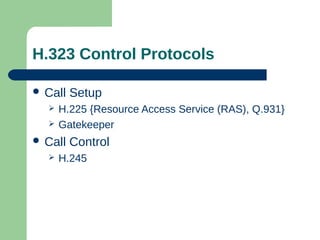
 Call Setup
 H.225 {Resource Access Service (RAS), Q.931}
 Gatekeeper
 Call Control
 H.245
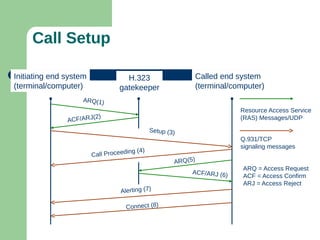
Call Setup
H.323
gatekeeper
Initiating end system
(terminal/computer)
Called end system
(terminal/computer)
ARQ(1)
ACF/ARJ(2)
Setup (3)
Call Proceeding (4)
ARQ(5)
ACF/ARJ (6)
Alerting (7)
Connect (8)
Resource Access Service
(RAS) Messages/UDP
Q.931/TCP
signaling messages
ARQ = Access Request
ACF = Access Confirm
ARJ = Access Reject
H.323 Gatekeeper
 To limit the number of concurrent VoIP calls
on a LAN.
 The objective is to provide guaranteed QoS.
 Optional
Call Control – H.245/TCP
 Exchange of system Control messages
between end-points.
 Opening of Logical channels for audio, video
and user data streams.
 Negotiation of capabilities.
Interworking
 H.323 also addresses Interworking between
end-points that are attached to circuit
switched networks.
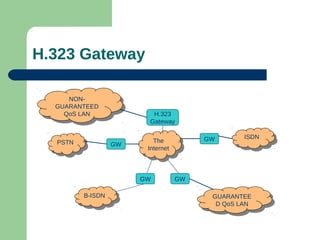
 This is achieved through H.323 Gateway.
The Role of H.323 Gateway
 To provide translation between different procedures and control
messages associated with each network type.
 To perform transcoding if communicating end systems are
using different coding standards.
 Address translation – in case where communicating end points
are connected to different networks because each uses a
different naming convention.
 Example – All the systems on a LAN are assigned an alias
PSTN number and all the systems external to LAN are
assigned an alias IP address.
H.323 Gateway
The
Internet
The
Internet
H.323
Gateway
GW
GW
GWGW
ISDNISDN
PSTNPSTN
GUARANTEE
D QoS LAN
GUARANTEE
D QoS LAN
B-ISDNB-ISDN
NON-
GUARANTEED
QoS LAN
NON-
GUARANTEED
QoS LAN
H.323 Sources
 Open Source Projects:
 WinRTP {www.vovida.org}.
 OpenPhone, ohphone {www.openh323.org}.
 Multimedia Communications, {Fred Halsall}
Thank you!

VoIP

  • 1.
  • 2.
    Defined  The Routingof telephonic conversations on the Internet or any other IP-based network.  General packet switching as opposed to traditional circuit switching.  VoIP Protocols are defined to address communication.
  • 3.
    VoIP Protocols  H.323(ITU-T) vs IETF  H.323 is a suite of protocols recommended by ITU-T.  Layered architecture.  Codecs – Voice digitization, compression  Signaling – Call establishment, control  Transport – End-to-end transport of voice.
  • 4.
  • 5.
    Codecs Analog to digitalconversion (& Compression)  Waveform Codecs  Preserve the actual waveform of the speech signal.  PCM, G.711, 64 kbps.  DPCM, 32kbps.  ADPCM, G.721,722,726, 64-16 kbps.
  • 6.
    Codecs  Vocoders  Encodethe parameters of speech signal separately to achieve low bit rates.  Code Excited Linear Predictive  G.729, 8 kbps  G.723.1, 5.3/6.3 kbps  AMR
  • 7.
    Transport  Real TimeTransport Protocol (RTP) RFC 3550.  Designed for real-time multimedia communication over IP networks.  It runs over UDP (TCP is also supported).  RTP packets carry encoded voice frames in the case of VoIP.
  • 8.
    RTP/RTCP  Support formulticast  Data transport is monitored by a sister protocol RTCP.  RTP aids in  Payload type Identification  Sequencing of the out-of-order packets.  Timely play out of the media data using timestamps.
  • 9.
    RTP/RTCP  RTCP  Monitorsthe quality of service.  Conveys information about the participants in on- going session.  Report packets are exchanged between senders and receivers of multimedia information.  Three Reports are defined: RTCP-SR, RTCP- RR, RTCP-SDES.
  • 10.
    RTCP  RTCP-SR/RTCP-RR containinformation on statistics such as number of packets lost, round-trip delay and jitter etc.  Used to modify sender transmission rates and for diagnostic purposes.
  • 11.
    H.323 Control Protocols Call Setup  H.225 {Resource Access Service (RAS), Q.931}  Gatekeeper  Call Control  H.245
  • 12.
    Call Setup H.323 gatekeeper Initiating endsystem (terminal/computer) Called end system (terminal/computer) ARQ(1) ACF/ARJ(2) Setup (3) Call Proceeding (4) ARQ(5) ACF/ARJ (6) Alerting (7) Connect (8) Resource Access Service (RAS) Messages/UDP Q.931/TCP signaling messages ARQ = Access Request ACF = Access Confirm ARJ = Access Reject
  • 13.
    H.323 Gatekeeper  Tolimit the number of concurrent VoIP calls on a LAN.  The objective is to provide guaranteed QoS.  Optional
  • 14.
    Call Control –H.245/TCP  Exchange of system Control messages between end-points.  Opening of Logical channels for audio, video and user data streams.  Negotiation of capabilities.
  • 15.
    Interworking  H.323 alsoaddresses Interworking between end-points that are attached to circuit switched networks.  This is achieved through H.323 Gateway.
  • 16.
    The Role ofH.323 Gateway  To provide translation between different procedures and control messages associated with each network type.  To perform transcoding if communicating end systems are using different coding standards.  Address translation – in case where communicating end points are connected to different networks because each uses a different naming convention.  Example – All the systems on a LAN are assigned an alias PSTN number and all the systems external to LAN are assigned an alias IP address.
  • 17.
    H.323 Gateway The Internet The Internet H.323 Gateway GW GW GWGW ISDNISDN PSTNPSTN GUARANTEE D QoSLAN GUARANTEE D QoS LAN B-ISDNB-ISDN NON- GUARANTEED QoS LAN NON- GUARANTEED QoS LAN
  • 18.
    H.323 Sources  OpenSource Projects:  WinRTP {www.vovida.org}.  OpenPhone, ohphone {www.openh323.org}.  Multimedia Communications, {Fred Halsall}
  • 19.