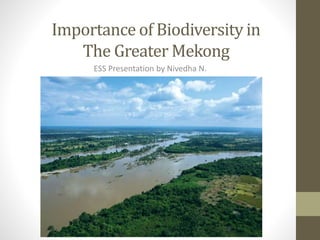
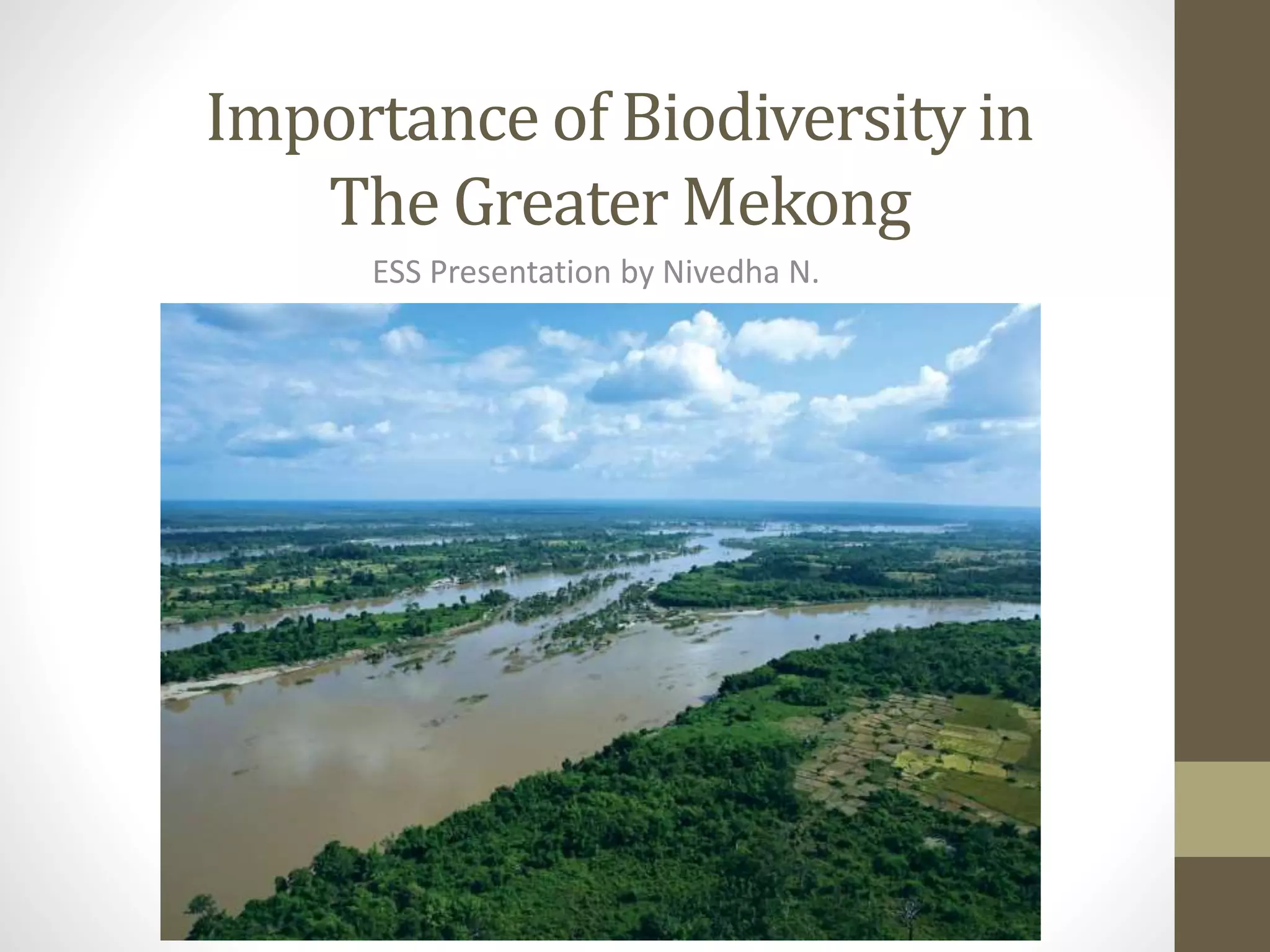
Importance of Biodiversity in
The Greater Mekong
ESS Presentation by Nivedha N.
Year 12
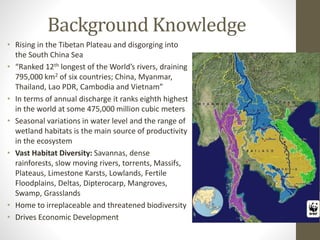
Background Knowledge
• Rising in the Tibetan Plateau and disgorging into
the South China Sea
• “Ranked 12th longest of the World’s rivers, draining
795,000 km2 of six countries; China, Myanmar,
Thailand, Lao PDR, Cambodia and Vietnam”
• In terms of annual discharge it ranks eighth highest
in the world at some 475,000 million cubic meters
• Seasonal variations in water level and the range of
wetland habitats is the main source of productivity
in the ecosystem
• Vast Habitat Diversity: Savannas, dense
rainforests, slow moving rivers, torrents, Massifs,
Plateaus, Limestone Karsts, Lowlands, Fertile
Floodplains, Deltas, Dipterocarp, Mangroves,
Swamp, Grasslands
• Home to irreplaceable and threatened biodiversity
• Drives Economic Development
Biodiversity
• Biodiversity is "the variability among living organisms from all sources including, inter
alia, terrestrial, marine and other aquatic ecosystems and the ecological complexes of
which they are a part; this includes diversity within species, between species and of
ecosystems” (Convention of Biodiversity)
• Annual flood pulses support the Biodiversity second to Amazon in numbers of fish,
mammals and birds
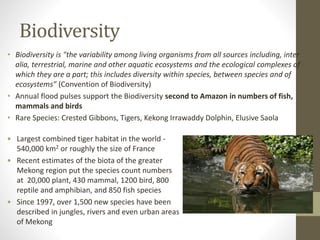
• Rare Species: Crested Gibbons, Tigers, Kekong Irrawaddy Dolphin, Elusive Saola
 Largest combined tiger habitat in the world -
540,000 km2 or roughly the size of France
 Recent estimates of the biota of the greater
Mekong region put the species count numbers
at 20,000 plant, 430 mammal, 1200 bird, 800
reptile and amphibian, and 850 fish species
 Since 1997, over 1,500 new species have been
described in jungles, rivers and even urban areas
of Mekong
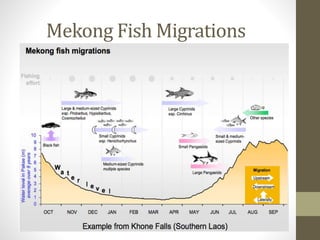
Mekong Fish Migrations
Threat to Biodiversity
• Sensitive species are critically endangered
such as Irrawaddy Dolphin, Siamese
Crocodile, Giant Catfish, Giant ibis and Sarus
Crane
• Human activity such as Water Pollution,
Salinization, Irrigation, Overharvesting and
Dam construction are major threats
• Dams regulate flow obstructing majority of
migratory fish dependent on hydrological
cycle and flows
• 87% of Fish species are migratory
• Deforestation near drainage basins cause
sedimentation of lakes and rivers
• Conservation vs. Development
• Illicit Wildfire trade causing extinction
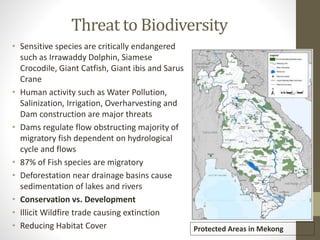
• Reducing Habitat Cover Protected Areas in Mekong
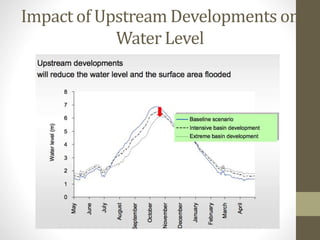
Impact of Upstream Developments on
Water Level
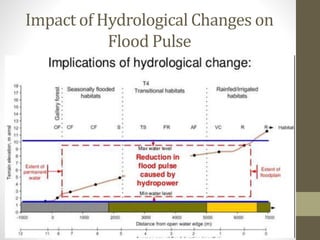
Impact of Hydrological Changes on
Flood Pulse
Link to Livelihood
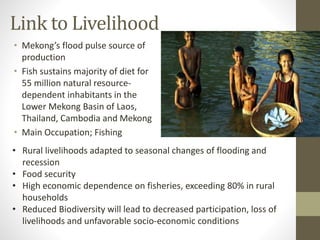
• Mekong’s flood pulse source of
production
• Fish sustains majority of diet for
55 million natural resource-
dependent inhabitants in the
Lower Mekong Basin of Laos,
Thailand, Cambodia and Mekong
• Main Occupation; Fishing
• Rural livelihoods adapted to seasonal changes of flooding and
recession
• Food security
• High economic dependence on fisheries, exceeding 80% in rural
households
• Reduced Biodiversity will lead to decreased participation, loss of
livelihoods and unfavorable socio-economic conditions
Link to Economy of Nations
• Countries characterized majorly as poor and rural populations
• Excepting Thailand, nominal per capita income ranges from US$254
in Cambodia to US$354 in
• Vietnam. Around 40% of the population in Cambodia, Laos and
Vietnam live beneath the poverty line
• Furthermore, the population growth rate in the region is high - 2.5%
for Laos
• High population growth rate; 2.5% for Laos and Cambodia leading to
ever-increasing demand for food and jobs.
• Mekong Region is the main source of employment
• Wetland resources and biodiversity are national treasures to the
nations as they serve for
• Source of resources, occupations and economy
• Tourism
• Large monetary and social value of the region’s ecosystems and
habitats
Conclusion
• Need for Regional Co-operation to protect the National and
Ecological treasure
• Strategies towards Sustainable Development to eradicate
issue of Conservation vs. Development to appreciate both
viewpoints
• The Mekong Region sustains a rich biodiversity of aquatic food
webs, complex ecosystems, rare species, habitat biodiversity
and is the key to the environmental, social and economic
stability of the countries involved
MLA Bibliography
• "Discovering the Greater Mekong." WWF-Discovering the Greater
Mekong. WWF, n.d. Web. 10 Mar. 2015.
<http://wwf.panda.org/what_we_do/where_we_work/greatermekong/
discovering_the_greater_mekong/>.
• "Biodiversity." Biodiversity. N.p., n.d. Web. 10 Mar. 2015.
<http://mekongriver.info/biodiversity>.
• "The Mekong." Mekong Wetlands Biodiversity Conservation. Mekong
Wetlands Biodiversity Conservation and Sustainable Use Programme,
IUCN, n.d. Web.
<http://www.mekongwetlands.org/Programme/mekong.htm>.
• Biodiversity and Fisheries in the Mekong River Basin. Phnom Penh,
Cambodia: Mekong River Commission, 2003. Biodiversity and Fisheries
in the Mekong River Basin. Web.
<http://www.mrcmekong.org/assets/Publications/report-management-
develop/Mek-Dev-No2-Mek-River-Biodiversityfiisheries-in.pdf>.

Greater Mekong Biodiversity

  • 1.
    Importance of Biodiversityin The Greater Mekong ESS Presentation by Nivedha N. Year 12
  • 2.
    Background Knowledge • Risingin the Tibetan Plateau and disgorging into the South China Sea • “Ranked 12th longest of the World’s rivers, draining 795,000 km2 of six countries; China, Myanmar, Thailand, Lao PDR, Cambodia and Vietnam” • In terms of annual discharge it ranks eighth highest in the world at some 475,000 million cubic meters • Seasonal variations in water level and the range of wetland habitats is the main source of productivity in the ecosystem • Vast Habitat Diversity: Savannas, dense rainforests, slow moving rivers, torrents, Massifs, Plateaus, Limestone Karsts, Lowlands, Fertile Floodplains, Deltas, Dipterocarp, Mangroves, Swamp, Grasslands • Home to irreplaceable and threatened biodiversity • Drives Economic Development
  • 3.
    Biodiversity • Biodiversity is"the variability among living organisms from all sources including, inter alia, terrestrial, marine and other aquatic ecosystems and the ecological complexes of which they are a part; this includes diversity within species, between species and of ecosystems” (Convention of Biodiversity) • Annual flood pulses support the Biodiversity second to Amazon in numbers of fish, mammals and birds • Rare Species: Crested Gibbons, Tigers, Kekong Irrawaddy Dolphin, Elusive Saola  Largest combined tiger habitat in the world - 540,000 km2 or roughly the size of France  Recent estimates of the biota of the greater Mekong region put the species count numbers at 20,000 plant, 430 mammal, 1200 bird, 800 reptile and amphibian, and 850 fish species  Since 1997, over 1,500 new species have been described in jungles, rivers and even urban areas of Mekong
  • 4.
  • 5.
    Threat to Biodiversity •Sensitive species are critically endangered such as Irrawaddy Dolphin, Siamese Crocodile, Giant Catfish, Giant ibis and Sarus Crane • Human activity such as Water Pollution, Salinization, Irrigation, Overharvesting and Dam construction are major threats • Dams regulate flow obstructing majority of migratory fish dependent on hydrological cycle and flows • 87% of Fish species are migratory • Deforestation near drainage basins cause sedimentation of lakes and rivers • Conservation vs. Development • Illicit Wildfire trade causing extinction • Reducing Habitat Cover Protected Areas in Mekong
  • 6.
    Impact of UpstreamDevelopments on Water Level
  • 7.
    Impact of HydrologicalChanges on Flood Pulse
  • 8.
    Link to Livelihood •Mekong’s flood pulse source of production • Fish sustains majority of diet for 55 million natural resource- dependent inhabitants in the Lower Mekong Basin of Laos, Thailand, Cambodia and Mekong • Main Occupation; Fishing • Rural livelihoods adapted to seasonal changes of flooding and recession • Food security • High economic dependence on fisheries, exceeding 80% in rural households • Reduced Biodiversity will lead to decreased participation, loss of livelihoods and unfavorable socio-economic conditions
  • 9.
    Link to Economyof Nations • Countries characterized majorly as poor and rural populations • Excepting Thailand, nominal per capita income ranges from US$254 in Cambodia to US$354 in • Vietnam. Around 40% of the population in Cambodia, Laos and Vietnam live beneath the poverty line • Furthermore, the population growth rate in the region is high - 2.5% for Laos • High population growth rate; 2.5% for Laos and Cambodia leading to ever-increasing demand for food and jobs. • Mekong Region is the main source of employment • Wetland resources and biodiversity are national treasures to the nations as they serve for • Source of resources, occupations and economy • Tourism • Large monetary and social value of the region’s ecosystems and habitats
  • 10.
    Conclusion • Need forRegional Co-operation to protect the National and Ecological treasure • Strategies towards Sustainable Development to eradicate issue of Conservation vs. Development to appreciate both viewpoints • The Mekong Region sustains a rich biodiversity of aquatic food webs, complex ecosystems, rare species, habitat biodiversity and is the key to the environmental, social and economic stability of the countries involved
  • 11.
    MLA Bibliography • "Discoveringthe Greater Mekong." WWF-Discovering the Greater Mekong. WWF, n.d. Web. 10 Mar. 2015. <http://wwf.panda.org/what_we_do/where_we_work/greatermekong/ discovering_the_greater_mekong/>. • "Biodiversity." Biodiversity. N.p., n.d. Web. 10 Mar. 2015. <http://mekongriver.info/biodiversity>. • "The Mekong." Mekong Wetlands Biodiversity Conservation. Mekong Wetlands Biodiversity Conservation and Sustainable Use Programme, IUCN, n.d. Web. <http://www.mekongwetlands.org/Programme/mekong.htm>. • Biodiversity and Fisheries in the Mekong River Basin. Phnom Penh, Cambodia: Mekong River Commission, 2003. Biodiversity and Fisheries in the Mekong River Basin. Web. <http://www.mrcmekong.org/assets/Publications/report-management- develop/Mek-Dev-No2-Mek-River-Biodiversityfiisheries-in.pdf>.