Petroleum Project Economics  Econ210D Presentation 10 Government Regulations Week 10
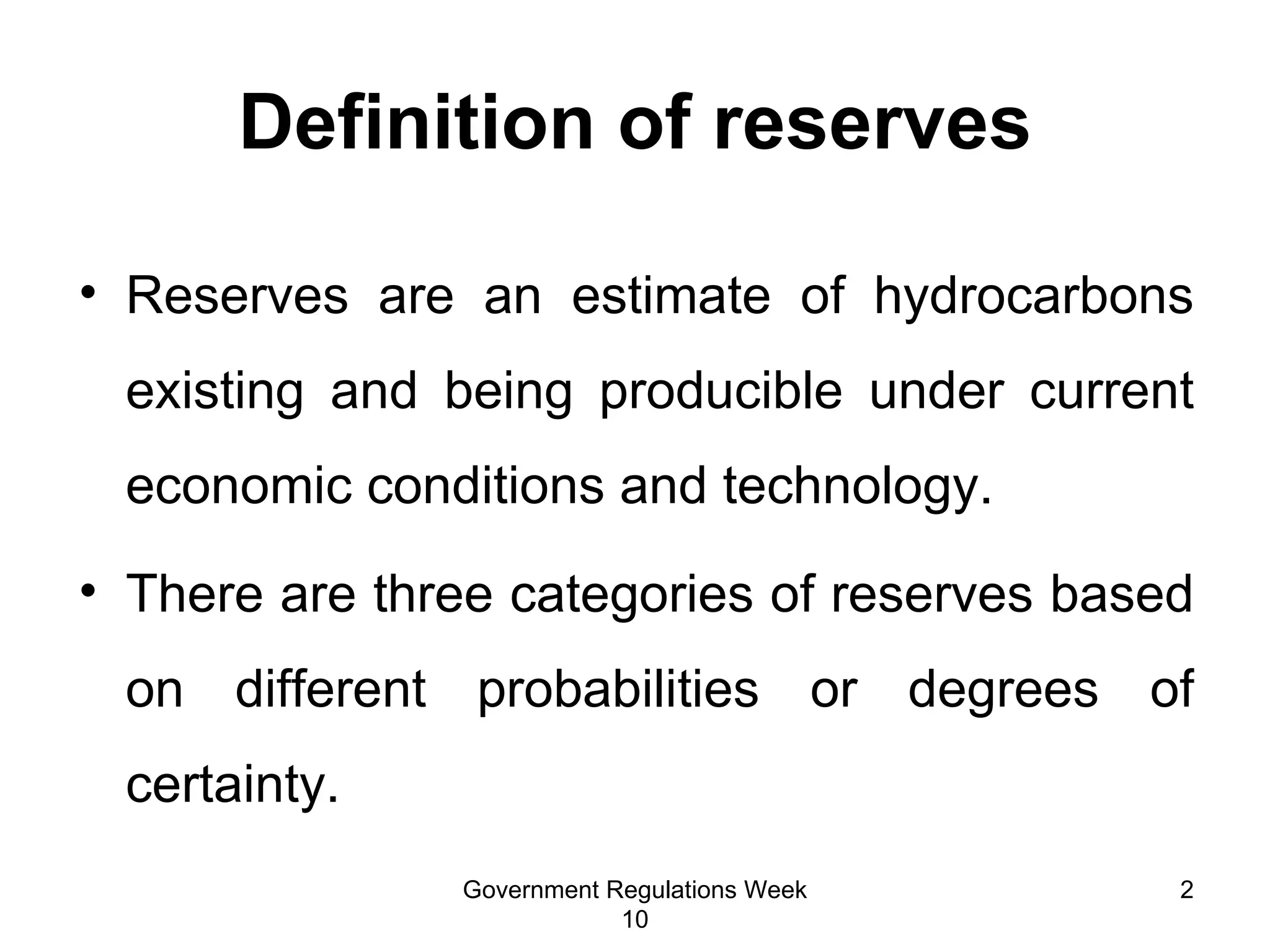
Definition of reserves Reserves are an estimate of hydrocarbons existing and being producible under current economic conditions and technology.  There are three categories of reserves based on different probabilities or degrees of certainty. Government Regulations Week 10
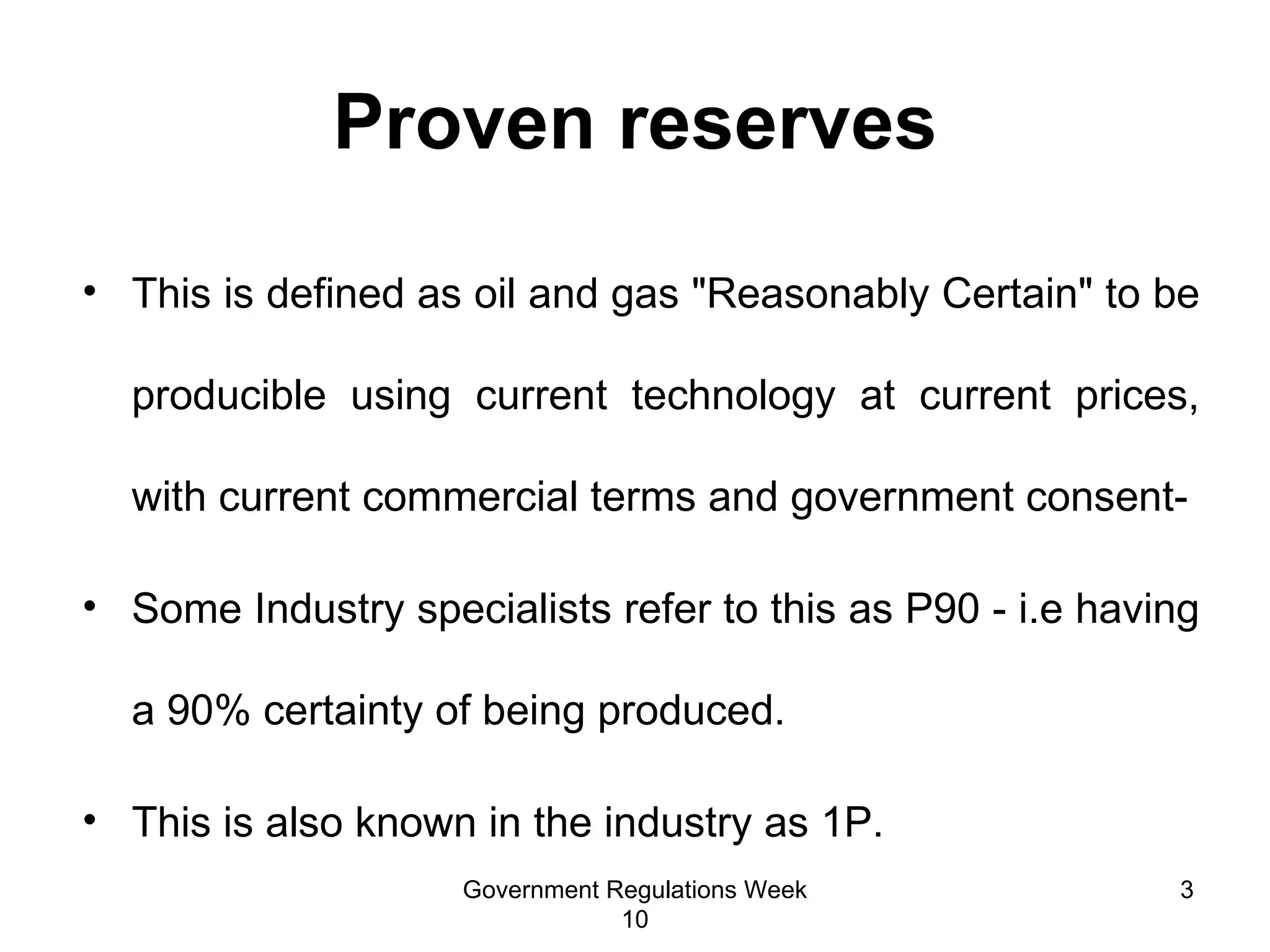
Proven reserves This is defined as oil and gas "Reasonably Certain" to be producible using current technology at current prices, with current commercial terms and government consent- Some Industry specialists refer to this as P90 - i.e having a 90% certainty of being produced.  This is  also known in the industry as 1P.  Government Regulations Week 10
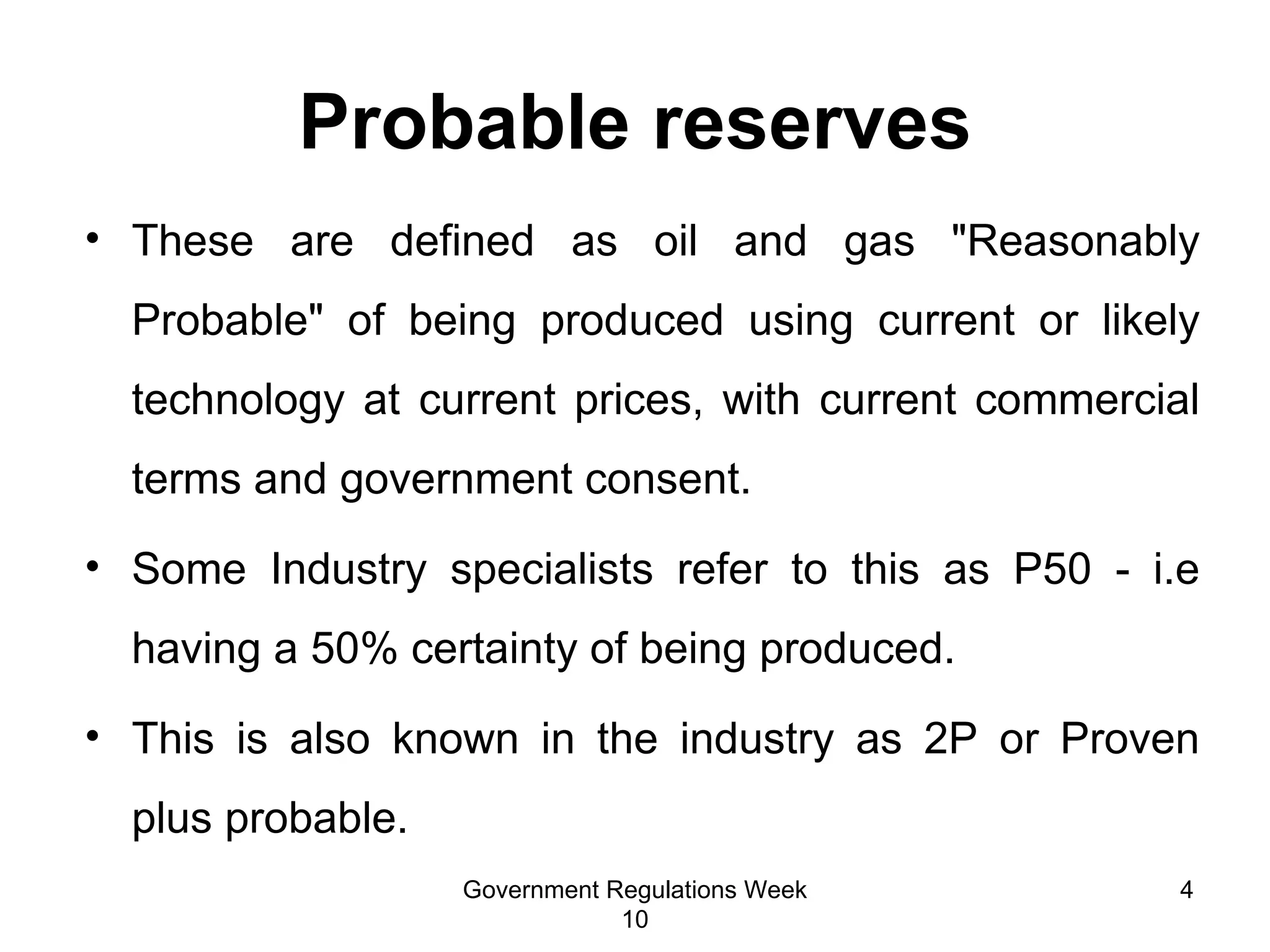
Probable reserves These are defined as oil and gas "Reasonably Probable" of being produced using current or likely technology at current prices, with current commercial terms and government consent. Some Industry specialists refer to this as P50 - i.e having a 50% certainty of being produced. This is also known in the industry as 2P or Proven plus probable.  Government Regulations Week 10
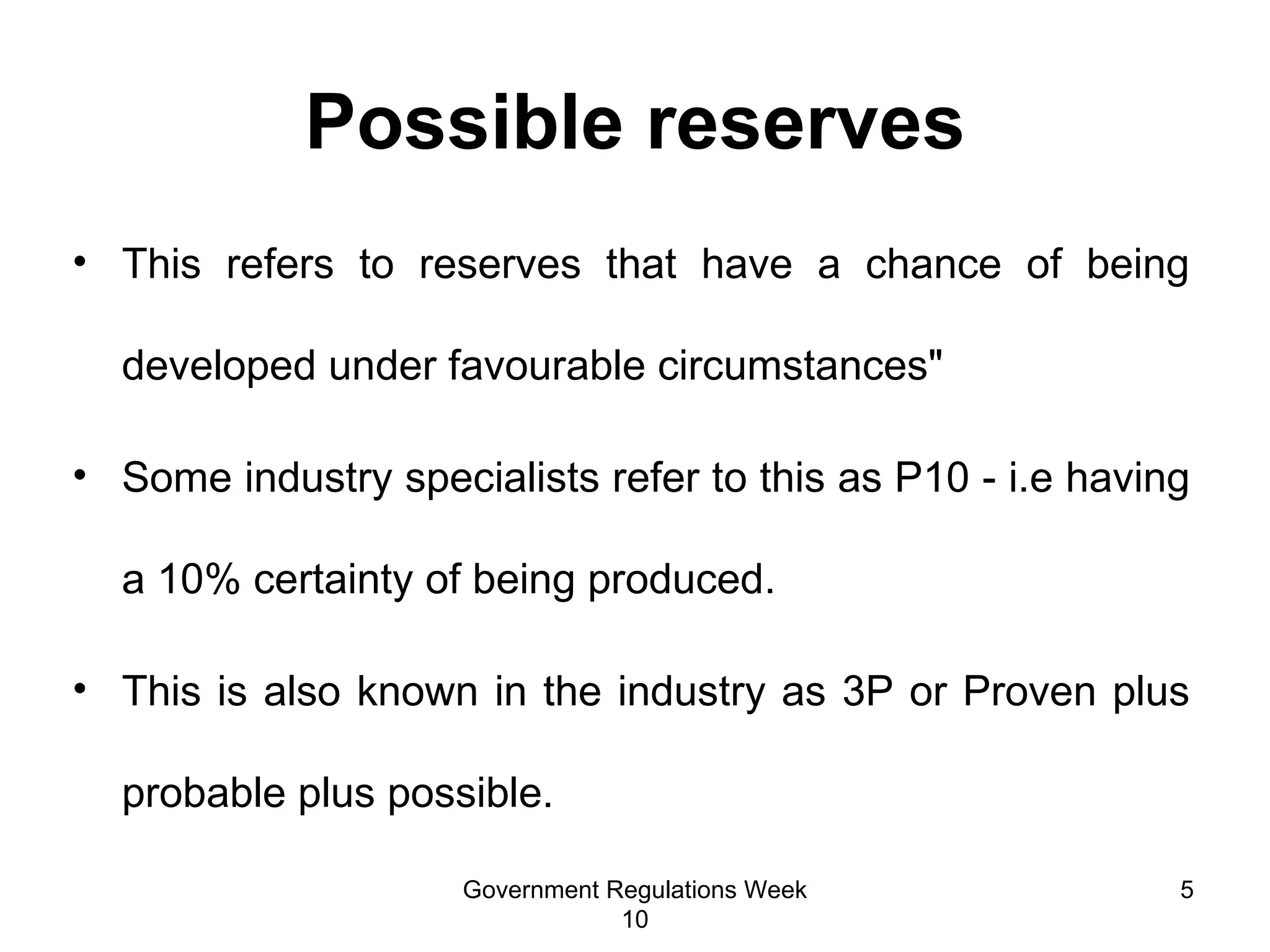
Possible reserves This refers to reserves that have a chance of being developed under favourable circumstances"  Some industry specialists refer to this as P10 - i.e having a 10% certainty of being produced. This is also known in the industry as 3P or Proven plus probable plus possible.  Government Regulations Week 10
Proven reserves can be further categorized as follows: Proved Developed Producing Proved Developed Non-Producing Proved Undeveloped Proven Reserve Categories Government Regulations Week 10
Structure maps & cross sections Well logs Core Analysis  Fluid Data  Well Histories Current Production Data  Estimating Remaining Reserves Government Regulations Week 10
Based on reserve estimates, production can be forecasted using the following methods: Volumetric Analysis Decline Curve Analysis P/z  Measuring Production Government Regulations Week 10
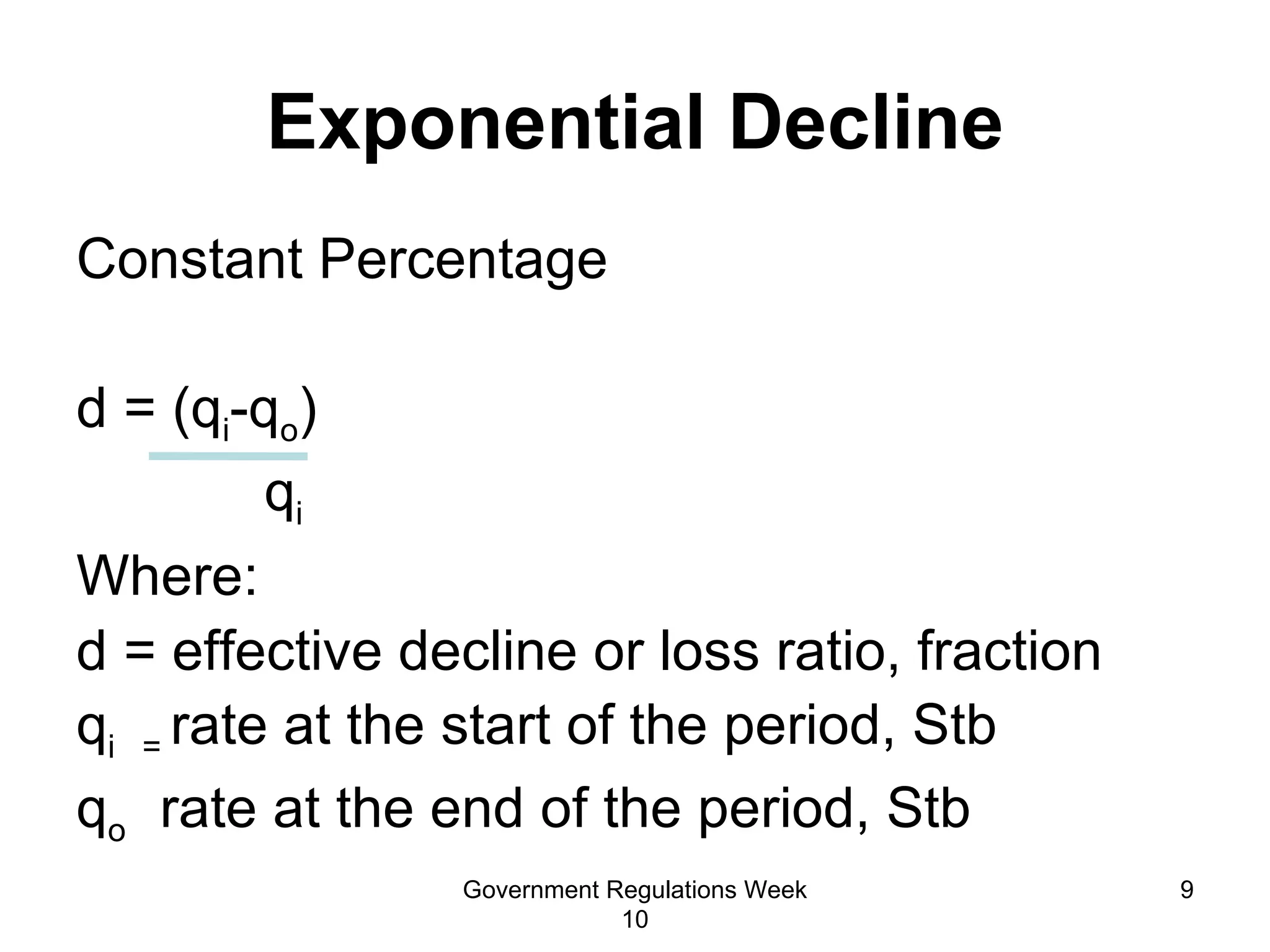
Exponential Decline Constant Percentage  d = (q i -q o ) q i Where: d = effective decline or loss ratio, fraction q i  =  rate at the start of the period, Stb q o   rate at the end of the period, Stb  Government Regulations Week 10
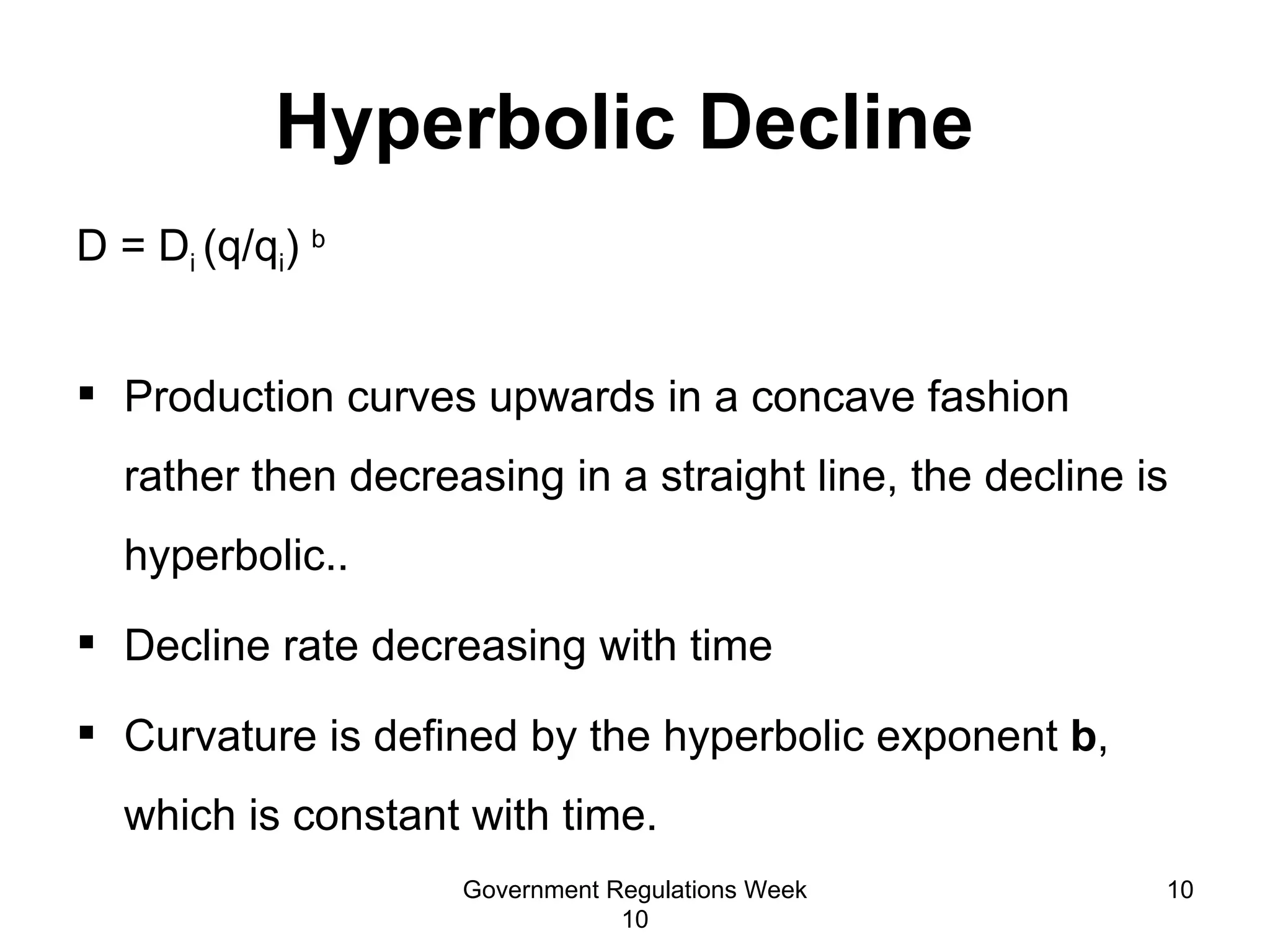
Hyperbolic Decline  D = D i  (q/q i )  b Production curves upwards in a concave fashion rather then decreasing in a straight line, the decline is hyperbolic..  Decline rate decreasing with time Curvature is defined by the hyperbolic exponent  b , which is constant with time. Government Regulations Week 10
Projection of future production Current and Projected Oil and Gas Prices Capital and Operating costs  Inflation rate Taxation Discount Rates Economic Evaluation Government Regulations Week 10
Reserves Estimation  Volumetric calculations Historical Production & reservoir performance analysis (Decline curve analysis) By analogy to similar reservoirs in close vicinity of the area under evaluation Material balance calculations Reservoir simulation Government Regulations Week 10
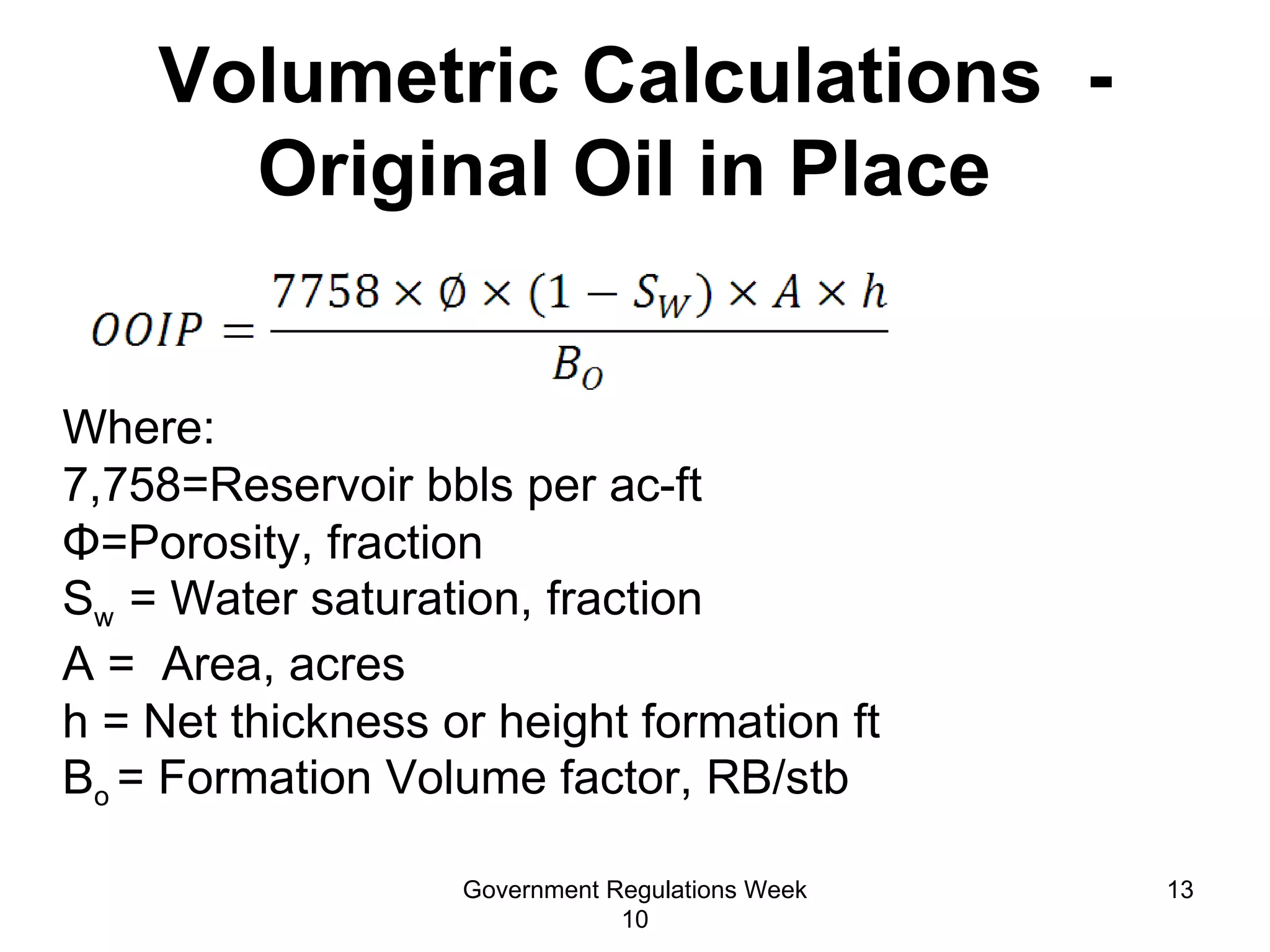
Volumetric Calculations  - Original Oil in Place  Where:  7,758=Reservoir bbls per ac-ft  Φ =Porosity, fraction S w  = Water saturation, fraction  A =  Area, acres h = Net thickness or height formation ft B o  = Formation Volume factor, RB/stb Government Regulations Week 10
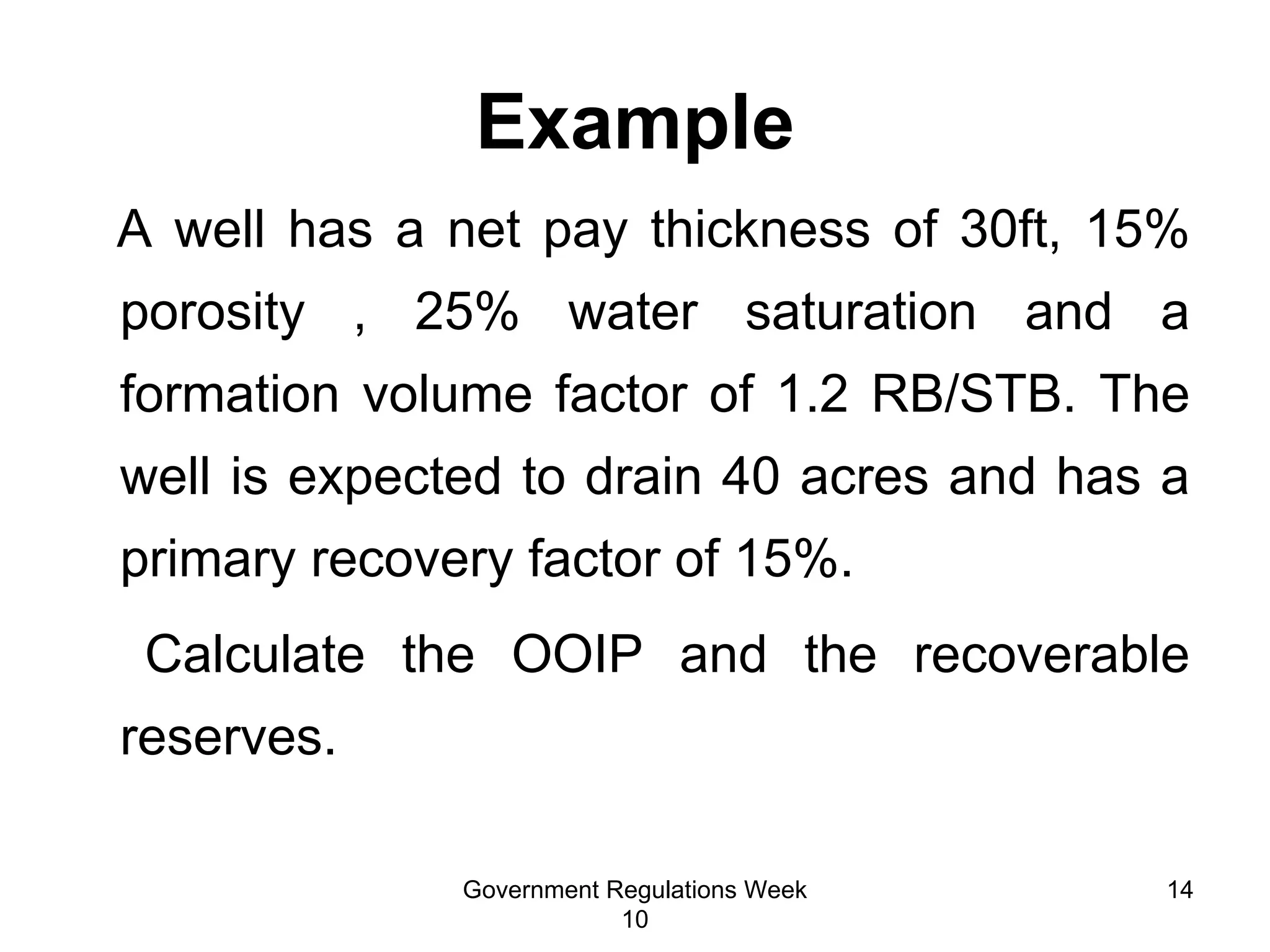
Example A well has a net pay thickness of 30ft, 15% porosity , 25% water saturation and a formation volume factor of 1.2 RB/STB. The well is expected to drain 40 acres and has a primary recovery factor of 15%. Calculate the OOIP and the recoverable reserves.  Government Regulations Week 10
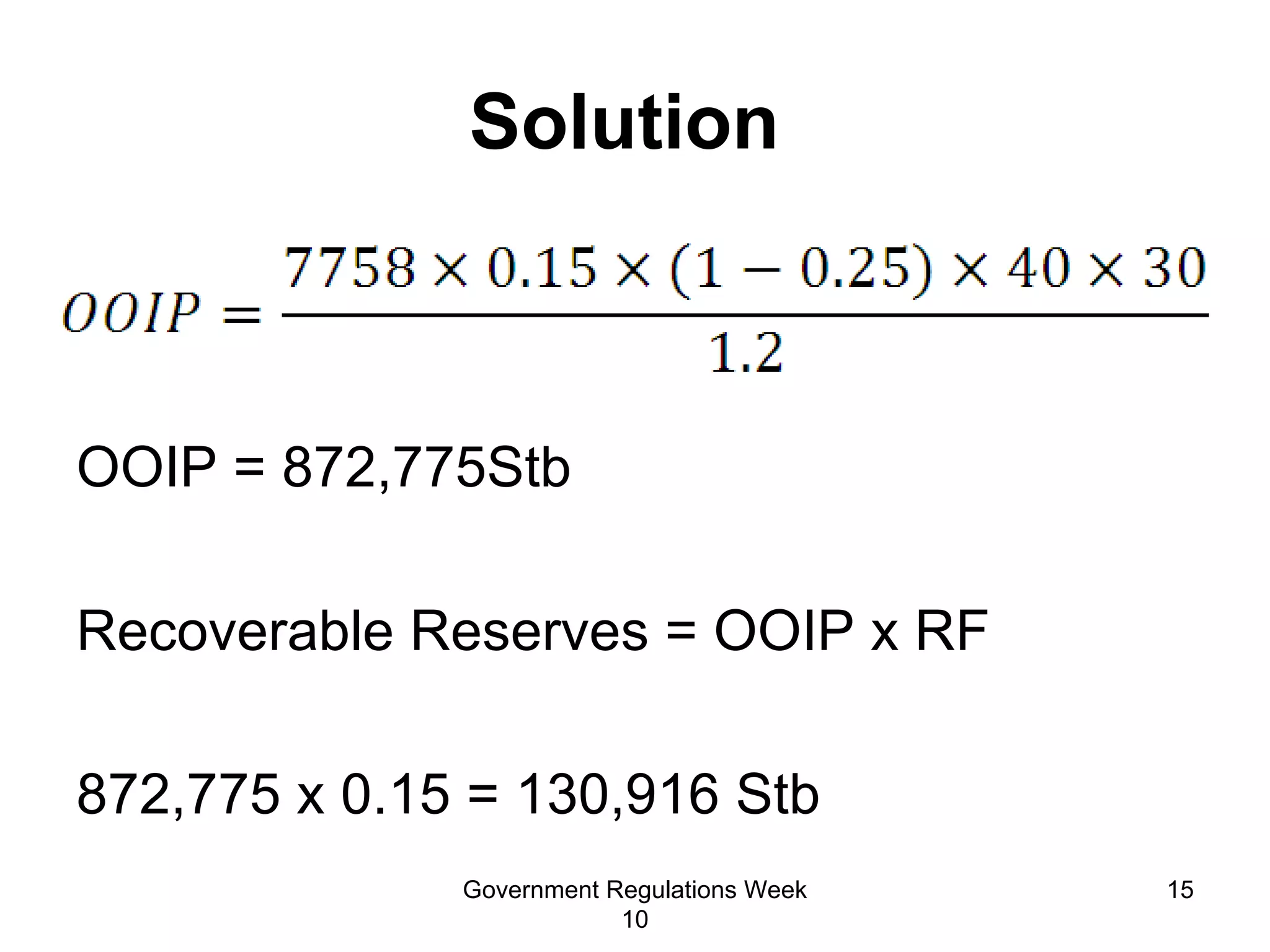
Solution  OOIP = 872,775Stb Recoverable Reserves = OOIP x RF 872,775 x 0.15 = 130,916 Stb Government Regulations Week 10
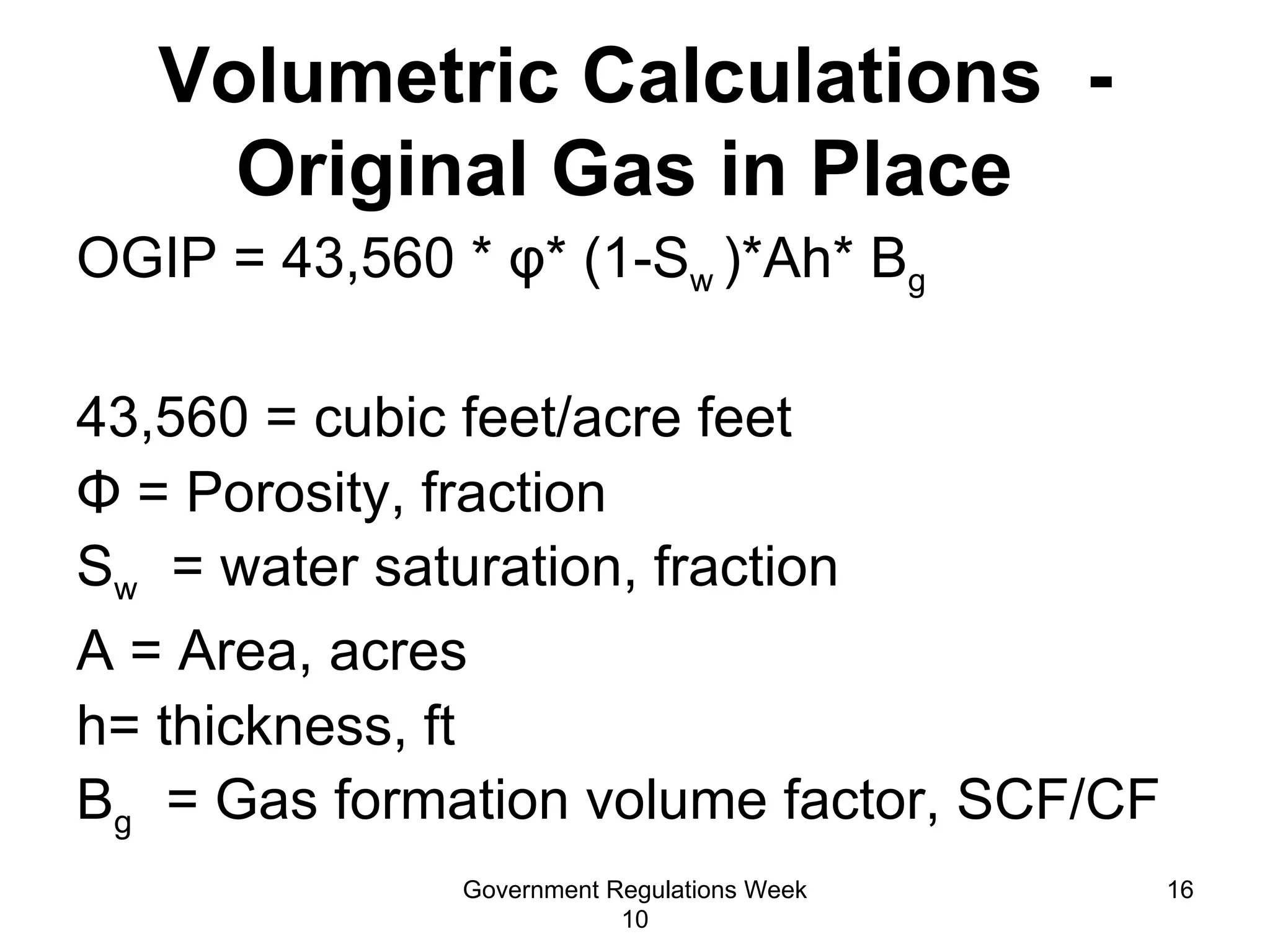
Volumetric Calculations  - Original Gas in Place  OGIP = 43,560 *  φ * (1-S w  )*Ah* B g   43,560 = cubic feet/acre feet Φ  = Porosity, fraction S w  = water saturation, fraction A = Area, acres h= thickness, ft  B g  = Gas formation volume factor, SCF/CF   Government Regulations Week 10
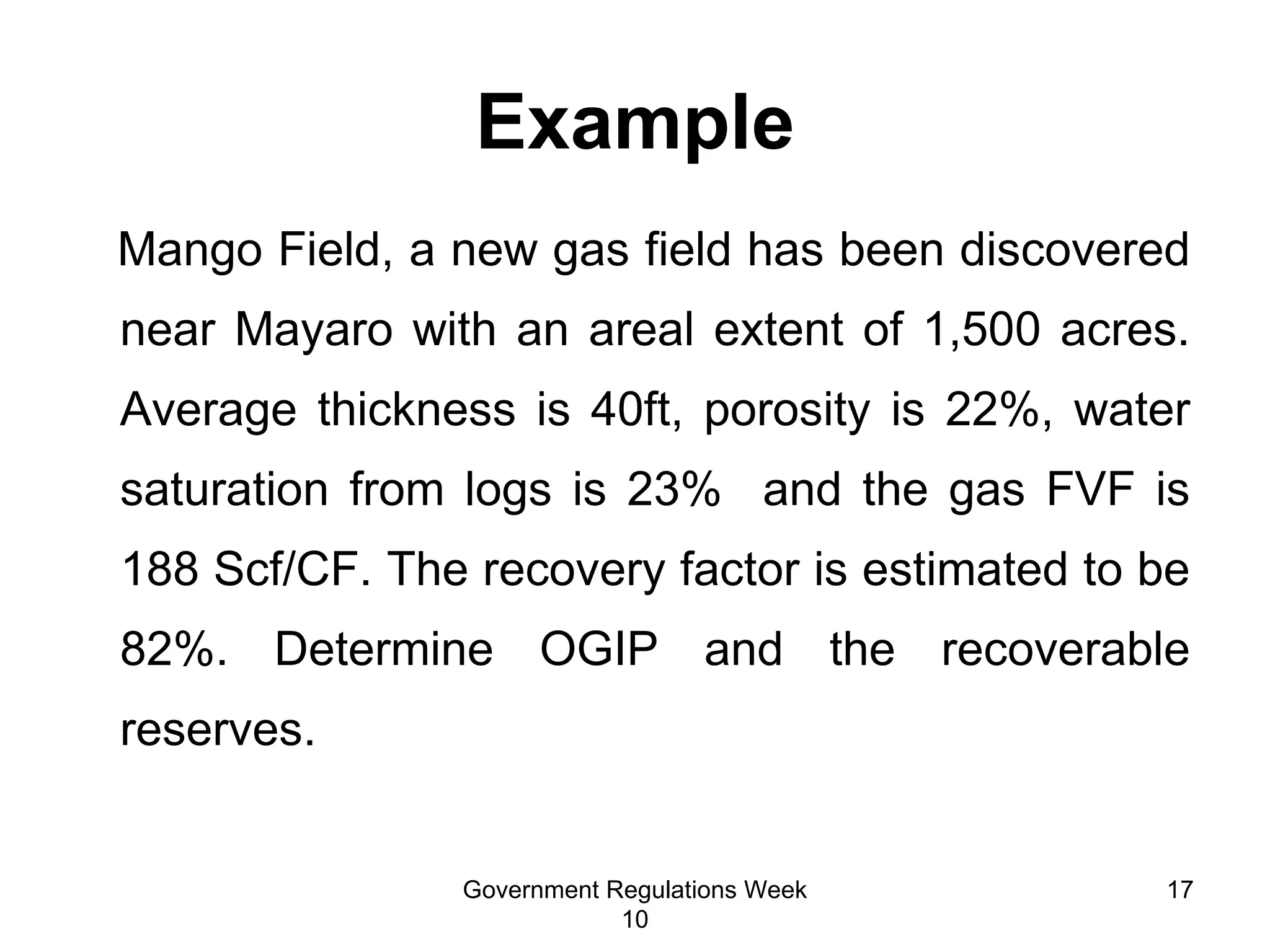
Example Mango Field, a new gas field has been discovered near Mayaro with an areal extent of 1,500 acres. Average thickness is 40ft, porosity is 22%, water saturation from logs is 23%  and the gas FVF is 188 Scf/CF. The recovery factor is estimated to be 82%. Determine OGIP and the recoverable reserves. Government Regulations Week 10
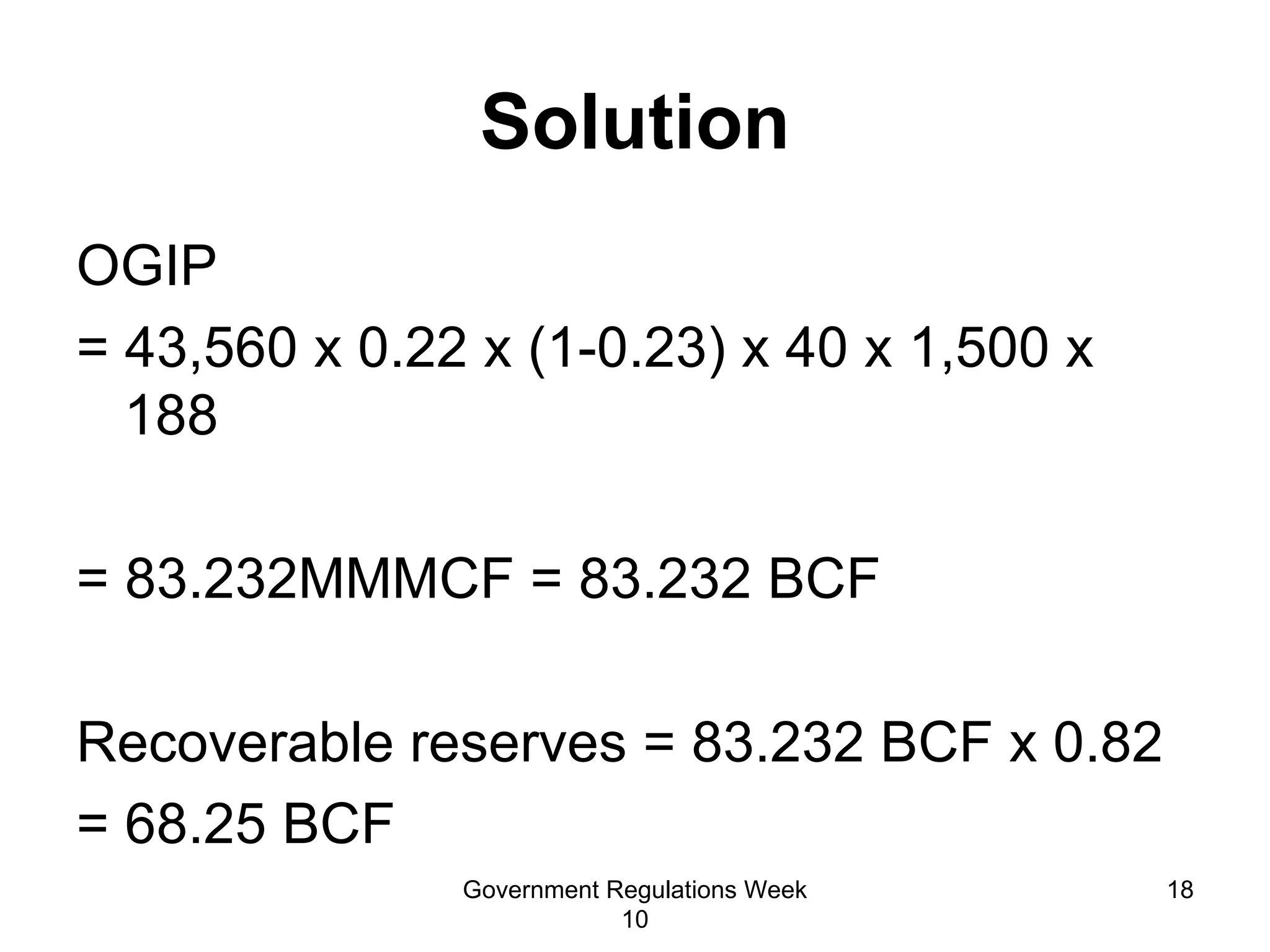
Solution OGIP  = 43,560 x 0.22 x (1-0.23) x 40 x 1,500 x 188 = 83.232MMMCF = 83.232 BCF Recoverable reserves = 83.232 BCF x 0.82 = 68.25 BCF Government Regulations Week 10

Presentation 10

  • 1.
    Petroleum Project Economics Econ210D Presentation 10 Government Regulations Week 10
  • 2.
    Definition of reservesReserves are an estimate of hydrocarbons existing and being producible under current economic conditions and technology. There are three categories of reserves based on different probabilities or degrees of certainty. Government Regulations Week 10
  • 3.
    Proven reserves Thisis defined as oil and gas "Reasonably Certain" to be producible using current technology at current prices, with current commercial terms and government consent- Some Industry specialists refer to this as P90 - i.e having a 90% certainty of being produced. This is also known in the industry as 1P. Government Regulations Week 10
  • 4.
    Probable reserves Theseare defined as oil and gas "Reasonably Probable" of being produced using current or likely technology at current prices, with current commercial terms and government consent. Some Industry specialists refer to this as P50 - i.e having a 50% certainty of being produced. This is also known in the industry as 2P or Proven plus probable. Government Regulations Week 10
  • 5.
    Possible reserves Thisrefers to reserves that have a chance of being developed under favourable circumstances" Some industry specialists refer to this as P10 - i.e having a 10% certainty of being produced. This is also known in the industry as 3P or Proven plus probable plus possible. Government Regulations Week 10
  • 6.
    Proven reserves canbe further categorized as follows: Proved Developed Producing Proved Developed Non-Producing Proved Undeveloped Proven Reserve Categories Government Regulations Week 10
  • 7.
    Structure maps &cross sections Well logs Core Analysis Fluid Data Well Histories Current Production Data Estimating Remaining Reserves Government Regulations Week 10
  • 8.
    Based on reserveestimates, production can be forecasted using the following methods: Volumetric Analysis Decline Curve Analysis P/z Measuring Production Government Regulations Week 10
  • 9.
    Exponential Decline ConstantPercentage d = (q i -q o ) q i Where: d = effective decline or loss ratio, fraction q i = rate at the start of the period, Stb q o rate at the end of the period, Stb Government Regulations Week 10
  • 10.
    Hyperbolic Decline D = D i (q/q i ) b Production curves upwards in a concave fashion rather then decreasing in a straight line, the decline is hyperbolic.. Decline rate decreasing with time Curvature is defined by the hyperbolic exponent b , which is constant with time. Government Regulations Week 10
  • 11.
    Projection of futureproduction Current and Projected Oil and Gas Prices Capital and Operating costs Inflation rate Taxation Discount Rates Economic Evaluation Government Regulations Week 10
  • 12.
    Reserves Estimation Volumetric calculations Historical Production & reservoir performance analysis (Decline curve analysis) By analogy to similar reservoirs in close vicinity of the area under evaluation Material balance calculations Reservoir simulation Government Regulations Week 10
  • 13.
    Volumetric Calculations - Original Oil in Place Where: 7,758=Reservoir bbls per ac-ft Φ =Porosity, fraction S w = Water saturation, fraction A = Area, acres h = Net thickness or height formation ft B o = Formation Volume factor, RB/stb Government Regulations Week 10
  • 14.
    Example A wellhas a net pay thickness of 30ft, 15% porosity , 25% water saturation and a formation volume factor of 1.2 RB/STB. The well is expected to drain 40 acres and has a primary recovery factor of 15%. Calculate the OOIP and the recoverable reserves. Government Regulations Week 10
  • 15.
    Solution OOIP= 872,775Stb Recoverable Reserves = OOIP x RF 872,775 x 0.15 = 130,916 Stb Government Regulations Week 10
  • 16.
    Volumetric Calculations - Original Gas in Place OGIP = 43,560 * φ * (1-S w )*Ah* B g 43,560 = cubic feet/acre feet Φ = Porosity, fraction S w = water saturation, fraction A = Area, acres h= thickness, ft B g = Gas formation volume factor, SCF/CF Government Regulations Week 10
  • 17.
    Example Mango Field,a new gas field has been discovered near Mayaro with an areal extent of 1,500 acres. Average thickness is 40ft, porosity is 22%, water saturation from logs is 23% and the gas FVF is 188 Scf/CF. The recovery factor is estimated to be 82%. Determine OGIP and the recoverable reserves. Government Regulations Week 10
  • 18.
    Solution OGIP = 43,560 x 0.22 x (1-0.23) x 40 x 1,500 x 188 = 83.232MMMCF = 83.232 BCF Recoverable reserves = 83.232 BCF x 0.82 = 68.25 BCF Government Regulations Week 10