Monetary Policy Chapter #12, 13 EDWARD BAHAW - Economic Principles and Their Application to Business (ABE)
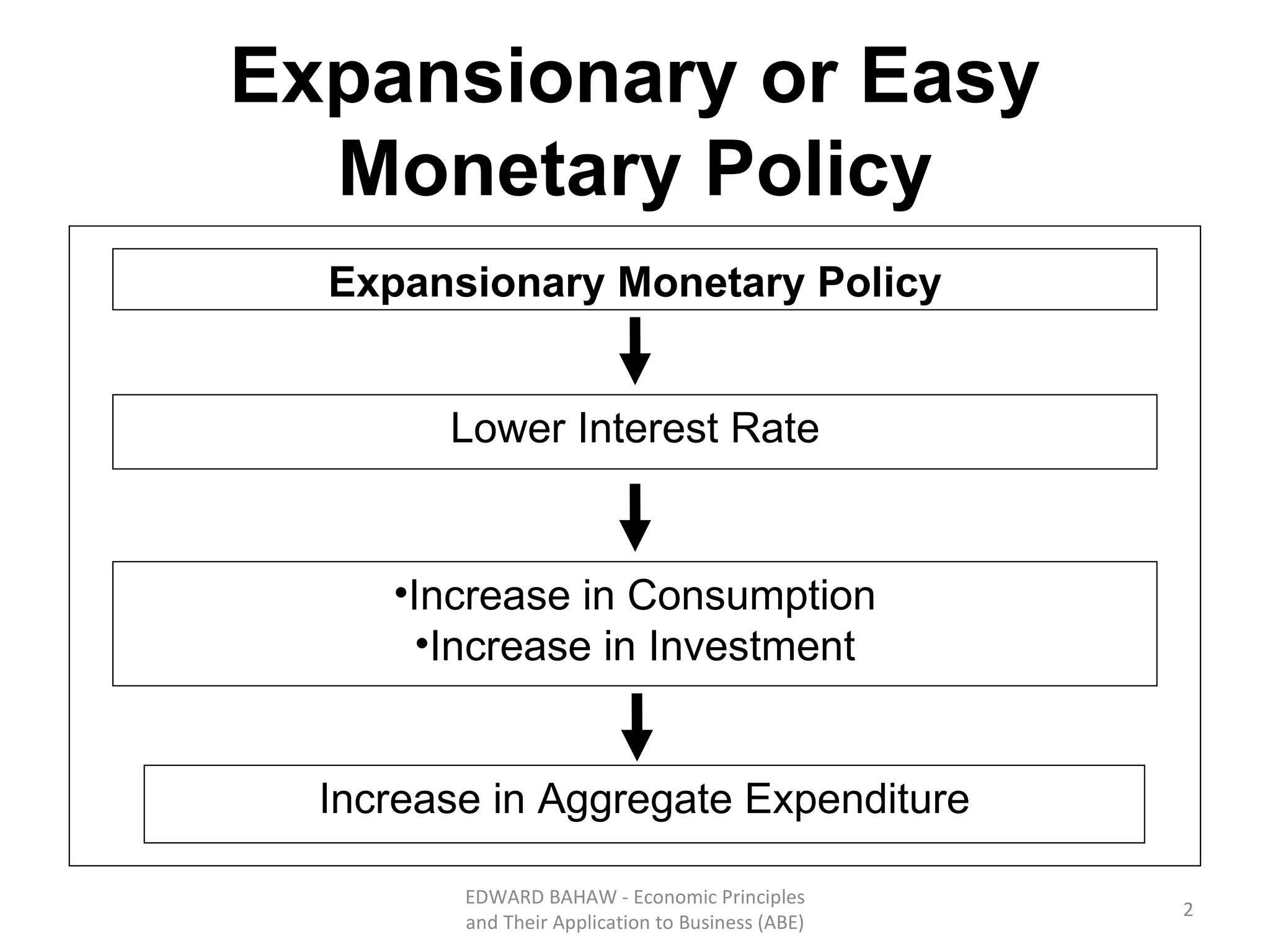
Expansionary or Easy Monetary Policy EDWARD BAHAW - Economic Principles and Their Application to Business (ABE) Lower Interest Rate Expansionary Monetary Policy Increase in Aggregate Expenditure Increase in Consumption Increase in Investment
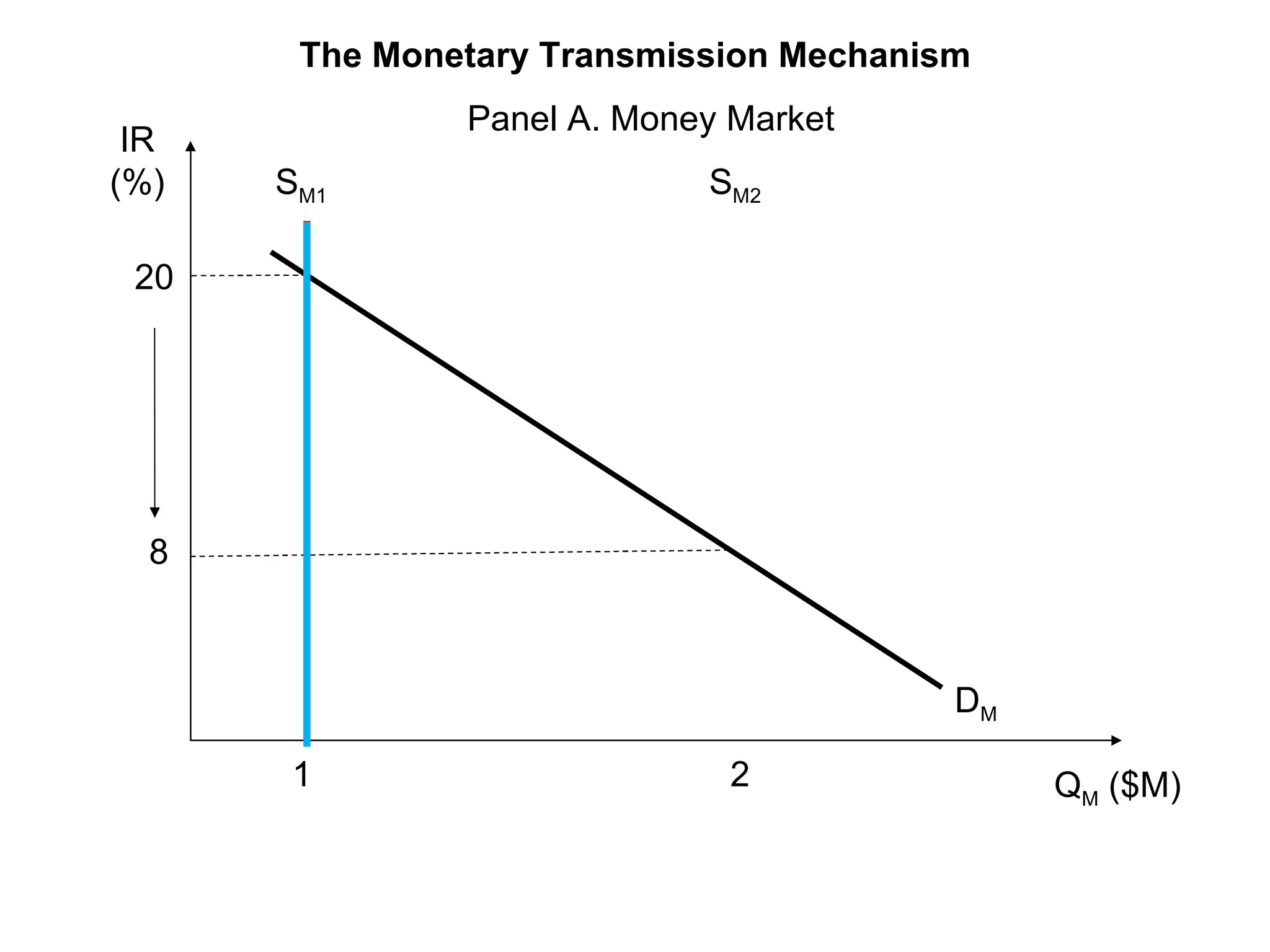
Panel A. Money Market D M S M1 S M2 Q M  ($M) 1 2 8 20 IR (%) The Monetary Transmission Mechanism
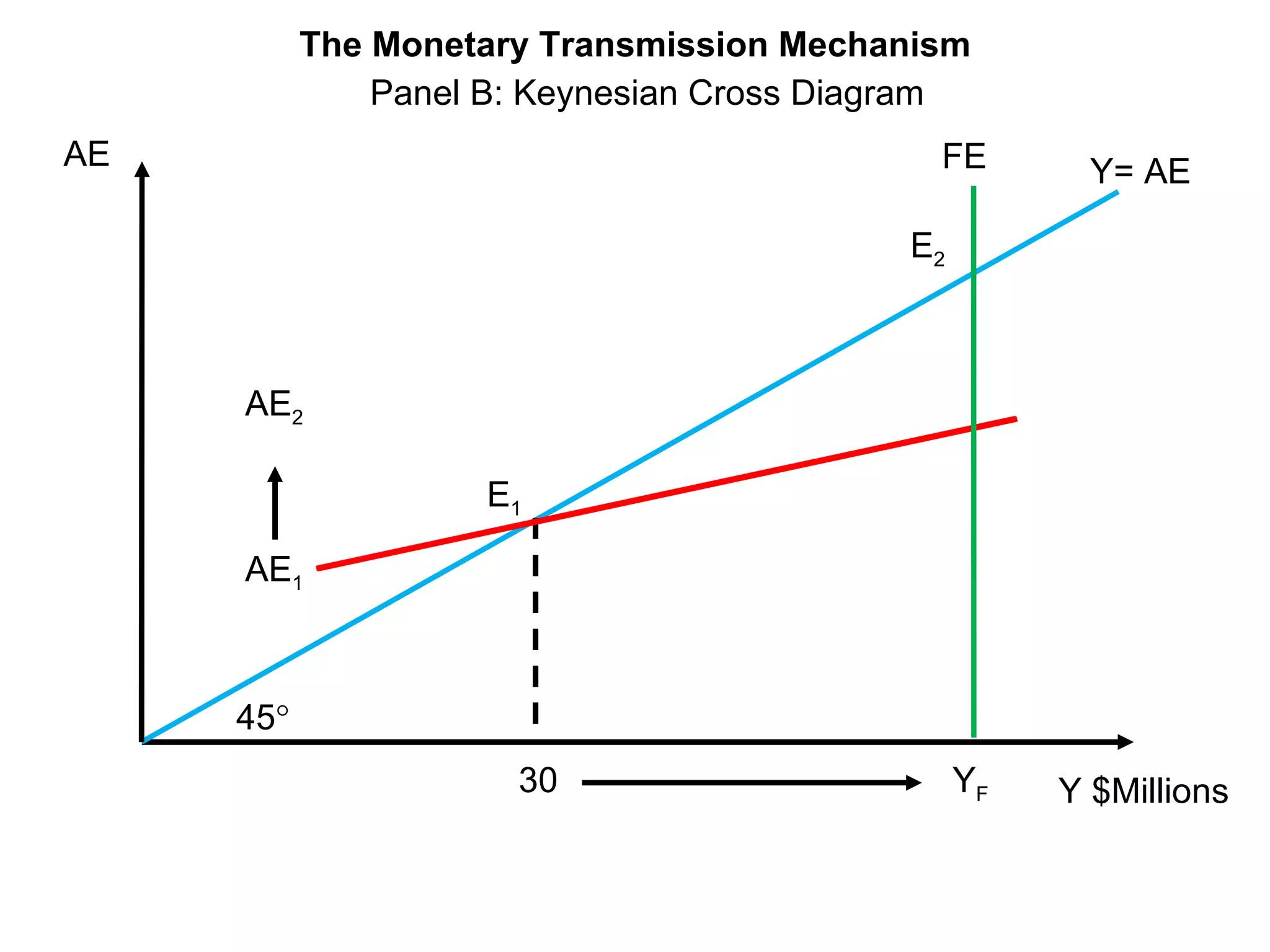
Y $Millions AE E 1 45  30 Y= AE E 2 AE 2 AE 1 Panel B: Keynesian Cross Diagram FE Y F The Monetary Transmission Mechanism
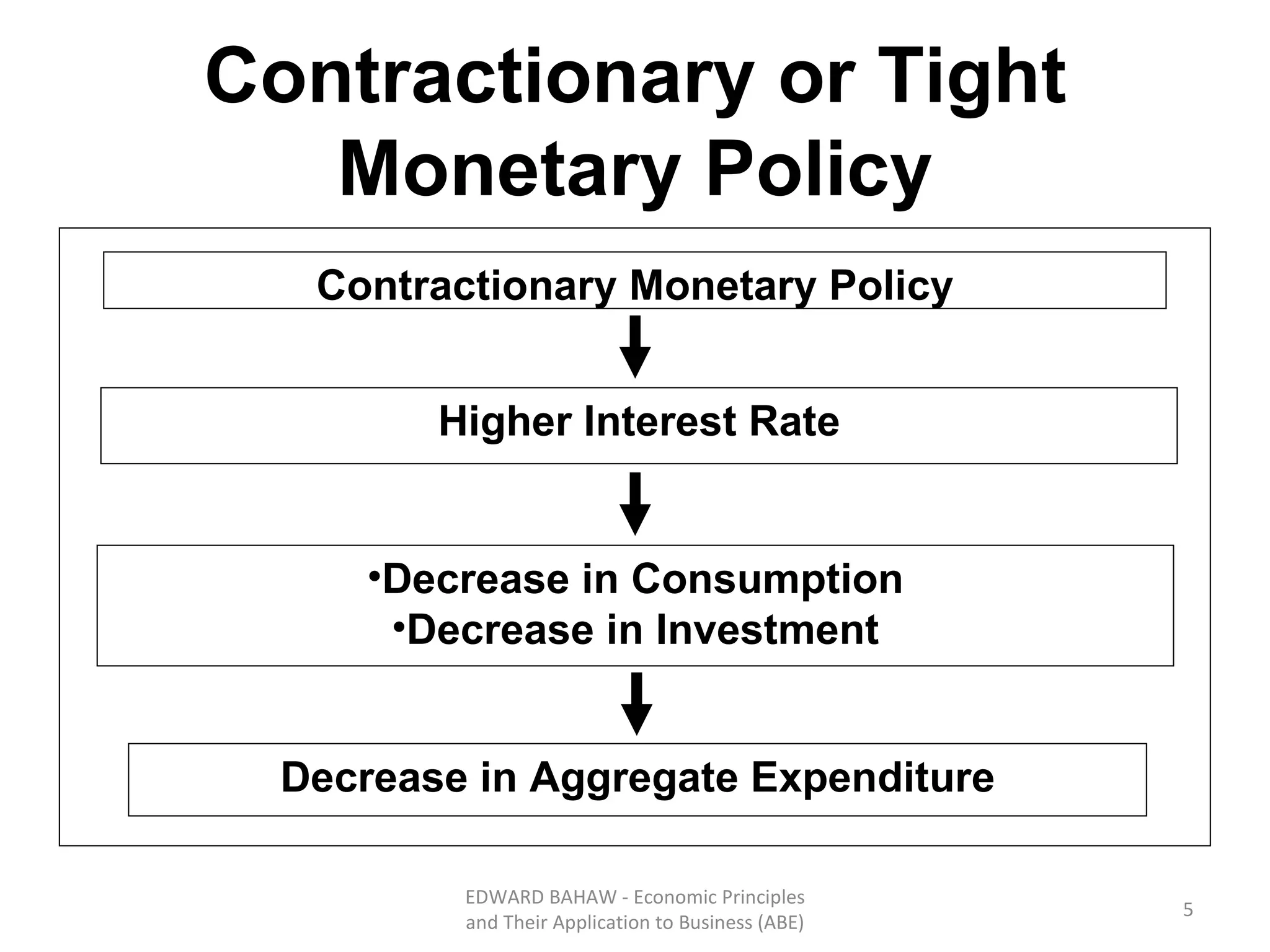
Contractionary or Tight Monetary Policy EDWARD BAHAW - Economic Principles and Their Application to Business (ABE) Higher Interest Rate Contractionary Monetary Policy Decrease in Aggregate Expenditure Decrease in Consumption Decrease in Investment
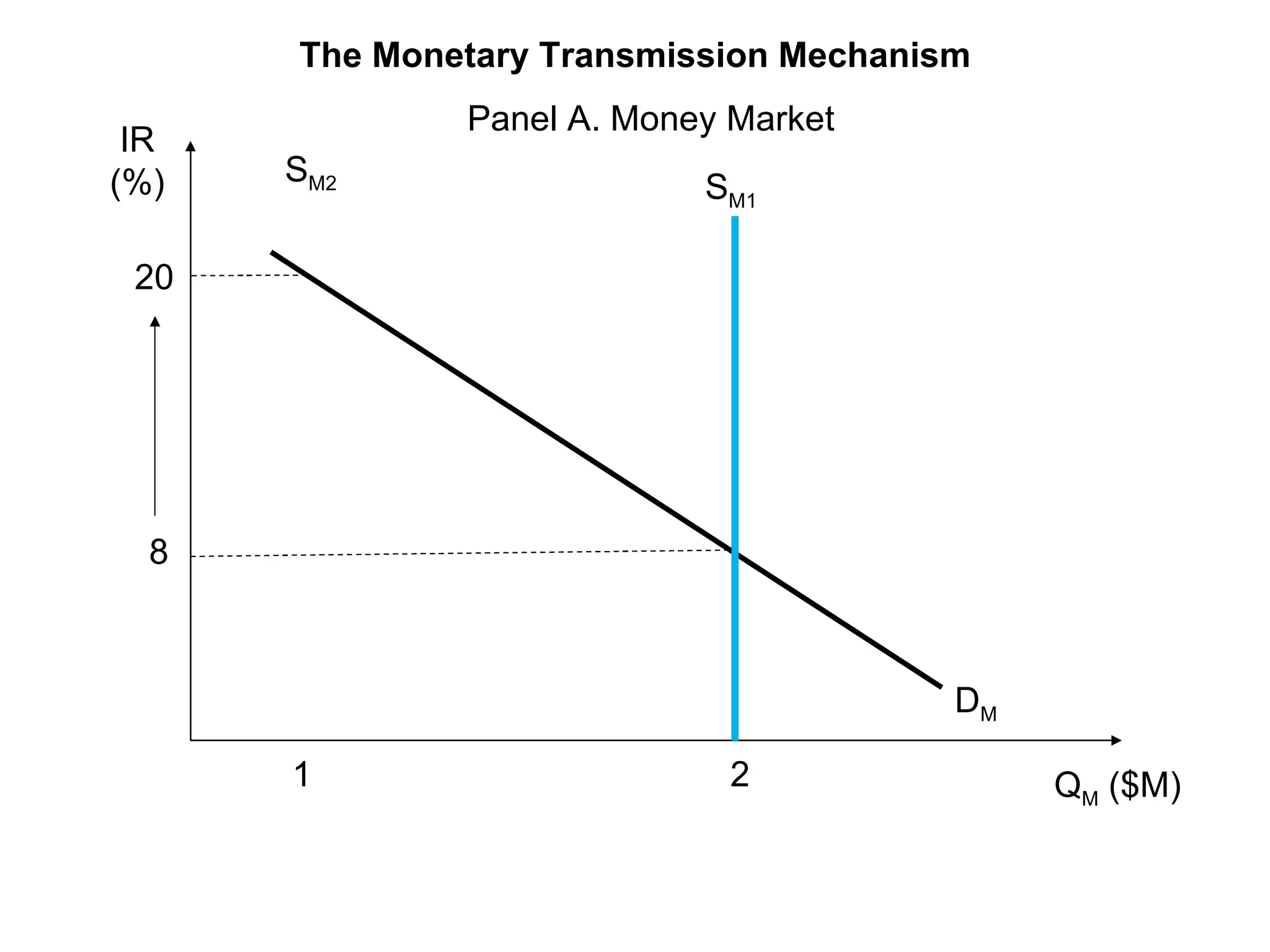
Panel A. Money Market D M S M1 S M2 Q M  ($M) 1 2 8 20 IR (%) The Monetary Transmission Mechanism
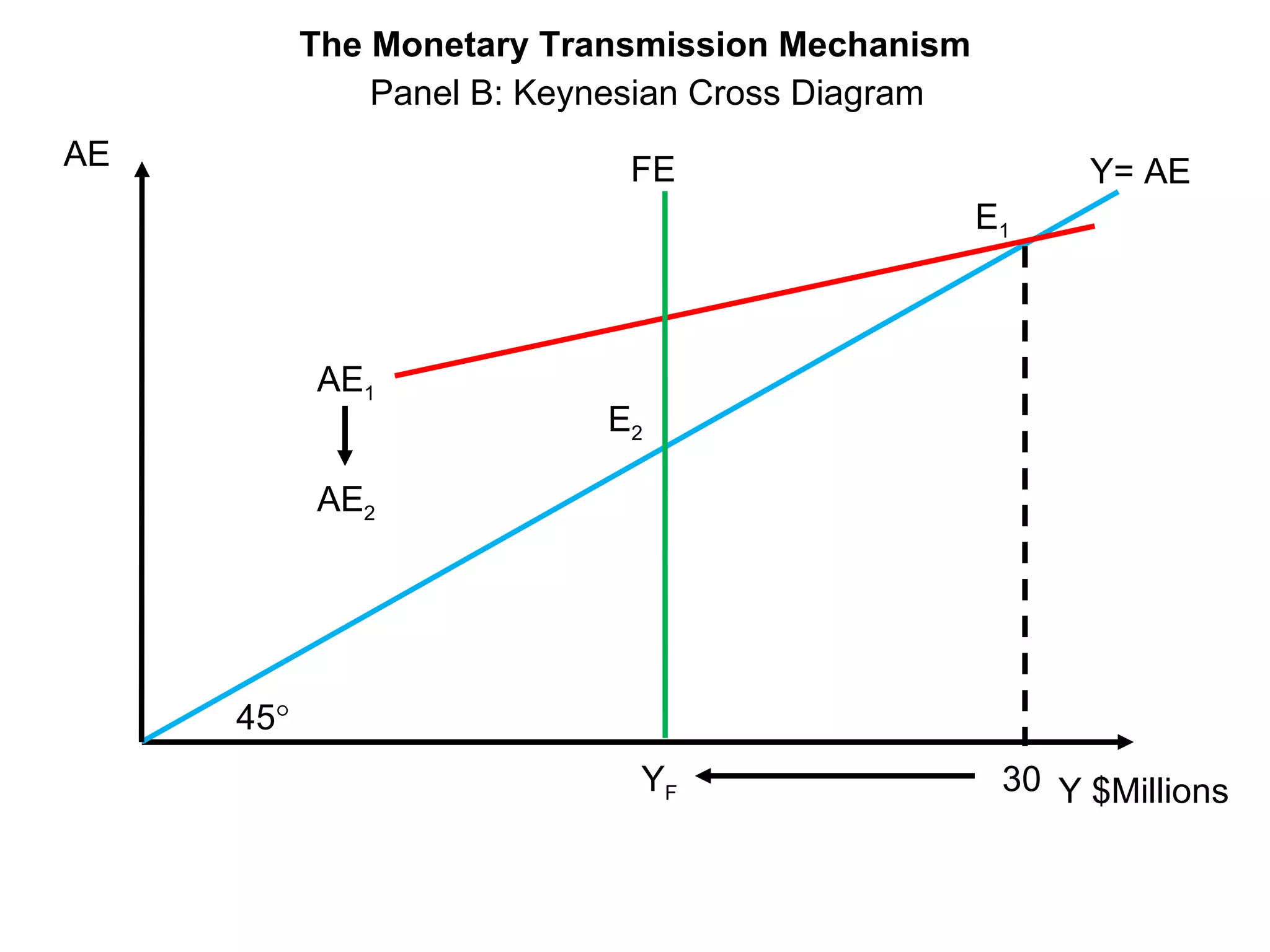
Y $Millions AE E 1 45  30 Y= AE E 2 AE 2 AE 1 Panel B: Keynesian Cross Diagram FE Y F The Monetary Transmission Mechanism
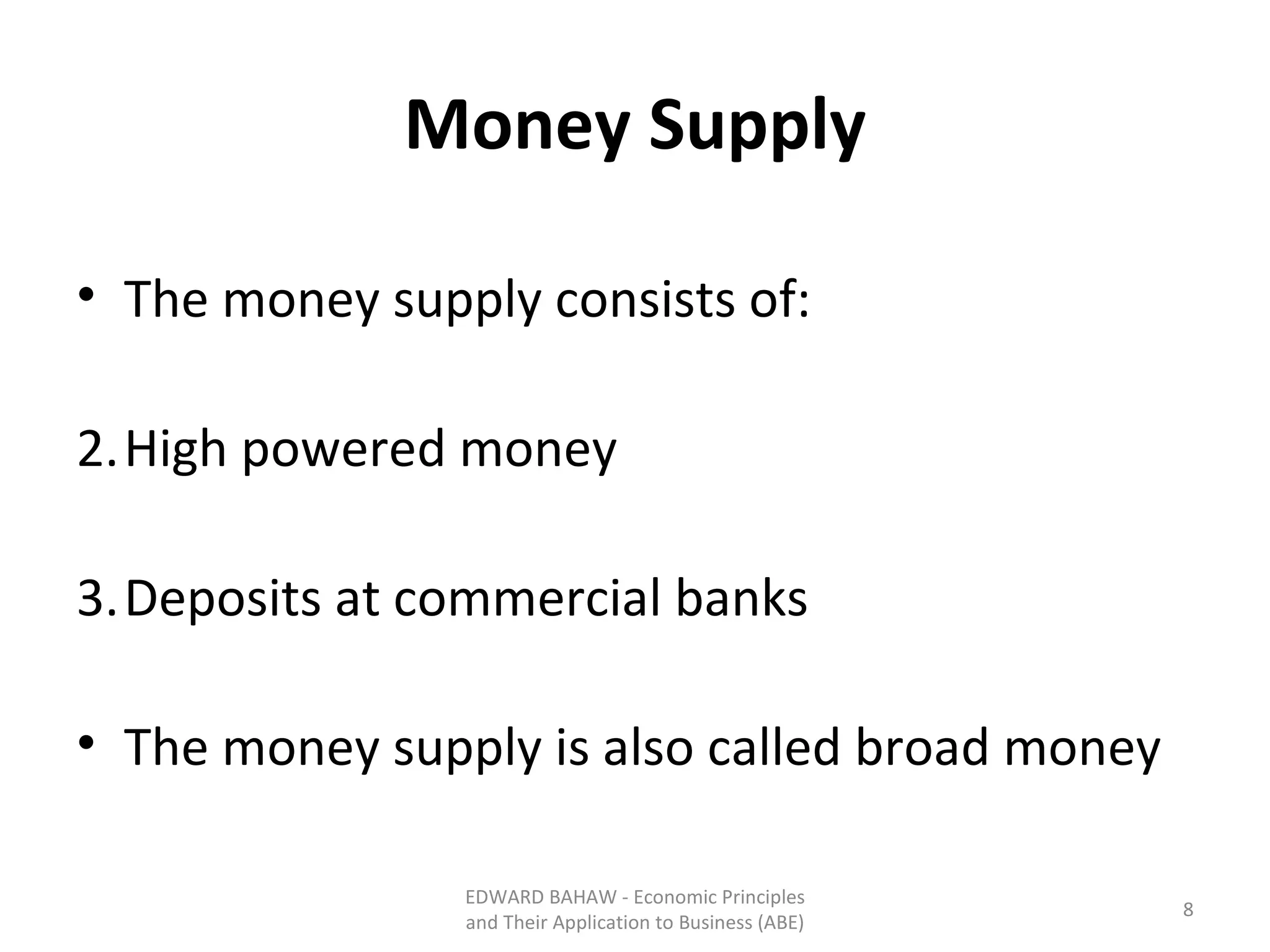
Money Supply The money supply consists of: High powered money Deposits at commercial banks The money supply is also called broad money EDWARD BAHAW - Economic Principles and Their Application to Business (ABE)
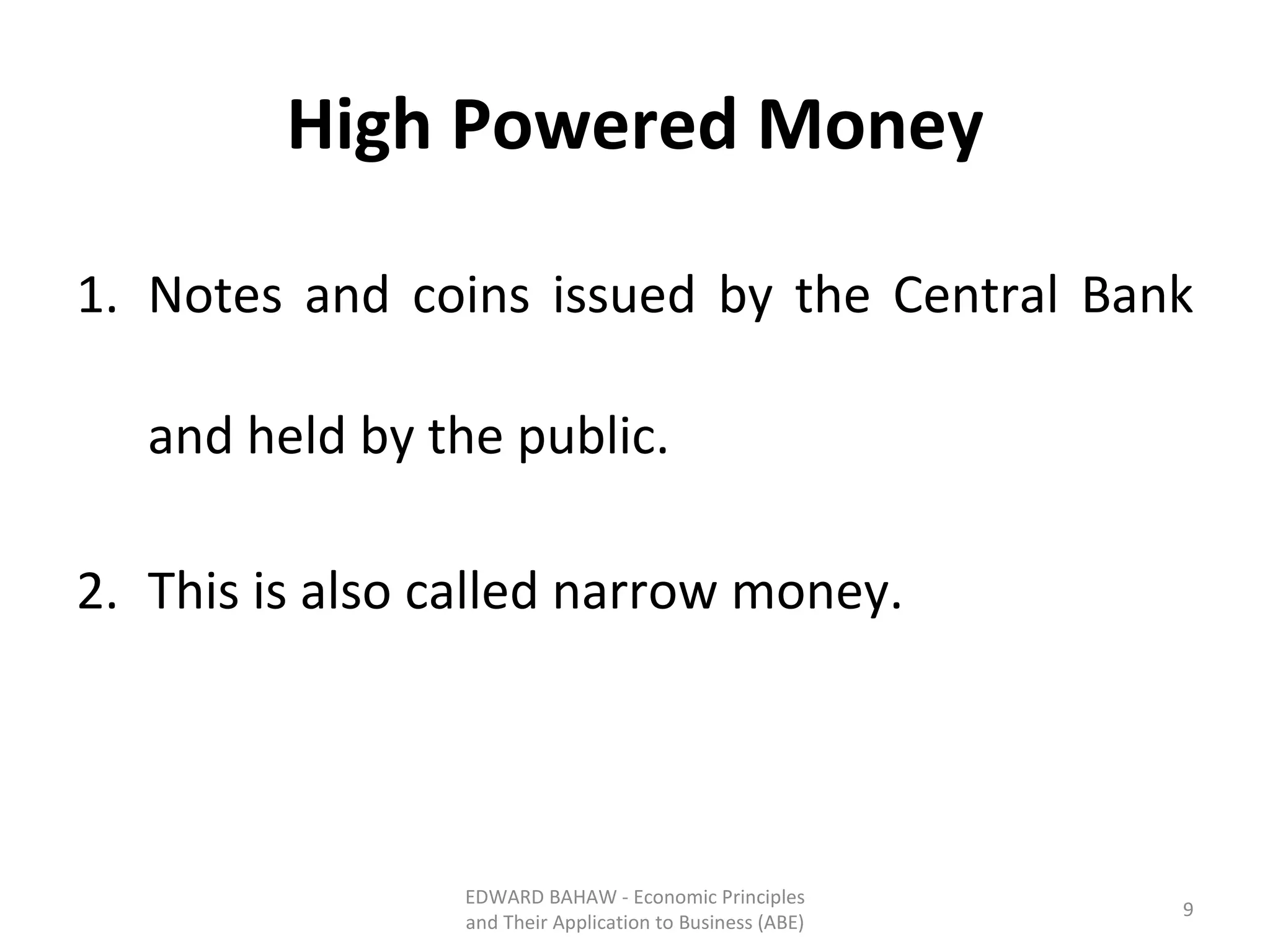
High Powered Money Notes and coins issued by the Central Bank and held by the public. This is also called narrow money. EDWARD BAHAW - Economic Principles and Their Application to Business (ABE)
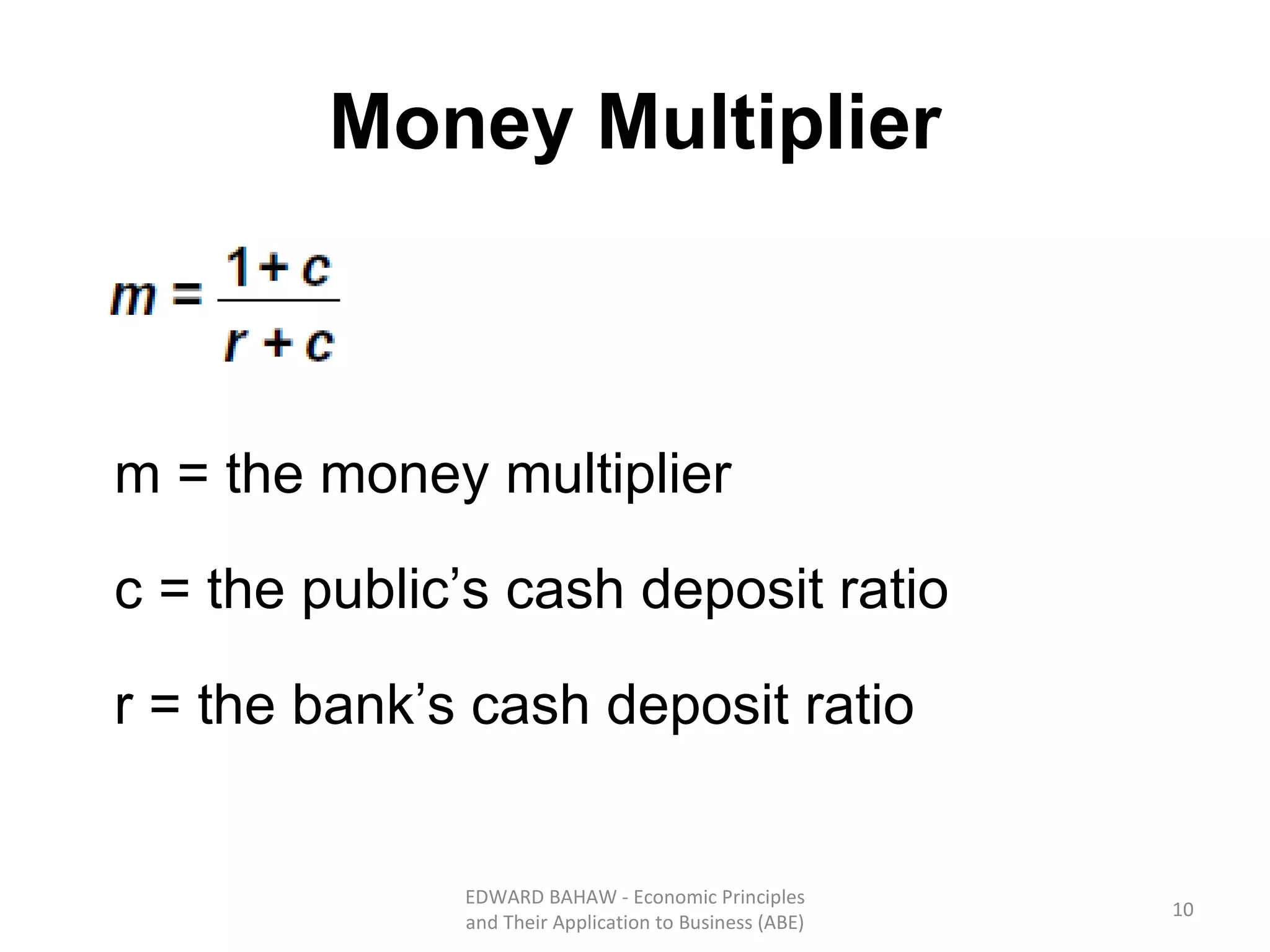
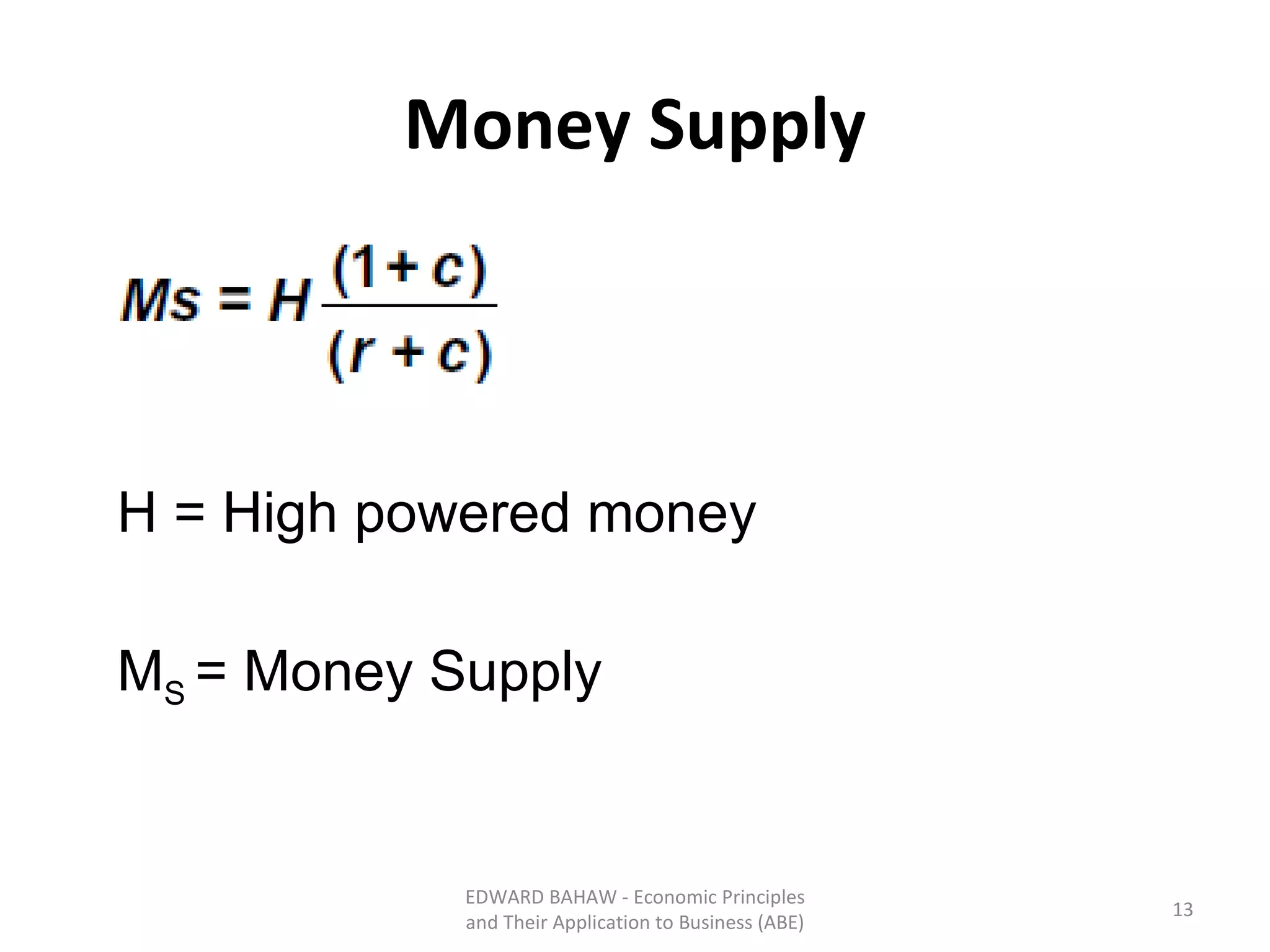
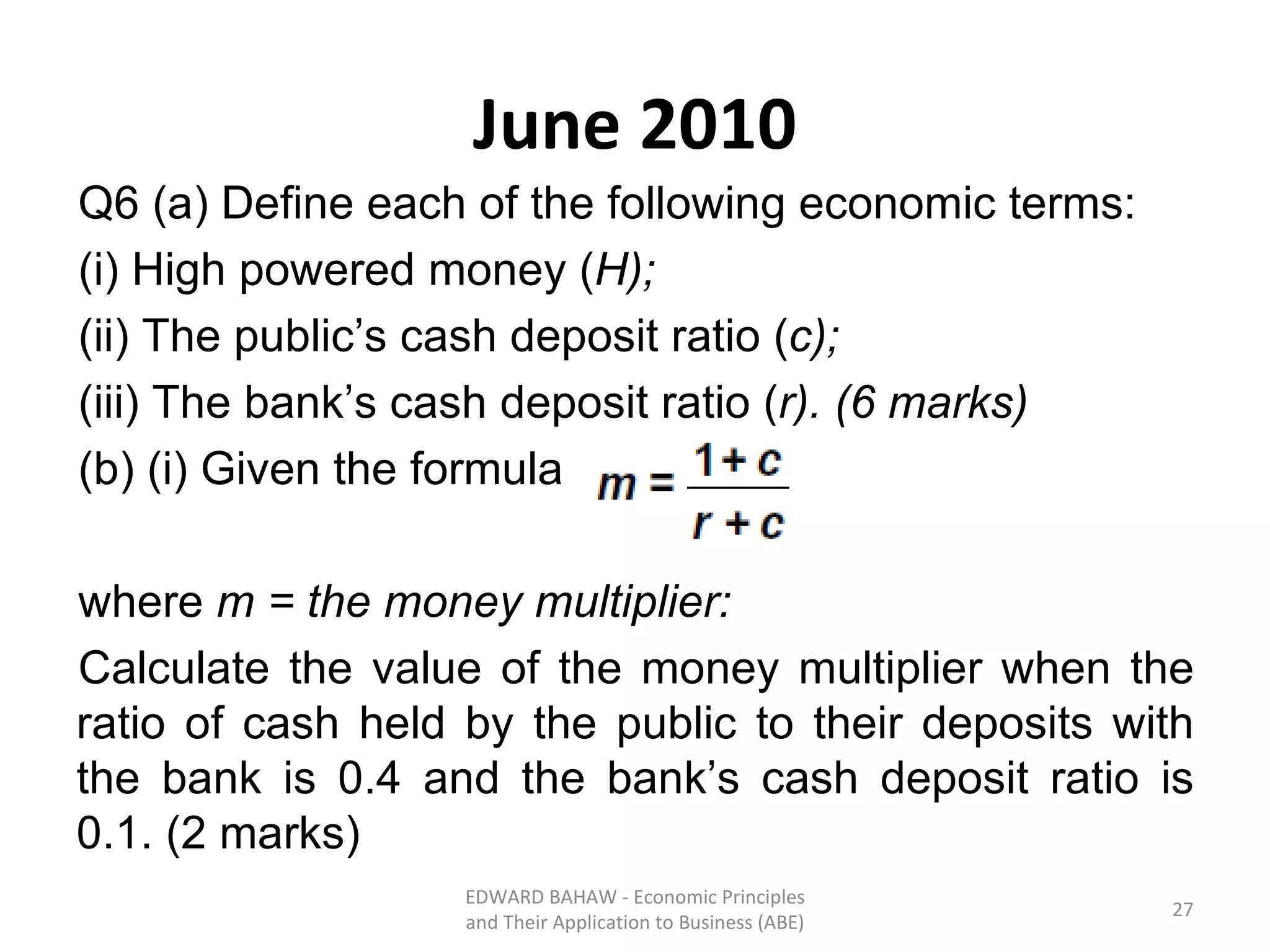
Money Multiplier m = the money multiplier c =  the public’s cash deposit ratio  r =  the bank’s cash deposit ratio  EDWARD BAHAW - Economic Principles and Their Application to Business (ABE)
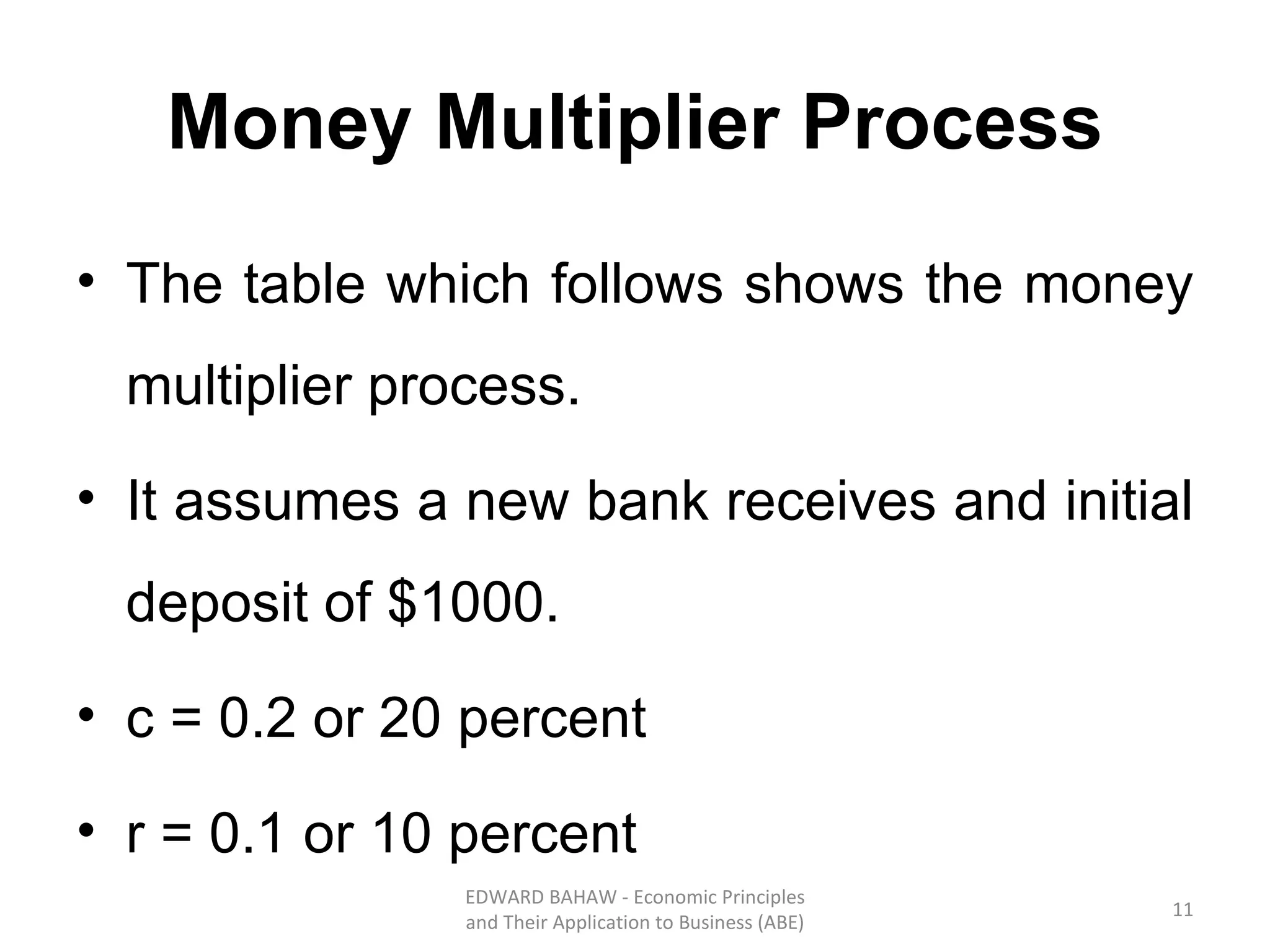
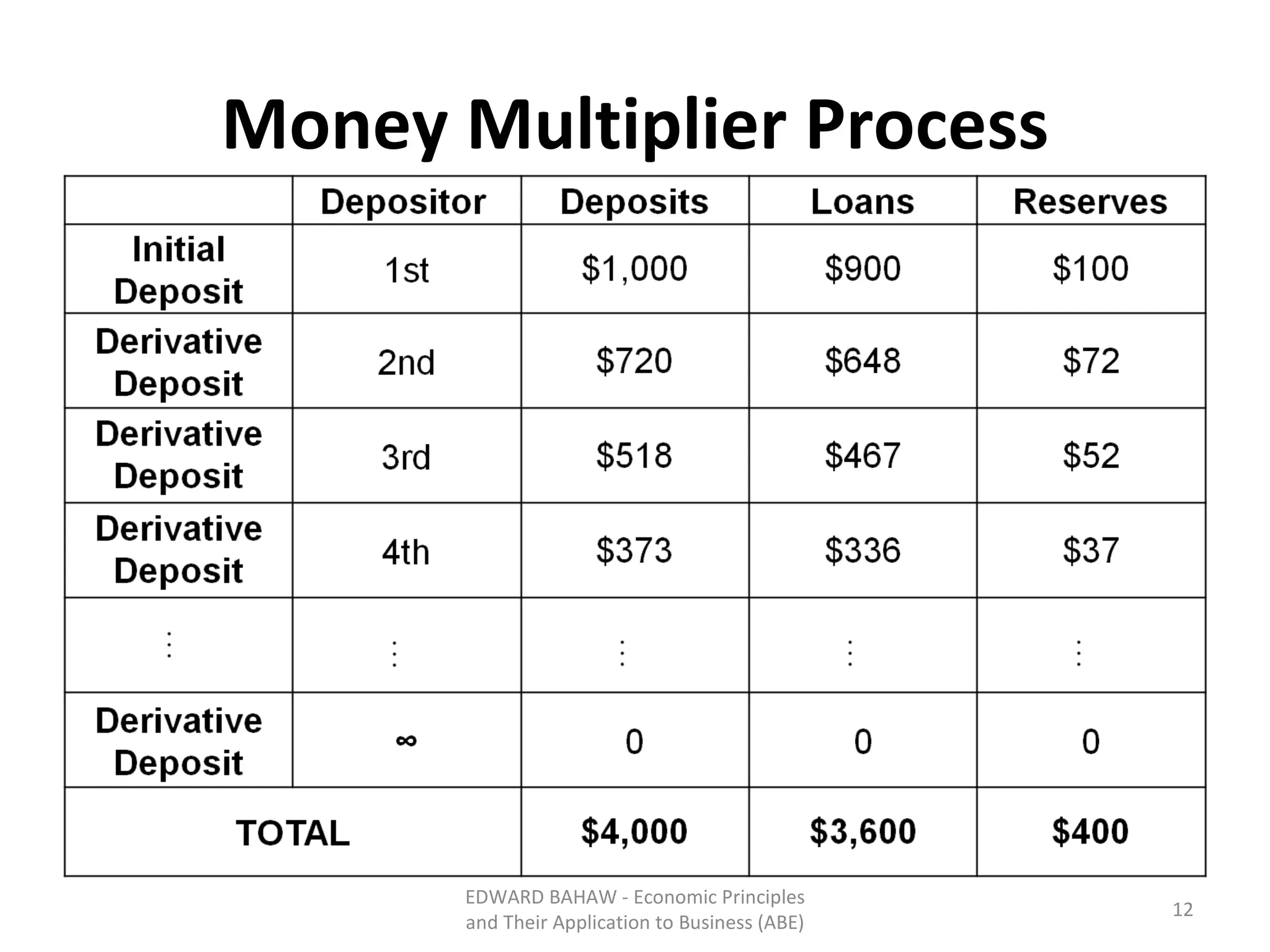
Money Multiplier Process The table which follows shows the money multiplier process. It assumes a new bank receives and initial deposit of $1000. c = 0 .2 or 20 percent r =  0.1 or 10 percent EDWARD BAHAW - Economic Principles and Their Application to Business (ABE)
Money Multiplier Process EDWARD BAHAW - Economic Principles and Their Application to Business (ABE)
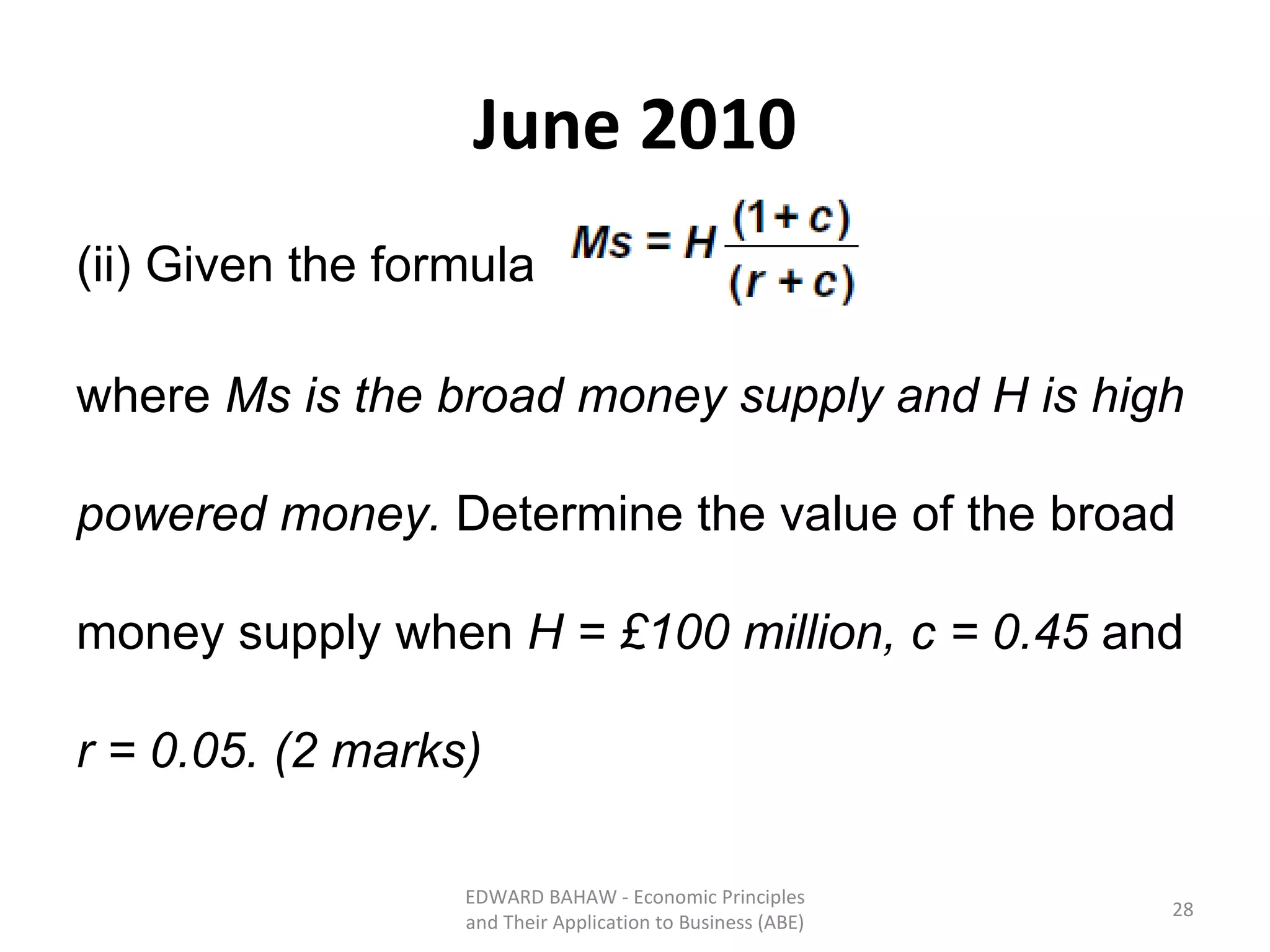
Money Supply H = High powered money M S  = Money Supply EDWARD BAHAW - Economic Principles and Their Application to Business (ABE)
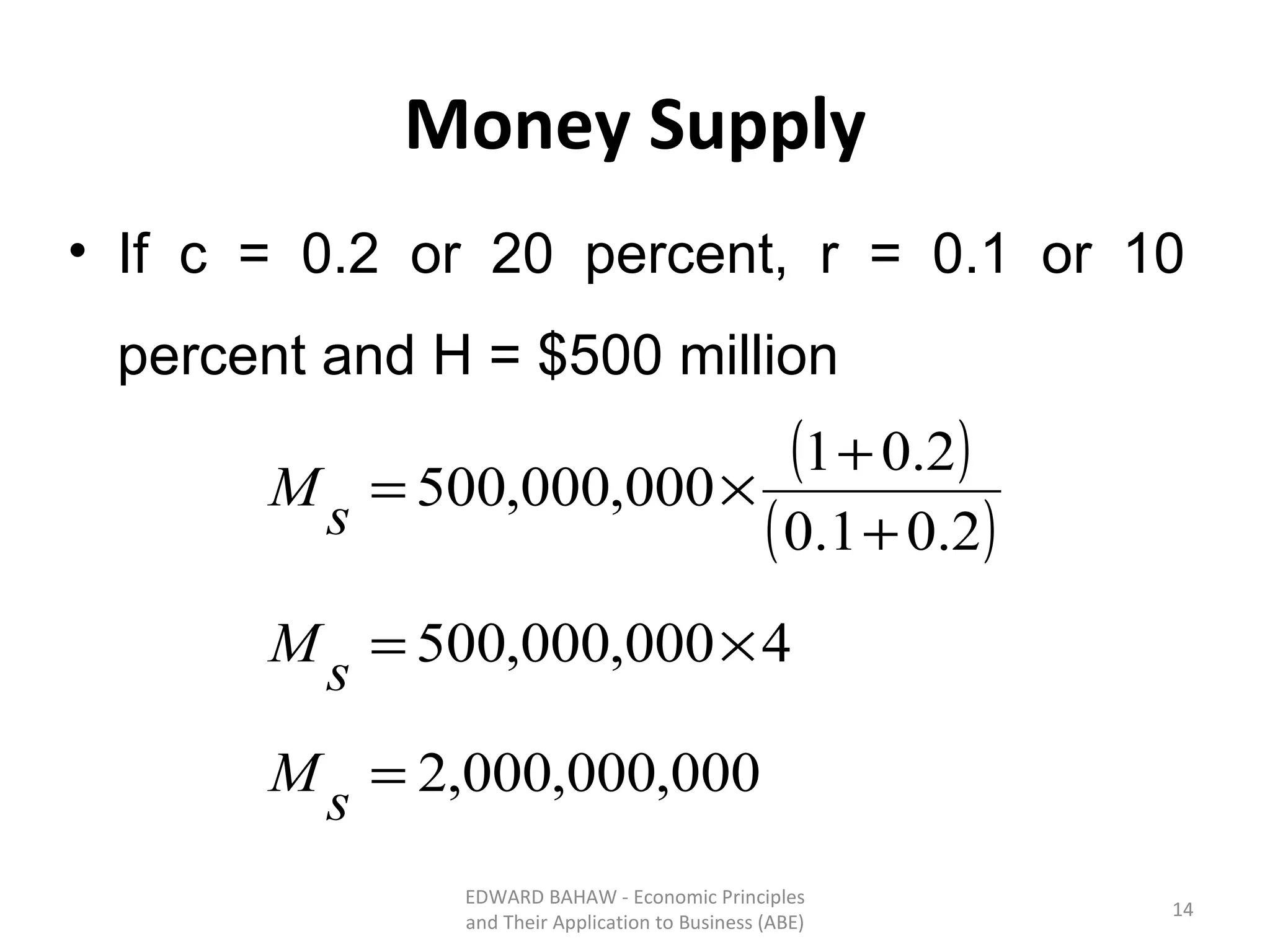
Money Supply If c = 0 .2 or 20 percent,  r =  0.1 or 10 percent and  H = $500 million EDWARD BAHAW - Economic Principles and Their Application to Business (ABE)
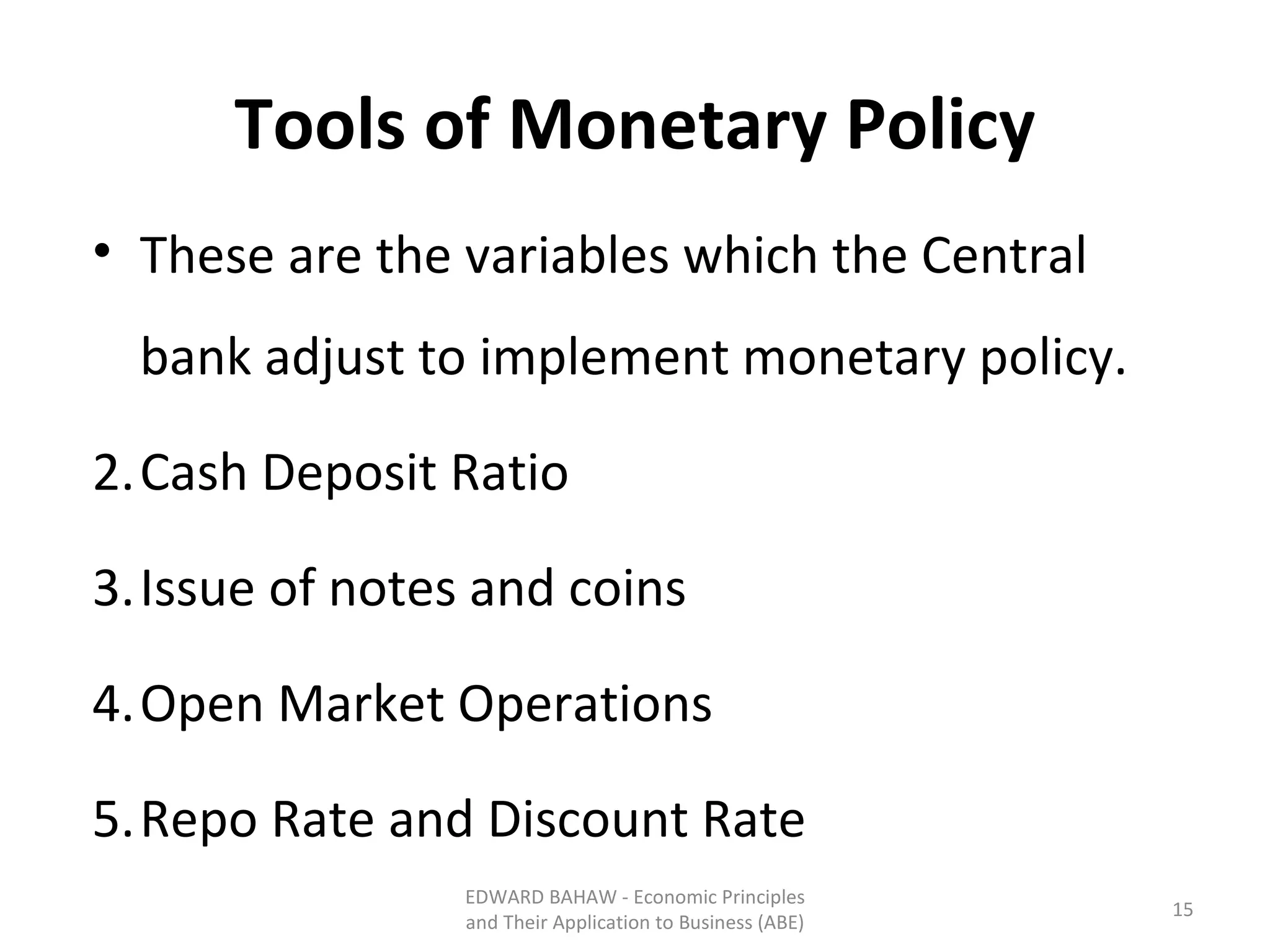
Tools of Monetary Policy These are the variables which the Central bank adjust to implement monetary policy. Cash Deposit Ratio Issue of notes and coins Open Market Operations Repo Rate and Discount Rate EDWARD BAHAW - Economic Principles and Their Application to Business (ABE)
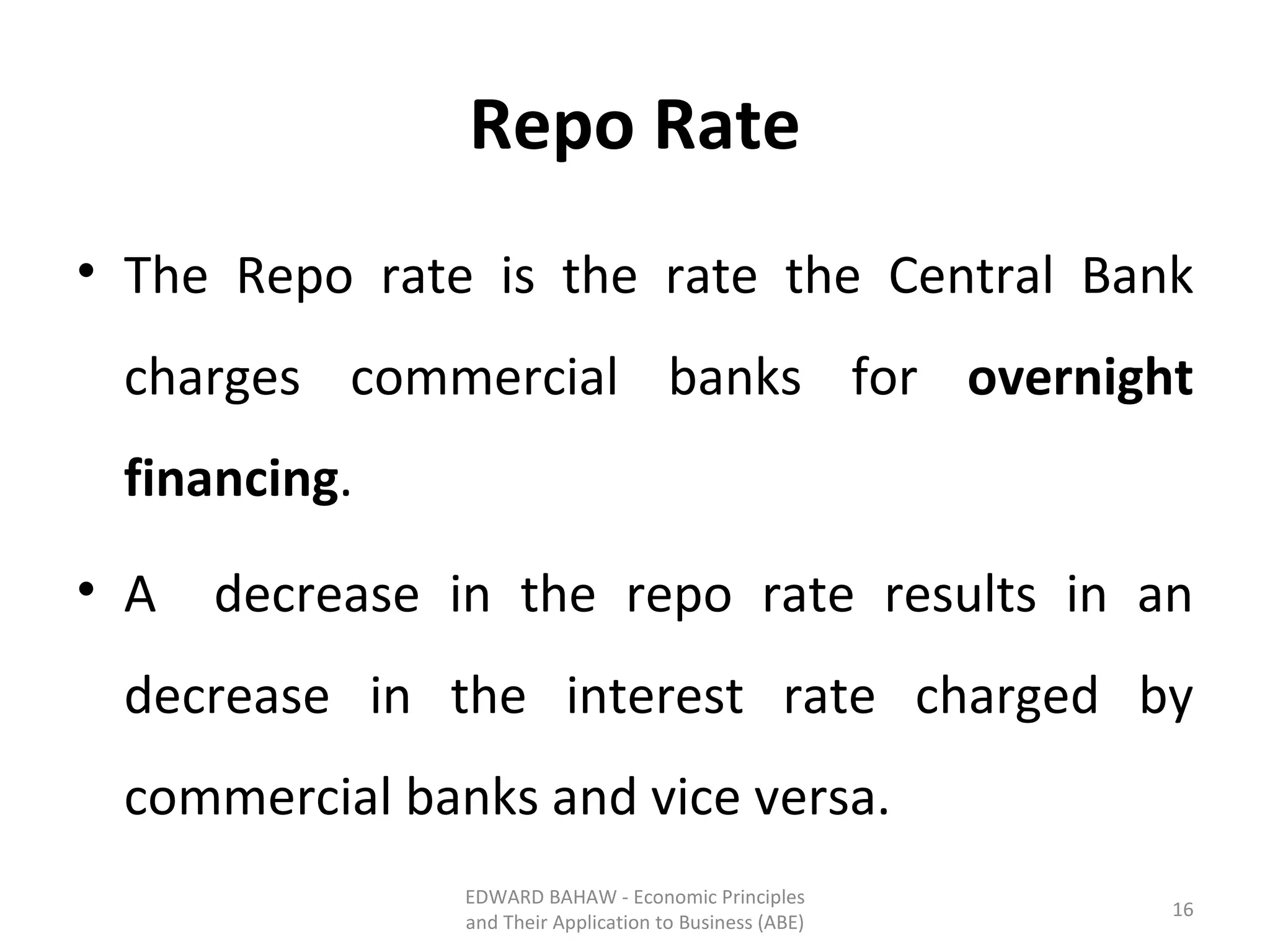
Repo Rate The Repo rate is the rate the Central Bank charges commercial banks for  overnight financing . A  decrease in the repo rate results in an decrease in the interest rate charged by commercial banks and vice versa. EDWARD BAHAW - Economic Principles and Their Application to Business (ABE)
Discount Rate The Discount Rate is the rate charged by the  Central Bank to commercials banks for  short term  loans.  A decrease in the discount rate results in a decrease in the interest rate charged by commercial banks and vice versa. EDWARD BAHAW - Economic Principles and Their Application to Business (ABE)
Cash to Deposit Ratio Decrease cash deposit ratio Increase lending More derivative deposits Total Deposits increase Money Supply increases Interest rate falls EDWARD BAHAW - Economic Principles and Their Application to Business (ABE)
Open Market Operations  As the Central Bank redeems treasury bills from the public . The money supply increases. The rate of interest falls. EDWARD BAHAW - Economic Principles and Their Application to Business (ABE)
Issue of notes and coins   As the Central Bank issues more notes and coins The money supply increases. As a result the interest rate decreases and vice versa. EDWARD BAHAW - Economic Principles and Their Application to Business (ABE)
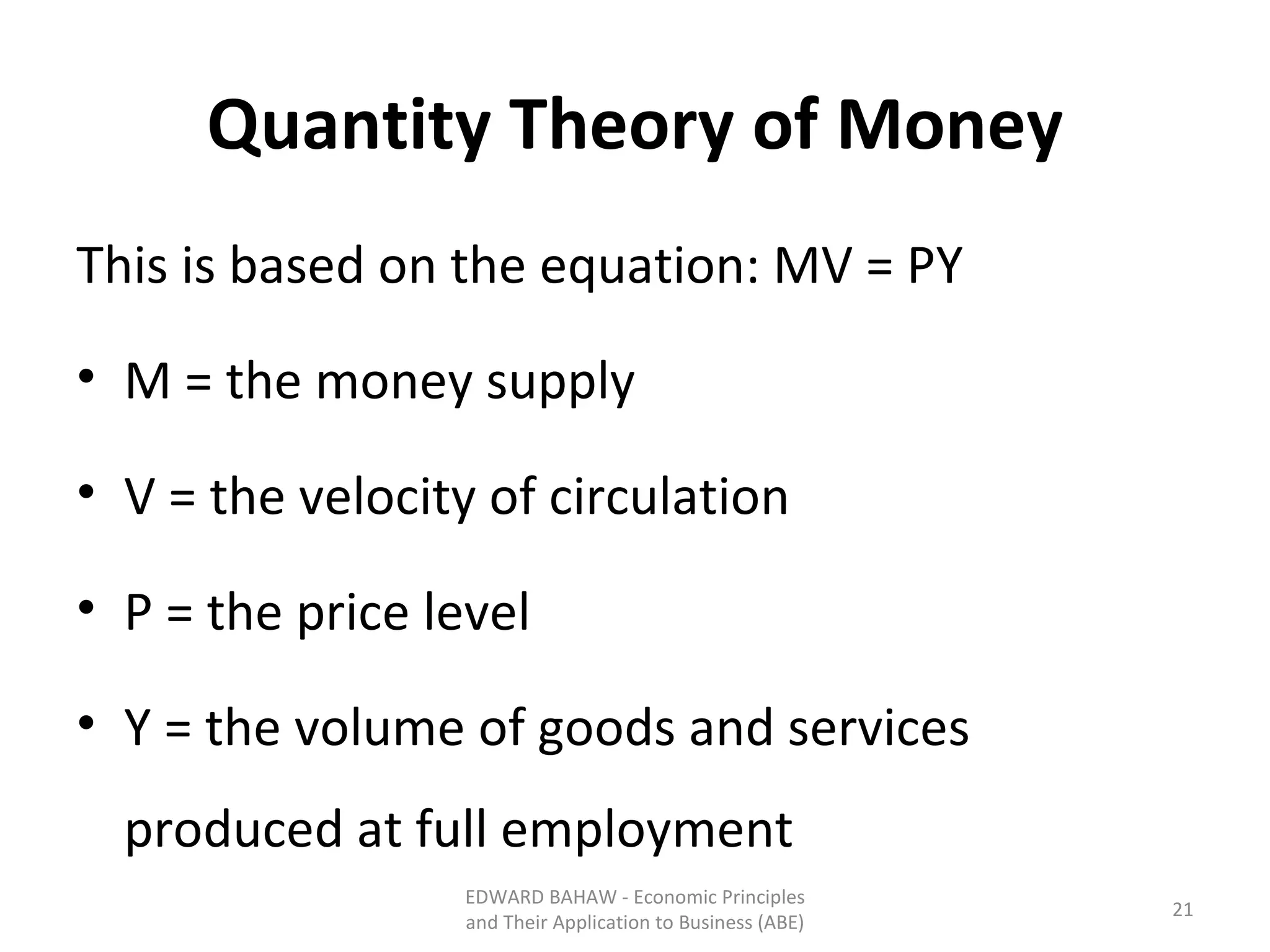
Quantity Theory of Money This is based on the equation: MV = PY M = the money supply V = the velocity of circulation P = the price level Y = the volume of goods and services produced at full employment EDWARD BAHAW - Economic Principles and Their Application to Business (ABE)
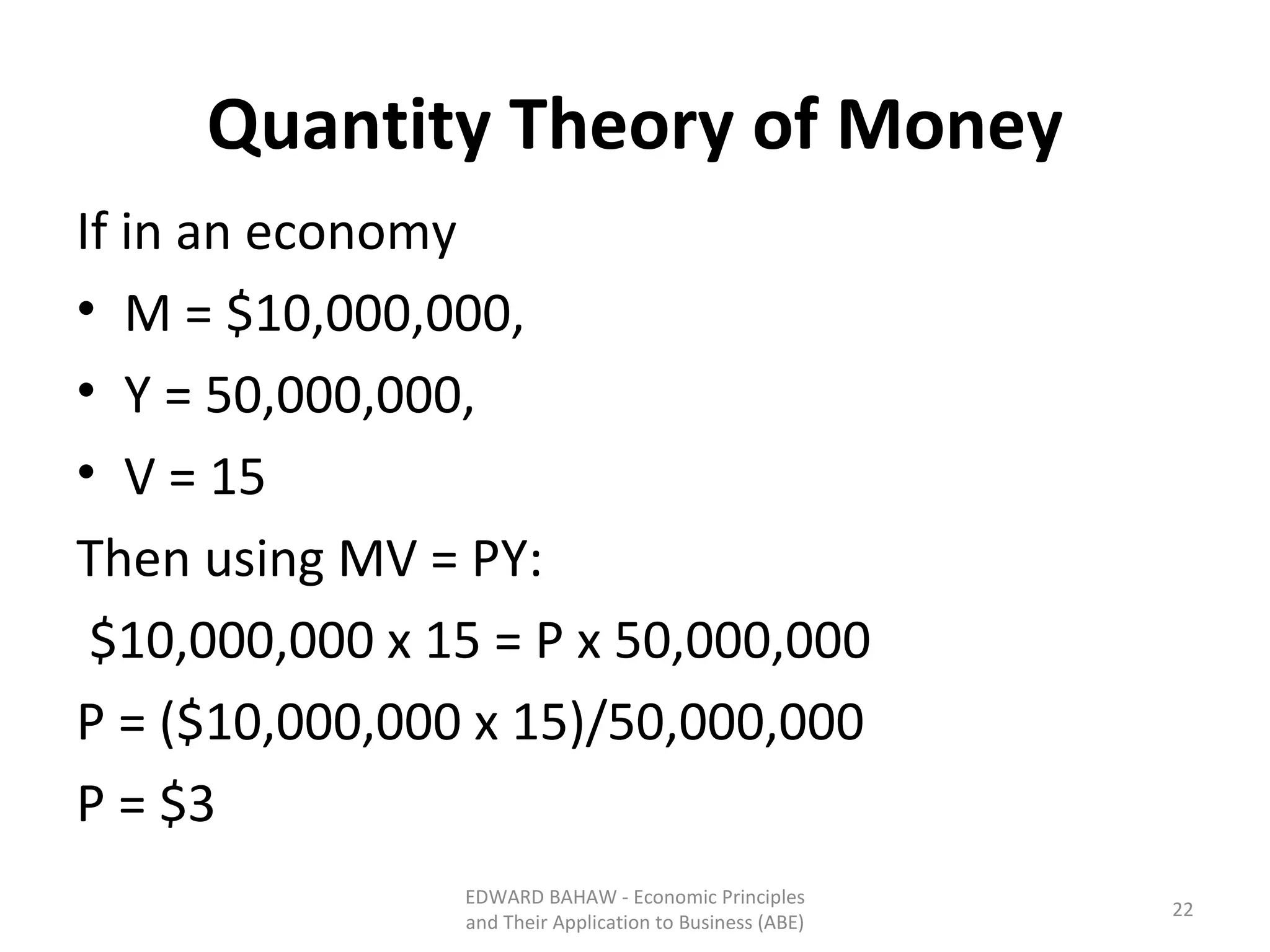
Quantity Theory of Money If in an economy M = $10,000,000,  Y = 50,000,000,  V = 15  Then using MV = PY:   $10,000,000 x 15 = P x 50,000,000 P = ($10,000,000 x 15)/50,000,000 P = $3 EDWARD BAHAW - Economic Principles and Their Application to Business (ABE)
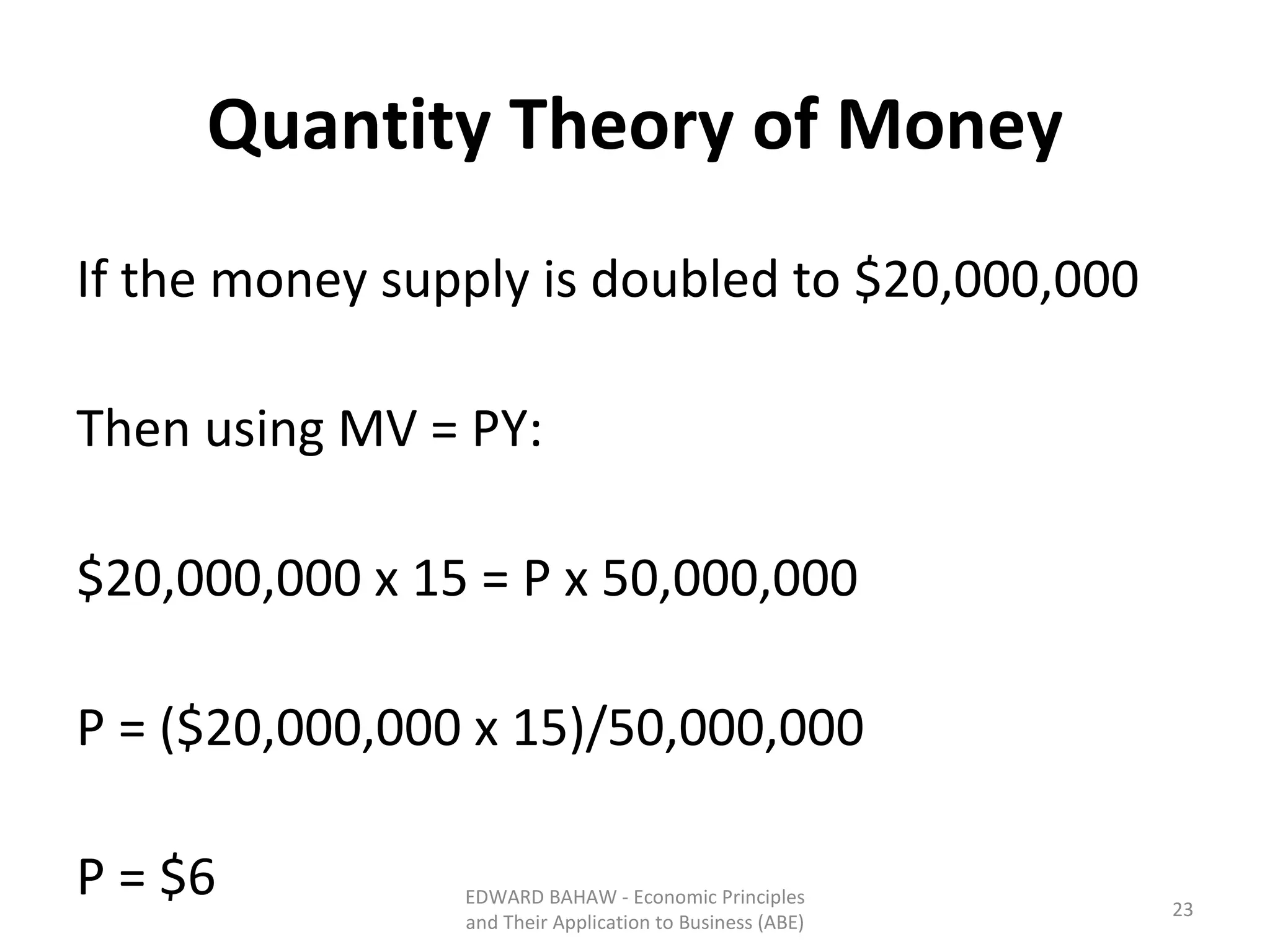
Quantity Theory of Money If the money supply is doubled to $20,000,000 Then using MV = PY: $20,000,000 x 15 = P x 50,000,000 P = ($20,000,000 x 15)/50,000,000 P = $6 EDWARD BAHAW - Economic Principles and Their Application to Business (ABE)
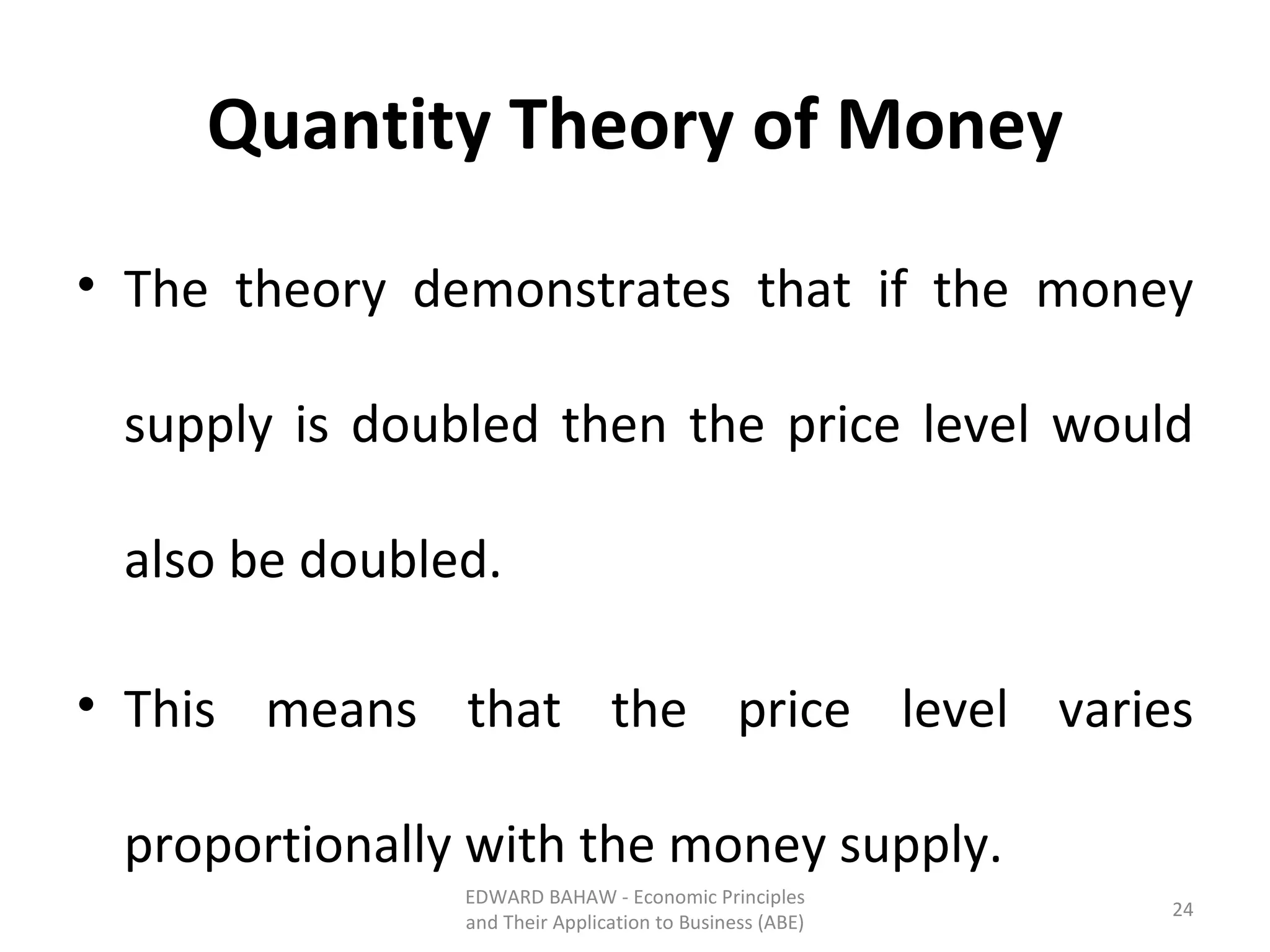
Quantity Theory of Money The theory demonstrates that if the money supply is doubled then the price level would also be doubled. This means that the price level varies proportionally with the money supply. EDWARD BAHAW - Economic Principles and Their Application to Business (ABE)
Dec 2007 Q7 (a) Explain what is meant by the term ‘high powered money’. (5 marks) (b) Discuss how open market operations are used to expand and contract the money supply. (8 marks) (c) Explain how a central bank can use its control of the supply of money to reduce the rate of inflation in an economy. (12 marks) EDWARD BAHAW - Economic Principles and Their Application to Business (ABE)
June 2009 Q7 (a) Define the ‘quantity theory of money’ and explain how a change in the money supply leads directly to a change in the price level. (10 marks) (b) Explain how control of the money supply can be used to control inflation. (15 marks) EDWARD BAHAW - Economic Principles and Their Application to Business (ABE)
June 2010 Q6 (a) Define each of the following economic terms: (i) High powered money ( H); (ii) The public’s cash deposit ratio ( c); (iii) The bank’s cash deposit ratio ( r). (6 marks) (b) (i) Given the formula  where  m = the money multiplier: Calculate the value of the money multiplier when the ratio of cash held by the public to their deposits with the bank is 0.4 and the bank’s cash deposit ratio is 0.1. (2 marks) EDWARD BAHAW - Economic Principles and Their Application to Business (ABE)
June 2010 (ii) Given the formula  where  Ms is the broad money supply and H is high powered money.  Determine the value of the broad money supply when  H = £100 million, c = 0.45  and  r = 0.05. (2 marks) EDWARD BAHAW - Economic Principles and Their Application to Business (ABE)

Topic 9

  • 1.
    Monetary Policy Chapter#12, 13 EDWARD BAHAW - Economic Principles and Their Application to Business (ABE)
  • 2.
    Expansionary or EasyMonetary Policy EDWARD BAHAW - Economic Principles and Their Application to Business (ABE) Lower Interest Rate Expansionary Monetary Policy Increase in Aggregate Expenditure Increase in Consumption Increase in Investment
  • 3.
    Panel A. MoneyMarket D M S M1 S M2 Q M ($M) 1 2 8 20 IR (%) The Monetary Transmission Mechanism
  • 4.
    Y $Millions AEE 1 45  30 Y= AE E 2 AE 2 AE 1 Panel B: Keynesian Cross Diagram FE Y F The Monetary Transmission Mechanism
  • 5.
    Contractionary or TightMonetary Policy EDWARD BAHAW - Economic Principles and Their Application to Business (ABE) Higher Interest Rate Contractionary Monetary Policy Decrease in Aggregate Expenditure Decrease in Consumption Decrease in Investment
  • 6.
    Panel A. MoneyMarket D M S M1 S M2 Q M ($M) 1 2 8 20 IR (%) The Monetary Transmission Mechanism
  • 7.
    Y $Millions AEE 1 45  30 Y= AE E 2 AE 2 AE 1 Panel B: Keynesian Cross Diagram FE Y F The Monetary Transmission Mechanism
  • 8.
    Money Supply Themoney supply consists of: High powered money Deposits at commercial banks The money supply is also called broad money EDWARD BAHAW - Economic Principles and Their Application to Business (ABE)
  • 9.
    High Powered MoneyNotes and coins issued by the Central Bank and held by the public. This is also called narrow money. EDWARD BAHAW - Economic Principles and Their Application to Business (ABE)
  • 10.
    Money Multiplier m= the money multiplier c = the public’s cash deposit ratio r = the bank’s cash deposit ratio EDWARD BAHAW - Economic Principles and Their Application to Business (ABE)
  • 11.
    Money Multiplier ProcessThe table which follows shows the money multiplier process. It assumes a new bank receives and initial deposit of $1000. c = 0 .2 or 20 percent r = 0.1 or 10 percent EDWARD BAHAW - Economic Principles and Their Application to Business (ABE)
  • 12.
    Money Multiplier ProcessEDWARD BAHAW - Economic Principles and Their Application to Business (ABE)
  • 13.
    Money Supply H= High powered money M S = Money Supply EDWARD BAHAW - Economic Principles and Their Application to Business (ABE)
  • 14.
    Money Supply Ifc = 0 .2 or 20 percent, r = 0.1 or 10 percent and H = $500 million EDWARD BAHAW - Economic Principles and Their Application to Business (ABE)
  • 15.
    Tools of MonetaryPolicy These are the variables which the Central bank adjust to implement monetary policy. Cash Deposit Ratio Issue of notes and coins Open Market Operations Repo Rate and Discount Rate EDWARD BAHAW - Economic Principles and Their Application to Business (ABE)
  • 16.
    Repo Rate TheRepo rate is the rate the Central Bank charges commercial banks for overnight financing . A decrease in the repo rate results in an decrease in the interest rate charged by commercial banks and vice versa. EDWARD BAHAW - Economic Principles and Their Application to Business (ABE)
  • 17.
    Discount Rate TheDiscount Rate is the rate charged by the Central Bank to commercials banks for short term loans. A decrease in the discount rate results in a decrease in the interest rate charged by commercial banks and vice versa. EDWARD BAHAW - Economic Principles and Their Application to Business (ABE)
  • 18.
    Cash to DepositRatio Decrease cash deposit ratio Increase lending More derivative deposits Total Deposits increase Money Supply increases Interest rate falls EDWARD BAHAW - Economic Principles and Their Application to Business (ABE)
  • 19.
    Open Market Operations As the Central Bank redeems treasury bills from the public . The money supply increases. The rate of interest falls. EDWARD BAHAW - Economic Principles and Their Application to Business (ABE)
  • 20.
    Issue of notesand coins As the Central Bank issues more notes and coins The money supply increases. As a result the interest rate decreases and vice versa. EDWARD BAHAW - Economic Principles and Their Application to Business (ABE)
  • 21.
    Quantity Theory ofMoney This is based on the equation: MV = PY M = the money supply V = the velocity of circulation P = the price level Y = the volume of goods and services produced at full employment EDWARD BAHAW - Economic Principles and Their Application to Business (ABE)
  • 22.
    Quantity Theory ofMoney If in an economy M = $10,000,000, Y = 50,000,000, V = 15 Then using MV = PY:   $10,000,000 x 15 = P x 50,000,000 P = ($10,000,000 x 15)/50,000,000 P = $3 EDWARD BAHAW - Economic Principles and Their Application to Business (ABE)
  • 23.
    Quantity Theory ofMoney If the money supply is doubled to $20,000,000 Then using MV = PY: $20,000,000 x 15 = P x 50,000,000 P = ($20,000,000 x 15)/50,000,000 P = $6 EDWARD BAHAW - Economic Principles and Their Application to Business (ABE)
  • 24.
    Quantity Theory ofMoney The theory demonstrates that if the money supply is doubled then the price level would also be doubled. This means that the price level varies proportionally with the money supply. EDWARD BAHAW - Economic Principles and Their Application to Business (ABE)
  • 25.
    Dec 2007 Q7(a) Explain what is meant by the term ‘high powered money’. (5 marks) (b) Discuss how open market operations are used to expand and contract the money supply. (8 marks) (c) Explain how a central bank can use its control of the supply of money to reduce the rate of inflation in an economy. (12 marks) EDWARD BAHAW - Economic Principles and Their Application to Business (ABE)
  • 26.
    June 2009 Q7(a) Define the ‘quantity theory of money’ and explain how a change in the money supply leads directly to a change in the price level. (10 marks) (b) Explain how control of the money supply can be used to control inflation. (15 marks) EDWARD BAHAW - Economic Principles and Their Application to Business (ABE)
  • 27.
    June 2010 Q6(a) Define each of the following economic terms: (i) High powered money ( H); (ii) The public’s cash deposit ratio ( c); (iii) The bank’s cash deposit ratio ( r). (6 marks) (b) (i) Given the formula where m = the money multiplier: Calculate the value of the money multiplier when the ratio of cash held by the public to their deposits with the bank is 0.4 and the bank’s cash deposit ratio is 0.1. (2 marks) EDWARD BAHAW - Economic Principles and Their Application to Business (ABE)
  • 28.
    June 2010 (ii)Given the formula where Ms is the broad money supply and H is high powered money. Determine the value of the broad money supply when H = £100 million, c = 0.45 and r = 0.05. (2 marks) EDWARD BAHAW - Economic Principles and Their Application to Business (ABE)

Editor's Notes

  • #22 Market Structure Past Paper Questions
  • #23 Market Structure Past Paper Questions