Introduction to Reservoir Engineering
History of Reservoir Engineering
•Traced to mid 1930’s
•1994 Dake in ‘Practise of Reservoir Engineering.’
•‘Reservoir Enginering shares the distinction with
geology in being one of the ‘underground
sciences’ of the oil industry, attempting to
describe what occurs in the wide open spaces of
the reservoir between the sparse points of
observation - the wells’
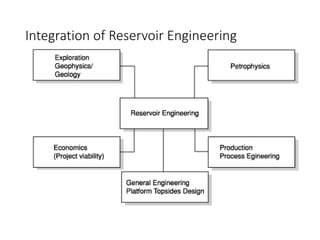
Integration of Reservoir Engineering
Roles of the Reservoir Engineer
•Contributing with geologists and
petrophysicists in estimation of oil-in-place
•Determining fraction of oil-in -place that can
be recovered.
•Attach a time scale to the recovery.
•Day-to-day operational reservoir engineering
throughout the project lifetime.
Activities of Reservoir Engineering
•Reserve Estimation
•Development Planning
•Production Operations Optimisation
Reserve Estimation
•The reserves are the main assets of an oil
company.
•Quantifying reserves and recovery factor is
an ongoing role of the reservoir engineer.
•Basic data not always straightforward.
•Reserves can be affected by the development
process
Reserve Estimation
•Not exclusive to reservoir engineers
•Volumetric estimates of reserves obtained at
various stages
•STOIIP - stock tank oil initially in place
•More later . . .
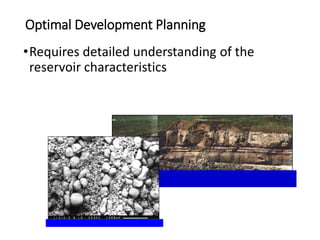
Optimal Development Planning
•Requires detailed understanding of the
reservoir characteristics
Petroleum Reserves Definitions
•Subject of study for some time.
•Agreed definitions by SPE and WPC in 1996.
•Recognizes that not practical to have precise
classification because of different forms of
occurrence, wide characteristics,
uncertainties of geological environment, and
evolution of technologies.
Petroleum Reserves Definitions
•Essential that governments and industry have
a clear assessment of quantities available and
anticipated within practical time frame
through additional field development,
technological advances, or exploration.
•Important that a consistent nomenclature be
used by industry to define reserves.
Reserves Definitions
•Reserves are those quantities which are
anticipated to be commercially recovered
from known accumulations from a given
date forward.
•Reserve estimates involve some degree of
uncertainty.
•Uncertainty depends on reliable geological
and engineering data available at the time of
estimate and its interpretation.
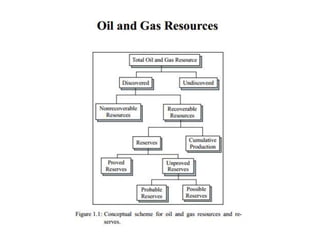
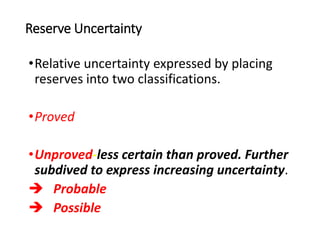
Reserve Uncertainty
•Relative uncertainty expressed by placing
reserves into two classifications.
•Proved
•Unproved-less certain than proved. Further
subdived to express increasing uncertainty.
 Probable
 Possible
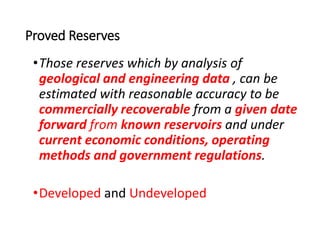
Proved Reserves
•Those reserves which by analysis of
geological and engineering data , can be
estimated with reasonable accuracy to be
commercially recoverable from a given date
forward from known reservoirs and under
current economic conditions, operating
methods and government regulations.
•Developed and Undeveloped
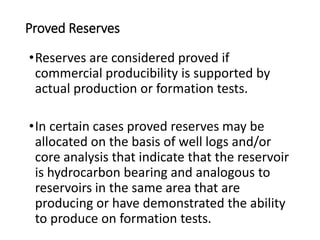
Proved Reserves
•Reserves are considered proved if
commercial producibility is supported by
actual production or formation tests.
•In certain cases proved reserves may be
allocated on the basis of well logs and/or
core analysis that indicate that the reservoir
is hydrocarbon bearing and analogous to
reservoirs in the same area that are
producing or have demonstrated the ability
to produce on formation tests.
Proved Reserves
•The area of the reservoir includes:
 the area delineated by drilling and defined by
contacts, if any.
 The undrilled portions of the reservoir that can
be reasonably judged as commercially productive
on the basis of available geological and engineering
data.
 If no fluid contacts, lowest occurrence of
hydrocarbons controls the proved limit unless
indicated by definite geological, engineering or
performance data.
Test 1
•What is wrong with the following statement ?
•Reserves are those quantities which are
anticipated to be recovered from a
petroleum accumulation
Test 1
•What is wrong with the following statement ?
•Reserves are those quantities which are
anticipated to be recovered from a
petroleum accumulation
•Answer
•Reserves are those quantities which are
anticipated to be commercially recovered.
Economics is very important aspect
Test 2.
•We have a structure in an area which we expect
to explore. We anticipate it to contain a STOIIP of
2000MMstb, and a recovery factor of 65% using
primary recovery (30%), secondary (25%) and
tertiary (10%) recovery methods. What are the
reserves?
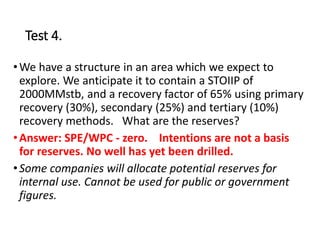
Test 4.
•We have a structure in an area which we expect to
explore. We anticipate it to contain a STOIIP of
2000MMstb, and a recovery factor of 65% using primary
recovery (30%), secondary (25%) and tertiary (10%)
recovery methods. What are the reserves?
•Answer: SPE/WPC - zero. Intentions are not a basis
for reserves. No well has yet been drilled.
•Some companies will allocate potential reserves for
internal use. Cannot be used for public or government
figures.
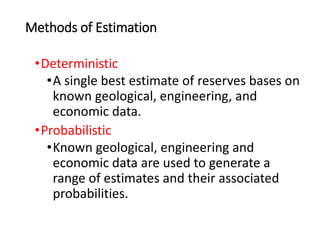
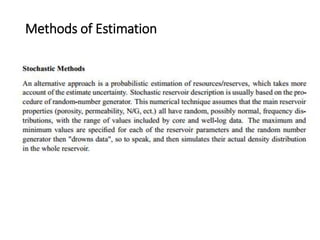
Methods of Estimation
•Deterministic
•A single best estimate of reserves bases on
known geological, engineering, and
economic data.
•Probabilistic
•Known geological, engineering and
economic data are used to generate a
range of estimates and their associated
probabilities.
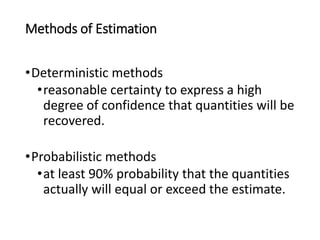
Methods of Estimation
•Deterministic methods
•reasonable certainty to express a high
degree of confidence that quantities will be
recovered.
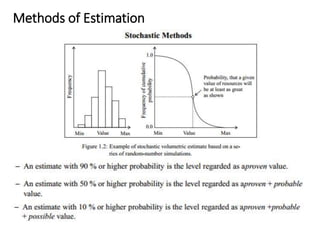
•Probabilistic methods
•at least 90% probability that the quantities
actually will equal or exceed the estimate.
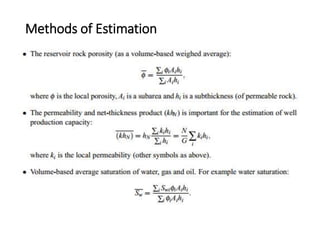
Methods of Estimation
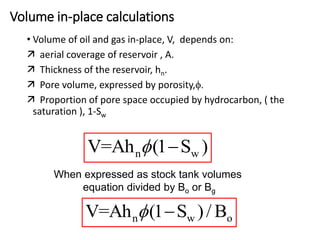
Volume in-place calculations
• Volume of oil and gas in-place, V, depends on:
 aerial coverage of reservoir , A.
 Thickness of the reservoir, hn.
 Pore volume, expressed by porosity,f.
 Proportion of pore space occupied by hydrocarbon, ( the
saturation ), 1-Sw
When expressed as stock tank volumes
equation divided by Bo or Bg
n w
V=Ah (1 S )

f
n w o
V=Ah (1 S )/ B

f
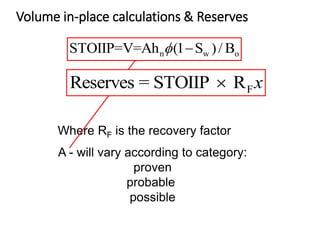
Volume in-place calculations & Reserves
Where RF is the recovery factor
A - will vary according to category:
proven
probable
possible
n w o
STOIIP=V=Ah (1 S )/ B

f
F
Reserves = STOIIP R
 x
Formation Volume Factors Oil,Bo and Gas, Bg
•Formation volume factors convert reservoir
volumes to surface volumes.
•They do not vary significantly across the
reservoir compared to other rock related
properties.
•In some reservoirs there is a compositional
gradient which results in variations in the oil
formation volume factor
•In this case average or values measured at
depth would be preferred
Recovery Factor
•Proportion of hydrocarbons recovered
called recovery factor.
•Influenced by a range of properties.
•Rock and fluid properties.
•Drive mechanisms.
•Formation characteristics & heterogeneity
•Development process
•Geometry and location of wells
Other Appraisal Tool - Production Test
•One of the moat powerful tools for reservoir
engineer.
•Used to evaluate the characteristics of the
reservoir under realistic conditions.
•Exploration well is turned temporally into a
producing well and downhole pressure
recorded.
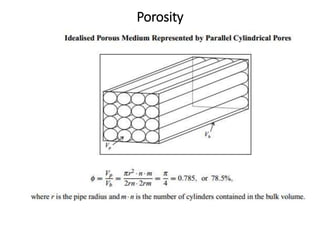
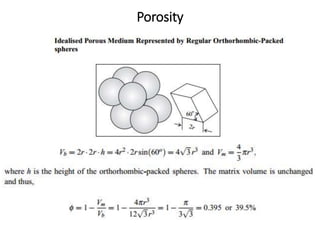
Porosity
•Complex
•Space between grains or limestone caves
•sometimes good estimates from laboratory
studies
•sometimes such measurement irrelevant
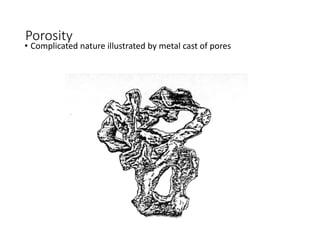
Porosity
• Complicated nature illustrated by metal cast of pores
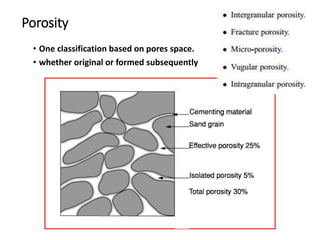
Porosity
• One classification based on pores space.
• whether original or formed subsequently
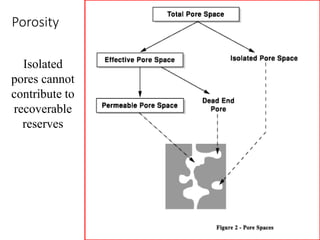
Porosity
Isolated
pores cannot
contribute to
recoverable
reserves
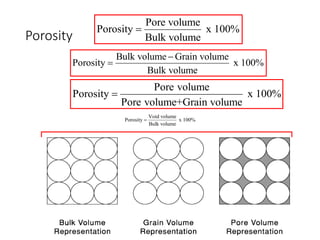
Porosity
Void volume
Porosity x 100%
Bulk volume

Bulk volume Grain volume
Porosity x 100%
Bulk volume


Pore volume
Porosity x 100%
Bulk volume

Pore volume
Porosity x 100%
Pore volume+Grain volume

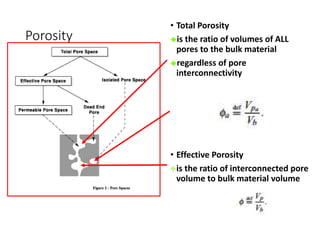
Porosity
• Total Porosity
is the ratio of volumes of ALL
pores to the bulk material
regardless of pore
interconnectivity
• Effective Porosity
is the ratio of interconnected pore
volume to bulk material volume
Porosity
Porosity
Porosity
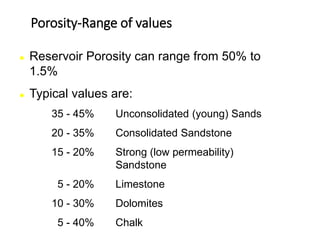
Porosity-Range of values
 Reservoir Porosity can range from 50% to
1.5%
 Typical values are:
35 - 45% Unconsolidated (young) Sands
20 - 35% Consolidated Sandstone
15 - 20% Strong (low permeability)
Sandstone
5 - 20% Limestone
10 - 30% Dolomites
5 - 40% Chalk
Subsurface Measurement
•Surface measurements made on recovered
core.
•Down hole measurements very
sophisticated.
•Downhole porosity related to acoustic and
radioactive properties of the rock.
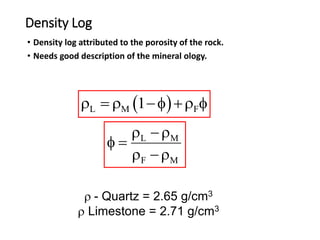
Density Log
• Density log attributed to the porosity of the rock.
• Needs good description of the mineral ology.
 
L M F
1
   f  f
L M
F M
 
f 
 
 - Quartz = 2.65 g/cm3
 Limestone = 2.71 g/cm3
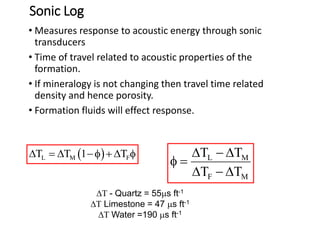
Sonic Log
• Measures response to acoustic energy through sonic
transducers
• Time of travel related to acoustic properties of the
formation.
• If mineralogy is not changing then travel time related
density and hence porosity.
• Formation fluids will effect response.
 
L M F
T T 1 T
   f   f L M
F M
T T
T T
  
f 
  
T - Quartz = 55ms ft-1
T Limestone = 47 ms ft-1
T Water =190 ms ft-1
Neutron Log
•Another radioactive logging technique
•Measures response of the hydrogen atoms in the
formation
•Neutrons of specific energy fired into formation.
•The radiated energy is detected by the tool.
•This is related to the hydrogen in the hydrocarbon
and water phase.
•The porosity determined by calibration
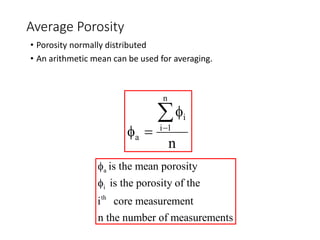
Average Porosity
• Porosity normally distributed
• An arithmetic mean can be used for averaging.
n
i
i 1
a
n

f
f 

a
i
th
is the mean porosity
is the porosity of the
i core measurement
n the number of measurements
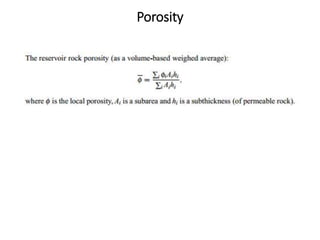
f
f
Porosity

Reservoir engineering.ppt

  • 1.
  • 2.
    History of ReservoirEngineering •Traced to mid 1930’s •1994 Dake in ‘Practise of Reservoir Engineering.’ •‘Reservoir Enginering shares the distinction with geology in being one of the ‘underground sciences’ of the oil industry, attempting to describe what occurs in the wide open spaces of the reservoir between the sparse points of observation - the wells’
  • 3.
  • 4.
    Roles of theReservoir Engineer •Contributing with geologists and petrophysicists in estimation of oil-in-place •Determining fraction of oil-in -place that can be recovered. •Attach a time scale to the recovery. •Day-to-day operational reservoir engineering throughout the project lifetime.
  • 5.
    Activities of ReservoirEngineering •Reserve Estimation •Development Planning •Production Operations Optimisation
  • 6.
    Reserve Estimation •The reservesare the main assets of an oil company. •Quantifying reserves and recovery factor is an ongoing role of the reservoir engineer. •Basic data not always straightforward. •Reserves can be affected by the development process
  • 7.
    Reserve Estimation •Not exclusiveto reservoir engineers •Volumetric estimates of reserves obtained at various stages •STOIIP - stock tank oil initially in place •More later . . .
  • 8.
    Optimal Development Planning •Requiresdetailed understanding of the reservoir characteristics
  • 9.
    Petroleum Reserves Definitions •Subjectof study for some time. •Agreed definitions by SPE and WPC in 1996. •Recognizes that not practical to have precise classification because of different forms of occurrence, wide characteristics, uncertainties of geological environment, and evolution of technologies.
  • 10.
    Petroleum Reserves Definitions •Essentialthat governments and industry have a clear assessment of quantities available and anticipated within practical time frame through additional field development, technological advances, or exploration. •Important that a consistent nomenclature be used by industry to define reserves.
  • 11.
    Reserves Definitions •Reserves arethose quantities which are anticipated to be commercially recovered from known accumulations from a given date forward. •Reserve estimates involve some degree of uncertainty. •Uncertainty depends on reliable geological and engineering data available at the time of estimate and its interpretation.
  • 13.
    Reserve Uncertainty •Relative uncertaintyexpressed by placing reserves into two classifications. •Proved •Unproved-less certain than proved. Further subdived to express increasing uncertainty.  Probable  Possible
  • 14.
    Proved Reserves •Those reserveswhich by analysis of geological and engineering data , can be estimated with reasonable accuracy to be commercially recoverable from a given date forward from known reservoirs and under current economic conditions, operating methods and government regulations. •Developed and Undeveloped
  • 15.
    Proved Reserves •Reserves areconsidered proved if commercial producibility is supported by actual production or formation tests. •In certain cases proved reserves may be allocated on the basis of well logs and/or core analysis that indicate that the reservoir is hydrocarbon bearing and analogous to reservoirs in the same area that are producing or have demonstrated the ability to produce on formation tests.
  • 16.
    Proved Reserves •The areaof the reservoir includes:  the area delineated by drilling and defined by contacts, if any.  The undrilled portions of the reservoir that can be reasonably judged as commercially productive on the basis of available geological and engineering data.  If no fluid contacts, lowest occurrence of hydrocarbons controls the proved limit unless indicated by definite geological, engineering or performance data.
  • 17.
    Test 1 •What iswrong with the following statement ? •Reserves are those quantities which are anticipated to be recovered from a petroleum accumulation
  • 18.
    Test 1 •What iswrong with the following statement ? •Reserves are those quantities which are anticipated to be recovered from a petroleum accumulation •Answer •Reserves are those quantities which are anticipated to be commercially recovered. Economics is very important aspect
  • 19.
    Test 2. •We havea structure in an area which we expect to explore. We anticipate it to contain a STOIIP of 2000MMstb, and a recovery factor of 65% using primary recovery (30%), secondary (25%) and tertiary (10%) recovery methods. What are the reserves?
  • 20.
    Test 4. •We havea structure in an area which we expect to explore. We anticipate it to contain a STOIIP of 2000MMstb, and a recovery factor of 65% using primary recovery (30%), secondary (25%) and tertiary (10%) recovery methods. What are the reserves? •Answer: SPE/WPC - zero. Intentions are not a basis for reserves. No well has yet been drilled. •Some companies will allocate potential reserves for internal use. Cannot be used for public or government figures.
  • 22.
    Methods of Estimation •Deterministic •Asingle best estimate of reserves bases on known geological, engineering, and economic data. •Probabilistic •Known geological, engineering and economic data are used to generate a range of estimates and their associated probabilities.
  • 23.
    Methods of Estimation •Deterministicmethods •reasonable certainty to express a high degree of confidence that quantities will be recovered. •Probabilistic methods •at least 90% probability that the quantities actually will equal or exceed the estimate.
  • 24.
  • 25.
  • 26.
  • 27.
    Volume in-place calculations •Volume of oil and gas in-place, V, depends on:  aerial coverage of reservoir , A.  Thickness of the reservoir, hn.  Pore volume, expressed by porosity,f.  Proportion of pore space occupied by hydrocarbon, ( the saturation ), 1-Sw When expressed as stock tank volumes equation divided by Bo or Bg n w V=Ah (1 S )  f n w o V=Ah (1 S )/ B  f
  • 28.
    Volume in-place calculations& Reserves Where RF is the recovery factor A - will vary according to category: proven probable possible n w o STOIIP=V=Ah (1 S )/ B  f F Reserves = STOIIP R  x
  • 29.
    Formation Volume FactorsOil,Bo and Gas, Bg •Formation volume factors convert reservoir volumes to surface volumes. •They do not vary significantly across the reservoir compared to other rock related properties. •In some reservoirs there is a compositional gradient which results in variations in the oil formation volume factor •In this case average or values measured at depth would be preferred
  • 30.
    Recovery Factor •Proportion ofhydrocarbons recovered called recovery factor. •Influenced by a range of properties. •Rock and fluid properties. •Drive mechanisms. •Formation characteristics & heterogeneity •Development process •Geometry and location of wells
  • 31.
    Other Appraisal Tool- Production Test •One of the moat powerful tools for reservoir engineer. •Used to evaluate the characteristics of the reservoir under realistic conditions. •Exploration well is turned temporally into a producing well and downhole pressure recorded.
  • 47.
    Porosity •Complex •Space between grainsor limestone caves •sometimes good estimates from laboratory studies •sometimes such measurement irrelevant
  • 48.
    Porosity • Complicated natureillustrated by metal cast of pores
  • 49.
    Porosity • One classificationbased on pores space. • whether original or formed subsequently
  • 50.
  • 51.
    Porosity Void volume Porosity x100% Bulk volume  Bulk volume Grain volume Porosity x 100% Bulk volume   Pore volume Porosity x 100% Bulk volume  Pore volume Porosity x 100% Pore volume+Grain volume 
  • 52.
    Porosity • Total Porosity isthe ratio of volumes of ALL pores to the bulk material regardless of pore interconnectivity • Effective Porosity is the ratio of interconnected pore volume to bulk material volume
  • 53.
  • 54.
  • 55.
  • 56.
    Porosity-Range of values Reservoir Porosity can range from 50% to 1.5%  Typical values are: 35 - 45% Unconsolidated (young) Sands 20 - 35% Consolidated Sandstone 15 - 20% Strong (low permeability) Sandstone 5 - 20% Limestone 10 - 30% Dolomites 5 - 40% Chalk
  • 57.
    Subsurface Measurement •Surface measurementsmade on recovered core. •Down hole measurements very sophisticated. •Downhole porosity related to acoustic and radioactive properties of the rock.
  • 58.
    Density Log • Densitylog attributed to the porosity of the rock. • Needs good description of the mineral ology.   L M F 1    f  f L M F M   f     - Quartz = 2.65 g/cm3  Limestone = 2.71 g/cm3
  • 59.
    Sonic Log • Measuresresponse to acoustic energy through sonic transducers • Time of travel related to acoustic properties of the formation. • If mineralogy is not changing then travel time related density and hence porosity. • Formation fluids will effect response.   L M F T T 1 T    f   f L M F M T T T T    f     T - Quartz = 55ms ft-1 T Limestone = 47 ms ft-1 T Water =190 ms ft-1
  • 60.
    Neutron Log •Another radioactivelogging technique •Measures response of the hydrogen atoms in the formation •Neutrons of specific energy fired into formation. •The radiated energy is detected by the tool. •This is related to the hydrogen in the hydrocarbon and water phase. •The porosity determined by calibration
  • 61.
    Average Porosity • Porositynormally distributed • An arithmetic mean can be used for averaging. n i i 1 a n  f f   a i th is the mean porosity is the porosity of the i core measurement n the number of measurements f f
  • 62.