Present Simple
 Present Simple
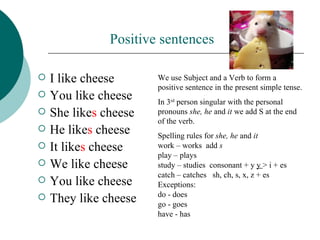
Positive sentences

   I like cheese      We use Subject and a Verb to form a
                       positive sentence in the present simple tense.
   You like cheese    In 3rd person singular with the personal
   She likes cheese   pronouns she, he and it we add S at the end
                       of the verb.
   He likes cheese    Spelling rules for she, he and it
   It likes cheese    work – works add s
                       play – plays
   We like cheese     study – studies consonant + y y > i + es
                       catch – catches sh, ch, s, x, z + es
   You like cheese    Exceptions:
                       do - does
   They like cheese   go - goes
                       have - has
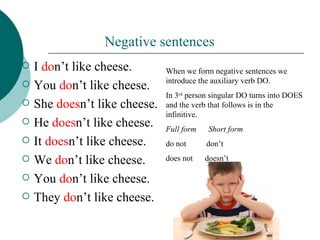
Negative sentences
   I don’t like cheese.       When we form negative sentences we
                               introduce the auxiliary verb DO.
   You don’t like cheese.
                               In 3rd person singular DO turns into DOES
   She doesn’t like cheese.   and the verb that follows is in the
                               infinitive.
   He doesn’t like cheese.    Full form    Short form
   It doesn’t like cheese.    do not      don’t
   We don’t like cheese.      does not    doesn’t

   You don’t like cheese.
   They don’t like cheese.
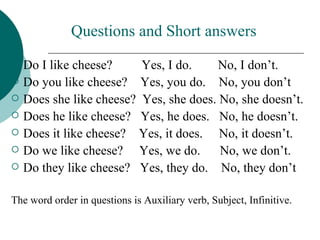
Questions and Short answers
   Do I like cheese?     Yes, I do.     No, I don’t.
   Do you like cheese? Yes, you do. No, you don’t
   Does she like cheese? Yes, she does. No, she doesn’t.
   Does he like cheese? Yes, he does. No, he doesn’t.
   Does it like cheese? Yes, it does. No, it doesn’t.
   Do we like cheese? Yes, we do.       No, we don’t.
   Do they like cheese? Yes, they do. No, they don’t

The word order in questions is Auxiliary verb, Subject, Infinitive.
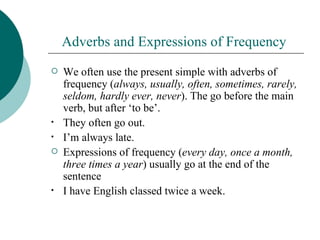
Adverbs and Expressions of Frequency
   We often use the present simple with adverbs of
    frequency (always, usually, often, sometimes, rarely,
    seldom, hardly ever, never). The go before the main
    verb, but after ‘to be’.
•   They often go out.
•   I’m always late.
   Expressions of frequency (every day, once a month,
    three times a year) usually go at the end of the
    sentence
•   I have English classed twice a week.
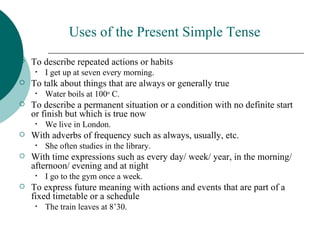
Uses of the Present Simple Tense
   To describe repeated actions or habits
     •   I get up at seven every morning.
   To talk about things that are always or generally true
     •   Water boils at 100o C.
   To describe a permanent situation or a condition with no definite start
    or finish but which is true now
     •   We live in London.
   With adverbs of frequency such as always, usually, etc.
     •   She often studies in the library.
   With time expressions such as every day/ week/ year, in the morning/
    afternoon/ evening and at night
     •   I go to the gym once a week.
   To express future meaning with actions and events that are part of a
    fixed timetable or a schedule
     •   The train leaves at 8’30.
It’s really simple
The Present Simple Tense

The Present Simple Tense

  • 1.
  • 2.
    Positive sentences  I like cheese We use Subject and a Verb to form a positive sentence in the present simple tense.  You like cheese In 3rd person singular with the personal  She likes cheese pronouns she, he and it we add S at the end of the verb.  He likes cheese Spelling rules for she, he and it  It likes cheese work – works add s play – plays  We like cheese study – studies consonant + y y > i + es catch – catches sh, ch, s, x, z + es  You like cheese Exceptions: do - does  They like cheese go - goes have - has
  • 3.
    Negative sentences  I don’t like cheese. When we form negative sentences we introduce the auxiliary verb DO.  You don’t like cheese. In 3rd person singular DO turns into DOES  She doesn’t like cheese. and the verb that follows is in the infinitive.  He doesn’t like cheese. Full form Short form  It doesn’t like cheese. do not don’t  We don’t like cheese. does not doesn’t  You don’t like cheese.  They don’t like cheese.
  • 4.
    Questions and Shortanswers  Do I like cheese? Yes, I do. No, I don’t.  Do you like cheese? Yes, you do. No, you don’t  Does she like cheese? Yes, she does. No, she doesn’t.  Does he like cheese? Yes, he does. No, he doesn’t.  Does it like cheese? Yes, it does. No, it doesn’t.  Do we like cheese? Yes, we do. No, we don’t.  Do they like cheese? Yes, they do. No, they don’t The word order in questions is Auxiliary verb, Subject, Infinitive.
  • 5.
    Adverbs and Expressionsof Frequency  We often use the present simple with adverbs of frequency (always, usually, often, sometimes, rarely, seldom, hardly ever, never). The go before the main verb, but after ‘to be’. • They often go out. • I’m always late.  Expressions of frequency (every day, once a month, three times a year) usually go at the end of the sentence • I have English classed twice a week.
  • 6.
    Uses of thePresent Simple Tense  To describe repeated actions or habits • I get up at seven every morning.  To talk about things that are always or generally true • Water boils at 100o C.  To describe a permanent situation or a condition with no definite start or finish but which is true now • We live in London.  With adverbs of frequency such as always, usually, etc. • She often studies in the library.  With time expressions such as every day/ week/ year, in the morning/ afternoon/ evening and at night • I go to the gym once a week.  To express future meaning with actions and events that are part of a fixed timetable or a schedule • The train leaves at 8’30.
  • 7.