BASICS OF ENGLISH
GRAMMAR
PRESENT TENSE
POSSESSIVE ADJECTIVES,
PRESENT CONTINUOUS,
CAN, PREPOSITIONS
PRESENT TENSE BE
● The verb BE has three forms: AM, IS, ARE,
which we have to use according to the pronoun
or subject.
TO BE
Occupations Nouns Adjectives Places
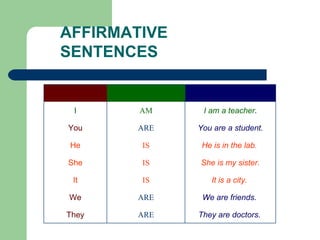
AFFIRMATIVE
SENTENCES
Subject Verb Form Example
I AM I am a teacher.
You ARE You are a student.
He IS He is in the lab.
She IS She is my sister.
It IS It is a city.
We ARE We are friends.
They ARE They are doctors.
NEGATIVE
SENTENCES
You can make negative sentences similar to the
sentences before. The only different is to add
NOT after am, is, are, as you can see in the
following chart.
She is not sad They are not in the school
NEGATIVE
SENTENCES
I am not I`m not
He
She is not It
He`s not = He isn’t
She’s not = She
isn’t It’s not =
It isn’t
We
You are not
They
We’re not = We aren’t
You’re not = You
aren’t They’re not =
They aren’t
YES / NO
QUESTIONS
● In English we have to kind of questions:
Yes/No questions and Wh-questions.
● The Yes / No Questions are called that
because the answers always start with Yes
or No
● Remember to answer Yes/No questions you
have to pay attention to the subject.
YES / NO QUESTIONS
WH -
QUESTIONS
● The wh-questions look for information
accoding to the question word.
● In this kind of questions you never answer
Yes or No, because they are asking for some
information. The answer is a statement with
the information according to the question
word.
WH -
QUESTIONS
Wh-word Information
about…
Example
What Things
Name
Occupations
Activities
What is this? It is a book.
What is your name? Roberth.
What do you do? I am a driver.
What is he doing? He’s working
Who People Who is the director of the school?
Carlos Samaniego.
Where Places Where is he? In the house.
How State
Form / manner
How are you? I am sad.
REVIEW
Statement
Negative
Statements
Yes/No Question Short Answers
I am a teacher. I am not a teacher. Am I a teacher?
Yes, you are / No, you
are not
You are a
student.
You are not a
student.
Are you a student? Yes, I am / No, I am not
He is in the lab. He is not in the lab. Is he in the lab? Yes, he is / No, he is not
She is my sister. She is not my sister. Is she my sister?
Yes, she is / No, she is
not
It is a city. It is not a city. Is it a city? Yes, it is / No, it is not
We are friends. We are not friends. Are we friends?
Yes, we are / No, we are
not
They are
doctors.
They are not
doctors.
Are they doctors?
Yes, they are / No they
are not
DEMONSTRATIVES
We use THIS / THESE when the objects are near to the speaker.
This is a blackboard These are papers
THIS +Singular Nouns THESE + Plural Nouns
DEMONSTRATIVES
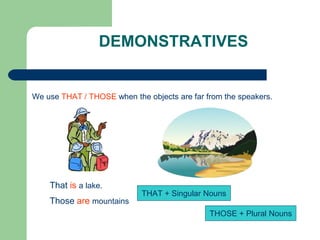
We use THAT / THOSE when the objects are far from the speakers.
That is a lake.
Those are mountains
THAT + Singular Nouns
THOSE + Plural Nouns
DEMONSTRATIVES
Questions
●What is that?
That is an
airplane.
●Is that a bird? No,
it is an airplane.
●What are those?
Those are books
●Are those books?
Yes, they are
books.
PLURAL NOUNS
Noun ending Forming the plural Examples
s, x, ch or sh Add -es boss - bosses
tax - taxes
bush - bushes
consonant + y Change y to i
then
Add –es
fly - flies
try - tries
curry – curries
most others Add -s cat - cats
face - faces
day – days
IRREGULAR
PLURAL
Noun type Forming the plural Examples
Ends with -fe Change f to
v then
Add –s
knife -
knives life -
lives wife -
wives
Ends with –f Change f to
v then
Add –es
half - halves
wolf -
wolves loaf
- loaves
Ends with - o Add –es potato - potatoes
tomato -
IRREGULAR
PLURAL
Noun type Forming the plural Examples
ALL KINDS Change the
vowel or
Change the
word or
Add a
different
ending
man - men
foot - feet
child -
children
person -
people tooth -
teeth mouse -
mice
Unchanging Singular and
plural are the
same
sheep
deer
fish (sometimes)
POSSESSIVE
ADJECTIVES
I My
You
He
Your
His
She Her +
It
We
Its
Our
They Their NOUN
POSSESSIVE ADJECTIVES
This is our house
Her pants are blue
His shirt is new
This is her cat
POSSESSIVE FORM ‘S
Kevin’s wife is Rose.
His wife is Rose.
Charlie’s book is black.
The Child’s mother is happy
PREPOSITION OF PLACE
IN (dentro de) In the house in a shop
In a room in a town
In a car in a garden
ON (sobre
una
superficie)
On a shelf on a wall
On a plate on the table
On a balcony
on a door
AT (lugar específico) At the bus station at home
At the door at the top
At work at the end of
PRESENT
CONTINOUS
● The present
contiuous tense is
used to describe
activities that happen
now, that means
activities that are
develop in the
moment of speaking
Subject BE -ING
FOR
M
I Am Singing
He
She
It
Is Singing
We
You
They
Are Singing
PRESENT
CONTINOUS
AFFIRMATIVE NEGATIVE YES/NO QUESTIONS
I am dancing
You are eating
I am not dancing
You are not eating
Am I dancing?
Are you eating?
He is sleeping He is not sleeping Is he sleeping?
She is reading She is not reading Is she reading?
It is running It is not running Is it running?
We are walking We are not walking Are we walking?
They are studying They are not studying Are they studying?
RULES
Verb ending in...
How to make the -
ING form Examples
1 vowel +
1
consonant
Double the
consonant, then
add –ING
swim -
swimming hit -
hitting
get – getting
1 vowel + 1
consonant +
E-
Remove E, then add
– INGcome
coming
lose -
losing live
– living
[anything else] Add –ING say - saying
go - going
CAN / CAN’T
● Can is used to show ability
They can dance He can’t play the piano He can play football
He can swim He can skate
NEGATIVE AND
QUESTIONS
AFFIRMATIVE NEGATIVE
YES/NO
QUESTIONS
SHORT ANSWERS
I can cook I can not cook Can I cook? Yes, you can / No,you can´t
You can dance You can not dance Can you dance? Yes I can / No I can’t
He can play He can not play Can he play? Yes, he can / No, he can`t
She can swim She can not swim Can she swim? Yes, she can / No, she can’t
It can run It can not run Can it run? Yes, it can / No, it can’t
We can sing We can not sing Can we sing? Yes, we can / No, we can’t
They can walk They can not walk Can they walk ?
Yes, they can / No,
they can’t
Tenses are the form taken by a verb to show the
time of an action or the state of an event.
⮚ There are three tenses
Present Tense
Past Tense
Future Tense.
⦿ Each of the three tenses has four forms or sub-
divisions to show continuity or completeness
of the action and time. These are :
1. Indefinite
2. Continuous or Imperfect
3. Perfect
4. Perfect Continuous
Tense
Present
Indefinite Continuo
us
Perfect Perfect
Continuo
us
Play (s) Is / Am /
Are Playing
Has /
Have
Playe
d
Has / Have
been
Playing
Past Played Was /
Were
Playing
Had
Playe
d
Had been
Playing
Future Will / Shall
Play
Will / Shall
be Playing
Will /
Shall
Have
Will / Shall
have been
Playing
Of
Englis
h
Table
Tense
s
o The Indefinite Tense does not indicate whether
the action is complete or not.
o The Continuous (Imperfect) Tense that the action
is still going on.
o The Perfect Tense indicates that the action
is complete , finished or perfect.
o The Perfect Continuous Tense indicates that
the action began in the past and is still
continuing.
Subject + Verb1 + Object
Expresses a general truth or an action that
is occurring now
Eg : The sun rises from the east.
Expresses an action that occurs regularly
or habitually
Eg : She goes to the school regularly.
⦿ Affirmative Sentences : They play.
⦿ Negative Sentences : They do not play.
⦿ Interrogative Sentences : Do they play ?
⦿ Negative Interrogative Sentences : Do they
not play ?
Subject + Is/Am/Are + V1 +
ing + Object.
The present continuous tense is
used to express an action which
is happening at a particular time
in the present or extending over
a period of present time.
⦿ Affirmative Sentences : You are playing.
⦿ Negative Sentences : You are not playing.
⦿ Interrogative Sentences : Are you playing ?
⦿ Negative Interrogative Sentences : Are you
not playing ?
⦿ Subject + has/have + V3 + Object.
⦿ Has -> Singular , Have -> Plural.
⦿ The present perfect tense denotes an action
that was started in the past and has just
been completed.
⦿ Affirmative Sentences : I have played.
⦿ Negative Sentences : I have not played.
⦿ Interrogative Sentences : Have I played ?
⦿ Negative Interrogative Sentences : Have I
not played ?
⦿ Subject + has/have + been + V1 + ing +
Object
⦿ The present perfect tense is used when
an action that started in the past is still
continuing.
⦿ Affirmative Sentences : We have been playing.
⦿ Negative Sentences : We have not been
playing.
⦿ Interrogative Sentences : Have we been
playing
?
⦿ Negative Interrogative Sentences : Have we
not been playing ?
⦿ Subject + V2 +
Object.
⦿ The simple past tense is used for an action
which happened at a particular time in the
past.
⦿ Affirmative Sentences : I played.
⦿ Negative Sentences : I did not play.
⦿ Interrogative Sentences : Did I play ?
⦿ Negative Interrogative Sentences : Did I
not played ?
⦿ Subject + was/were + V1 + ing + Object.
⦿ The past continuous tense is used for an action
which was happening at a particular time in
the past.
⦿ Affirmative Sentences : Boys were playing.
⦿ Negative Sentences : Boys were not playing.
⦿ Interrogative Sentences : Were boys playing
?
⦿ Negative Interrogative Sentences : Were
boys not playing ?
⦿ Subject + had + V3 + Object.
⦿ The past perfect tense is used to express an
action that was completed before another
action started in the past. It is used with the
earlier of the two actions. The simple past
tense is used with the other action.
⦿ Affirmative Sentences : Sheila had played.
⦿ Negative Sentences : Sheila had not played.
⦿ Interrogative Sentences : Had Sheila played?
⦿ Negative Interrogative Sentences : Had
Sheila not played ?
⦿ Subject + had + been + V1 + Object.
⦿ The past perfect continuous tense is used for
an action that began before a certain point in
the past and continued up to that point.
⦿ Affirmative Sentences : Ria had been playing.
⦿ Negative Sentences : Ria had not been playing.
⦿ Interrogative Sentences : Had Ria been playing?
⦿ Negative Interrogative Sentences : Had Ria not
been playing ?
⦿ Subject + will/shall + V1 + Object.
⦿ The simple future tense is used for an
action that will take place at particular
time in the future.
⦿ Affirmative Sentences : Ravi will play.
⦿ Negative Sentences : Ravi will not play.
⦿ Interrogative Sentences : Will Ravi play ?
⦿ Negative Interrogative Sentences : Will Ravi
not play ?
⦿ Subject + will/shall + be +V1 + ing + Object
⦿ The future continuous tense is used to
express an action which will be in progress
at a particular time in the future.
⦿ Affirmative sentences : I will be playing.
⦿ Negative sentences : I will not be playing.
⦿ Interrogative sentences : Shall I be playing?
⦿ Negative Interrogative Sentences : Shall
I not be playing?
⦿ Subject + shall/will + have + V3 + Object.
⦿ Future perfect tense is used to indicate the
completion of an action by a certain period
of time in the future.
⦿ Affirmative Sentences : She will have played.
⦿ Negative Sentences : She will not have played.
⦿ Interrogative Sentences : Will she have
played?
⦿ Negative Interrogative Sentences : Will she
not have played?
⦿ Subject + shall/will +have been + V1 +
ing + Object.
⦿ The future perfect tense is used when an
action is to continue up to a certain point of
time in the future.
⦿ Affirmative Sentences : Raj will have
been playing.
⦿ Negative Sentences : Raj will not have
been playing.
⦿ Interrogative Sentences : Will Raj have
been playing ?
⦿ Negative Interrogative Sentences : Will Raj
not have been playing ?
20CS313 basics-of-english-grammar.pptx

20CS313 basics-of-english-grammar.pptx

  • 1.
    BASICS OF ENGLISH GRAMMAR PRESENTTENSE POSSESSIVE ADJECTIVES, PRESENT CONTINUOUS, CAN, PREPOSITIONS
  • 2.
    PRESENT TENSE BE ●The verb BE has three forms: AM, IS, ARE, which we have to use according to the pronoun or subject. TO BE Occupations Nouns Adjectives Places
  • 3.
    AFFIRMATIVE SENTENCES Subject Verb FormExample I AM I am a teacher. You ARE You are a student. He IS He is in the lab. She IS She is my sister. It IS It is a city. We ARE We are friends. They ARE They are doctors.
  • 4.
    NEGATIVE SENTENCES You can makenegative sentences similar to the sentences before. The only different is to add NOT after am, is, are, as you can see in the following chart. She is not sad They are not in the school
  • 5.
    NEGATIVE SENTENCES I am notI`m not He She is not It He`s not = He isn’t She’s not = She isn’t It’s not = It isn’t We You are not They We’re not = We aren’t You’re not = You aren’t They’re not = They aren’t
  • 6.
    YES / NO QUESTIONS ●In English we have to kind of questions: Yes/No questions and Wh-questions. ● The Yes / No Questions are called that because the answers always start with Yes or No ● Remember to answer Yes/No questions you have to pay attention to the subject.
  • 7.
    YES / NOQUESTIONS
  • 8.
    WH - QUESTIONS ● Thewh-questions look for information accoding to the question word. ● In this kind of questions you never answer Yes or No, because they are asking for some information. The answer is a statement with the information according to the question word.
  • 9.
    WH - QUESTIONS Wh-word Information about… Example WhatThings Name Occupations Activities What is this? It is a book. What is your name? Roberth. What do you do? I am a driver. What is he doing? He’s working Who People Who is the director of the school? Carlos Samaniego. Where Places Where is he? In the house. How State Form / manner How are you? I am sad.
  • 10.
    REVIEW Statement Negative Statements Yes/No Question ShortAnswers I am a teacher. I am not a teacher. Am I a teacher? Yes, you are / No, you are not You are a student. You are not a student. Are you a student? Yes, I am / No, I am not He is in the lab. He is not in the lab. Is he in the lab? Yes, he is / No, he is not She is my sister. She is not my sister. Is she my sister? Yes, she is / No, she is not It is a city. It is not a city. Is it a city? Yes, it is / No, it is not We are friends. We are not friends. Are we friends? Yes, we are / No, we are not They are doctors. They are not doctors. Are they doctors? Yes, they are / No they are not
  • 11.
    DEMONSTRATIVES We use THIS/ THESE when the objects are near to the speaker. This is a blackboard These are papers THIS +Singular Nouns THESE + Plural Nouns
  • 13.
    DEMONSTRATIVES We use THAT/ THOSE when the objects are far from the speakers. That is a lake. Those are mountains THAT + Singular Nouns THOSE + Plural Nouns
  • 14.
    DEMONSTRATIVES Questions ●What is that? Thatis an airplane. ●Is that a bird? No, it is an airplane. ●What are those? Those are books ●Are those books? Yes, they are books.
  • 15.
    PLURAL NOUNS Noun endingForming the plural Examples s, x, ch or sh Add -es boss - bosses tax - taxes bush - bushes consonant + y Change y to i then Add –es fly - flies try - tries curry – curries most others Add -s cat - cats face - faces day – days
  • 16.
    IRREGULAR PLURAL Noun type Formingthe plural Examples Ends with -fe Change f to v then Add –s knife - knives life - lives wife - wives Ends with –f Change f to v then Add –es half - halves wolf - wolves loaf - loaves Ends with - o Add –es potato - potatoes tomato -
  • 17.
    IRREGULAR PLURAL Noun type Formingthe plural Examples ALL KINDS Change the vowel or Change the word or Add a different ending man - men foot - feet child - children person - people tooth - teeth mouse - mice Unchanging Singular and plural are the same sheep deer fish (sometimes)
  • 18.
  • 19.
    POSSESSIVE ADJECTIVES This isour house Her pants are blue His shirt is new This is her cat
  • 20.
    POSSESSIVE FORM ‘S Kevin’swife is Rose. His wife is Rose. Charlie’s book is black. The Child’s mother is happy
  • 21.
    PREPOSITION OF PLACE IN(dentro de) In the house in a shop In a room in a town In a car in a garden ON (sobre una superficie) On a shelf on a wall On a plate on the table On a balcony on a door AT (lugar específico) At the bus station at home At the door at the top At work at the end of
  • 22.
    PRESENT CONTINOUS ● The present contiuoustense is used to describe activities that happen now, that means activities that are develop in the moment of speaking Subject BE -ING FOR M I Am Singing He She It Is Singing We You They Are Singing
  • 23.
    PRESENT CONTINOUS AFFIRMATIVE NEGATIVE YES/NOQUESTIONS I am dancing You are eating I am not dancing You are not eating Am I dancing? Are you eating? He is sleeping He is not sleeping Is he sleeping? She is reading She is not reading Is she reading? It is running It is not running Is it running? We are walking We are not walking Are we walking? They are studying They are not studying Are they studying?
  • 24.
    RULES Verb ending in... Howto make the - ING form Examples 1 vowel + 1 consonant Double the consonant, then add –ING swim - swimming hit - hitting get – getting 1 vowel + 1 consonant + E- Remove E, then add – INGcome coming lose - losing live – living [anything else] Add –ING say - saying go - going
  • 25.
    CAN / CAN’T ●Can is used to show ability They can dance He can’t play the piano He can play football He can swim He can skate
  • 26.
    NEGATIVE AND QUESTIONS AFFIRMATIVE NEGATIVE YES/NO QUESTIONS SHORTANSWERS I can cook I can not cook Can I cook? Yes, you can / No,you can´t You can dance You can not dance Can you dance? Yes I can / No I can’t He can play He can not play Can he play? Yes, he can / No, he can`t She can swim She can not swim Can she swim? Yes, she can / No, she can’t It can run It can not run Can it run? Yes, it can / No, it can’t We can sing We can not sing Can we sing? Yes, we can / No, we can’t They can walk They can not walk Can they walk ? Yes, they can / No, they can’t
  • 28.
    Tenses are theform taken by a verb to show the time of an action or the state of an event. ⮚ There are three tenses Present Tense Past Tense Future Tense.
  • 29.
    ⦿ Each ofthe three tenses has four forms or sub- divisions to show continuity or completeness of the action and time. These are : 1. Indefinite 2. Continuous or Imperfect 3. Perfect 4. Perfect Continuous
  • 30.
    Tense Present Indefinite Continuo us Perfect Perfect Continuo us Play(s) Is / Am / Are Playing Has / Have Playe d Has / Have been Playing Past Played Was / Were Playing Had Playe d Had been Playing Future Will / Shall Play Will / Shall be Playing Will / Shall Have Will / Shall have been Playing Of Englis h Table Tense s
  • 31.
    o The IndefiniteTense does not indicate whether the action is complete or not. o The Continuous (Imperfect) Tense that the action is still going on. o The Perfect Tense indicates that the action is complete , finished or perfect. o The Perfect Continuous Tense indicates that the action began in the past and is still continuing.
  • 32.
    Subject + Verb1+ Object Expresses a general truth or an action that is occurring now Eg : The sun rises from the east. Expresses an action that occurs regularly or habitually Eg : She goes to the school regularly.
  • 33.
    ⦿ Affirmative Sentences: They play. ⦿ Negative Sentences : They do not play. ⦿ Interrogative Sentences : Do they play ? ⦿ Negative Interrogative Sentences : Do they not play ?
  • 34.
    Subject + Is/Am/Are+ V1 + ing + Object. The present continuous tense is used to express an action which is happening at a particular time in the present or extending over a period of present time.
  • 35.
    ⦿ Affirmative Sentences: You are playing. ⦿ Negative Sentences : You are not playing. ⦿ Interrogative Sentences : Are you playing ? ⦿ Negative Interrogative Sentences : Are you not playing ?
  • 36.
    ⦿ Subject +has/have + V3 + Object. ⦿ Has -> Singular , Have -> Plural. ⦿ The present perfect tense denotes an action that was started in the past and has just been completed.
  • 37.
    ⦿ Affirmative Sentences: I have played. ⦿ Negative Sentences : I have not played. ⦿ Interrogative Sentences : Have I played ? ⦿ Negative Interrogative Sentences : Have I not played ?
  • 38.
    ⦿ Subject +has/have + been + V1 + ing + Object ⦿ The present perfect tense is used when an action that started in the past is still continuing.
  • 39.
    ⦿ Affirmative Sentences: We have been playing. ⦿ Negative Sentences : We have not been playing. ⦿ Interrogative Sentences : Have we been playing ? ⦿ Negative Interrogative Sentences : Have we not been playing ?
  • 40.
    ⦿ Subject +V2 + Object. ⦿ The simple past tense is used for an action which happened at a particular time in the past.
  • 41.
    ⦿ Affirmative Sentences: I played. ⦿ Negative Sentences : I did not play. ⦿ Interrogative Sentences : Did I play ? ⦿ Negative Interrogative Sentences : Did I not played ?
  • 42.
    ⦿ Subject +was/were + V1 + ing + Object. ⦿ The past continuous tense is used for an action which was happening at a particular time in the past.
  • 43.
    ⦿ Affirmative Sentences: Boys were playing. ⦿ Negative Sentences : Boys were not playing. ⦿ Interrogative Sentences : Were boys playing ? ⦿ Negative Interrogative Sentences : Were boys not playing ?
  • 44.
    ⦿ Subject +had + V3 + Object. ⦿ The past perfect tense is used to express an action that was completed before another action started in the past. It is used with the earlier of the two actions. The simple past tense is used with the other action.
  • 45.
    ⦿ Affirmative Sentences: Sheila had played. ⦿ Negative Sentences : Sheila had not played. ⦿ Interrogative Sentences : Had Sheila played? ⦿ Negative Interrogative Sentences : Had Sheila not played ?
  • 46.
    ⦿ Subject +had + been + V1 + Object. ⦿ The past perfect continuous tense is used for an action that began before a certain point in the past and continued up to that point.
  • 47.
    ⦿ Affirmative Sentences: Ria had been playing. ⦿ Negative Sentences : Ria had not been playing. ⦿ Interrogative Sentences : Had Ria been playing? ⦿ Negative Interrogative Sentences : Had Ria not been playing ?
  • 48.
    ⦿ Subject +will/shall + V1 + Object. ⦿ The simple future tense is used for an action that will take place at particular time in the future.
  • 49.
    ⦿ Affirmative Sentences: Ravi will play. ⦿ Negative Sentences : Ravi will not play. ⦿ Interrogative Sentences : Will Ravi play ? ⦿ Negative Interrogative Sentences : Will Ravi not play ?
  • 50.
    ⦿ Subject +will/shall + be +V1 + ing + Object ⦿ The future continuous tense is used to express an action which will be in progress at a particular time in the future.
  • 51.
    ⦿ Affirmative sentences: I will be playing. ⦿ Negative sentences : I will not be playing. ⦿ Interrogative sentences : Shall I be playing? ⦿ Negative Interrogative Sentences : Shall I not be playing?
  • 52.
    ⦿ Subject +shall/will + have + V3 + Object. ⦿ Future perfect tense is used to indicate the completion of an action by a certain period of time in the future.
  • 53.
    ⦿ Affirmative Sentences: She will have played. ⦿ Negative Sentences : She will not have played. ⦿ Interrogative Sentences : Will she have played? ⦿ Negative Interrogative Sentences : Will she not have played?
  • 54.
    ⦿ Subject +shall/will +have been + V1 + ing + Object. ⦿ The future perfect tense is used when an action is to continue up to a certain point of time in the future.
  • 55.
    ⦿ Affirmative Sentences: Raj will have been playing. ⦿ Negative Sentences : Raj will not have been playing. ⦿ Interrogative Sentences : Will Raj have been playing ? ⦿ Negative Interrogative Sentences : Will Raj not have been playing ?