Francisco Martínez
.Reforzamiento


_____________________________________________:Name


(Guia de reforzamiento (explicacion

Temas: Present simple tense
Question words
.Expression words: like-love-hate


Present simple
El presente simple se utiliza para poder hablar de acciones que ocurren todos los dias
.((cotidianeidad

.Ej: I go to school every day

En este tense, el verbo debe ir en infinitivo, sin embargo para los pronombres he she it, todos
.(los verbos deben conjugarse (solo en modo afirmativo


Si el verbo termina en "y" cuando antes de ésta se sitúa una consonante se cambia ésta
por una "i" y se le agrega la desinencia "es" en la tercera persona del singular.

           to carry
                     to study to copy
          'llevar a'
I         carry      study    copy
You       carry      study    copy
He/She/It carries studies copies
We        carry      study    copy
They      carry      study    copy
       Ejemplos

        He flies an airplane.
        She studies for the test of tomorrow.
En cambio, si el verbo termina en O, CH, SH, X, SS o Z no se cambian estas
terminaciones y se le agrega la terminación -es en la tercera persona del singular.

          to wash to watch fix
I         wash watch      fix
You       wash watch      fix
He/She/It washes watches fixes
We        wash watch      fix
They      wash watch      fix

Ejemplos:

- She goes to the theater.

- He watches T.V.

Y por ultimo para el resto de los verbos se debe agregar una "s" al final de la tercera
persona del singular. Al resto de las personas, no se le agrega nada.

          to eat to talk to play to drink
          'comer' 'hablar' 'jugar' 'beber'
I         eat     talk     play drink
You       eat     talk     play drink
He/She/It eats    talks plays drinks
We        eat     talk     play drink
They      eat     talk     play drink

Ejemplos:

        You work in a company 'Tú trabajas en una empresa'
        He drinks a lot of water 'Él toma mucha agua'


En el caso de las formas Negativas de este tense, no es necesario hacerle modificacion
alguna al verbo, debido a que el AUX (auxiliar) deja en claro en que tense, estamos
hablando, por lo que tener un AUX y un verbo conjugado, seria redundante.


EJ: I don't eat vegetables
   She doesn't work at weekends

En el caso de las preguntas lo que hay que hacer es utilizar los AUX en su forma
.infinitiva ( do, does) y ubicarlos al principio de la oracion

:Ej de la transicion

 I don't eat vegetables > I do eat vegetables > Do I eat vegetables? ( y se le añade el
(question mark
She doesn’t work at weekends > She does work at weekends > Does she work at
?weekends

Question words

 ?What ? - ¿Qué? ¿Cuál? ¿Cuáles
 ?Which ? - ¿Qué? ¿Cuál? ¿Cuáles
 ?How ? - ¿Cómo? ¿Cuán
 ?How old ? - ¿Qué edad? ¿Cuán viejo
 ?When ? - ¿Cuándo
 ?Where ? - ¿Dónde? ¿Adónde
 ?Why ? - ¿Por qué? ¿Para qué
?Who ? - ¿Quién? ¿Quienes
?How much ? - ¿Cuánto/a
 ?What time ? - ¿Qué hora? ¿A qué hora
?How many ? - ¿Cuántos/as


Expression words

Los verbos que expresan gustos o disgustos pueden estar seguidos de un
sustantivo.

For example:


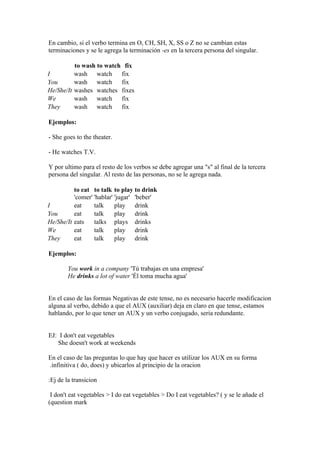
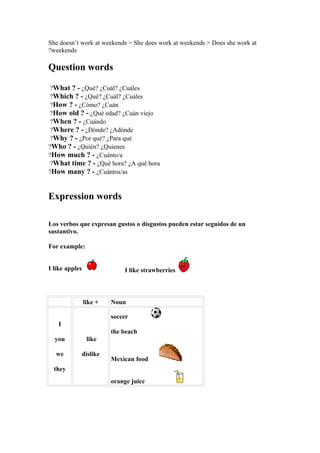
I like apples                I like strawberries


                like +   Noun

                         soccer
   I
                         the beach
  you            like

  we        dislike
                         Mexican food
  they
                         orange juice
music

                         Chinese food


   he
                 likes
  she
            dislikes
   it


                         milk


Tambien pueden estar seguidas de un verbo.

For example:

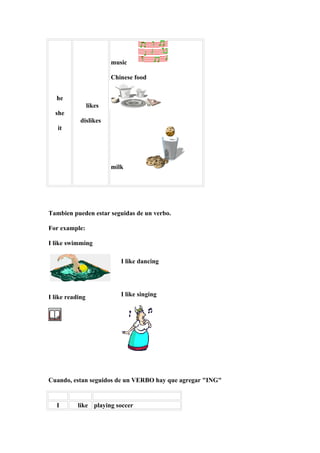
I like swimming

                            I like dancing


I like reading              I like singing


Cuando, estan seguidos de un VERBO hay que agregar "ING"


   I       like playing soccer
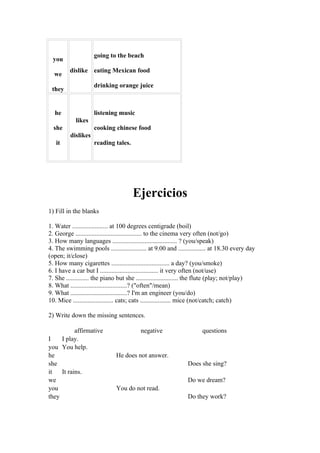
going to the beach
  you
         dislike eating Mexican food
  we
                    drinking orange juice
 they


  he                listening music
            likes
  she               cooking chinese food
         dislikes
   it               reading tales.


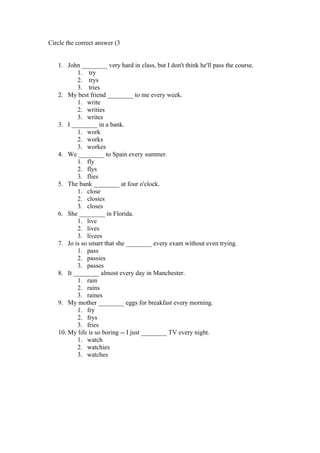
                                     Ejercicios
1) Fill in the blanks

1. Water ...................... at 100 degrees centigrade (boil)
2. George ......................................... to the cinema very often (not/go)
3. How many languages ........................................ ? (you/speak)
4. The swimming pools ...................... at 9.00 and ................. at 18.30 every day
(open; it/close)
5. How many cigarettes .................................... a day? (you/smoke)
6. I have a car but I .................................... it very often (not/use)
7. She .............. the piano but she .......................... the flute (play; not/play)
8. What ...................................? ("often"/mean)
9. What ...................................? I'm an engineer (you/do)
10. Mice ......................... cats; cats ................... mice (not/catch; catch)

2) Write down the missing sentences.

           affirmative                   negative                    questions
I    I play.
you You help.
he                            He does not answer.
she                                                           Does she sing?
it   It rains.
we                                                            Do we dream?
you                           You do not read.
they                                                          Do they work?
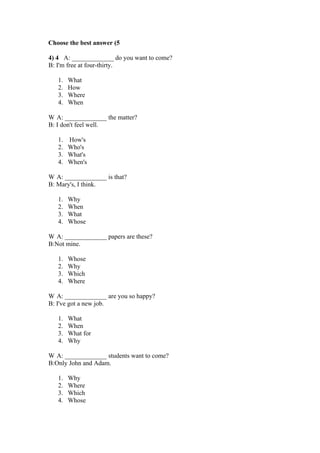
Circle the correct answer (3


   1. John ________ very hard in class, but I don't think he'll pass the course.
          1. try
          2. trys
          3. tries
   2. My best friend ________ to me every week.
          1. write
          2. writies
          3. writes
   3. I ________ in a bank.
          1. work
          2. works
          3. workes
   4. We ________ to Spain every summer.
          1. fly
          2. flys
          3. flies
   5. The bank ________ at four o'clock.
          1. close
          2. closies
          3. closes
   6. She ________ in Florida.
          1. live
          2. lives
          3. livees
   7. Jo is so smart that she ________ every exam without even trying.
          1. pass
          2. passies
          3. passes
   8. It ________ almost every day in Manchester.
          1. rain
          2. rains
          3. raines
   9. My mother ________ eggs for breakfast every morning.
          1. fry
          2. frys
          3. fries
   10. My life is so boring -- I just ________ TV every night.
          1. watch
          2. watchies
          3. watches
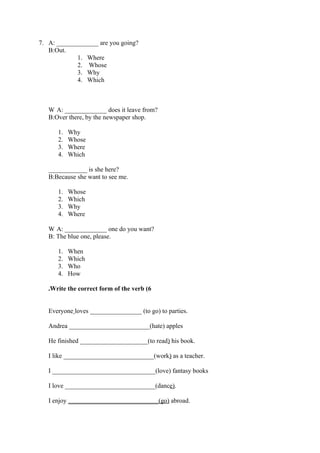
Choose the best answer (5

4) 4 A: _____________ do you want to come?
B: I'm free at four-thirty.

   1.   What
   2.   How
   3.   Where
   4.   When

W A: _____________ the matter?
B: I don't feel well.

   1. How's
   2. Who's
   3. What's
   4. When's

W A: _____________ is that?
B: Mary's, I think.

   1.   Why
   2.   When
   3.   What
   4.   Whose

W A: _____________ papers are these?
B:Not mine.

   1.   Whose
   2.   Why
   3.   Which
   4.   Where

W A: _____________ are you so happy?
B: I've got a new job.

   1.   What
   2.   When
   3.   What for
   4.   Why

W A: _____________ students want to come?
B:Only John and Adam.

   1.   Why
   2.   Where
   3.   Which
   4.   Whose
7. A: _____________ are you going?
   B:Out.
             1. Where
             2. Whose
             3. Why
             4. Which


   W A: _____________ does it leave from?
   B:Over there, by the newspaper shop.

      1.   Why
      2.   Whose
      3.   Where
      4.   Which

   ____________ is she here?
   B:Because she want to see me.

      1.   Whose
      2.   Which
      3.   Why
      4.   Where

   W A: _____________ one do you want?
   B: The blue one, please.

      1.   When
      2.   Which
      3.   Who
      4.   How

   .Write the correct form of the verb (6


   Everyone loves ________________ (to go) to parties.

   Andrea _________________________(hate) apples

   He finished _____________________(to read) his book.

   I like ____________________________(work) as a teacher.

   I ________________________________(love) fantasy books

   I love ____________________________(dance).

   I enjoy ____________________________(go) abroad.
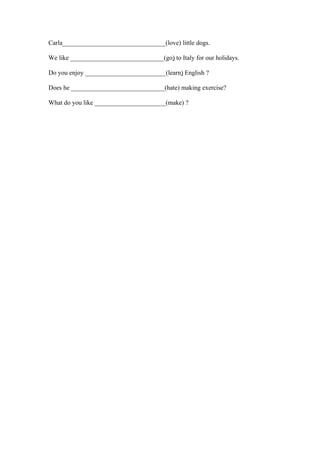
Carla________________________________(love) little dogs.

We like _____________________________(go) to Italy for our holidays.

Do you enjoy _________________________(learn) English ?

Does he _____________________________(hate) making exercise?

What do you like ______________________(make) ?

Guia reforzamiento presente simple explicacion

  • 1.
    Francisco Martínez .Reforzamiento _____________________________________________:Name (Guia dereforzamiento (explicacion Temas: Present simple tense Question words .Expression words: like-love-hate Present simple El presente simple se utiliza para poder hablar de acciones que ocurren todos los dias .((cotidianeidad .Ej: I go to school every day En este tense, el verbo debe ir en infinitivo, sin embargo para los pronombres he she it, todos .(los verbos deben conjugarse (solo en modo afirmativo Si el verbo termina en "y" cuando antes de ésta se sitúa una consonante se cambia ésta por una "i" y se le agrega la desinencia "es" en la tercera persona del singular. to carry to study to copy 'llevar a' I carry study copy You carry study copy He/She/It carries studies copies We carry study copy They carry study copy Ejemplos He flies an airplane. She studies for the test of tomorrow.
  • 2.
    En cambio, siel verbo termina en O, CH, SH, X, SS o Z no se cambian estas terminaciones y se le agrega la terminación -es en la tercera persona del singular. to wash to watch fix I wash watch fix You wash watch fix He/She/It washes watches fixes We wash watch fix They wash watch fix Ejemplos: - She goes to the theater. - He watches T.V. Y por ultimo para el resto de los verbos se debe agregar una "s" al final de la tercera persona del singular. Al resto de las personas, no se le agrega nada. to eat to talk to play to drink 'comer' 'hablar' 'jugar' 'beber' I eat talk play drink You eat talk play drink He/She/It eats talks plays drinks We eat talk play drink They eat talk play drink Ejemplos: You work in a company 'Tú trabajas en una empresa' He drinks a lot of water 'Él toma mucha agua' En el caso de las formas Negativas de este tense, no es necesario hacerle modificacion alguna al verbo, debido a que el AUX (auxiliar) deja en claro en que tense, estamos hablando, por lo que tener un AUX y un verbo conjugado, seria redundante. EJ: I don't eat vegetables She doesn't work at weekends En el caso de las preguntas lo que hay que hacer es utilizar los AUX en su forma .infinitiva ( do, does) y ubicarlos al principio de la oracion :Ej de la transicion I don't eat vegetables > I do eat vegetables > Do I eat vegetables? ( y se le añade el (question mark
  • 3.
    She doesn’t workat weekends > She does work at weekends > Does she work at ?weekends Question words ?What ? - ¿Qué? ¿Cuál? ¿Cuáles ?Which ? - ¿Qué? ¿Cuál? ¿Cuáles ?How ? - ¿Cómo? ¿Cuán ?How old ? - ¿Qué edad? ¿Cuán viejo ?When ? - ¿Cuándo ?Where ? - ¿Dónde? ¿Adónde ?Why ? - ¿Por qué? ¿Para qué ?Who ? - ¿Quién? ¿Quienes ?How much ? - ¿Cuánto/a ?What time ? - ¿Qué hora? ¿A qué hora ?How many ? - ¿Cuántos/as Expression words Los verbos que expresan gustos o disgustos pueden estar seguidos de un sustantivo. For example: I like apples I like strawberries like + Noun soccer I the beach you like we dislike Mexican food they orange juice
  • 4.
    music Chinese food he likes she dislikes it milk Tambien pueden estar seguidas de un verbo. For example: I like swimming I like dancing I like reading I like singing Cuando, estan seguidos de un VERBO hay que agregar "ING" I like playing soccer
  • 5.
    going to thebeach you dislike eating Mexican food we drinking orange juice they he listening music likes she cooking chinese food dislikes it reading tales. Ejercicios 1) Fill in the blanks 1. Water ...................... at 100 degrees centigrade (boil) 2. George ......................................... to the cinema very often (not/go) 3. How many languages ........................................ ? (you/speak) 4. The swimming pools ...................... at 9.00 and ................. at 18.30 every day (open; it/close) 5. How many cigarettes .................................... a day? (you/smoke) 6. I have a car but I .................................... it very often (not/use) 7. She .............. the piano but she .......................... the flute (play; not/play) 8. What ...................................? ("often"/mean) 9. What ...................................? I'm an engineer (you/do) 10. Mice ......................... cats; cats ................... mice (not/catch; catch) 2) Write down the missing sentences. affirmative negative questions I I play. you You help. he He does not answer. she Does she sing? it It rains. we Do we dream? you You do not read. they Do they work?
  • 6.
    Circle the correctanswer (3 1. John ________ very hard in class, but I don't think he'll pass the course. 1. try 2. trys 3. tries 2. My best friend ________ to me every week. 1. write 2. writies 3. writes 3. I ________ in a bank. 1. work 2. works 3. workes 4. We ________ to Spain every summer. 1. fly 2. flys 3. flies 5. The bank ________ at four o'clock. 1. close 2. closies 3. closes 6. She ________ in Florida. 1. live 2. lives 3. livees 7. Jo is so smart that she ________ every exam without even trying. 1. pass 2. passies 3. passes 8. It ________ almost every day in Manchester. 1. rain 2. rains 3. raines 9. My mother ________ eggs for breakfast every morning. 1. fry 2. frys 3. fries 10. My life is so boring -- I just ________ TV every night. 1. watch 2. watchies 3. watches
  • 7.
    Choose the bestanswer (5 4) 4 A: _____________ do you want to come? B: I'm free at four-thirty. 1. What 2. How 3. Where 4. When W A: _____________ the matter? B: I don't feel well. 1. How's 2. Who's 3. What's 4. When's W A: _____________ is that? B: Mary's, I think. 1. Why 2. When 3. What 4. Whose W A: _____________ papers are these? B:Not mine. 1. Whose 2. Why 3. Which 4. Where W A: _____________ are you so happy? B: I've got a new job. 1. What 2. When 3. What for 4. Why W A: _____________ students want to come? B:Only John and Adam. 1. Why 2. Where 3. Which 4. Whose
  • 8.
    7. A: _____________are you going? B:Out. 1. Where 2. Whose 3. Why 4. Which W A: _____________ does it leave from? B:Over there, by the newspaper shop. 1. Why 2. Whose 3. Where 4. Which ____________ is she here? B:Because she want to see me. 1. Whose 2. Which 3. Why 4. Where W A: _____________ one do you want? B: The blue one, please. 1. When 2. Which 3. Who 4. How .Write the correct form of the verb (6 Everyone loves ________________ (to go) to parties. Andrea _________________________(hate) apples He finished _____________________(to read) his book. I like ____________________________(work) as a teacher. I ________________________________(love) fantasy books I love ____________________________(dance). I enjoy ____________________________(go) abroad.
  • 9.
    Carla________________________________(love) little dogs. Welike _____________________________(go) to Italy for our holidays. Do you enjoy _________________________(learn) English ? Does he _____________________________(hate) making exercise? What do you like ______________________(make) ?