
PRESENTE SIMPLE
1. ¿Cuándo se utiliza el Presente Simple?

2. DO/DOES como verbo auxiliar:

3. Reglas de ortografía para la 3ª persona del singular

4. Afirmativo

5. Negativo

6. Interrogativo

7. Respuesta Corta
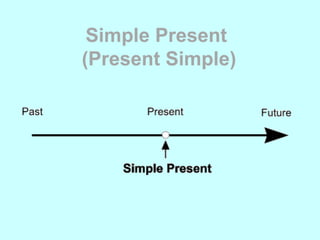
Simple Present
(Present Simple)
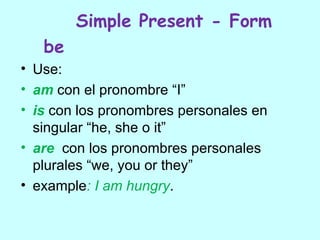
Simple Present - Form
   be
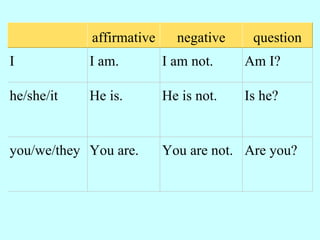
• Use:
• am con el pronombre “I”
• is con los pronombres personales en
  singular “he, she o it”
• are con los pronombres personales
  plurales “we, you or they”
• example: I am hungry.
      affirmative     negative    question
I           I am.         I am not.    Am I?

he/she/it   He is.        He is not.   Is he?


you/we/they You are.      You are not. Are you?
0
06

         Simple Present

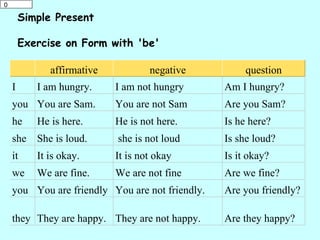
         Exercise on Form with 'be'

                 affirmative           negative         question
     I        I am hungry.     I am not hungry     Am I hungry?
     you You are Sam.          You are not Sam     Are you Sam?
     he       He is here.      He is not here.     Is he here?
     she      She is loud.      she is not loud    Is she loud?
     it       It is okay.      It is not okay      Is it okay?
     we       We are fine.     We are not fine     Are we fine?
     you You are friendly  You are not friendly.   Are you friendly?

     they They are happy. They are not happy.      Are they happy?
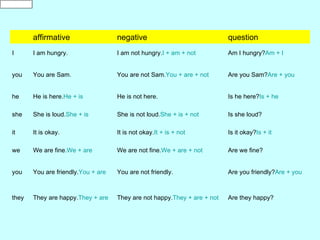
affirmative                  negative                              question
I      I am hungry.                 I am not hungry.I + am + not          Am I hungry?Am + I


you    You are Sam.                 You are not Sam.You + are + not       Are you Sam?Are + you


he     He is here.He + is           He is not here.                       Is he here?Is + he

she    She is loud.She + is         She is not loud.She + is + not        Is she loud?

it     It is okay.                  It is not okay.It + is + not          Is it okay?Is + it

we     We are fine.We + are         We are not fine.We + are + not        Are we fine?


you    You are friendly.You + are   You are not friendly.                 Are you friendly?Are + you


they   They are happy.They + are    They are not happy.They + are + not   Are they happy?
PRESENTE SIMPLE
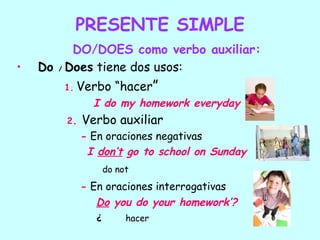
          DO/DOES como verbo auxiliar:
•   Do / Does tiene dos usos:
        1.   Verbo “hacer”
               I do my homework everyday
        2.   Verbo auxiliar
             - En oraciones negativas
              I don’t go to school on Sunday
                    do not
             - En oraciones interrogativas
                Do you do your homework’?
                ¿        hacer
0
default

                                Simple Present

                              Exercises on Form
                       Write down the missing sentences.

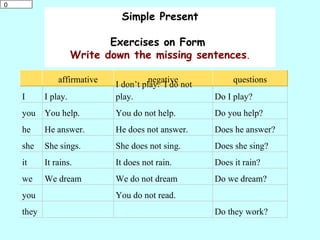
                 affirmative             negative              questions
                               I don’t play.  I do not 
      I      I play.           play.                      Do I play?
      you    You help.         You do not help.           Do you help?
      he     He answer.        He does not answer.        Does he answer?
      she    She sings.        She does not sing.         Does she sing?
      it     It rains.         It does not rain.          Does it rain?
      we     We dream          We do not dream            Do we dream?
      you                      You do not read.
      they                                                Do they work?
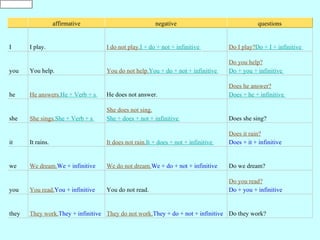
affirmative                          negative                                 questions


I      I play.                      I do not play.I + do + not + infinitive          Do I play?Do + I + infinitive 

                                                                                     Do you help?
you    You help.                    You do not help.You + do + not + infinitive      Do + you + infinitive 

                                                                                     Does he answer?
he     He answers.He + Verb + s     He does not answer.                              Does + he + infinitive 

                                    She does not sing.
she    She sings.She + Verb + s     She + does + not + infinitive                    Does she sing?

                                                                                     Does it rain?
it     It rains.                    It does not rain.It + does + not + infinitive    Does + it + infinitive 


we     We dream.We + infinitive     We do not dream.We + do + not + infinitive       Do we dream?

                                                                                     Do you read?
you    You read.You + infinitive    You do not read.                                 Do + you + infinitive 


they   They work.They + infinitive  They do not work.They + do + not + infinitive  Do they work?
PRESENTE SIMPLE
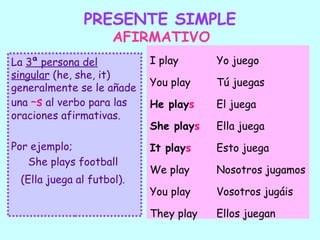
                     AFIRMATIVO
La 3ª persona del          I play      Yo juego
singular (he, she, it)
                           You play    Tú juegas
generalmente se le añade
una –s al verbo para las   He plays    El juega
oraciones afirmativas.
                           She plays   Ella juega
Por ejemplo;               It plays    Esto juega
   She plays football
                           We play     Nosotros jugamos
 (Ella juega al futbol).
                           You play    Vosotros jugáis

                           They play   Ellos juegan
PRESENTE SIMPLE
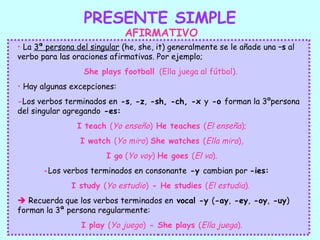
                             AFIRMATIVO
• La 3ª persona del singular (he, she, it) generalmente se le añade una –s al
verbo para las oraciones afirmativas. Por ejemplo;
                  She plays football (Ella juega al fútbol).
• Hay algunas excepciones:
-Los verbos terminados en -s, -z, -sh, -ch, -x y -o forman la 3ºpersona
del singular agregando -es:
                I teach (Yo enseño) He teaches (El enseña);
                 I watch (Yo miro) She watches (Ella mira),
                        I go (Yo voy) He goes (El va).
       -Los verbos terminados en consonante -y cambian por -ies:
              I study (Yo estudio) - He studies (El estudia).
 Recuerda que los verbos terminados en vocal -y (-ay, -ey, -oy, -uy)
forman la 3ª persona regularmente:
                 I play (Yo juego) - She plays (Ella juega).
c
0an
default

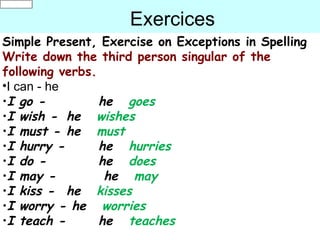
                    Exercices
Simple Present, Exercise on Exceptions in Spelling
Write down the third person singular of the
following verbs.
•I can - he
•I go -          he goes
•I wish - he wishes
•I must - he must
•I hurry -       he hurries
•I do -          he does
•I may -          he may
•I kiss - he kisses
•I worry - he worries
•I teach -       he teaches
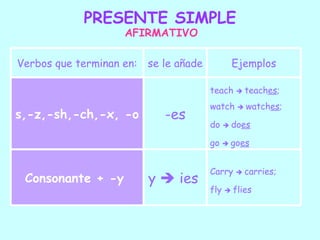
PRESENTE SIMPLE
                    AFIRMATIVO

Verbos que terminan en: se le añade             Ejemplos

                                      teach       teaches;

                                      watch  watches;
s,-z,-sh,-ch,-x, -o        -es
                                      do       does

                                      go  goes


                                      Carry         carries;
 Consonante + -y        y  ies
                                                

                                      fly      flies
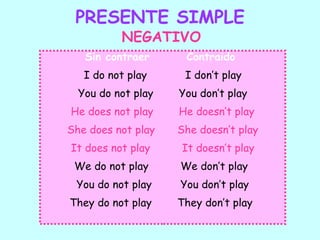
PRESENTE SIMPLE
          NEGATIVO
   Sin contraer      Contraido
   I do not play     I don’t play
  You do not play   You don’t play
He does not play    He doesn’t play
She does not play   She doesn’t play
It does not play    It doesn’t play
 We do not play     We don’t play
 You do not play    You don’t play
They do not play    They don’t play
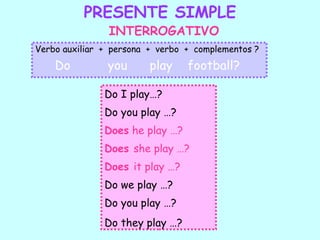
PRESENTE SIMPLE
                INTERROGATIVO
Verbo auxiliar + persona + verbo + complementos ?
    Do         you       play    football?

               Do I play…?
               Do you play …?
               Does he play …?
               Does she play …?
               Does it play …?
               Do we play …?
               Do you play …?
               Do they play …?
PRESENTE SIMPLE
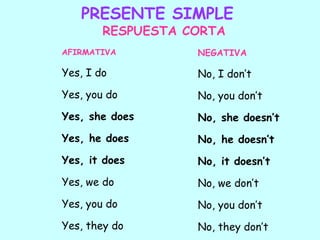
        RESPUESTA CORTA
AFIRMATIVA         NEGATIVA

Yes, I do          No, I don’t
Yes, you do        No, you don’t
Yes, she does      No, she doesn’t
Yes, he does       No, he doesn’t
Yes, it does       No, it doesn’t
Yes, we do         No, we don’t
Yes, you do        No, you don’t
Yes, they do       No, they don’t
PRESENTE SIMPLE
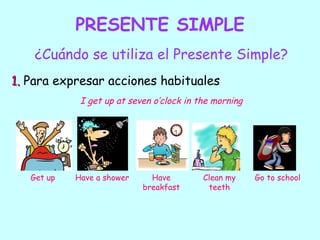
    ¿Cuándo se utiliza el Presente Simple?
1. Para expresar acciones habituales
             I get up at seven o’clock in the morning


   Get up   Have a shower     Have         Clean my     Go to school
                            breakfast       teeth
Video activity
PRESENTE SIMPLE
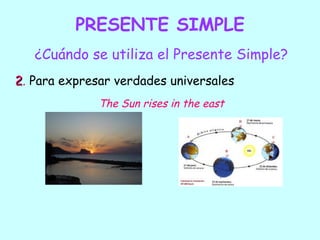
   ¿Cuándo se utiliza el Presente Simple?
2. Para expresar verdades universales
              The Sun rises in the east
is
0
default


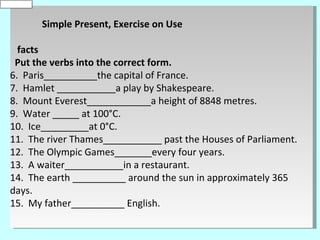
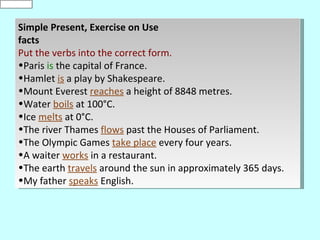
          Simple Present, Exercise on Use

    facts
   Put the verbs into the correct form.
  6. Paris__________the capital of France.
  7. Hamlet ___________a play by Shakespeare.
  8. Mount Everest____________a height of 8848 metres.
  9. Water _____ at 100°C.
  10. Ice_________at 0°C.
  11. The river Thames___________ past the Houses of Parliament.
  12. The Olympic Games_______every four years.
  13. A waiter___________in a restaurant.
  14. The earth __________ around the sun in approximately 365
  days.
  15. My father__________ English.
is
0
default


     Simple Present, Exercise on Use
     facts
     Put the verbs into the correct form.
     •Paris is the capital of France.
     •Hamlet is a play by Shakespeare.
     •Mount Everest reaches a height of 8848 metres.
     •Water boils at 100°C.
     •Ice melts at 0°C.
     •The river Thames flows past the Houses of Parliament.
     •The Olympic Games take place every four years.
     •A waiter works in a restaurant.
     •The earth travels around the sun in approximately 365 days.
     •My father speaks English.
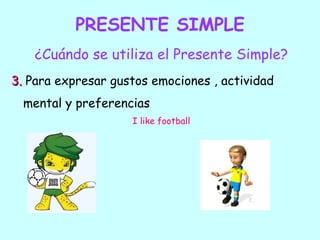
PRESENTE SIMPLE
    ¿Cuándo se utiliza el Presente Simple?
3. Para expresar gustos emociones , actividad
  mental y preferencias
                    I like football
like

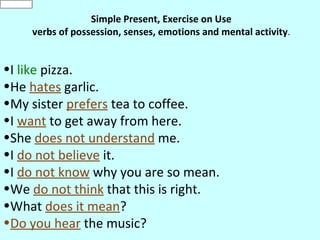
                    Simple Present, Exercise on Use
       verbs of possession, senses, emotions and mental activity.


•I like pizza.
•He hates garlic.
•My sister prefers tea to coffee.
•I want to get away from here.
•She does not understand me.
•I do not believe it.
•I do not know why you are so mean.
•We do not think that this is right.
•What does it mean?
•Do you hear the music?

Presente simple

  • 1.
    PRESENTE SIMPLE 1. ¿Cuándose utiliza el Presente Simple? 2. DO/DOES como verbo auxiliar: 3. Reglas de ortografía para la 3ª persona del singular 4. Afirmativo 5. Negativo 6. Interrogativo 7. Respuesta Corta
  • 2.
  • 3.
    Simple Present -Form be • Use: • am con el pronombre “I” • is con los pronombres personales en singular “he, she o it” • are con los pronombres personales plurales “we, you or they” • example: I am hungry.
  • 4.
      affirmative negative question I I am. I am not. Am I? he/she/it He is. He is not. Is he? you/we/they You are. You are not. Are you?
  • 5.
    0 06 Simple Present Exercise on Form with 'be'   affirmative negative question I I am hungry. I am not hungry Am I hungry? you You are Sam. You are not Sam Are you Sam? he He is here. He is not here. Is he here? she She is loud.  she is not loud Is she loud? it It is okay. It is not okay Is it okay? we We are fine. We are not fine Are we fine? you You are friendly  You are not friendly. Are you friendly? they They are happy. They are not happy. Are they happy?
  • 6.
    affirmative negative question I I am hungry. I am not hungry.I + am + not Am I hungry?Am + I you You are Sam. You are not Sam.You + are + not Are you Sam?Are + you he He is here.He + is He is not here. Is he here?Is + he she She is loud.She + is She is not loud.She + is + not Is she loud? it It is okay. It is not okay.It + is + not Is it okay?Is + it we We are fine.We + are We are not fine.We + are + not Are we fine? you You are friendly.You + are You are not friendly. Are you friendly?Are + you they They are happy.They + are They are not happy.They + are + not Are they happy?
  • 7.
    PRESENTE SIMPLE DO/DOES como verbo auxiliar: • Do / Does tiene dos usos: 1. Verbo “hacer” I do my homework everyday 2. Verbo auxiliar - En oraciones negativas I don’t go to school on Sunday do not - En oraciones interrogativas Do you do your homework’? ¿ hacer
  • 8.
    0 default Simple Present Exercises on Form Write down the missing sentences. affirmative negative questions I don’t play.  I do not  I I play. play. Do I play? you You help. You do not help. Do you help? he He answer. He does not answer. Does he answer? she She sings. She does not sing. Does she sing? it It rains. It does not rain. Does it rain? we We dream We do not dream Do we dream? you You do not read. they Do they work?
  • 9.
    affirmative negative questions I I play. I do not play.I + do + not + infinitive  Do I play?Do + I + infinitive  Do you help? you You help. You do not help.You + do + not + infinitive  Do + you + infinitive  Does he answer? he He answers.He + Verb + s  He does not answer. Does + he + infinitive  She does not sing. she She sings.She + Verb + s  She + does + not + infinitive  Does she sing? Does it rain? it It rains. It does not rain.It + does + not + infinitive  Does + it + infinitive  we We dream.We + infinitive  We do not dream.We + do + not + infinitive  Do we dream? Do you read? you You read.You + infinitive  You do not read. Do + you + infinitive  they They work.They + infinitive  They do not work.They + do + not + infinitive  Do they work?
  • 10.
    PRESENTE SIMPLE AFIRMATIVO La 3ª persona del I play Yo juego singular (he, she, it) You play Tú juegas generalmente se le añade una –s al verbo para las He plays El juega oraciones afirmativas. She plays Ella juega Por ejemplo; It plays Esto juega She plays football We play Nosotros jugamos (Ella juega al futbol). You play Vosotros jugáis They play Ellos juegan
  • 11.
    PRESENTE SIMPLE AFIRMATIVO • La 3ª persona del singular (he, she, it) generalmente se le añade una –s al verbo para las oraciones afirmativas. Por ejemplo; She plays football (Ella juega al fútbol). • Hay algunas excepciones: -Los verbos terminados en -s, -z, -sh, -ch, -x y -o forman la 3ºpersona del singular agregando -es: I teach (Yo enseño) He teaches (El enseña); I watch (Yo miro) She watches (Ella mira), I go (Yo voy) He goes (El va). -Los verbos terminados en consonante -y cambian por -ies: I study (Yo estudio) - He studies (El estudia).  Recuerda que los verbos terminados en vocal -y (-ay, -ey, -oy, -uy) forman la 3ª persona regularmente: I play (Yo juego) - She plays (Ella juega).
  • 12.
    c 0an default Exercices Simple Present, Exercise on Exceptions in Spelling Write down the third person singular of the following verbs. •I can - he •I go - he goes •I wish - he wishes •I must - he must •I hurry - he hurries •I do - he does •I may - he may •I kiss - he kisses •I worry - he worries •I teach - he teaches
  • 13.
    PRESENTE SIMPLE AFIRMATIVO Verbos que terminan en: se le añade Ejemplos teach  teaches; watch  watches; s,-z,-sh,-ch,-x, -o -es do  does go  goes Carry carries; Consonante + -y y  ies  fly  flies
  • 14.
    PRESENTE SIMPLE NEGATIVO Sin contraer Contraido I do not play I don’t play You do not play You don’t play He does not play He doesn’t play She does not play She doesn’t play It does not play It doesn’t play We do not play We don’t play You do not play You don’t play They do not play They don’t play
  • 15.
    PRESENTE SIMPLE INTERROGATIVO Verbo auxiliar + persona + verbo + complementos ? Do you play football? Do I play…? Do you play …? Does he play …? Does she play …? Does it play …? Do we play …? Do you play …? Do they play …?
  • 16.
    PRESENTE SIMPLE RESPUESTA CORTA AFIRMATIVA NEGATIVA Yes, I do No, I don’t Yes, you do No, you don’t Yes, she does No, she doesn’t Yes, he does No, he doesn’t Yes, it does No, it doesn’t Yes, we do No, we don’t Yes, you do No, you don’t Yes, they do No, they don’t
  • 17.
    PRESENTE SIMPLE ¿Cuándo se utiliza el Presente Simple? 1. Para expresar acciones habituales I get up at seven o’clock in the morning Get up Have a shower Have Clean my Go to school breakfast teeth
  • 18.
  • 19.
    PRESENTE SIMPLE ¿Cuándo se utiliza el Presente Simple? 2. Para expresar verdades universales The Sun rises in the east
  • 20.
    is 0 default Simple Present, Exercise on Use facts Put the verbs into the correct form. 6. Paris__________the capital of France. 7. Hamlet ___________a play by Shakespeare. 8. Mount Everest____________a height of 8848 metres. 9. Water _____ at 100°C. 10. Ice_________at 0°C. 11. The river Thames___________ past the Houses of Parliament. 12. The Olympic Games_______every four years. 13. A waiter___________in a restaurant. 14. The earth __________ around the sun in approximately 365 days. 15. My father__________ English.
  • 21.
    is 0 default Simple Present, Exercise on Use facts Put the verbs into the correct form. •Paris is the capital of France. •Hamlet is a play by Shakespeare. •Mount Everest reaches a height of 8848 metres. •Water boils at 100°C. •Ice melts at 0°C. •The river Thames flows past the Houses of Parliament. •The Olympic Games take place every four years. •A waiter works in a restaurant. •The earth travels around the sun in approximately 365 days. •My father speaks English.
  • 22.
    PRESENTE SIMPLE ¿Cuándo se utiliza el Presente Simple? 3. Para expresar gustos emociones , actividad mental y preferencias I like football
  • 23.
    like Simple Present, Exercise on Use verbs of possession, senses, emotions and mental activity. •I like pizza. •He hates garlic. •My sister prefers tea to coffee. •I want to get away from here. •She does not understand me. •I do not believe it. •I do not know why you are so mean. •We do not think that this is right. •What does it mean? •Do you hear the music?