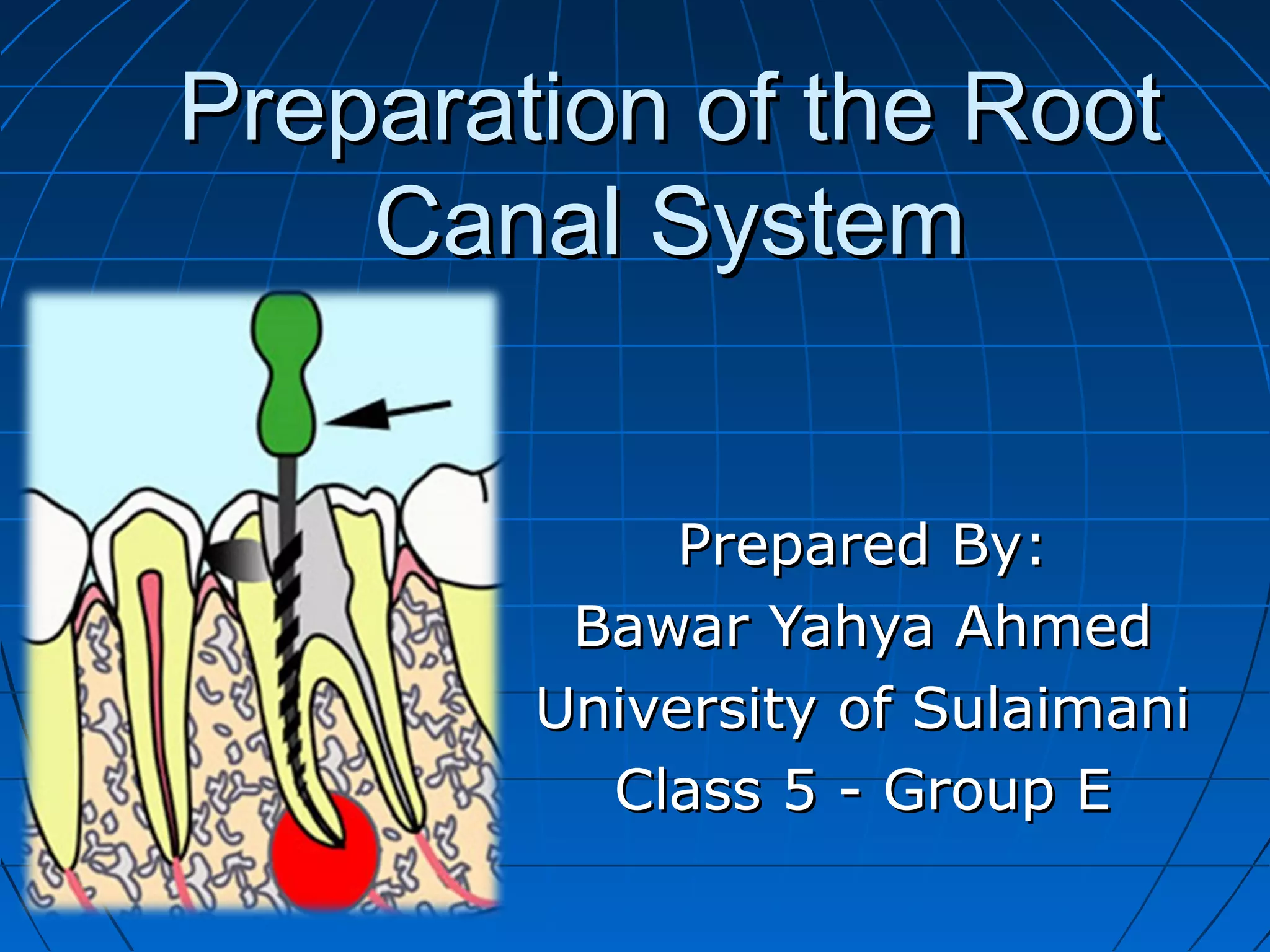
Preparation of the RootPreparation of the Root
Canal SystemCanal System
Prepared By:Prepared By:
Bawar Yahya AhmedBawar Yahya Ahmed
University of SulaimaniUniversity of Sulaimani
Class 5 - Group EClass 5 - Group E
Root canal preparationRoot canal preparation
 1. Cleaning
 2. Shaping
Root canal preparationRoot canal preparation
 Cleaning is the removal of all contents of the root
canal system before and during shaping: infected
materials, antigenic materials, organic substances,
microflora, bacterial by products, food, caries, tissue
remnants, denticles, pulp stones, collagen,
inflammatory chemicals, contaminated canal filling
materials, and dentinal debris created during canal
shaping procedures. Cleaning entails accomplished by
both mechanical instrumentation and chemically by
irrigation.
Root canal preparationRoot canal preparation
 Shaping is a mechanical process accomplished
(with files, reamers, Gates-Glidden drills, slow speed
burs, high speed diamonds-tipped drills, and sonic and
ultrasonic, and nickel-titanium instruments of variable
taper) to establishment of a specific cavity from that
permits pluggers, spreaders, and other Obturation
instruments to fit freely within the root canal system
and to generate the pressures needed to transform and
capture a maximal Obturation cushion, forcing gutta-
percha and a microfilm of sealer into all foramina.
Equally important, shaping facilitates three-dimensional
cleaning by providing easy direct access for file,
reamer, rotary instruments and irrigant during the
treatment process.
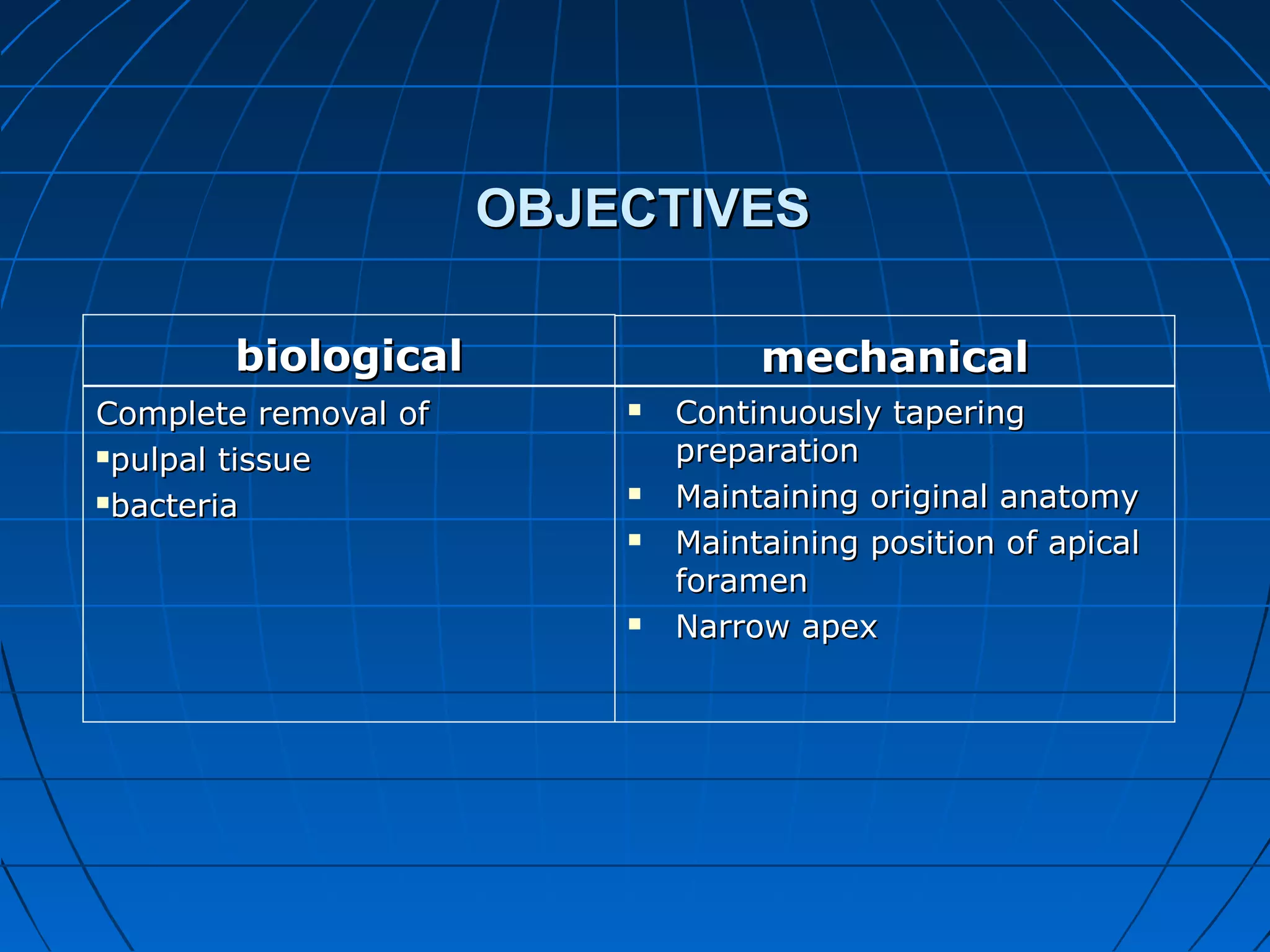
OBJECTIVESOBJECTIVES
biologicalbiological
Complete removal ofComplete removal of
pulpal tissuepulpal tissue
bacteriabacteria
mechanicalmechanical
 Continuously taperingContinuously tapering
preparationpreparation
 Maintaining original anatomyMaintaining original anatomy
 Maintaining position of apicalMaintaining position of apical
foramenforamen
 Narrow apexNarrow apex
Objectives of root canal preparationObjectives of root canal preparation
 1. Biological
 2. Mechanical
Objectives of root canal preparationObjectives of root canal preparation
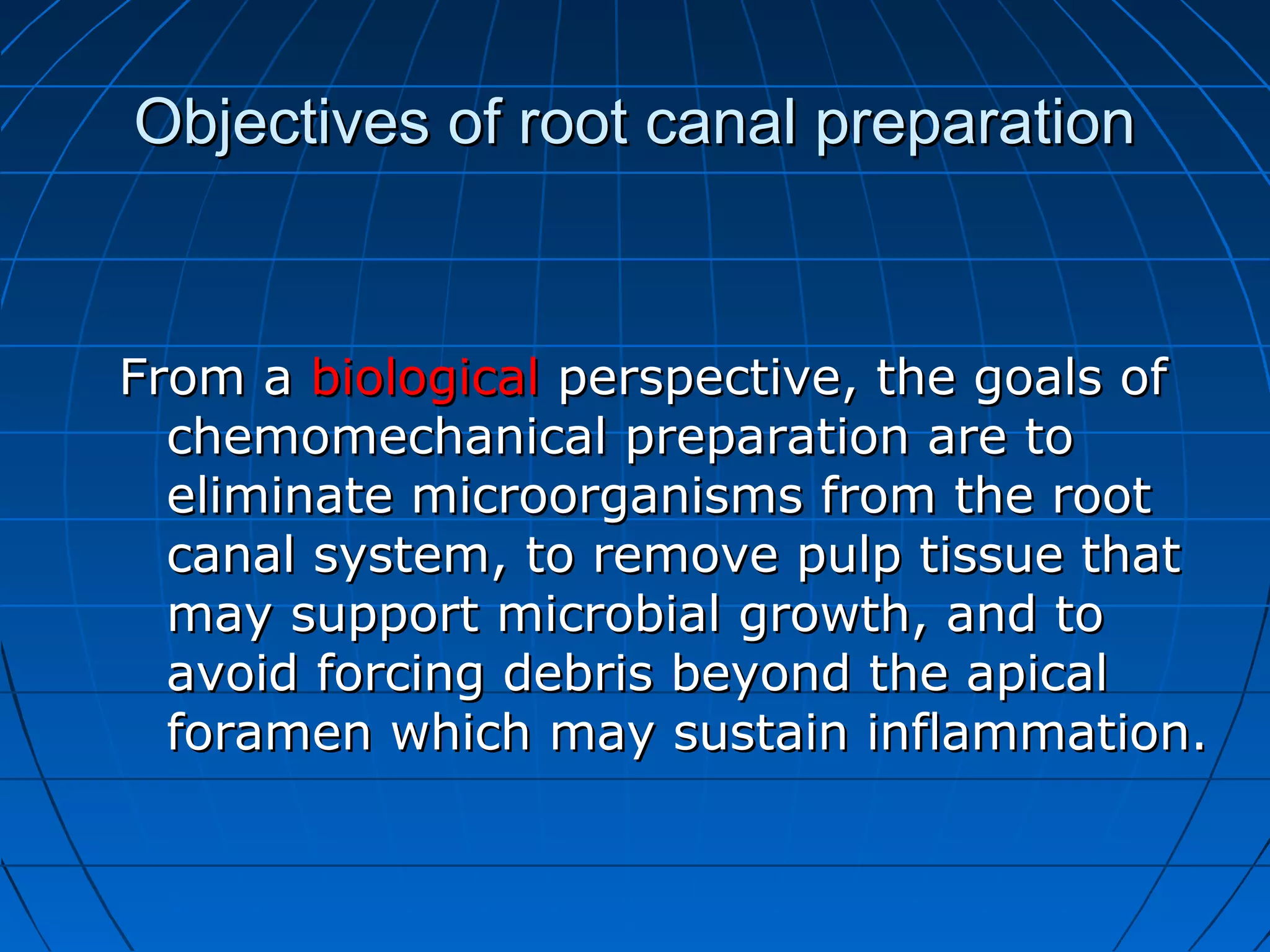
From aFrom a biologicalbiological perspective, the goals ofperspective, the goals of
chemomechanical preparation are tochemomechanical preparation are to
eliminate microorganisms from the rooteliminate microorganisms from the root
canal system, to remove pulp tissue thatcanal system, to remove pulp tissue that
may support microbial growth, and tomay support microbial growth, and to
avoid forcing debris beyond the apicalavoid forcing debris beyond the apical
foramen which may sustain inflammation.foramen which may sustain inflammation.
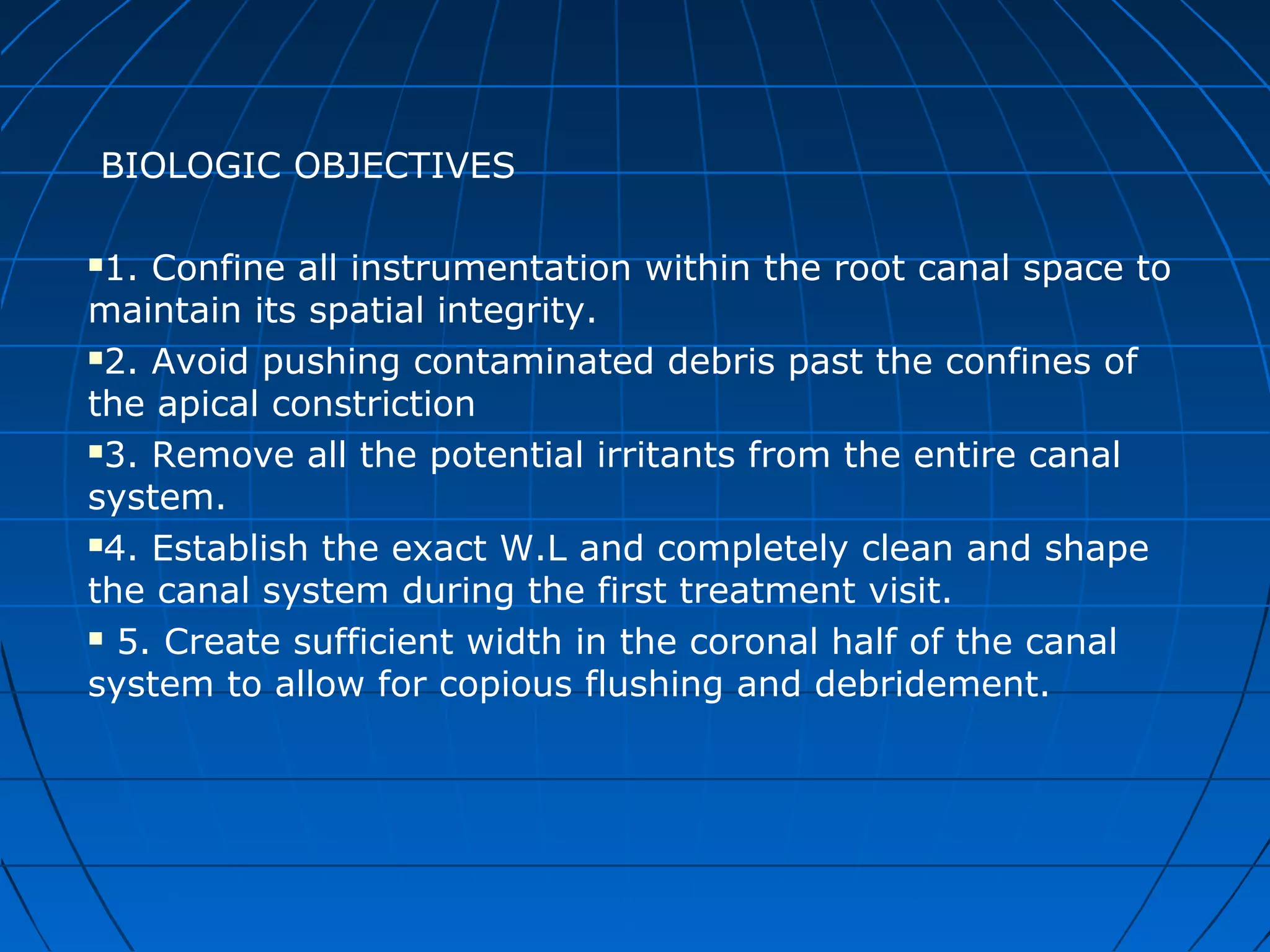
BIOLOGIC OBJECTIVES
1. Confine all instrumentation within the root canal space to
maintain its spatial integrity.
2. Avoid pushing contaminated debris past the confines of
the apical constriction
3. Remove all the potential irritants from the entire canal
system.
4. Establish the exact W.L and completely clean and shape
the canal system during the first treatment visit.
 5. Create sufficient width in the coronal half of the canal
system to allow for copious flushing and debridement.
MECHANICAL OBJECTIVES
1. Develop a continuously tapering conical form in the root
canal preparation. The final preparation of this system should
be an exact replica of the original canal configuration in
shape, taper.
2. Prepare a sound apical dentine matrix at the DC junction.
 This provides the resistance form to the intraradicular
cavity preparation. This also prevents the over- extension of
instruments and controls the apical movement of gutta-percha
sealer during obturation.
3. Prepare the canal to taper apically, with the narrowest
cross- sectional diameter at the apical termination (apical
dentin matrix).
4. Confine cleaning and shaping procedures to the canal
system, thereby maintaining the spatial integrity of the apical
foramen.
PrinciplesPrinciples
 Note: the current concept
of root canal preparation is
not cleaning and shaping,
but shaping and cleaning.
Principles of RCTPrinciples of RCT
 Principles of Endodontic cavity preparation Endodontic cavity
preparation may be separated into two anatomic divisions:
(a) Coronal preparation
(b) Radicular preparation.
Principles of RCTPrinciples of RCT
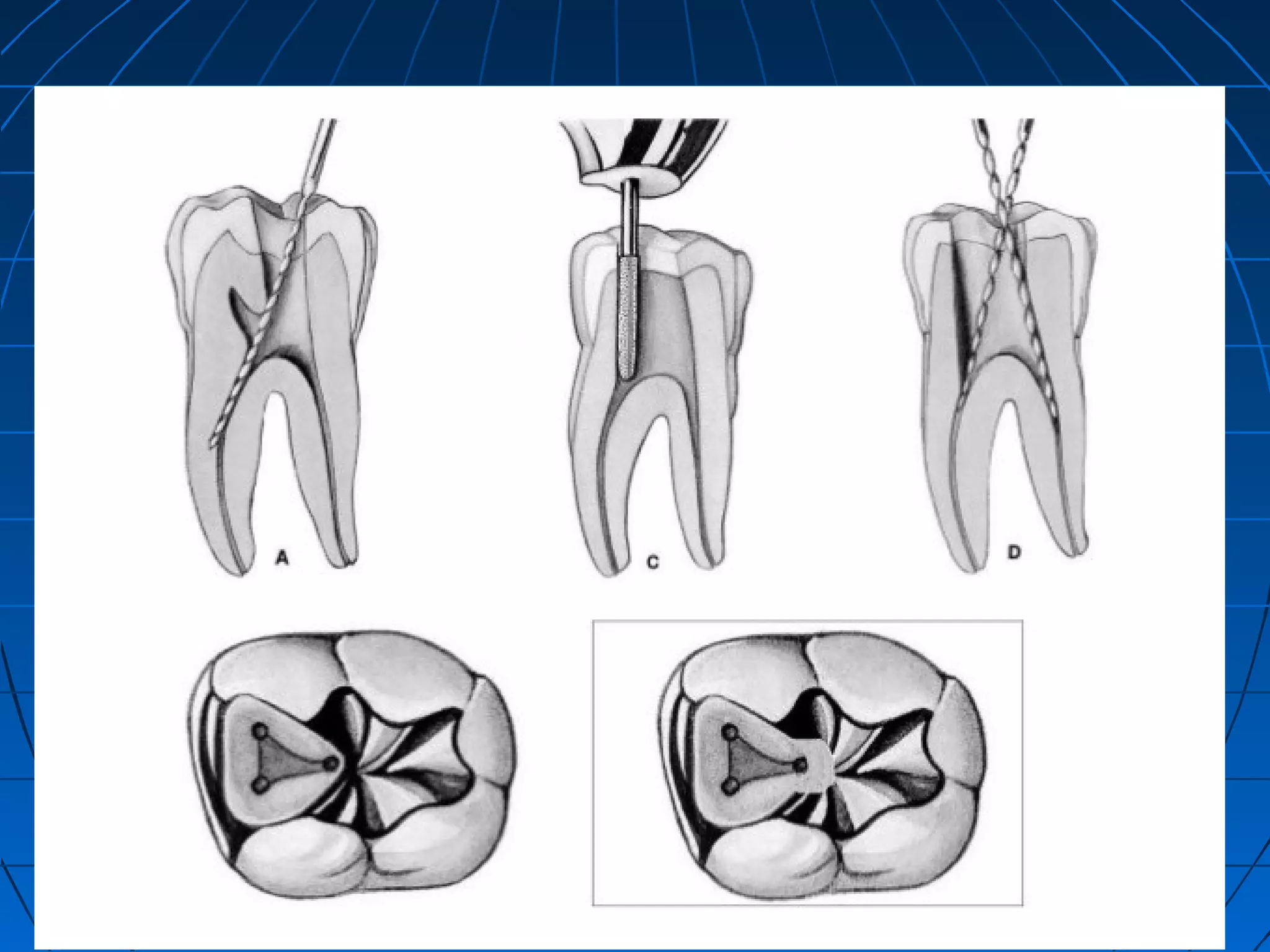
 Black's principles of cavity preparation can be modified to include
the Root canal 'cavity' preparation
 1. Coronal:
I. Outline Form
II. Convenience Form
III. Removal of the remaining carious dentin (and defective
restorations)
IV. Toilet of the cavity
Principles of RCTPrinciples of RCT
 Black's principles of cavity preparation can be modified to include
the Root canal 'cavity' preparation
 2. Radicular:
I and II. Outline Form and Convenience Form
IV. Toilet of the cavity
V. Retention Form
VI. Resistance Form
Outline FormOutline Form
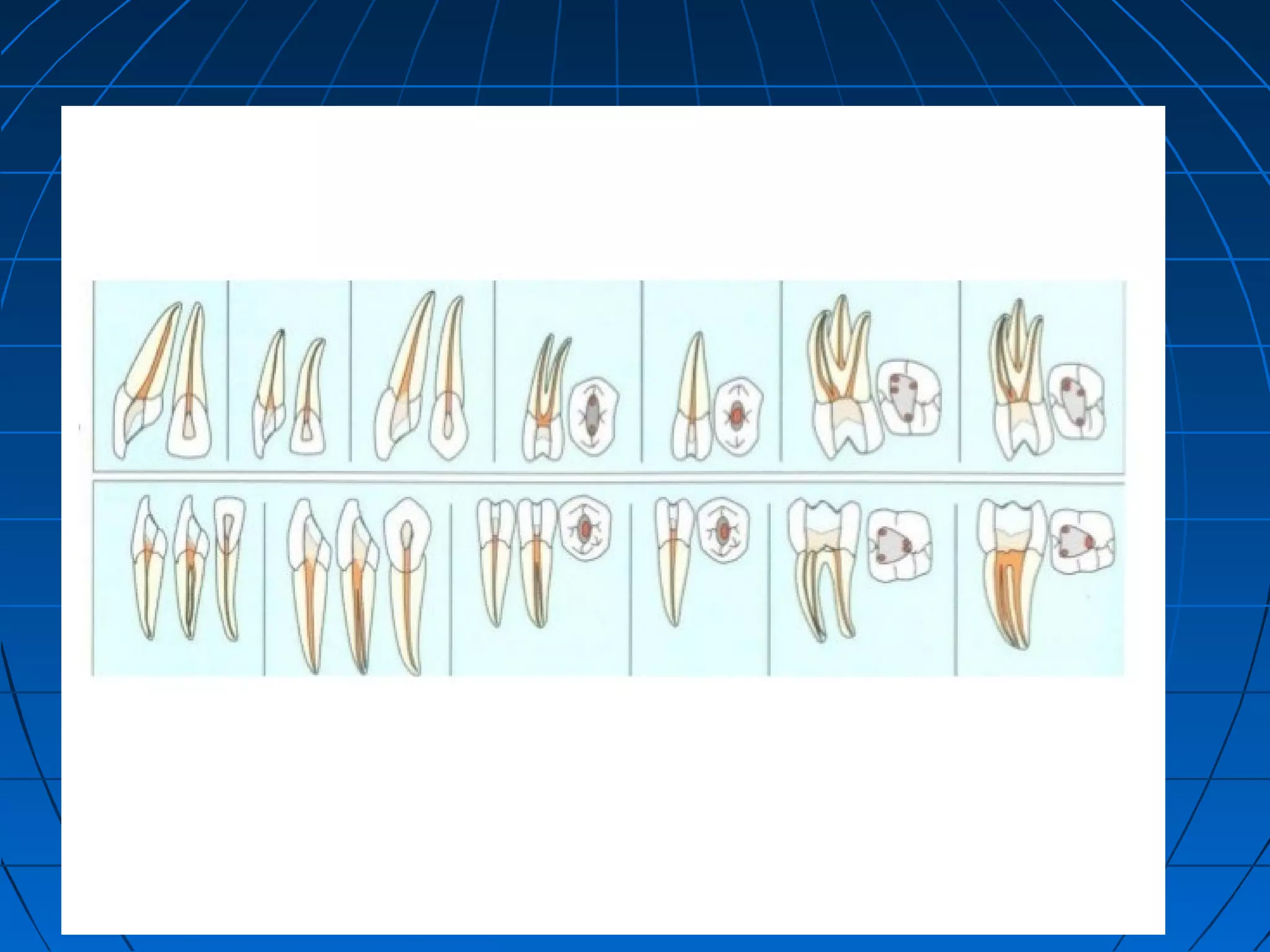
 To achieve optimal preparation, three factors of anatomy must be considered:
(1)the size of the pulp chamber,
(2)the shape of the pulp chamber,
(3)the number of individual root canals,
their curvature, and their position
internal
 The finished outline form should
accurately reflect the shape of the
pulp chamber.
Convenience FormConvenience Form
 Removing excess of coronal dentin, so as to allow
passage of larger instruments, for better
instrumentation, irrigation and obturation.
 Four important benefits are gained through convenience
form modifications: (1) unobstructed access to the canal
orifice, (2) direct access to the apical foramen, (3) cavity
expansion to accommodate filling techniques, and (4)
complete authority over the enlarging instrument.
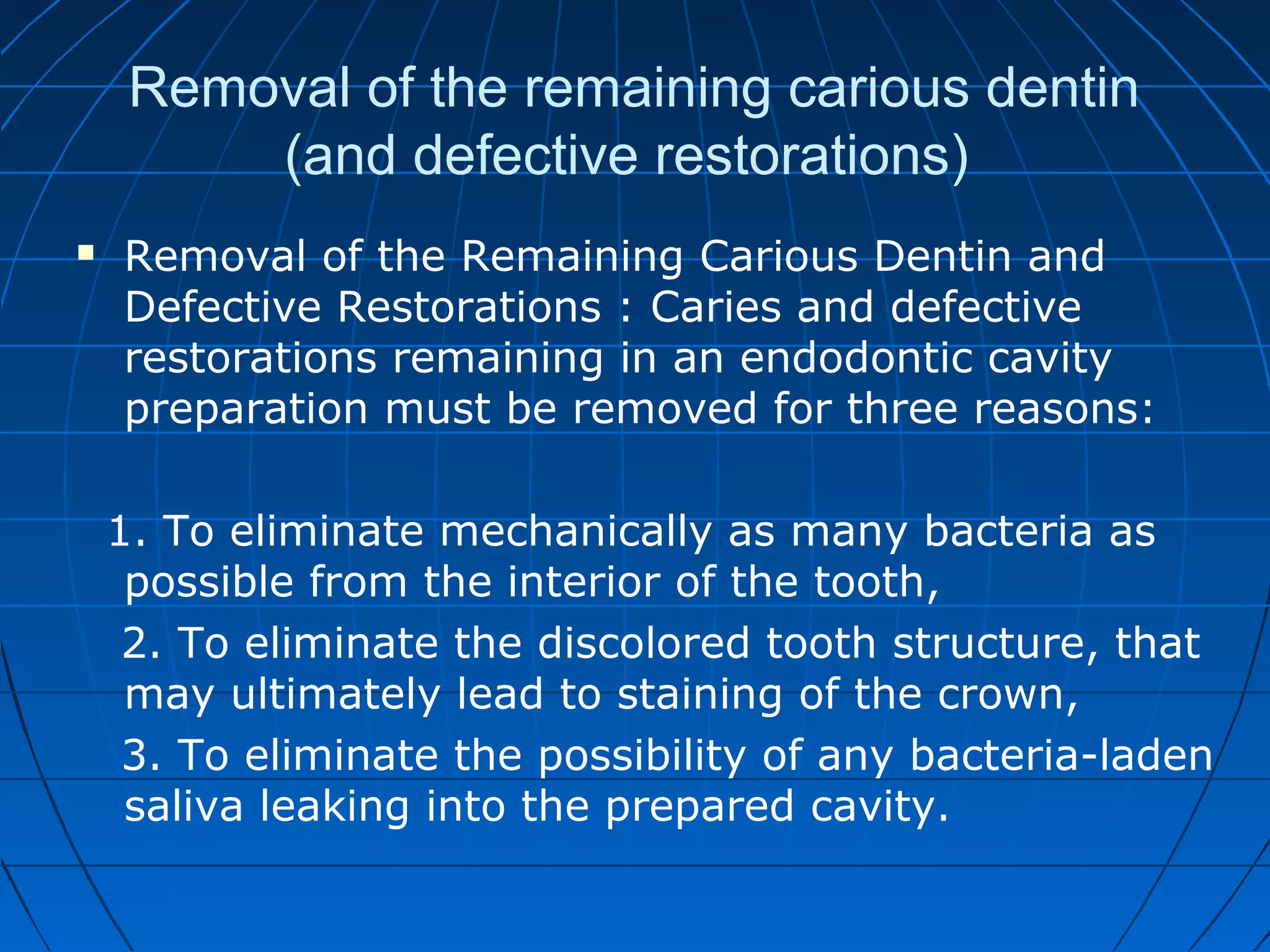
Removal of the remaining carious dentin
(and defective restorations)
 Removal of the Remaining Carious Dentin and
Defective Restorations : Caries and defective
restorations remaining in an endodontic cavity
preparation must be removed for three reasons:
1. To eliminate mechanically as many bacteria as
possible from the interior of the tooth,
2. To eliminate the discolored tooth structure, that
may ultimately lead to staining of the crown,
3. To eliminate the possibility of any bacteria-laden
saliva leaking into the prepared cavity.
Toilet of the Cavity
•All of the caries, debris, and necrotic
material must be removed from the
chamber before the radicular preparation
is begun.
•If the calcified or metallic debris is left in
the chamber and carried into the canal, it
may act as an obstruction during canal
enlargement.
• Soft debris carried from the chamber
might increase the bacterial population in
the canal
Retention form
 Near parallel walls in the apical 2-3
mm ensure a snugly fitting G.P
[ Apical TUG BACK ] .
  Most crucial for preventing apical
leakage.
Resistance form
 Resistance to overfilling is provided
by maintaining the integrity of the
natural constriction of the apical
preparation
  Prevents over instrumentation
  Prevents forcing debris or
obturating material
  Provides a stop, against which G.P
can be compacted. .
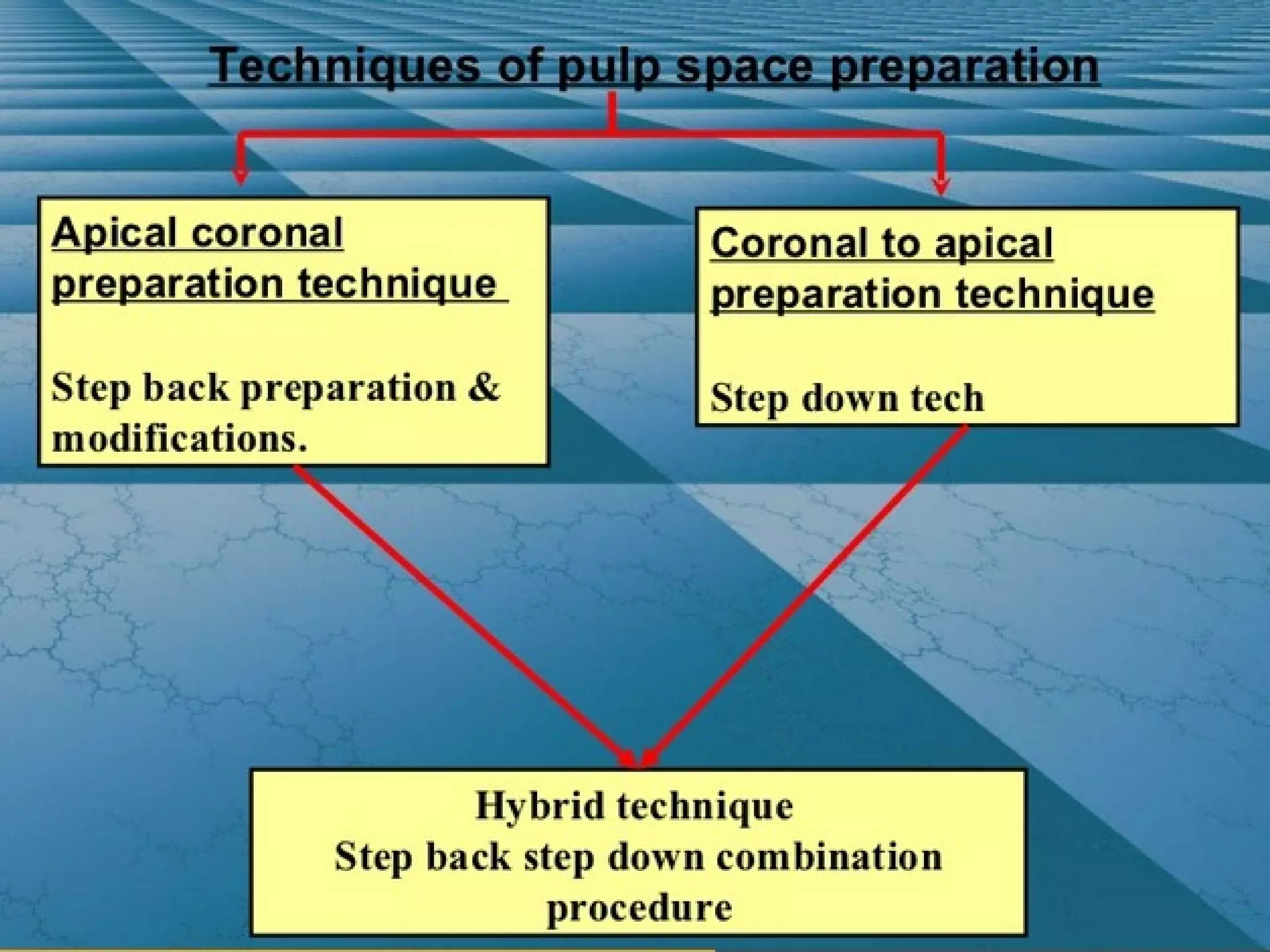
TYPES OF ROOT CANALTYPES OF ROOT CANAL
PREPARATIONSPREPARATIONS
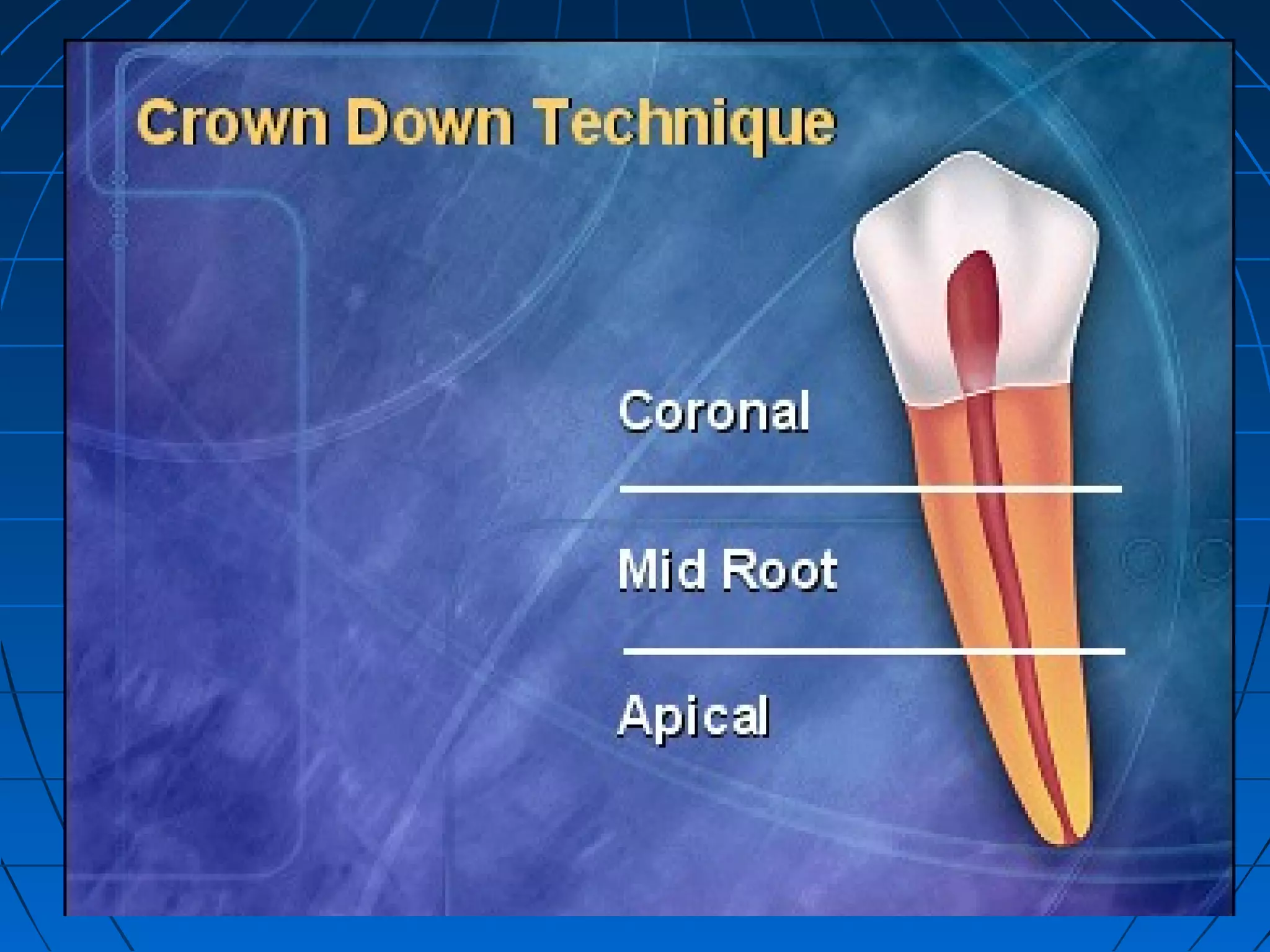
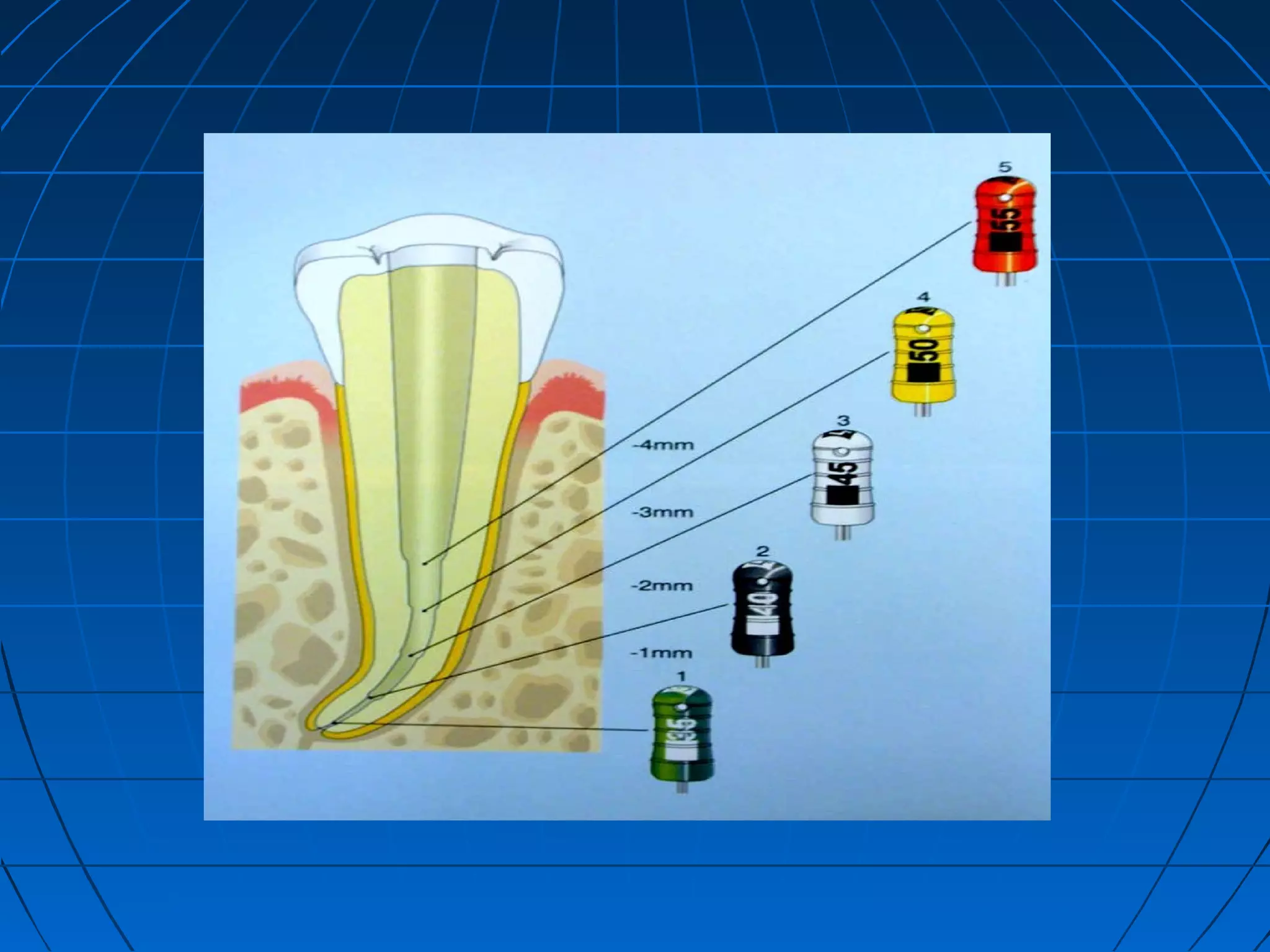
 Crown downCrown down
 Step backStep back
 hybridhybrid
Step backStep back
Filing techniquesFiling techniques
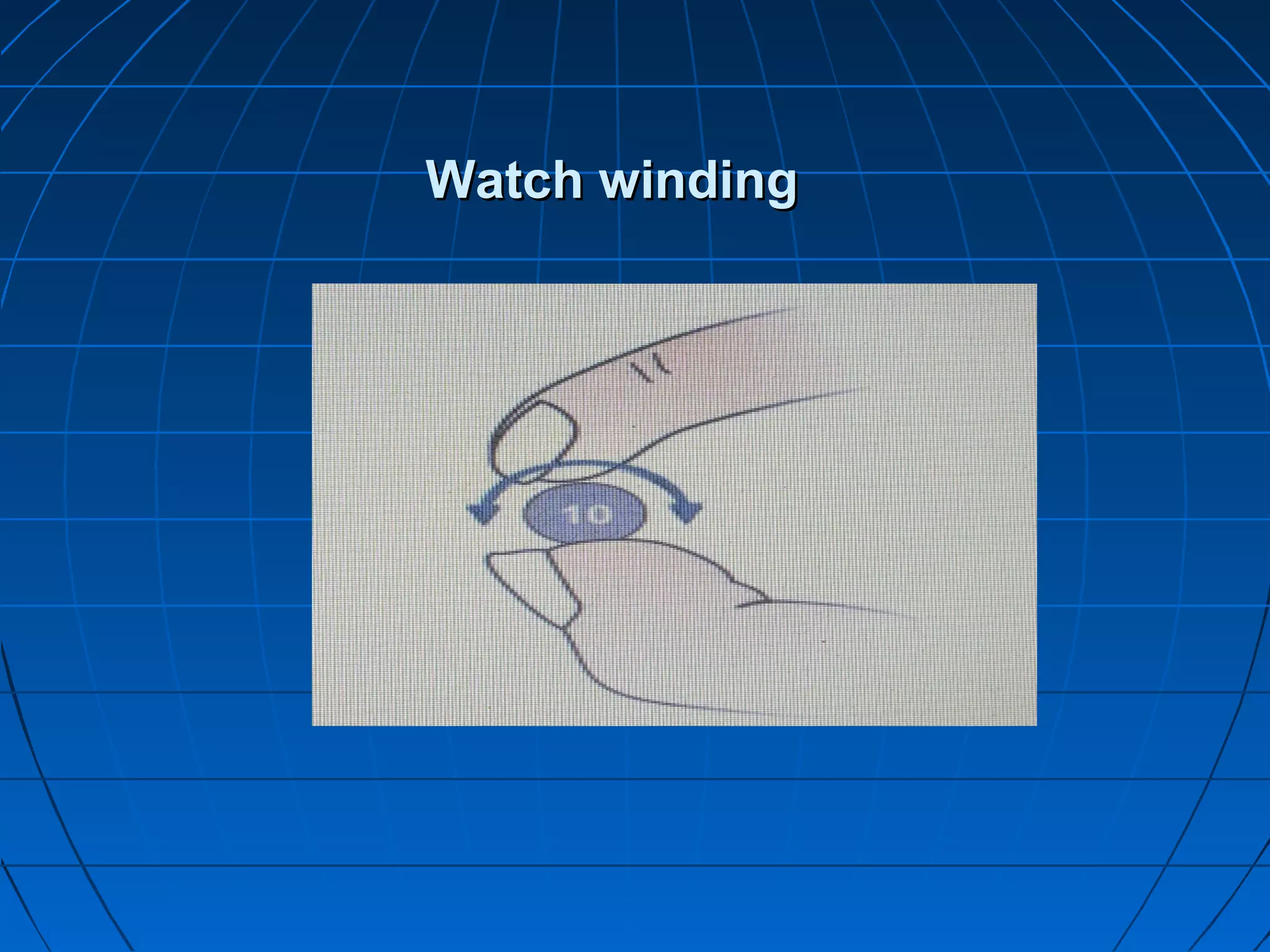
 Watch windingWatch winding
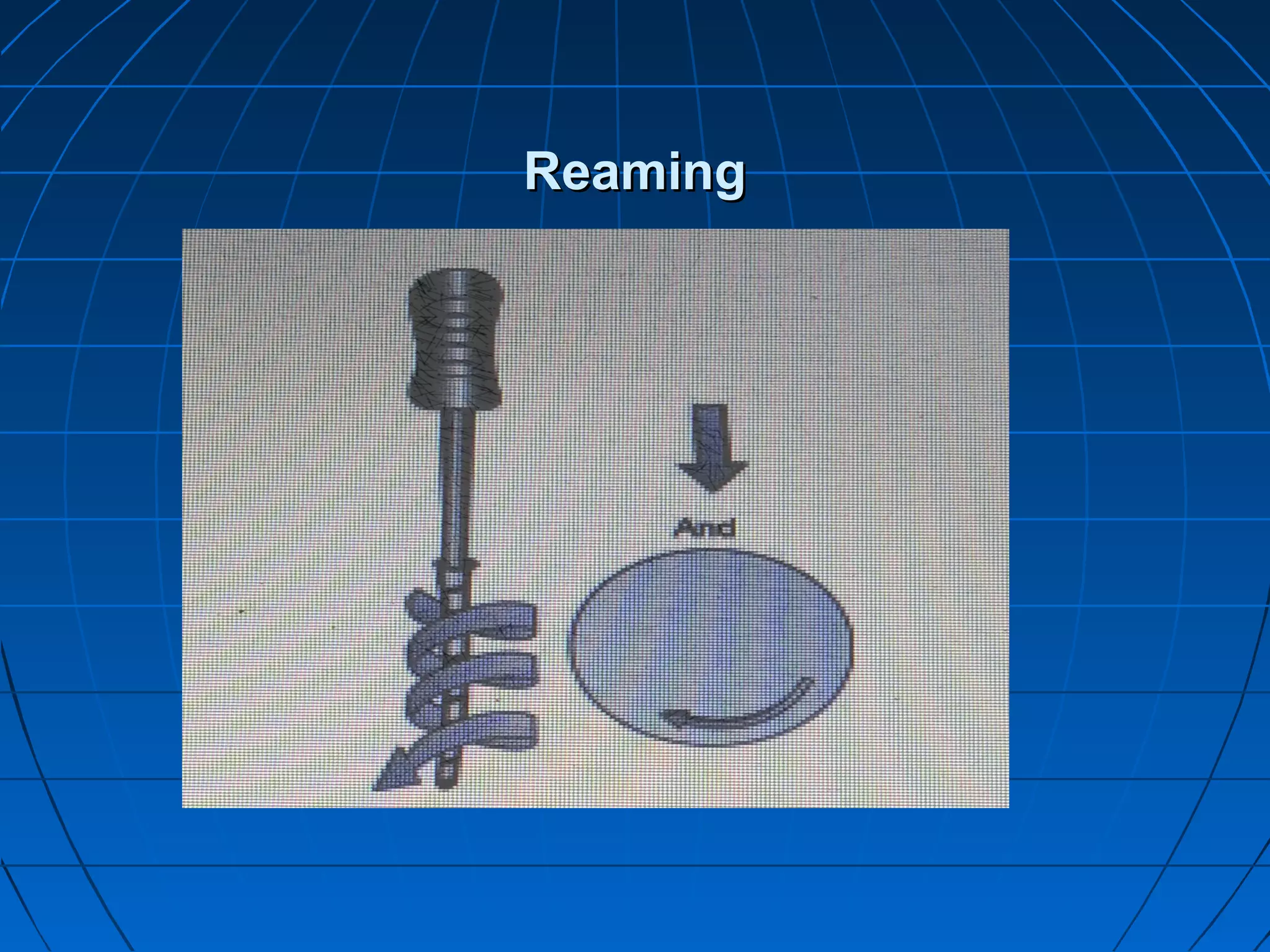
 ReamingReaming
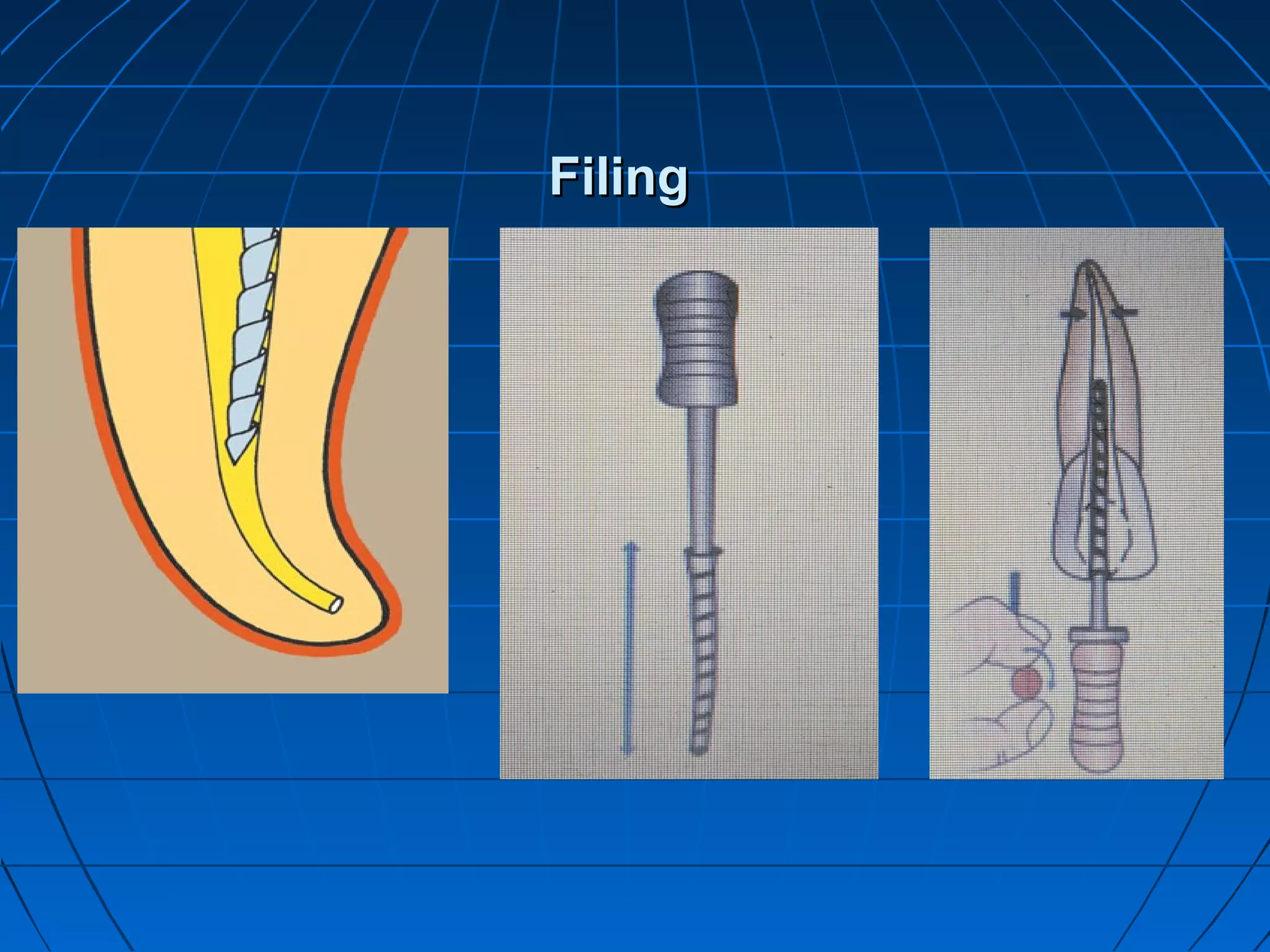
 FilingFiling
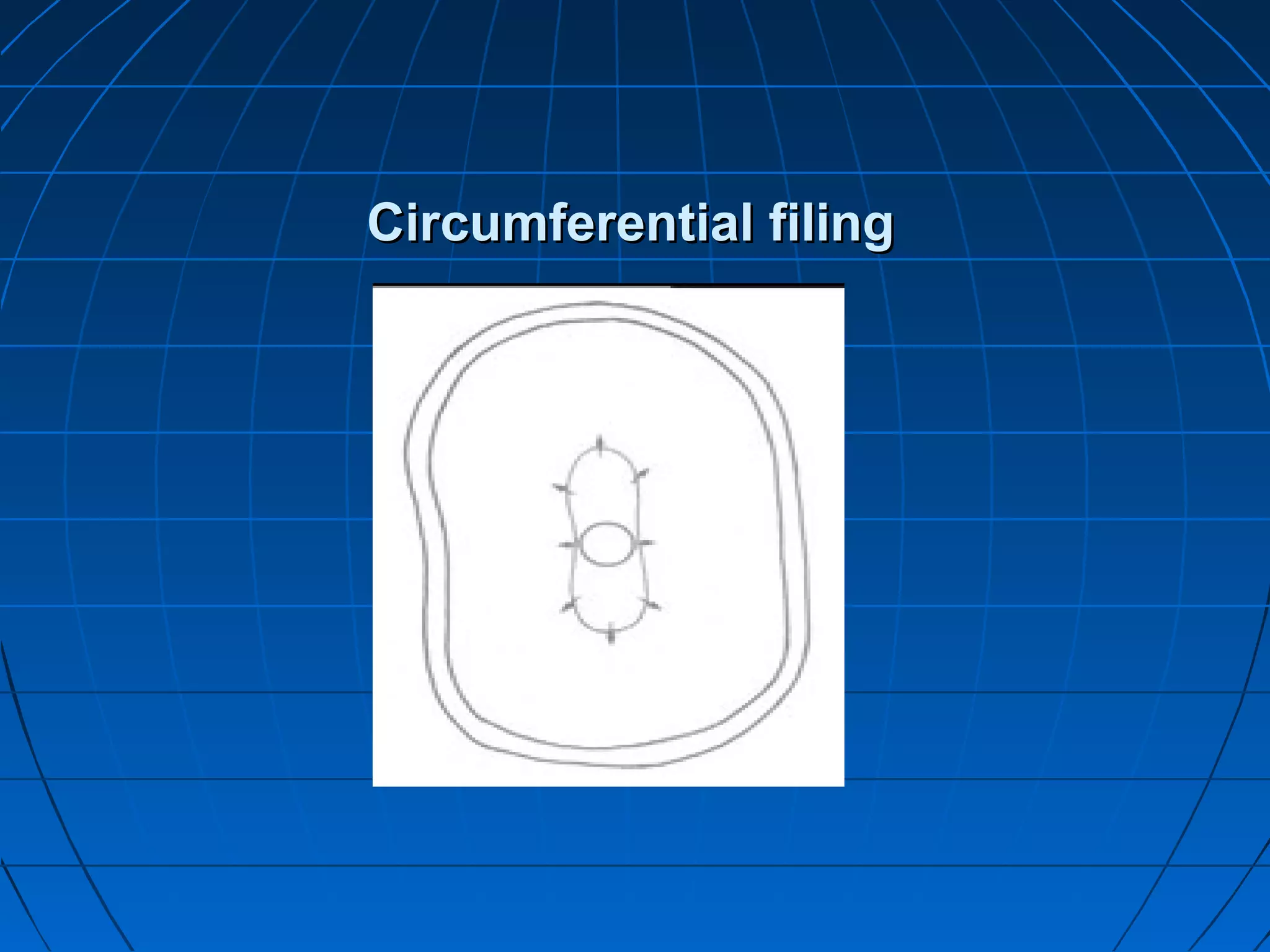
 Circumferential filingCircumferential filing
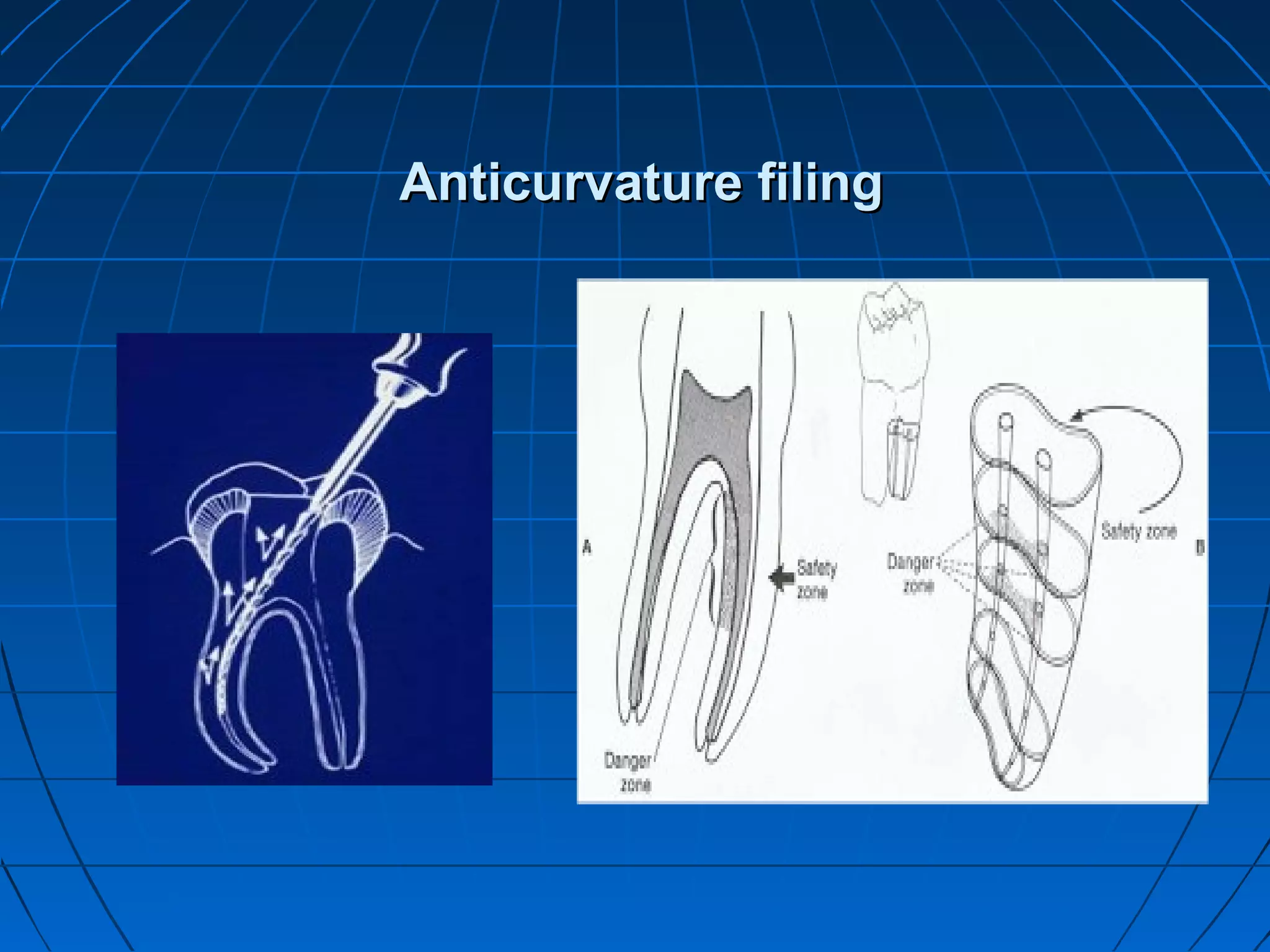
 AnticurvatureAnticurvature
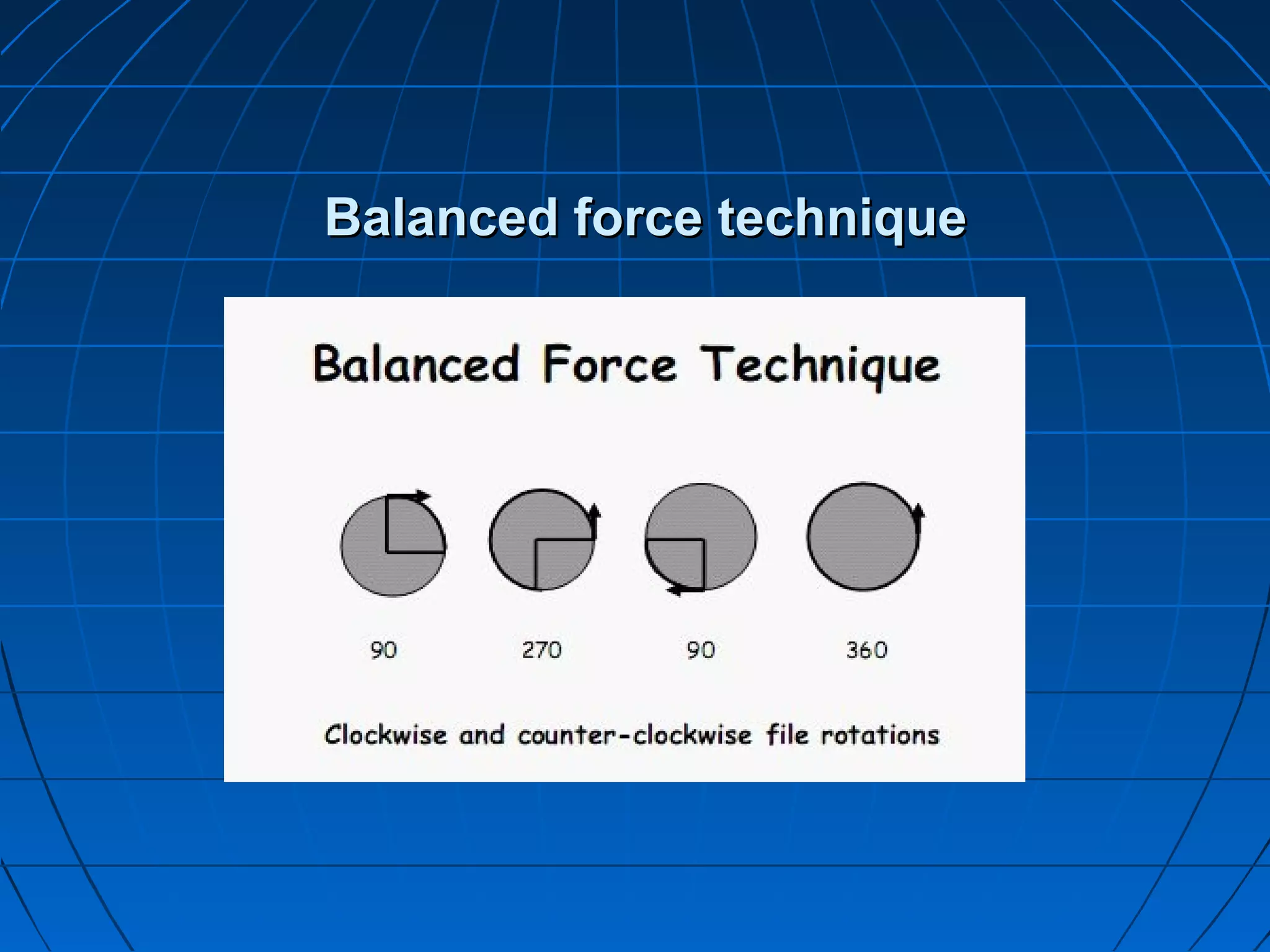
 Balanced force techniqueBalanced force technique
Watch windingWatch winding
ReamingReaming
FilingFiling
Circumferential filingCircumferential filing
Anticurvature filingAnticurvature filing
Balanced force techniqueBalanced force technique
IrrigationIrrigation
An ideal irrigant:An ideal irrigant:
 Is nontoxicIs nontoxic
 Dissolves vital and necrotic tissueDissolves vital and necrotic tissue
 Is bactericidalIs bactericidal
 Lubricates the canalLubricates the canal
 Removes the smear layerRemoves the smear layer
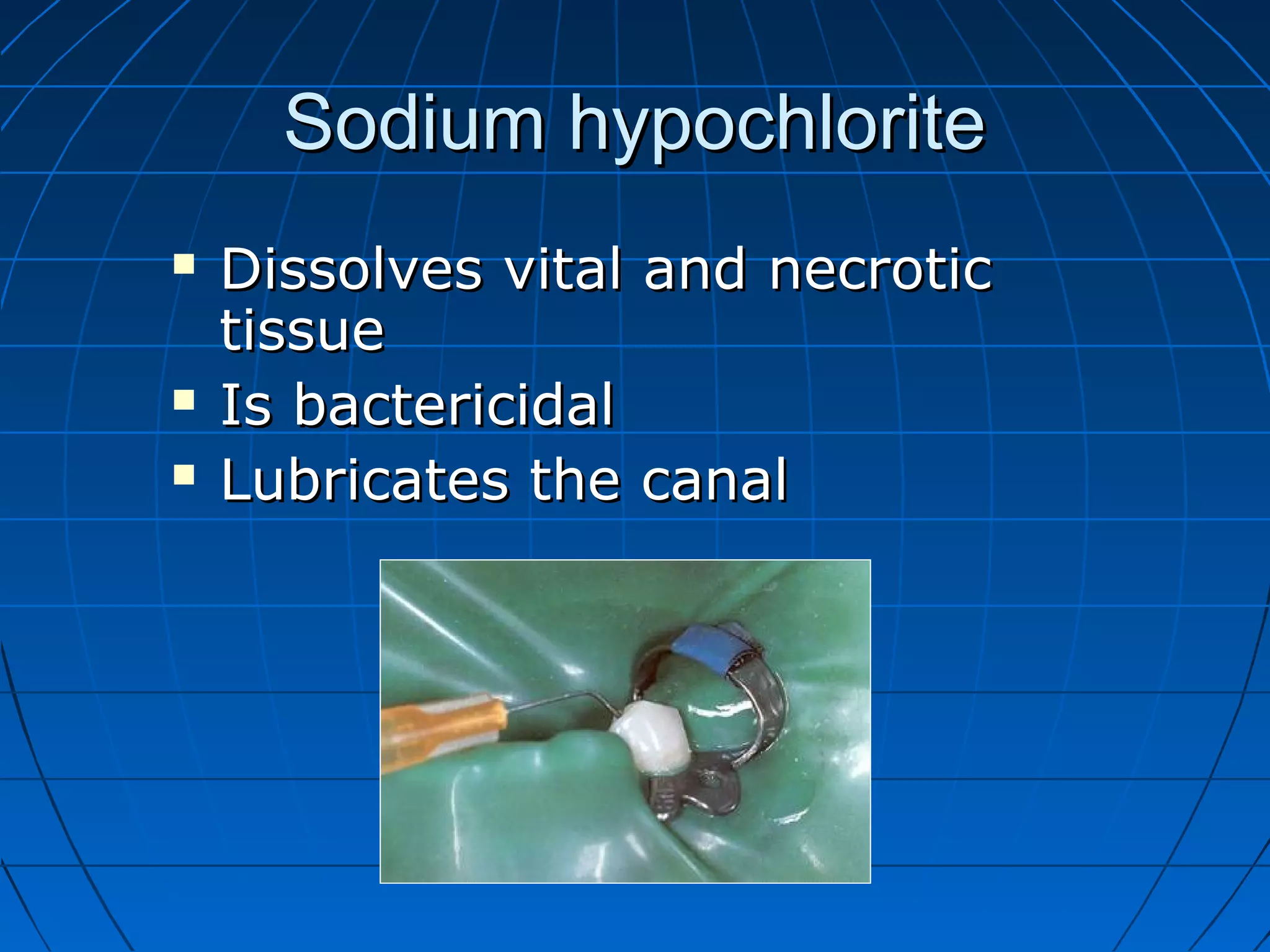
Sodium hypochloriteSodium hypochlorite
 Dissolves vital and necroticDissolves vital and necrotic
tissuetissue
 Is bactericidalIs bactericidal
 Lubricates the canalLubricates the canal
Sodium HypochloriteSodium Hypochlorite
Cannot be considered
non-toxic!!!
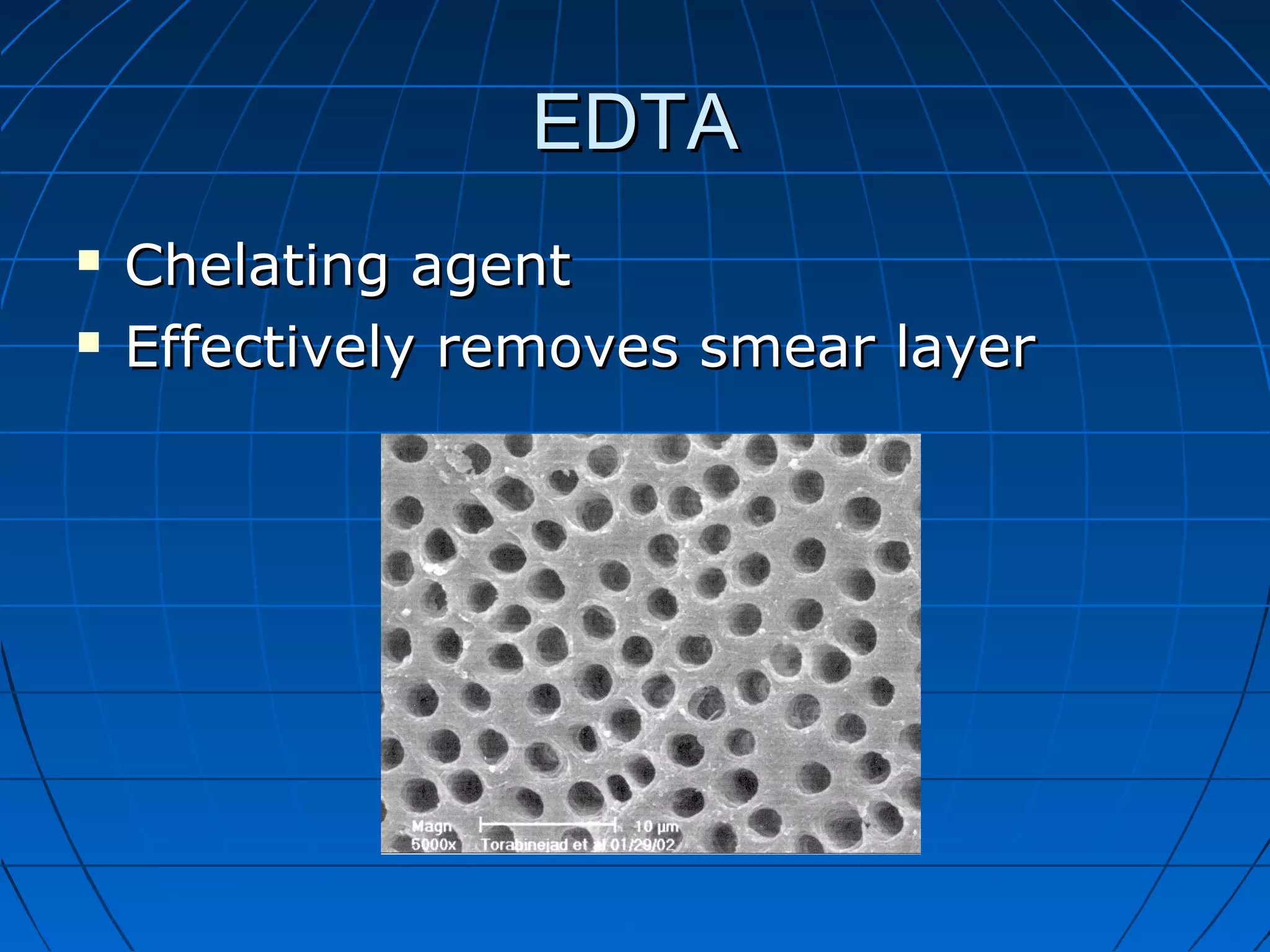
EDTAEDTA
 Chelating agentChelating agent
 Effectively removes smear layerEffectively removes smear layer
InstrumentsInstruments
Instruments differ according to:Instruments differ according to:
 MetalMetal
 TaperTaper
 Tip designTip design
 Cross sectional geometryCross sectional geometry
 Length of cutting bladesLength of cutting blades
 SizingSizing
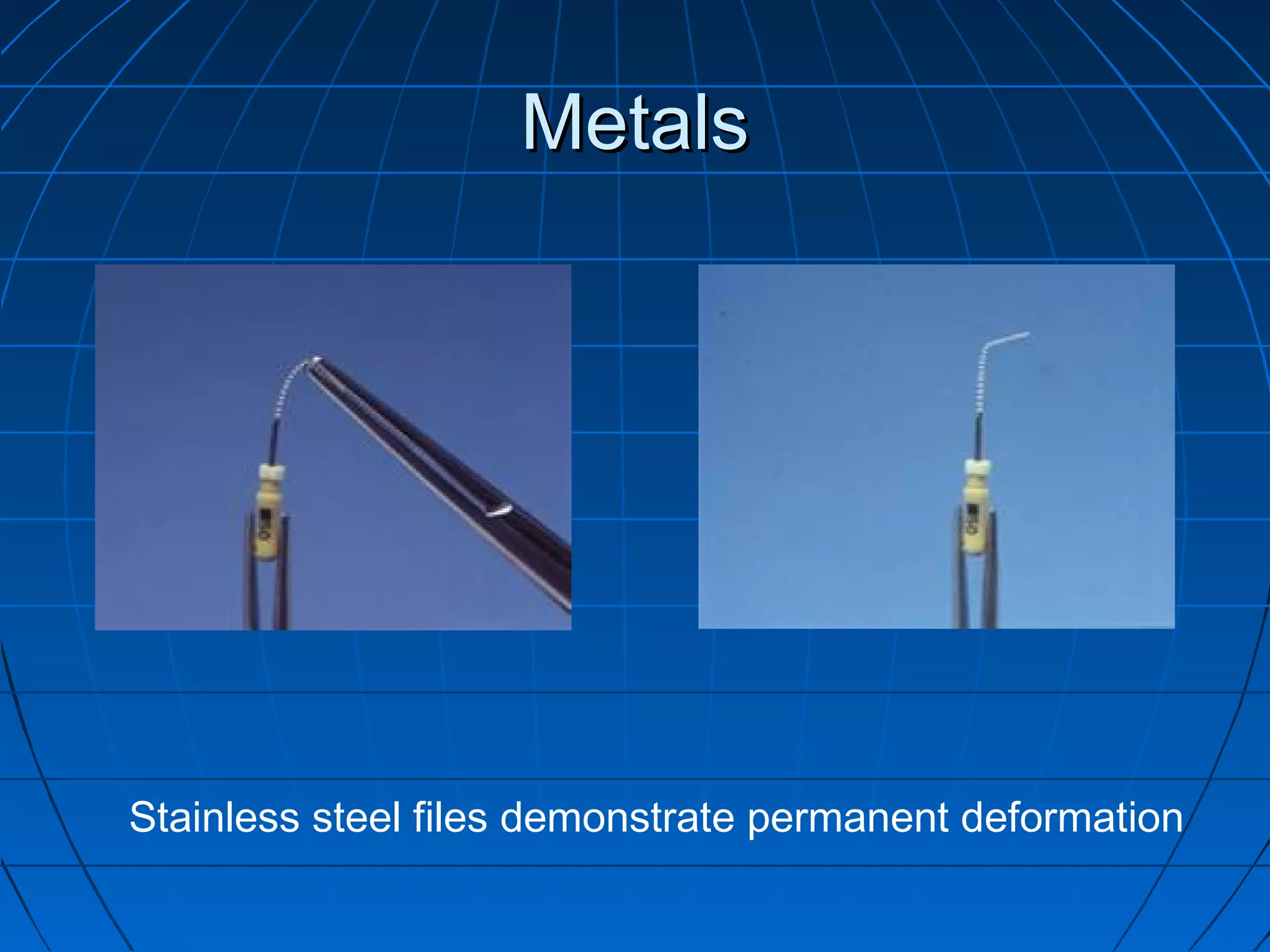
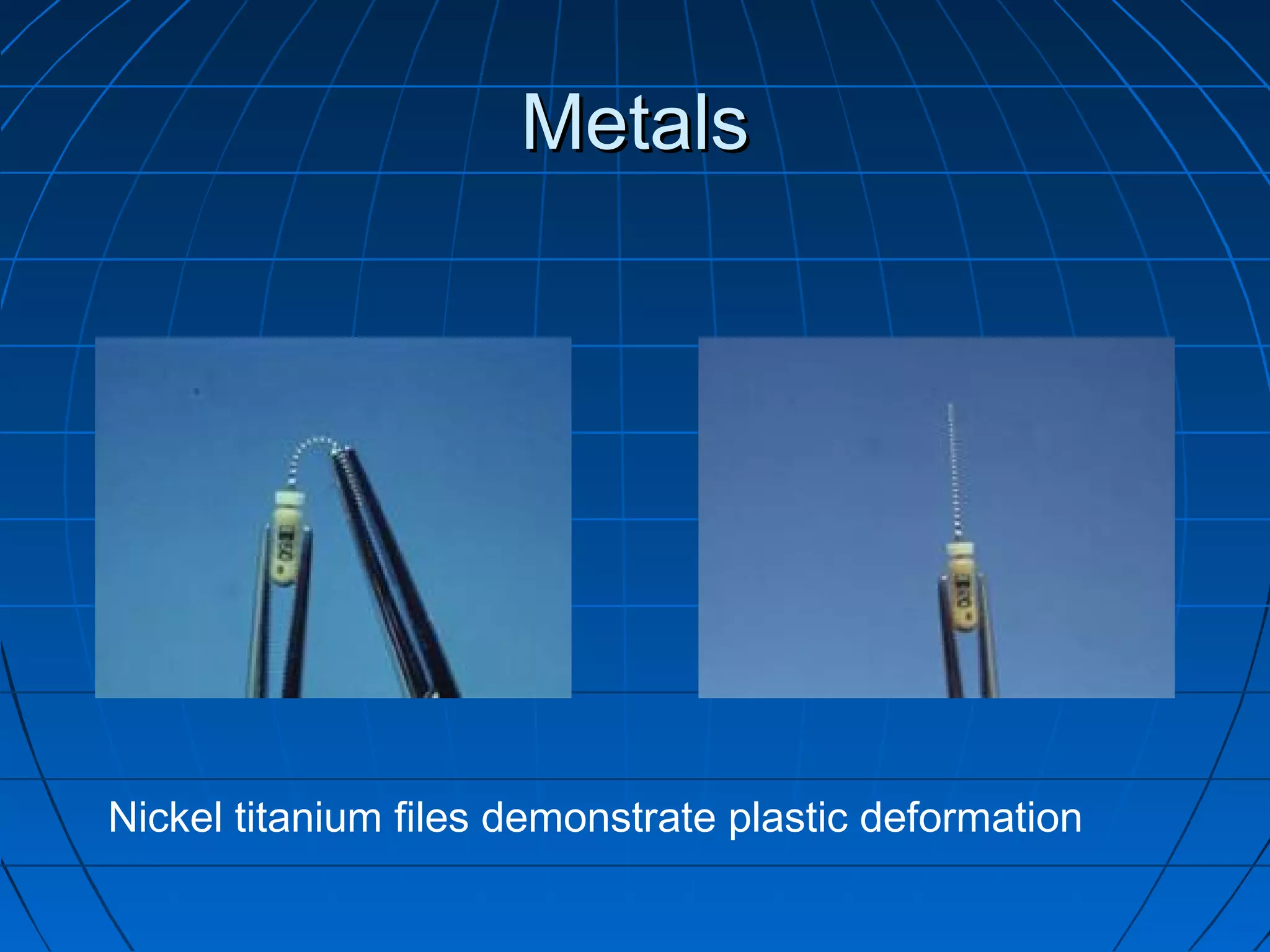
MetalsMetals
Nickel titaniumNickel titanium Stainless steelStainless steel
Excellent flexibilityExcellent flexibility Less flexibleLess flexible
Conforms to canalConforms to canal Straightens andStraightens and
curvaturecurvature transports canaltransports canal
Plastic deformationPlastic deformation PermanentPermanent
deformationdeformation
MetalsMetals
Stainless steel files demonstrate permanent deformation
MetalsMetals
Nickel titanium files demonstrate plastic deformation
TaperTaper
DefinitionDefinition
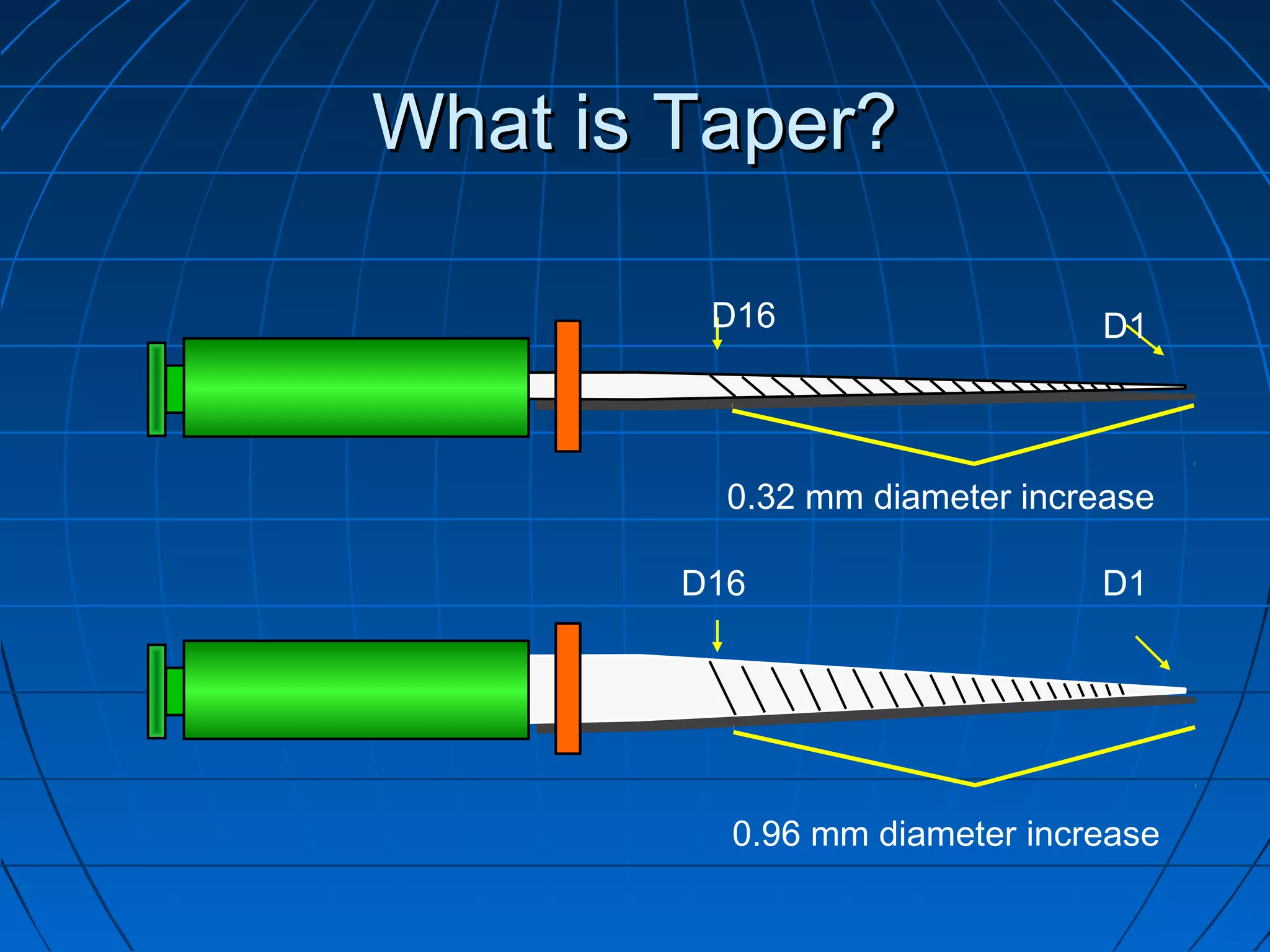
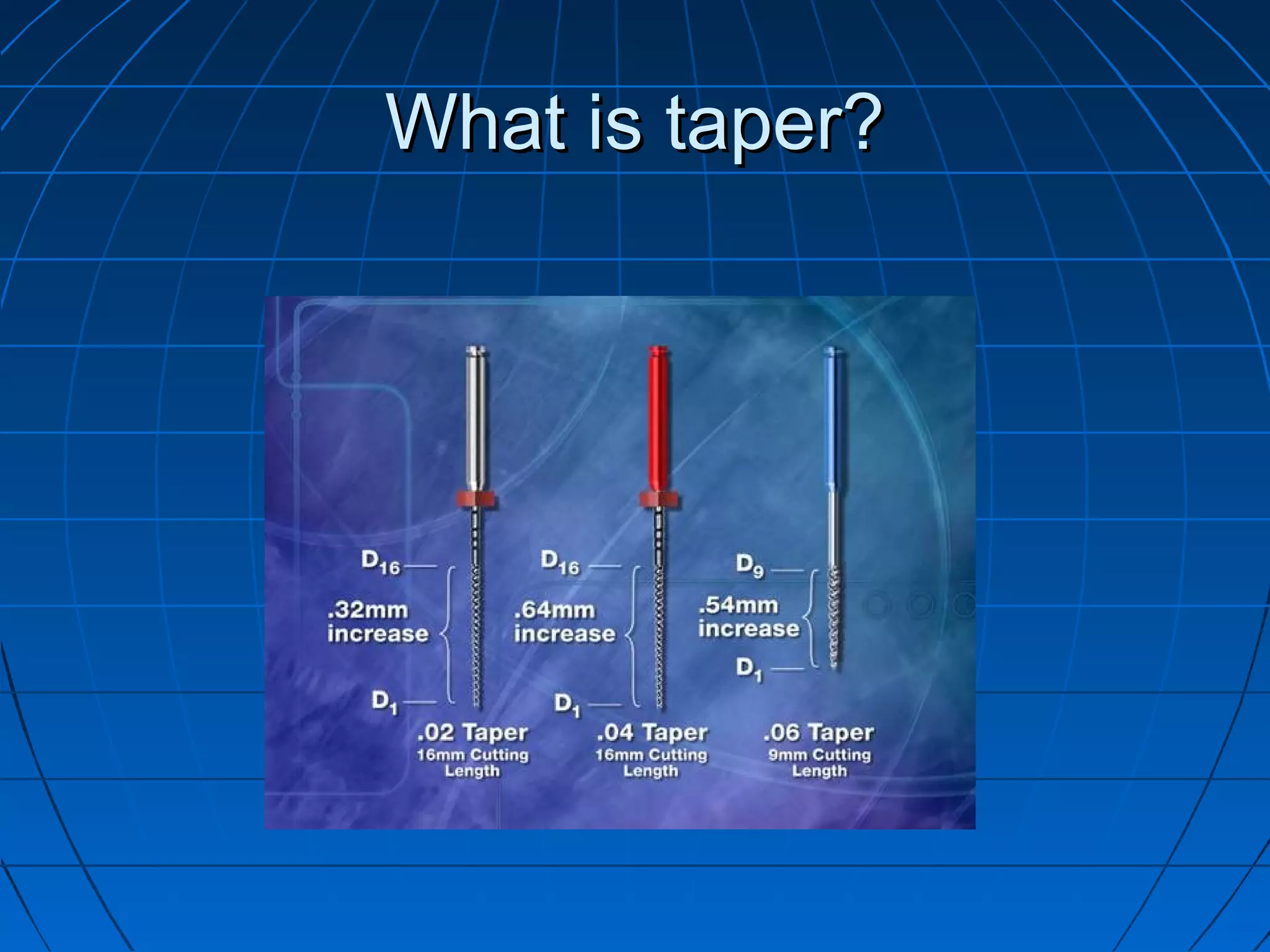
Increase in diameter per unit lengthIncrease in diameter per unit length
What is Taper?What is Taper?
0.32 mm diameter increase
D16 D1
0.96 mm diameter increase
D16 D1
What is taper?What is taper?
TaperTaper
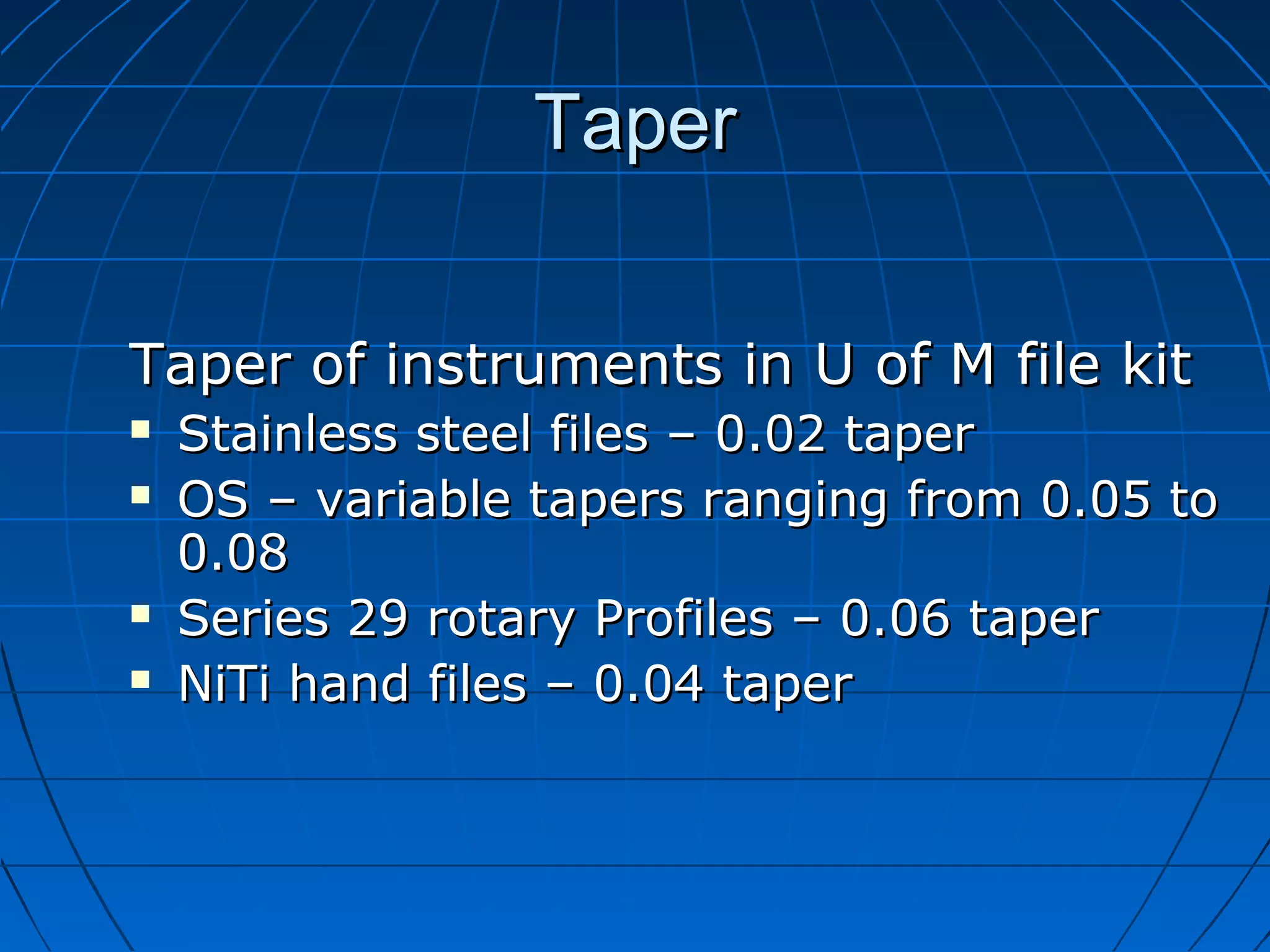
Taper of instruments in U of M file kitTaper of instruments in U of M file kit
 Stainless steel files – 0.02 taperStainless steel files – 0.02 taper
 OS – variable tapers ranging from 0.05 toOS – variable tapers ranging from 0.05 to
0.080.08
 Series 29 rotary Profiles – 0.06 taperSeries 29 rotary Profiles – 0.06 taper
 NiTi hand files – 0.04 taperNiTi hand files – 0.04 taper
Tip DesignTip Design
 Non-cutting tipNon-cutting tip
 Bullet nose (60 degree) tipBullet nose (60 degree) tip
 Smooth transition angle whereSmooth transition angle where
tip meets flat radial landstip meets flat radial lands
Tip DesignTip Design
 Designed to follow a pilot holeDesigned to follow a pilot hole
 Guides instrument through canalGuides instrument through canal
during preparationduring preparation
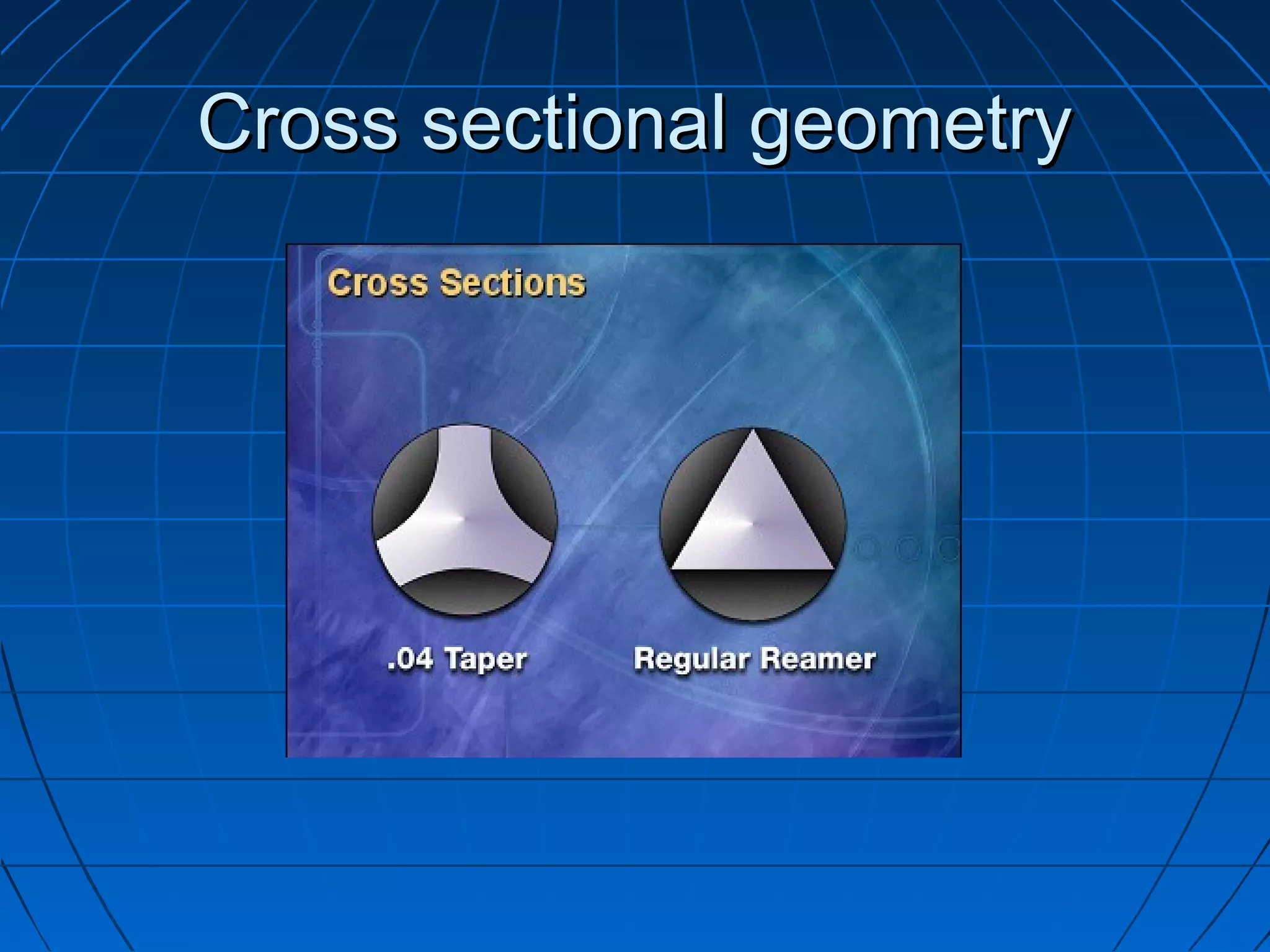
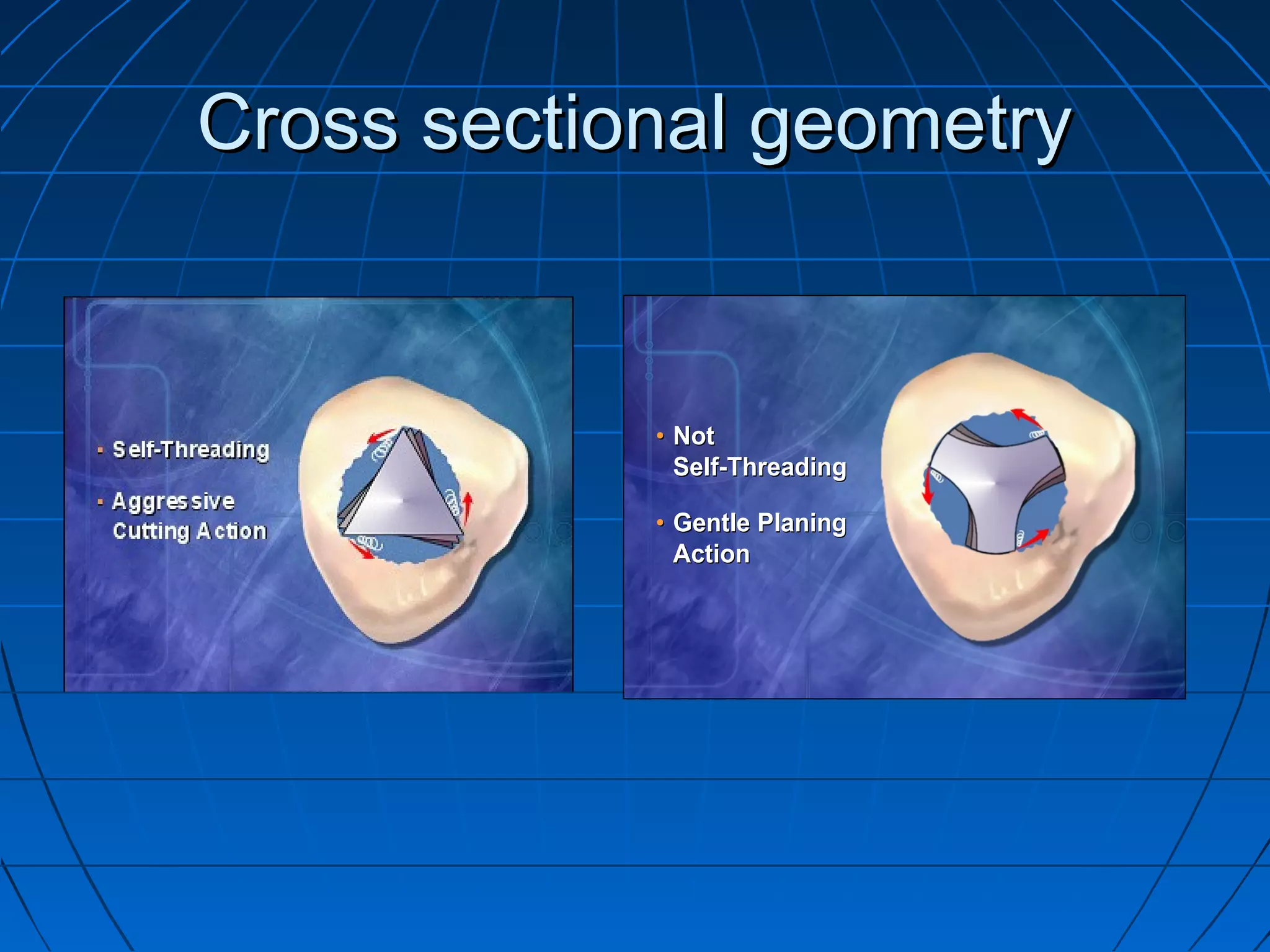
Cross sectional geometryCross sectional geometry
•• NotNot
SelfSelf--ThreadingThreading
•• Gentle PlaningGentle Planing
ActionAction
Cross sectional geometryCross sectional geometry
 Radial lands separated by three u-Radial lands separated by three u-
shaped flutesshaped flutes
 Provide space for accumulation ofProvide space for accumulation of
debrisdebris
 Moves debris out of canalMoves debris out of canal
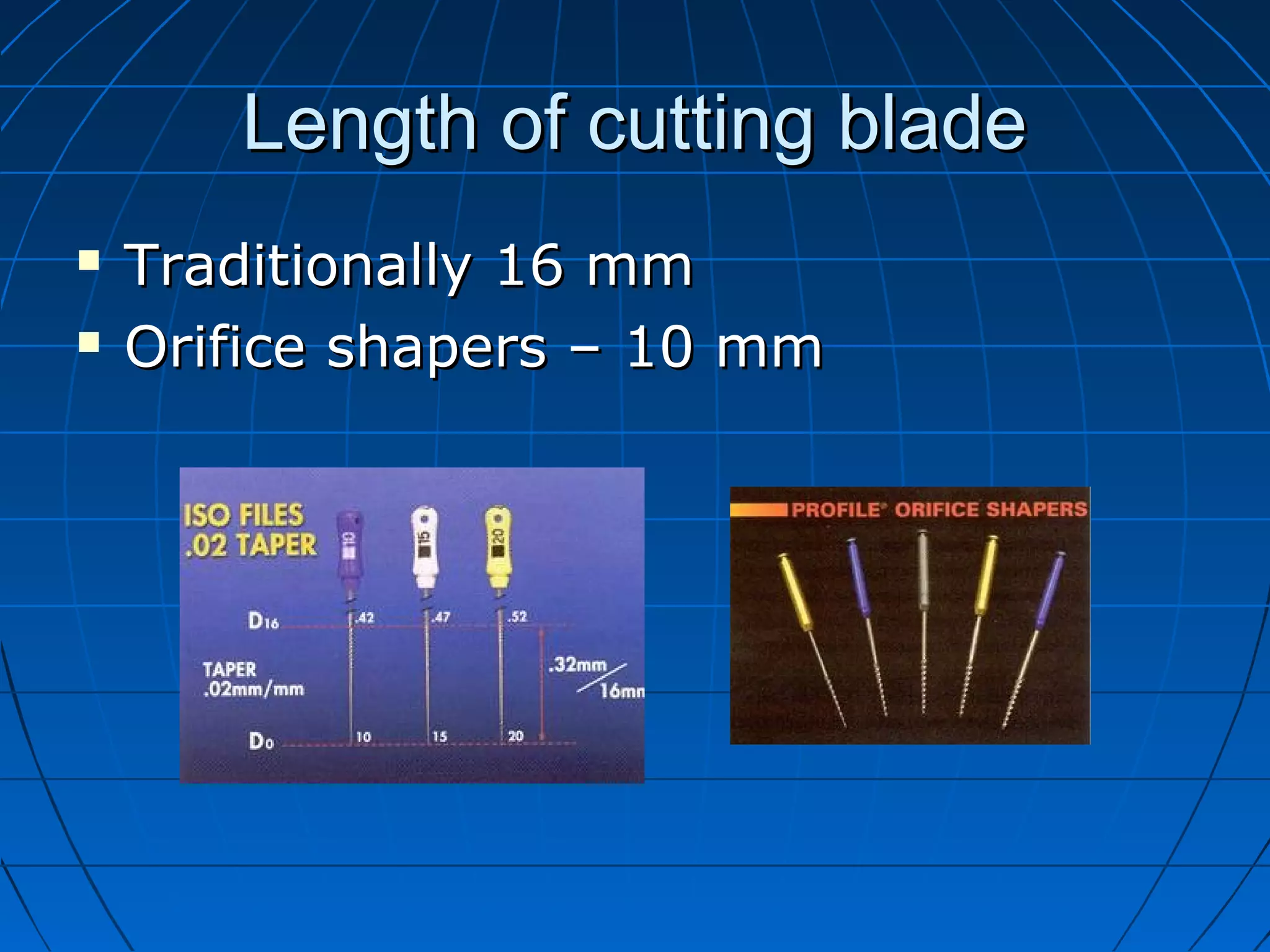
Length of cutting bladeLength of cutting blade
 Traditionally 16 mmTraditionally 16 mm
 Orifice shapers – 10 mmOrifice shapers – 10 mm
Sizing of instrumentsSizing of instruments
ISO sizesISO sizes
 Number refers to tip diameter inNumber refers to tip diameter in
tenths of mmtenths of mm
 The tip diameter increases byThe tip diameter increases by
0.05 mm from sizes 10 to 60,0.05 mm from sizes 10 to 60,
then by 0.10 mmthen by 0.10 mm
Sizing of instrumentsSizing of instruments
 % increase in diameter from #10% increase in diameter from #10
to #15 file is 50%to #15 file is 50%
 Difference between #55 and #60Difference between #55 and #60
is only 9%is only 9%
Sizing of instrumentsSizing of instruments
Series 29Series 29
 Progressive 29% increase in tipProgressive 29% increase in tip
diameterdiameter
 Instruments are better spacedInstruments are better spaced
 More instruments in smaller sizesMore instruments in smaller sizes
and fewer large instrumentsand fewer large instruments
REFERENCESREFERENCES
 Endodontics, Volume 1
By John Ide Ingle, Leif K. Bakland
 COHEN’S PATHWAY OF PULPCOHEN’S PATHWAY OF PULP
 GOOGLEGOOGLE
 SlideshareSlideshare
TTHHAANNKK YYOOUU

Preparation of the root canal system

  • 1.
    Preparation of theRootPreparation of the Root Canal SystemCanal System Prepared By:Prepared By: Bawar Yahya AhmedBawar Yahya Ahmed University of SulaimaniUniversity of Sulaimani Class 5 - Group EClass 5 - Group E
  • 2.
    Root canal preparationRootcanal preparation  1. Cleaning  2. Shaping
  • 3.
    Root canal preparationRootcanal preparation  Cleaning is the removal of all contents of the root canal system before and during shaping: infected materials, antigenic materials, organic substances, microflora, bacterial by products, food, caries, tissue remnants, denticles, pulp stones, collagen, inflammatory chemicals, contaminated canal filling materials, and dentinal debris created during canal shaping procedures. Cleaning entails accomplished by both mechanical instrumentation and chemically by irrigation.
  • 4.
    Root canal preparationRootcanal preparation  Shaping is a mechanical process accomplished (with files, reamers, Gates-Glidden drills, slow speed burs, high speed diamonds-tipped drills, and sonic and ultrasonic, and nickel-titanium instruments of variable taper) to establishment of a specific cavity from that permits pluggers, spreaders, and other Obturation instruments to fit freely within the root canal system and to generate the pressures needed to transform and capture a maximal Obturation cushion, forcing gutta- percha and a microfilm of sealer into all foramina. Equally important, shaping facilitates three-dimensional cleaning by providing easy direct access for file, reamer, rotary instruments and irrigant during the treatment process.
  • 5.
    OBJECTIVESOBJECTIVES biologicalbiological Complete removal ofCompleteremoval of pulpal tissuepulpal tissue bacteriabacteria mechanicalmechanical  Continuously taperingContinuously tapering preparationpreparation  Maintaining original anatomyMaintaining original anatomy  Maintaining position of apicalMaintaining position of apical foramenforamen  Narrow apexNarrow apex
  • 6.
    Objectives of rootcanal preparationObjectives of root canal preparation  1. Biological  2. Mechanical
  • 7.
    Objectives of rootcanal preparationObjectives of root canal preparation From aFrom a biologicalbiological perspective, the goals ofperspective, the goals of chemomechanical preparation are tochemomechanical preparation are to eliminate microorganisms from the rooteliminate microorganisms from the root canal system, to remove pulp tissue thatcanal system, to remove pulp tissue that may support microbial growth, and tomay support microbial growth, and to avoid forcing debris beyond the apicalavoid forcing debris beyond the apical foramen which may sustain inflammation.foramen which may sustain inflammation.
  • 8.
    BIOLOGIC OBJECTIVES 1. Confineall instrumentation within the root canal space to maintain its spatial integrity. 2. Avoid pushing contaminated debris past the confines of the apical constriction 3. Remove all the potential irritants from the entire canal system. 4. Establish the exact W.L and completely clean and shape the canal system during the first treatment visit.  5. Create sufficient width in the coronal half of the canal system to allow for copious flushing and debridement.
  • 9.
    MECHANICAL OBJECTIVES 1. Developa continuously tapering conical form in the root canal preparation. The final preparation of this system should be an exact replica of the original canal configuration in shape, taper. 2. Prepare a sound apical dentine matrix at the DC junction.  This provides the resistance form to the intraradicular cavity preparation. This also prevents the over- extension of instruments and controls the apical movement of gutta-percha sealer during obturation. 3. Prepare the canal to taper apically, with the narrowest cross- sectional diameter at the apical termination (apical dentin matrix). 4. Confine cleaning and shaping procedures to the canal system, thereby maintaining the spatial integrity of the apical foramen.
  • 10.
    PrinciplesPrinciples  Note: thecurrent concept of root canal preparation is not cleaning and shaping, but shaping and cleaning.
  • 11.
    Principles of RCTPrinciplesof RCT  Principles of Endodontic cavity preparation Endodontic cavity preparation may be separated into two anatomic divisions: (a) Coronal preparation (b) Radicular preparation.
  • 12.
    Principles of RCTPrinciplesof RCT  Black's principles of cavity preparation can be modified to include the Root canal 'cavity' preparation  1. Coronal: I. Outline Form II. Convenience Form III. Removal of the remaining carious dentin (and defective restorations) IV. Toilet of the cavity
  • 13.
    Principles of RCTPrinciplesof RCT  Black's principles of cavity preparation can be modified to include the Root canal 'cavity' preparation  2. Radicular: I and II. Outline Form and Convenience Form IV. Toilet of the cavity V. Retention Form VI. Resistance Form
  • 14.
    Outline FormOutline Form To achieve optimal preparation, three factors of anatomy must be considered: (1)the size of the pulp chamber, (2)the shape of the pulp chamber, (3)the number of individual root canals, their curvature, and their position internal  The finished outline form should accurately reflect the shape of the pulp chamber.
  • 16.
    Convenience FormConvenience Form Removing excess of coronal dentin, so as to allow passage of larger instruments, for better instrumentation, irrigation and obturation.  Four important benefits are gained through convenience form modifications: (1) unobstructed access to the canal orifice, (2) direct access to the apical foramen, (3) cavity expansion to accommodate filling techniques, and (4) complete authority over the enlarging instrument.
  • 18.
    Removal of theremaining carious dentin (and defective restorations)  Removal of the Remaining Carious Dentin and Defective Restorations : Caries and defective restorations remaining in an endodontic cavity preparation must be removed for three reasons: 1. To eliminate mechanically as many bacteria as possible from the interior of the tooth, 2. To eliminate the discolored tooth structure, that may ultimately lead to staining of the crown, 3. To eliminate the possibility of any bacteria-laden saliva leaking into the prepared cavity.
  • 19.
    Toilet of theCavity •All of the caries, debris, and necrotic material must be removed from the chamber before the radicular preparation is begun. •If the calcified or metallic debris is left in the chamber and carried into the canal, it may act as an obstruction during canal enlargement. • Soft debris carried from the chamber might increase the bacterial population in the canal
  • 20.
    Retention form  Nearparallel walls in the apical 2-3 mm ensure a snugly fitting G.P [ Apical TUG BACK ] .   Most crucial for preventing apical leakage.
  • 21.
    Resistance form  Resistanceto overfilling is provided by maintaining the integrity of the natural constriction of the apical preparation   Prevents over instrumentation   Prevents forcing debris or obturating material   Provides a stop, against which G.P can be compacted. .
  • 22.
    TYPES OF ROOTCANALTYPES OF ROOT CANAL PREPARATIONSPREPARATIONS  Crown downCrown down  Step backStep back  hybridhybrid
  • 25.
  • 35.
    Filing techniquesFiling techniques Watch windingWatch winding  ReamingReaming  FilingFiling  Circumferential filingCircumferential filing  AnticurvatureAnticurvature  Balanced force techniqueBalanced force technique
  • 36.
  • 37.
  • 38.
  • 39.
  • 40.
  • 41.
  • 42.
    IrrigationIrrigation An ideal irrigant:Anideal irrigant:  Is nontoxicIs nontoxic  Dissolves vital and necrotic tissueDissolves vital and necrotic tissue  Is bactericidalIs bactericidal  Lubricates the canalLubricates the canal  Removes the smear layerRemoves the smear layer
  • 43.
    Sodium hypochloriteSodium hypochlorite Dissolves vital and necroticDissolves vital and necrotic tissuetissue  Is bactericidalIs bactericidal  Lubricates the canalLubricates the canal
  • 44.
  • 45.
    EDTAEDTA  Chelating agentChelatingagent  Effectively removes smear layerEffectively removes smear layer
  • 46.
    InstrumentsInstruments Instruments differ accordingto:Instruments differ according to:  MetalMetal  TaperTaper  Tip designTip design  Cross sectional geometryCross sectional geometry  Length of cutting bladesLength of cutting blades  SizingSizing
  • 47.
    MetalsMetals Nickel titaniumNickel titaniumStainless steelStainless steel Excellent flexibilityExcellent flexibility Less flexibleLess flexible Conforms to canalConforms to canal Straightens andStraightens and curvaturecurvature transports canaltransports canal Plastic deformationPlastic deformation PermanentPermanent deformationdeformation
  • 48.
    MetalsMetals Stainless steel filesdemonstrate permanent deformation
  • 49.
    MetalsMetals Nickel titanium filesdemonstrate plastic deformation
  • 50.
    TaperTaper DefinitionDefinition Increase in diameterper unit lengthIncrease in diameter per unit length
  • 51.
    What is Taper?Whatis Taper? 0.32 mm diameter increase D16 D1 0.96 mm diameter increase D16 D1
  • 52.
  • 53.
    TaperTaper Taper of instrumentsin U of M file kitTaper of instruments in U of M file kit  Stainless steel files – 0.02 taperStainless steel files – 0.02 taper  OS – variable tapers ranging from 0.05 toOS – variable tapers ranging from 0.05 to 0.080.08  Series 29 rotary Profiles – 0.06 taperSeries 29 rotary Profiles – 0.06 taper  NiTi hand files – 0.04 taperNiTi hand files – 0.04 taper
  • 54.
    Tip DesignTip Design Non-cutting tipNon-cutting tip  Bullet nose (60 degree) tipBullet nose (60 degree) tip  Smooth transition angle whereSmooth transition angle where tip meets flat radial landstip meets flat radial lands
  • 55.
    Tip DesignTip Design Designed to follow a pilot holeDesigned to follow a pilot hole  Guides instrument through canalGuides instrument through canal during preparationduring preparation
  • 56.
  • 57.
    Cross sectional geometryCrosssectional geometry •• NotNot SelfSelf--ThreadingThreading •• Gentle PlaningGentle Planing ActionAction
  • 58.
    Cross sectional geometryCrosssectional geometry  Radial lands separated by three u-Radial lands separated by three u- shaped flutesshaped flutes  Provide space for accumulation ofProvide space for accumulation of debrisdebris  Moves debris out of canalMoves debris out of canal
  • 59.
    Length of cuttingbladeLength of cutting blade  Traditionally 16 mmTraditionally 16 mm  Orifice shapers – 10 mmOrifice shapers – 10 mm
  • 60.
    Sizing of instrumentsSizingof instruments ISO sizesISO sizes  Number refers to tip diameter inNumber refers to tip diameter in tenths of mmtenths of mm  The tip diameter increases byThe tip diameter increases by 0.05 mm from sizes 10 to 60,0.05 mm from sizes 10 to 60, then by 0.10 mmthen by 0.10 mm
  • 61.
    Sizing of instrumentsSizingof instruments  % increase in diameter from #10% increase in diameter from #10 to #15 file is 50%to #15 file is 50%  Difference between #55 and #60Difference between #55 and #60 is only 9%is only 9%
  • 62.
    Sizing of instrumentsSizingof instruments Series 29Series 29  Progressive 29% increase in tipProgressive 29% increase in tip diameterdiameter  Instruments are better spacedInstruments are better spaced  More instruments in smaller sizesMore instruments in smaller sizes and fewer large instrumentsand fewer large instruments
  • 63.
    REFERENCESREFERENCES  Endodontics, Volume1 By John Ide Ingle, Leif K. Bakland  COHEN’S PATHWAY OF PULPCOHEN’S PATHWAY OF PULP  GOOGLEGOOGLE  SlideshareSlideshare
  • 64.