CLEANING AND
SHAPING THE ROOT
CANAL SYSTEM
PRINCIPLES OF CLEANING AND
SHAPING
Mechanical Objectives:
• Aim to completely and centrally incorporate the original canal anatomy into the prepared shape.
• Goal: All canal surfaces should be mechanically prepared.
• Current techniques often fall short of this ideal.
• Important to preserve cervical and radicular dentin to maintain structural integrity.
• Minimizing dentin removal helps prevent root fractures.
Biologic Objective:
• Enlarged apical canals and finer irrigation needles allow deeper needle penetration.
• Deeper needle placement enhances debridement and disinfection of the root canal system.
ENDODONTIC INSTRUMENTS
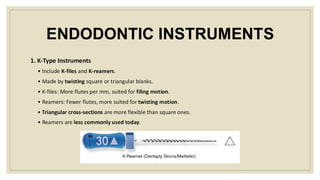
1. K-Type Instruments
• Include K-files and K-reamers.
• Made by twisting square or triangular blanks.
• K-files: More flutes per mm, suited for filing motion.
• Reamers: Fewer flutes, more suited for twisting motion.
• Triangular cross-sections are more flexible than square ones.
• Reamers are less commonly used today.
ENDODONTIC INSTRUMENTS
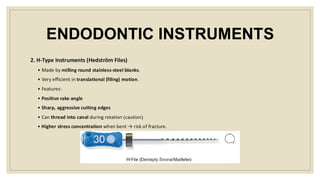
2. H-Type Instruments (Hedström Files)
• Made by milling round stainless-steel blanks.
• Very efficient in translational (filing) motion.
• Features:
• Positive rake angle
• Sharp, aggressive cutting edges
• Can thread into canal during rotation (caution).
• Higher stress concentration when bent → risk of fracture.
ENDODONTIC INSTRUMENTS
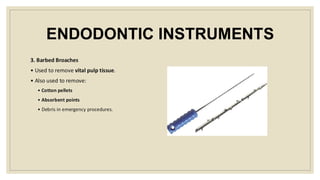
3. Barbed Broaches
• Used to remove vital pulp tissue.
• Also used to remove:
• Cotton pellets
• Absorbent points
• Debris in emergency procedures.
LOW-SPEED ENGINE-DRIVEN INSTRUMENTS
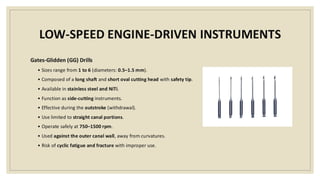
Gates-Glidden (GG) Drills
• Sizes range from 1 to 6 (diameters: 0.5–1.5 mm).
• Composed of a long shaft and short oval cutting head with safety tip.
• Available in stainless steel and NiTi.
• Function as side-cutting instruments.
• Effective during the outstroke (withdrawal).
• Use limited to straight canal portions.
• Operate safely at 750–1500 rpm.
• Used against the outer canal wall, away from curvatures.
• Risk of cyclic fatigue and fracture with improper use.
LOW-SPEED ENGINE-DRIVEN INSTRUMENTS
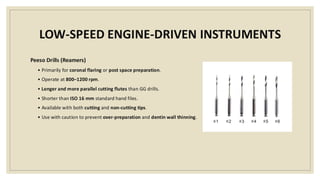
Peeso Drills (Reamers)
• Primarily for coronal flaring or post space preparation.
• Operate at 800–1200 rpm.
• Longer and more parallel cutting flutes than GG drills.
• Shorter than ISO 16 mm standard hand files.
• Available with both cutting and non-cutting tips.
• Use with caution to prevent over-preparation and dentin wall thinning.
STEPS OF CLEANING AND SHAPING
1. Coronal Preflaring
• Extension of access cavity into coronal part of the root canal.
• Tools:
• Gates Glidden drills
• NiTi instruments
• Orifice shaping rotaries (single-instrument systems).
• Benefits:
• Reduces risk of working length changes.
• Facilitates straighter access for instruments.
• Improves irrigation effectiveness.
STEPS OF CLEANING AND SHAPING
2. Patency File
• Use of a small K-file (#10 or #15) extended slightly beyond the apical foramen.
• Recommended for most rotary instrumentation techniques.
• Functions:
• Clears apical debris.
• Maintains accurate working length.
• Improves overall canal cleanliness.
• Note: Does not increase post-op symptoms when used correctly.
WORKING LENGTH DETERMINATION
Devices
• Traditional methods:
• Radiographs, tactile sensation, moisture on paper points, root morphology.
• Electronic Apex Locator (EAL):
• Highly accurate for determining working length.
• Apical resorption does not affect accuracy.
• Early generations were affected by canal contents and irrigants.
• Caution: Avoid use in pacemaker patients unless cleared by cardiologist.
CLEANING AND SHAPING TECHNIQUES
1. Standardized Technique
• All instruments used to same working length.
• Canal shape dictated by instrument shape.
• Limited by instrument standardization.
2. Step-Back Technique
• Larger files used in steps 0.5–1 mm shorter than previous.
• Creates flared canal with 0.05–0.10 taper.
• Reduces preparation errors, especially in curved canals.
CLEANING AND SHAPING TECHNIQUES
3. Step-Down Technique
• Shape coronal portion first, then apical instrumentation.
• Minimizes extrusion of necrotic debris.
4. Crown-Down Technique
• Emphasizes coronal flaring first, then apical shaping.
• Working length determined after coronal flaring.
• Use of stainless-steel K-file to explore apical area.
• Avoid excessive wall contact to prevent blockage.
CLEANING AND SHAPING TECHNIQUES
5. Balanced Forces Technique
• Minimizes canal aberrations.
• Best canal-centering hand technique.
• Involves 3 steps:
o 90° clockwise to engage dentin
o 180–270° counterclockwise to cut
o 360–720° clockwise to remove file
6. Rotary Instrumentation
• Requires glide path of size #15–20 K-file.
• Needs copious irrigation and frequent recapitulation.
NiTi ROTARY TECHNIQUES
◦ Crown-Down
• WL determined after pre-enlargement.
• Glide path secured first with K-files.
◦ Single Length (e.g., ProTaper)
• No crown-down step.
• Follows specific file sequence:
S1/S2 → re-irrigation → WL confirmation → Finishing files.
DISINFECTION OF THE ROOT CANAL
SYSTEM
Objectives of Irrigation:
• Mechanical:
1. Flush out debris
2. Lubricate canal
3. Prevent or remove smear layer
• Chemical:
1. Dissolve organic/inorganic tissue
2. Kill microorganisms
• Biologic: Overall canal disinfection
DISINFECTION OF THE ROOT CANAL
SYSTEM
Effectiveness Depends On:
• Mechanical: Streaming forces throughout the canal
• Chemical: Concentration, contact area, and duration
Ideal Properties of Irrigants
• Kill bacteria in planktonic and biofilm states
• Inactivate endotoxins
• Be non-toxic to vital tissues
• Avoid anaphylactic reactions
DISINFECTION OF THE ROOT CANAL
SYSTEM
Factors affecting irrigation efficiency:
1. Needle penetration depth
2. Canal diameter
3. Needle size and design (e.g., 30-gauge NiTi needle for curved canals)
4. Irrigation pressure (narrow needles = higher pressure/velocity)
5. Viscosity of the irrigant
6. Velocity at the needle tip
7. Needle tip type and orientation
• Side-vented or double side-vented → safer & better cleaning
• Closed-end tips → prevent apical extrusion
Sodium Hypochlorite (NaOCl)
• Most commonly used endodontic irrigant
• Strong antibacterial agent
• Dissolves necrotic/vital pulp tissue, organic dentin & biofilms
• Used in 0.5%–6% concentrations
• Higher concentrations:
• Better at tissue dissolution
• More effective against E. faecalis & C. albicans
• More toxic
• Lower concentrations in higher volumes can be equally effective
Sodium Hypochlorite (NaOCl)
Toxicity and Accidents
• Extrusion beyond apex can cause:
• Severe pain, edema, bleeding, ecchymosis
• Possible paresthesia, infection, or sinus irritation
• Management:
• Inform patient
• Pain control: local anesthesia, analgesics
• Cold compress (first day), then warm compresses & rinses
• Daily follow-up
• ABs & antihistamines not obligatory
• Corticosteroid use is controversial
Chlorhexidine (CHX)
• Less effective than NaOCl for tissue dissolution
• More effective than saline as final rinse
As Intracanal Medicament
• Comparable/better than Ca(OH)₂ against E. faecalis
• Helps prevent root resorption and bacterial regrowth
• Works as gel or liquid
Other Uses
• Helps prevent bacterial coronal penetration
• Inhibits MMPs → improves dentin bond stability
Ethylenediamine Tetraacetic Acid (EDTA)
• Removes inorganic part of smear layer
• Must be combined with NaOCl to eliminate organic components
• Effective in <1 min contact time
• Overuse or sequential NaOCl use can cause dentin erosion
EDTA Use Protocol
• Used after cleaning/shaping, for ~1 minute
• Can be ultrasonically activated for deeper penetration
• Should not be heated — heat reduces calcium-binding ability
Interaction with NaOCl
• Should be used separately
• Alternate regimen with copious NaOCl rinse after EDTA
• Avoid prolonged or combined exposure to prevent erosion
INTRACANAL MEDICATIONS
Purpose of Intracanal Medications
• Prevent bacterial regrowth between appointments.
• Provide continued disinfection.
• Act as a physical barrier inside the root canal system.
INTRACANAL MEDICATIONS
◦ Calcium Hydroxide (Ca(OH)₂)
◦ Phenolic Compounds
◦ Formaldehyde Compounds
◦ Halogens
◦ Chlorhexidine (CHX)
◦ Steroids (e.g., Ledermix Paste)
◦ Triple-Antibiotic Paste (TAP)
◦ Bioactive Glass
◦ Lubricants
Calcium Hydroxide (Ca(OH)₂)
◦ The most commonly used.
◦ 24-hour contact needed for complete elimination of E. faecalis.
• Application:
• Mixed with sterile water or saline.
• Placed using Lentulo spiral.
• Mixture must be moist but not overly dry.
• Used for:
• Apexification in immature necrotic teeth.
• Revascularization as an alternative to antibiotic pastes.
• Limitations:
• Incomplete removal (residues remain).
• Interferes with root canal sealers.
• Not fully effective against E. faecalis and Candida albicans.
CRITERIA TO EVALUATE CLEANING
AND SHAPING
What is a Well-Shaped Canal?
◦ Free of procedural errors.
◦ Achieves effective disinfection.
◦ Preserves as much natural tooth structure as possible.
SIGNS OF PROCEDURAL MISHAPS
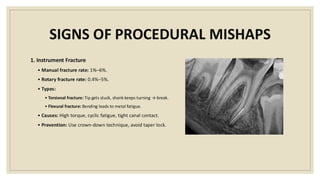
1. Instrument Fracture
• Manual fracture rate: 1%–6%.
• Rotary fracture rate: 0.4%–5%.
• Types:
• Torsional fracture: Tip gets stuck, shank keeps turning → break.
• Flexural fracture: Bending leads to metal fatigue.
• Causes: High torque, cyclic fatigue, tight canal contact.
• Prevention: Use crown-down technique, avoid taper lock.
SIGNS OF PROCEDURAL MISHAPS
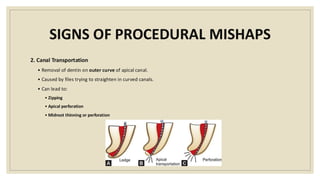
2. Canal Transportation
• Removal of dentin on outer curve of apical canal.
• Caused by files trying to straighten in curved canals.
• Can lead to:
• Zipping
• Apical perforation
• Midroot thinning or perforation
SIGNS OF PROCEDURAL MISHAPS
3. Perforation Types
• Strip perforation: Furcation area in multirooted teeth (“danger zone”).
• Curvature-related perforation: At curved canals.
• Apical perforation: Through the apex.
4. Blockage
• Canal becomes blocked by:
• Compacted debris.
• Pulp remnants.
• Broken file or filling materials.
SIGNS OF PROCEDURAL MISHAPS
5. Instrumentation Errors
• Ledge formation: Artificial step or shelf in canal wall.
• Transportation: Shifting canal end to a wrong location.
• Minor, Moderate, or Severe
• Zipping: Apical shape changed from round to teardrop/hourglass.
• Perforation: Unintended opening into periodontal ligament (PDL).

Cleaning and Shaping the Root Canal System.pdf

  • 1.
    CLEANING AND SHAPING THEROOT CANAL SYSTEM
  • 2.
    PRINCIPLES OF CLEANINGAND SHAPING Mechanical Objectives: • Aim to completely and centrally incorporate the original canal anatomy into the prepared shape. • Goal: All canal surfaces should be mechanically prepared. • Current techniques often fall short of this ideal. • Important to preserve cervical and radicular dentin to maintain structural integrity. • Minimizing dentin removal helps prevent root fractures. Biologic Objective: • Enlarged apical canals and finer irrigation needles allow deeper needle penetration. • Deeper needle placement enhances debridement and disinfection of the root canal system.
  • 3.
    ENDODONTIC INSTRUMENTS 1. K-TypeInstruments • Include K-files and K-reamers. • Made by twisting square or triangular blanks. • K-files: More flutes per mm, suited for filing motion. • Reamers: Fewer flutes, more suited for twisting motion. • Triangular cross-sections are more flexible than square ones. • Reamers are less commonly used today.
  • 4.
    ENDODONTIC INSTRUMENTS 2. H-TypeInstruments (Hedström Files) • Made by milling round stainless-steel blanks. • Very efficient in translational (filing) motion. • Features: • Positive rake angle • Sharp, aggressive cutting edges • Can thread into canal during rotation (caution). • Higher stress concentration when bent → risk of fracture.
  • 5.
    ENDODONTIC INSTRUMENTS 3. BarbedBroaches • Used to remove vital pulp tissue. • Also used to remove: • Cotton pellets • Absorbent points • Debris in emergency procedures.
  • 6.
    LOW-SPEED ENGINE-DRIVEN INSTRUMENTS Gates-Glidden(GG) Drills • Sizes range from 1 to 6 (diameters: 0.5–1.5 mm). • Composed of a long shaft and short oval cutting head with safety tip. • Available in stainless steel and NiTi. • Function as side-cutting instruments. • Effective during the outstroke (withdrawal). • Use limited to straight canal portions. • Operate safely at 750–1500 rpm. • Used against the outer canal wall, away from curvatures. • Risk of cyclic fatigue and fracture with improper use.
  • 7.
    LOW-SPEED ENGINE-DRIVEN INSTRUMENTS PeesoDrills (Reamers) • Primarily for coronal flaring or post space preparation. • Operate at 800–1200 rpm. • Longer and more parallel cutting flutes than GG drills. • Shorter than ISO 16 mm standard hand files. • Available with both cutting and non-cutting tips. • Use with caution to prevent over-preparation and dentin wall thinning.
  • 8.
    STEPS OF CLEANINGAND SHAPING 1. Coronal Preflaring • Extension of access cavity into coronal part of the root canal. • Tools: • Gates Glidden drills • NiTi instruments • Orifice shaping rotaries (single-instrument systems). • Benefits: • Reduces risk of working length changes. • Facilitates straighter access for instruments. • Improves irrigation effectiveness.
  • 9.
    STEPS OF CLEANINGAND SHAPING 2. Patency File • Use of a small K-file (#10 or #15) extended slightly beyond the apical foramen. • Recommended for most rotary instrumentation techniques. • Functions: • Clears apical debris. • Maintains accurate working length. • Improves overall canal cleanliness. • Note: Does not increase post-op symptoms when used correctly.
  • 10.
    WORKING LENGTH DETERMINATION Devices •Traditional methods: • Radiographs, tactile sensation, moisture on paper points, root morphology. • Electronic Apex Locator (EAL): • Highly accurate for determining working length. • Apical resorption does not affect accuracy. • Early generations were affected by canal contents and irrigants. • Caution: Avoid use in pacemaker patients unless cleared by cardiologist.
  • 11.
    CLEANING AND SHAPINGTECHNIQUES 1. Standardized Technique • All instruments used to same working length. • Canal shape dictated by instrument shape. • Limited by instrument standardization. 2. Step-Back Technique • Larger files used in steps 0.5–1 mm shorter than previous. • Creates flared canal with 0.05–0.10 taper. • Reduces preparation errors, especially in curved canals.
  • 12.
    CLEANING AND SHAPINGTECHNIQUES 3. Step-Down Technique • Shape coronal portion first, then apical instrumentation. • Minimizes extrusion of necrotic debris. 4. Crown-Down Technique • Emphasizes coronal flaring first, then apical shaping. • Working length determined after coronal flaring. • Use of stainless-steel K-file to explore apical area. • Avoid excessive wall contact to prevent blockage.
  • 13.
    CLEANING AND SHAPINGTECHNIQUES 5. Balanced Forces Technique • Minimizes canal aberrations. • Best canal-centering hand technique. • Involves 3 steps: o 90° clockwise to engage dentin o 180–270° counterclockwise to cut o 360–720° clockwise to remove file 6. Rotary Instrumentation • Requires glide path of size #15–20 K-file. • Needs copious irrigation and frequent recapitulation.
  • 14.
    NiTi ROTARY TECHNIQUES ◦Crown-Down • WL determined after pre-enlargement. • Glide path secured first with K-files. ◦ Single Length (e.g., ProTaper) • No crown-down step. • Follows specific file sequence: S1/S2 → re-irrigation → WL confirmation → Finishing files.
  • 15.
    DISINFECTION OF THEROOT CANAL SYSTEM Objectives of Irrigation: • Mechanical: 1. Flush out debris 2. Lubricate canal 3. Prevent or remove smear layer • Chemical: 1. Dissolve organic/inorganic tissue 2. Kill microorganisms • Biologic: Overall canal disinfection
  • 16.
    DISINFECTION OF THEROOT CANAL SYSTEM Effectiveness Depends On: • Mechanical: Streaming forces throughout the canal • Chemical: Concentration, contact area, and duration Ideal Properties of Irrigants • Kill bacteria in planktonic and biofilm states • Inactivate endotoxins • Be non-toxic to vital tissues • Avoid anaphylactic reactions
  • 17.
    DISINFECTION OF THEROOT CANAL SYSTEM Factors affecting irrigation efficiency: 1. Needle penetration depth 2. Canal diameter 3. Needle size and design (e.g., 30-gauge NiTi needle for curved canals) 4. Irrigation pressure (narrow needles = higher pressure/velocity) 5. Viscosity of the irrigant 6. Velocity at the needle tip 7. Needle tip type and orientation • Side-vented or double side-vented → safer & better cleaning • Closed-end tips → prevent apical extrusion
  • 18.
    Sodium Hypochlorite (NaOCl) •Most commonly used endodontic irrigant • Strong antibacterial agent • Dissolves necrotic/vital pulp tissue, organic dentin & biofilms • Used in 0.5%–6% concentrations • Higher concentrations: • Better at tissue dissolution • More effective against E. faecalis & C. albicans • More toxic • Lower concentrations in higher volumes can be equally effective
  • 19.
    Sodium Hypochlorite (NaOCl) Toxicityand Accidents • Extrusion beyond apex can cause: • Severe pain, edema, bleeding, ecchymosis • Possible paresthesia, infection, or sinus irritation • Management: • Inform patient • Pain control: local anesthesia, analgesics • Cold compress (first day), then warm compresses & rinses • Daily follow-up • ABs & antihistamines not obligatory • Corticosteroid use is controversial
  • 20.
    Chlorhexidine (CHX) • Lesseffective than NaOCl for tissue dissolution • More effective than saline as final rinse As Intracanal Medicament • Comparable/better than Ca(OH)₂ against E. faecalis • Helps prevent root resorption and bacterial regrowth • Works as gel or liquid Other Uses • Helps prevent bacterial coronal penetration • Inhibits MMPs → improves dentin bond stability
  • 21.
    Ethylenediamine Tetraacetic Acid(EDTA) • Removes inorganic part of smear layer • Must be combined with NaOCl to eliminate organic components • Effective in <1 min contact time • Overuse or sequential NaOCl use can cause dentin erosion EDTA Use Protocol • Used after cleaning/shaping, for ~1 minute • Can be ultrasonically activated for deeper penetration • Should not be heated — heat reduces calcium-binding ability Interaction with NaOCl • Should be used separately • Alternate regimen with copious NaOCl rinse after EDTA • Avoid prolonged or combined exposure to prevent erosion
  • 22.
    INTRACANAL MEDICATIONS Purpose ofIntracanal Medications • Prevent bacterial regrowth between appointments. • Provide continued disinfection. • Act as a physical barrier inside the root canal system.
  • 23.
    INTRACANAL MEDICATIONS ◦ CalciumHydroxide (Ca(OH)₂) ◦ Phenolic Compounds ◦ Formaldehyde Compounds ◦ Halogens ◦ Chlorhexidine (CHX) ◦ Steroids (e.g., Ledermix Paste) ◦ Triple-Antibiotic Paste (TAP) ◦ Bioactive Glass ◦ Lubricants
  • 24.
    Calcium Hydroxide (Ca(OH)₂) ◦The most commonly used. ◦ 24-hour contact needed for complete elimination of E. faecalis. • Application: • Mixed with sterile water or saline. • Placed using Lentulo spiral. • Mixture must be moist but not overly dry. • Used for: • Apexification in immature necrotic teeth. • Revascularization as an alternative to antibiotic pastes. • Limitations: • Incomplete removal (residues remain). • Interferes with root canal sealers. • Not fully effective against E. faecalis and Candida albicans.
  • 25.
    CRITERIA TO EVALUATECLEANING AND SHAPING What is a Well-Shaped Canal? ◦ Free of procedural errors. ◦ Achieves effective disinfection. ◦ Preserves as much natural tooth structure as possible.
  • 26.
    SIGNS OF PROCEDURALMISHAPS 1. Instrument Fracture • Manual fracture rate: 1%–6%. • Rotary fracture rate: 0.4%–5%. • Types: • Torsional fracture: Tip gets stuck, shank keeps turning → break. • Flexural fracture: Bending leads to metal fatigue. • Causes: High torque, cyclic fatigue, tight canal contact. • Prevention: Use crown-down technique, avoid taper lock.
  • 27.
    SIGNS OF PROCEDURALMISHAPS 2. Canal Transportation • Removal of dentin on outer curve of apical canal. • Caused by files trying to straighten in curved canals. • Can lead to: • Zipping • Apical perforation • Midroot thinning or perforation
  • 28.
    SIGNS OF PROCEDURALMISHAPS 3. Perforation Types • Strip perforation: Furcation area in multirooted teeth (“danger zone”). • Curvature-related perforation: At curved canals. • Apical perforation: Through the apex. 4. Blockage • Canal becomes blocked by: • Compacted debris. • Pulp remnants. • Broken file or filling materials.
  • 29.
    SIGNS OF PROCEDURALMISHAPS 5. Instrumentation Errors • Ledge formation: Artificial step or shelf in canal wall. • Transportation: Shifting canal end to a wrong location. • Minor, Moderate, or Severe • Zipping: Apical shape changed from round to teardrop/hourglass. • Perforation: Unintended opening into periodontal ligament (PDL).