Presenter Dr Neethu Rita Jose
Moderator Dr Swetha Kamath
 Introduction
 Conduct
 Benefits
 Present scenario
 Guidelines
 History
 Airway assessment
 Other examination
 Investigations
 Pre op drug therapy and
modification
 Premedication
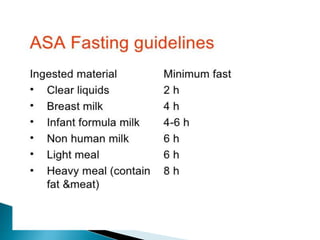
 Fasting guidelines
 References
 Basic element of anaesthesia care
 PERIOPERATIVE MEDICAL
SPECIALISTS
 Assessment and optimisation of
patients who are being prepared
for surgery
 Joint commission mandates
documentation of history and
physical examination for any
surgical patients WITHIN 30 DAYS
before the planned procedure
 Reassessment WITHIN 48 HRS
preceding surgery
Personal interview in the ward,
operating theatre or PAE clinic or
Preset questionnaires assisted by
trained nursing or paramedical
staff under the supervision of an
anaesthesiologist
 Emergency surgery-
PAE done and risks documented
 More selective ordering of lab
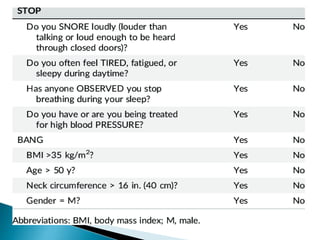
tests.
 Reduced patient anxiety.
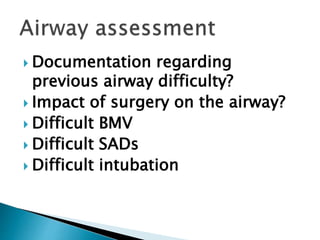
 Improved acceptance of regional
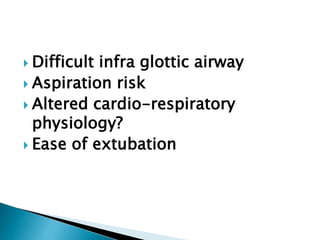
anaesthesia.
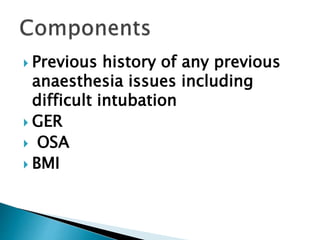
 Shorter duration of
hospitalisation.
 Lower hospital costs.
 Fewer case cancellations on the
day of surgery
 Every patient should be
considered as COVID 19 positive
and anaesthetists should wear
MASK(N 95) all the time
 WASH hands –soap and
water/alcohol based sanitizer
frequently
 Wear cap,gown &shoe cover, GLOVES
 FACE SHIELD/GOGGLES
 Maintain SOCIAL DISTANCING
 Restrict NUMBER of attendants to PAC
 Prevent CROWDING in PAC
 History of FEVER,COUGH,SORE
THROAT
 Record body TEMPERATURE before
entering PAC clinic
 Patients should also wear MASKS
 Detailed PAC to be taken-TRAVEL
international/domestic to affected
areas in last 14 days
 Careful chest auscultation
 All reusable equipments (steth,BP
apparatus)SANITISED frequently
 At the end of day , clean by
wiping surfaces of furniture and
floor with 2-3% hydrogen
peroxide
 Correct method of using and
disposing surgical masks
 Introduction of the medical
practitioner performing the
consultation.
 Confirmation of the patient’s
identity , procedure including site
and side
 Medical assessment of the patient
- History
−Review patient records
− Clinical examination ( Systemic
and Airway)
− Medications
− Relevant investigations
- Previous anaesthesia records
 Specialist consultation , if
required
 Informed consent
 Instructions regarding fasting
 Information regarding pain
management
 Information regarding
modification of current
medications
 Requirement of assistance after
the procedure
 Educate patient regarding
modifiable health factors
 Rapport with patient and family-
reduce anxiety
 Clear and detailed documentation
 Name, Age, Sex
 Date & time of examination
 Source of history: patient, relative,
care taker.
 Occupation and social status
 Community / Religion
Atypical pseudocholinesterase
in Shetty community
 HPI- indication for surgery and
planned procedure
 Mode of onset, cause of onset,
progress and treatment received
 History of recent respiratory
infections
 Menstrual history
 History of allergy
History pertaining to various
symptoms
a. Cardiovascular system
b. Respiratory system
c. Central Nervous system
d. Gastrointestinal tract
e. Genito-Urinary system
f. Musculoskeletal
g. Hematological system
h. Endocrine system
 History of medications- especially
OTC
 History of addictions
 History of previous surgery
 History of previous anesthesia
 Any treatment for cancer
 Family history of any adverse
events related to anesthesia
 History of snoring
 Antenatal history
 Term/pre term
 Birth weight
 Mode of delivery- indication
 History of ICU admission
 Developmental delay
 Immunisation history
 Congenital disorders
 Recent respiratory infections
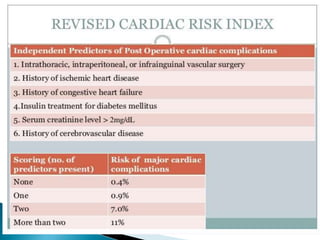
 CVS complications are common
perioperative adverse events
 50% of peri-op deaths
 Identify risk factors
 Severity of the disease
 Need for pre-op interventions
 Risk of peri-op adverse events
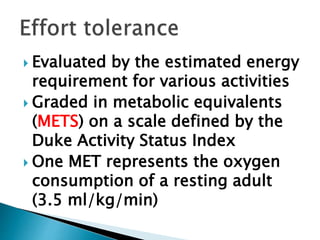
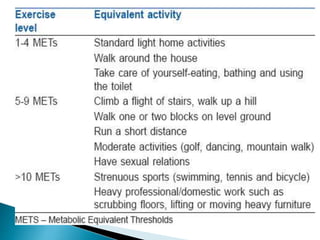
 Evaluated by the estimated energy
requirement for various activities
 Graded in metabolic equivalents
(METS) on a scale defined by the
Duke Activity Status Index
 One MET represents the oxygen
consumption of a resting adult
(3.5 ml/kg/min)
 Risk factors for post-op
pulmonary complications
 Procedure-related risk factors: −
how close the surgery is to the
diaphragm (i.e. upper abdominal
and thoracic surgery are the
highest risk procedures).
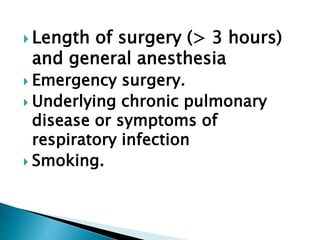
 Length of surgery (> 3 hours)
and general anesthesia
 Emergency surgery.
 Underlying chronic pulmonary
disease or symptoms of
respiratory infection
 Smoking.
 Age >60 years.
 Obesity.
 Presence of obstructive sleep
apnea. (STOP BANG questionnaire)
 Poor exercise tolerance or poor
general health status
 Documentation regarding
previous airway difficulty?
 Impact of surgery on the airway?
 Difficult BMV
 Difficult SADs
 Difficult intubation
 Difficult infra glottic airway
 Aspiration risk
 Altered cardio-respiratory
physiology?
 Ease of extubation
 Previous history of any previous
anaesthesia issues including
difficult intubation
 GER
 OSA
 BMI
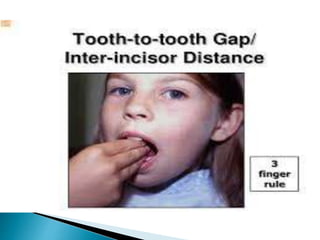
 Mouth opening and interincisor
gap (IIG)
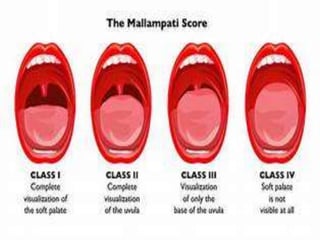
 Modified Mallampati score
 Teeth examination
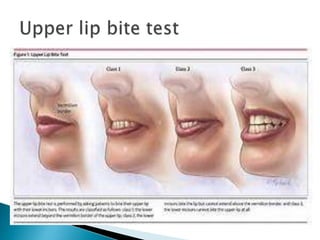
 Upper lip bite test
(ULBT)/Mandible protrusion test
 Thyromental distance (TMD)
 Cervical spine movement
 Pierre Robins - Micrognathia,
macroglossia, cleft soft palate
 Treacher – Collins - Auricular and
ocular defects, malar and
mandibular hypoplasia
 Goldenhaar - Auricular and ocular
defects, malar and mandibular
hypoplasia
 Downs - Poorly developed or
absent bridge of the nose,
macroglossia
 Klippel Fiel - Congenital fusion of
a variable number of cervical
vertebrae, restriction of neck
movement
 Acquired : − Infections : Abscess,
Croup Arthritis , Benign tumors ,
Acromegaly ,Burns
 It is the distance between the
upper and lower incisors.
 Normal is 4.5 cm or more;
 < 3.5 cm predicts difficult airway
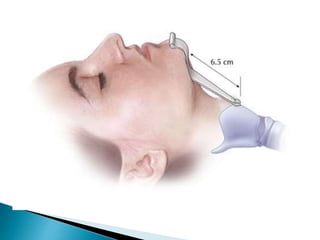
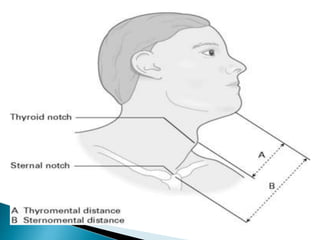
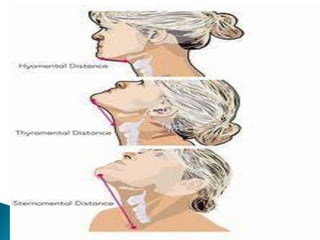
 Distance from the mentum to the
thyroid notch while the patient’s
neck is fully extended.
 TMD< 3 finger breadths or < 6
cm in adults
 Distance from the suprasternal
notch to the mentum with the
head fully extended on the neck
with the mouth closed.
 Less than 12 cm
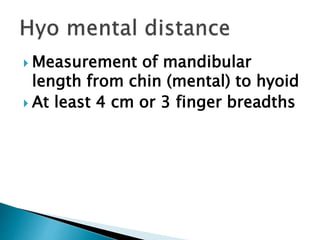
 Measurement of mandibular
length from chin (mental) to hyoid
 At least 4 cm or 3 finger breadths
 Flexion of neck
 Atlanto occipital (AO) joint
extension
 Normally more than 35 degrees
 Turn right and left
 Rotate head
 L - Look externally (facial trauma,
large incisors, beard or
moustache, large tongue)
 E - Evaluate the 3-3-2 rule
(IIG>3fb, HMD > 3FB and
TMD>2fb)
 M - Mallampati (Mallampati score
> 3).
 O - Obstruction (presence of any
condition like epiglottitis,
peritonsillar abscess, trauma).
 N - Neck mobility (limited neck
mobility)
 Beard
 Obesity BMI>26kg/m2
 No teeth
 Elderly >55yrs
 Snorer
 Restricted mouth opening
 Obstruction upper airway
 Disrupted airway-burns,trauma
 Stiff lung
 Height
 Weight
 BMI(kg/m2)
 PICCLE
 SPO2
 Vitals-temperature,PR,BP
 System examination
 IV access
 Positioning of patient
 Teeth
 Spine
 Assess the pain score
Complete blood count
 Major surgery
 Chronic CVS,renal,pulmonary or
hepatic d/s or malignancy
 Known or suspected
anemia,bleeding
diathesis,myelosuppression
 Less than one year of age
 Hb less than 8g%-transfuse and
repeat Hb on day of sx
 Serology
 INR, aPTT
Anticoagulant therapy
Bleeding diathesis
Liver disease
Fasting glucose
 DM
 GRBS monitoring Q6H
 Electrolytes and creatinine
HTN,DM,Renal disease,
Pituitary/adrenal disease,
Digoxin/diuretic therapy
 LFT
 Urine pregnancy test(menstrual
age group)
ECG
 Heart disease,HTN,DM
 Other factors for cardiac
disease(age)
 SAH/ICH, CVA, head trauma
 All ASA>II –above 30yrs
 ASA I- above 35yrs
 <30yrs if symptomatic
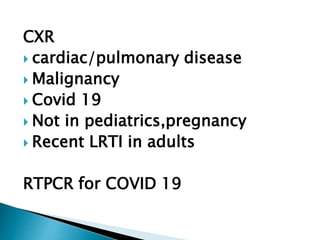
CXR
 cardiac/pulmonary disease
 Malignancy
 Covid 19
 Not in pediatrics,pregnancy
 Recent LRTI in adults
RTPCR for COVID 19
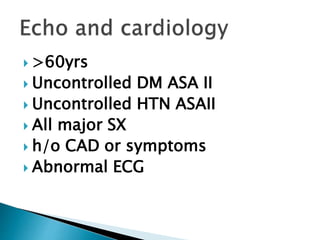
 >60yrs
 Uncontrolled DM ASA II
 Uncontrolled HTN ASAII
 All major SX
 h/o CAD or symptoms
 Abnormal ECG
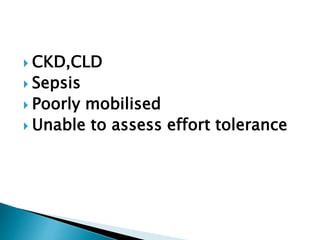
 CKD,CLD
 Sepsis
 Poorly mobilised
 Unable to assess effort tolerance
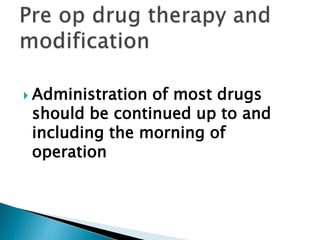
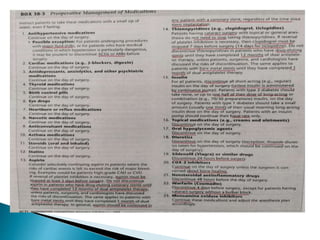
 Administration of most drugs
should be continued up to and
including the morning of
operation
 Stop 6 weeks before – OCP
 Stop 2-3 weeks before – MAO
inhibitors, Herbal supplements
 Stop 1 week before – Clopidogrel
 Stop 4 -5 days before – Oral
anticoagulants
 Stop 24 – 48hrs before – NSAIDS
 Stop on day of surgery –
− OHA /Insulin
− ACEI & ARBs
− Diuretics-unless severe heart
failure
 Unfractionated Heparin- stop 6
hours prior
 LMWH-
 Stop 12hours prior prophylactic
dose
 Stop 24hours prior therapeutic
dose
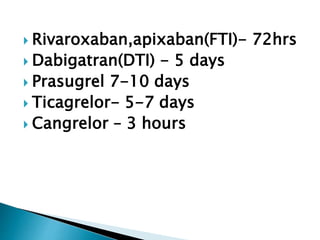
 Rivaroxaban,apixaban(FTI)- 72hrs
 Dabigatran(DTI) - 5 days
 Prasugrel 7-10 days
 Ticagrelor- 5-7 days
 Cangrelor – 3 hours
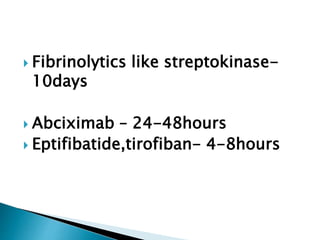
 Fibrinolytics like streptokinase-
10days
 Abciximab – 24-48hours
 Eptifibatide,tirofiban- 4-8hours
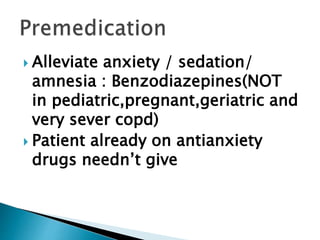
 Alleviate anxiety / sedation/
amnesia : Benzodiazepines(NOT
in pediatric,pregnant,geriatric and
very sever copd)
 Patient already on antianxiety
drugs needn’t give
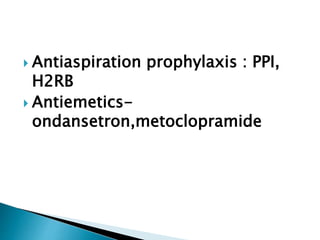
 Antiaspiration prophylaxis : PPI,
H2RB
 Antiemetics-
ondansetron,metoclopramide
 Fasting prior to procedure is to
decrease the risk of peri-
operative regurgitation, which
may result in aspiration
syndrome.
 Before any anesthetic procedure.
 Prescribed medications may be
taken with a sips of water less
than two hours prior to
anaesthesia unless otherwise
directed
 Ask to start IVF @ 50-75ml per
hour from 6am
 For cases posted noon or later
 Caution in CKD,low EF patients
 Informed consent
 Blood arrangement( open
abdominal
Sx,hysterectomy,LSCS,hip dx,
neuro sx,major head and neck
sx,any major sx,anemic patient)
 A – Allergies
 M – Medical history
 P – Previous surgery
 L – Last meal
 E – Events leading up to the
surgery
 A minimum pre anesthetic
physical examination should
include
 1. Airway examination
 2. Pulmonary examination to
include auscultation of the lungs
 3. Cardiovascular examination
 Miller’s anesthesia 9th edition
 IJA,year 2020,volume-64,pages
267-274
 ASRA and pain medicine April
2018 guidelines
PRE-ANESTHETIC EVALUATION

PRE-ANESTHETIC EVALUATION

  • 1.
    Presenter Dr NeethuRita Jose Moderator Dr Swetha Kamath
  • 2.
     Introduction  Conduct Benefits  Present scenario  Guidelines  History
  • 3.
     Airway assessment Other examination  Investigations  Pre op drug therapy and modification  Premedication  Fasting guidelines  References
  • 4.
     Basic elementof anaesthesia care  PERIOPERATIVE MEDICAL SPECIALISTS  Assessment and optimisation of patients who are being prepared for surgery
  • 5.
     Joint commissionmandates documentation of history and physical examination for any surgical patients WITHIN 30 DAYS before the planned procedure  Reassessment WITHIN 48 HRS preceding surgery
  • 6.
    Personal interview inthe ward, operating theatre or PAE clinic or Preset questionnaires assisted by trained nursing or paramedical staff under the supervision of an anaesthesiologist
  • 7.
     Emergency surgery- PAEdone and risks documented
  • 8.
     More selectiveordering of lab tests.  Reduced patient anxiety.  Improved acceptance of regional anaesthesia.
  • 9.
     Shorter durationof hospitalisation.  Lower hospital costs.  Fewer case cancellations on the day of surgery
  • 10.
     Every patientshould be considered as COVID 19 positive and anaesthetists should wear MASK(N 95) all the time  WASH hands –soap and water/alcohol based sanitizer frequently
  • 11.
     Wear cap,gown&shoe cover, GLOVES  FACE SHIELD/GOGGLES  Maintain SOCIAL DISTANCING  Restrict NUMBER of attendants to PAC  Prevent CROWDING in PAC
  • 12.
     History ofFEVER,COUGH,SORE THROAT  Record body TEMPERATURE before entering PAC clinic
  • 13.
     Patients shouldalso wear MASKS  Detailed PAC to be taken-TRAVEL international/domestic to affected areas in last 14 days  Careful chest auscultation
  • 14.
     All reusableequipments (steth,BP apparatus)SANITISED frequently  At the end of day , clean by wiping surfaces of furniture and floor with 2-3% hydrogen peroxide  Correct method of using and disposing surgical masks
  • 15.
     Introduction ofthe medical practitioner performing the consultation.  Confirmation of the patient’s identity , procedure including site and side
  • 16.
     Medical assessmentof the patient - History −Review patient records − Clinical examination ( Systemic and Airway) − Medications − Relevant investigations - Previous anaesthesia records
  • 17.
     Specialist consultation, if required  Informed consent  Instructions regarding fasting
  • 18.
     Information regardingpain management  Information regarding modification of current medications
  • 19.
     Requirement ofassistance after the procedure  Educate patient regarding modifiable health factors
  • 20.
     Rapport withpatient and family- reduce anxiety  Clear and detailed documentation
  • 21.
     Name, Age,Sex  Date & time of examination  Source of history: patient, relative, care taker.  Occupation and social status
  • 22.
     Community /Religion Atypical pseudocholinesterase in Shetty community  HPI- indication for surgery and planned procedure  Mode of onset, cause of onset, progress and treatment received
  • 23.
     History ofrecent respiratory infections  Menstrual history  History of allergy
  • 24.
    History pertaining tovarious symptoms a. Cardiovascular system b. Respiratory system c. Central Nervous system d. Gastrointestinal tract e. Genito-Urinary system f. Musculoskeletal g. Hematological system h. Endocrine system
  • 25.
     History ofmedications- especially OTC  History of addictions  History of previous surgery  History of previous anesthesia
  • 26.
     Any treatmentfor cancer  Family history of any adverse events related to anesthesia  History of snoring
  • 27.
     Antenatal history Term/pre term  Birth weight  Mode of delivery- indication  History of ICU admission
  • 28.
     Developmental delay Immunisation history  Congenital disorders  Recent respiratory infections
  • 29.
     CVS complicationsare common perioperative adverse events  50% of peri-op deaths
  • 30.
     Identify riskfactors  Severity of the disease  Need for pre-op interventions  Risk of peri-op adverse events
  • 32.
     Evaluated bythe estimated energy requirement for various activities  Graded in metabolic equivalents (METS) on a scale defined by the Duke Activity Status Index  One MET represents the oxygen consumption of a resting adult (3.5 ml/kg/min)
  • 36.
     Risk factorsfor post-op pulmonary complications  Procedure-related risk factors: − how close the surgery is to the diaphragm (i.e. upper abdominal and thoracic surgery are the highest risk procedures).
  • 37.
     Length ofsurgery (> 3 hours) and general anesthesia  Emergency surgery.  Underlying chronic pulmonary disease or symptoms of respiratory infection  Smoking.
  • 38.
     Age >60years.  Obesity.  Presence of obstructive sleep apnea. (STOP BANG questionnaire)  Poor exercise tolerance or poor general health status
  • 40.
     Documentation regarding previousairway difficulty?  Impact of surgery on the airway?  Difficult BMV  Difficult SADs  Difficult intubation
  • 41.
     Difficult infraglottic airway  Aspiration risk  Altered cardio-respiratory physiology?  Ease of extubation
  • 42.
     Previous historyof any previous anaesthesia issues including difficult intubation  GER  OSA  BMI
  • 43.
     Mouth openingand interincisor gap (IIG)  Modified Mallampati score  Teeth examination
  • 44.
     Upper lipbite test (ULBT)/Mandible protrusion test  Thyromental distance (TMD)  Cervical spine movement
  • 45.
     Pierre Robins- Micrognathia, macroglossia, cleft soft palate  Treacher – Collins - Auricular and ocular defects, malar and mandibular hypoplasia
  • 46.
     Goldenhaar -Auricular and ocular defects, malar and mandibular hypoplasia  Downs - Poorly developed or absent bridge of the nose, macroglossia
  • 47.
     Klippel Fiel- Congenital fusion of a variable number of cervical vertebrae, restriction of neck movement  Acquired : − Infections : Abscess, Croup Arthritis , Benign tumors , Acromegaly ,Burns
  • 49.
     It isthe distance between the upper and lower incisors.  Normal is 4.5 cm or more;  < 3.5 cm predicts difficult airway
  • 51.
     Distance fromthe mentum to the thyroid notch while the patient’s neck is fully extended.  TMD< 3 finger breadths or < 6 cm in adults
  • 53.
     Distance fromthe suprasternal notch to the mentum with the head fully extended on the neck with the mouth closed.  Less than 12 cm
  • 55.
     Measurement ofmandibular length from chin (mental) to hyoid  At least 4 cm or 3 finger breadths
  • 58.
     Flexion ofneck  Atlanto occipital (AO) joint extension  Normally more than 35 degrees  Turn right and left  Rotate head
  • 59.
     L -Look externally (facial trauma, large incisors, beard or moustache, large tongue)  E - Evaluate the 3-3-2 rule (IIG>3fb, HMD > 3FB and TMD>2fb)
  • 60.
     M -Mallampati (Mallampati score > 3).  O - Obstruction (presence of any condition like epiglottitis, peritonsillar abscess, trauma).  N - Neck mobility (limited neck mobility)
  • 61.
     Beard  ObesityBMI>26kg/m2  No teeth  Elderly >55yrs  Snorer
  • 62.
     Restricted mouthopening  Obstruction upper airway  Disrupted airway-burns,trauma  Stiff lung
  • 63.
     Height  Weight BMI(kg/m2)  PICCLE  SPO2  Vitals-temperature,PR,BP
  • 64.
     System examination IV access  Positioning of patient  Teeth  Spine  Assess the pain score
  • 66.
    Complete blood count Major surgery  Chronic CVS,renal,pulmonary or hepatic d/s or malignancy  Known or suspected anemia,bleeding diathesis,myelosuppression  Less than one year of age
  • 67.
     Hb lessthan 8g%-transfuse and repeat Hb on day of sx  Serology  INR, aPTT Anticoagulant therapy Bleeding diathesis Liver disease
  • 68.
    Fasting glucose  DM GRBS monitoring Q6H
  • 69.
     Electrolytes andcreatinine HTN,DM,Renal disease, Pituitary/adrenal disease, Digoxin/diuretic therapy  LFT  Urine pregnancy test(menstrual age group)
  • 70.
    ECG  Heart disease,HTN,DM Other factors for cardiac disease(age)  SAH/ICH, CVA, head trauma  All ASA>II –above 30yrs  ASA I- above 35yrs  <30yrs if symptomatic
  • 71.
    CXR  cardiac/pulmonary disease Malignancy  Covid 19  Not in pediatrics,pregnancy  Recent LRTI in adults RTPCR for COVID 19
  • 72.
     >60yrs  UncontrolledDM ASA II  Uncontrolled HTN ASAII  All major SX  h/o CAD or symptoms  Abnormal ECG
  • 73.
     CKD,CLD  Sepsis Poorly mobilised  Unable to assess effort tolerance
  • 74.
     Administration ofmost drugs should be continued up to and including the morning of operation
  • 75.
     Stop 6weeks before – OCP  Stop 2-3 weeks before – MAO inhibitors, Herbal supplements  Stop 1 week before – Clopidogrel
  • 76.
     Stop 4-5 days before – Oral anticoagulants  Stop 24 – 48hrs before – NSAIDS  Stop on day of surgery – − OHA /Insulin − ACEI & ARBs − Diuretics-unless severe heart failure
  • 78.
     Unfractionated Heparin-stop 6 hours prior  LMWH-  Stop 12hours prior prophylactic dose  Stop 24hours prior therapeutic dose
  • 79.
     Rivaroxaban,apixaban(FTI)- 72hrs Dabigatran(DTI) - 5 days  Prasugrel 7-10 days  Ticagrelor- 5-7 days  Cangrelor – 3 hours
  • 80.
     Fibrinolytics likestreptokinase- 10days  Abciximab – 24-48hours  Eptifibatide,tirofiban- 4-8hours
  • 81.
     Alleviate anxiety/ sedation/ amnesia : Benzodiazepines(NOT in pediatric,pregnant,geriatric and very sever copd)  Patient already on antianxiety drugs needn’t give
  • 82.
     Antiaspiration prophylaxis: PPI, H2RB  Antiemetics- ondansetron,metoclopramide
  • 83.
     Fasting priorto procedure is to decrease the risk of peri- operative regurgitation, which may result in aspiration syndrome.  Before any anesthetic procedure.
  • 84.
     Prescribed medicationsmay be taken with a sips of water less than two hours prior to anaesthesia unless otherwise directed
  • 85.
     Ask tostart IVF @ 50-75ml per hour from 6am  For cases posted noon or later  Caution in CKD,low EF patients
  • 87.
     Informed consent Blood arrangement( open abdominal Sx,hysterectomy,LSCS,hip dx, neuro sx,major head and neck sx,any major sx,anemic patient)
  • 88.
     A –Allergies  M – Medical history  P – Previous surgery  L – Last meal  E – Events leading up to the surgery
  • 89.
     A minimumpre anesthetic physical examination should include  1. Airway examination  2. Pulmonary examination to include auscultation of the lungs  3. Cardiovascular examination
  • 90.
     Miller’s anesthesia9th edition  IJA,year 2020,volume-64,pages 267-274  ASRA and pain medicine April 2018 guidelines