Pregnancy-induced
hypertension
Presented by:
Yasmine mahmoud
Out lines:
▪Definition of hypertensive disorders of
pregnancy.
▪Classification of hypertensive disorders of
pregnancy.
▪Definitions of pregnancy-induced
hypertension.
▪Causes of pregnancy-induced
hypertension.
Out lines:
✓Pre – eclampsia
-Definition
– Clinical pictures
– Diagnosis
–Treatment
✓E-clampsia
-Definition
– stages of convulsion
– severity of convulsion
–Treatment
Hypertensive disorders of
pregnancy
Definition:
A group of disorders occurring during
pregnancy characterized by one or
more of the following signs:
• Hypertension
• Proteinuria and edema
➢N.B: recently edema/has no diagnostic or
prognostic value(it is present in 50% of
normal pregnant women)
Incidence
• Hypertensive disorders are among the most significant &
still now unresolving problem complicating almost one in
ten pregnancies
• Responsible for 16% of Maternal Mortality in developing
countries
• Commonest cause of iatrogenic prematurity accounting
15% of all premature births & 20% of very LBW births
Hypertension in Pregnancy
• Systolic B.P. > 140 mmHg
•and/or
• Diastolic B.P. > 90 mmHg
• Documented on two occasions
• At least 6 hours apart
• Not more than 7 days apart
• Other Criteria (Not part of definition currently)
• SBP increased by 30mmHg
• DBP increased by 15mmHg
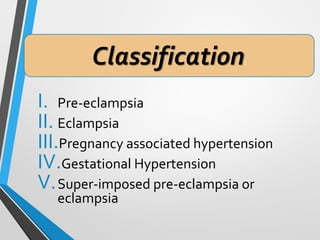
I. Pre-eclampsia
II. Eclampsia
III.Pregnancy associated hypertension
IV.Gestational Hypertension
V.Super-imposed pre-eclampsia or
eclampsia
Classification:
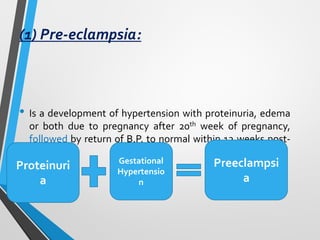
(1) Pre-eclampsia:
• Is a development of hypertension with proteinuria, edema
or both due to pregnancy after 20th week of pregnancy,
followed by return of B.P. to normal within 12 weeks post-
partum
Preeclampsi
a
Gestational
Hypertensio
n
Proteinuri
a
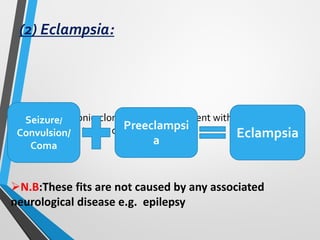
(2) Eclampsia:
• Generalized tonic-clonic seizure in a patient with Preeclampsia
not attributed to any other cause.
Seizure/
Convulsion/
Coma
Preeclampsi
a
Eclampsia
➢N.B:These fits are not caused by any associated
neurological disease e.g. epilepsy
(3)Pregnancy associated hypertension(chronic
hypertensive disease)
Presence of persistent hypertension
before pregnancy or in the 1st 20 weeks
of gestation(in the absence of vesicular
mole) or persistent hypertension after 6
weeks post partum.
➢causes
1.Essential HTN (Most Common).
2. Secondary H.T.N :
✓ Endocrine problems
✓ Chronic vascular disease(essential hypertension)
✓ Chronic nephritis
✓ Systematic lupus erythematous
Chronic Hypertension
• Treatment of mild to moderate chronic
hypertension neither benefits the fetus nor
prevents preeclampsia.
• Excessively lowering blood pressure may result
in decreased placental perfusion and adverse
perinatal outcomes.
• When BP is 150 to 180/100 to 110 mm Hg,
pharmacologic treatment is needed to prevent
maternal end-organ damage.
Treatment of Chronic Hypertension
• labetalol, and nifedipine most common oral
agents.
• AVOID: atenolol, thiazide diuretics
• Women in active labor with uncontrolled
severe chronic hypertension require
treatment with intravenous labetalol or
hydralazine.
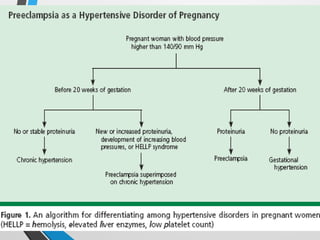
(4)Gestational Hypertension
New onset of hypertension after 20 weeks of gestation
without proteinuria, followed by return of B.P. to normal
within 12 weeks post-partum.
:(5)Super imposed hypertension
• Development of pre-eclampsia or eclampsia in a patient with
chronic hypertensive disease.
Diagnosis:
• Rise of 30 mmhg in systolic BP and rise of diastolic BP 15
mmhg.
• Development of proteinuria in hypertensive patient
• Development of hypertension in protienuric patient.
New onset proteinuria in hypertensive women but
no proteinuria before 20 weeks' gestation
• A sudden increase in proteinuria or blood pressure or
platelet count < 100,000/L in women with hypertension and
proteinuria before 20 weeks' gestation
Pregnancy induced hypertension
(pre-eclampsia &Eclampsia)
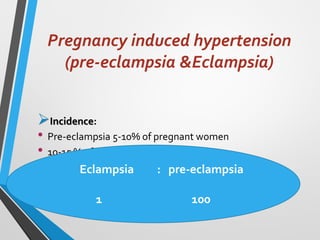
➢Incidence:
• Pre-eclampsia 5-10% of pregnant women
• 10-15 % of primi gravid women
• Eclampsia 1/1000-1/2000 pregnant wpmen
Eclampsia : pre-eclampsia
1 100
Causes of PIH
Not exactly known but common in certain groups of females
they are called PIH prone
1. parity
▪ PIH is almost entirely the disease of primigravida especially
the elderly
▪ Occur in multi gravida under the following conditions:
✓Those who changed their partner
✓Those who had vesicular mole
Causes of PIH Cont.………,
2- Age
3- Multifetal pregnancy(5times commoner)
4- Chronic hypertension
5- Chronic nephritis
6- Diabetes mellitus
7-Vesicular mole
8- Obesity
9- Family history
Pathology
(1)pathologic physiology:
Without known cause there is failure
of of trophoplastic invasion that
leading to vasospasm of blood vessels
in arteriols which leading to decrease
placenral perfusion and leading to
IUGR-IUFD
• The vasospasm causing release of mediators(toxins)
which reach to blood in all organs and causing vascular
endothelial cell damage
• vascular endothelial cell damage causing constriction and
fibrosis to endothelium of blood vessels that destroy
blood components and leading to hemolysis
(2) Pathologic biochemistry:
•Due to constriction of blood vessels
endothelium shifting of fluid from
intravascular to extravascular causing
edema
•All blood component at extravascular
cells is mostly fluid because hemolysis
and that causing DIC
3-Placental isocheimal theory:
oPlacental ischemia leads to decreased kidney function and
cause protienurea
oDecrease of liver function leading to elevated in liver enzymes
oDecrease of brain infusion leading to brain edema
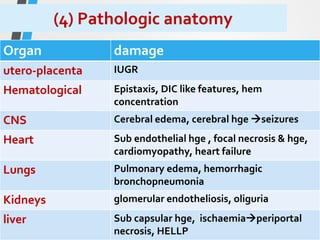
(4) Pathologic anatomy
damage
Organ
IUGR
utero-placenta
Epistaxis, DIC like features, hem
concentration
Hematological
Cerebral edema, cerebral hge →seizures
CNS
Sub endothelial hge , focal necrosis & hge,
cardiomyopathy, heart failure
Heart
Pulmonary edema, hemorrhagic
bronchopneumonia
Lungs
glomerular endotheliosis, oliguria
Kidneys
Sub capsular hge, ischaemia→periportal
necrosis, HELLP
liver
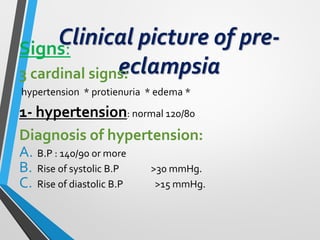
Clinical picture of pre-
eclampsia
Signs:
3 cardinal signs:
hypertension * protienuria * edema *
1- hypertension: normal 120/80
Diagnosis of hypertension:
A. B.P : 140/90 or more
B. Rise of systolic B.P >30 mmHg.
C. Rise of diastolic B.P >15 mmHg.
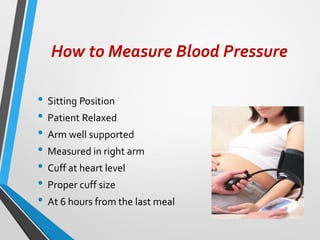
How to Measure Blood Pressure
• Sitting Position
• Patient Relaxed
• Arm well supported
• Measured in right arm
• Cuff at heart level
• Proper cuff size
• At 6 hours from the last meal
Roll over test:
✓At 28-32 weeks, the client is placed in left lateral
position for 20 minutes, then rolled into their her
back.
✓Blood pressure is taken immediately and 5
minutes later.
✓A 20 mmHg diastolic rise is a response that
predicts the development of PIH
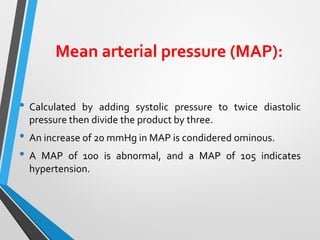
Mean arterial pressure (MAP):
• Calculated by adding systolic pressure to twice diastolic
pressure then divide the product by three.
• An increase of 20 mmHg in MAP is condidered ominous.
• A MAP of 100 is abnormal, and a MAP of 105 indicates
hypertension.
2-protienuria
Definition:
Presence of more than 0.3 gm/liter in 24-hour urine collection
3- edema (2 types):
A.Occult edema: usually develop
before H.T.N. edema of the internal
organ
Diagnosis
Excessive weight gain
B. Clinical edema
•usually develop after H.T.N
•Edema is detected at the ankle, leg, lower
abdominal wall ,face and vulva
in sever cases only))symptoms
1-headache: usually frontal
2-Eye symptoms: blurring on vision
• Flashes on lights
• Blindness
3- oliguria and anuria:
• Oliguria:urine output<500 cc /day
• Anuria: urine output <100 cc/day or no
urine out put.
4-nausea and vomiting
5-epigastric pain
Preeclampsia
• Characterized as mild or severe based on the degree of
hypertension and proteinuria, and the presence of
symptoms resulting from involvement of the kidneys,
brain, liver, and cardiovascular system
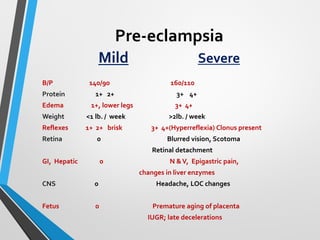
Pre-eclampsia
Mild Severe
B/P 140/90 160/110
Protein 1+ 2+ 3+ 4+
Edema 1+, lower legs 3+ 4+
Weight <1 lb. / week >2lb. / week
Reflexes 1+ 2+ brisk 3+ 4+(Hyperreflexia) Clonus present
Retina 0 Blurred vision, Scotoma
Retinal detachment
GI, Hepatic 0 N &V, Epigastric pain,
changes in liver enzymes
CNS 0 Headache, LOC changes
Fetus 0 Premature aging of placenta
IUGR; late decelerations
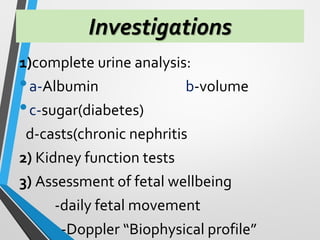
Investigations
1)complete urine analysis:
•a-Albumin b-volume
•c-sugar(diabetes)
d-casts(chronic nephritis
2) Kidney function tests
3) Assessment of fetal wellbeing
-daily fetal movement
-Doppler “Biophysical profile”
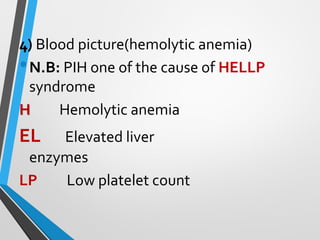
4) Blood picture(hemolytic anemia)
•N.B: PIH one of the cause of HELLP
syndrome
H Hemolytic anemia
EL Elevated liver
enzymes
LP Low platelet count
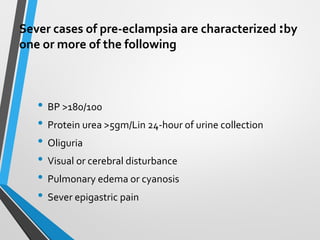
Sever cases of pre-eclampsia are characterized :by
one or more of the following
• BP >180/100
• Protein urea >5gm/Lin 24-hour of urine collection
• Oliguria
• Visual or cerebral disturbance
• Pulmonary edema or cyanosis
• Sever epigastric pain
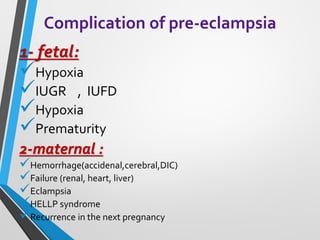
Complication of pre-eclampsia
1- fetal:
✓Hypoxia
✓IUGR , IUFD
✓Hypoxia
✓Prematurity
2-maternal :
✓Hemorrhage(accidenal,cerebral,DIC)
✓Failure (renal, heart, liver)
✓Eclampsia
✓HELLP syndrome
✓Recurrence in the next pregnancy
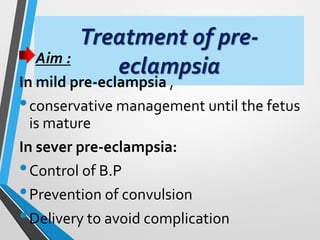
Treatment of pre-
eclampsia
Aim :
In mild pre-eclampsia ,
•conservative management until the fetus
is mature
In sever pre-eclampsia:
•Control of B.P
•Prevention of convulsion
•Delivery to avoid complication
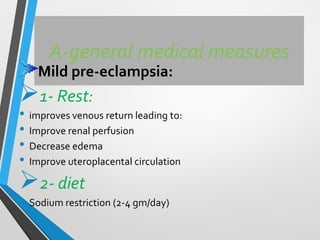
A-general medical measures
Mild pre-eclampsia:
➢1- Rest:
• improves venous return leading to:
• Improve renal perfusion
• Decrease edema
• Improve uteroplacental circulation
➢2- diet
• Sodium restriction (2-4 gm/day)
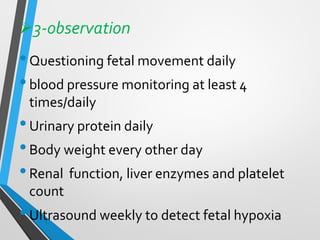
➢3-observation
•Questioning fetal movement daily
•blood pressure monitoring at least 4
times/daily
•Urinary protein daily
•Body weight every other day
•Renal function, liver enzymes and platelet
count
•Ultrasound weekly to detect fetal hypoxia
➢4-mild sedative
➢5- antihypertensive
Aim:
• to decrease the maternal complication
• Alpha methy1 dope is commonly uses
250 mg tablets (maximum 2 gm daily)
N.B : Diuretics are not used m as they will
increase hemoconcentration
B- sever pre-eclampsia
1- Rest in bed : in semi-dark & quite room
2- fluids should not exceed 125ml/hour to
avoid pulmonary edema
3- observation for:
•Vital signs & urine out put
•Signs of toxicity of magnesium sulphate
•Abdominal tenderness to detect
conclead accidental hemorrhage
4-magnesium sulphate
For prevention of convulsion
Mechanism of action:
Central anticonvulsant on the cerebral
cortex
Dose :
Loading dose : 6gm given IV infusion
Maintenance dose : 4 gm/4 hours given
IV infusion
Before administration to prevent
toxicity
a- patellar reflex should be present.
b-The respiratory rate should be more
than 16/min
c-Urine out put should be at least
100ml/4hours.
Side effects:
CNS & respiratory depression
5- emergency antihypertensive:
Aim: to decrease maternal complication
Hydralazine
Action : vasodilator& improve renal perfusion
Dose : 5-10 mg every 20 min till diastolic B.P is 100 mmhg
not less to avoid reduction of placenta perfusion
B-Termination of pregnancy
Advantages:
It reduces complication
Disadvantages
Prematurity
Time of deli vary :
Mild pre-eclampsia: at 37th weeks
Management during labor
• Maternal observation especially B.P
• Observation of FHS by continuous electronic monitoring
E-eclampsia
Definition:
➢Sever pre-eclampsia with convulsion
➢Convulsion due to cerebral edema & hypoxia
Diagnosis
1- History
• The majority of cases are preceded by pre-eclampsia.
• Convulsion before pregnancy must be asked for to exclude
epilepsy
2-signs
• In addition to hypertension,edema,protienuria& there are
convulsions showing
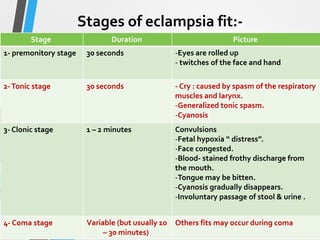
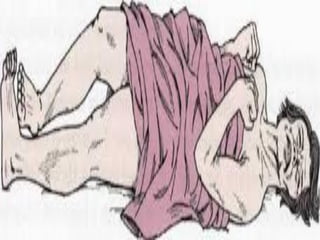
Stages of eclampsia fit:-
Picture
Duration
Stage
-Eyes are rolled up
- twitches of the face and hand
30 seconds
1- premonitory stage
- Cry : caused by spasm of the respiratory
muscles and larynx.
-Generalized tonic spasm.
-Cyanosis
30 seconds
2-Tonic stage
Convulsions
-Fetal hypoxia “ distress”.
-Face congested.
-Blood- stained frothy discharge from
the mouth.
-Tongue may be bitten.
-Cyanosis gradually disappears.
-Involuntary passage of stool & urine .
1 – 2 minutes
3- Clonic stage
Others fits may occur during coma
Variable (but usually 10
– 30 minutes)
4- Coma stage
b-Timing of convulsion:
• Ante partum (65%): convulsion during pregnancy
• Intra partum (20%): convulsion during labor
• Post partum (15%): 24-48 hours after labor
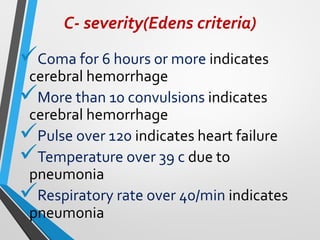
C- severity(Edens criteria)
✓Coma for 6 hours or more indicates
cerebral hemorrhage
✓More than 10 convulsions indicates
cerebral hemorrhage
✓Pulse over 120 indicates heart failure
✓Temperature over 39 c due to
pneumonia
✓Respiratory rate over 40/min indicates
pneumonia
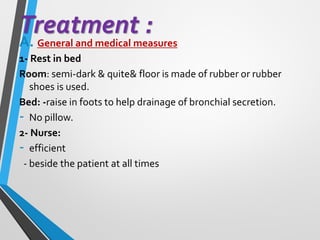
Treatment :
A. General and medical measures
1- Rest in bed
Room: semi-dark & quite& floor is made of rubber or rubber
shoes is used.
Bed: -raise in foots to help drainage of bronchial secretion.
- No pillow.
2- Nurse:
- efficient
- beside the patient at all times
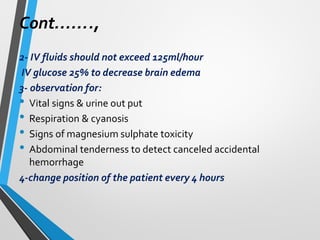
Cont…….,
2- IV fluids should not exceed 125ml/hour
IV glucose 25% to decrease brain edema
3- observation for:
• Vital signs & urine out put
• Respiration & cyanosis
• Signs of magnesium sulphate toxicity
• Abdominal tenderness to detect canceled accidental
hemorrhage
4-change position of the patient every 4 hours
Cont………,
• During convulsion a mouth gag is used to protect the tongue
• Bronchial secretion should be aspirated
5- control of convulsion:
• Magnesium sulphate : the best and the safest drug.
Action :
oCNS depressant
oAnti convulsion
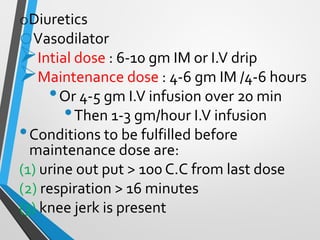
oDiuretics
oVasodilator
➢Intial dose : 6-10 gm IM or I.V drip
➢Maintenance dose : 4-6 gm IM /4-6 hours
•Or 4-5 gm I.V infusion over 20 min
•Then 1-3 gm/hour I.V infusion
•Conditions to be fulfilled before
maintenance dose are:
(1) urine out put > 100 C.C from last dose
(2) respiration > 16 minutes
(3) knee jerk is present
Side effects of magnesium sulphate:
• Maternal :
✓Respiratory depression
✓Cardiac arrest
✓Hypocalcaemic tetany
✓Poor control of fits
✓Post partum hemorrhage
• Fetal :
✓Absent beat or beat variation
✓Respiratory depression
Signs of magnesium sulphate
toxicity
1.Absent knee jerk.
2.Respiratory rate <16 minute.
3.Urine < 100 C.C from last dose.
➢Anti dote :
Calcium gluconate 10 C.C is given if signs
of Mgso4 toxicity.
Cont………..,
5- emergency antihypertensive as
hydralazine
6- oxygen is given
➢Delivery
•If labor does not start spontaneously
within 24 hours after control of fits
delivery is essential as the convulsion
may occur
• Phenytoin : 25 mg/kg initially followed by 500mg IV every
12 hours
• Other drugs : IV diazepam
Nursing Care Plan
For the Woman with Preeclampsia
➢Nursing Diagnosis:
1) Deficient Fluid Volume related to fluid shift from
intravascular to extravascular space secondary to
vasospasm
➢Goal:
Patient will be restored to normal fluid volume levels.
➢Expected Outcome:
The signs and symptoms of preeclampsia will
diminish as evidenced by decreased blood
pressure, urine protein levels of zero, and a
return of the deep tendon reflexes to normal.
➢Nursing intervention:
• Encourage woman to lie in the left lateral recumbent position.
• Assess blood pressure every 1 to 4 hours as necessary.
• Monitor urine for volume and proteinuria every shift or every
hour.
• Assess deep tendon reflexes and clonus.
• Assess for edema.
Cont..,
• Administer magnesium sulfate per infusion pump as ordered.
• Assess for magnesium sulfate toxicity.
• Provide a balanced diet that includes 80 to 100 g/day or 1.5
g/kg/ day of protein.
➢Nursing diagnosis:
2) Ineffective CerebralTissue Perfusion related to interruption
of blood flow, occlusive disorders, hemorrhage, cerebral
vasospasm, cerebral edema.
➢Expectant outcome:
- Maintain a balane input and output with
urinary output greater than 30ml/hr.
➢Nursing intervention:
• Monitor or record the neurological status as often as possible
and compare it to standard or normal state.
• Monitor vital signs.
• Record the data changes such as the blindness of vision, or
visual field disturbances in perception.
• Assess the higher functions, such as speech function.
Cont..,
• Put head slightly elevated position and the anatomical
position (neutral).
• Maintain a state of bed rest, creating a peaceful environment,
limit the activities of visitors or patients as indicated.
• Help prevent the occurrence of straining during defecation
and breathing force (continuous cough).
• Collaboration in oxygen and drugs as indicated
➢Nursing Diagnosis:
3) Risk for impaired in fetal wellbeing related to
uteroplacental insufficiency secondary to vasospasm .
➢Expected Outcome:
• The fetus will have an adequate supply of oxygen and
nutrients as evidenced by absence of signs of non
reassuring fetal status and b fetal diagnostic test results
within normal limits.
➢Nursing intervention:
• Instruct patient to count fetal movements three times
a day for 20 to 30 minutes.
• Encourage patient to rest in the left lateral recumbent
position.
• Continuous electronic fetal monitoring.
• Perform non stress test (NST) as ordered.
• Report any signs of reassuring to physician.
pregnancy-induced-hypertension  final-1.pdf

pregnancy-induced-hypertension final-1.pdf

  • 2.
  • 3.
  • 4.
    Out lines: ▪Definition ofhypertensive disorders of pregnancy. ▪Classification of hypertensive disorders of pregnancy. ▪Definitions of pregnancy-induced hypertension. ▪Causes of pregnancy-induced hypertension.
  • 5.
    Out lines: ✓Pre –eclampsia -Definition – Clinical pictures – Diagnosis –Treatment ✓E-clampsia -Definition – stages of convulsion – severity of convulsion –Treatment
  • 6.
    Hypertensive disorders of pregnancy Definition: Agroup of disorders occurring during pregnancy characterized by one or more of the following signs: • Hypertension • Proteinuria and edema ➢N.B: recently edema/has no diagnostic or prognostic value(it is present in 50% of normal pregnant women)
  • 7.
    Incidence • Hypertensive disordersare among the most significant & still now unresolving problem complicating almost one in ten pregnancies • Responsible for 16% of Maternal Mortality in developing countries • Commonest cause of iatrogenic prematurity accounting 15% of all premature births & 20% of very LBW births
  • 8.
    Hypertension in Pregnancy •Systolic B.P. > 140 mmHg •and/or • Diastolic B.P. > 90 mmHg • Documented on two occasions • At least 6 hours apart • Not more than 7 days apart • Other Criteria (Not part of definition currently) • SBP increased by 30mmHg • DBP increased by 15mmHg
  • 9.
    I. Pre-eclampsia II. Eclampsia III.Pregnancyassociated hypertension IV.Gestational Hypertension V.Super-imposed pre-eclampsia or eclampsia Classification:
  • 11.
    (1) Pre-eclampsia: • Isa development of hypertension with proteinuria, edema or both due to pregnancy after 20th week of pregnancy, followed by return of B.P. to normal within 12 weeks post- partum Preeclampsi a Gestational Hypertensio n Proteinuri a
  • 12.
    (2) Eclampsia: • Generalizedtonic-clonic seizure in a patient with Preeclampsia not attributed to any other cause. Seizure/ Convulsion/ Coma Preeclampsi a Eclampsia ➢N.B:These fits are not caused by any associated neurological disease e.g. epilepsy
  • 13.
    (3)Pregnancy associated hypertension(chronic hypertensivedisease) Presence of persistent hypertension before pregnancy or in the 1st 20 weeks of gestation(in the absence of vesicular mole) or persistent hypertension after 6 weeks post partum.
  • 14.
    ➢causes 1.Essential HTN (MostCommon). 2. Secondary H.T.N : ✓ Endocrine problems ✓ Chronic vascular disease(essential hypertension) ✓ Chronic nephritis ✓ Systematic lupus erythematous
  • 15.
    Chronic Hypertension • Treatmentof mild to moderate chronic hypertension neither benefits the fetus nor prevents preeclampsia. • Excessively lowering blood pressure may result in decreased placental perfusion and adverse perinatal outcomes. • When BP is 150 to 180/100 to 110 mm Hg, pharmacologic treatment is needed to prevent maternal end-organ damage.
  • 16.
    Treatment of ChronicHypertension • labetalol, and nifedipine most common oral agents. • AVOID: atenolol, thiazide diuretics • Women in active labor with uncontrolled severe chronic hypertension require treatment with intravenous labetalol or hydralazine.
  • 17.
    (4)Gestational Hypertension New onsetof hypertension after 20 weeks of gestation without proteinuria, followed by return of B.P. to normal within 12 weeks post-partum.
  • 18.
    :(5)Super imposed hypertension •Development of pre-eclampsia or eclampsia in a patient with chronic hypertensive disease. Diagnosis: • Rise of 30 mmhg in systolic BP and rise of diastolic BP 15 mmhg. • Development of proteinuria in hypertensive patient • Development of hypertension in protienuric patient.
  • 19.
    New onset proteinuriain hypertensive women but no proteinuria before 20 weeks' gestation • A sudden increase in proteinuria or blood pressure or platelet count < 100,000/L in women with hypertension and proteinuria before 20 weeks' gestation
  • 20.
    Pregnancy induced hypertension (pre-eclampsia&Eclampsia) ➢Incidence: • Pre-eclampsia 5-10% of pregnant women • 10-15 % of primi gravid women • Eclampsia 1/1000-1/2000 pregnant wpmen Eclampsia : pre-eclampsia 1 100
  • 21.
    Causes of PIH Notexactly known but common in certain groups of females they are called PIH prone 1. parity ▪ PIH is almost entirely the disease of primigravida especially the elderly ▪ Occur in multi gravida under the following conditions: ✓Those who changed their partner ✓Those who had vesicular mole
  • 22.
    Causes of PIHCont.………, 2- Age 3- Multifetal pregnancy(5times commoner) 4- Chronic hypertension 5- Chronic nephritis 6- Diabetes mellitus 7-Vesicular mole 8- Obesity 9- Family history
  • 23.
    Pathology (1)pathologic physiology: Without knowncause there is failure of of trophoplastic invasion that leading to vasospasm of blood vessels in arteriols which leading to decrease placenral perfusion and leading to IUGR-IUFD
  • 24.
    • The vasospasmcausing release of mediators(toxins) which reach to blood in all organs and causing vascular endothelial cell damage • vascular endothelial cell damage causing constriction and fibrosis to endothelium of blood vessels that destroy blood components and leading to hemolysis
  • 25.
    (2) Pathologic biochemistry: •Dueto constriction of blood vessels endothelium shifting of fluid from intravascular to extravascular causing edema •All blood component at extravascular cells is mostly fluid because hemolysis and that causing DIC
  • 26.
    3-Placental isocheimal theory: oPlacentalischemia leads to decreased kidney function and cause protienurea oDecrease of liver function leading to elevated in liver enzymes oDecrease of brain infusion leading to brain edema
  • 27.
    (4) Pathologic anatomy damage Organ IUGR utero-placenta Epistaxis,DIC like features, hem concentration Hematological Cerebral edema, cerebral hge →seizures CNS Sub endothelial hge , focal necrosis & hge, cardiomyopathy, heart failure Heart Pulmonary edema, hemorrhagic bronchopneumonia Lungs glomerular endotheliosis, oliguria Kidneys Sub capsular hge, ischaemia→periportal necrosis, HELLP liver
  • 28.
    Clinical picture ofpre- eclampsia Signs: 3 cardinal signs: hypertension * protienuria * edema * 1- hypertension: normal 120/80 Diagnosis of hypertension: A. B.P : 140/90 or more B. Rise of systolic B.P >30 mmHg. C. Rise of diastolic B.P >15 mmHg.
  • 29.
    How to MeasureBlood Pressure • Sitting Position • Patient Relaxed • Arm well supported • Measured in right arm • Cuff at heart level • Proper cuff size • At 6 hours from the last meal
  • 30.
    Roll over test: ✓At28-32 weeks, the client is placed in left lateral position for 20 minutes, then rolled into their her back. ✓Blood pressure is taken immediately and 5 minutes later. ✓A 20 mmHg diastolic rise is a response that predicts the development of PIH
  • 31.
    Mean arterial pressure(MAP): • Calculated by adding systolic pressure to twice diastolic pressure then divide the product by three. • An increase of 20 mmHg in MAP is condidered ominous. • A MAP of 100 is abnormal, and a MAP of 105 indicates hypertension.
  • 32.
    2-protienuria Definition: Presence of morethan 0.3 gm/liter in 24-hour urine collection 3- edema (2 types): A.Occult edema: usually develop before H.T.N. edema of the internal organ Diagnosis Excessive weight gain
  • 33.
    B. Clinical edema •usuallydevelop after H.T.N •Edema is detected at the ankle, leg, lower abdominal wall ,face and vulva
  • 34.
    in sever casesonly))symptoms 1-headache: usually frontal 2-Eye symptoms: blurring on vision • Flashes on lights • Blindness 3- oliguria and anuria: • Oliguria:urine output<500 cc /day • Anuria: urine output <100 cc/day or no urine out put. 4-nausea and vomiting 5-epigastric pain
  • 35.
    Preeclampsia • Characterized asmild or severe based on the degree of hypertension and proteinuria, and the presence of symptoms resulting from involvement of the kidneys, brain, liver, and cardiovascular system
  • 36.
    Pre-eclampsia Mild Severe B/P 140/90160/110 Protein 1+ 2+ 3+ 4+ Edema 1+, lower legs 3+ 4+ Weight <1 lb. / week >2lb. / week Reflexes 1+ 2+ brisk 3+ 4+(Hyperreflexia) Clonus present Retina 0 Blurred vision, Scotoma Retinal detachment GI, Hepatic 0 N &V, Epigastric pain, changes in liver enzymes CNS 0 Headache, LOC changes Fetus 0 Premature aging of placenta IUGR; late decelerations
  • 37.
    Investigations 1)complete urine analysis: •a-Albuminb-volume •c-sugar(diabetes) d-casts(chronic nephritis 2) Kidney function tests 3) Assessment of fetal wellbeing -daily fetal movement -Doppler “Biophysical profile”
  • 38.
    4) Blood picture(hemolyticanemia) •N.B: PIH one of the cause of HELLP syndrome H Hemolytic anemia EL Elevated liver enzymes LP Low platelet count
  • 39.
    Sever cases ofpre-eclampsia are characterized :by one or more of the following • BP >180/100 • Protein urea >5gm/Lin 24-hour of urine collection • Oliguria • Visual or cerebral disturbance • Pulmonary edema or cyanosis • Sever epigastric pain
  • 40.
    Complication of pre-eclampsia 1-fetal: ✓Hypoxia ✓IUGR , IUFD ✓Hypoxia ✓Prematurity 2-maternal : ✓Hemorrhage(accidenal,cerebral,DIC) ✓Failure (renal, heart, liver) ✓Eclampsia ✓HELLP syndrome ✓Recurrence in the next pregnancy
  • 41.
    Treatment of pre- eclampsia Aim: In mild pre-eclampsia , •conservative management until the fetus is mature In sever pre-eclampsia: •Control of B.P •Prevention of convulsion •Delivery to avoid complication
  • 42.
    A-general medical measures Mildpre-eclampsia: ➢1- Rest: • improves venous return leading to: • Improve renal perfusion • Decrease edema • Improve uteroplacental circulation ➢2- diet • Sodium restriction (2-4 gm/day)
  • 43.
    ➢3-observation •Questioning fetal movementdaily •blood pressure monitoring at least 4 times/daily •Urinary protein daily •Body weight every other day •Renal function, liver enzymes and platelet count •Ultrasound weekly to detect fetal hypoxia
  • 44.
    ➢4-mild sedative ➢5- antihypertensive Aim: •to decrease the maternal complication • Alpha methy1 dope is commonly uses 250 mg tablets (maximum 2 gm daily) N.B : Diuretics are not used m as they will increase hemoconcentration
  • 45.
    B- sever pre-eclampsia 1-Rest in bed : in semi-dark & quite room 2- fluids should not exceed 125ml/hour to avoid pulmonary edema 3- observation for: •Vital signs & urine out put •Signs of toxicity of magnesium sulphate •Abdominal tenderness to detect conclead accidental hemorrhage
  • 46.
    4-magnesium sulphate For preventionof convulsion Mechanism of action: Central anticonvulsant on the cerebral cortex Dose : Loading dose : 6gm given IV infusion Maintenance dose : 4 gm/4 hours given IV infusion
  • 47.
    Before administration toprevent toxicity a- patellar reflex should be present. b-The respiratory rate should be more than 16/min c-Urine out put should be at least 100ml/4hours. Side effects: CNS & respiratory depression
  • 48.
    5- emergency antihypertensive: Aim:to decrease maternal complication Hydralazine Action : vasodilator& improve renal perfusion Dose : 5-10 mg every 20 min till diastolic B.P is 100 mmhg not less to avoid reduction of placenta perfusion
  • 49.
    B-Termination of pregnancy Advantages: Itreduces complication Disadvantages Prematurity Time of deli vary : Mild pre-eclampsia: at 37th weeks
  • 50.
    Management during labor •Maternal observation especially B.P • Observation of FHS by continuous electronic monitoring
  • 51.
    E-eclampsia Definition: ➢Sever pre-eclampsia withconvulsion ➢Convulsion due to cerebral edema & hypoxia
  • 52.
    Diagnosis 1- History • Themajority of cases are preceded by pre-eclampsia. • Convulsion before pregnancy must be asked for to exclude epilepsy 2-signs • In addition to hypertension,edema,protienuria& there are convulsions showing
  • 53.
    Stages of eclampsiafit:- Picture Duration Stage -Eyes are rolled up - twitches of the face and hand 30 seconds 1- premonitory stage - Cry : caused by spasm of the respiratory muscles and larynx. -Generalized tonic spasm. -Cyanosis 30 seconds 2-Tonic stage Convulsions -Fetal hypoxia “ distress”. -Face congested. -Blood- stained frothy discharge from the mouth. -Tongue may be bitten. -Cyanosis gradually disappears. -Involuntary passage of stool & urine . 1 – 2 minutes 3- Clonic stage Others fits may occur during coma Variable (but usually 10 – 30 minutes) 4- Coma stage
  • 55.
    b-Timing of convulsion: •Ante partum (65%): convulsion during pregnancy • Intra partum (20%): convulsion during labor • Post partum (15%): 24-48 hours after labor
  • 56.
    C- severity(Edens criteria) ✓Comafor 6 hours or more indicates cerebral hemorrhage ✓More than 10 convulsions indicates cerebral hemorrhage ✓Pulse over 120 indicates heart failure ✓Temperature over 39 c due to pneumonia ✓Respiratory rate over 40/min indicates pneumonia
  • 57.
    Treatment : A. Generaland medical measures 1- Rest in bed Room: semi-dark & quite& floor is made of rubber or rubber shoes is used. Bed: -raise in foots to help drainage of bronchial secretion. - No pillow. 2- Nurse: - efficient - beside the patient at all times
  • 58.
    Cont……., 2- IV fluidsshould not exceed 125ml/hour IV glucose 25% to decrease brain edema 3- observation for: • Vital signs & urine out put • Respiration & cyanosis • Signs of magnesium sulphate toxicity • Abdominal tenderness to detect canceled accidental hemorrhage 4-change position of the patient every 4 hours
  • 59.
    Cont………, • During convulsiona mouth gag is used to protect the tongue • Bronchial secretion should be aspirated 5- control of convulsion: • Magnesium sulphate : the best and the safest drug. Action : oCNS depressant oAnti convulsion
  • 60.
    oDiuretics oVasodilator ➢Intial dose :6-10 gm IM or I.V drip ➢Maintenance dose : 4-6 gm IM /4-6 hours •Or 4-5 gm I.V infusion over 20 min •Then 1-3 gm/hour I.V infusion •Conditions to be fulfilled before maintenance dose are: (1) urine out put > 100 C.C from last dose (2) respiration > 16 minutes (3) knee jerk is present
  • 61.
    Side effects ofmagnesium sulphate: • Maternal : ✓Respiratory depression ✓Cardiac arrest ✓Hypocalcaemic tetany ✓Poor control of fits ✓Post partum hemorrhage • Fetal : ✓Absent beat or beat variation ✓Respiratory depression
  • 62.
    Signs of magnesiumsulphate toxicity 1.Absent knee jerk. 2.Respiratory rate <16 minute. 3.Urine < 100 C.C from last dose. ➢Anti dote : Calcium gluconate 10 C.C is given if signs of Mgso4 toxicity.
  • 63.
    Cont……….., 5- emergency antihypertensiveas hydralazine 6- oxygen is given ➢Delivery •If labor does not start spontaneously within 24 hours after control of fits delivery is essential as the convulsion may occur
  • 64.
    • Phenytoin :25 mg/kg initially followed by 500mg IV every 12 hours • Other drugs : IV diazepam
  • 65.
    Nursing Care Plan Forthe Woman with Preeclampsia ➢Nursing Diagnosis: 1) Deficient Fluid Volume related to fluid shift from intravascular to extravascular space secondary to vasospasm ➢Goal: Patient will be restored to normal fluid volume levels.
  • 66.
    ➢Expected Outcome: The signsand symptoms of preeclampsia will diminish as evidenced by decreased blood pressure, urine protein levels of zero, and a return of the deep tendon reflexes to normal.
  • 67.
    ➢Nursing intervention: • Encouragewoman to lie in the left lateral recumbent position. • Assess blood pressure every 1 to 4 hours as necessary. • Monitor urine for volume and proteinuria every shift or every hour. • Assess deep tendon reflexes and clonus. • Assess for edema.
  • 68.
    Cont.., • Administer magnesiumsulfate per infusion pump as ordered. • Assess for magnesium sulfate toxicity. • Provide a balanced diet that includes 80 to 100 g/day or 1.5 g/kg/ day of protein.
  • 69.
    ➢Nursing diagnosis: 2) IneffectiveCerebralTissue Perfusion related to interruption of blood flow, occlusive disorders, hemorrhage, cerebral vasospasm, cerebral edema. ➢Expectant outcome: - Maintain a balane input and output with urinary output greater than 30ml/hr.
  • 70.
    ➢Nursing intervention: • Monitoror record the neurological status as often as possible and compare it to standard or normal state. • Monitor vital signs. • Record the data changes such as the blindness of vision, or visual field disturbances in perception. • Assess the higher functions, such as speech function.
  • 71.
    Cont.., • Put headslightly elevated position and the anatomical position (neutral). • Maintain a state of bed rest, creating a peaceful environment, limit the activities of visitors or patients as indicated. • Help prevent the occurrence of straining during defecation and breathing force (continuous cough). • Collaboration in oxygen and drugs as indicated
  • 72.
    ➢Nursing Diagnosis: 3) Riskfor impaired in fetal wellbeing related to uteroplacental insufficiency secondary to vasospasm . ➢Expected Outcome: • The fetus will have an adequate supply of oxygen and nutrients as evidenced by absence of signs of non reassuring fetal status and b fetal diagnostic test results within normal limits.
  • 73.
    ➢Nursing intervention: • Instructpatient to count fetal movements three times a day for 20 to 30 minutes. • Encourage patient to rest in the left lateral recumbent position. • Continuous electronic fetal monitoring. • Perform non stress test (NST) as ordered. • Report any signs of reassuring to physician.