Pregnancy induced hypertension
Prepared by:
Prativa Kafle
Karishma Thapa
Chitwan Medical College
Definition of PIH
An absolute rise of blood pressure of at least 140/90 mm Hg, if the
previous blood pressure is not known or a rise in systolic pressure of at
least 30 mm Hg, or a rise in diastolic pressure of at least 15 mm Hg over
the previously known blood pressure is called pregnancy induced
hypertension.
Predisposing factors:
• Primigravida
• Maternal age <19, >40 years
• Family history
• Multiple gestation
• Diabetes
• Chronic hypertension
• Chronic renal disease
• Rh incompatibility
• Placenta abnormalities
• Obesity
• Genetic disorder
• Immunological phenomena
• Pre exiting vascular disease
PIH…
It includes
• Gestational hypertension,
• Pre-eclampsia, and
• Eclampsia.
Gestational Hypertension
• A sustained rise of blood pressure to 140/90 mm Hg or more on at
least two occasions 4 or more hours apart beyond the 20th week of
pregnancy or during the first 24 hours after delivery in a previously
normotensive woman is called gestational hypertension.
Causes:
• Pre existing hypertension
• Hypertension
• Kidney disease
• Diabetes mellitus
• Mother age younger than 20 or older than 40
• Multiple fetus
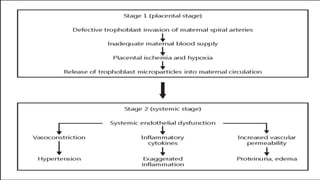
Pathophysiology:
Preeclampsia
• Pre-eclampsia is a multisystem disorder of unknown etiology
characterized by development of hypertension to the extent of 140/90
mm Hg or more with proteinuria after the 20th week in a previously
normotensive and nonproteinuric woman.
• Edema has been excluded from the diagnostic criteria unless it is
pathological
Causes:
• The primary causes is abnormal development of placenta
• The abnormal placentation and decrease placental infusion.
• Large placental mass
• The maternal immune response
Types
• Mild
• Severe
Mild
• This includes cases of sustained rise of blood pressure of more than
140/90 mm Hg but less than 160 mm Hg systolic or 110 mm Hg
diastolic without significant proteinuria.
.
Severe:
• A persistent SBP of >160 mm Hg or DBP of >110 mm Hg.
• Protein excretion of >5 gm/24 hr.
• Oliguria (<400 ml/24 hr.).
• Platelet count < 100,000/mm3.
• HELLP syndrome.
• Cerebral or visual disturbances.
• Persistent severe epigastric pain.
• Retinal hemorrhages, exudates or papilledema.
• IUGR
• Pulmonary edema.
Clinical Features
• Alarming symptoms:
• Headache
• Disturbed sleep
• Diminished urine output
• Epigastric pain
• Eye symptoms: Dimness of vision, blurring
Signs
• Abnormal weight gain
• Rise of blood pressure
• Edema
• Pulmonary edema
• Abdominal examination: scanty liquor or growth retardation of fetus.
Investigations
• Urine
• Ophthalmologic examination
• Blood values
• Antenatal fetal monitoring
Manage on an outpatient basis:
• Monitor blood pressure, urine and fetal condition weekly.
• If blood pressure worsens, manage as mild pre-eclampsia .
• If there are signs of severe fetal growth restriction or fetal
compromise, admit the woman to the hospital for assessment and
possible expedited delivery.
• Counsel the woman and her family about danger signals indicating
preeclampsia or eclampsia.
• If all observations remain stable, allow to proceed with normal labour
and childbirth
Mild pre-eclampsia
a. Gestation less than 37 weeks
• Monitor blood pressure, urine (for proteinuria), reflexes and fetal
condition.
• Counsel the woman and her family about danger signals of severe
preeclampsia or eclampsia.
• Encourage additional periods of rest.
• Encourage the woman to eat a normal diet.
• Do not give anticonvulsants, antihypertensives, sedatives or
tranquillizers.
Contd...
• Do not give diuretics
• If the DBP decreases to normal levels or her condition remains
stable, send the woman home:
• Advise her to rest and to watch out for significant swelling or
symptoms of severe pre-eclampsia;
• See her twice weekly to monitor BP, urine and fetal condition
and to assess for symptoms and signs of severe pre-eclampsia;
• If DBP rises again, readmit her;
Contd...
• If the signs remain unchanged, keep the woman in the hospital.
Continue the same management and monitor fetal growth by
symphysis-fundal height;
• If there are signs of growth restriction, consider early delivery.
If not, continue hospitalization until term.
• If urinary protein level increases, manage as severe pre-eclampsia
b. Gestation more than 37 complete weeks
• If there are signs of fetal compromise (e.g. decreased amniotic fluid,
growth restriction), assess the cervix and expedite delivery:
• If the cervix is favorable, rupture the membranes with an amniotic
hook or a Kocher clamp and induce labor using oxytocin .
• If the cervix is unfavorable, ripen the cervix using prostaglandins or a
Foley catheter or deliver by caesarean section.
Eclampsia
Eclampsia is the new onset of seizure or coma in a pregnant women
with pre eclampsia. These seizure are not related to an brain condition.
Cause of convulsion in Eclampsia
The irritation may be provoked by:
• Anoxia — spasm of the cerebral vessels → increased cerebral
vascular resistance → fall in cerebral oxygen consumption → anoxia,
• Cerebral edema — may contribute to irritation,
• Cerebral dysrhythmia — increases following anoxia or
edema. There is excessive release of excitatory neurotransmitters
(glutamate)
Clinical features of eclampsia
• Eclamptic convulsion or fit: The fits are epileptiform and consist of
four stages.
— Premonitory stage:
• The patient becomes unconscious.
• There is twitching of the muscles of the face, tongue, and limbs.
• Eyeballs roll or are turned to one side and become fixed.
• This stage lasts for about 30 seconds.
Contd...
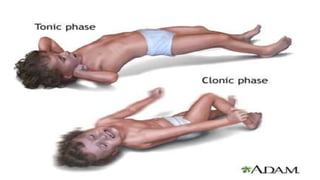
Tonic stage:
• The whole body goes into a tonic spasm--the trunk-opisthotonus,
limbs are flexed and hands clenched.
• Respiration ceases and the tongue protrudes between the teeth.
• Cyanosis appears.
• Eyeballs become fixed.
• This stage lasts for about 30 seconds.
Contd...
Clonic stage:
• All the voluntary muscles undergo alternate contraction and relaxation.
• The twitching start in the face then involve one side of the extremities
and ultimately the whole body is involved in the convulsion.
• Biting of the tongue occurs.
• Breathing is stertorous and blood stained frothy secretions fill the
mouth; cyanosis gradually disappears.
• This stage lasts for 1–4 minutes.
Contd...
Stage of coma:
• Following the fit, the patient passes on to the stage of coma.
• It may last for a brief period or in others deep coma persists till another
convulsion.
• On occasion, the patient appears to be in a confused
state following the fit and fails to remember the happenings.
• Rarely, the coma occurs without prior convulsion
Maternal complications of eclampsia
• Injuries: Tongue bite, injuries due to fall from bed, bed sore.
• Pulmonary complications:
– Edema—due to leaky blood capillaries
– Pneumonia—due to aspiration, hypostatic or infective
– Adult respiratory distress syndrome
– Embolism
• Hyperpyrexia
• Cardiac—Acute left ventricular failure
• Renal failure
• Hepatic—necrosis, Subcapsular hematoma
Contd...
• Cerebral: Edema (vasogenic) hemorrhage
• Neurological deficits
• Disturbed vision: Due to retinal detachment or occipital lobe ischemia.
• Hematological
– Thrombocytopenia
– Disseminated intravascular coagulopathy
• Postpartum
– Shock
– Sepsis
– Psychosis
Management during a convulsion
• Shout for help.
• Gather equipment (airway, suction, mask and bag, oxygen) and give
oxygen at 4–6 L per minute.
• Protect the woman from injury but do not actively restrain her.
• Prepare anticonvulsive drugs
Contd...
• Maintain: airway, breathing & circulation
• Hemodynamic stabilization (control BP)
• Oxygen administration 8–10 L/min
• Organize investigations
• Arrest convulsions
• Deliver by 6-8 hours
• Ventilatory support (if needed)
• Prevention of complications
• Prevention of injury
• Postpartum care (intensive)
General management
• Start an IV infusion and infuse IV fluids
• Monitor vital signs, reflexes and FHR hourly
• If DBP remains above 110 mm Hg, give antihypertensive drugs.
Reduce the diastolic blood pressure to less than 100 mm Hg but not
below 90 mm Hg.
• After the convulsion:
• Give anticonvulsive drugs;
• Position the woman on her left side to reduce risk of aspiration of
secretions, vomit and blood;
• Aspirate the mouth and throat as necessary.
Contd...
• Catheterize the bladder to monitor urine output and proteinuria.
• Maintain a strict fluid balance chart prevent fluid overload.
• If urine output is less than 30 mL per hour:
• Withhold magnesium sulfate and infuse IV fluids (NS or RL) at 1 L
in eight hours;
• Monitor for the development of pulmonary oedema.
• Never leave the woman alone. A convulsion followed by aspiration of
vomit may cause death of the woman and fetus.
Contd...
• Auscultate the lung bases hourly for rales indicating pulmonary
oedema.
• If rales are heard, withhold fluids and give frusemide 40 mg IV once.
• Assess clotting status with a bedside clotting test. Failure of a clot to
form after seven minutes or a soft clot that breaks down easily
suggests coagulopathy
Anticonvulsive drugs
• Magnesium sulfate is the drug of choice for preventing and treating
convulsions in severe pre-eclampsia and eclampsia.
• If magnesium sulfate is not available, diazepam may be used
Contd...
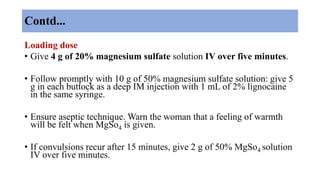
Loading dose
• Give 4 g of 20% magnesium sulfate solution IV over five minutes.
• Follow promptly with 10 g of 50% magnesium sulfate solution: give 5
g in each buttock as a deep IM injection with 1 mL of 2% lignocaine
in the same syringe.
• Ensure aseptic technique. Warn the woman that a feeling of warmth
will be felt when MgSo4 is given.
• If convulsions recur after 15 minutes, give 2 g of 50% MgSo4 solution
IV over five minutes.
Contd...
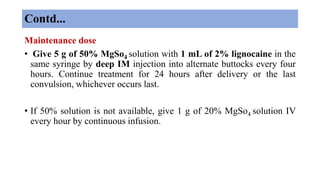
Maintenance dose
• Give 5 g of 50% MgSo4 solution with 1 mL of 2% lignocaine in the
same syringe by deep IM injection into alternate buttocks every four
hours. Continue treatment for 24 hours after delivery or the last
convulsion, whichever occurs last.
• If 50% solution is not available, give 1 g of 20% MgSo4 solution IV
every hour by continuous infusion.
Contd...
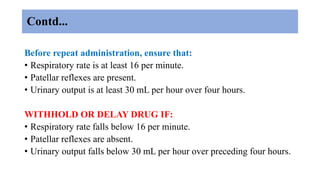
Before repeat administration, ensure that:
• Respiratory rate is at least 16 per minute.
• Patellar reflexes are present.
• Urinary output is at least 30 mL per hour over four hours.
WITHHOLD OR DELAY DRUG IF:
• Respiratory rate falls below 16 per minute.
• Patellar reflexes are absent.
• Urinary output falls below 30 mL per hour over preceding four hours.
Contd...
• Keep antidote ready
• In case of respiratory arrest:
• Assist ventilation (mask and bag, anesthesia apparatus, intubation).
• Give calcium gluconate 1 g (10 mL of 10% solution) IV slowly
until calcium gluconate begins to antagonize the effects of
magnesium sulfate and respiration begins.
Antihypertensive drugs
• If the DBP is 110 mm Hg or more, give antihypertensive drugs.
• The goal is to keep the DBP between 90 mm Hg and 100 mm Hg to
prevent cerebral hemorrhage. Hydralazine is the drug of choice.
• Give hydralazine 5 mg IV slowly every five minutes until blood
pressure is lowered. Repeat hourly as needed or give hydralazine 12.5
mg IM every two hours as needed.
• If hydralazine is not available, give labetalol or nifedipine:
Contd...
• If response to labetalol is inadequate (DBP remains above 110 mm
Hg) after 10 minutes, give labetalol 20 mg IV;
• Nifedipine 5 mg under the tongue
Delivery
• Delivery should take place as soon as the woman’s condition has
stabilized.
• Delivery should occur regardless of the gestational age. Assess the
cervix.
• Favorable cervix: Rupture the membranes and induce labor using
oxytocin.
• Note: In severe pre-eclampsia, delivery should occur within 24
hours of the onset of symptoms. In eclampsia, delivery should
occur within 12 hours of the onset of convulsions
Contd...
• If vaginal delivery is not anticipated within 12 hours (for eclampsia) or
24 hours (for severe pre eclampsia), deliver by CS.
• If there are FHR abnormalities (<100 or > 80 beats per minute),
deliver by CS.
• If the cervix is unfavorable (firm, thick, closed) and the fetus is alive,
deliver by CS.
• If safe anesthesia is not available for caesarean section or if the fetus is
dead or too premature for survival:
• Aim for vaginal delivery;
Contd...
• If the cervix is unfavorable (firm, thick, closed), ripen the cervix using
misoprostol, prostaglandins or a Foley catheter.
• Note: If caesarean section is performed, ensure that:
• Coagulopathy has been ruled out;
• Safe general anesthesia is available. Spinal anesthesia is associated
with the risk of hypotension. This risk can be reduced if adequate IV
fluids (500–1000 ml) are infused prior to administration of the
anesthetic
Postpartum care
• Anticonvulsive therapy should be maintained for 24 hours after
delivery or the last convulsion, whichever occurs last.
• Continue antihypertensive therapy as long as the diastolic pressure is
110 mm Hg or more.
• Continue to monitor urine output.
Referral for tertiary level care
1. Consider referral of women who have:
1. oliguria that persists for 48 hours after delivery;
2. coagulation failure (e.g. coagulopathy or HELLP syndrome);
3. persistent coma lasting more than 24 hours after convulsion
• Write down the management of Pre-eclampsia, and Eclampsia.
Assignment
References
• Fraser DM, Cooper MA. Myles textbook for midwives.15th edition.
Philadelphia: Churchill Livingstone elsevier;2009
• Dutta DC. Textbook of obstetrics. 7th edition. Calcutta:New central
book agency;2014
• Pillitteri A. Maternal and Child health nursing: Care of the
childbearing and childrearing family. 6th edition. Lippincott Williams
and Wilkins : Philadelphia; 2010
• Prasai DS, Bhattarai SG. Midwifery Nursing.PartI.2nd edition.
Kathmandu.Medhavipublication:2011
Pregnancy Induced Hypertension.pptx

Pregnancy Induced Hypertension.pptx

  • 1.
    Pregnancy induced hypertension Preparedby: Prativa Kafle Karishma Thapa Chitwan Medical College
  • 2.
    Definition of PIH Anabsolute rise of blood pressure of at least 140/90 mm Hg, if the previous blood pressure is not known or a rise in systolic pressure of at least 30 mm Hg, or a rise in diastolic pressure of at least 15 mm Hg over the previously known blood pressure is called pregnancy induced hypertension.
  • 3.
    Predisposing factors: • Primigravida •Maternal age <19, >40 years • Family history • Multiple gestation • Diabetes • Chronic hypertension • Chronic renal disease • Rh incompatibility • Placenta abnormalities • Obesity • Genetic disorder • Immunological phenomena • Pre exiting vascular disease
  • 4.
    PIH… It includes • Gestationalhypertension, • Pre-eclampsia, and • Eclampsia.
  • 5.
    Gestational Hypertension • Asustained rise of blood pressure to 140/90 mm Hg or more on at least two occasions 4 or more hours apart beyond the 20th week of pregnancy or during the first 24 hours after delivery in a previously normotensive woman is called gestational hypertension.
  • 6.
    Causes: • Pre existinghypertension • Hypertension • Kidney disease • Diabetes mellitus • Mother age younger than 20 or older than 40 • Multiple fetus
  • 7.
  • 9.
    Preeclampsia • Pre-eclampsia isa multisystem disorder of unknown etiology characterized by development of hypertension to the extent of 140/90 mm Hg or more with proteinuria after the 20th week in a previously normotensive and nonproteinuric woman. • Edema has been excluded from the diagnostic criteria unless it is pathological
  • 10.
    Causes: • The primarycauses is abnormal development of placenta • The abnormal placentation and decrease placental infusion. • Large placental mass • The maternal immune response
  • 11.
  • 12.
    Mild • This includescases of sustained rise of blood pressure of more than 140/90 mm Hg but less than 160 mm Hg systolic or 110 mm Hg diastolic without significant proteinuria.
  • 13.
    . Severe: • A persistentSBP of >160 mm Hg or DBP of >110 mm Hg. • Protein excretion of >5 gm/24 hr. • Oliguria (<400 ml/24 hr.). • Platelet count < 100,000/mm3. • HELLP syndrome. • Cerebral or visual disturbances. • Persistent severe epigastric pain. • Retinal hemorrhages, exudates or papilledema. • IUGR • Pulmonary edema.
  • 14.
    Clinical Features • Alarmingsymptoms: • Headache • Disturbed sleep • Diminished urine output • Epigastric pain • Eye symptoms: Dimness of vision, blurring Signs • Abnormal weight gain • Rise of blood pressure • Edema • Pulmonary edema • Abdominal examination: scanty liquor or growth retardation of fetus.
  • 15.
    Investigations • Urine • Ophthalmologicexamination • Blood values • Antenatal fetal monitoring
  • 16.
    Manage on anoutpatient basis: • Monitor blood pressure, urine and fetal condition weekly. • If blood pressure worsens, manage as mild pre-eclampsia . • If there are signs of severe fetal growth restriction or fetal compromise, admit the woman to the hospital for assessment and possible expedited delivery. • Counsel the woman and her family about danger signals indicating preeclampsia or eclampsia. • If all observations remain stable, allow to proceed with normal labour and childbirth
  • 17.
    Mild pre-eclampsia a. Gestationless than 37 weeks • Monitor blood pressure, urine (for proteinuria), reflexes and fetal condition. • Counsel the woman and her family about danger signals of severe preeclampsia or eclampsia. • Encourage additional periods of rest. • Encourage the woman to eat a normal diet. • Do not give anticonvulsants, antihypertensives, sedatives or tranquillizers.
  • 18.
    Contd... • Do notgive diuretics • If the DBP decreases to normal levels or her condition remains stable, send the woman home: • Advise her to rest and to watch out for significant swelling or symptoms of severe pre-eclampsia; • See her twice weekly to monitor BP, urine and fetal condition and to assess for symptoms and signs of severe pre-eclampsia; • If DBP rises again, readmit her;
  • 19.
    Contd... • If thesigns remain unchanged, keep the woman in the hospital. Continue the same management and monitor fetal growth by symphysis-fundal height; • If there are signs of growth restriction, consider early delivery. If not, continue hospitalization until term. • If urinary protein level increases, manage as severe pre-eclampsia
  • 20.
    b. Gestation morethan 37 complete weeks • If there are signs of fetal compromise (e.g. decreased amniotic fluid, growth restriction), assess the cervix and expedite delivery: • If the cervix is favorable, rupture the membranes with an amniotic hook or a Kocher clamp and induce labor using oxytocin . • If the cervix is unfavorable, ripen the cervix using prostaglandins or a Foley catheter or deliver by caesarean section.
  • 21.
    Eclampsia Eclampsia is thenew onset of seizure or coma in a pregnant women with pre eclampsia. These seizure are not related to an brain condition.
  • 22.
    Cause of convulsionin Eclampsia The irritation may be provoked by: • Anoxia — spasm of the cerebral vessels → increased cerebral vascular resistance → fall in cerebral oxygen consumption → anoxia, • Cerebral edema — may contribute to irritation, • Cerebral dysrhythmia — increases following anoxia or edema. There is excessive release of excitatory neurotransmitters (glutamate)
  • 23.
    Clinical features ofeclampsia • Eclamptic convulsion or fit: The fits are epileptiform and consist of four stages. — Premonitory stage: • The patient becomes unconscious. • There is twitching of the muscles of the face, tongue, and limbs. • Eyeballs roll or are turned to one side and become fixed. • This stage lasts for about 30 seconds.
  • 24.
    Contd... Tonic stage: • Thewhole body goes into a tonic spasm--the trunk-opisthotonus, limbs are flexed and hands clenched. • Respiration ceases and the tongue protrudes between the teeth. • Cyanosis appears. • Eyeballs become fixed. • This stage lasts for about 30 seconds.
  • 25.
    Contd... Clonic stage: • Allthe voluntary muscles undergo alternate contraction and relaxation. • The twitching start in the face then involve one side of the extremities and ultimately the whole body is involved in the convulsion. • Biting of the tongue occurs. • Breathing is stertorous and blood stained frothy secretions fill the mouth; cyanosis gradually disappears. • This stage lasts for 1–4 minutes.
  • 26.
    Contd... Stage of coma: •Following the fit, the patient passes on to the stage of coma. • It may last for a brief period or in others deep coma persists till another convulsion. • On occasion, the patient appears to be in a confused state following the fit and fails to remember the happenings. • Rarely, the coma occurs without prior convulsion
  • 28.
    Maternal complications ofeclampsia • Injuries: Tongue bite, injuries due to fall from bed, bed sore. • Pulmonary complications: – Edema—due to leaky blood capillaries – Pneumonia—due to aspiration, hypostatic or infective – Adult respiratory distress syndrome – Embolism • Hyperpyrexia • Cardiac—Acute left ventricular failure • Renal failure • Hepatic—necrosis, Subcapsular hematoma
  • 29.
    Contd... • Cerebral: Edema(vasogenic) hemorrhage • Neurological deficits • Disturbed vision: Due to retinal detachment or occipital lobe ischemia. • Hematological – Thrombocytopenia – Disseminated intravascular coagulopathy • Postpartum – Shock – Sepsis – Psychosis
  • 30.
    Management during aconvulsion • Shout for help. • Gather equipment (airway, suction, mask and bag, oxygen) and give oxygen at 4–6 L per minute. • Protect the woman from injury but do not actively restrain her. • Prepare anticonvulsive drugs
  • 31.
    Contd... • Maintain: airway,breathing & circulation • Hemodynamic stabilization (control BP) • Oxygen administration 8–10 L/min • Organize investigations • Arrest convulsions • Deliver by 6-8 hours • Ventilatory support (if needed) • Prevention of complications • Prevention of injury • Postpartum care (intensive)
  • 32.
    General management • Startan IV infusion and infuse IV fluids • Monitor vital signs, reflexes and FHR hourly • If DBP remains above 110 mm Hg, give antihypertensive drugs. Reduce the diastolic blood pressure to less than 100 mm Hg but not below 90 mm Hg. • After the convulsion: • Give anticonvulsive drugs; • Position the woman on her left side to reduce risk of aspiration of secretions, vomit and blood; • Aspirate the mouth and throat as necessary.
  • 33.
    Contd... • Catheterize thebladder to monitor urine output and proteinuria. • Maintain a strict fluid balance chart prevent fluid overload. • If urine output is less than 30 mL per hour: • Withhold magnesium sulfate and infuse IV fluids (NS or RL) at 1 L in eight hours; • Monitor for the development of pulmonary oedema. • Never leave the woman alone. A convulsion followed by aspiration of vomit may cause death of the woman and fetus.
  • 34.
    Contd... • Auscultate thelung bases hourly for rales indicating pulmonary oedema. • If rales are heard, withhold fluids and give frusemide 40 mg IV once. • Assess clotting status with a bedside clotting test. Failure of a clot to form after seven minutes or a soft clot that breaks down easily suggests coagulopathy
  • 35.
    Anticonvulsive drugs • Magnesiumsulfate is the drug of choice for preventing and treating convulsions in severe pre-eclampsia and eclampsia. • If magnesium sulfate is not available, diazepam may be used
  • 36.
    Contd... Loading dose • Give4 g of 20% magnesium sulfate solution IV over five minutes. • Follow promptly with 10 g of 50% magnesium sulfate solution: give 5 g in each buttock as a deep IM injection with 1 mL of 2% lignocaine in the same syringe. • Ensure aseptic technique. Warn the woman that a feeling of warmth will be felt when MgSo4 is given. • If convulsions recur after 15 minutes, give 2 g of 50% MgSo4 solution IV over five minutes.
  • 37.
    Contd... Maintenance dose • Give5 g of 50% MgSo4 solution with 1 mL of 2% lignocaine in the same syringe by deep IM injection into alternate buttocks every four hours. Continue treatment for 24 hours after delivery or the last convulsion, whichever occurs last. • If 50% solution is not available, give 1 g of 20% MgSo4 solution IV every hour by continuous infusion.
  • 38.
    Contd... Before repeat administration,ensure that: • Respiratory rate is at least 16 per minute. • Patellar reflexes are present. • Urinary output is at least 30 mL per hour over four hours. WITHHOLD OR DELAY DRUG IF: • Respiratory rate falls below 16 per minute. • Patellar reflexes are absent. • Urinary output falls below 30 mL per hour over preceding four hours.
  • 39.
    Contd... • Keep antidoteready • In case of respiratory arrest: • Assist ventilation (mask and bag, anesthesia apparatus, intubation). • Give calcium gluconate 1 g (10 mL of 10% solution) IV slowly until calcium gluconate begins to antagonize the effects of magnesium sulfate and respiration begins.
  • 40.
    Antihypertensive drugs • Ifthe DBP is 110 mm Hg or more, give antihypertensive drugs. • The goal is to keep the DBP between 90 mm Hg and 100 mm Hg to prevent cerebral hemorrhage. Hydralazine is the drug of choice. • Give hydralazine 5 mg IV slowly every five minutes until blood pressure is lowered. Repeat hourly as needed or give hydralazine 12.5 mg IM every two hours as needed. • If hydralazine is not available, give labetalol or nifedipine:
  • 41.
    Contd... • If responseto labetalol is inadequate (DBP remains above 110 mm Hg) after 10 minutes, give labetalol 20 mg IV; • Nifedipine 5 mg under the tongue
  • 42.
    Delivery • Delivery shouldtake place as soon as the woman’s condition has stabilized. • Delivery should occur regardless of the gestational age. Assess the cervix. • Favorable cervix: Rupture the membranes and induce labor using oxytocin. • Note: In severe pre-eclampsia, delivery should occur within 24 hours of the onset of symptoms. In eclampsia, delivery should occur within 12 hours of the onset of convulsions
  • 43.
    Contd... • If vaginaldelivery is not anticipated within 12 hours (for eclampsia) or 24 hours (for severe pre eclampsia), deliver by CS. • If there are FHR abnormalities (<100 or > 80 beats per minute), deliver by CS. • If the cervix is unfavorable (firm, thick, closed) and the fetus is alive, deliver by CS. • If safe anesthesia is not available for caesarean section or if the fetus is dead or too premature for survival: • Aim for vaginal delivery;
  • 44.
    Contd... • If thecervix is unfavorable (firm, thick, closed), ripen the cervix using misoprostol, prostaglandins or a Foley catheter. • Note: If caesarean section is performed, ensure that: • Coagulopathy has been ruled out; • Safe general anesthesia is available. Spinal anesthesia is associated with the risk of hypotension. This risk can be reduced if adequate IV fluids (500–1000 ml) are infused prior to administration of the anesthetic
  • 45.
    Postpartum care • Anticonvulsivetherapy should be maintained for 24 hours after delivery or the last convulsion, whichever occurs last. • Continue antihypertensive therapy as long as the diastolic pressure is 110 mm Hg or more. • Continue to monitor urine output.
  • 46.
    Referral for tertiarylevel care 1. Consider referral of women who have: 1. oliguria that persists for 48 hours after delivery; 2. coagulation failure (e.g. coagulopathy or HELLP syndrome); 3. persistent coma lasting more than 24 hours after convulsion
  • 47.
    • Write downthe management of Pre-eclampsia, and Eclampsia. Assignment
  • 48.
    References • Fraser DM,Cooper MA. Myles textbook for midwives.15th edition. Philadelphia: Churchill Livingstone elsevier;2009 • Dutta DC. Textbook of obstetrics. 7th edition. Calcutta:New central book agency;2014 • Pillitteri A. Maternal and Child health nursing: Care of the childbearing and childrearing family. 6th edition. Lippincott Williams and Wilkins : Philadelphia; 2010 • Prasai DS, Bhattarai SG. Midwifery Nursing.PartI.2nd edition. Kathmandu.Medhavipublication:2011