Author can be contacted on fidanzasaqibregoo@gmail.com
By: Najmu Saaqib Reegoo
DVM 9th Semester
2015-2019
AUP
Peshawar
“CYSTIC
OVARIAN
DEGENERATION”
In Cattle
Introduction
General Introduction:
• Cystic ovarian degeneration is a pathological condition of dairy cows that results in the formation
of ovarian cysts secondary to anovulation of pre-ovulatory follicles.
• The condition can occur anytime during the lactation period but the incidence reportedly is higher
between 40-150 days post parturition or between 31-60 days and 120-201 days post parturition.
• The positive feedback of the esterdiol on release of GnRH is compromised. Therefore, although
the pituitary gland is able to release LH in cows with ovarian cysts, function of the hypothalamic-
pituitary-ovarian axis is altered.
• When a preovulatory follicle fails to ovulate, a transient increase in FSH concentration stimulates
new wave of follicular development under conditions of low progesterone concentration and high
LH concentration, which causes excessive growth of dominant follicles. These follicles produce
large amounts of esterdiol and inhibin, which are responsible for a delay in follicular turnover.
• Ovarian Cyst (OC) is an important ovarian dysfunction and a major cause of reproductive failure in
dairy cattle.
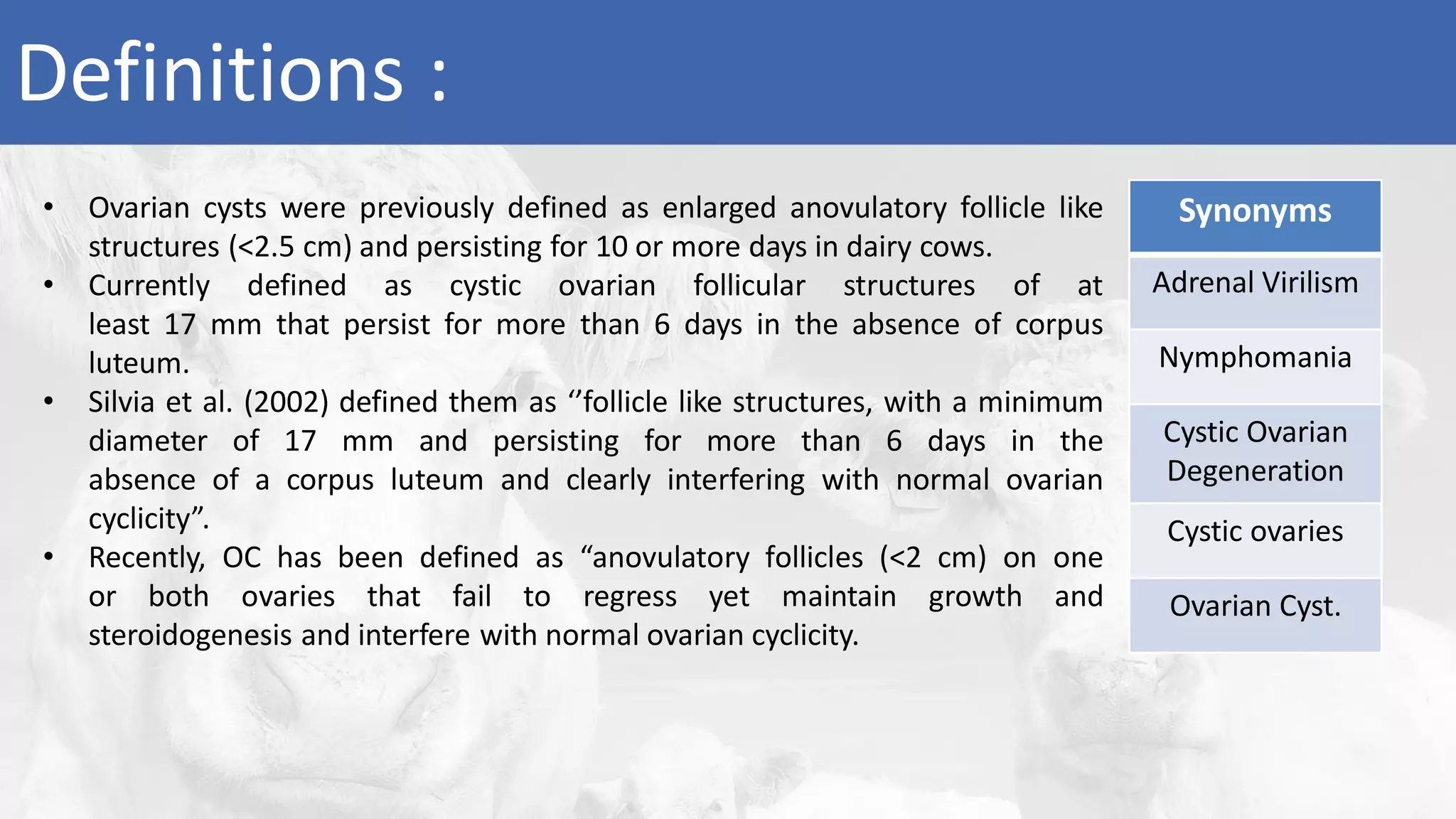
• Ovarian cysts were previously defined as enlarged anovulatory follicle like
structures (<2.5 cm) and persisting for 10 or more days in dairy cows.
• Currently defined as cystic ovarian follicular structures of at
least 17 mm that persist for more than 6 days in the absence of corpus
luteum.
• Silvia et al. (2002) defined them as ‘’follicle like structures, with a minimum
diameter of 17 mm and persisting for more than 6 days in the
absence of a corpus luteum and clearly interfering with normal ovarian
cyclicity”.
• Recently, OC has been defined as “anovulatory follicles (<2 cm) on one
or both ovaries that fail to regress yet maintain growth and
steroidogenesis and interfere with normal ovarian cyclicity.
Synonyms
Adrenal Virilism
Nymphomania
Cystic Ovarian
Degeneration
Cystic ovaries
Ovarian Cyst.
Definitions :
• The absence of a corpus luteum is an essential OC criterion.
• The condition is a consequence of a mature follicle that fails to ovulate at the appointed time of
ovulation during the estrous cycle (Peter, 2004).
• Research using ovarian ultrasonography indicates that follicles typically ovulate at 13-17 mm in
diameter (Ginther et al., 1989) so follicles that persist at that diameter or greater may be considered
to be cystic.
• On average, cysts are maintained for 13 days i.e follicular turnover in cows with ovarian cysts takes
13 to 19 days, whereas in clinically normal cows, it occurs every 8.5 days .
• In most cases (62-85%), cows with luteinized cysts remain anoestrous, as a result of the production
of progesterone by luteinized cysts.
• Ball and Peters (2004) refer to these cysts as luteinized cystic follicles, describing them as cysts with
thicker walls that produce high levels of progesterone.
Etiology:
The exact factors responsible for cyst formations are unknown.
However researchers believe that a malfunction in the pre-
ovulatory release of luteinizing hormone is responsible.
When cysts develop, follicles enlarge to an abnormal size instead
of ovulating and releasing an egg (Figure 2). The presence of cysts
prevents the cow from having normal 21 day estrous cycles.
Therefore, the cow cannot be bred, and pregnancy will be delayed
until the cyst(s) regresses spontaneously or responds to
treatment.
This decline in the incidence of ovarian cysts implicates genetics as
having a major role in the transmission of cystic ovarian disease
from one generation to the next. Therefore, culling cows and
heifers with ovarian cysts would appear to be one method of
permanently decreasing the occurrence of ovarian cysts in dairy
herds.
Ovarian cysts and normal pre-ovulatory follicles are differentiated
on the basis of number, size but most importantly uterine tonicity
(main aspect).
Nutrition:
Comprehensive studies have not demonstrated a link between nutrition and ovarian cysts in
dairy cattle when experiments were conducted with properly balanced rations. However, it is of
utmost importance that rations be properly balanced and provided in adequate amounts to meet
the requirements of milking cows.
Production Influences:
Although it is a common belief that high producers may be more prone to develop ovarian cysts,
no experimental data supports this contention. Increased milk production may be a result of the
altered hormone environment that occurs with ovarian cysts rather than a cause of ovarian cysts.
Factors associated with high incidence:
• Metabolic disorders,
• Stress,
• Uterine infection and lameness.
• Genetic predisposition may also be involved.
Types:
Occurs when a follicle reaches to an ovulatory size (17-19 mm) but fails to rupture a
nd continues to grow, thus leads to a large persistent cyst called follicular cyst.
There can be a single cyst or multiple cysts on one or both the ovaries.
In the figure, the appearance on ultrasound for follicular cyst is clear as large cystic
structure with a very thin outer wall with black fluid, extending the outer edges.
Adjacent to this is another follicular cyst. Rupture of these cysts is quite easy from
rectal palpation, which can traumatize the ovary leading to hemorrhaging, and
possible adhesion formation on the ovary.
(A) Follicular cyst:
(B) Luteal cyst:
When a corpus luteum fails to involute and continues to grow as a cyst, it is a luteal
cyst. They are believed to develop from follicular cysts that have continued to
develop into their later stages.
They have a thicker wall of luteal tissue around their edges. The major difference
between the two is that the luteal cysts luteinize primarily and have different
shapes depending upon the rate of luteinisation.
Appearance of “cobwebs” within the lumen of the luteal cyst where the cyst appear
depict an attempt of further luteinisation.
Follicular Cyst vs Luteal Cysts.
Parameter Follicular cysts Luteal Cysts
Structure Thin- walled, thickened theca layer
+ variable amount of granulosa cells
Thick walled + luteal tissue lining inside follicle
No of cysts per ovary
Progesterone
Single or multiple
<1ng/ml on analysis
Usually single on one
>1ng/ml on analysis.
Ovary distribution One or both One
Behaviour (cows) Anestrus
Erratic estrus
Nymphomania
Anestrus ( Usually)
Recovery chances without treatment 30-70 % Same
Recommended treatment 100 ug GnRH followed by PG 9 days later may be
administered too.
Same Rx
Days to estrus after Rx 21 days without PG
12 days with PG
Same
Treatment response 60-70 % 70-80 %
Conception rate at first estrus after Rx 45-60 % Same
Diagnosis
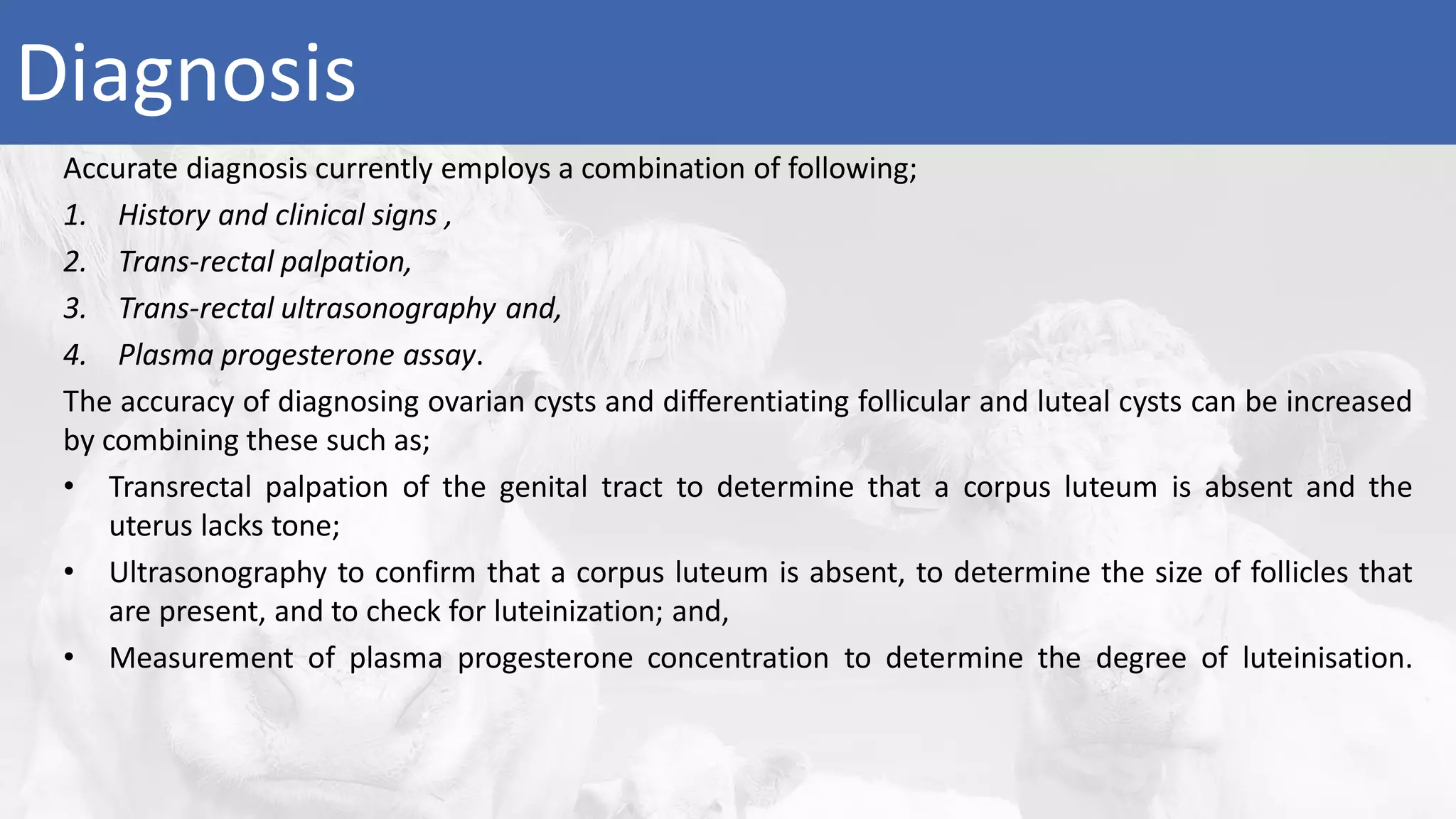
Accurate diagnosis currently employs a combination of following;
1. History and clinical signs ,
2. Trans-rectal palpation,
3. Trans-rectal ultrasonography and,
4. Plasma progesterone assay.
The accuracy of diagnosing ovarian cysts and differentiating follicular and luteal cysts can be increased
by combining these such as;
• Transrectal palpation of the genital tract to determine that a corpus luteum is absent and the
uterus lacks tone;
• Ultrasonography to confirm that a corpus luteum is absent, to determine the size of follicles that
are present, and to check for luteinization; and,
• Measurement of plasma progesterone concentration to determine the degree of luteinisation.
Clinical and Physical Signs:
The physical signs associated with OC according to Williams and Williams in 1923:
1. Loss of tonicity throughout the female genital tract,
2. Relaxation or stretching of the sacro-sciatic and sacro-iliac ligaments giving the raised tail head
appearance,
3. Behavioural changes (buller cow; pawing the ground, bellowing),
Irregular oestrus intervals and development of masculine physical traits are other signs which
may be present especially later during lactation.
4. Nymphomania (i.e., excessive mounting, standing, and bawling with noticeably deeper tone)
5. Erratic milk production ( abrupt changes )
The clinical signs though are variable, anoestrus is most common, especially during the postpartum
period . Nymphomania and irregular cycles are commonly seen too.
Ovarian cysts diagnosed after the puerperium had a negative effect on fertility, whereas when cysts are
diagnosed during the puerperium they do not affect reproduction.
Puerperium is the period of about six weeks postparturition during which the mother's reproductive organs
return to their original non-pregnant condition.
Ovarian Impairment: The most likely time of diagnosis is 30-60 day after parturition in high-yielding dairy
cows but the detection of anovulatory follicles during the first weeks after calving should not be considered
an ovarian impairment
On Transrectal Palpation:
Ovarian cysts are identified as multiple follicles, typically larger than normal ovulatory follicles with an
increased overall ovarian diameter along with a flaccid uterus in the absence of a corpus luteum, while cows
in proestrus have an erect and turgid uterus.
OC differentiated from shallow anestrus: On the basis of,
1. Number,
2. Size,
3. Occurrence of follicular waves,
4. Body condition score (BCS), and,
5. Stage of lactation
Treatment
Treatments for OC are numerous and variable.
Treatment originally consisted of administration of exogenous compounds with LH activity to induce LH release that may
stimulate lutenisation of the cyst and ovulation of follicles resolving the cystic condition.
Many endocrine based treatments for cysts have been evaluated including steroids, gonadotropins and GnRH
Earliest treatments include:
1. Manual rupture, (In the past, manual rupture of OC had been suggested (Roberts, 1971) however, recently it has been
mentioned that this method should be weighed against the cost of hormone therapy), Later it was not recommended
by Brito & Palmer (2004) because it may result in trauma and hemorrhage causing adhesions and contributing to
fertility reduction
2. Ovariectomy,
3. Injection of ovarian extract,
4. Injection of CL extract,
5. Uterine infusions of antibiotics or antiseptics,
6. Injections of adrenaline chloride and Pituitrin.
Roberts (1986) refuted ovariectomy as a treatment option suggesting that spaying will correct nymphomania but the
removal of only one ovary if it is affected with cysts is useless, since the remaining ovary will promptly develop cysts
Current Treatments :
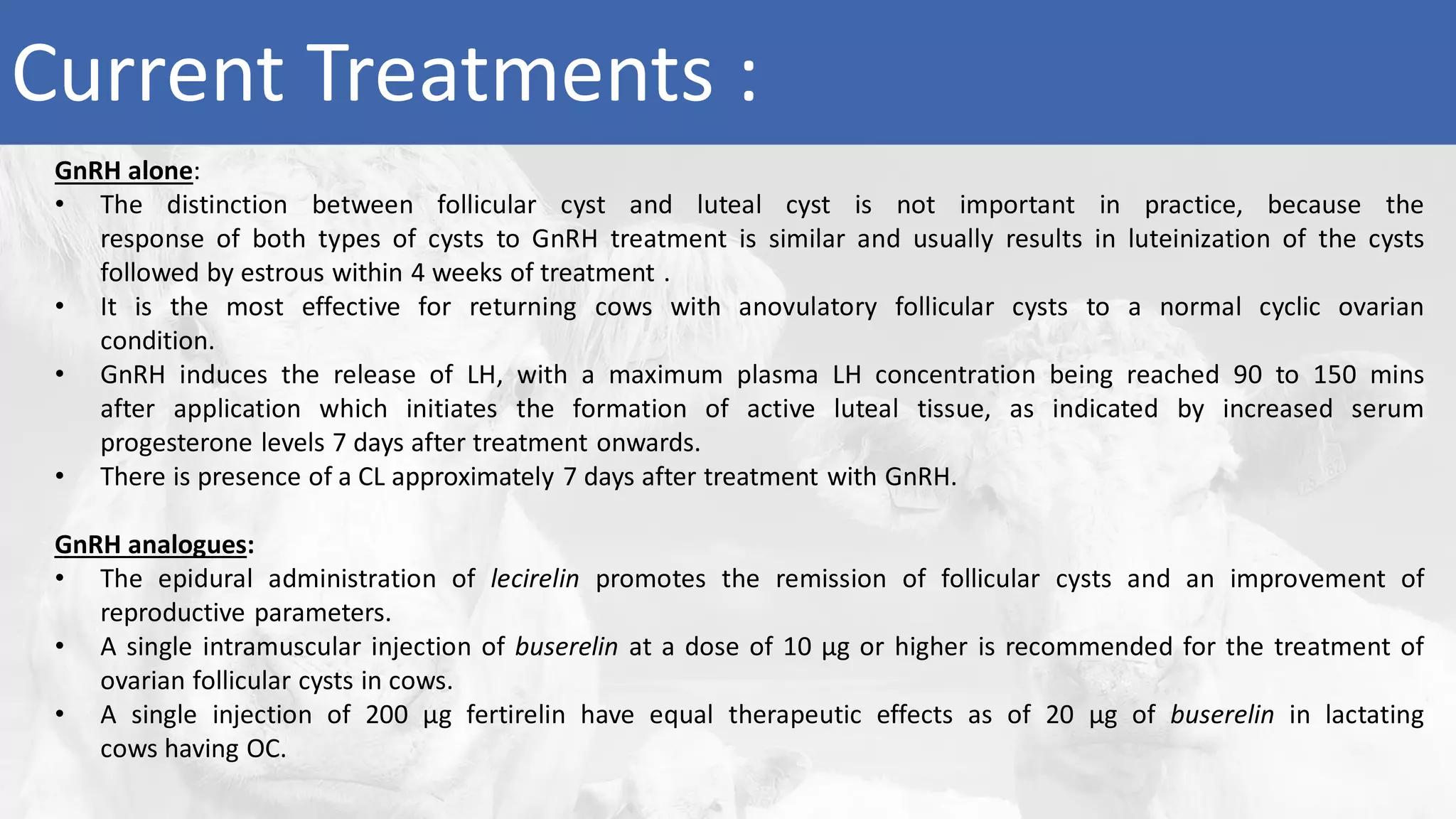
GnRH alone:
• The distinction between follicular cyst and luteal cyst is not important in practice, because the
response of both types of cysts to GnRH treatment is similar and usually results in luteinization of the cysts
followed by estrous within 4 weeks of treatment .
• It is the most effective for returning cows with anovulatory follicular cysts to a normal cyclic ovarian
condition.
• GnRH induces the release of LH, with a maximum plasma LH concentration being reached 90 to 150 mins
after application which initiates the formation of active luteal tissue, as indicated by increased serum
progesterone levels 7 days after treatment onwards.
• There is presence of a CL approximately 7 days after treatment with GnRH.
GnRH analogues:
• The epidural administration of lecirelin promotes the remission of follicular cysts and an improvement of
reproductive parameters.
• A single intramuscular injection of buserelin at a dose of 10 μg or higher is recommended for the treatment of
ovarian follicular cysts in cows.
• A single injection of 200 µg fertirelin have equal therapeutic effects as of 20 µg of buserelin in lactating
cows having OC.
hCG treatment:
• GnRH and hCG elicit equivalent endocrine and clinical responses, but GnRH has an advantage over hCG in
its minimal antigenicity.
• The treatment of OC with hCG is somewhat more effective than a treatment with hCG + P4.
• Both treatments appear to be equally effective with regards to treatment response and fertility but the next
estrus would occur 5-21 days after treatment.
Progesterone:
• Administration of Progesterone has been successfully used in the treatment of cows with follicular cysts.
Various progesterone intravaginal devices such as Progesterone releasing intravaginal device (PRID) and
Controlled internal drug releasing insert (CIDR) have been used.
• PRID treated follicular cystic cows respond with the formation of a CL in 14 days after treatment and this
results in ovulation 2-4 days after completion of CL formation.
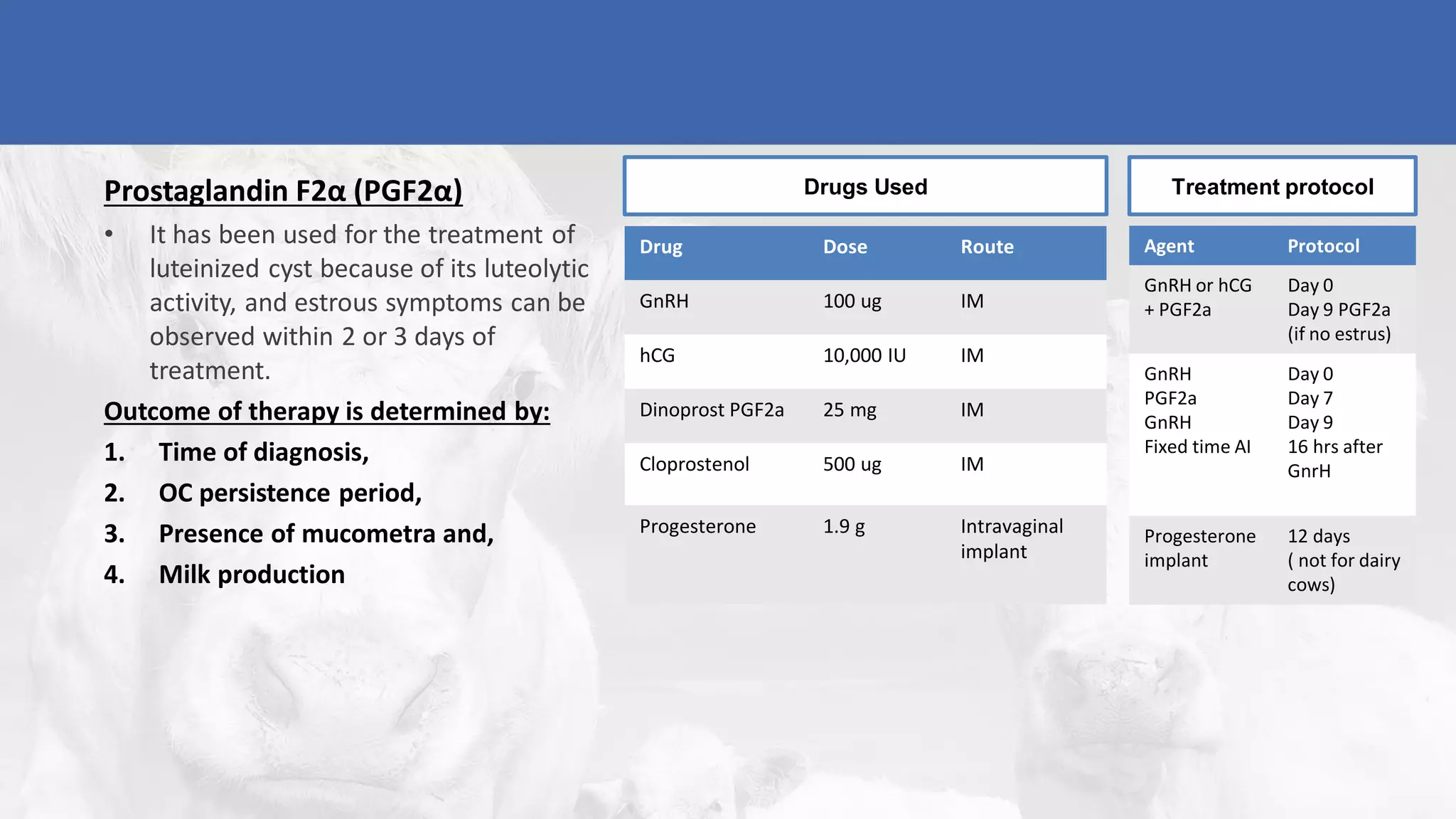
Prostaglandin F2α (PGF2α)
• It has been used for the treatment of
luteinized cyst because of its luteolytic
activity, and estrous symptoms can be
observed within 2 or 3 days of
treatment.
Outcome of therapy is determined by:
1. Time of diagnosis,
2. OC persistence period,
3. Presence of mucometra and,
4. Milk production
Drug Dose Route
GnRH 100 ug IM
hCG 10,000 IU IM
Dinoprost PGF2a 25 mg IM
Cloprostenol 500 ug IM
Progesterone 1.9 g Intravaginal
implant
Agent Protocol
GnRH or hCG
+ PGF2a
Day 0
Day 9 PGF2a
(if no estrus)
GnRH
PGF2a
GnRH
Fixed time AI
Day 0
Day 7
Day 9
16 hrs after
GnrH
Progesterone
implant
12 days
( not for dairy
cows)
Treatment protocolDrugs Used
References
Ovarian cysts in dairy cows: old and new concepts for definition, diagnosis and therapy, K. Jeengar, V. Chaudhary, A.
Kumar, S. Raiya, M. Gaur, G.N. Purohit1.
Strategies for the diagnosis and treatment of ovarian cysts in diary cattle; Julian A. Bartolome, William W. Thatcher, Pedro
Melendez, Carlos A. Risco, Louis F. Archbald el. al
Cystic Ovarian disease in cattle by Leonardo Brito, ABS Global Inc, January 2004 s publication at:
https://www.researchgate.net/publication/213860186
___________________________________________________________________
___________________________________________________________________
___________________________________________________________________
___________________________________________________________________
___________________________________________________________________
___________________________________________________________________

Cystic ovarian degeneration Dr. Najmu Saaqib Reegoo DVM

  • 1.
    Author can becontacted on fidanzasaqibregoo@gmail.com By: Najmu Saaqib Reegoo DVM 9th Semester 2015-2019 AUP Peshawar “CYSTIC OVARIAN DEGENERATION” In Cattle
  • 2.
    Introduction General Introduction: • Cysticovarian degeneration is a pathological condition of dairy cows that results in the formation of ovarian cysts secondary to anovulation of pre-ovulatory follicles. • The condition can occur anytime during the lactation period but the incidence reportedly is higher between 40-150 days post parturition or between 31-60 days and 120-201 days post parturition. • The positive feedback of the esterdiol on release of GnRH is compromised. Therefore, although the pituitary gland is able to release LH in cows with ovarian cysts, function of the hypothalamic- pituitary-ovarian axis is altered. • When a preovulatory follicle fails to ovulate, a transient increase in FSH concentration stimulates new wave of follicular development under conditions of low progesterone concentration and high LH concentration, which causes excessive growth of dominant follicles. These follicles produce large amounts of esterdiol and inhibin, which are responsible for a delay in follicular turnover. • Ovarian Cyst (OC) is an important ovarian dysfunction and a major cause of reproductive failure in dairy cattle.
  • 3.
    • Ovarian cystswere previously defined as enlarged anovulatory follicle like structures (<2.5 cm) and persisting for 10 or more days in dairy cows. • Currently defined as cystic ovarian follicular structures of at least 17 mm that persist for more than 6 days in the absence of corpus luteum. • Silvia et al. (2002) defined them as ‘’follicle like structures, with a minimum diameter of 17 mm and persisting for more than 6 days in the absence of a corpus luteum and clearly interfering with normal ovarian cyclicity”. • Recently, OC has been defined as “anovulatory follicles (<2 cm) on one or both ovaries that fail to regress yet maintain growth and steroidogenesis and interfere with normal ovarian cyclicity. Synonyms Adrenal Virilism Nymphomania Cystic Ovarian Degeneration Cystic ovaries Ovarian Cyst. Definitions :
  • 4.
    • The absenceof a corpus luteum is an essential OC criterion. • The condition is a consequence of a mature follicle that fails to ovulate at the appointed time of ovulation during the estrous cycle (Peter, 2004). • Research using ovarian ultrasonography indicates that follicles typically ovulate at 13-17 mm in diameter (Ginther et al., 1989) so follicles that persist at that diameter or greater may be considered to be cystic. • On average, cysts are maintained for 13 days i.e follicular turnover in cows with ovarian cysts takes 13 to 19 days, whereas in clinically normal cows, it occurs every 8.5 days . • In most cases (62-85%), cows with luteinized cysts remain anoestrous, as a result of the production of progesterone by luteinized cysts. • Ball and Peters (2004) refer to these cysts as luteinized cystic follicles, describing them as cysts with thicker walls that produce high levels of progesterone.
  • 5.
    Etiology: The exact factorsresponsible for cyst formations are unknown. However researchers believe that a malfunction in the pre- ovulatory release of luteinizing hormone is responsible. When cysts develop, follicles enlarge to an abnormal size instead of ovulating and releasing an egg (Figure 2). The presence of cysts prevents the cow from having normal 21 day estrous cycles. Therefore, the cow cannot be bred, and pregnancy will be delayed until the cyst(s) regresses spontaneously or responds to treatment. This decline in the incidence of ovarian cysts implicates genetics as having a major role in the transmission of cystic ovarian disease from one generation to the next. Therefore, culling cows and heifers with ovarian cysts would appear to be one method of permanently decreasing the occurrence of ovarian cysts in dairy herds. Ovarian cysts and normal pre-ovulatory follicles are differentiated on the basis of number, size but most importantly uterine tonicity (main aspect).
  • 6.
    Nutrition: Comprehensive studies havenot demonstrated a link between nutrition and ovarian cysts in dairy cattle when experiments were conducted with properly balanced rations. However, it is of utmost importance that rations be properly balanced and provided in adequate amounts to meet the requirements of milking cows. Production Influences: Although it is a common belief that high producers may be more prone to develop ovarian cysts, no experimental data supports this contention. Increased milk production may be a result of the altered hormone environment that occurs with ovarian cysts rather than a cause of ovarian cysts. Factors associated with high incidence: • Metabolic disorders, • Stress, • Uterine infection and lameness. • Genetic predisposition may also be involved.
  • 7.
    Types: Occurs when afollicle reaches to an ovulatory size (17-19 mm) but fails to rupture a nd continues to grow, thus leads to a large persistent cyst called follicular cyst. There can be a single cyst or multiple cysts on one or both the ovaries. In the figure, the appearance on ultrasound for follicular cyst is clear as large cystic structure with a very thin outer wall with black fluid, extending the outer edges. Adjacent to this is another follicular cyst. Rupture of these cysts is quite easy from rectal palpation, which can traumatize the ovary leading to hemorrhaging, and possible adhesion formation on the ovary. (A) Follicular cyst: (B) Luteal cyst: When a corpus luteum fails to involute and continues to grow as a cyst, it is a luteal cyst. They are believed to develop from follicular cysts that have continued to develop into their later stages. They have a thicker wall of luteal tissue around their edges. The major difference between the two is that the luteal cysts luteinize primarily and have different shapes depending upon the rate of luteinisation. Appearance of “cobwebs” within the lumen of the luteal cyst where the cyst appear depict an attempt of further luteinisation.
  • 8.
    Follicular Cyst vsLuteal Cysts. Parameter Follicular cysts Luteal Cysts Structure Thin- walled, thickened theca layer + variable amount of granulosa cells Thick walled + luteal tissue lining inside follicle No of cysts per ovary Progesterone Single or multiple <1ng/ml on analysis Usually single on one >1ng/ml on analysis. Ovary distribution One or both One Behaviour (cows) Anestrus Erratic estrus Nymphomania Anestrus ( Usually) Recovery chances without treatment 30-70 % Same Recommended treatment 100 ug GnRH followed by PG 9 days later may be administered too. Same Rx Days to estrus after Rx 21 days without PG 12 days with PG Same Treatment response 60-70 % 70-80 % Conception rate at first estrus after Rx 45-60 % Same
  • 9.
    Diagnosis Accurate diagnosis currentlyemploys a combination of following; 1. History and clinical signs , 2. Trans-rectal palpation, 3. Trans-rectal ultrasonography and, 4. Plasma progesterone assay. The accuracy of diagnosing ovarian cysts and differentiating follicular and luteal cysts can be increased by combining these such as; • Transrectal palpation of the genital tract to determine that a corpus luteum is absent and the uterus lacks tone; • Ultrasonography to confirm that a corpus luteum is absent, to determine the size of follicles that are present, and to check for luteinization; and, • Measurement of plasma progesterone concentration to determine the degree of luteinisation.
  • 10.
    Clinical and PhysicalSigns: The physical signs associated with OC according to Williams and Williams in 1923: 1. Loss of tonicity throughout the female genital tract, 2. Relaxation or stretching of the sacro-sciatic and sacro-iliac ligaments giving the raised tail head appearance, 3. Behavioural changes (buller cow; pawing the ground, bellowing), Irregular oestrus intervals and development of masculine physical traits are other signs which may be present especially later during lactation. 4. Nymphomania (i.e., excessive mounting, standing, and bawling with noticeably deeper tone) 5. Erratic milk production ( abrupt changes ) The clinical signs though are variable, anoestrus is most common, especially during the postpartum period . Nymphomania and irregular cycles are commonly seen too.
  • 11.
    Ovarian cysts diagnosedafter the puerperium had a negative effect on fertility, whereas when cysts are diagnosed during the puerperium they do not affect reproduction. Puerperium is the period of about six weeks postparturition during which the mother's reproductive organs return to their original non-pregnant condition. Ovarian Impairment: The most likely time of diagnosis is 30-60 day after parturition in high-yielding dairy cows but the detection of anovulatory follicles during the first weeks after calving should not be considered an ovarian impairment On Transrectal Palpation: Ovarian cysts are identified as multiple follicles, typically larger than normal ovulatory follicles with an increased overall ovarian diameter along with a flaccid uterus in the absence of a corpus luteum, while cows in proestrus have an erect and turgid uterus. OC differentiated from shallow anestrus: On the basis of, 1. Number, 2. Size, 3. Occurrence of follicular waves, 4. Body condition score (BCS), and, 5. Stage of lactation
  • 12.
    Treatment Treatments for OCare numerous and variable. Treatment originally consisted of administration of exogenous compounds with LH activity to induce LH release that may stimulate lutenisation of the cyst and ovulation of follicles resolving the cystic condition. Many endocrine based treatments for cysts have been evaluated including steroids, gonadotropins and GnRH Earliest treatments include: 1. Manual rupture, (In the past, manual rupture of OC had been suggested (Roberts, 1971) however, recently it has been mentioned that this method should be weighed against the cost of hormone therapy), Later it was not recommended by Brito & Palmer (2004) because it may result in trauma and hemorrhage causing adhesions and contributing to fertility reduction 2. Ovariectomy, 3. Injection of ovarian extract, 4. Injection of CL extract, 5. Uterine infusions of antibiotics or antiseptics, 6. Injections of adrenaline chloride and Pituitrin. Roberts (1986) refuted ovariectomy as a treatment option suggesting that spaying will correct nymphomania but the removal of only one ovary if it is affected with cysts is useless, since the remaining ovary will promptly develop cysts
  • 13.
    Current Treatments : GnRHalone: • The distinction between follicular cyst and luteal cyst is not important in practice, because the response of both types of cysts to GnRH treatment is similar and usually results in luteinization of the cysts followed by estrous within 4 weeks of treatment . • It is the most effective for returning cows with anovulatory follicular cysts to a normal cyclic ovarian condition. • GnRH induces the release of LH, with a maximum plasma LH concentration being reached 90 to 150 mins after application which initiates the formation of active luteal tissue, as indicated by increased serum progesterone levels 7 days after treatment onwards. • There is presence of a CL approximately 7 days after treatment with GnRH. GnRH analogues: • The epidural administration of lecirelin promotes the remission of follicular cysts and an improvement of reproductive parameters. • A single intramuscular injection of buserelin at a dose of 10 μg or higher is recommended for the treatment of ovarian follicular cysts in cows. • A single injection of 200 µg fertirelin have equal therapeutic effects as of 20 µg of buserelin in lactating cows having OC.
  • 14.
    hCG treatment: • GnRHand hCG elicit equivalent endocrine and clinical responses, but GnRH has an advantage over hCG in its minimal antigenicity. • The treatment of OC with hCG is somewhat more effective than a treatment with hCG + P4. • Both treatments appear to be equally effective with regards to treatment response and fertility but the next estrus would occur 5-21 days after treatment. Progesterone: • Administration of Progesterone has been successfully used in the treatment of cows with follicular cysts. Various progesterone intravaginal devices such as Progesterone releasing intravaginal device (PRID) and Controlled internal drug releasing insert (CIDR) have been used. • PRID treated follicular cystic cows respond with the formation of a CL in 14 days after treatment and this results in ovulation 2-4 days after completion of CL formation.
  • 15.
    Prostaglandin F2α (PGF2α) •It has been used for the treatment of luteinized cyst because of its luteolytic activity, and estrous symptoms can be observed within 2 or 3 days of treatment. Outcome of therapy is determined by: 1. Time of diagnosis, 2. OC persistence period, 3. Presence of mucometra and, 4. Milk production Drug Dose Route GnRH 100 ug IM hCG 10,000 IU IM Dinoprost PGF2a 25 mg IM Cloprostenol 500 ug IM Progesterone 1.9 g Intravaginal implant Agent Protocol GnRH or hCG + PGF2a Day 0 Day 9 PGF2a (if no estrus) GnRH PGF2a GnRH Fixed time AI Day 0 Day 7 Day 9 16 hrs after GnrH Progesterone implant 12 days ( not for dairy cows) Treatment protocolDrugs Used
  • 16.
    References Ovarian cysts indairy cows: old and new concepts for definition, diagnosis and therapy, K. Jeengar, V. Chaudhary, A. Kumar, S. Raiya, M. Gaur, G.N. Purohit1. Strategies for the diagnosis and treatment of ovarian cysts in diary cattle; Julian A. Bartolome, William W. Thatcher, Pedro Melendez, Carlos A. Risco, Louis F. Archbald el. al Cystic Ovarian disease in cattle by Leonardo Brito, ABS Global Inc, January 2004 s publication at: https://www.researchgate.net/publication/213860186 ___________________________________________________________________ ___________________________________________________________________ ___________________________________________________________________ ___________________________________________________________________ ___________________________________________________________________ ___________________________________________________________________