SUSAN SCHOENIAN (Shāy-nē-ŭn)
Sheep & Goat Specialist
Western Maryland Research & Education Center
sschoen@umd.edu - www.sheepandgoat.com


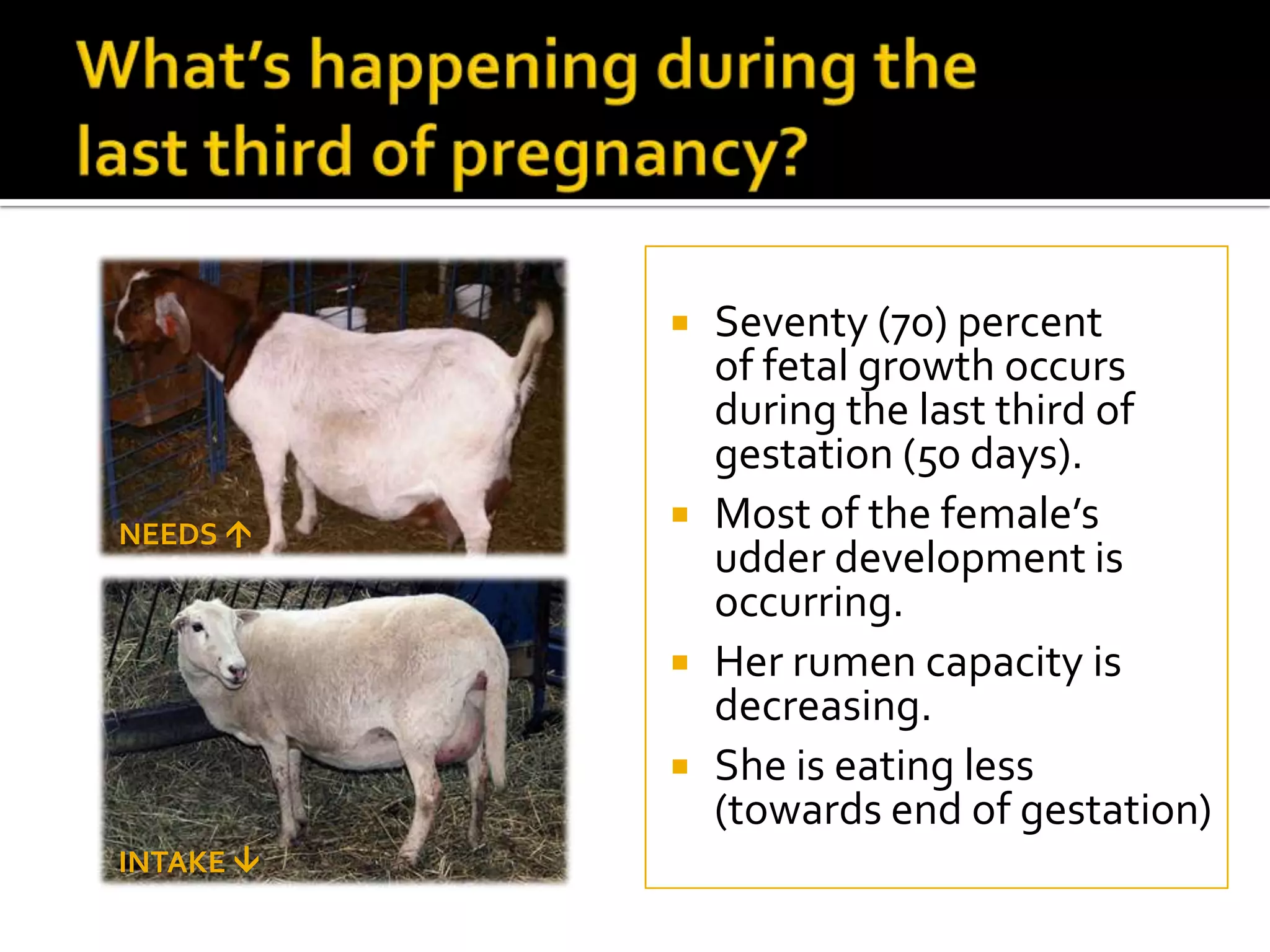
NEEDS 






INTAKE 

Seventy (70) percent
of fetal growth occurs
during the last third of
gestation (50 days).
Most of the female’s
udder development is
occurring.
Her rumen capacity is
decreasing.
She is eating less
(towards end of gestation)


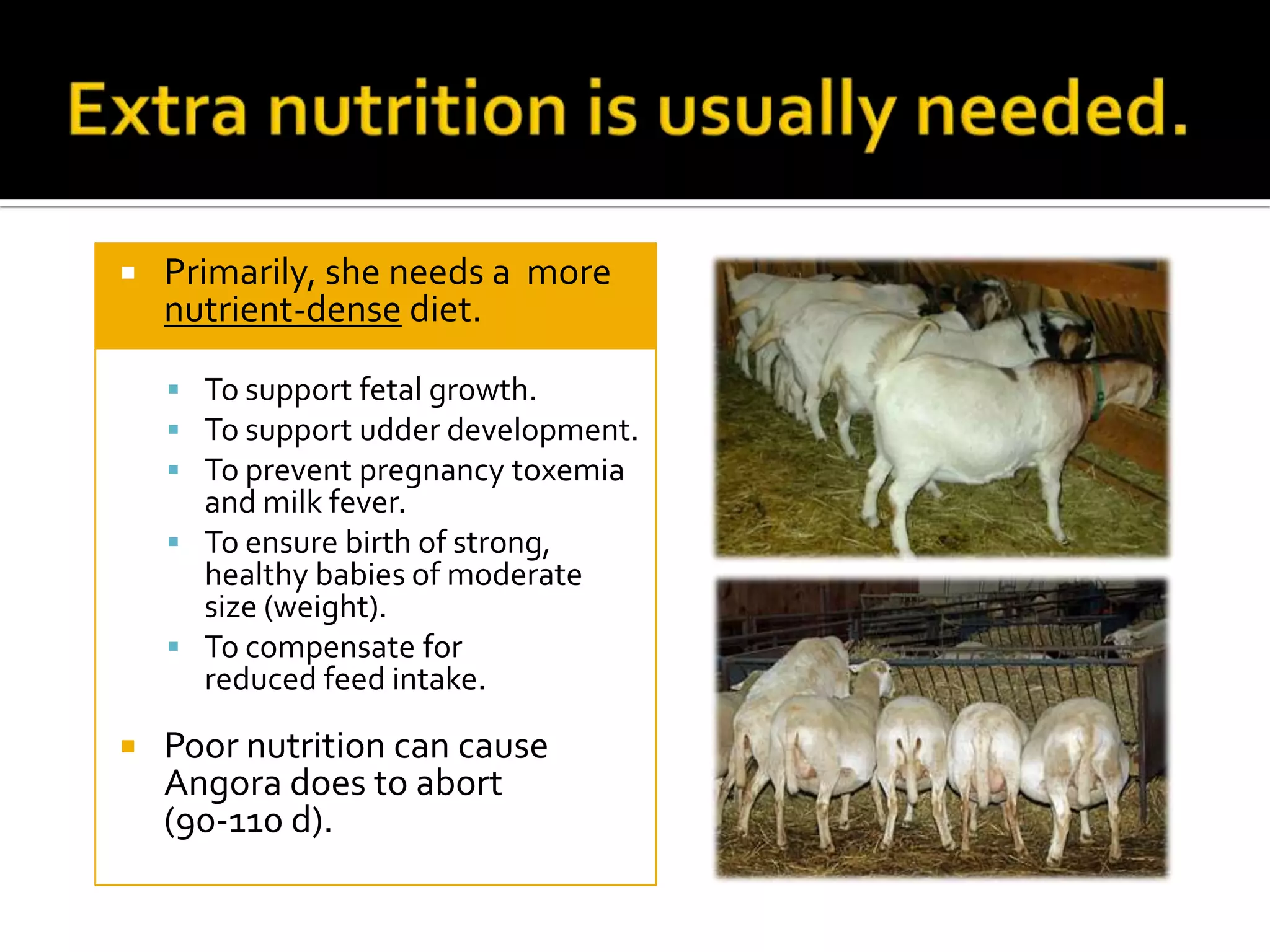
Primarily, she needs a more
nutrient-dense diet.
 To support fetal growth.
 To support udder development.
 To prevent pregnancy toxemia

and milk fever.
 To ensure birth of strong,
healthy babies of moderate
size (weight).
 To compensate for
reduced feed intake.


Poor nutrition can cause
Angora does to abort
(90-110 d).


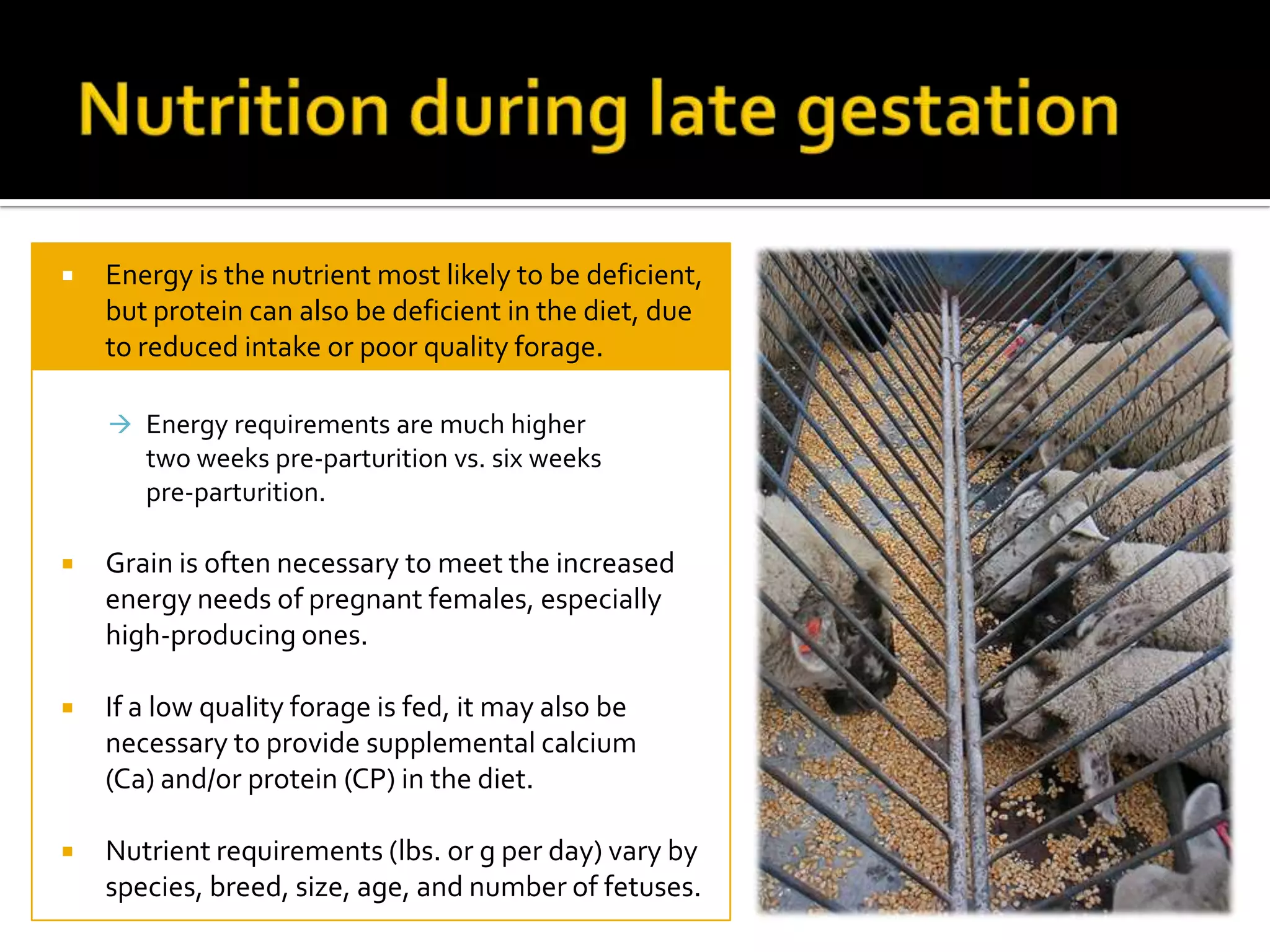
Energy is the nutrient most likely to be deficient,
but protein can also be deficient in the diet, due
to reduced intake or poor quality forage.
 Energy requirements are much higher

two weeks pre-parturition vs. six weeks
pre-parturition.


Grain is often necessary to meet the increased
energy needs of pregnant females, especially
high-producing ones.



If a low quality forage is fed, it may also be
necessary to provide supplemental calcium
(Ca) and/or protein (CP) in the diet.



Nutrient requirements (lbs. or g per day) vary by
species, breed, size, age, and number of fetuses.
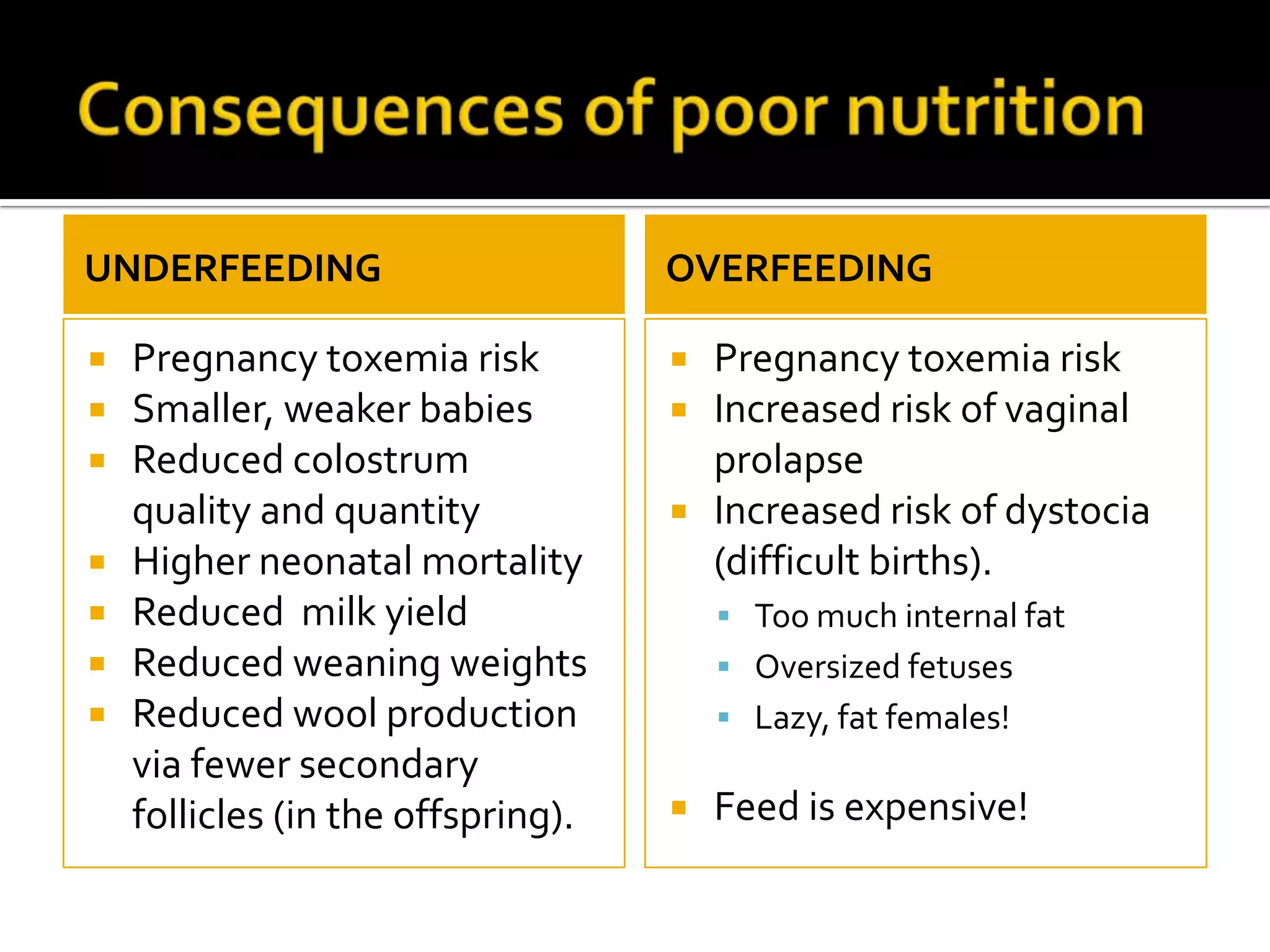
UNDERFEEDING

OVERFEEDING

Pregnancy toxemia risk
Smaller, weaker babies
 Reduced colostrum
quality and quantity
 Higher neonatal mortality
 Reduced milk yield
 Reduced weaning weights
 Reduced wool production
via fewer secondary
follicles (in the offspring).









Pregnancy toxemia risk
Increased risk of vaginal
prolapse
Increased risk of dystocia
(difficult births).
 Too much internal fat

 Oversized fetuses
 Lazy, fat females!



Feed is expensive!


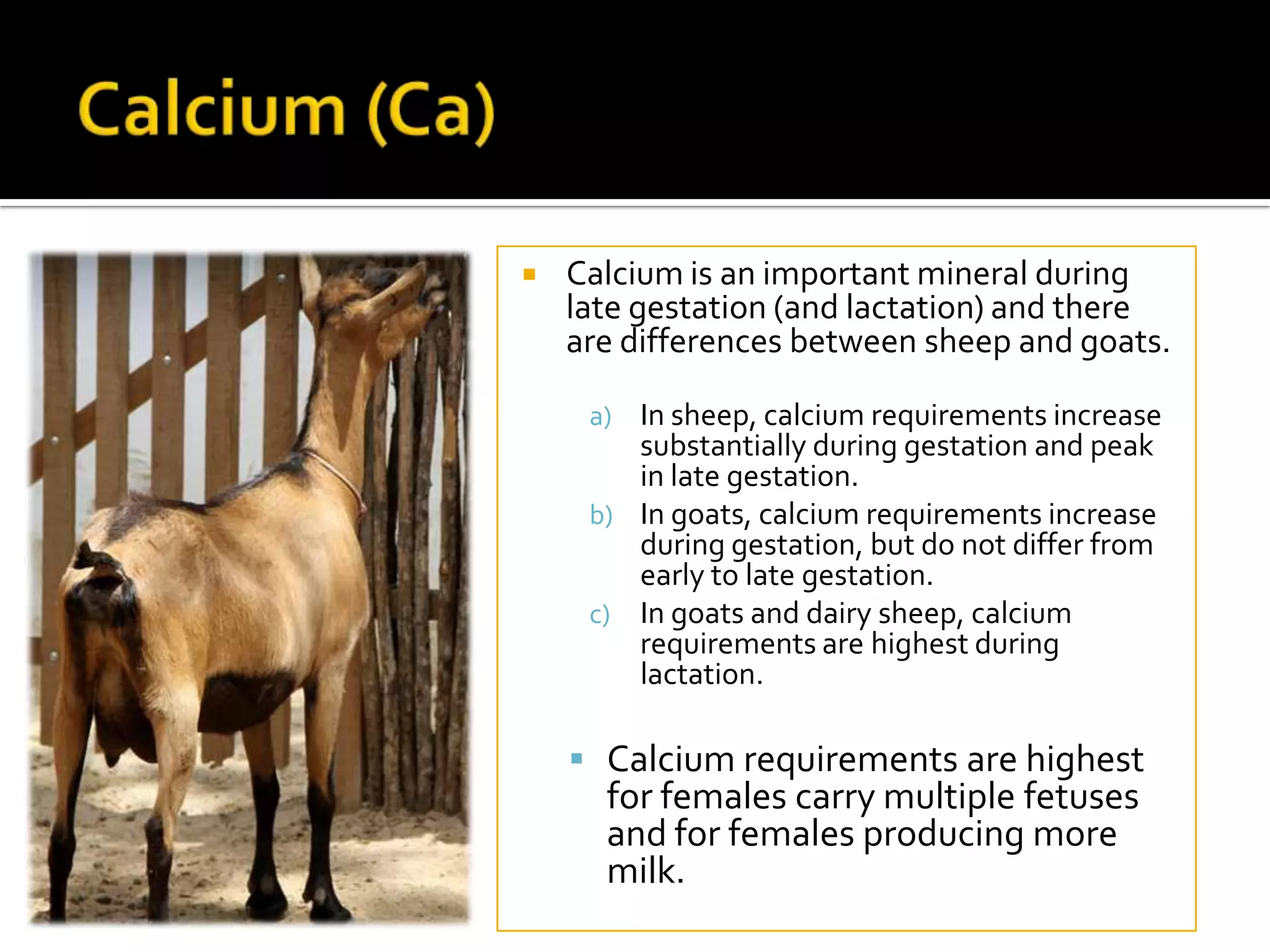
Calcium is an important mineral during
late gestation (and lactation) and there
are differences between sheep and goats.
a) In sheep, calcium requirements increase

substantially during gestation and peak
in late gestation.
b) In goats, calcium requirements increase
during gestation, but do not differ from
early to late gestation.
c) In goats and dairy sheep, calcium
requirements are highest during
lactation.

 Calcium requirements are highest

for females carry multiple fetuses
and for females producing more
milk.


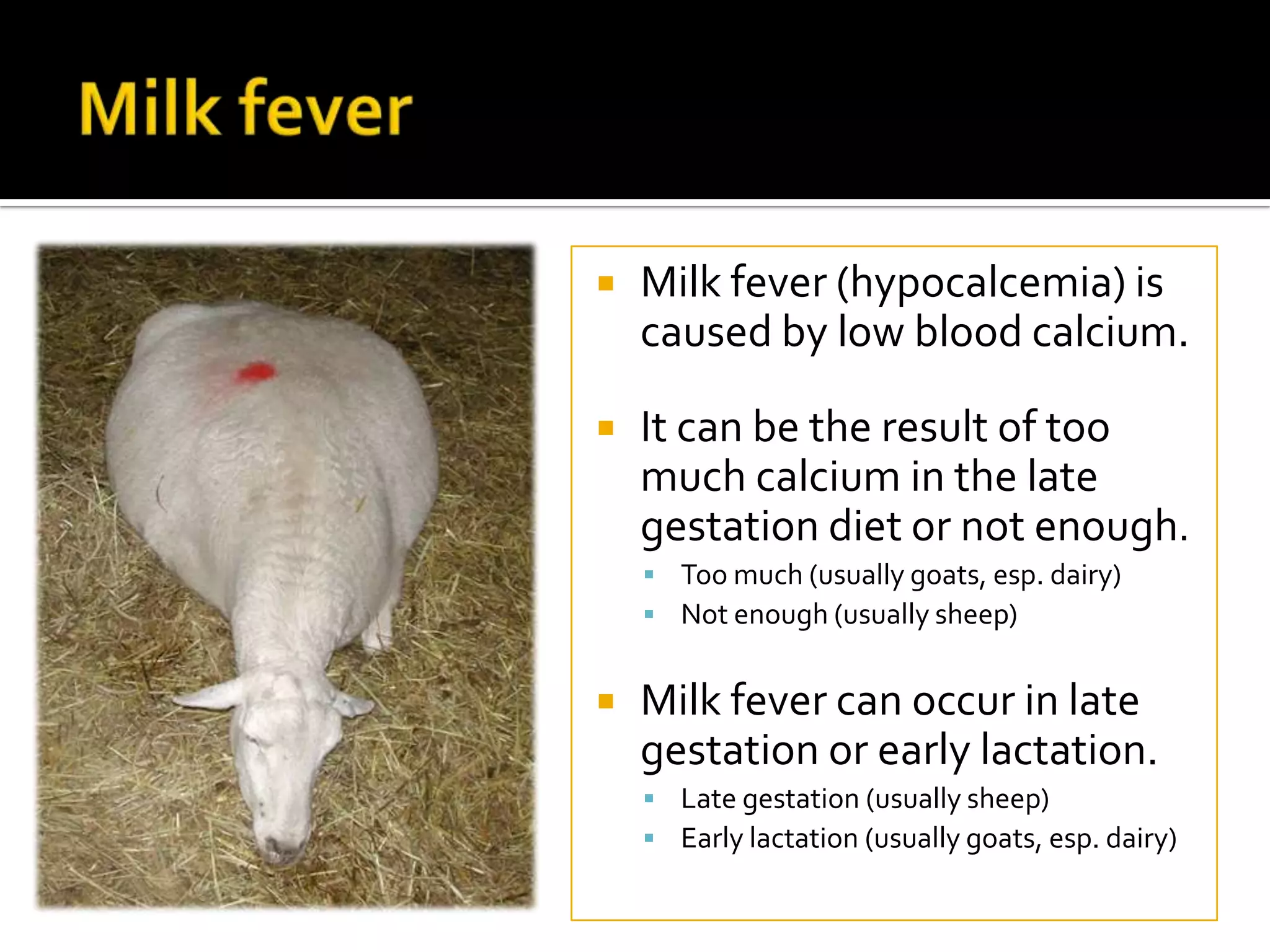
Milk fever (hypocalcemia) is
caused by low blood calcium.



It can be the result of too
much calcium in the late
gestation diet or not enough.
 Too much (usually goats, esp. dairy)
 Not enough (usually sheep)



Milk fever can occur in late
gestation or early lactation.
 Late gestation (usually sheep)
 Early lactation (usually goats, esp. dairy)
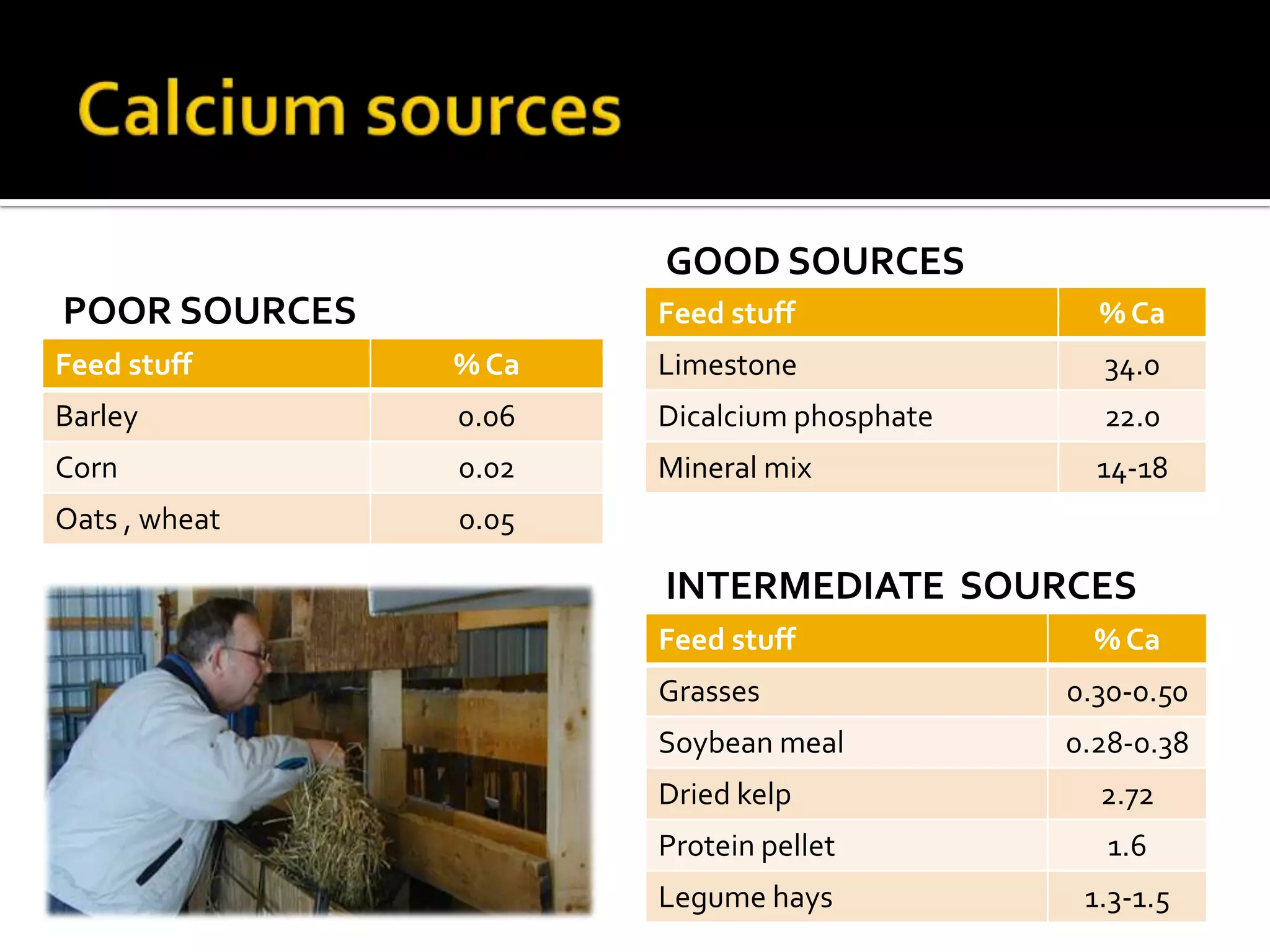
GOOD SOURCES
POOR SOURCES

Feed stuff

% Ca

Feed stuff

% Ca

Limestone

34.0

Barley

0.06

Dicalcium phosphate

22.0

Corn

0.02

Mineral mix

14-18

Oats , wheat

0.05

INTERMEDIATE SOURCES
Feed stuff

% Ca

Grasses

0.30-0.50

Soybean meal

0.28-0.38

Dried kelp

2.72

Protein pellet

1.6

Legume hays

1.3-1.5


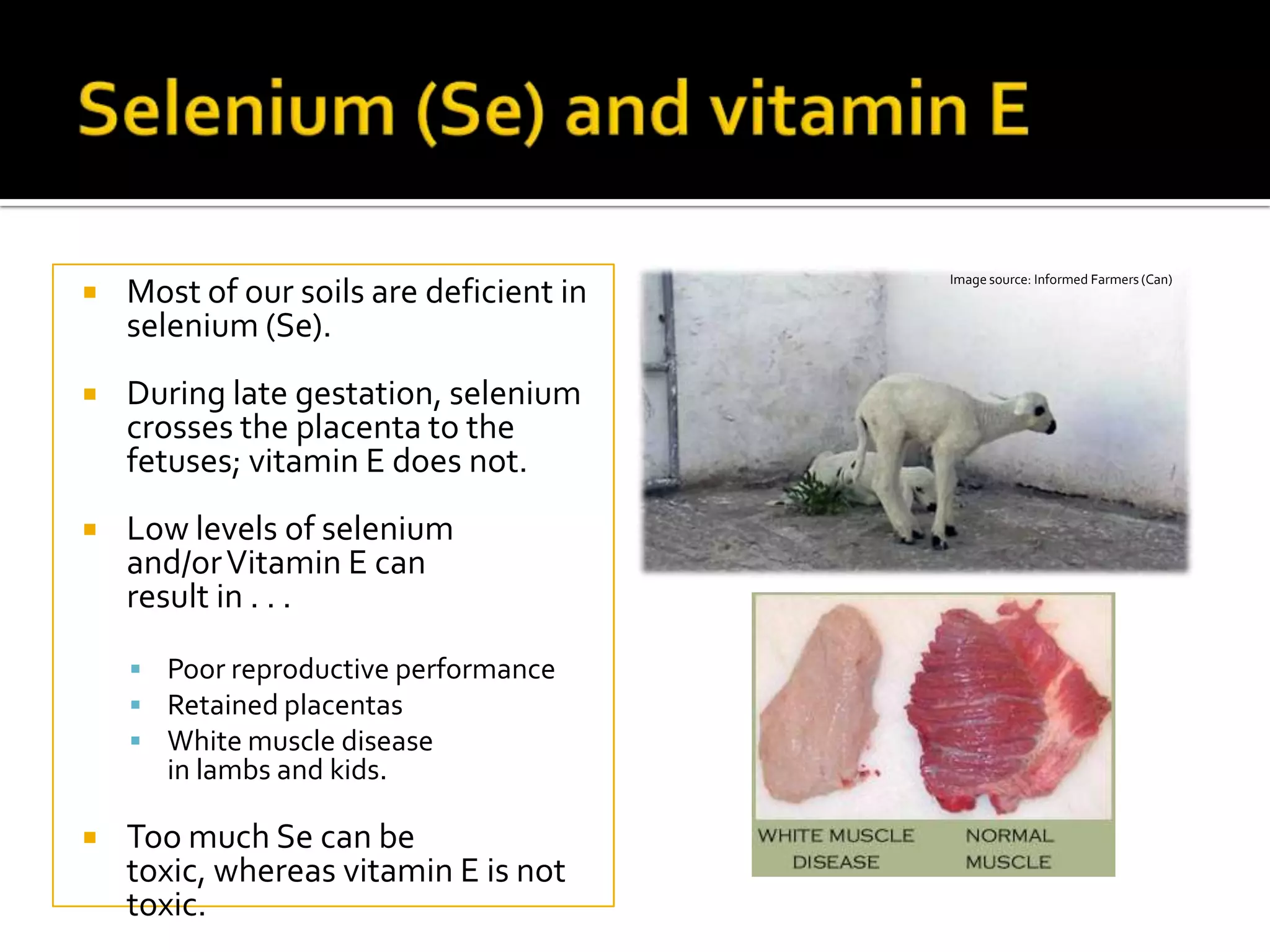
Most of our soils are deficient in
selenium (Se).



During late gestation, selenium
crosses the placenta to the
fetuses; vitamin E does not.



Low levels of selenium
and/or Vitamin E can
result in . . .
 Poor reproductive performance
 Retained placentas
 White muscle disease

in lambs and kids.



Too much Se can be
toxic, whereas vitamin E is not
toxic.

Image source: Informed Farmers (Can)


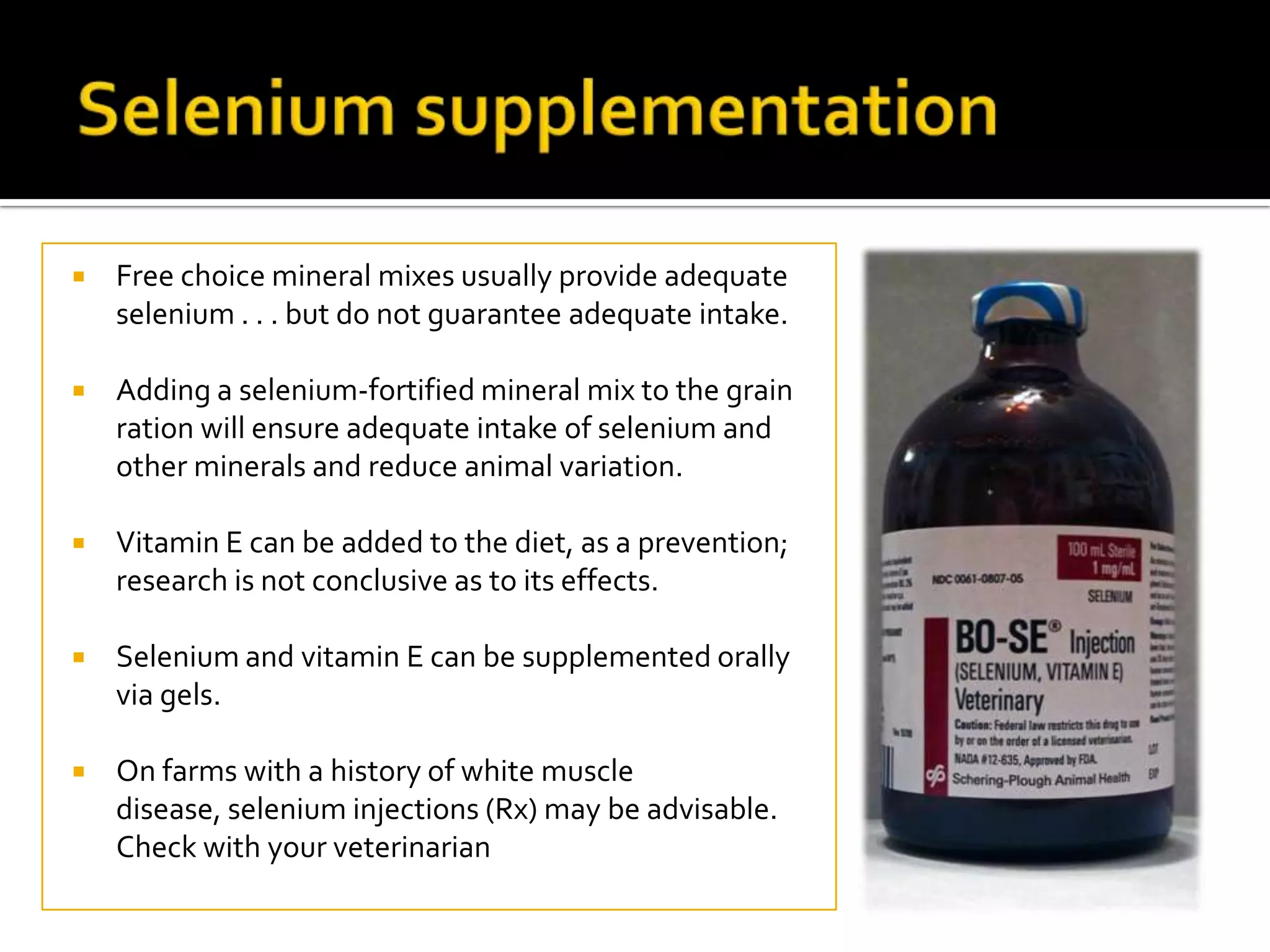
Free choice mineral mixes usually provide adequate
selenium . . . but do not guarantee adequate intake.



Adding a selenium-fortified mineral mix to the grain
ration will ensure adequate intake of selenium and
other minerals and reduce animal variation.



Vitamin E can be added to the diet, as a prevention;
research is not conclusive as to its effects.



Selenium and vitamin E can be supplemented orally
via gels.



On farms with a history of white muscle
disease, selenium injections (Rx) may be advisable.
Check with your veterinarian


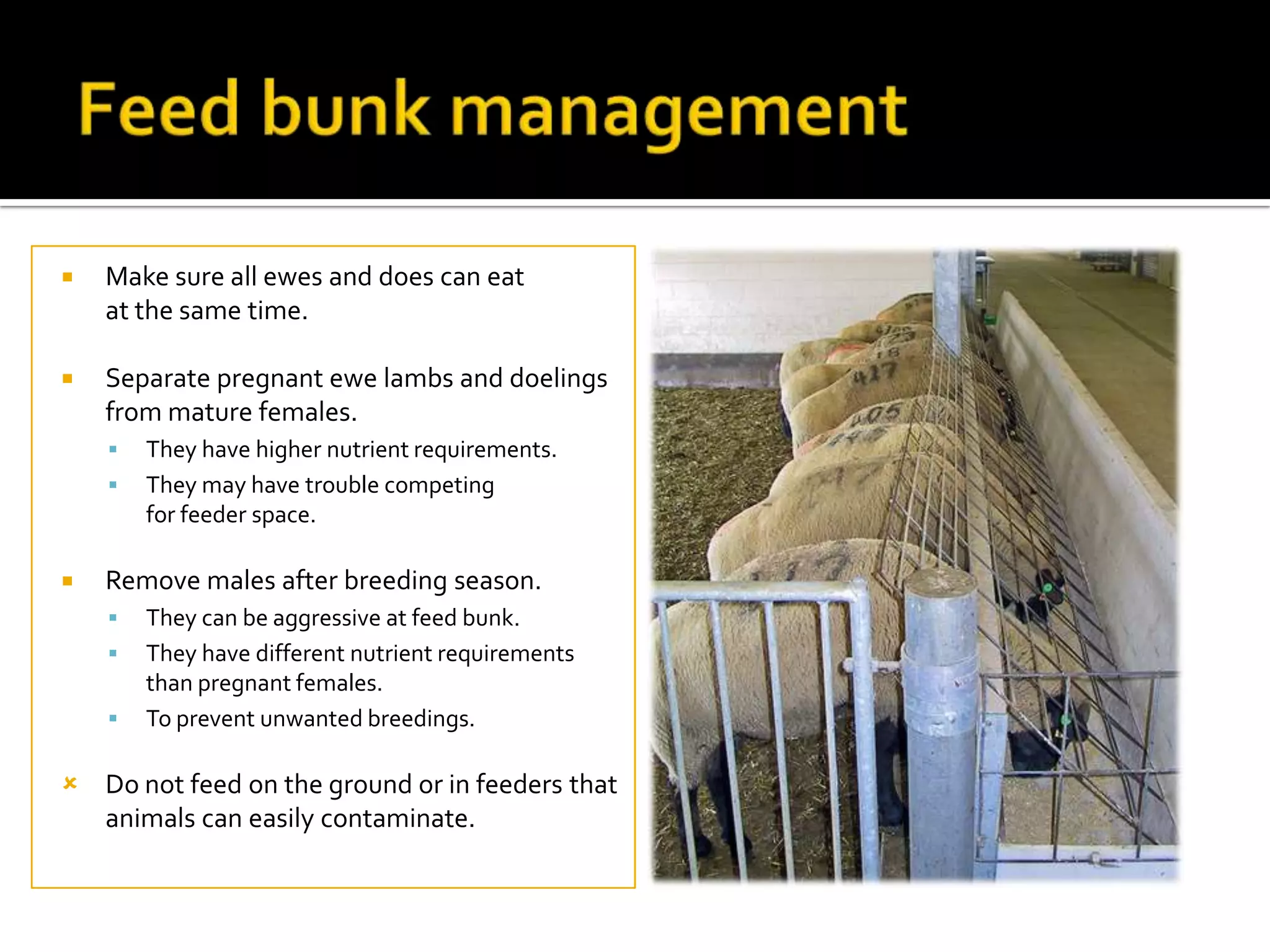
Make sure all ewes and does can eat
at the same time.



Separate pregnant ewe lambs and doelings
from mature females.





They have higher nutrient requirements.
They may have trouble competing
for feeder space.

Remove males after breeding season.




They can be aggressive at feed bunk.
They have different nutrient requirements
than pregnant females.
To prevent unwanted breedings.

 Do not feed on the ground or in feeders that
animals can easily contaminate.


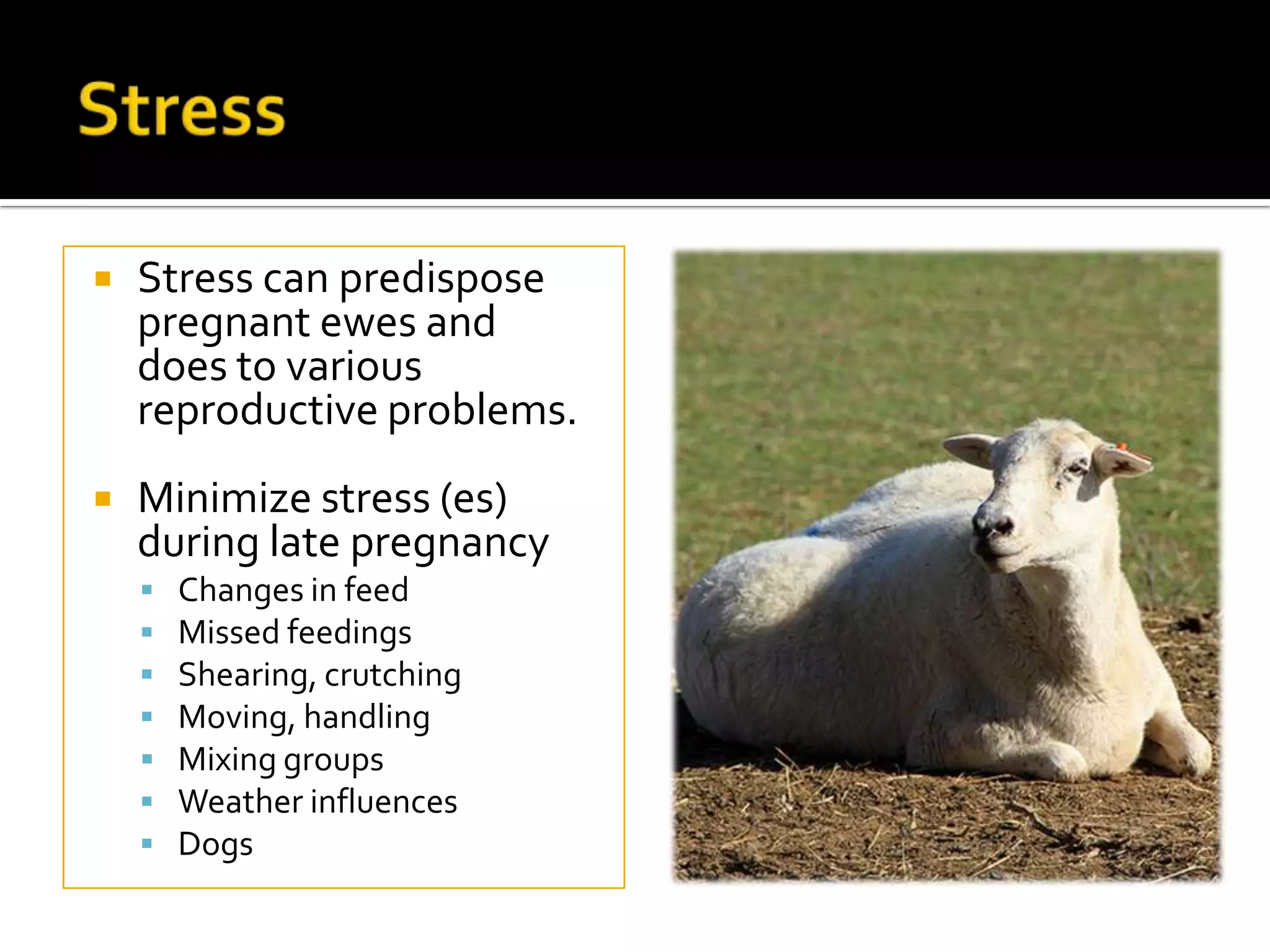
Stress can predispose
pregnant ewes and
does to various
reproductive problems.



Minimize stress (es)
during late pregnancy








Changes in feed
Missed feedings
Shearing, crutching
Moving, handling
Mixing groups
Weather influences
Dogs


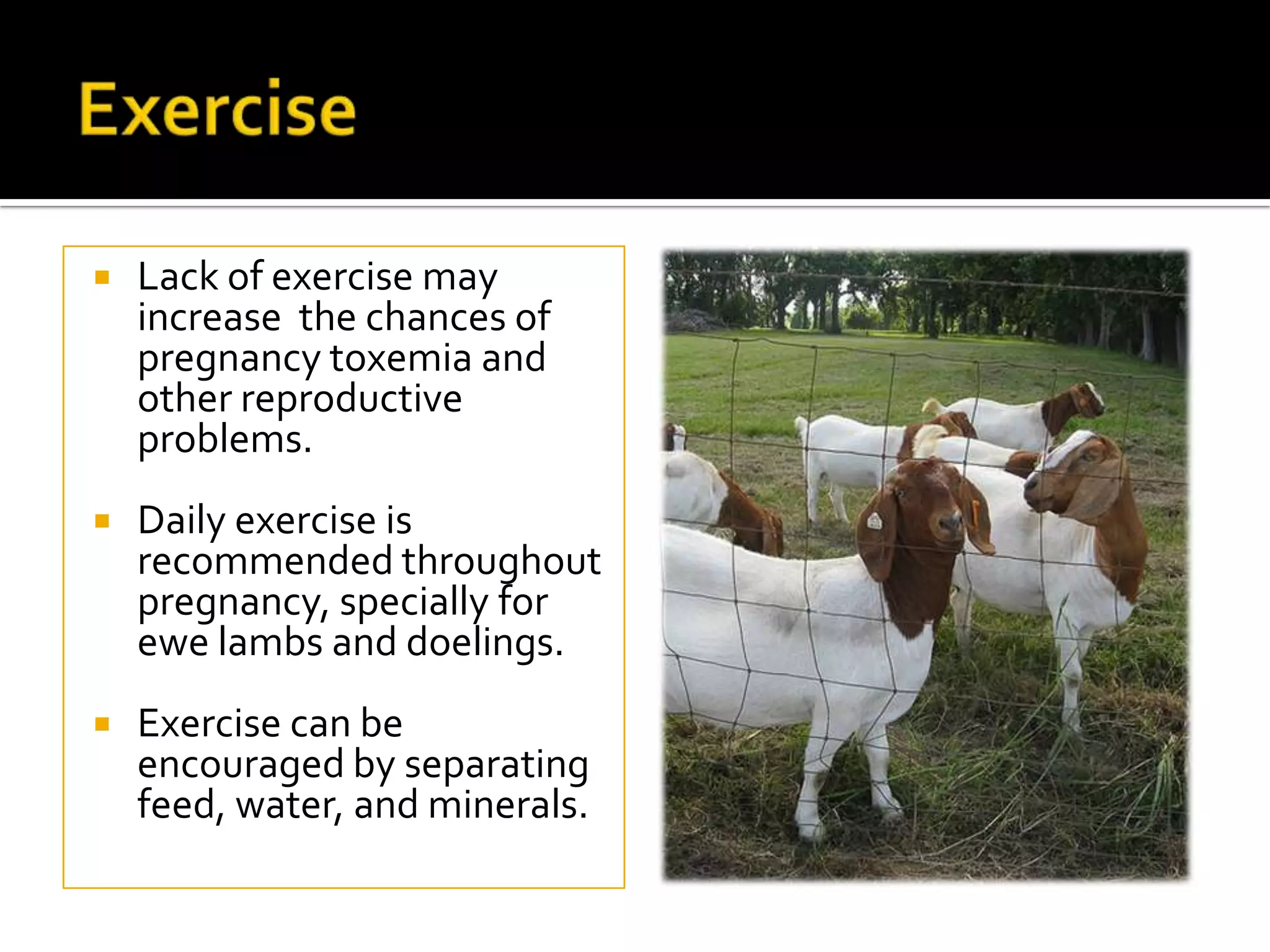
Lack of exercise may
increase the chances of
pregnancy toxemia and
other reproductive
problems.



Daily exercise is
recommended throughout
pregnancy, specially for
ewe lambs and doelings.



Exercise can be
encouraged by separating
feed, water, and minerals.


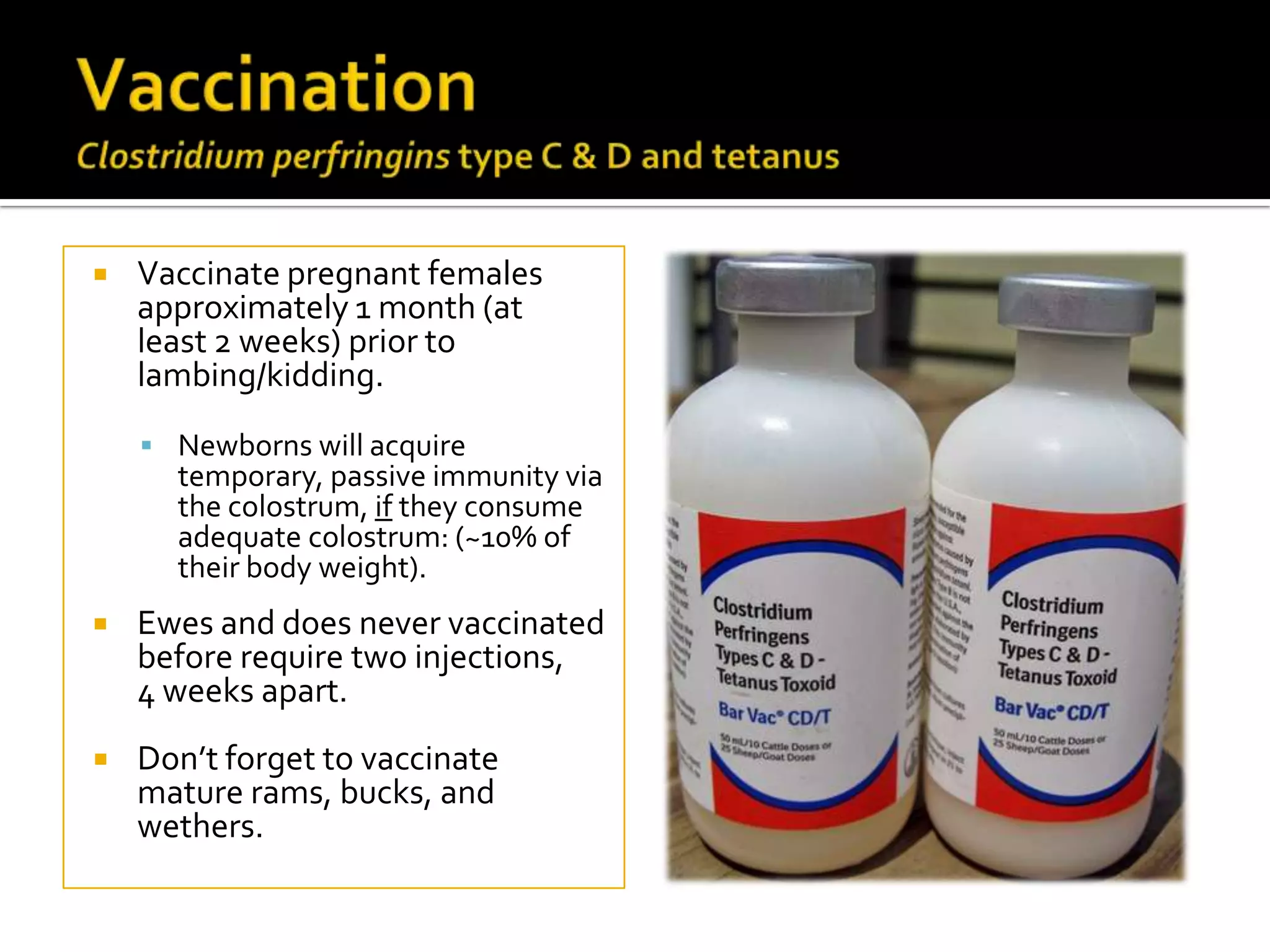
Vaccinate pregnant females
approximately 1 month (at
least 2 weeks) prior to
lambing/kidding.
 Newborns will acquire

temporary, passive immunity via
the colostrum, if they consume
adequate colostrum: (~10% of
their body weight).



Ewes and does never vaccinated
before require two injections,
4 weeks apart.



Don’t forget to vaccinate
mature rams, bucks, and
wethers.


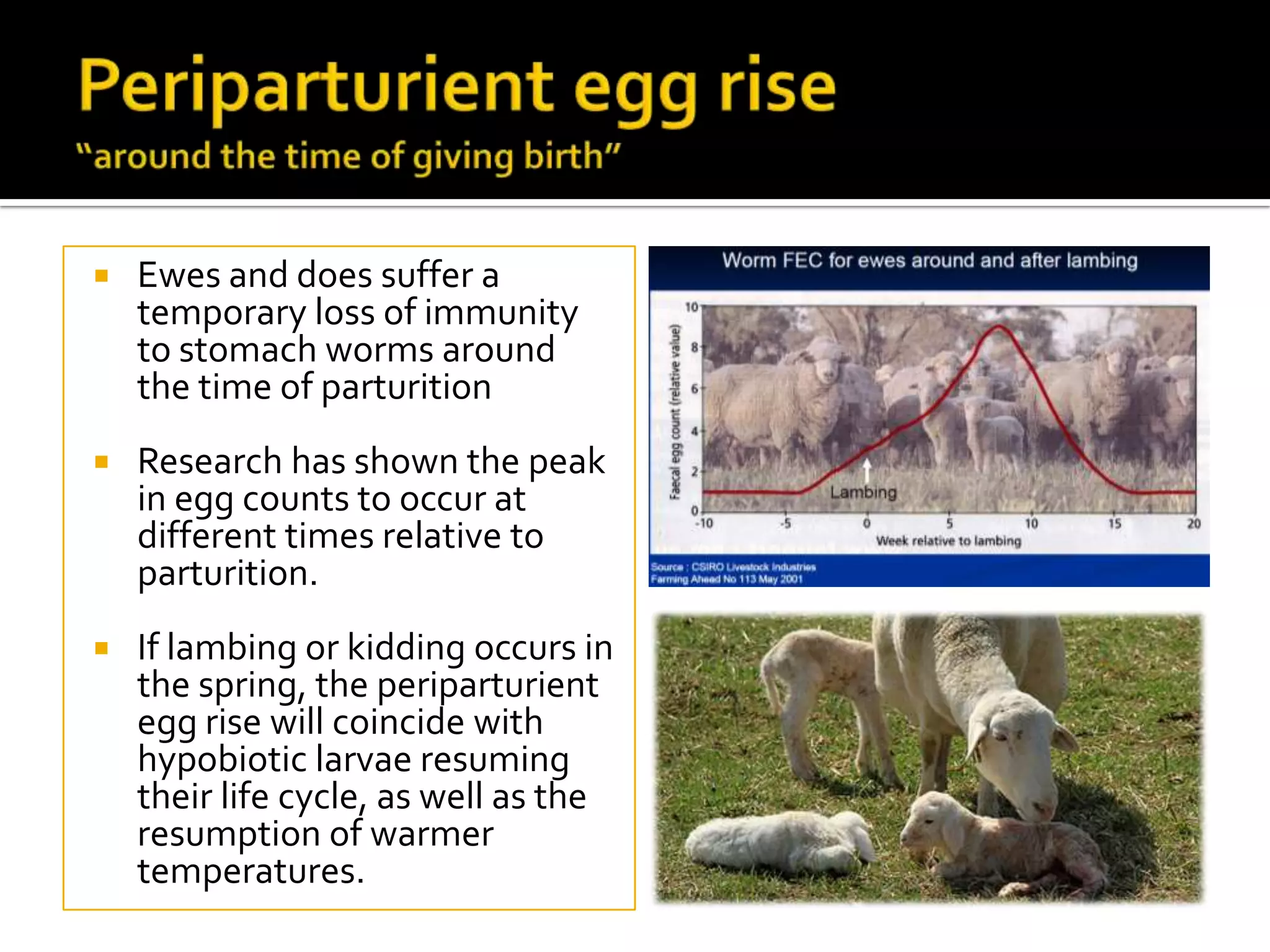
Ewes and does suffer a
temporary loss of immunity
to stomach worms around
the time of parturition



Research has shown the peak
in egg counts to occur at
different times relative to
parturition.



If lambing or kidding occurs in
the spring, the periparturient
egg rise will coincide with
hypobiotic larvae resuming
their life cycle, as well as the
resumption of warmer
temperatures.


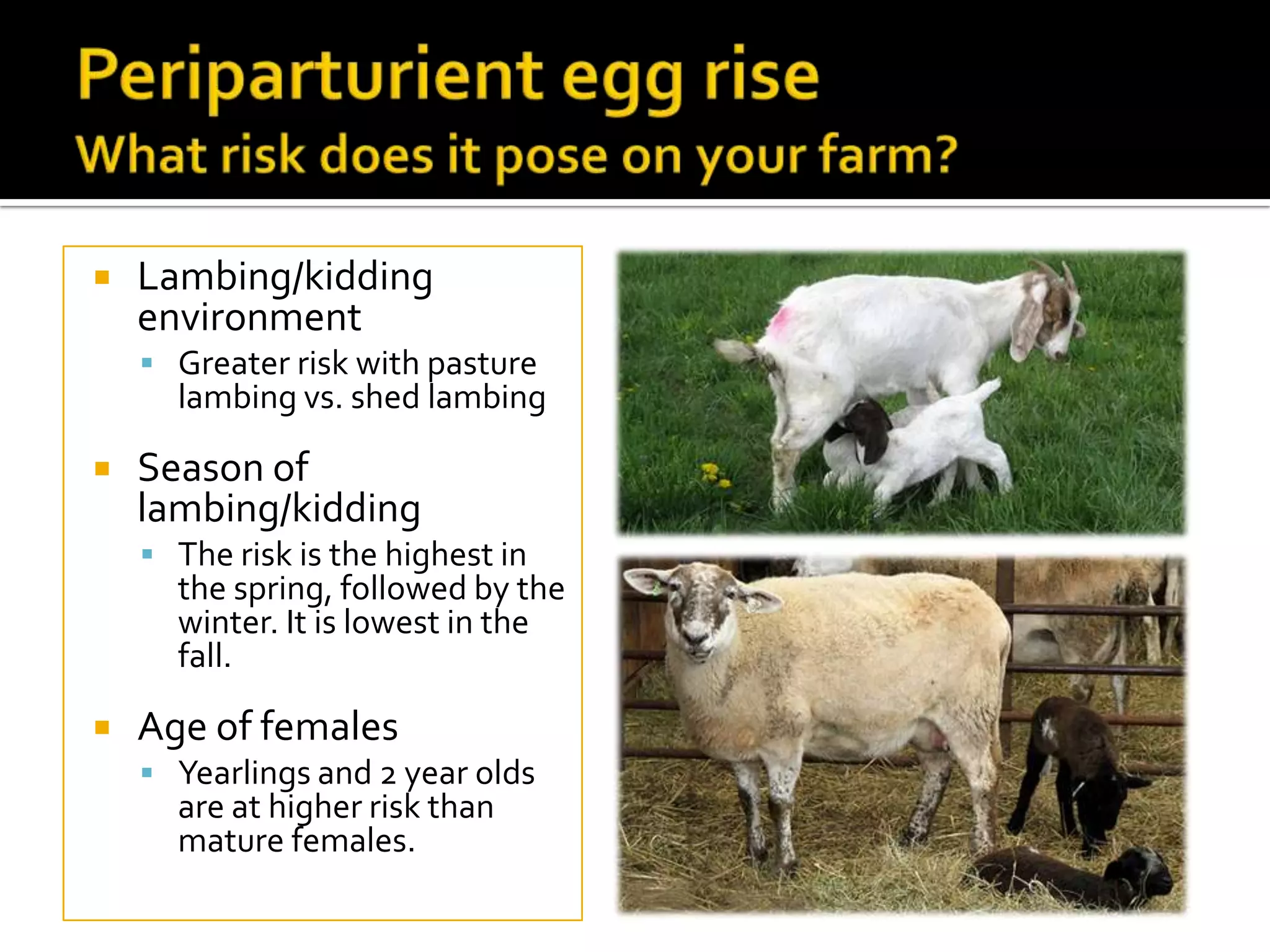
Lambing/kidding
environment
 Greater risk with pasture

lambing vs. shed lambing



Season of
lambing/kidding
 The risk is the highest in

the spring, followed by the
winter. It is lowest in the
fall.



Age of females
 Yearlings and 2 year olds

are at higher risk than
mature females.


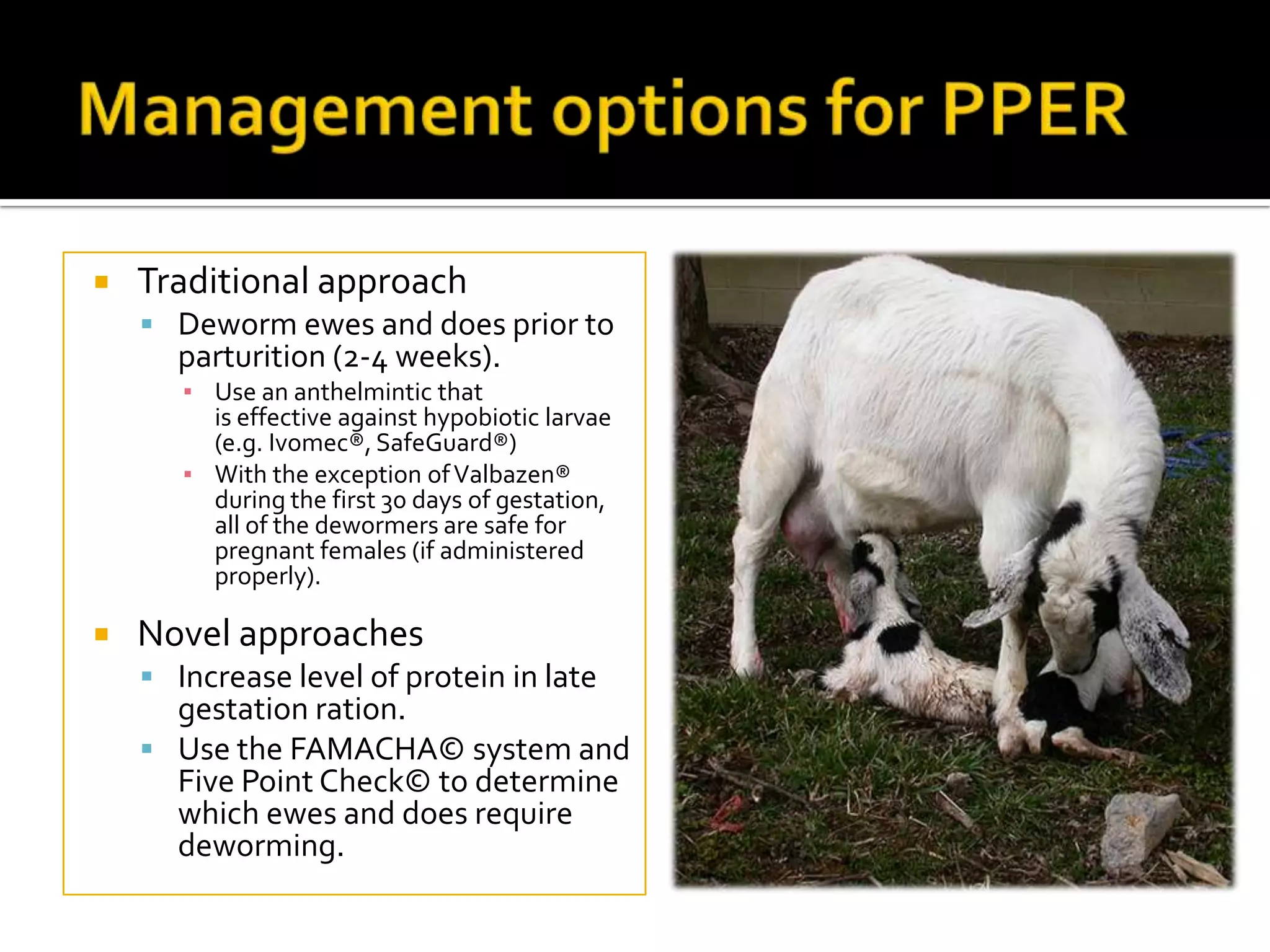
Traditional approach
 Deworm ewes and does prior to

parturition (2-4 weeks).

▪ Use an anthelmintic that
is effective against hypobiotic larvae
(e.g. Ivomec®, SafeGuard®)
▪ With the exception of Valbazen®
during the first 30 days of gestation,
all of the dewormers are safe for
pregnant females (if administered
properly).



Novel approaches
 Increase level of protein in late

gestation ration.
 Use the FAMACHA© system and
Five Point Check© to determine
which ewes and does require
deworming.
 In feed or mineral
1) Bovatec® - sheep
2) Rumensin® - goats
3) Deccox® - sheep, goats



Why?
 To prevent coccidiosis

in lambs and kids.

▪ Reduce shedding of coccidia
organism into environment.

 As an aid to prevent abortions

caused by Toxoplasma gondii.
[There is no vaccine for toxo.]

 It is best to incorporate

coccidiostat into gestation
ration to ensure adequate
intake and reduce variability
of intake.

 Coccidiostats, especially Rumensin® can be toxic to equines and dogs.


Why?
 To prevent losses due to

infectious causes of abortion
▪ If the flock has a history of
diagnosed abortions (e.g.
Chlamydia, Vibrio).
▪ If the flock is at risk for abortion.
▪ In the event of an abortion storm.



How?
 Feed chlorotetracycline

(aureomycin) at a rate of 80
mg/head/day during the last 6
weeks of gestation [Rx for
goats].
 Inject oxytetracycline (LA-200)
at two week intervals during
late gestation [Rx].


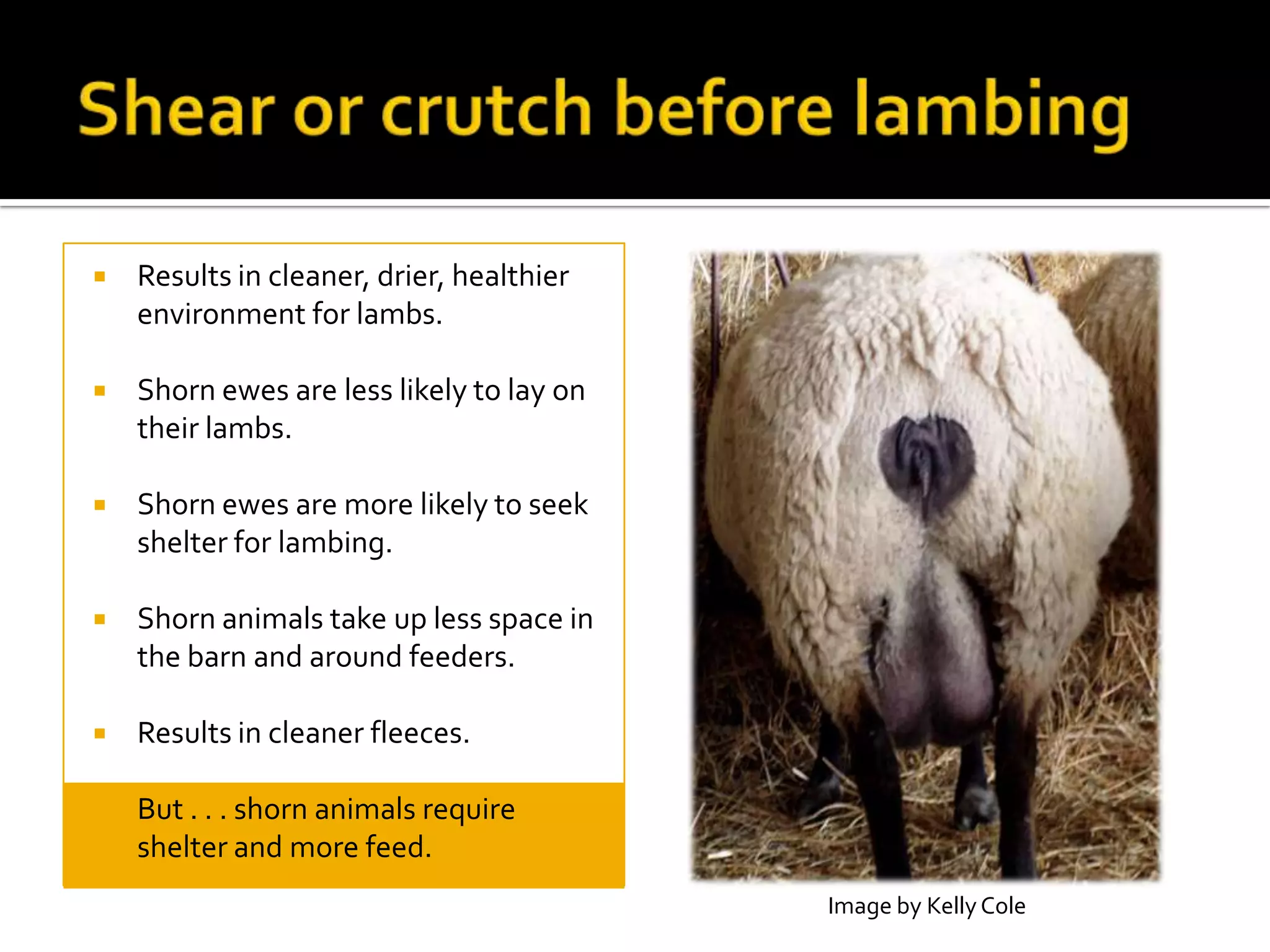
Results in cleaner, drier, healthier
environment for lambs.



Shorn ewes are less likely to lay on
their lambs.



Shorn ewes are more likely to seek
shelter for lambing.



Shorn animals take up less space in
the barn and around feeders.



Results in cleaner fleeces.



But . . . shorn animals require
shelter and more feed.
Image by Kelly Cole
FACILITIES


Clean, dry, draft-free
building
 Drop area
 Small pens (jugs)
 Mixing pens



Clean, well-rested pastures
 Shelter
 Emergency pens

SUPPLIES
















Panels, buckets and
feeders for jugs
Frozen colostrum
Colostrum replacement/supplement
Milk replacer
Esophageal feeding tube
OB sleeves and lubricant
Disinfectant for dipping navels
Prolapse harness or spoon
Needles and syringes
Propylene glycol
Calcium borogluconate
Antibiotics
Bo-Se
Thermometer
More…
DO’S











Increase nutrition (gradually)
Feed pregnant ewe lambs
and doelings separately
Encourage daily exercise
Minimize stress
Vaccinate for CD-T
Manage periparturient
egg rise
Feed a coccidiostat
Shear or crutch females
Prepare facilities
Gather/inventory supplies

DON’TS

Overfeed
Underfeed
 Stress females
 Introduce new animals
 Change groupings
 Leave males in
 Worry


Happy lambing and kidding!
Thank you for your
attention.
Any questions?

Susan Schoenian
sschoen@umd.edu
www.sheepandgoat.com
www.acsrpc.org

Getting Ready for Lambing & Kidding (2013)

  • 1.
    SUSAN SCHOENIAN (Shāy-nē-ŭn) Sheep& Goat Specialist Western Maryland Research & Education Center sschoen@umd.edu - www.sheepandgoat.com
  • 2.
     NEEDS     INTAKE  Seventy(70) percent of fetal growth occurs during the last third of gestation (50 days). Most of the female’s udder development is occurring. Her rumen capacity is decreasing. She is eating less (towards end of gestation)
  • 3.
     Primarily, she needsa more nutrient-dense diet.  To support fetal growth.  To support udder development.  To prevent pregnancy toxemia and milk fever.  To ensure birth of strong, healthy babies of moderate size (weight).  To compensate for reduced feed intake.  Poor nutrition can cause Angora does to abort (90-110 d).
  • 4.
     Energy is thenutrient most likely to be deficient, but protein can also be deficient in the diet, due to reduced intake or poor quality forage.  Energy requirements are much higher two weeks pre-parturition vs. six weeks pre-parturition.  Grain is often necessary to meet the increased energy needs of pregnant females, especially high-producing ones.  If a low quality forage is fed, it may also be necessary to provide supplemental calcium (Ca) and/or protein (CP) in the diet.  Nutrient requirements (lbs. or g per day) vary by species, breed, size, age, and number of fetuses.
  • 5.
    UNDERFEEDING OVERFEEDING Pregnancy toxemia risk Smaller,weaker babies  Reduced colostrum quality and quantity  Higher neonatal mortality  Reduced milk yield  Reduced weaning weights  Reduced wool production via fewer secondary follicles (in the offspring).      Pregnancy toxemia risk Increased risk of vaginal prolapse Increased risk of dystocia (difficult births).  Too much internal fat  Oversized fetuses  Lazy, fat females!  Feed is expensive!
  • 6.
     Calcium is animportant mineral during late gestation (and lactation) and there are differences between sheep and goats. a) In sheep, calcium requirements increase substantially during gestation and peak in late gestation. b) In goats, calcium requirements increase during gestation, but do not differ from early to late gestation. c) In goats and dairy sheep, calcium requirements are highest during lactation.  Calcium requirements are highest for females carry multiple fetuses and for females producing more milk.
  • 7.
     Milk fever (hypocalcemia)is caused by low blood calcium.  It can be the result of too much calcium in the late gestation diet or not enough.  Too much (usually goats, esp. dairy)  Not enough (usually sheep)  Milk fever can occur in late gestation or early lactation.  Late gestation (usually sheep)  Early lactation (usually goats, esp. dairy)
  • 8.
    GOOD SOURCES POOR SOURCES Feedstuff % Ca Feed stuff % Ca Limestone 34.0 Barley 0.06 Dicalcium phosphate 22.0 Corn 0.02 Mineral mix 14-18 Oats , wheat 0.05 INTERMEDIATE SOURCES Feed stuff % Ca Grasses 0.30-0.50 Soybean meal 0.28-0.38 Dried kelp 2.72 Protein pellet 1.6 Legume hays 1.3-1.5
  • 9.
     Most of oursoils are deficient in selenium (Se).  During late gestation, selenium crosses the placenta to the fetuses; vitamin E does not.  Low levels of selenium and/or Vitamin E can result in . . .  Poor reproductive performance  Retained placentas  White muscle disease in lambs and kids.  Too much Se can be toxic, whereas vitamin E is not toxic. Image source: Informed Farmers (Can)
  • 10.
     Free choice mineralmixes usually provide adequate selenium . . . but do not guarantee adequate intake.  Adding a selenium-fortified mineral mix to the grain ration will ensure adequate intake of selenium and other minerals and reduce animal variation.  Vitamin E can be added to the diet, as a prevention; research is not conclusive as to its effects.  Selenium and vitamin E can be supplemented orally via gels.  On farms with a history of white muscle disease, selenium injections (Rx) may be advisable. Check with your veterinarian
  • 11.
     Make sure allewes and does can eat at the same time.  Separate pregnant ewe lambs and doelings from mature females.    They have higher nutrient requirements. They may have trouble competing for feeder space. Remove males after breeding season.    They can be aggressive at feed bunk. They have different nutrient requirements than pregnant females. To prevent unwanted breedings.  Do not feed on the ground or in feeders that animals can easily contaminate.
  • 12.
     Stress can predispose pregnantewes and does to various reproductive problems.  Minimize stress (es) during late pregnancy        Changes in feed Missed feedings Shearing, crutching Moving, handling Mixing groups Weather influences Dogs
  • 13.
     Lack of exercisemay increase the chances of pregnancy toxemia and other reproductive problems.  Daily exercise is recommended throughout pregnancy, specially for ewe lambs and doelings.  Exercise can be encouraged by separating feed, water, and minerals.
  • 14.
     Vaccinate pregnant females approximately1 month (at least 2 weeks) prior to lambing/kidding.  Newborns will acquire temporary, passive immunity via the colostrum, if they consume adequate colostrum: (~10% of their body weight).  Ewes and does never vaccinated before require two injections, 4 weeks apart.  Don’t forget to vaccinate mature rams, bucks, and wethers.
  • 15.
     Ewes and doessuffer a temporary loss of immunity to stomach worms around the time of parturition  Research has shown the peak in egg counts to occur at different times relative to parturition.  If lambing or kidding occurs in the spring, the periparturient egg rise will coincide with hypobiotic larvae resuming their life cycle, as well as the resumption of warmer temperatures.
  • 16.
     Lambing/kidding environment  Greater riskwith pasture lambing vs. shed lambing  Season of lambing/kidding  The risk is the highest in the spring, followed by the winter. It is lowest in the fall.  Age of females  Yearlings and 2 year olds are at higher risk than mature females.
  • 17.
     Traditional approach  Dewormewes and does prior to parturition (2-4 weeks). ▪ Use an anthelmintic that is effective against hypobiotic larvae (e.g. Ivomec®, SafeGuard®) ▪ With the exception of Valbazen® during the first 30 days of gestation, all of the dewormers are safe for pregnant females (if administered properly).  Novel approaches  Increase level of protein in late gestation ration.  Use the FAMACHA© system and Five Point Check© to determine which ewes and does require deworming.
  • 18.
     In feedor mineral 1) Bovatec® - sheep 2) Rumensin® - goats 3) Deccox® - sheep, goats  Why?  To prevent coccidiosis in lambs and kids. ▪ Reduce shedding of coccidia organism into environment.  As an aid to prevent abortions caused by Toxoplasma gondii. [There is no vaccine for toxo.]  It is best to incorporate coccidiostat into gestation ration to ensure adequate intake and reduce variability of intake.  Coccidiostats, especially Rumensin® can be toxic to equines and dogs.
  • 19.
     Why?  To preventlosses due to infectious causes of abortion ▪ If the flock has a history of diagnosed abortions (e.g. Chlamydia, Vibrio). ▪ If the flock is at risk for abortion. ▪ In the event of an abortion storm.  How?  Feed chlorotetracycline (aureomycin) at a rate of 80 mg/head/day during the last 6 weeks of gestation [Rx for goats].  Inject oxytetracycline (LA-200) at two week intervals during late gestation [Rx].
  • 20.
     Results in cleaner,drier, healthier environment for lambs.  Shorn ewes are less likely to lay on their lambs.  Shorn ewes are more likely to seek shelter for lambing.  Shorn animals take up less space in the barn and around feeders.  Results in cleaner fleeces.  But . . . shorn animals require shelter and more feed. Image by Kelly Cole
  • 21.
    FACILITIES  Clean, dry, draft-free building Drop area  Small pens (jugs)  Mixing pens  Clean, well-rested pastures  Shelter  Emergency pens SUPPLIES                Panels, buckets and feeders for jugs Frozen colostrum Colostrum replacement/supplement Milk replacer Esophageal feeding tube OB sleeves and lubricant Disinfectant for dipping navels Prolapse harness or spoon Needles and syringes Propylene glycol Calcium borogluconate Antibiotics Bo-Se Thermometer More…
  • 22.
    DO’S           Increase nutrition (gradually) Feedpregnant ewe lambs and doelings separately Encourage daily exercise Minimize stress Vaccinate for CD-T Manage periparturient egg rise Feed a coccidiostat Shear or crutch females Prepare facilities Gather/inventory supplies DON’TS Overfeed Underfeed  Stress females  Introduce new animals  Change groupings  Leave males in  Worry  
  • 23.
    Happy lambing andkidding! Thank you for your attention. Any questions? Susan Schoenian sschoen@umd.edu www.sheepandgoat.com www.acsrpc.org