WHERE IS IT?
 It is located behind the forehead, in the
frontal lobe of the brain
AND WHAT DOES IT
DO…?
 Regulates short term
and long term
decision making
 Allows to plan
ahead and make
strategies
 Enables to concentrate
and learn
 It also controls intense
emotions and impulses
(So the prefrontal cortex
gives us good judgement,
controlling inappropriate
behavior)
STUDIES ON THE
PREFRONTAL CORTEX
 On 2010, one group in the University
College London discovered a link
between the size of one specific part of
the prefrontal cortex and the ability of
turning thoughts inward and reflecting
upon one’s decisions.
 Here is the link of the study (in case you
want to read further) https://www.sciencedaily.com/releases/201
0/09/100916145047.htm
 Another interesting study was one that took
place in Iran. The aim of this study was to
find out if the frontal lobe activity of chess
players would differ from the frontal lobe
activity of those who didn’t play chess. What
researchers discovered is that chess
players do not have any advantage in
selective attention and inhibition. This study
was completed in 2012.
https://www.researchgate.net/publication/2
30573724_Frontal_Lobe_Function_in_Che
ss_Players
And don’t forget the
extraordinary case of Phineas
Gage
 Phineas Gage had a terrible accident on
1848, when a metal rod crossed his head
from the cheekbone to the top of his head.
His frontal cortex got serious damage,
which caused the loss of social inhibitions
(Conscious or unconscious restraint of a
behavioral process, desire, or impulse).
These accident gave neurologists evidence
that the frontal cortex was involved in
personality and behavior.
https://bigpictureeducation.com/brain-case-
study-phineas-gage
A DYSFUNCTIONAL
PREFRONTAL CORTEX
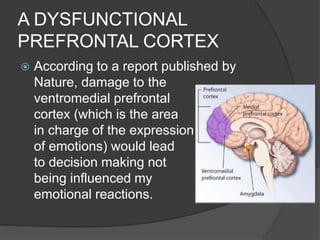
 According to a report published by
Nature, damage to the
ventromedial prefrontal
cortex (which is the area
in charge of the expression
of emotions) would lead
to decision making not
being influenced my
emotional reactions.
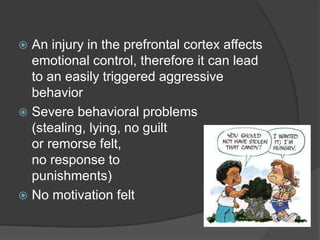
 An injury in the prefrontal cortex affects
emotional control, therefore it can lead
to an easily triggered aggressive
behavior
 Severe behavioral problems
(stealing, lying, no guilt
or remorse felt,
no response to
punishments)
 No motivation felt
 http://www.bcftbi.org/about-
tbi/behavior.asp
 http://www.scientificamerican.com/article
/brain-damage-makes-utilitarian-
decisions-easier/

The Prefrontal Cortex

  • 2.
    WHERE IS IT? It is located behind the forehead, in the frontal lobe of the brain
  • 3.
    AND WHAT DOESIT DO…?  Regulates short term and long term decision making  Allows to plan ahead and make strategies
  • 4.
     Enables toconcentrate and learn  It also controls intense emotions and impulses (So the prefrontal cortex gives us good judgement, controlling inappropriate behavior)
  • 5.
    STUDIES ON THE PREFRONTALCORTEX  On 2010, one group in the University College London discovered a link between the size of one specific part of the prefrontal cortex and the ability of turning thoughts inward and reflecting upon one’s decisions.  Here is the link of the study (in case you want to read further) https://www.sciencedaily.com/releases/201 0/09/100916145047.htm
  • 6.
     Another interestingstudy was one that took place in Iran. The aim of this study was to find out if the frontal lobe activity of chess players would differ from the frontal lobe activity of those who didn’t play chess. What researchers discovered is that chess players do not have any advantage in selective attention and inhibition. This study was completed in 2012. https://www.researchgate.net/publication/2 30573724_Frontal_Lobe_Function_in_Che ss_Players
  • 7.
    And don’t forgetthe extraordinary case of Phineas Gage  Phineas Gage had a terrible accident on 1848, when a metal rod crossed his head from the cheekbone to the top of his head. His frontal cortex got serious damage, which caused the loss of social inhibitions (Conscious or unconscious restraint of a behavioral process, desire, or impulse). These accident gave neurologists evidence that the frontal cortex was involved in personality and behavior. https://bigpictureeducation.com/brain-case- study-phineas-gage
  • 9.
    A DYSFUNCTIONAL PREFRONTAL CORTEX According to a report published by Nature, damage to the ventromedial prefrontal cortex (which is the area in charge of the expression of emotions) would lead to decision making not being influenced my emotional reactions.
  • 10.
     An injuryin the prefrontal cortex affects emotional control, therefore it can lead to an easily triggered aggressive behavior  Severe behavioral problems (stealing, lying, no guilt or remorse felt, no response to punishments)  No motivation felt
  • 11.