Mr. Sakhare R.S.
M. Pharm, (PhD.)
Gpat 2020, Niper 2020, Gpat 2022, Niper PhD entrance 2022, SRTMUN PET 2022 Qualified
Assistant Professor
Dept. of Pharmaceutics,
Latur College of Pharmacy, Hasegaon
2.
Contents
Introduction
Goals& Objectives
Study of Physico-chemical characteristics of drug
substances
BCS Classification of drugs
Applications of preformulation
Impact of Preformulation Studies on Stability of
dosage forms
2
3.
• Introduction
Priorto development of formulation or dosage form, it is
essential that certain properties of drug molecule are to be
determined.
This information decides many of the subsequent events &
approaches in formulation development.
Preformulation: Phase of research & development in which
the physical and chemical properties of a drug molecule in
order to develop safe, effective and stable dosage form.
Preformulation is a first step in rational development of a
dosage form of a drug substance.
Preformulation Pre + Formulation
(Before) (Formulation)
3
4.
• Goals &Objectives
To establish the physicochemical properties of a new
chemical entity (NCE).
To establish its compatibility with excipients and
determine product stability.
To ensure the product quality.
To develop safe, effective and stable dosage form.
Determine kinetic rate profile.
To develop an optimal drug delivery.
To support the need for molecular modifications if
needed. 4
A. PHYSICAL PROPERTIESOF DRUG SUBSTANCES
The physical properties of drug molecules can affect the structure and
stability formulations and may also alter the bioavailability of the drugs
from the dosage forms.
Hence, physical properties of drugs are important in the dosage form
design.
There are three categories of physical properties influence dosage form
design.
i) Organoleptic Characterization:
Refers to the evaluation of drug on the basis of colour, odour, texture and taste.
Product should be good in appearance
Colour should be eye appealing
Odour and taste should be pleasant.
Absence of impurities and should be in the purest form.
6
7.
ii) Bulk Characterization
Bulk characterization of drug molecules involves the
characterization of various solid-state properties that
could change during the process development.
Variability of bulk characterizations, significantly
prove subsequent events and approaches in drug
development process.
Bulk Characterization includes :--
Crystallinity, Amorphism, and Polymorphism physical
properties.
Fine particle characterization
Density of Drug Substances
Powder Flow Properties.
7
8.
A) Crystallinity, Amorphism,and Polymorphism – Physical
properties
1. Crystallinity:
Crystal compounds are characterized by repetitious spacing of
constituent atoms or molecules.
Crystals can be of different shapes. E.g cubic, tetragonal,
orthorhombic etc.
The crystal habit and crystal internal structure of a drug can
affect the bulk and flow properties as well as chemical
stability.
Crystal habit: Outer appearance of a crystal
Internal structure: molecular arrangement within the solid.
Degree of crystallinity affects the hardness, density,
transparency, and diffusion.
Crystallinity has a greater affect on the absorption of drugs.
Crystalline compounds may have stoichiometric or non
stoichiometric adduct, where the non stoichiometric adduct is
undesirable and removed. 8
9.
2. Amorphism:
Amorphouscompounds are those whose atoms or molecules
are randomly placed.
Internal structure shows a major distinction whether the solid
is crystalline or amorphous.
Some drugs can exist in amorphous state. They are typically
prepared by rapid precipitation, lyophilization.
Such drugs represent highest energy state, or higher
thermodynamic energy than the crystalline state.
Amorphous form are less stable than its crystalline state.
The solubility of amorphous form is greater than its
crystalline state.
Upon storage, amorphous solids tend to revert to more stable
forms. Thermodynamic instability is a major disadvantage for
developing a dosage form.
9
10.
Sr. No. Crystallinesolids Amorphous solids
1 Regular repeating units Irregular repeating
units
2 Sharp M.P. Don’t have sharp M.P.
3 Called Isotropic Called anisotropic
4 Definite heat fusion No definite heat fusion
5 True solids Pseudo solids
6 Physically Hard Physically soft
7 Ex. Diamond Ex. Glass, plastic
10
11.
3. Polymorphism:
Whena substance exists in more than one crystalline form - the
different forms are designated as Polymorphs and the phenomenon -
Polymorphism.
Polymorphs are of two types: Enantiotropic polymorphs and
Monotropic polymorphs.
Enantiotropic polymorphs is the one which can be reversibly changed
into another form by altering the temperature or pressure.
Monotropic polymorphs which is stable at all temperatures and
pressures.
Polymorphs differ from each other respect to their physical
properties like solubility, melting point, density etc.
Depending on the stability one form will be more stable than the other.
Such stable forms have lower energy state, high melting point, least
aqueous stability.
Other forms are called metastable forms with the opposite properties.
Determined by Differential Scanning Calorimetry, X Ray Diffraction
methods.
11
12.
B) Fine ParticleCharacterization:
Bulk flow, formulation homogeneity and surface controlled
processes such as dissolution and chemical reactivity are directly
affected by size, shape, an surface morphology of drug particles.
1. Particle Size:
Size affects drug release from dosage forms, drug absorption,
therapeutic action, physical stability of dosage forms like
suspensions and emulsions, flow properties of powders like
interference in the flow ability of the powder.
Particle size generally denoted in micrometers.
Determined by different methods :-
Optical microscopy - gives number distribution using
Sedimentation methods
Andersen Pipette method.
Conductivity methods based on the principle of change of light
intensity using methods like counter coulter method, light
scattering method.
12
13.
2. Particle Shape:
Shape has a influence on the surface area, flow
properties, packing and compaction of the particles.
Spherical particles have minimum surface area and
better flow properties.
Shape also influences rate of dissolution of drugs.
Determination of particle Shape: microscopy method
and light scattering method.
3. Particle Surface Area:
Size and surface area are inversely related to each
other.
Smaller the drug particle, greater the surface area.
Maximum surface area ensures better solubility.
Determination of particle surface area: adsorption
method and air - permeability method. 13
14.
4) Density ofDrug Substance:
Densities of particles should be observed carefully
because sometimes particles can be hard and smooth in
one case, and rough and spongy in another.
Density is defined as weight per unit volume.
Four different types of densities are generally observed :-
a) True Density:
Density of the material itself.
True density = Powder Weight / True Volume
True volume: volume obtained excluding the void
volume and intra particle pores.
Measure using the gas displacement or liquid
displacement method. 14
15.
b) Granule Density:
Determined for granules that are employed in the
manufacture of tablets.
Granule density = Granule Weight / Granule Volume
Granule density measured using mercury displacement
method.
c) Bulk Density:
Defined as the mass of the powder divided by the bulk
volume.
Bulk density = Bulk Weight / Bulk Volume
Bulk density value indicates the volume of all pores
within the powder sample.
d) Tapped Density:
Ratio of the mass of the powders to the volume occupied by
powder after it has been tapped for a defined period of
time. 15
16.
D) Flow Propertiesof Materials:
Flow property can be affected by a number of factors
like changes in particle size, shape, surface area,
density, frictional forces, van der waals forces etc.
Efficient flow of particles is needed for an effective
formulation. In case of liquid materials, flow properties
are measured using rheology and thixotropy.
1. Hausner's ratio: Number that is correlated to the flow
ability of powder or granular material.
Hausner's Ratio = Tapped Density / Bulk Density
2. Carr's Compressibility Index: Ability of powder to
decrease in volume under pressure.
Carr's Compressibility Index = {[Tapped - Bulk
Density] / Tapped Density } X 100 16
17.
17
Correlation between Carr’sindex, Hausner’s ratio & Flow ability of
Particles
Carr’s
Index
Hausner’s
ratio
Flow ability
5 -10 1.00 -1.11 Excellent
11-15 1.12-1.18 Good
16 -20 1.19 -1.25 Fair
21-25 1.26 -1.34 Passable
26 -31 1.35 -1.45 Poor
31-37 1.46 -1.59 Very Poor
>38 > 1.60 Extremely Poor
18.
3. Angle ofRepose:
Indirect method of quantifying powder's flow ability,
because of their relationship with inter - particle
cohesion.
Angle of repose = maximum angle between the
surface of a pile of a powder, and a horizontal plane.
Such an angle is calculated using,
tan ϴ = height of conical heap / radius of horizontal
plane of powder (i.e. Tan ϴ = h/r)
18
19.
CORRELATION BETWEEN ANGLEOF REPOSE
& FLOWABILITY OF PARTICLES
4. Moisture Content: reduces the flow property of the
particles.
5. Nature of Particles: coarse and fine particles shows a
good low property.
6. Particle Size: particle size when smaller, flow
property is better.
ANGLE OF REPOSE FLOW PROPERTY
< 25 Excellent
25-30 Good
30-40 Passable
> 40 Very Poor
19
20.
iii) Solubility Analysisof Drug Substances:
Preformulation solubility studies focus on drug - solvent
systems that could occur during the delivery of a drug
candidate.
Understanding the drugs solubility profile and possible
solubilisation mechanisms provide a basis for formulation
work.
Solubility Analysis includes :-
pKa determination
pH solubility profile
Partition Coefficient
20
21.
pKa (Dissociation constant)determination:
pKa is the dissociation constant of a drug.
As the drug needs to be introduced via a route of
administration, a dosage form should be selected.
Most of the drugs are absorbed even before the
therapeutic effect takes place.
The cell membrane acts as a barrier for most of the drugs
to be absorbed as it is a lipophilic barrier.
The un-ionized drug is lipid soluble thus permeates
through lipid membrane.
The ionized substance is lipid insoluble therefore
permeation is slow.
Degree of ionization depends on pH.
21
pH solubility profile:
pH is the negative logarithm of H+ ion. .
Solubility of many compounds depend strongly on the
pH of the solution.
Changing the pH, can make a difference in the solubility
of the acidic or basic drugs.
The pH scale ranges from 0 to 14, 1 is the most acidic, a
pH of 7 is neutral, and 14 is the most alkaline.
Determination of pH of a drug/substance is very
necessary during a pharmaceutical preparation.
23
24.
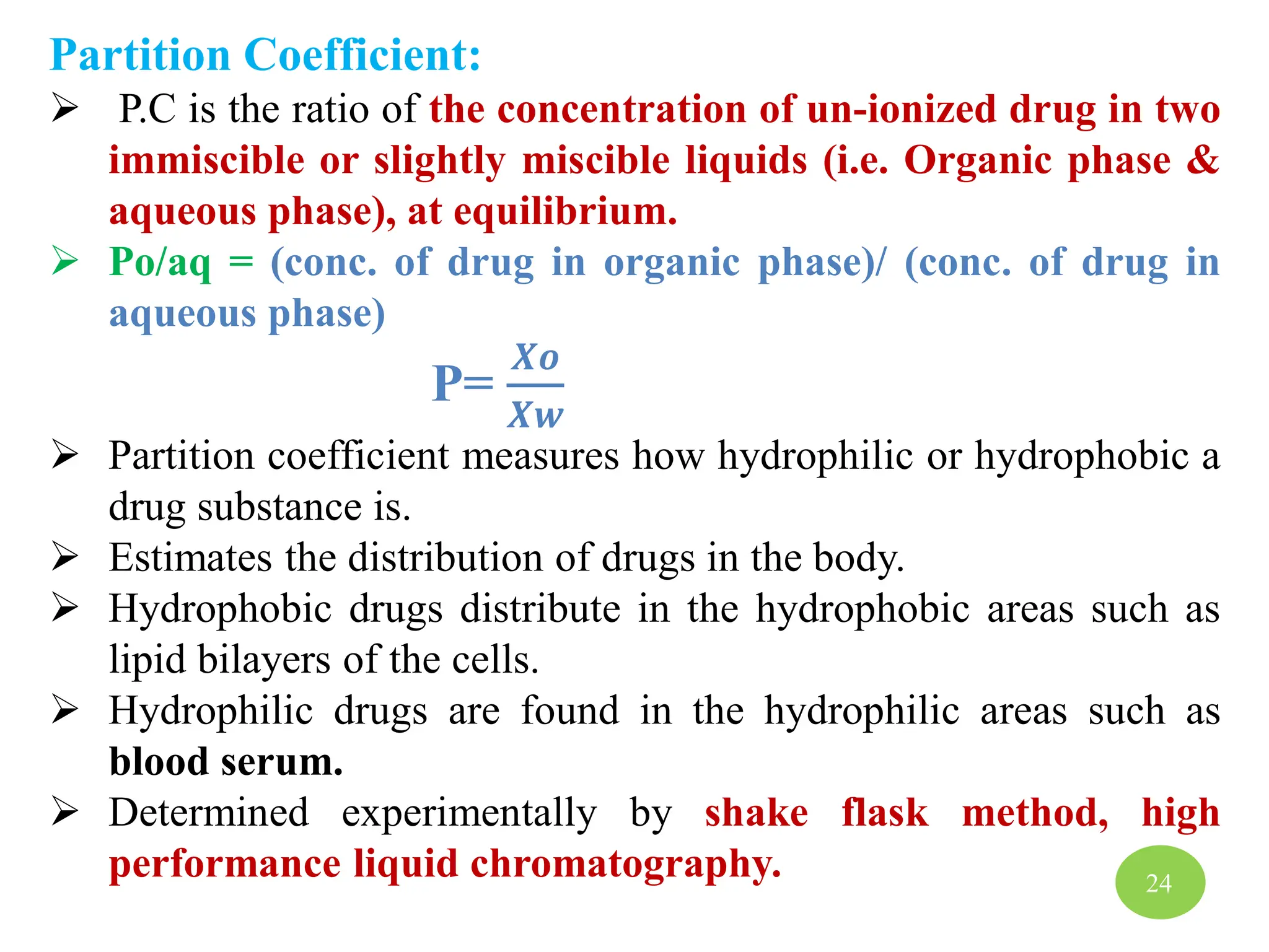
Partition Coefficient:
P.Cis the ratio of the concentration of un-ionized drug in two
immiscible or slightly miscible liquids (i.e. Organic phase &
aqueous phase), at equilibrium.
Po/aq = (conc. of drug in organic phase)/ (conc. of drug in
aqueous phase)
P=
𝑿𝒐
𝑿𝒘
Partition coefficient measures how hydrophilic or hydrophobic a
drug substance is.
Estimates the distribution of drugs in the body.
Hydrophobic drugs distribute in the hydrophobic areas such as
lipid bilayers of the cells.
Hydrophilic drugs are found in the hydrophilic areas such as
blood serum.
Determined experimentally by shake flask method, high
performance liquid chromatography. 24
25.
Dissolution Studies:
Dissolutionand drug release tests are in-vitro tests that
measure the rate and extent of dissolution or release of the
drug substance from a drug product, usually in aqueous
medium under specified conditions.
It is an important QC procedure for the drug product and
linked to product performance in-vivo.
Importance of dissolution studies:
Evaluation of bioavailability.
Batch to batch drug release uniformity.
Development of more effective and therapeutically optical
dosage forms.
Ensure quality and stability of the product.
Product development, quality control, research and
application. 25
26.
Common ion effect:
The reduction of the degree of dissociation of a salt by
the addition of a common ion is called the common ion
effect.
Adding a common ion decreases solubility of slightly
soluble electrolyte.
For example, hydrochloride salts often exhibit lower
solubility in gastric juice due to abundance of the
chloride ions.
26
27.
B. CHEMICAL PROPERTIESOF DRUG
SUBSTANCES:
A chemical property is a drugs property that becomes
evident after a chemical reaction.
Chemical properties are determined by the
investigation of the chemical reaction.
Major chemical properties that are studies in
preformulation are:-
Hydrolysis
Oxidation and Reduction
Racemization
Polymerization
27
28.
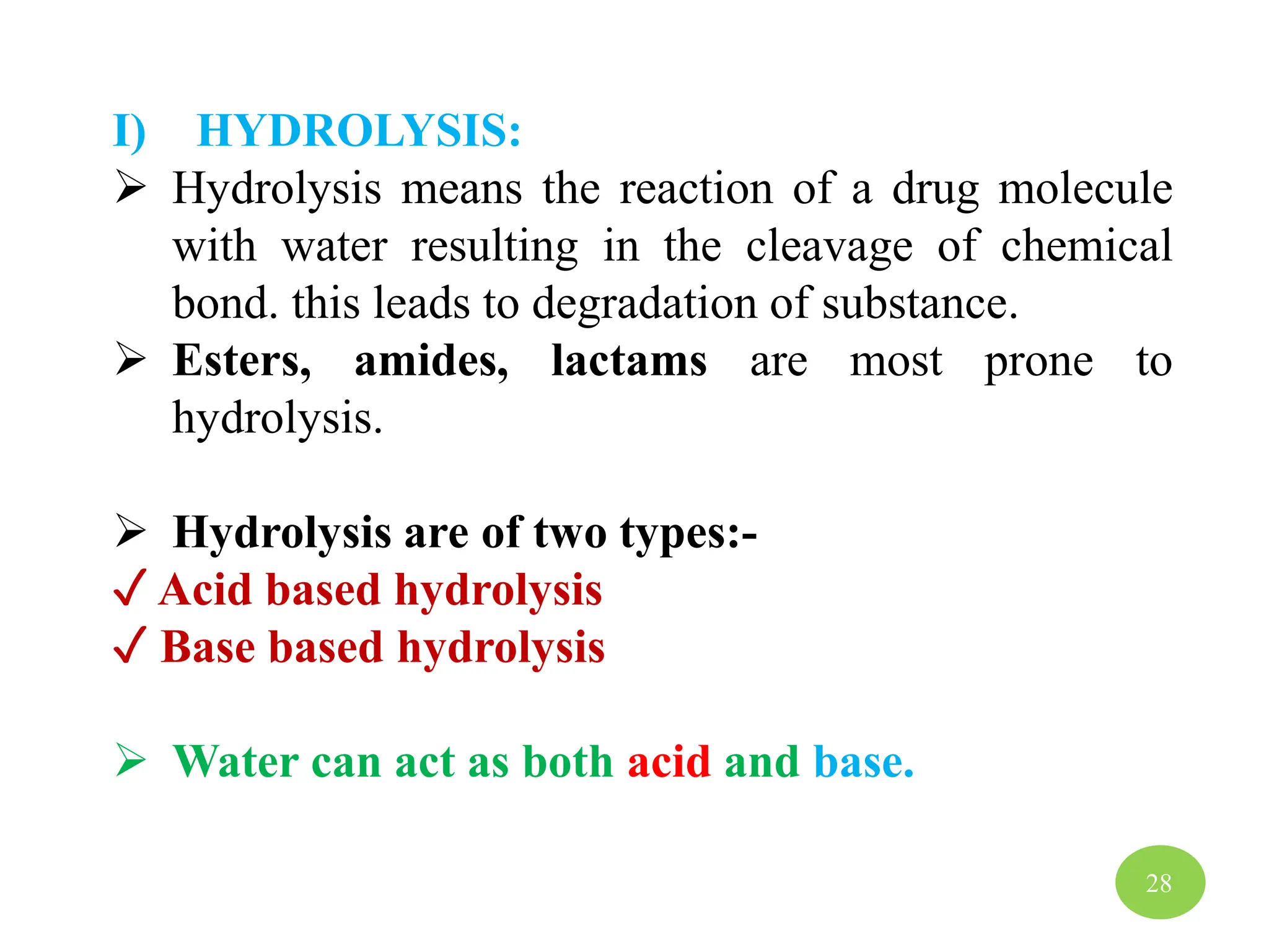
I) HYDROLYSIS:
Hydrolysismeans the reaction of a drug molecule
with water resulting in the cleavage of chemical
bond. this leads to degradation of substance.
Esters, amides, lactams are most prone to
hydrolysis.
Hydrolysis are of two types:-
✓ Acid based hydrolysis
✓ Base based hydrolysis
Water can act as both acid and base.
28
29.
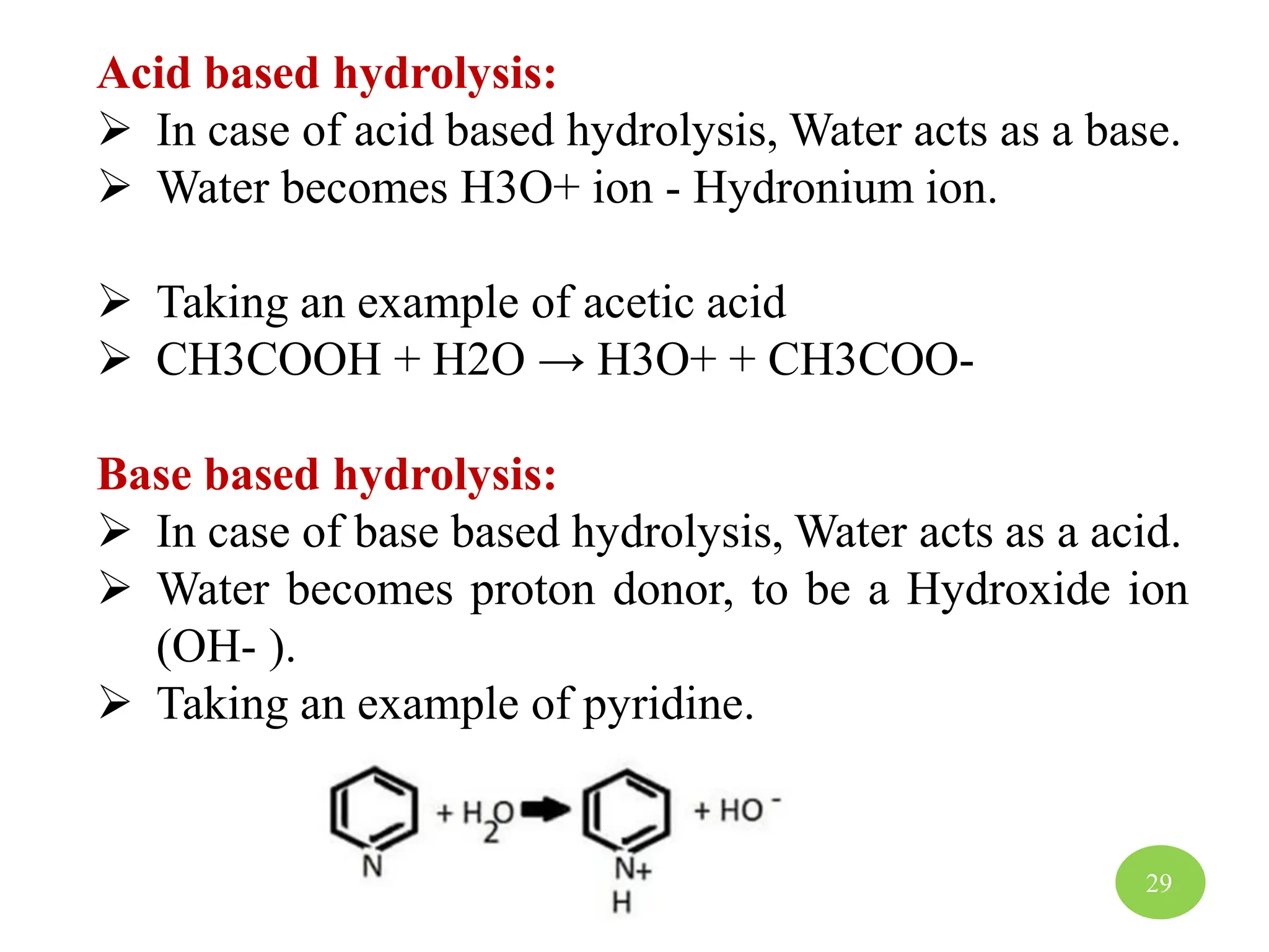
Acid based hydrolysis:
In case of acid based hydrolysis, Water acts as a base.
Water becomes H3O+ ion - Hydronium ion.
Taking an example of acetic acid
CH3COOH + H2O → H3O+ + CH3COO-
Base based hydrolysis:
In case of base based hydrolysis, Water acts as a acid.
Water becomes proton donor, to be a Hydroxide ion
(OH- ).
Taking an example of pyridine.
29
30.
Hydrolysis can beprevented by :-
Addition of buffers, additives, surfactants suppresses
hydrolysis.
Modification of chemical structure.
Replacing aqueous solvents with non aqueous
solvent - reduces hydrolysis.
Reduce exposure to water.
Conversion of some drugs into dry powder for
reconstitution.
Examples of drugs that undergo hydrolysis - aspirin,
penicillin, di-morphine, etc.
30
31.
II) OXIDATION ANDREDUCTION:
Oxidation and reduction are the common pathway for
drug degradation in solid and liquid formulations.
Oxidation and reduction involve the transfer of
electrons, between the reactants.
These two processes are together called Redox
reactions.
Oxidation: loss of electrons
Reduction: gain of electrons
Generally, in pharmaceutical formulations, oxidation is
mediated by the reaction with atmospheric oxygen.
Oxidation occurs in two ways:-
a) Auto-oxidation
b) Free radical chain process
31
32.
Auto oxidation:
Defined asreaction of substance with molecular oxygen,
which produces free radical, by homolytic bond fission of a
covalent bond.
Free radical chain process:
Occurs as 3 step process- initiation, propagation and
termination.
During initiation, compound is converted to a free radical.
In propagation step, free radical combines with oxygen to form
peroxy radical.
The peroxy radical further combines with hydrogen to form
hydroperoxide and new radical is formed in the termination step.
Some radicals combine to form inactive products.
32
33.
Such a degenerationcan be prevented by :-
Use of antioxidants and chelating agent.
Contact of drugs with heavy metals must be avoided.
Reducing agents can be used to prevent oxidation
pH adjustment can be done to prevent oxidation and
reduction.
Oxygen in containers can be replaced with nitrogen or
carbon dioxide.
Store in dark and cool containers. 33
34.
III) RACEMISATION:
aprocess of conversion of optically active compound
into an optically inactive compound.
Half of the compound becomes its mirror images.
Rate of racemization depends on the presence of
catalytic hydrogen, hydroxyl ion, heat, light,
temperature and solvent.
Inter conversion can alter the pharmacokinetic
properties, pharmacological properties, and
toxicological properties.
This conversion can make the drug inert or dangerous.
Eg. 1- epinephrine is 15-20 times active than the d-
form. 34
35.
IV) POLYMERISATION:
formof chemical degradation where two or more identical molecules
combine to form large complex molecules known as polymers.
It can also be defined as a process in which simple monomer molecules
combined to form large complex.
Polymerization can be of mainly two types:-
Addictive polymerization: monomers with double or triple bond
combine to form polymers, and the reaction does not give by products.
Condensation polymerization: monomers combine to form polymers
along with the formation of by products like water, ammonia,
hydrochloric acid etc.
Examples:
shellac on aging undergoes polymerization which affect disintegration
and dissolution time.
Glucose solution darkens due to polymerization.
Formaldehyde solution, on standing, leads to formation of white
deposit.
35
36.
BIOPHARMACEUTICAL CLASSIFICATION
SYSTEM [BCS]OF DRUGS
BCS of drugs is a system to differentiate drugs on the
basis of :-
Solubility
Permeability
Dissolution
Scientific framework for classifying drug substances
based on their aqueous solubility and intestinal
permeability.
36
37.
A theoreticalbasis for correlating in-vitro drug
dissolution with in-vivo bioavailability was
developed.
The classification of drugs is based on Fick's first law.
Fick's first law states,
Jw = Pw X Cw
Jw = drug flux across the gut wall
Pw = permeability of the membrane
Cw = drug concentration at GI membrane
37
38.
• SOLUBILITY:
Maximumamount of solute dissolved in a given solvent
under standard conditions of temperature, pressure, and
pH: measured to determine solubility.
Solubility is the ability of the drug to be soluble in a
solvent after dissolution.
• PERMEABILITY:
Ability of drug to pass the biological membrane which
is lipophilic.
Permeability of drug is indirectly based on the extent of
absorption of a drug substance.
38
39.
• DISSOLUTION:
Itis a process in which solid substance solubilizes in
a solvent.
Determined using UPS Apparatus I @ 100rpm or
Apparatus II @ 50rpm
Dissolution media: 900ml 0.1 N HCl, pH - 4.5 or
6.8 buffer, simulated intestinal fluid.
39
40.
Class Solubility PermeabilityExamples
Class-I High High Propanolol, Metoprolol
Class-II Low High Nifedipine, Ketoprofen
Class-III High Low Cimetidine, Ranitidine
Class-IV Low Low Taxol, Furosemide
Table: BCS classification system of drugs
40
41.
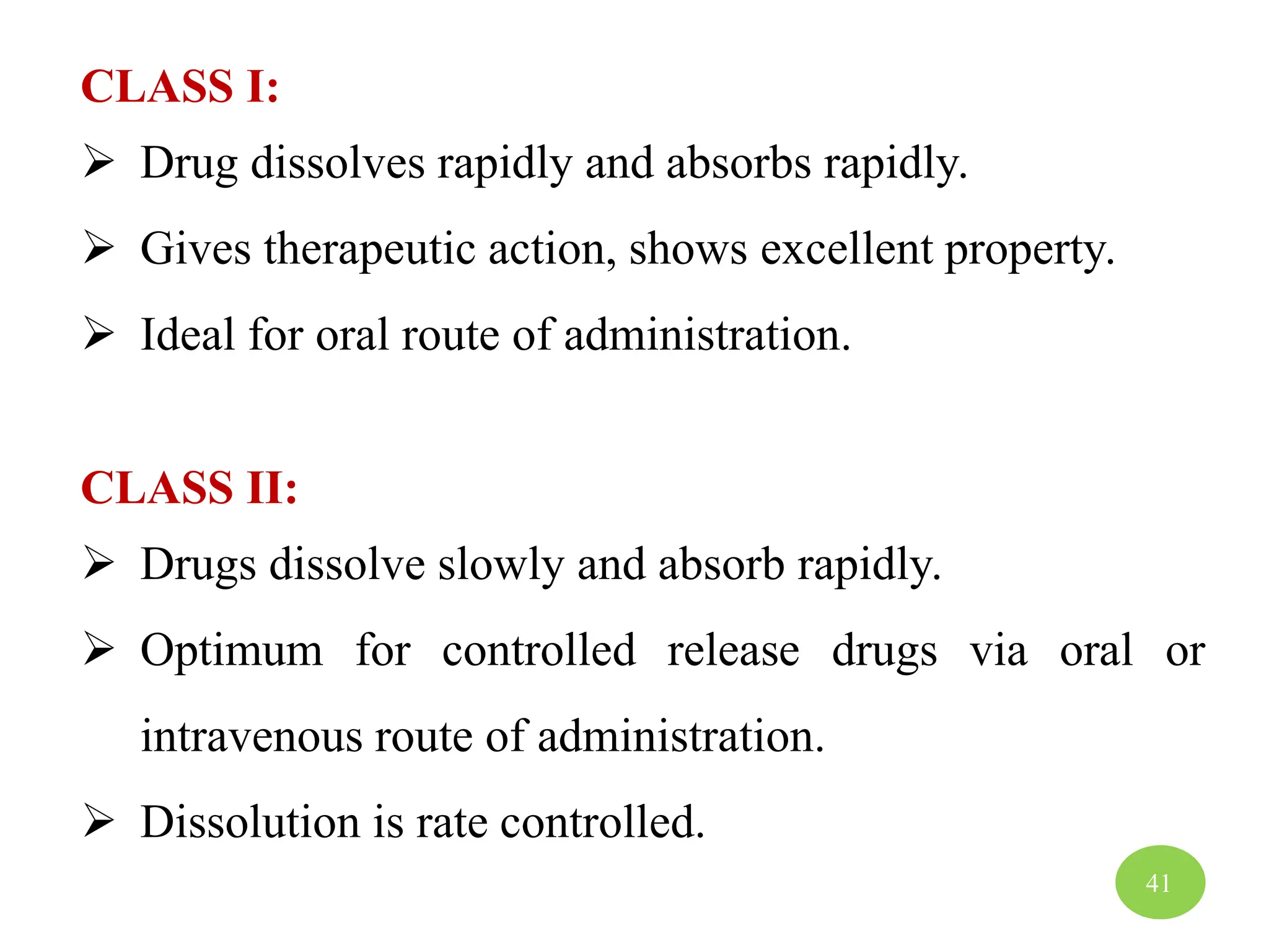
CLASS I:
Drugdissolves rapidly and absorbs rapidly.
Gives therapeutic action, shows excellent property.
Ideal for oral route of administration.
CLASS II:
Drugs dissolve slowly and absorb rapidly.
Optimum for controlled release drugs via oral or
intravenous route of administration.
Dissolution is rate controlled.
41
42.
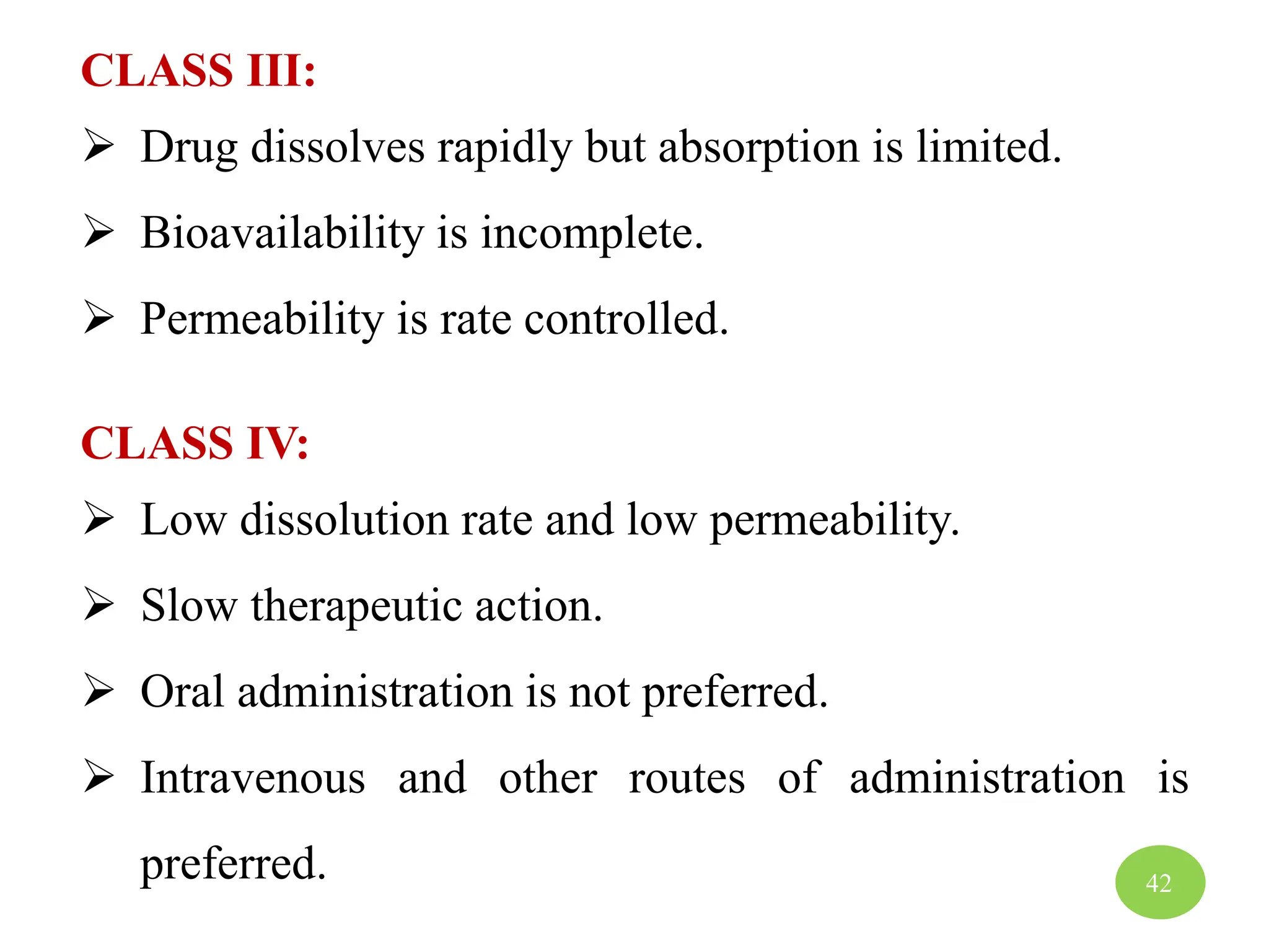
CLASS III:
Drugdissolves rapidly but absorption is limited.
Bioavailability is incomplete.
Permeability is rate controlled.
CLASS IV:
Low dissolution rate and low permeability.
Slow therapeutic action.
Oral administration is not preferred.
Intravenous and other routes of administration is
preferred. 42
43.
APPLICATIONS of BCSof DRUGS
Valuable tool for formulation scientist for selection of
design of dosage form.
Reduce cost and time for scale-up and post- approval
changes.
Applicable in clinical and pre-clinical testing.
Eliminates the need of human subjects to unnecessary
drug exposure.
Helps in maintaining high public standard of therapeutic
equivalence.
43
44.
APPROACHES TO BEMADE IN EACH CLASS OF BCS
CLASS I: Simple oral dosage form.
CLASS II: techniques to increase surface area, change
solvents or surfactants.
CLASS III: incorporate permeability enhancers.
CLASS IV: combine approaches of class I &II.
44
45.
APPLICATION OF PREFORMULATIONIN
DIFFERENT DOSAGE FORMS AND IMPACT IN
ITS STABILITY
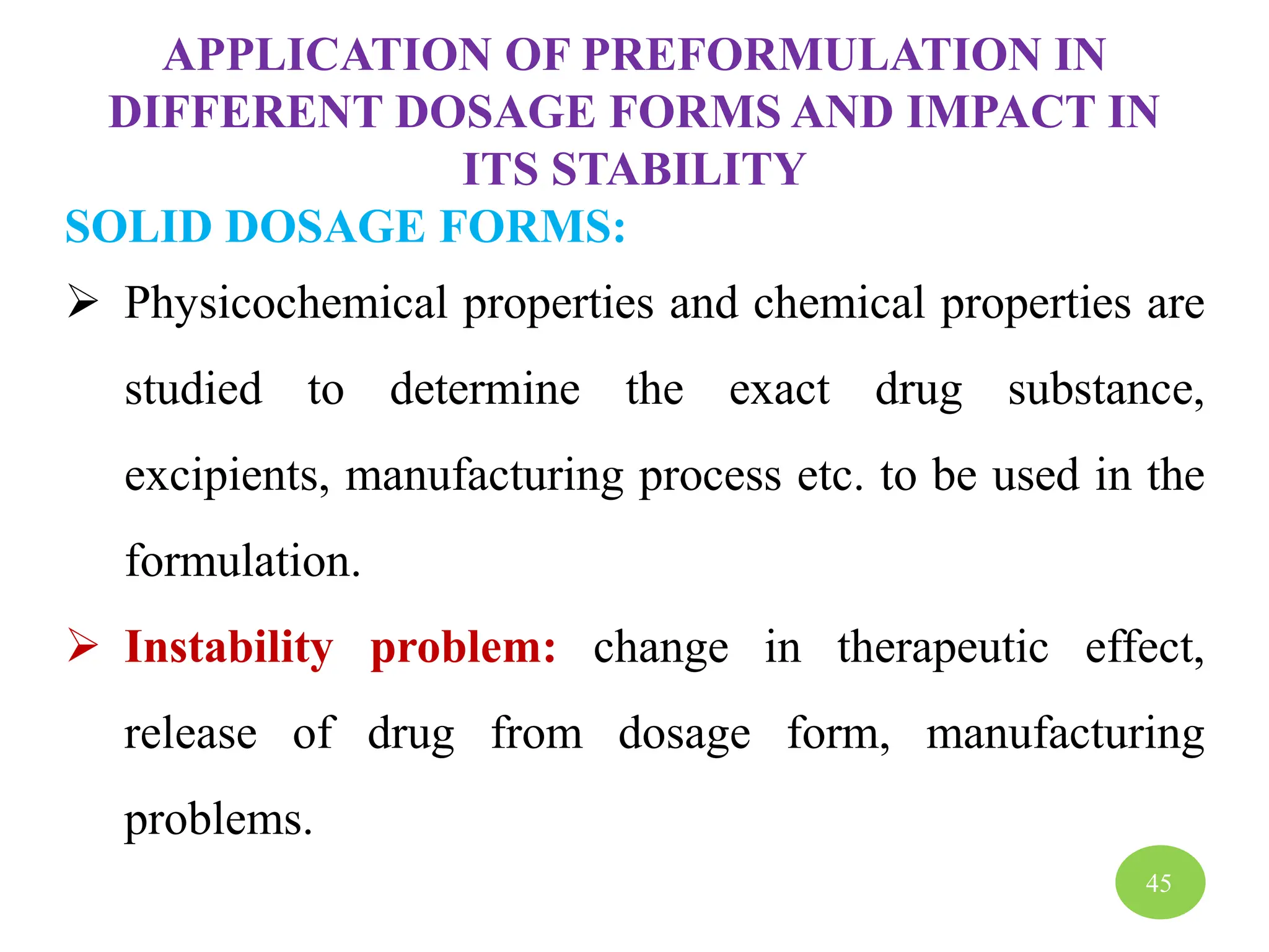
SOLID DOSAGE FORMS:
Physicochemical properties and chemical properties are
studied to determine the exact drug substance,
excipients, manufacturing process etc. to be used in the
formulation.
Instability problem: change in therapeutic effect,
release of drug from dosage form, manufacturing
problems.
45
46.
LIQUID DOSAGE FORMS:
Physicochemical properties like pH, color, clarity,
viscosity etc.
Chemical problems: assay, degradation product
analysis, microbial determination properties.
Instability problems: loss of flavor, interaction with
plastic bottles, settling, caking, and crystal growth,
creaming, coalescence, breaking, flocculation, phase
inversion.
46
47.
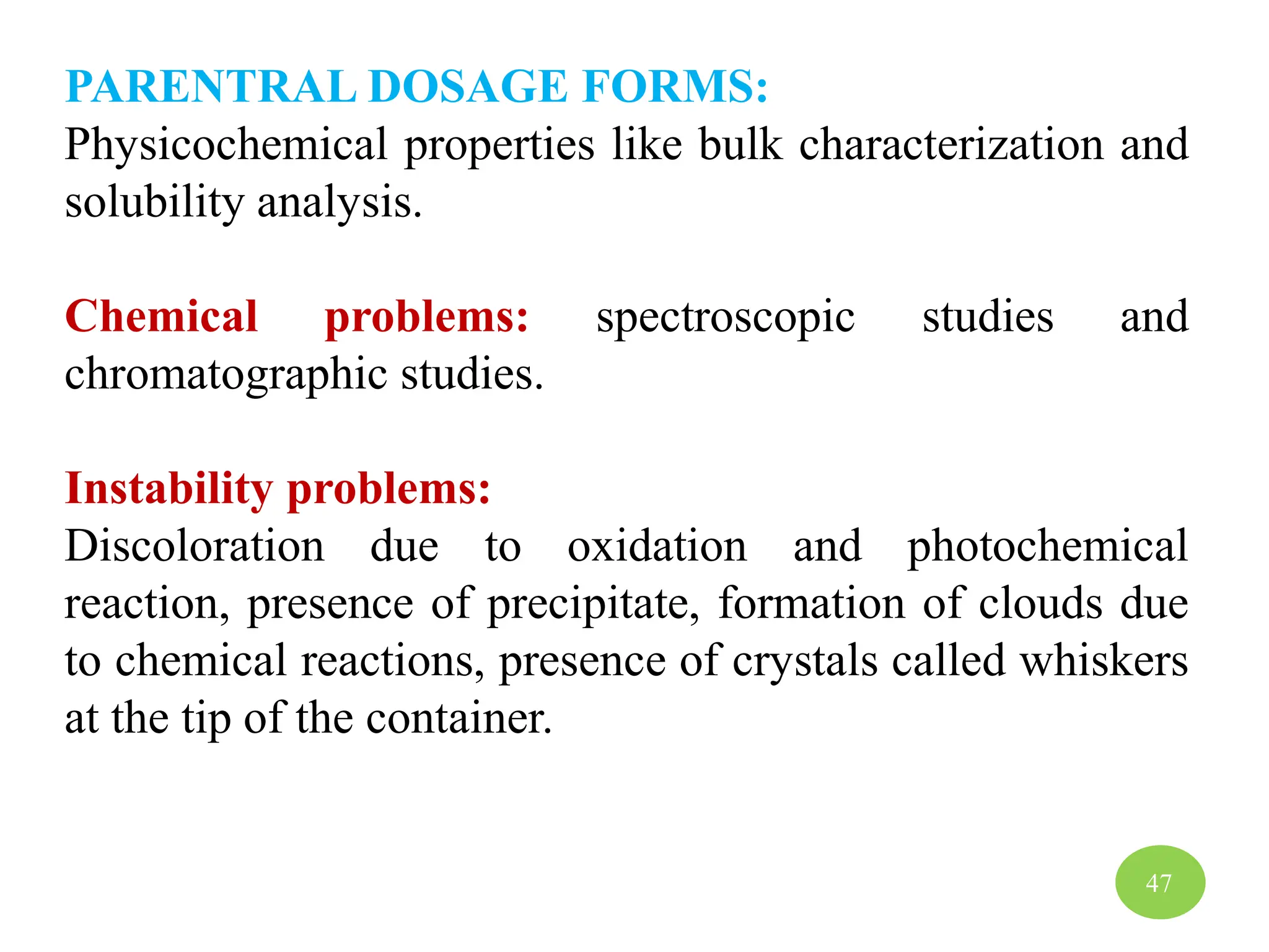
PARENTRAL DOSAGE FORMS:
Physicochemicalproperties like bulk characterization and
solubility analysis.
Chemical problems: spectroscopic studies and
chromatographic studies.
Instability problems:
Discoloration due to oxidation and photochemical
reaction, presence of precipitate, formation of clouds due
to chemical reactions, presence of crystals called whiskers
at the tip of the container.
47




![D) Flow Properties of Materials:
Flow property can be affected by a number of factors
like changes in particle size, shape, surface area,
density, frictional forces, van der waals forces etc.
Efficient flow of particles is needed for an effective
formulation. In case of liquid materials, flow properties
are measured using rheology and thixotropy.
1. Hausner's ratio: Number that is correlated to the flow
ability of powder or granular material.
Hausner's Ratio = Tapped Density / Bulk Density
2. Carr's Compressibility Index: Ability of powder to
decrease in volume under pressure.
Carr's Compressibility Index = {[Tapped - Bulk
Density] / Tapped Density } X 100 16](https://image.slidesharecdn.com/uniti-250817151858-35a557d6/75/IP-I-Unit-I-Preformulation-Studies-16-2048.jpg)









![BIOPHARMACEUTICAL CLASSIFICATION
SYSTEM [BCS] OF DRUGS
BCS of drugs is a system to differentiate drugs on the
basis of :-
Solubility
Permeability
Dissolution
Scientific framework for classifying drug substances
based on their aqueous solubility and intestinal
permeability.
36](https://image.slidesharecdn.com/uniti-250817151858-35a557d6/75/IP-I-Unit-I-Preformulation-Studies-36-2048.jpg)