TAF 3023: DISCRETE
MATH


 Power !
PROPOSITIONAL LOGIC

Proposition   • possible condition of the world
                about which we want to say
                something.

Example       • Apple is a fruit.
PROPOSITIONAL LOGIC
• Propositional   • A proposition or statement is a
  logic             sentence which is either true or
                    false.


• Example         • True - Apple is a fruit.
                  • False - Rice is a fruit.
PROPOSITIONAL LOGIC
• Propositional   • Propositional variables use letters to
  variables         represent it, just as letters used to
                    represent numerical variables.


• Example         • p, q, r, s, ………
PROPOSITIONAL LOGIC
Types of Truth Table
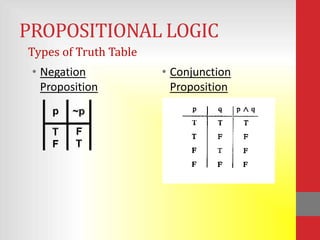
 • Negation            • Conjunction
   Proposition           Proposition
PROPOSITIONAL LOGIC
Types of Truth Table
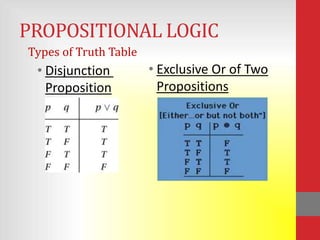
 • Disjunction         • Exclusive Or of Two
   Proposition           Propositions
PROPOSITIONAL LOGIC
Types of Truth Table
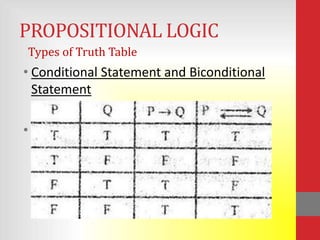
• Conditional Statement and Biconditional
  Statement

•
PROPOSITIONAL LOGIC
 Types of Truth Table
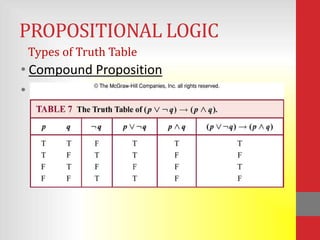
• Compound Proposition
•
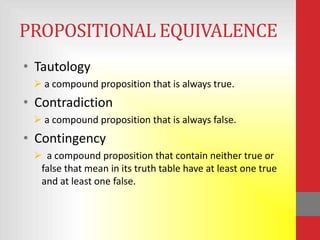
PROPOSITIONAL EQUIVALENCE
• Tautology
  a compound proposition that is always true.
• Contradiction
  a compound proposition that is always false.
• Contingency
  a compound proposition that contain neither true or
  false that mean in its truth table have at least one true
  and at least one false.
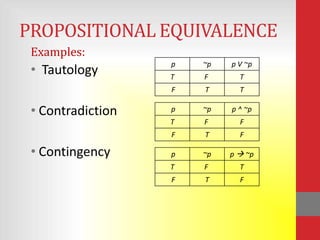
PROPOSITIONAL EQUIVALENCE
 Examples:
                   p   ~p   p V ~p
 • Tautology       T   F      T
                   F   T      T

 • Contradiction   p   ~p   p ^ ~p
                   T   F      F
                   F   T      F

 • Contingency     p   ~p   p  ~p
                   T   F      T
                   F   T      F
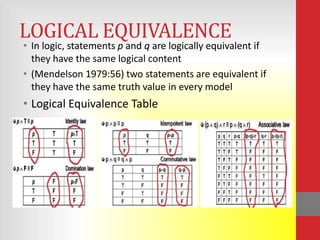
LOGICAL EQUIVALENCE
• In logic, statements p and q are logically equivalent if
  they have the same logical content
• (Mendelson 1979:56) two statements are equivalent if
  they have the same truth value in every model
• Logical Equivalence Table
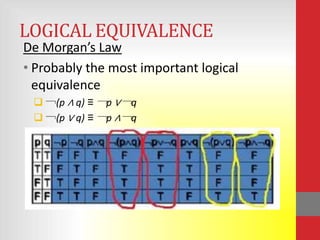
LOGICAL EQUIVALENCE
De Morgan’s Law
• Probably the most important logical
  equivalence
  ¬(p ∧ q) ≡ ¬p ∨¬q
  ¬(p ∨ q) ≡ ¬p ∧¬q
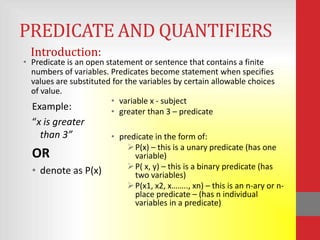
PREDICATE AND QUANTIFIERS
  Introduction:
• Predicate is an open statement or sentence that contains a finite
  numbers of variables. Predicates become statement when specifies
  values are substituted for the variables by certain allowable choices
  of value.
                         • variable x - subject
  Example:               • greater than 3 – predicate
  “x is greater
    than 3”             • predicate in the form of:
                             P(x) – this is a unary predicate (has one
  OR                          variable)
                             P( x, y) – this is a binary predicate (has
  • denote as P(x)            two variables)
                             P(x1, x2, x…….., xn) – this is an n-ary or n-
                              place predicate – (has n individual
                              variables in a predicate)
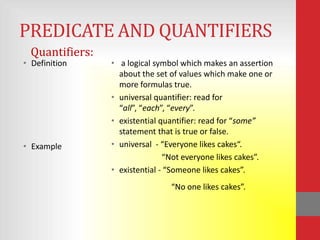
PREDICATE AND QUANTIFIERS
  Quantifiers:
• Definition     • a logical symbol which makes an assertion
                   about the set of values which make one or
                   more formulas true.
                 • universal quantifier: read for
                   “all”, “each”, “every”.
                 • existential quantifier: read for “some”
                   statement that is true or false.
• Example        • universal - “Everyone likes cakes“.
                                “Not everyone likes cakes”.
                 • existential - “Someone likes cakes”.
                                “No one likes cakes”.
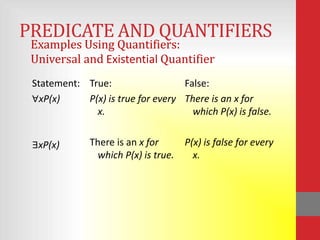
PREDICATE AND QUANTIFIERS
 Examples Using Quantifiers:
 Universal and Existential Quantifier
 Statement: True:                  False:
 ∀xP(x)     P(x) is true for every There is an x for
              x.                     which P(x) is false.


 ∃xP(x)       There is an x for       P(x) is false for every
                which P(x) is true.     x.
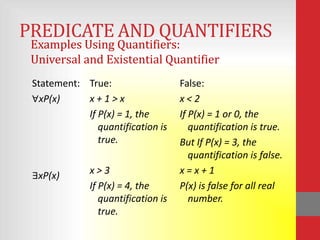
PREDICATE AND QUANTIFIERS
 Examples Using Quantifiers:
 Universal and Existential Quantifier
 Statement: True:                    False:
 ∀xP(x)     x+1>x                    x<2
            If P(x) = 1, the         If P(x) = 1 or 0, the
               quantification is        quantification is true.
               true.                 But If P(x) = 3, the
                                        quantification is false.
 ∃xP(x)       x>3                    x=x+1
              If P(x) = 4, the       P(x) is false for all real
                 quantification is      number.
                 true.

Math

  • 1.
  • 2.
    PROPOSITIONAL LOGIC Proposition • possible condition of the world about which we want to say something. Example • Apple is a fruit.
  • 3.
    PROPOSITIONAL LOGIC • Propositional • A proposition or statement is a logic sentence which is either true or false. • Example • True - Apple is a fruit. • False - Rice is a fruit.
  • 4.
    PROPOSITIONAL LOGIC • Propositional • Propositional variables use letters to variables represent it, just as letters used to represent numerical variables. • Example • p, q, r, s, ………
  • 5.
    PROPOSITIONAL LOGIC Types ofTruth Table • Negation • Conjunction Proposition Proposition
  • 6.
    PROPOSITIONAL LOGIC Types ofTruth Table • Disjunction • Exclusive Or of Two Proposition Propositions
  • 7.
    PROPOSITIONAL LOGIC Types ofTruth Table • Conditional Statement and Biconditional Statement •
  • 8.
    PROPOSITIONAL LOGIC Typesof Truth Table • Compound Proposition •
  • 9.
    PROPOSITIONAL EQUIVALENCE • Tautology  a compound proposition that is always true. • Contradiction  a compound proposition that is always false. • Contingency  a compound proposition that contain neither true or false that mean in its truth table have at least one true and at least one false.
  • 10.
    PROPOSITIONAL EQUIVALENCE Examples: p ~p p V ~p • Tautology T F T F T T • Contradiction p ~p p ^ ~p T F F F T F • Contingency p ~p p  ~p T F T F T F
  • 11.
    LOGICAL EQUIVALENCE • Inlogic, statements p and q are logically equivalent if they have the same logical content • (Mendelson 1979:56) two statements are equivalent if they have the same truth value in every model • Logical Equivalence Table
  • 12.
    LOGICAL EQUIVALENCE De Morgan’sLaw • Probably the most important logical equivalence  ¬(p ∧ q) ≡ ¬p ∨¬q  ¬(p ∨ q) ≡ ¬p ∧¬q
  • 13.
    PREDICATE AND QUANTIFIERS Introduction: • Predicate is an open statement or sentence that contains a finite numbers of variables. Predicates become statement when specifies values are substituted for the variables by certain allowable choices of value. • variable x - subject Example: • greater than 3 – predicate “x is greater than 3” • predicate in the form of:  P(x) – this is a unary predicate (has one OR variable)  P( x, y) – this is a binary predicate (has • denote as P(x) two variables)  P(x1, x2, x…….., xn) – this is an n-ary or n- place predicate – (has n individual variables in a predicate)
  • 14.
    PREDICATE AND QUANTIFIERS Quantifiers: • Definition • a logical symbol which makes an assertion about the set of values which make one or more formulas true. • universal quantifier: read for “all”, “each”, “every”. • existential quantifier: read for “some” statement that is true or false. • Example • universal - “Everyone likes cakes“. “Not everyone likes cakes”. • existential - “Someone likes cakes”. “No one likes cakes”.
  • 15.
    PREDICATE AND QUANTIFIERS Examples Using Quantifiers: Universal and Existential Quantifier Statement: True: False: ∀xP(x) P(x) is true for every There is an x for x. which P(x) is false. ∃xP(x) There is an x for P(x) is false for every which P(x) is true. x.
  • 16.
    PREDICATE AND QUANTIFIERS Examples Using Quantifiers: Universal and Existential Quantifier Statement: True: False: ∀xP(x) x+1>x x<2 If P(x) = 1, the If P(x) = 1 or 0, the quantification is quantification is true. true. But If P(x) = 3, the quantification is false. ∃xP(x) x>3 x=x+1 If P(x) = 4, the P(x) is false for all real quantification is number. true.