Models and Formalisms
S. Garlatti
MR2A Informatique
2012
Progress
1 Introduction
2 Formal Systems
3 Propositional Logic
4 The Predicate Calculus or First Order Logic
2 / 109 SG Models and Formalisms
Introduction
Concatenation Modeling?
Answer from a logical point of view:
Conc([X|L], L1, [X|L2]) :− Conc(L, L1, L2).
Conc([], L, L).
Conc([a,b], [c,d], L)?
3 / 109 SG Models and Formalisms
Introduction
History of Logic
Plato’s logic, Aristotle’s logic, Stoic logic
Medieval logic, etc.
Rise of Modern Logic, the mid-nineteenth century:
Rigorous and formalistic discipline whose exemplar was the exact
method of proof used in mathematics
The modern so-called "symbolic" or "mathematical" logic
Modern logic: a calculus whose rules of operation are determined
only by the shape and not by the meaning of the symbols it
employs, as in mathematics.
4 / 109 SG Models and Formalisms
Progress
1 Introduction
2 Formal Systems
3 Propositional Logic
4 The Predicate Calculus or First Order Logic
5 / 109 SG Models and Formalisms
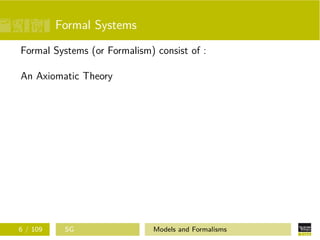
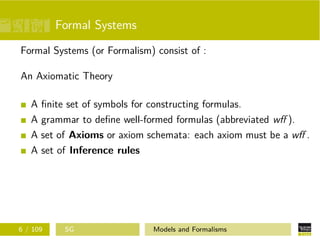
Formal Systems
Formal Systems (or Formalism) consist of :
An Axiomatic Theory
6 / 109 SG Models and Formalisms
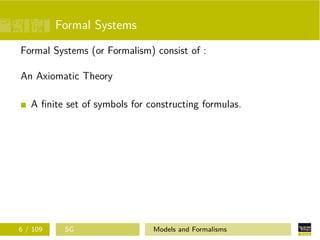
Formal Systems
Formal Systems (or Formalism) consist of :
An Axiomatic Theory
A finite set of symbols for constructing formulas.
6 / 109 SG Models and Formalisms
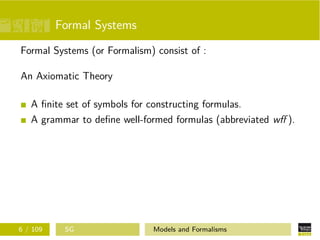
Formal Systems
Formal Systems (or Formalism) consist of :
An Axiomatic Theory
A finite set of symbols for constructing formulas.
A grammar to define well-formed formulas (abbreviated wff ).
6 / 109 SG Models and Formalisms
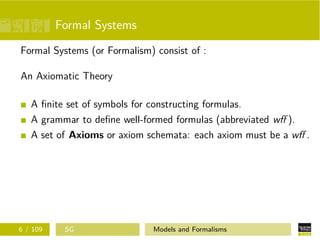
Formal Systems
Formal Systems (or Formalism) consist of :
An Axiomatic Theory
A finite set of symbols for constructing formulas.
A grammar to define well-formed formulas (abbreviated wff ).
A set of Axioms or axiom schemata: each axiom must be a wff .
6 / 109 SG Models and Formalisms
Formal Systems
Formal Systems (or Formalism) consist of :
An Axiomatic Theory
A finite set of symbols for constructing formulas.
A grammar to define well-formed formulas (abbreviated wff ).
A set of Axioms or axiom schemata: each axiom must be a wff .
A set of Inference rules
6 / 109 SG Models and Formalisms
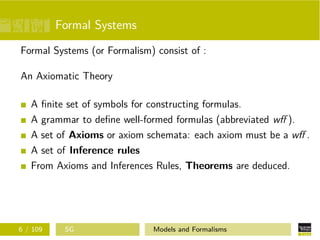
Formal Systems
Formal Systems (or Formalism) consist of :
An Axiomatic Theory
A finite set of symbols for constructing formulas.
A grammar to define well-formed formulas (abbreviated wff ).
A set of Axioms or axiom schemata: each axiom must be a wff .
A set of Inference rules
From Axioms and Inferences Rules, Theorems are deduced.
6 / 109 SG Models and Formalisms
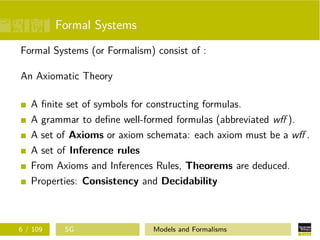
Formal Systems
Formal Systems (or Formalism) consist of :
An Axiomatic Theory
A finite set of symbols for constructing formulas.
A grammar to define well-formed formulas (abbreviated wff ).
A set of Axioms or axiom schemata: each axiom must be a wff .
A set of Inference rules
From Axioms and Inferences Rules, Theorems are deduced.
Properties: Consistency and Decidability
6 / 109 SG Models and Formalisms
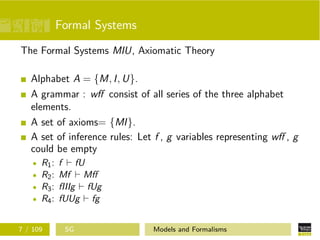
Formal Systems
The Formal Systems MIU, Axiomatic Theory
Alphabet A = {M, I, U}.
A grammar : wff consist of all series of the three alphabet
elements.
A set of axioms= {MI}.
A set of inference rules: Let f , g variables representing wff , g
could be empty
R1: f fU
R2: Mf Mff
R3: fIIIg fUg
R4: fUUg fg
7 / 109 SG Models and Formalisms
Formal Systems
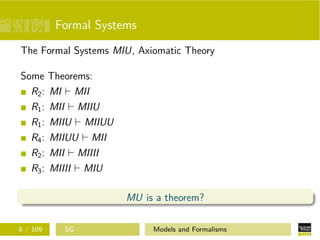
The Formal Systems MIU, Axiomatic Theory
Some Theorems:
R2: MI MII
R1: MII MIIU
R1: MIIU MIIUU
R4: MIIUU MII
R2: MII MIIII
R3: MIIII MIU
MU is a theorem?
8 / 109 SG Models and Formalisms
Formal Systems
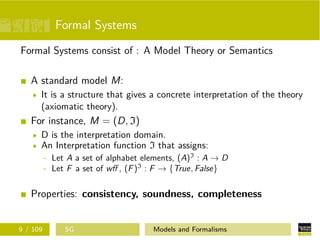
Formal Systems consist of : A Model Theory or Semantics
A standard model M:
It is a structure that gives a concrete interpretation of the theory
(axiomatic theory).
For instance, M = (D, I)
D is the interpretation domain.
An Interpretation function I that assigns:
- Let A a set of alphabet elements, (A)I
: A → D
- Let F a set of wff , (F)I
: F → {True, False}
Properties: consistency, soundness, completeness
9 / 109 SG Models and Formalisms
Formal Systems
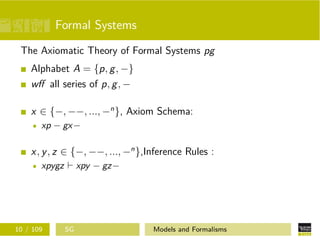
The Axiomatic Theory of Formal Systems pg
Alphabet A = {p, g, −}
wff all series of p, g, −
x ∈ {−, −−, ..., −n
}, Axiom Schema:
xp − gx−
x, y, z ∈ {−, −−, ..., −n
},Inference Rules :
xpygz xpy − gz−
10 / 109 SG Models and Formalisms
Formal Systems
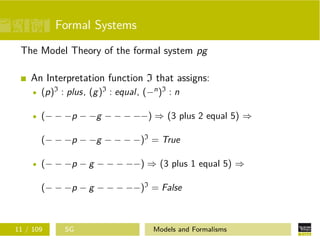
The Model Theory of the formal system pg
An Interpretation function I that assigns:
(p)I : plus, (g)I : equal, (−n)I : n
(− − −p − −g − − − −−) ⇒ (3 plus 2 equal 5) ⇒
(− − −p − −g − − − −)I = True
(− − −p − g − − − −−) ⇒ (3 plus 1 equal 5) ⇒
(− − −p − g − − − −−)I = False
11 / 109 SG Models and Formalisms
Formal Systems
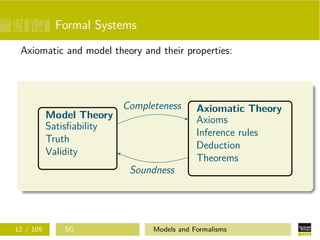
Axiomatic and model theory and their properties:
Model Theory
Satisfiability
Truth
Validity
Axiomatic Theory
Axioms
Inference rules
Deduction
Theorems
Completeness
Soundness
12 / 109 SG Models and Formalisms
Progress
1 Introduction
2 Formal Systems
3 Propositional Logic
4 The Predicate Calculus or First Order Logic
13 / 109 SG Models and Formalisms
The Propositional Logic
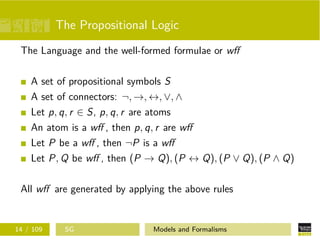
The Language and the well-formed formulae or wff
A set of propositional symbols S
A set of connectors: ¬, →, ↔, ∨, ∧
Let p, q, r ∈ S, p, q, r are atoms
An atom is a wff , then p, q, r are wff
Let P be a wff , then ¬P is a wff
Let P, Q be wff , then (P → Q), (P ↔ Q), (P ∨ Q), (P ∧ Q)
All wff are generated by applying the above rules
14 / 109 SG Models and Formalisms
The Model Theory of Propositional Logic
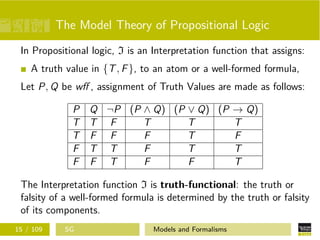
In Propositional logic, I is an Interpretation function that assigns:
A truth value in {T, F}, to an atom or a well-formed formula,
Let P, Q be wff , assignment of Truth Values are made as follows:
P Q ¬P (P ∧ Q) (P ∨ Q) (P → Q)
T T F T T T
T F F F T F
F T T F T T
F F T F F T
The Interpretation function I is truth-functional: the truth or
falsity of a well-formed formula is determined by the truth or falsity
of its components.
15 / 109 SG Models and Formalisms
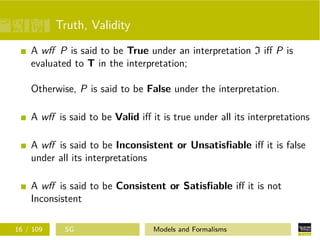
Truth, Validity
A wff P is said to be True under an interpretation I iff P is
evaluated to T in the interpretation;
Otherwise, P is said to be False under the interpretation.
A wff is said to be Valid iff it is true under all its interpretations
A wff is said to be Inconsistent or Unsatisfiable iff it is false
under all its interpretations
A wff is said to be Consistent or Satisfiable iff it is not
Inconsistent
16 / 109 SG Models and Formalisms
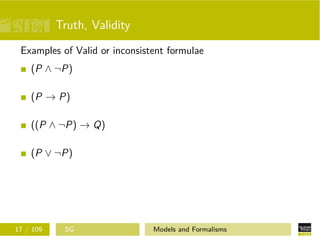
Truth, Validity
Examples of Valid or inconsistent formulae
(P ∧ ¬P)
(P → P)
((P ∧ ¬P) → Q)
(P ∨ ¬P)
17 / 109 SG Models and Formalisms
Outline
1 Introduction
2 Formal Systems
3 Propositional Logic
The Axiomatic Theory
Propositional Logic Properties
Resolution Principles
4 The Predicate Calculus or First Order Logic
The Model Theory or Semantics
The Axiomatic Theory
Predicate Calculus Properties
Resolution Principles
Resolution Strategy
Prolog Modeling
18 / 109 SG Models and Formalisms
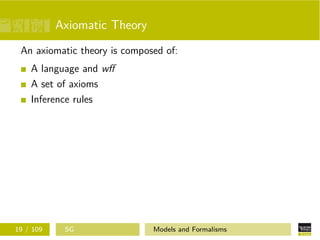
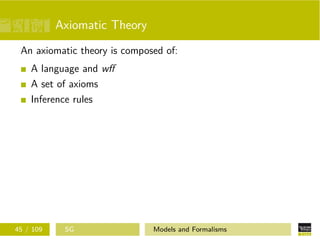
Axiomatic Theory
An axiomatic theory is composed of:
A language and wff
A set of axioms
Inference rules
19 / 109 SG Models and Formalisms
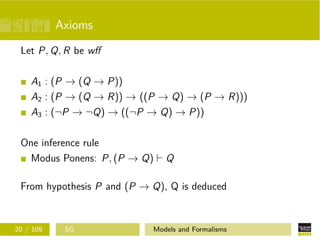
Axioms
Let P, Q, R be wff
A1 : (P → (Q → P))
A2 : (P → (Q → R)) → ((P → Q) → (P → R)))
A3 : (¬P → ¬Q) → ((¬P → Q) → P))
One inference rule
Modus Ponens: P, (P → Q) Q
From hypothesis P and (P → Q), Q is deduced
20 / 109 SG Models and Formalisms
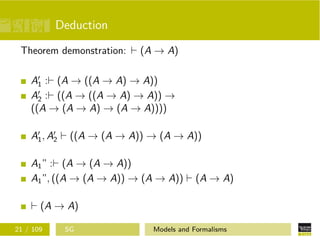
Deduction
Theorem demonstration: (A → A)
A1 : (A → ((A → A) → A))
A2 : ((A → ((A → A) → A)) →
((A → (A → A) → (A → A))))
A1, A2 ((A → (A → A)) → (A → A))
A1” : (A → (A → A))
A1”, ((A → (A → A)) → (A → A)) (A → A)
(A → A)
21 / 109 SG Models and Formalisms
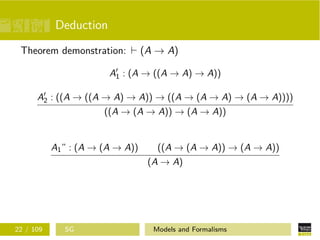
Deduction
Theorem demonstration: (A → A)
A1 : (A → ((A → A) → A))
A2 : ((A → ((A → A) → A)) → ((A → (A → A) → (A → A))))
((A → (A → A)) → (A → A))
A1” : (A → (A → A)) ((A → (A → A)) → (A → A))
(A → A)
22 / 109 SG Models and Formalisms
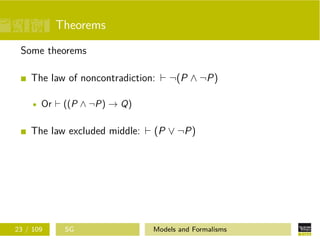
Theorems
Some theorems
The law of noncontradiction: ¬(P ∧ ¬P)
Or ((P ∧ ¬P) → Q)
The law excluded middle: (P ∨ ¬P)
23 / 109 SG Models and Formalisms
Outline
1 Introduction
2 Formal Systems
3 Propositional Logic
The Axiomatic Theory
Propositional Logic Properties
Resolution Principles
4 The Predicate Calculus or First Order Logic
The Model Theory or Semantics
The Axiomatic Theory
Predicate Calculus Properties
Resolution Principles
Resolution Strategy
Prolog Modeling
24 / 109 SG Models and Formalisms
Propositional Logic Properties
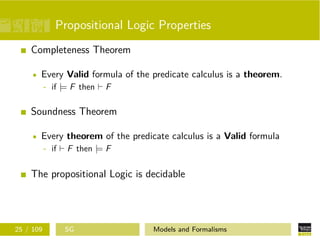
Completeness Theorem
Every Valid formula of the predicate calculus is a theorem.
- if |= F then F
Soundness Theorem
Every theorem of the predicate calculus is a Valid formula
- if F then |= F
The propositional Logic is decidable
25 / 109 SG Models and Formalisms
Propositional Logic Properties
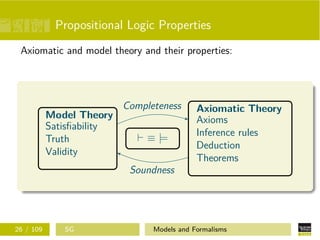
Axiomatic and model theory and their properties:
Model Theory
Satisfiability
Truth
Validity
Axiomatic Theory
Axioms
Inference rules
Deduction
Theorems
≡ |=
Completeness
Soundness
26 / 109 SG Models and Formalisms
Outline
1 Introduction
2 Formal Systems
3 Propositional Logic
The Axiomatic Theory
Propositional Logic Properties
Resolution Principles
4 The Predicate Calculus or First Order Logic
The Model Theory or Semantics
The Axiomatic Theory
Predicate Calculus Properties
Resolution Principles
Resolution Strategy
Prolog Modeling
27 / 109 SG Models and Formalisms
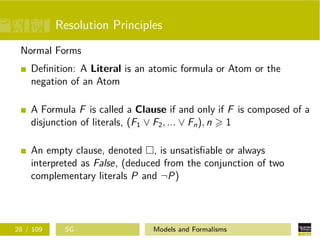
Resolution Principles
Normal Forms
Definition: A Literal is an atomic formula or Atom or the
negation of an Atom
A Formula F is called a Clause if and only if F is composed of a
disjunction of literals, (F1 ∨ F2, ... ∨ Fn), n 1
An empty clause, denoted , is unsatisfiable or always
interpreted as False, (deduced from the conjunction of two
complementary literals P and ¬P)
28 / 109 SG Models and Formalisms
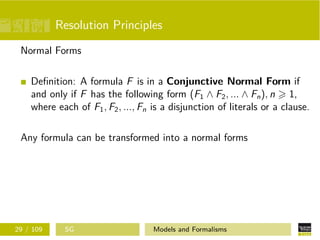
Resolution Principles
Normal Forms
Definition: A formula F is in a Conjunctive Normal Form if
and only if F has the following form (F1 ∧ F2, ... ∧ Fn), n 1,
where each of F1, F2, ..., Fn is a disjunction of literals or a clause.
Any formula can be transformed into a normal forms
29 / 109 SG Models and Formalisms
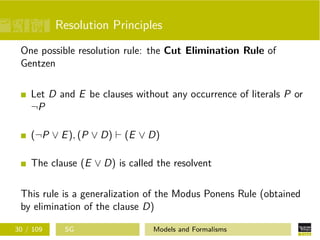
Resolution Principles
One possible resolution rule: the Cut Elimination Rule of
Gentzen
Let D and E be clauses without any occurrence of literals P or
¬P
(¬P ∨ E), (P ∨ D) (E ∨ D)
The clause (E ∨ D) is called the resolvent
This rule is a generalization of the Modus Ponens Rule (obtained
by elimination of the clause D)
30 / 109 SG Models and Formalisms
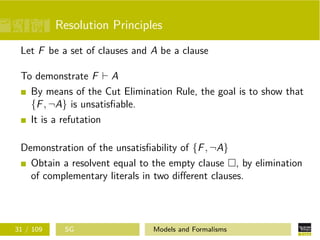
Resolution Principles
Let F be a set of clauses and A be a clause
To demonstrate F A
By means of the Cut Elimination Rule, the goal is to show that
{F, ¬A} is unsatisfiable.
It is a refutation
Demonstration of the unsatisfiability of {F, ¬A}
Obtain a resolvent equal to the empty clause , by elimination
of complementary literals in two different clauses.
31 / 109 SG Models and Formalisms
Resolution Principles
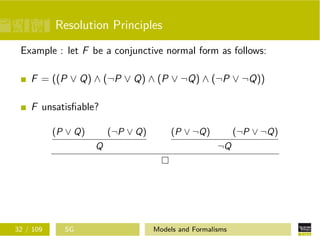
Example : let F be a conjunctive normal form as follows:
F = ((P ∨ Q) ∧ (¬P ∨ Q) ∧ (P ∨ ¬Q) ∧ (¬P ∨ ¬Q))
F unsatisfiable?
(P ∨ Q) (¬P ∨ Q)
Q
(P ∨ ¬Q) (¬P ∨ ¬Q)
¬Q
32 / 109 SG Models and Formalisms
Progress
1 Introduction
2 Formal Systems
3 Propositional Logic
4 The Predicate Calculus or First Order Logic
33 / 109 SG Models and Formalisms
The Predicate Calculus
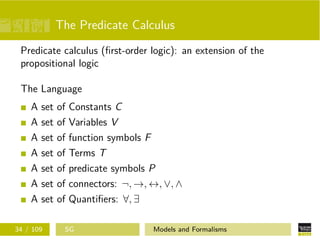
Predicate calculus (first-order logic): an extension of the
propositional logic
The Language
A set of Constants C
A set of Variables V
A set of function symbols F
A set of Terms T
A set of predicate symbols P
A set of connectors: ¬, →, ↔, ∨, ∧
A set of Quantifiers: ∀, ∃
34 / 109 SG Models and Formalisms
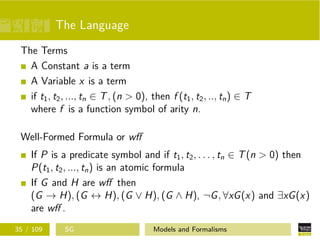
The Language
The Terms
A Constant a is a term
A Variable x is a term
if t1, t2, ..., tn ∈ T, (n > 0), then f (t1, t2, .., tn) ∈ T
where f is a function symbol of arity n.
Well-Formed Formula or wff
If P is a predicate symbol and if t1, t2, . . . , tn ∈ T(n > 0) then
P(t1, t2, ..., tn) is an atomic formula
If G and H are wff then
(G → H), (G ↔ H), (G ∨ H), (G ∧ H), ¬G, ∀xG(x) and ∃xG(x)
are wff .
35 / 109 SG Models and Formalisms
The Language
Quantification theory
Scope of quantifiers
Free and bound variables
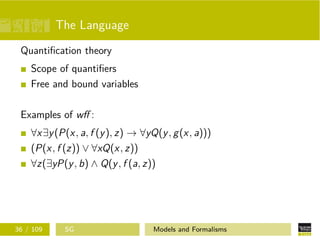
Examples of wff :
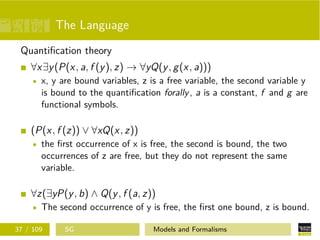
∀x∃y(P(x, a, f (y), z) → ∀yQ(y, g(x, a)))
(P(x, f (z)) ∨ ∀xQ(x, z))
∀z(∃yP(y, b) ∧ Q(y, f (a, z))
36 / 109 SG Models and Formalisms
The Language
Quantification theory
∀x∃y(P(x, a, f (y), z) → ∀yQ(y, g(x, a)))
x, y are bound variables, z is a free variable, the second variable y
is bound to the quantification forally, a is a constant, f and g are
functional symbols.
(P(x, f (z)) ∨ ∀xQ(x, z))
the first occurrence of x is free, the second is bound, the two
occurrences of z are free, but they do not represent the same
variable.
∀z(∃yP(y, b) ∧ Q(y, f (a, z))
The second occurrence of y is free, the first one bound, z is bound.
37 / 109 SG Models and Formalisms
Outline
1 Introduction
2 Formal Systems
3 Propositional Logic
The Axiomatic Theory
Propositional Logic Properties
Resolution Principles
4 The Predicate Calculus or First Order Logic
The Model Theory or Semantics
The Axiomatic Theory
Predicate Calculus Properties
Resolution Principles
Resolution Strategy
Prolog Modeling
38 / 109 SG Models and Formalisms
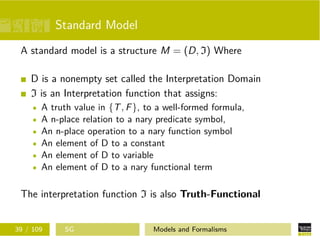
Standard Model
A standard model is a structure M = (D, I) Where
D is a nonempty set called the Interpretation Domain
I is an Interpretation function that assigns:
A truth value in {T, F}, to a well-formed formula,
A n-place relation to a nary predicate symbol,
An n-place operation to a nary function symbol
An element of D to a constant
An element of D to variable
An element of D to a nary functional term
The interpretation function I is also Truth-Functional
39 / 109 SG Models and Formalisms
Satisfiability, Truth, Models, Validity
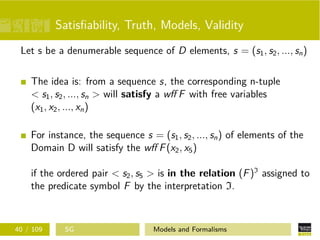
Let s be a denumerable sequence of D elements, s = (s1, s2, ..., sn)
The idea is: from a sequence s, the corresponding n-tuple
< s1, s2, ..., sn > will satisfy a wff F with free variables
(x1, x2, ..., xn)
For instance, the sequence s = (s1, s2, ..., sn) of elements of the
Domain D will satisfy the wff F(x2, x5)
if the ordered pair < s2, s5 > is in the relation (F)I
assigned to
the predicate symbol F by the interpretation I.
40 / 109 SG Models and Formalisms
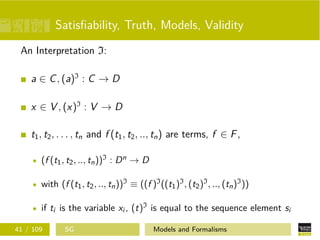
Satisfiability, Truth, Models, Validity
An Interpretation I:
a ∈ C, (a)I
: C → D
x ∈ V , (x)I
: V → D
t1, t2, . . . , tn and f (t1, t2, .., tn) are terms, f ∈ F,
(f (t1, t2, .., tn))I : Dn → D
with (f (t1, t2, .., tn))I ≡ ((f )I((t1)I, (t2)I, .., (tn)I))
if ti is the variable xi , (t)I is equal to the sequence element si
41 / 109 SG Models and Formalisms
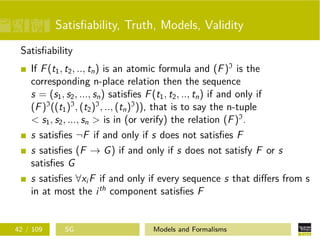
Satisfiability, Truth, Models, Validity
Satisfiability
If F(t1, t2, .., tn) is an atomic formula and (F)I
is the
corresponding n-place relation then the sequence
s = (s1, s2, ..., sn) satisfies F(t1, t2, .., tn) if and only if
(F)I
((t1)I
, (t2)I
, .., (tn)I
)), that is to say the n-tuple
< s1, s2, ..., sn > is in (or verify) the relation (F)I
.
s satisfies ¬F if and only if s does not satisfies F
s satisfies (F → G) if and only if s does not satisfy F or s
satisfies G
s satisfies ∀xi F if and only if every sequence s that differs from s
in at most the ith
component satisfies F
42 / 109 SG Models and Formalisms
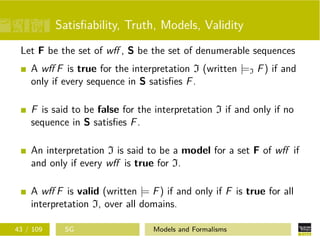
Satisfiability, Truth, Models, Validity
Let F be the set of wff , S be the set of denumerable sequences
A wff F is true for the interpretation I (written |=I F) if and
only if every sequence in S satisfies F.
F is said to be false for the interpretation I if and only if no
sequence in S satisfies F.
An interpretation I is said to be a model for a set F of wff if
and only if every wff is true for I.
A wff F is valid (written |= F) if and only if F is true for all
interpretation I, over all domains.
43 / 109 SG Models and Formalisms
Outline
1 Introduction
2 Formal Systems
3 Propositional Logic
The Axiomatic Theory
Propositional Logic Properties
Resolution Principles
4 The Predicate Calculus or First Order Logic
The Model Theory or Semantics
The Axiomatic Theory
Predicate Calculus Properties
Resolution Principles
Resolution Strategy
Prolog Modeling
44 / 109 SG Models and Formalisms
Axiomatic Theory
An axiomatic theory is composed of:
A language and wff
A set of axioms
Inference rules
45 / 109 SG Models and Formalisms
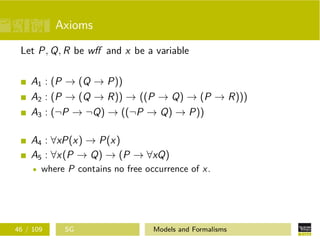
Axioms
Let P, Q, R be wff and x be a variable
A1 : (P → (Q → P))
A2 : (P → (Q → R)) → ((P → Q) → (P → R)))
A3 : (¬P → ¬Q) → ((¬P → Q) → P))
A4 : ∀xP(x) → P(x)
A5 : ∀x(P → Q) → (P → ∀xQ)
where P contains no free occurrence of x.
46 / 109 SG Models and Formalisms
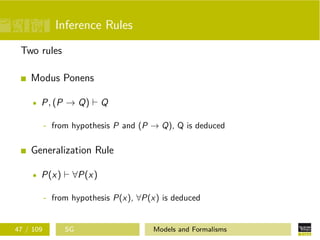
Inference Rules
Two rules
Modus Ponens
P, (P → Q) Q
- from hypothesis P and (P → Q), Q is deduced
Generalization Rule
P(x) ∀P(x)
- from hypothesis P(x), ∀P(x) is deduced
47 / 109 SG Models and Formalisms
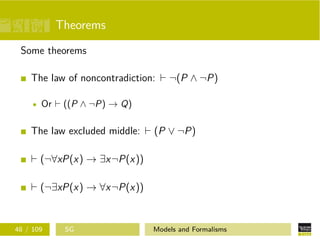
Theorems
Some theorems
The law of noncontradiction: ¬(P ∧ ¬P)
Or ((P ∧ ¬P) → Q)
The law excluded middle: (P ∨ ¬P)
(¬∀xP(x) → ∃x¬P(x))
(¬∃xP(x) → ∀x¬P(x))
48 / 109 SG Models and Formalisms
Outline
1 Introduction
2 Formal Systems
3 Propositional Logic
The Axiomatic Theory
Propositional Logic Properties
Resolution Principles
4 The Predicate Calculus or First Order Logic
The Model Theory or Semantics
The Axiomatic Theory
Predicate Calculus Properties
Resolution Principles
Resolution Strategy
Prolog Modeling
49 / 109 SG Models and Formalisms
Predicate Calculus Properties
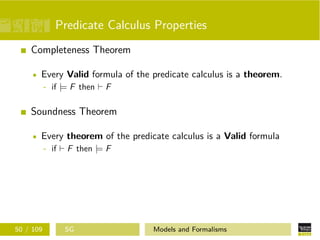
Completeness Theorem
Every Valid formula of the predicate calculus is a theorem.
- if |= F then F
Soundness Theorem
Every theorem of the predicate calculus is a Valid formula
- if F then |= F
50 / 109 SG Models and Formalisms
Predicate Calculus Properties
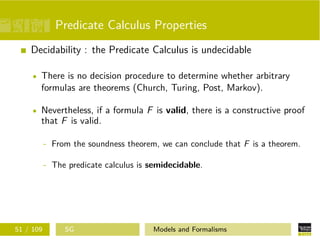
Decidability : the Predicate Calculus is undecidable
There is no decision procedure to determine whether arbitrary
formulas are theorems (Church, Turing, Post, Markov).
Nevertheless, if a formula F is valid, there is a constructive proof
that F is valid.
- From the soundness theorem, we can conclude that F is a theorem.
- The predicate calculus is semidecidable.
51 / 109 SG Models and Formalisms
Predicate Calculus Properties
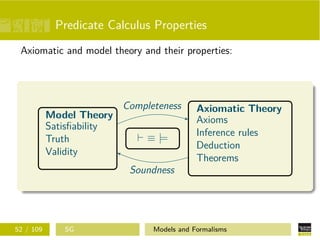
Axiomatic and model theory and their properties:
Model Theory
Satisfiability
Truth
Validity
Axiomatic Theory
Axioms
Inference rules
Deduction
Theorems
≡ |=
Completeness
Soundness
52 / 109 SG Models and Formalisms
Outline
1 Introduction
2 Formal Systems
3 Propositional Logic
The Axiomatic Theory
Propositional Logic Properties
Resolution Principles
4 The Predicate Calculus or First Order Logic
The Model Theory or Semantics
The Axiomatic Theory
Predicate Calculus Properties
Resolution Principles
Resolution Strategy
Prolog Modeling
53 / 109 SG Models and Formalisms
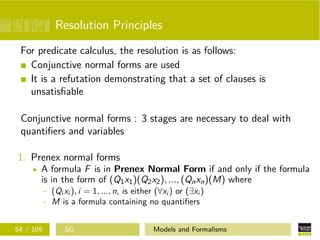
Resolution Principles
For predicate calculus, the resolution is as follows:
Conjunctive normal forms are used
It is a refutation demonstrating that a set of clauses is
unsatisfiable
Conjunctive normal forms : 3 stages are necessary to deal with
quantifiers and variables
1. Prenex normal forms
A formula F is in Prenex Normal Form if and only if the formula
is in the form of (Q1x1)(Q2x2), ..., (Qnxn)(M) where
- (Qi xi ), i = 1, ..., n, is either (∀xi ) or (∃xi )
- M is a formula containing no quantifiers
54 / 109 SG Models and Formalisms
Resolution Principles
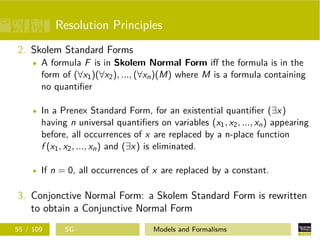
2. Skolem Standard Forms
A formula F is in Skolem Normal Form iff the formula is in the
form of (∀x1)(∀x2), ..., (∀xn)(M) where M is a formula containing
no quantifier
In a Prenex Standard Form, for an existential quantifier (∃x)
having n universal quantifiers on variables (x1, x2, ..., xn) appearing
before, all occurrences of x are replaced by a n-place function
f (x1, x2, ..., xn) and (∃x) is eliminated.
If n = 0, all occurrences of x are replaced by a constant.
3. Conjonctive Normal Form: a Skolem Standard Form is rewritten
to obtain a Conjunctive Normal Form
55 / 109 SG Models and Formalisms
Resolution Principles
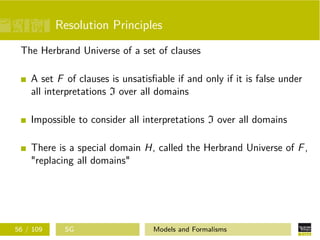
The Herbrand Universe of a set of clauses
A set F of clauses is unsatisfiable if and only if it is false under
all interpretations I over all domains
Impossible to consider all interpretations I over all domains
There is a special domain H, called the Herbrand Universe of F,
"replacing all domains"
56 / 109 SG Models and Formalisms
Resolution Principles
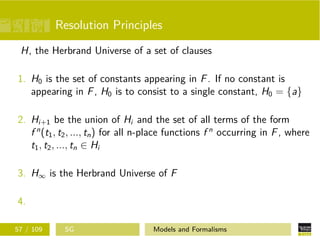
H, the Herbrand Universe of a set of clauses
1. H0 is the set of constants appearing in F. If no constant is
appearing in F, H0 is to consist to a single constant, H0 = {a}
2. Hi+1 be the union of Hi and the set of all terms of the form
f n
(t1, t2, ..., tn) for all n-place functions f n
occurring in F, where
t1, t2, ..., tn ∈ Hi
3. H∞ is the Herbrand Universe of F
4.
57 / 109 SG Models and Formalisms
Resolution Principles
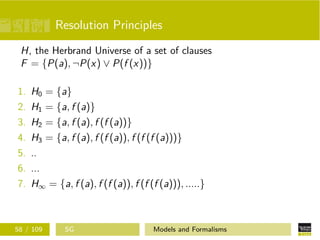
H, the Herbrand Universe of a set of clauses
F = {P(a), ¬P(x) ∨ P(f (x))}
1. H0 = {a}
2. H1 = {a, f (a)}
3. H2 = {a, f (a), f (f (a))}
4. H3 = {a, f (a), f (f (a)), f (f (f (a)))}
5. ..
6. ...
7. H∞ = {a, f (a), f (f (a)), f (f (f (a))), .....}
58 / 109 SG Models and Formalisms
Resolution Principles
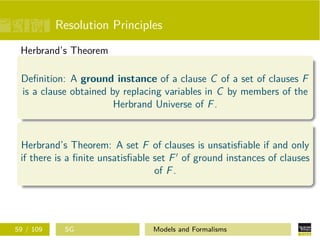
Herbrand’s Theorem
Definition: A ground instance of a clause C of a set of clauses F
is a clause obtained by replacing variables in C by members of the
Herbrand Universe of F.
Herbrand’s Theorem: A set F of clauses is unsatisfiable if and only
if there is a finite unsatisfiable set F of ground instances of clauses
of F.
59 / 109 SG Models and Formalisms
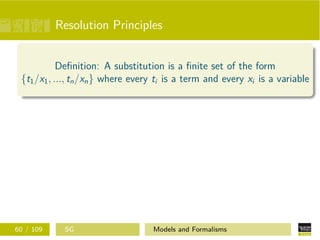
Resolution Principles
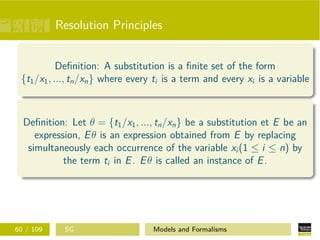
Definition: A substitution is a finite set of the form
{t1/x1, ..., tn/xn} where every ti is a term and every xi is a variable
60 / 109 SG Models and Formalisms
Resolution Principles
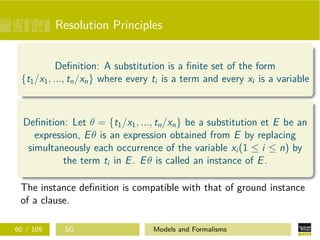
Definition: A substitution is a finite set of the form
{t1/x1, ..., tn/xn} where every ti is a term and every xi is a variable
Definition: Let θ = {t1/x1, ..., tn/xn} be a substitution et E be an
expression, Eθ is an expression obtained from E by replacing
simultaneously each occurrence of the variable xi (1 ≤ i ≤ n) by
the term ti in E. Eθ is called an instance of E.
60 / 109 SG Models and Formalisms
Resolution Principles
Definition: A substitution is a finite set of the form
{t1/x1, ..., tn/xn} where every ti is a term and every xi is a variable
Definition: Let θ = {t1/x1, ..., tn/xn} be a substitution et E be an
expression, Eθ is an expression obtained from E by replacing
simultaneously each occurrence of the variable xi (1 ≤ i ≤ n) by
the term ti in E. Eθ is called an instance of E.
The instance definition is compatible with that of ground instance
of a clause.
60 / 109 SG Models and Formalisms
Resolution Principles
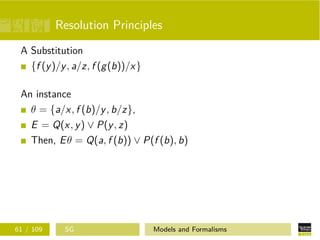
A Substitution
{f (y)/y, a/z, f (g(b))/x}
An instance
θ = {a/x, f (b)/y, b/z},
E = Q(x, y) ∨ P(y, z)
Then, Eθ = Q(a, f (b)) ∨ P(f (b), b)
61 / 109 SG Models and Formalisms
Resolution Principles
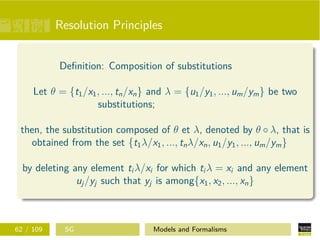
Definition: Composition of substitutions
Let θ = {t1/x1, ..., tn/xn} and λ = {u1/y1, ..., um/ym} be two
substitutions;
then, the substitution composed of θ et λ, denoted by θ ◦ λ, that is
obtained from the set {t1λ/x1, ..., tnλ/xn, u1/y1, ..., um/ym}
by deleting any element ti λ/xi for which ti λ = xi and any element
uj/yj such that yj is among{x1, x2, ..., xn}
62 / 109 SG Models and Formalisms
Resolution Principles
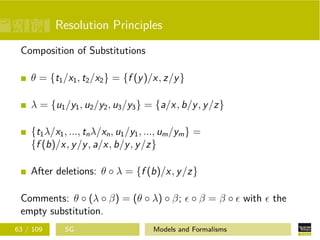
Composition of Substitutions
θ = {t1/x1, t2/x2} = {f (y)/x, z/y}
λ = {u1/y1, u2/y2, u3/y3} = {a/x, b/y, y/z}
{t1λ/x1, ..., tnλ/xn, u1/y1, ..., um/ym} =
{f (b)/x, y/y, a/x, b/y, y/z}
After deletions: θ ◦ λ = {f (b)/x, y/z}
Comments: θ ◦ (λ ◦ β) = (θ ◦ λ) ◦ β; ◦ β = β ◦ with the
empty substitution.
63 / 109 SG Models and Formalisms
Resolution Principles
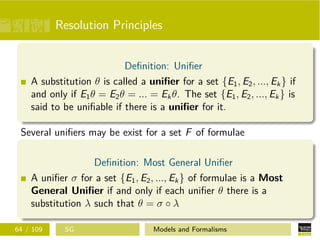
Definition: Unifier
A substitution θ is called a unifier for a set {E1, E2, ..., Ek} if
and only if E1θ = E2θ = ... = Ekθ. The set {E1, E2, ..., Ek} is
said to be unifiable if there is a unifier for it.
Several unifiers may be exist for a set F of formulae
Definition: Most General Unifier
A unifier σ for a set {E1, E2, ..., Ek} of formulae is a Most
General Unifier if and only if each unifier θ there is a
substitution λ such that θ = σ ◦ λ
64 / 109 SG Models and Formalisms
Resolution Principles
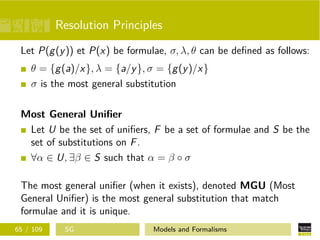
Let P(g(y)) et P(x) be formulae, σ, λ, θ can be defined as follows:
θ = {g(a)/x}, λ = {a/y}, σ = {g(y)/x}
σ is the most general substitution
Most General Unifier
Let U be the set of unifiers, F be a set of formulae and S be the
set of substitutions on F.
∀α ∈ U, ∃β ∈ S such that α = β ◦ σ
The most general unifier (when it exists), denoted MGU (Most
General Unifier) is the most general substitution that match
formulae and it is unique.
65 / 109 SG Models and Formalisms
Resolution Principles
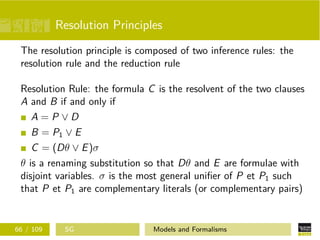
The resolution principle is composed of two inference rules: the
resolution rule and the reduction rule
Resolution Rule: the formula C is the resolvent of the two clauses
A and B if and only if
A = P ∨ D
B = P1 ∨ E
C = (Dθ ∨ E)σ
θ is a renaming substitution so that Dθ and E are formulae with
disjoint variables. σ is the most general unifier of P et P1 such
that P et P1 are complementary literals (or complementary pairs)
66 / 109 SG Models and Formalisms
Resolution Principles
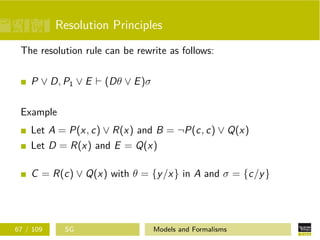
The resolution rule can be rewrite as follows:
P ∨ D, P1 ∨ E (Dθ ∨ E)σ
Example
Let A = P(x, c) ∨ R(x) and B = ¬P(c, c) ∨ Q(x)
Let D = R(x) and E = Q(x)
C = R(c) ∨ Q(x) with θ = {y/x} in A and σ = {c/y}
67 / 109 SG Models and Formalisms
Resolution Principles
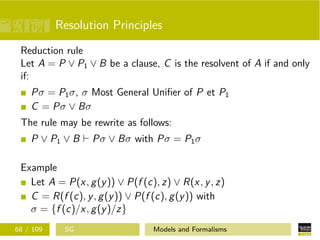
Reduction rule
Let A = P ∨ P1 ∨ B be a clause, C is the resolvent of A if and only
if:
Pσ = P1σ, σ Most General Unifier of P et P1
C = Pσ ∨ Bσ
The rule may be rewrite as follows:
P ∨ P1 ∨ B Pσ ∨ Bσ with Pσ = P1σ
Example
Let A = P(x, g(y)) ∨ P(f (c), z) ∨ R(x, y, z)
C = R(f (c), y, g(y)) ∨ P(f (c), g(y)) with
σ = {f (c)/x, g(y)/z}
68 / 109 SG Models and Formalisms
Resolution Principles
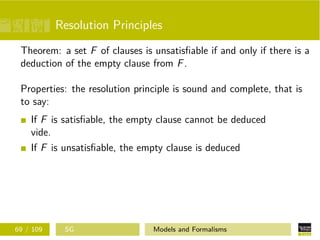
Theorem: a set F of clauses is unsatisfiable if and only if there is a
deduction of the empty clause from F.
Properties: the resolution principle is sound and complete, that is
to say:
If F is satisfiable, the empty clause cannot be deduced
vide.
If F is unsatisfiable, the empty clause is deduced
69 / 109 SG Models and Formalisms
Outline
1 Introduction
2 Formal Systems
3 Propositional Logic
The Axiomatic Theory
Propositional Logic Properties
Resolution Principles
4 The Predicate Calculus or First Order Logic
The Model Theory or Semantics
The Axiomatic Theory
Predicate Calculus Properties
Resolution Principles
Resolution Strategy
Prolog Modeling
70 / 109 SG Models and Formalisms
Resolution Strategy
The two main methods are: the management of a set of clauses
and the exploration of deduction tree.
We focus on the later. Two possible choices are available for this
strategy:
Selection of a sub-tree of the deduction tree, limitation of the
possible deductions
Selection of an exploration strategy of a sub-tree (Depth- first
search, Breadth-first search, ...)
71 / 109 SG Models and Formalisms
Resolution Strategy
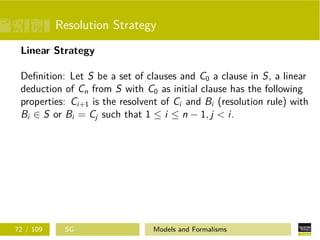
Linear Strategy
Definition: Let S be a set of clauses and C0 a clause in S, a linear
deduction of Cn from S with C0 as initial clause has the following
properties: Ci+1 is the resolvent of Ci and Bi (resolution rule) with
Bi ∈ S or Bi = Cj such that 1 ≤ i ≤ n − 1, j < i.
72 / 109 SG Models and Formalisms
Resolution Strategy
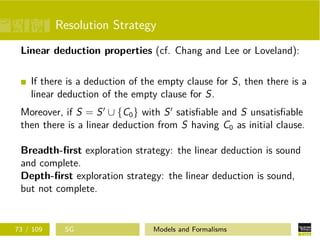
Linear deduction properties (cf. Chang and Lee or Loveland):
If there is a deduction of the empty clause for S, then there is a
linear deduction of the empty clause for S.
Moreover, if S = S ∪ {C0} with S satisfiable and S unsatisfiable
then there is a linear deduction from S having C0 as initial clause.
Breadth-first exploration strategy: the linear deduction is sound
and complete.
Depth-first exploration strategy: the linear deduction is sound,
but not complete.
73 / 109 SG Models and Formalisms
Resolution Strategy
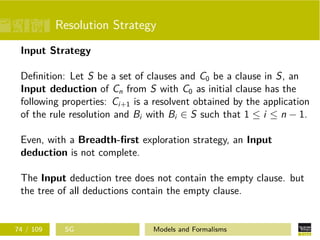
Input Strategy
Definition: Let S be a set of clauses and C0 be a clause in S, an
Input deduction of Cn from S with C0 as initial clause has the
following properties: Ci+1 is a resolvent obtained by the application
of the rule resolution and Bi with Bi ∈ S such that 1 ≤ i ≤ n − 1.
Even, with a Breadth-first exploration strategy, an Input
deduction is not complete.
The Input deduction tree does not contain the empty clause. but
the tree of all deductions contain the empty clause.
74 / 109 SG Models and Formalisms
Resolution Strategy
Input Strategy
Nevertheless, there is an interesting result in a particular case::
If S = S ∪ {C0} is unsatisfiable, C0 is a negative clause that
only contains negative literals and S only contains clauses with
exactly one positive literal (Horn clauses) then there is an input
deduction with C0 as initial clause which gives the empty clause
clause and does not use the reduction rule.
75 / 109 SG Models and Formalisms
Resolution Strategy
Ordered Strategy
Definition: An ordered resolution between two ordered clauses
(without common variables) C1 and C2 deduces the ordered clause
C with the following conditions:
C1 = L1 ∨ L2 ∨ ... ∨ Ln
C2 = ¬L1 ∨ L2 ∨ ... ∨ Lm
C = (L2 ∨ ... ∨ Ln ∨ L2 ∨ ... ∨ Lm)θ avec θ Most General Unifier
of L1 and ¬L1
The clause C is ordered: the clause containing the positive literal is
located at the beginning of the resolvent and the respective orders
of the two clauses are kept
76 / 109 SG Models and Formalisms
Resolution Strategy
Definition: Let S be a set of clauses and C0 be a clause in S, a
linear ordered deduction of Cn from S with C0 as initial clause is a
deduction obtained by applying n ordered resolutions.
Linear ordered Strategy
Definition: Let S be a set of clauses and C0 be a clause in S, an
ordered deduction of Cn from S with C0 as initial clause has the
following properties: Ci+1 is an ordered resolvent of ordered clauses
Ci and Bi (ordered resolution) with Bi ∈ S or Bi = Cj such that
1 ≤ i ≤ n1, j < i.
77 / 109 SG Models and Formalisms
Resolution Strategy
A linear ordered refutation is a linear ordered deduction of the
empty clause.
With a Breadth-first exploration strategy, the linear ordered
deduction is sound and complete.
The most important result is as follows:
If S = S ∪ {C0} is unsatisfiable, C0 is a negative literal and S
does not have clauses with exactly one positive literal (Horn
clauses) then there is an input and linear ordered with the initial
clause C0 leading to the empty clause.
78 / 109 SG Models and Formalisms
Resolution Strategy
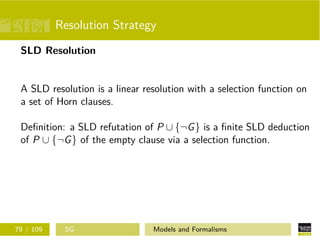
SLD Resolution
A SLD resolution is a linear resolution with a selection function on
a set of Horn clauses.
Definition: a SLD refutation of P ∪ {¬G} is a finite SLD deduction
of P ∪ {¬G} of the empty clause via a selection function.
79 / 109 SG Models and Formalisms
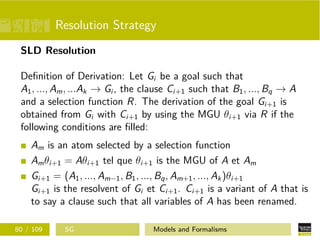
Resolution Strategy
SLD Resolution
Definition of Derivation: Let Gi be a goal such that
A1, ..., Am, ...Ak → Gi , the clause Ci+1 such that B1, ..., Bq → A
and a selection function R. The derivation of the goal Gi+1 is
obtained from Gi with Ci+1 by using the MGU θi+1 via R if the
following conditions are filled:
Am is an atom selected by a selection function
Amθi+1 = Aθi+1 tel que θi+1 is the MGU of A et Am
Gi+1 = (A1, ..., Am−1, B1, ..., Bq, Am+1, ..., Ak)θi+1
Gi+1 is the resolvent of Gi et Ci+1. Ci+1 is a variant of A that is
to say a clause such that all variables of A has been renamed.
80 / 109 SG Models and Formalisms
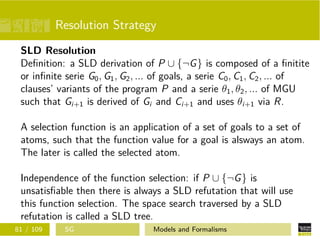
Resolution Strategy
SLD Resolution
Definition: a SLD derivation of P ∪ {¬G} is composed of a finitite
or infinite serie G0, G1, G2, ... of goals, a serie C0, C1, C2, ... of
clauses’ variants of the program P and a serie θ1, θ2, ... of MGU
such that Gi+1 is derived of Gi and Ci+1 and uses θi+1 via R.
A selection function is an application of a set of goals to a set of
atoms, such that the function value for a goal is alsways an atom.
The later is called the selected atom.
Independence of the function selection: if P ∪ {¬G} is
unsatisfiable then there is always a SLD refutation that will use
this function selection. The space search traversed by a SLD
refutation is called a SLD tree.
81 / 109 SG Models and Formalisms
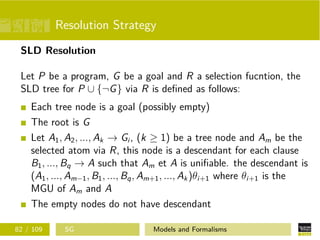
Resolution Strategy
SLD Resolution
Let P be a program, G be a goal and R a selection fucntion, the
SLD tree for P ∪ {¬G} via R is defined as follows:
Each tree node is a goal (possibly empty)
The root is G
Let A1, A2, ..., Ak → Gi , (k ≥ 1) be a tree node and Am be the
selected atom via R, this node is a descendant for each clause
B1, ..., Bq → A such that Am et A is unifiable. the descendant is
(A1, ..., Am−1, B1, ..., Bq, Am+1, ..., Ak)θi+1 where θi+1 is the
MGU of Am and A
The empty nodes do not have descendant
82 / 109 SG Models and Formalisms
Resolution Strategy
SLD Resolution
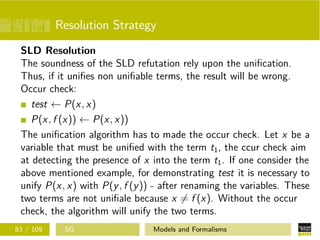
The soundness of the SLD refutation rely upon the unification.
Thus, if it unifies non unifiable terms, the result will be wrong.
Occur check:
test ← P(x, x)
P(x, f (x)) ← P(x, x))
The unification algorithm has to made the occur check. Let x be a
variable that must be unified with the term t1, the ccur check aim
at detecting the presence of x into the term t1. If one consider the
above mentioned example, for demonstrating test it is necessary to
unify P(x, x) with P(y, f (y)) - after renaming the variables. These
two terms are not unifiale because x = f (x). Without the occur
check, the algorithm will unify the two terms.
83 / 109 SG Models and Formalisms
Outline
1 Introduction
2 Formal Systems
3 Propositional Logic
The Axiomatic Theory
Propositional Logic Properties
Resolution Principles
4 The Predicate Calculus or First Order Logic
The Model Theory or Semantics
The Axiomatic Theory
Predicate Calculus Properties
Resolution Principles
Resolution Strategy
Prolog Modeling
84 / 109 SG Models and Formalisms
Prolog Modeling
Concatenation Program
Conc([X|L], L1, [X|L2]) :− Conc(L, L1, L2).
Conc([], L, L).
Conc([a,b], [c,d], L)?
85 / 109 SG Models and Formalisms
Prolog Modeling
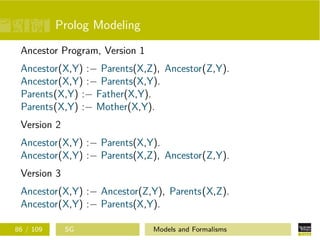
Ancestor Program, Version 1
Ancestor(X,Y) :− Parents(X,Z), Ancestor(Z,Y).
Ancestor(X,Y) :− Parents(X,Y).
Parents(X,Y) :− Father(X,Y).
Parents(X,Y) :− Mother(X,Y).
Version 2
Ancestor(X,Y) :− Parents(X,Y).
Ancestor(X,Y) :− Parents(X,Z), Ancestor(Z,Y).
Version 3
Ancestor(X,Y) :− Ancestor(Z,Y), Parents(X,Z).
Ancestor(X,Y) :− Parents(X,Y).
86 / 109 SG Models and Formalisms
Prolog Modeling
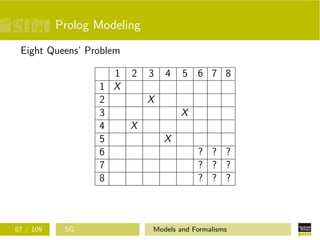
Eight Queens’ Problem
1 2 3 4 5 6 7 8
1 X
2 X
3 X
4 X
5 X
6 ? ? ?
7 ? ? ?
8 ? ? ?
87 / 109 SG Models and Formalisms
Prolog Modeling
Eight Queens’ Program
Put(Listdd, Listdg ,Col,8, Result ).
Put(Listdd, Listdg ,Col,Row,Result) :−
Row_1 is Row + 1,
column(I), not(member(I,Col)),
Dd is Row_1 + I, Dg is I − Row_1,
not(member(Dd,Listdd)),
not(member(Dg,Listdg)),
Put([Dd|Listdd ],[ Dg|Listdg ],[ I |Col ], Row_1,[[Row_1,I]|Result]).
Column(1). Column(2). Column(3). Column(4).
Column(5). Column(6). Column(7). Column(8).
88 / 109 SG Models and Formalisms
Prolog Theorem Proving
Concatenation Program
Conc([X|L], L1, [X|L2]) :− Conc(L, L1, L2).
Conc([], L, L).
Conc([a,b], [c,d], L)?
∀X, L, L1, L2 (Conc(f (X, L), L1, f (X, L2)) ∨ ¬Conc(L, L1, L2))∧
∀L (Conc(f (empty), L, L)∧
∀L ¬Conc(f (a, f (b, f (empty))), f (c, f (d, f (empty))), L)
89 / 109 SG Models and Formalisms
Prolog Theorem Proving
Concatenation Demonstration
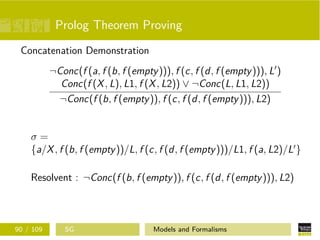
¬Conc(f (a, f (b, f (empty))), f (c, f (d, f (empty))), L )
Conc(f (X, L), L1, f (X, L2)) ∨ ¬Conc(L, L1, L2))
¬Conc(f (b, f (empty)), f (c, f (d, f (empty))), L2)
σ =
{a/X, f (b, f (empty))/L, f (c, f (d, f (empty)))/L1, f (a, L2)/L }
Resolvent : ¬Conc(f (b, f (empty)), f (c, f (d, f (empty))), L2)
90 / 109 SG Models and Formalisms
Prolog Theorem Proving
Concatenation Demonstration
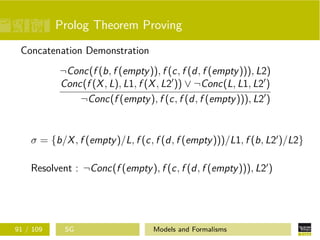
¬Conc(f (b, f (empty)), f (c, f (d, f (empty))), L2)
Conc(f (X, L), L1, f (X, L2 )) ∨ ¬Conc(L, L1, L2 )
¬Conc(f (empty), f (c, f (d, f (empty))), L2 )
σ = {b/X, f (empty)/L, f (c, f (d, f (empty)))/L1, f (b, L2 )/L2}
Resolvent : ¬Conc(f (empty), f (c, f (d, f (empty))), L2 )
91 / 109 SG Models and Formalisms
Prolog Theorem Proving
Concatenation Demonstration
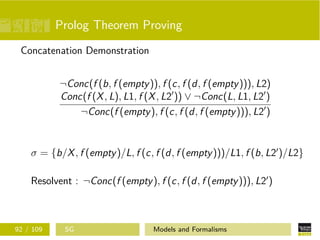
¬Conc(f (b, f (empty)), f (c, f (d, f (empty))), L2)
Conc(f (X, L), L1, f (X, L2 )) ∨ ¬Conc(L, L1, L2 )
¬Conc(f (empty), f (c, f (d, f (empty))), L2 )
σ = {b/X, f (empty)/L, f (c, f (d, f (empty)))/L1, f (b, L2 )/L2}
Resolvent : ¬Conc(f (empty), f (c, f (d, f (empty))), L2 )
92 / 109 SG Models and Formalisms
Prolog Theorem Proving
Concatenation Demonstration
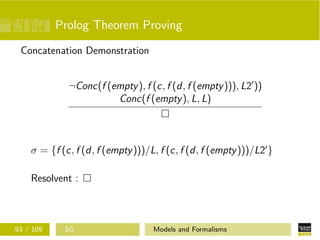
¬Conc(f (empty), f (c, f (d, f (empty))), L2 ))
Conc(f (empty), L, L)
σ = {f (c, f (d, f (empty)))/L, f (c, f (d, f (empty)))/L2 }
Resolvent :
93 / 109 SG Models and Formalisms
Prolog Theorem Proving
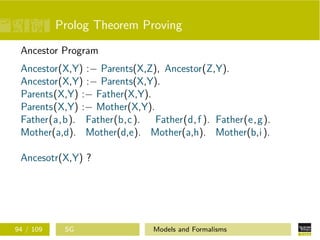
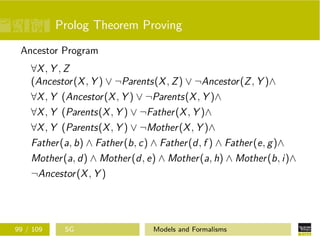
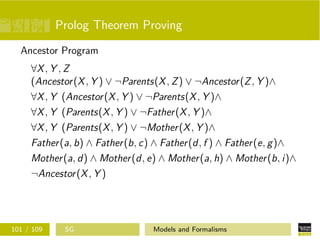
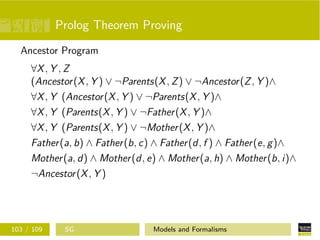
Ancestor Program
Ancestor(X,Y) :− Parents(X,Z), Ancestor(Z,Y).
Ancestor(X,Y) :− Parents(X,Y).
Parents(X,Y) :− Father(X,Y).
Parents(X,Y) :− Mother(X,Y).
Father(a,b). Father(b,c). Father(d,f ). Father(e,g).
Mother(a,d). Mother(d,e). Mother(a,h). Mother(b,i).
Ancesotr(X,Y) ?
94 / 109 SG Models and Formalisms
Prolog Theorem Proving
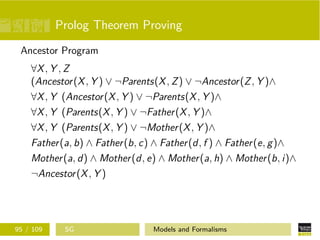
Ancestor Program
∀X, Y , Z
(Ancestor(X, Y ) ∨ ¬Parents(X, Z) ∨ ¬Ancestor(Z, Y )∧
∀X, Y (Ancestor(X, Y ) ∨ ¬Parents(X, Y )∧
∀X, Y (Parents(X, Y ) ∨ ¬Father(X, Y )∧
∀X, Y (Parents(X, Y ) ∨ ¬Mother(X, Y )∧
Father(a, b) ∧ Father(b, c) ∧ Father(d, f ) ∧ Father(e, g)∧
Mother(a, d) ∧ Mother(d, e) ∧ Mother(a, h) ∧ Mother(b, i)∧
¬Ancestor(X, Y )
95 / 109 SG Models and Formalisms
Prolog Theorem Proving
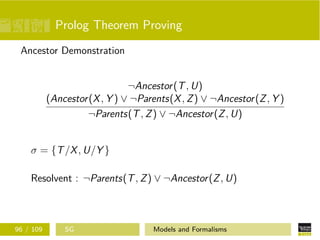
Ancestor Demonstration
¬Ancestor(T, U)
(Ancestor(X, Y ) ∨ ¬Parents(X, Z) ∨ ¬Ancestor(Z, Y )
¬Parents(T, Z) ∨ ¬Ancestor(Z, U)
σ = {T/X, U/Y }
Resolvent : ¬Parents(T, Z) ∨ ¬Ancestor(Z, U)
96 / 109 SG Models and Formalisms
Prolog Theorem Proving
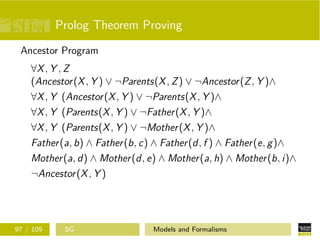
Ancestor Program
∀X, Y , Z
(Ancestor(X, Y ) ∨ ¬Parents(X, Z) ∨ ¬Ancestor(Z, Y )∧
∀X, Y (Ancestor(X, Y ) ∨ ¬Parents(X, Y )∧
∀X, Y (Parents(X, Y ) ∨ ¬Father(X, Y )∧
∀X, Y (Parents(X, Y ) ∨ ¬Mother(X, Y )∧
Father(a, b) ∧ Father(b, c) ∧ Father(d, f ) ∧ Father(e, g)∧
Mother(a, d) ∧ Mother(d, e) ∧ Mother(a, h) ∧ Mother(b, i)∧
¬Ancestor(X, Y )
97 / 109 SG Models and Formalisms
Prolog Theorem Proving
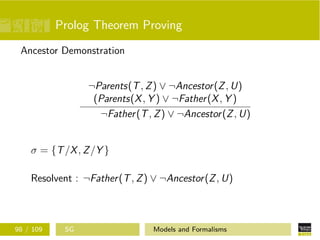
Ancestor Demonstration
¬Parents(T, Z) ∨ ¬Ancestor(Z, U)
(Parents(X, Y ) ∨ ¬Father(X, Y )
¬Father(T, Z) ∨ ¬Ancestor(Z, U)
σ = {T/X, Z/Y }
Resolvent : ¬Father(T, Z) ∨ ¬Ancestor(Z, U)
98 / 109 SG Models and Formalisms
Prolog Theorem Proving
Ancestor Program
∀X, Y , Z
(Ancestor(X, Y ) ∨ ¬Parents(X, Z) ∨ ¬Ancestor(Z, Y )∧
∀X, Y (Ancestor(X, Y ) ∨ ¬Parents(X, Y )∧
∀X, Y (Parents(X, Y ) ∨ ¬Father(X, Y )∧
∀X, Y (Parents(X, Y ) ∨ ¬Mother(X, Y )∧
Father(a, b) ∧ Father(b, c) ∧ Father(d, f ) ∧ Father(e, g)∧
Mother(a, d) ∧ Mother(d, e) ∧ Mother(a, h) ∧ Mother(b, i)∧
¬Ancestor(X, Y )
99 / 109 SG Models and Formalisms
Prolog Theorem Proving
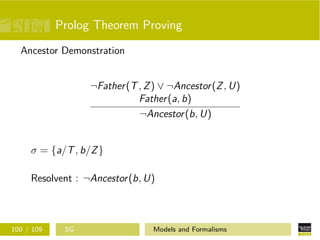
Ancestor Demonstration
¬Father(T, Z) ∨ ¬Ancestor(Z, U)
Father(a, b)
¬Ancestor(b, U)
σ = {a/T, b/Z}
Resolvent : ¬Ancestor(b, U)
100 / 109 SG Models and Formalisms
Prolog Theorem Proving
Ancestor Program
∀X, Y , Z
(Ancestor(X, Y ) ∨ ¬Parents(X, Z) ∨ ¬Ancestor(Z, Y )∧
∀X, Y (Ancestor(X, Y ) ∨ ¬Parents(X, Y )∧
∀X, Y (Parents(X, Y ) ∨ ¬Father(X, Y )∧
∀X, Y (Parents(X, Y ) ∨ ¬Mother(X, Y )∧
Father(a, b) ∧ Father(b, c) ∧ Father(d, f ) ∧ Father(e, g)∧
Mother(a, d) ∧ Mother(d, e) ∧ Mother(a, h) ∧ Mother(b, i)∧
¬Ancestor(X, Y )
101 / 109 SG Models and Formalisms
Prolog Theorem Proving
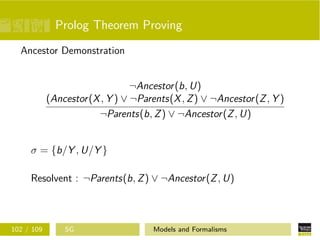
Ancestor Demonstration
¬Ancestor(b, U)
(Ancestor(X, Y ) ∨ ¬Parents(X, Z) ∨ ¬Ancestor(Z, Y )
¬Parents(b, Z) ∨ ¬Ancestor(Z, U)
σ = {b/Y , U/Y }
Resolvent : ¬Parents(b, Z) ∨ ¬Ancestor(Z, U)
102 / 109 SG Models and Formalisms
Prolog Theorem Proving
Ancestor Program
∀X, Y , Z
(Ancestor(X, Y ) ∨ ¬Parents(X, Z) ∨ ¬Ancestor(Z, Y )∧
∀X, Y (Ancestor(X, Y ) ∨ ¬Parents(X, Y )∧
∀X, Y (Parents(X, Y ) ∨ ¬Father(X, Y )∧
∀X, Y (Parents(X, Y ) ∨ ¬Mother(X, Y )∧
Father(a, b) ∧ Father(b, c) ∧ Father(d, f ) ∧ Father(e, g)∧
Mother(a, d) ∧ Mother(d, e) ∧ Mother(a, h) ∧ Mother(b, i)∧
¬Ancestor(X, Y )
103 / 109 SG Models and Formalisms
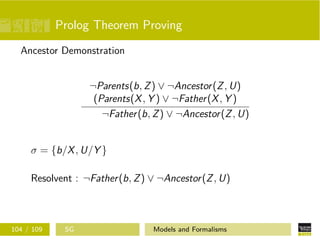
Prolog Theorem Proving
Ancestor Demonstration
¬Parents(b, Z) ∨ ¬Ancestor(Z, U)
(Parents(X, Y ) ∨ ¬Father(X, Y )
¬Father(b, Z) ∨ ¬Ancestor(Z, U)
σ = {b/X, U/Y }
Resolvent : ¬Father(b, Z) ∨ ¬Ancestor(Z, U)
104 / 109 SG Models and Formalisms
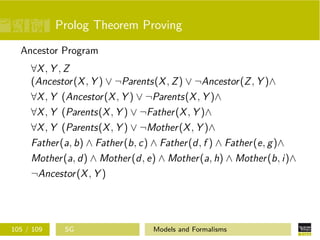
Prolog Theorem Proving
Ancestor Program
∀X, Y , Z
(Ancestor(X, Y ) ∨ ¬Parents(X, Z) ∨ ¬Ancestor(Z, Y )∧
∀X, Y (Ancestor(X, Y ) ∨ ¬Parents(X, Y )∧
∀X, Y (Parents(X, Y ) ∨ ¬Father(X, Y )∧
∀X, Y (Parents(X, Y ) ∨ ¬Mother(X, Y )∧
Father(a, b) ∧ Father(b, c) ∧ Father(d, f ) ∧ Father(e, g)∧
Mother(a, d) ∧ Mother(d, e) ∧ Mother(a, h) ∧ Mother(b, i)∧
¬Ancestor(X, Y )
105 / 109 SG Models and Formalisms
Prolog Theorem Proving
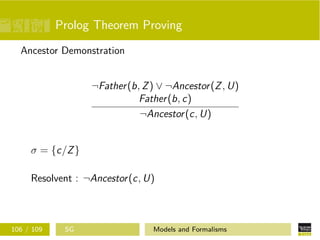
Ancestor Demonstration
¬Father(b, Z) ∨ ¬Ancestor(Z, U)
Father(b, c)
¬Ancestor(c, U)
σ = {c/Z}
Resolvent : ¬Ancestor(c, U)
106 / 109 SG Models and Formalisms
Prolog Theorem Proving
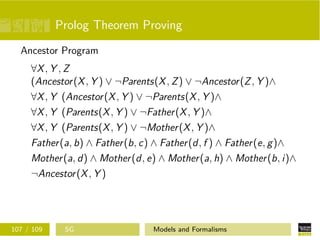
Ancestor Program
∀X, Y , Z
(Ancestor(X, Y ) ∨ ¬Parents(X, Z) ∨ ¬Ancestor(Z, Y )∧
∀X, Y (Ancestor(X, Y ) ∨ ¬Parents(X, Y )∧
∀X, Y (Parents(X, Y ) ∨ ¬Father(X, Y )∧
∀X, Y (Parents(X, Y ) ∨ ¬Mother(X, Y )∧
Father(a, b) ∧ Father(b, c) ∧ Father(d, f ) ∧ Father(e, g)∧
Mother(a, d) ∧ Mother(d, e) ∧ Mother(a, h) ∧ Mother(b, i)∧
¬Ancestor(X, Y )
107 / 109 SG Models and Formalisms
Prolog Theorem Proving
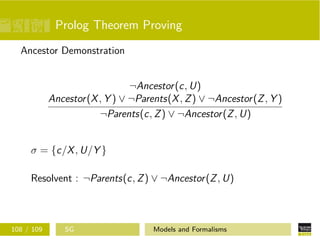
Ancestor Demonstration
¬Ancestor(c, U)
Ancestor(X, Y ) ∨ ¬Parents(X, Z) ∨ ¬Ancestor(Z, Y )
¬Parents(c, Z) ∨ ¬Ancestor(Z, U)
σ = {c/X, U/Y }
Resolvent : ¬Parents(c, Z) ∨ ¬Ancestor(Z, U)
108 / 109 SG Models and Formalisms
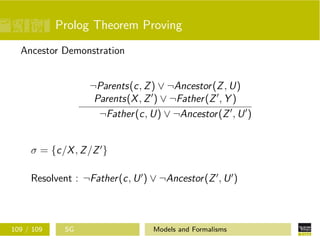
Prolog Theorem Proving
Ancestor Demonstration
¬Parents(c, Z) ∨ ¬Ancestor(Z, U)
Parents(X, Z ) ∨ ¬Father(Z , Y )
¬Father(c, U) ∨ ¬Ancestor(Z , U )
σ = {c/X, Z/Z }
Resolvent : ¬Father(c, U ) ∨ ¬Ancestor(Z , U )
109 / 109 SG Models and Formalisms

Predicate Calculus

  • 1.
    Models and Formalisms S.Garlatti MR2A Informatique 2012
  • 2.
    Progress 1 Introduction 2 FormalSystems 3 Propositional Logic 4 The Predicate Calculus or First Order Logic 2 / 109 SG Models and Formalisms
  • 3.
    Introduction Concatenation Modeling? Answer froma logical point of view: Conc([X|L], L1, [X|L2]) :− Conc(L, L1, L2). Conc([], L, L). Conc([a,b], [c,d], L)? 3 / 109 SG Models and Formalisms
  • 4.
    Introduction History of Logic Plato’slogic, Aristotle’s logic, Stoic logic Medieval logic, etc. Rise of Modern Logic, the mid-nineteenth century: Rigorous and formalistic discipline whose exemplar was the exact method of proof used in mathematics The modern so-called "symbolic" or "mathematical" logic Modern logic: a calculus whose rules of operation are determined only by the shape and not by the meaning of the symbols it employs, as in mathematics. 4 / 109 SG Models and Formalisms
  • 5.
    Progress 1 Introduction 2 FormalSystems 3 Propositional Logic 4 The Predicate Calculus or First Order Logic 5 / 109 SG Models and Formalisms
  • 6.
    Formal Systems Formal Systems(or Formalism) consist of : An Axiomatic Theory 6 / 109 SG Models and Formalisms
  • 7.
    Formal Systems Formal Systems(or Formalism) consist of : An Axiomatic Theory A finite set of symbols for constructing formulas. 6 / 109 SG Models and Formalisms
  • 8.
    Formal Systems Formal Systems(or Formalism) consist of : An Axiomatic Theory A finite set of symbols for constructing formulas. A grammar to define well-formed formulas (abbreviated wff ). 6 / 109 SG Models and Formalisms
  • 9.
    Formal Systems Formal Systems(or Formalism) consist of : An Axiomatic Theory A finite set of symbols for constructing formulas. A grammar to define well-formed formulas (abbreviated wff ). A set of Axioms or axiom schemata: each axiom must be a wff . 6 / 109 SG Models and Formalisms
  • 10.
    Formal Systems Formal Systems(or Formalism) consist of : An Axiomatic Theory A finite set of symbols for constructing formulas. A grammar to define well-formed formulas (abbreviated wff ). A set of Axioms or axiom schemata: each axiom must be a wff . A set of Inference rules 6 / 109 SG Models and Formalisms
  • 11.
    Formal Systems Formal Systems(or Formalism) consist of : An Axiomatic Theory A finite set of symbols for constructing formulas. A grammar to define well-formed formulas (abbreviated wff ). A set of Axioms or axiom schemata: each axiom must be a wff . A set of Inference rules From Axioms and Inferences Rules, Theorems are deduced. 6 / 109 SG Models and Formalisms
  • 12.
    Formal Systems Formal Systems(or Formalism) consist of : An Axiomatic Theory A finite set of symbols for constructing formulas. A grammar to define well-formed formulas (abbreviated wff ). A set of Axioms or axiom schemata: each axiom must be a wff . A set of Inference rules From Axioms and Inferences Rules, Theorems are deduced. Properties: Consistency and Decidability 6 / 109 SG Models and Formalisms
  • 13.
    Formal Systems The FormalSystems MIU, Axiomatic Theory Alphabet A = {M, I, U}. A grammar : wff consist of all series of the three alphabet elements. A set of axioms= {MI}. A set of inference rules: Let f , g variables representing wff , g could be empty R1: f fU R2: Mf Mff R3: fIIIg fUg R4: fUUg fg 7 / 109 SG Models and Formalisms
  • 14.
    Formal Systems The FormalSystems MIU, Axiomatic Theory Some Theorems: R2: MI MII R1: MII MIIU R1: MIIU MIIUU R4: MIIUU MII R2: MII MIIII R3: MIIII MIU MU is a theorem? 8 / 109 SG Models and Formalisms
  • 15.
    Formal Systems Formal Systemsconsist of : A Model Theory or Semantics A standard model M: It is a structure that gives a concrete interpretation of the theory (axiomatic theory). For instance, M = (D, I) D is the interpretation domain. An Interpretation function I that assigns: - Let A a set of alphabet elements, (A)I : A → D - Let F a set of wff , (F)I : F → {True, False} Properties: consistency, soundness, completeness 9 / 109 SG Models and Formalisms
  • 16.
    Formal Systems The AxiomaticTheory of Formal Systems pg Alphabet A = {p, g, −} wff all series of p, g, − x ∈ {−, −−, ..., −n }, Axiom Schema: xp − gx− x, y, z ∈ {−, −−, ..., −n },Inference Rules : xpygz xpy − gz− 10 / 109 SG Models and Formalisms
  • 17.
    Formal Systems The ModelTheory of the formal system pg An Interpretation function I that assigns: (p)I : plus, (g)I : equal, (−n)I : n (− − −p − −g − − − −−) ⇒ (3 plus 2 equal 5) ⇒ (− − −p − −g − − − −)I = True (− − −p − g − − − −−) ⇒ (3 plus 1 equal 5) ⇒ (− − −p − g − − − −−)I = False 11 / 109 SG Models and Formalisms
  • 18.
    Formal Systems Axiomatic andmodel theory and their properties: Model Theory Satisfiability Truth Validity Axiomatic Theory Axioms Inference rules Deduction Theorems Completeness Soundness 12 / 109 SG Models and Formalisms
  • 19.
    Progress 1 Introduction 2 FormalSystems 3 Propositional Logic 4 The Predicate Calculus or First Order Logic 13 / 109 SG Models and Formalisms
  • 20.
    The Propositional Logic TheLanguage and the well-formed formulae or wff A set of propositional symbols S A set of connectors: ¬, →, ↔, ∨, ∧ Let p, q, r ∈ S, p, q, r are atoms An atom is a wff , then p, q, r are wff Let P be a wff , then ¬P is a wff Let P, Q be wff , then (P → Q), (P ↔ Q), (P ∨ Q), (P ∧ Q) All wff are generated by applying the above rules 14 / 109 SG Models and Formalisms
  • 21.
    The Model Theoryof Propositional Logic In Propositional logic, I is an Interpretation function that assigns: A truth value in {T, F}, to an atom or a well-formed formula, Let P, Q be wff , assignment of Truth Values are made as follows: P Q ¬P (P ∧ Q) (P ∨ Q) (P → Q) T T F T T T T F F F T F F T T F T T F F T F F T The Interpretation function I is truth-functional: the truth or falsity of a well-formed formula is determined by the truth or falsity of its components. 15 / 109 SG Models and Formalisms
  • 22.
    Truth, Validity A wffP is said to be True under an interpretation I iff P is evaluated to T in the interpretation; Otherwise, P is said to be False under the interpretation. A wff is said to be Valid iff it is true under all its interpretations A wff is said to be Inconsistent or Unsatisfiable iff it is false under all its interpretations A wff is said to be Consistent or Satisfiable iff it is not Inconsistent 16 / 109 SG Models and Formalisms
  • 23.
    Truth, Validity Examples ofValid or inconsistent formulae (P ∧ ¬P) (P → P) ((P ∧ ¬P) → Q) (P ∨ ¬P) 17 / 109 SG Models and Formalisms
  • 24.
    Outline 1 Introduction 2 FormalSystems 3 Propositional Logic The Axiomatic Theory Propositional Logic Properties Resolution Principles 4 The Predicate Calculus or First Order Logic The Model Theory or Semantics The Axiomatic Theory Predicate Calculus Properties Resolution Principles Resolution Strategy Prolog Modeling 18 / 109 SG Models and Formalisms
  • 25.
    Axiomatic Theory An axiomatictheory is composed of: A language and wff A set of axioms Inference rules 19 / 109 SG Models and Formalisms
  • 26.
    Axioms Let P, Q,R be wff A1 : (P → (Q → P)) A2 : (P → (Q → R)) → ((P → Q) → (P → R))) A3 : (¬P → ¬Q) → ((¬P → Q) → P)) One inference rule Modus Ponens: P, (P → Q) Q From hypothesis P and (P → Q), Q is deduced 20 / 109 SG Models and Formalisms
  • 27.
    Deduction Theorem demonstration: (A→ A) A1 : (A → ((A → A) → A)) A2 : ((A → ((A → A) → A)) → ((A → (A → A) → (A → A)))) A1, A2 ((A → (A → A)) → (A → A)) A1” : (A → (A → A)) A1”, ((A → (A → A)) → (A → A)) (A → A) (A → A) 21 / 109 SG Models and Formalisms
  • 28.
    Deduction Theorem demonstration: (A→ A) A1 : (A → ((A → A) → A)) A2 : ((A → ((A → A) → A)) → ((A → (A → A) → (A → A)))) ((A → (A → A)) → (A → A)) A1” : (A → (A → A)) ((A → (A → A)) → (A → A)) (A → A) 22 / 109 SG Models and Formalisms
  • 29.
    Theorems Some theorems The lawof noncontradiction: ¬(P ∧ ¬P) Or ((P ∧ ¬P) → Q) The law excluded middle: (P ∨ ¬P) 23 / 109 SG Models and Formalisms
  • 30.
    Outline 1 Introduction 2 FormalSystems 3 Propositional Logic The Axiomatic Theory Propositional Logic Properties Resolution Principles 4 The Predicate Calculus or First Order Logic The Model Theory or Semantics The Axiomatic Theory Predicate Calculus Properties Resolution Principles Resolution Strategy Prolog Modeling 24 / 109 SG Models and Formalisms
  • 31.
    Propositional Logic Properties CompletenessTheorem Every Valid formula of the predicate calculus is a theorem. - if |= F then F Soundness Theorem Every theorem of the predicate calculus is a Valid formula - if F then |= F The propositional Logic is decidable 25 / 109 SG Models and Formalisms
  • 32.
    Propositional Logic Properties Axiomaticand model theory and their properties: Model Theory Satisfiability Truth Validity Axiomatic Theory Axioms Inference rules Deduction Theorems ≡ |= Completeness Soundness 26 / 109 SG Models and Formalisms
  • 33.
    Outline 1 Introduction 2 FormalSystems 3 Propositional Logic The Axiomatic Theory Propositional Logic Properties Resolution Principles 4 The Predicate Calculus or First Order Logic The Model Theory or Semantics The Axiomatic Theory Predicate Calculus Properties Resolution Principles Resolution Strategy Prolog Modeling 27 / 109 SG Models and Formalisms
  • 34.
    Resolution Principles Normal Forms Definition:A Literal is an atomic formula or Atom or the negation of an Atom A Formula F is called a Clause if and only if F is composed of a disjunction of literals, (F1 ∨ F2, ... ∨ Fn), n 1 An empty clause, denoted , is unsatisfiable or always interpreted as False, (deduced from the conjunction of two complementary literals P and ¬P) 28 / 109 SG Models and Formalisms
  • 35.
    Resolution Principles Normal Forms Definition:A formula F is in a Conjunctive Normal Form if and only if F has the following form (F1 ∧ F2, ... ∧ Fn), n 1, where each of F1, F2, ..., Fn is a disjunction of literals or a clause. Any formula can be transformed into a normal forms 29 / 109 SG Models and Formalisms
  • 36.
    Resolution Principles One possibleresolution rule: the Cut Elimination Rule of Gentzen Let D and E be clauses without any occurrence of literals P or ¬P (¬P ∨ E), (P ∨ D) (E ∨ D) The clause (E ∨ D) is called the resolvent This rule is a generalization of the Modus Ponens Rule (obtained by elimination of the clause D) 30 / 109 SG Models and Formalisms
  • 37.
    Resolution Principles Let Fbe a set of clauses and A be a clause To demonstrate F A By means of the Cut Elimination Rule, the goal is to show that {F, ¬A} is unsatisfiable. It is a refutation Demonstration of the unsatisfiability of {F, ¬A} Obtain a resolvent equal to the empty clause , by elimination of complementary literals in two different clauses. 31 / 109 SG Models and Formalisms
  • 38.
    Resolution Principles Example :let F be a conjunctive normal form as follows: F = ((P ∨ Q) ∧ (¬P ∨ Q) ∧ (P ∨ ¬Q) ∧ (¬P ∨ ¬Q)) F unsatisfiable? (P ∨ Q) (¬P ∨ Q) Q (P ∨ ¬Q) (¬P ∨ ¬Q) ¬Q 32 / 109 SG Models and Formalisms
  • 39.
    Progress 1 Introduction 2 FormalSystems 3 Propositional Logic 4 The Predicate Calculus or First Order Logic 33 / 109 SG Models and Formalisms
  • 40.
    The Predicate Calculus Predicatecalculus (first-order logic): an extension of the propositional logic The Language A set of Constants C A set of Variables V A set of function symbols F A set of Terms T A set of predicate symbols P A set of connectors: ¬, →, ↔, ∨, ∧ A set of Quantifiers: ∀, ∃ 34 / 109 SG Models and Formalisms
  • 41.
    The Language The Terms AConstant a is a term A Variable x is a term if t1, t2, ..., tn ∈ T, (n > 0), then f (t1, t2, .., tn) ∈ T where f is a function symbol of arity n. Well-Formed Formula or wff If P is a predicate symbol and if t1, t2, . . . , tn ∈ T(n > 0) then P(t1, t2, ..., tn) is an atomic formula If G and H are wff then (G → H), (G ↔ H), (G ∨ H), (G ∧ H), ¬G, ∀xG(x) and ∃xG(x) are wff . 35 / 109 SG Models and Formalisms
  • 42.
    The Language Quantification theory Scopeof quantifiers Free and bound variables Examples of wff : ∀x∃y(P(x, a, f (y), z) → ∀yQ(y, g(x, a))) (P(x, f (z)) ∨ ∀xQ(x, z)) ∀z(∃yP(y, b) ∧ Q(y, f (a, z)) 36 / 109 SG Models and Formalisms
  • 43.
    The Language Quantification theory ∀x∃y(P(x,a, f (y), z) → ∀yQ(y, g(x, a))) x, y are bound variables, z is a free variable, the second variable y is bound to the quantification forally, a is a constant, f and g are functional symbols. (P(x, f (z)) ∨ ∀xQ(x, z)) the first occurrence of x is free, the second is bound, the two occurrences of z are free, but they do not represent the same variable. ∀z(∃yP(y, b) ∧ Q(y, f (a, z)) The second occurrence of y is free, the first one bound, z is bound. 37 / 109 SG Models and Formalisms
  • 44.
    Outline 1 Introduction 2 FormalSystems 3 Propositional Logic The Axiomatic Theory Propositional Logic Properties Resolution Principles 4 The Predicate Calculus or First Order Logic The Model Theory or Semantics The Axiomatic Theory Predicate Calculus Properties Resolution Principles Resolution Strategy Prolog Modeling 38 / 109 SG Models and Formalisms
  • 45.
    Standard Model A standardmodel is a structure M = (D, I) Where D is a nonempty set called the Interpretation Domain I is an Interpretation function that assigns: A truth value in {T, F}, to a well-formed formula, A n-place relation to a nary predicate symbol, An n-place operation to a nary function symbol An element of D to a constant An element of D to variable An element of D to a nary functional term The interpretation function I is also Truth-Functional 39 / 109 SG Models and Formalisms
  • 46.
    Satisfiability, Truth, Models,Validity Let s be a denumerable sequence of D elements, s = (s1, s2, ..., sn) The idea is: from a sequence s, the corresponding n-tuple < s1, s2, ..., sn > will satisfy a wff F with free variables (x1, x2, ..., xn) For instance, the sequence s = (s1, s2, ..., sn) of elements of the Domain D will satisfy the wff F(x2, x5) if the ordered pair < s2, s5 > is in the relation (F)I assigned to the predicate symbol F by the interpretation I. 40 / 109 SG Models and Formalisms
  • 47.
    Satisfiability, Truth, Models,Validity An Interpretation I: a ∈ C, (a)I : C → D x ∈ V , (x)I : V → D t1, t2, . . . , tn and f (t1, t2, .., tn) are terms, f ∈ F, (f (t1, t2, .., tn))I : Dn → D with (f (t1, t2, .., tn))I ≡ ((f )I((t1)I, (t2)I, .., (tn)I)) if ti is the variable xi , (t)I is equal to the sequence element si 41 / 109 SG Models and Formalisms
  • 48.
    Satisfiability, Truth, Models,Validity Satisfiability If F(t1, t2, .., tn) is an atomic formula and (F)I is the corresponding n-place relation then the sequence s = (s1, s2, ..., sn) satisfies F(t1, t2, .., tn) if and only if (F)I ((t1)I , (t2)I , .., (tn)I )), that is to say the n-tuple < s1, s2, ..., sn > is in (or verify) the relation (F)I . s satisfies ¬F if and only if s does not satisfies F s satisfies (F → G) if and only if s does not satisfy F or s satisfies G s satisfies ∀xi F if and only if every sequence s that differs from s in at most the ith component satisfies F 42 / 109 SG Models and Formalisms
  • 49.
    Satisfiability, Truth, Models,Validity Let F be the set of wff , S be the set of denumerable sequences A wff F is true for the interpretation I (written |=I F) if and only if every sequence in S satisfies F. F is said to be false for the interpretation I if and only if no sequence in S satisfies F. An interpretation I is said to be a model for a set F of wff if and only if every wff is true for I. A wff F is valid (written |= F) if and only if F is true for all interpretation I, over all domains. 43 / 109 SG Models and Formalisms
  • 50.
    Outline 1 Introduction 2 FormalSystems 3 Propositional Logic The Axiomatic Theory Propositional Logic Properties Resolution Principles 4 The Predicate Calculus or First Order Logic The Model Theory or Semantics The Axiomatic Theory Predicate Calculus Properties Resolution Principles Resolution Strategy Prolog Modeling 44 / 109 SG Models and Formalisms
  • 51.
    Axiomatic Theory An axiomatictheory is composed of: A language and wff A set of axioms Inference rules 45 / 109 SG Models and Formalisms
  • 52.
    Axioms Let P, Q,R be wff and x be a variable A1 : (P → (Q → P)) A2 : (P → (Q → R)) → ((P → Q) → (P → R))) A3 : (¬P → ¬Q) → ((¬P → Q) → P)) A4 : ∀xP(x) → P(x) A5 : ∀x(P → Q) → (P → ∀xQ) where P contains no free occurrence of x. 46 / 109 SG Models and Formalisms
  • 53.
    Inference Rules Two rules ModusPonens P, (P → Q) Q - from hypothesis P and (P → Q), Q is deduced Generalization Rule P(x) ∀P(x) - from hypothesis P(x), ∀P(x) is deduced 47 / 109 SG Models and Formalisms
  • 54.
    Theorems Some theorems The lawof noncontradiction: ¬(P ∧ ¬P) Or ((P ∧ ¬P) → Q) The law excluded middle: (P ∨ ¬P) (¬∀xP(x) → ∃x¬P(x)) (¬∃xP(x) → ∀x¬P(x)) 48 / 109 SG Models and Formalisms
  • 55.
    Outline 1 Introduction 2 FormalSystems 3 Propositional Logic The Axiomatic Theory Propositional Logic Properties Resolution Principles 4 The Predicate Calculus or First Order Logic The Model Theory or Semantics The Axiomatic Theory Predicate Calculus Properties Resolution Principles Resolution Strategy Prolog Modeling 49 / 109 SG Models and Formalisms
  • 56.
    Predicate Calculus Properties CompletenessTheorem Every Valid formula of the predicate calculus is a theorem. - if |= F then F Soundness Theorem Every theorem of the predicate calculus is a Valid formula - if F then |= F 50 / 109 SG Models and Formalisms
  • 57.
    Predicate Calculus Properties Decidability: the Predicate Calculus is undecidable There is no decision procedure to determine whether arbitrary formulas are theorems (Church, Turing, Post, Markov). Nevertheless, if a formula F is valid, there is a constructive proof that F is valid. - From the soundness theorem, we can conclude that F is a theorem. - The predicate calculus is semidecidable. 51 / 109 SG Models and Formalisms
  • 58.
    Predicate Calculus Properties Axiomaticand model theory and their properties: Model Theory Satisfiability Truth Validity Axiomatic Theory Axioms Inference rules Deduction Theorems ≡ |= Completeness Soundness 52 / 109 SG Models and Formalisms
  • 59.
    Outline 1 Introduction 2 FormalSystems 3 Propositional Logic The Axiomatic Theory Propositional Logic Properties Resolution Principles 4 The Predicate Calculus or First Order Logic The Model Theory or Semantics The Axiomatic Theory Predicate Calculus Properties Resolution Principles Resolution Strategy Prolog Modeling 53 / 109 SG Models and Formalisms
  • 60.
    Resolution Principles For predicatecalculus, the resolution is as follows: Conjunctive normal forms are used It is a refutation demonstrating that a set of clauses is unsatisfiable Conjunctive normal forms : 3 stages are necessary to deal with quantifiers and variables 1. Prenex normal forms A formula F is in Prenex Normal Form if and only if the formula is in the form of (Q1x1)(Q2x2), ..., (Qnxn)(M) where - (Qi xi ), i = 1, ..., n, is either (∀xi ) or (∃xi ) - M is a formula containing no quantifiers 54 / 109 SG Models and Formalisms
  • 61.
    Resolution Principles 2. SkolemStandard Forms A formula F is in Skolem Normal Form iff the formula is in the form of (∀x1)(∀x2), ..., (∀xn)(M) where M is a formula containing no quantifier In a Prenex Standard Form, for an existential quantifier (∃x) having n universal quantifiers on variables (x1, x2, ..., xn) appearing before, all occurrences of x are replaced by a n-place function f (x1, x2, ..., xn) and (∃x) is eliminated. If n = 0, all occurrences of x are replaced by a constant. 3. Conjonctive Normal Form: a Skolem Standard Form is rewritten to obtain a Conjunctive Normal Form 55 / 109 SG Models and Formalisms
  • 62.
    Resolution Principles The HerbrandUniverse of a set of clauses A set F of clauses is unsatisfiable if and only if it is false under all interpretations I over all domains Impossible to consider all interpretations I over all domains There is a special domain H, called the Herbrand Universe of F, "replacing all domains" 56 / 109 SG Models and Formalisms
  • 63.
    Resolution Principles H, theHerbrand Universe of a set of clauses 1. H0 is the set of constants appearing in F. If no constant is appearing in F, H0 is to consist to a single constant, H0 = {a} 2. Hi+1 be the union of Hi and the set of all terms of the form f n (t1, t2, ..., tn) for all n-place functions f n occurring in F, where t1, t2, ..., tn ∈ Hi 3. H∞ is the Herbrand Universe of F 4. 57 / 109 SG Models and Formalisms
  • 64.
    Resolution Principles H, theHerbrand Universe of a set of clauses F = {P(a), ¬P(x) ∨ P(f (x))} 1. H0 = {a} 2. H1 = {a, f (a)} 3. H2 = {a, f (a), f (f (a))} 4. H3 = {a, f (a), f (f (a)), f (f (f (a)))} 5. .. 6. ... 7. H∞ = {a, f (a), f (f (a)), f (f (f (a))), .....} 58 / 109 SG Models and Formalisms
  • 65.
    Resolution Principles Herbrand’s Theorem Definition:A ground instance of a clause C of a set of clauses F is a clause obtained by replacing variables in C by members of the Herbrand Universe of F. Herbrand’s Theorem: A set F of clauses is unsatisfiable if and only if there is a finite unsatisfiable set F of ground instances of clauses of F. 59 / 109 SG Models and Formalisms
  • 66.
    Resolution Principles Definition: Asubstitution is a finite set of the form {t1/x1, ..., tn/xn} where every ti is a term and every xi is a variable 60 / 109 SG Models and Formalisms
  • 67.
    Resolution Principles Definition: Asubstitution is a finite set of the form {t1/x1, ..., tn/xn} where every ti is a term and every xi is a variable Definition: Let θ = {t1/x1, ..., tn/xn} be a substitution et E be an expression, Eθ is an expression obtained from E by replacing simultaneously each occurrence of the variable xi (1 ≤ i ≤ n) by the term ti in E. Eθ is called an instance of E. 60 / 109 SG Models and Formalisms
  • 68.
    Resolution Principles Definition: Asubstitution is a finite set of the form {t1/x1, ..., tn/xn} where every ti is a term and every xi is a variable Definition: Let θ = {t1/x1, ..., tn/xn} be a substitution et E be an expression, Eθ is an expression obtained from E by replacing simultaneously each occurrence of the variable xi (1 ≤ i ≤ n) by the term ti in E. Eθ is called an instance of E. The instance definition is compatible with that of ground instance of a clause. 60 / 109 SG Models and Formalisms
  • 69.
    Resolution Principles A Substitution {f(y)/y, a/z, f (g(b))/x} An instance θ = {a/x, f (b)/y, b/z}, E = Q(x, y) ∨ P(y, z) Then, Eθ = Q(a, f (b)) ∨ P(f (b), b) 61 / 109 SG Models and Formalisms
  • 70.
    Resolution Principles Definition: Compositionof substitutions Let θ = {t1/x1, ..., tn/xn} and λ = {u1/y1, ..., um/ym} be two substitutions; then, the substitution composed of θ et λ, denoted by θ ◦ λ, that is obtained from the set {t1λ/x1, ..., tnλ/xn, u1/y1, ..., um/ym} by deleting any element ti λ/xi for which ti λ = xi and any element uj/yj such that yj is among{x1, x2, ..., xn} 62 / 109 SG Models and Formalisms
  • 71.
    Resolution Principles Composition ofSubstitutions θ = {t1/x1, t2/x2} = {f (y)/x, z/y} λ = {u1/y1, u2/y2, u3/y3} = {a/x, b/y, y/z} {t1λ/x1, ..., tnλ/xn, u1/y1, ..., um/ym} = {f (b)/x, y/y, a/x, b/y, y/z} After deletions: θ ◦ λ = {f (b)/x, y/z} Comments: θ ◦ (λ ◦ β) = (θ ◦ λ) ◦ β; ◦ β = β ◦ with the empty substitution. 63 / 109 SG Models and Formalisms
  • 72.
    Resolution Principles Definition: Unifier Asubstitution θ is called a unifier for a set {E1, E2, ..., Ek} if and only if E1θ = E2θ = ... = Ekθ. The set {E1, E2, ..., Ek} is said to be unifiable if there is a unifier for it. Several unifiers may be exist for a set F of formulae Definition: Most General Unifier A unifier σ for a set {E1, E2, ..., Ek} of formulae is a Most General Unifier if and only if each unifier θ there is a substitution λ such that θ = σ ◦ λ 64 / 109 SG Models and Formalisms
  • 73.
    Resolution Principles Let P(g(y))et P(x) be formulae, σ, λ, θ can be defined as follows: θ = {g(a)/x}, λ = {a/y}, σ = {g(y)/x} σ is the most general substitution Most General Unifier Let U be the set of unifiers, F be a set of formulae and S be the set of substitutions on F. ∀α ∈ U, ∃β ∈ S such that α = β ◦ σ The most general unifier (when it exists), denoted MGU (Most General Unifier) is the most general substitution that match formulae and it is unique. 65 / 109 SG Models and Formalisms
  • 74.
    Resolution Principles The resolutionprinciple is composed of two inference rules: the resolution rule and the reduction rule Resolution Rule: the formula C is the resolvent of the two clauses A and B if and only if A = P ∨ D B = P1 ∨ E C = (Dθ ∨ E)σ θ is a renaming substitution so that Dθ and E are formulae with disjoint variables. σ is the most general unifier of P et P1 such that P et P1 are complementary literals (or complementary pairs) 66 / 109 SG Models and Formalisms
  • 75.
    Resolution Principles The resolutionrule can be rewrite as follows: P ∨ D, P1 ∨ E (Dθ ∨ E)σ Example Let A = P(x, c) ∨ R(x) and B = ¬P(c, c) ∨ Q(x) Let D = R(x) and E = Q(x) C = R(c) ∨ Q(x) with θ = {y/x} in A and σ = {c/y} 67 / 109 SG Models and Formalisms
  • 76.
    Resolution Principles Reduction rule LetA = P ∨ P1 ∨ B be a clause, C is the resolvent of A if and only if: Pσ = P1σ, σ Most General Unifier of P et P1 C = Pσ ∨ Bσ The rule may be rewrite as follows: P ∨ P1 ∨ B Pσ ∨ Bσ with Pσ = P1σ Example Let A = P(x, g(y)) ∨ P(f (c), z) ∨ R(x, y, z) C = R(f (c), y, g(y)) ∨ P(f (c), g(y)) with σ = {f (c)/x, g(y)/z} 68 / 109 SG Models and Formalisms
  • 77.
    Resolution Principles Theorem: aset F of clauses is unsatisfiable if and only if there is a deduction of the empty clause from F. Properties: the resolution principle is sound and complete, that is to say: If F is satisfiable, the empty clause cannot be deduced vide. If F is unsatisfiable, the empty clause is deduced 69 / 109 SG Models and Formalisms
  • 78.
    Outline 1 Introduction 2 FormalSystems 3 Propositional Logic The Axiomatic Theory Propositional Logic Properties Resolution Principles 4 The Predicate Calculus or First Order Logic The Model Theory or Semantics The Axiomatic Theory Predicate Calculus Properties Resolution Principles Resolution Strategy Prolog Modeling 70 / 109 SG Models and Formalisms
  • 79.
    Resolution Strategy The twomain methods are: the management of a set of clauses and the exploration of deduction tree. We focus on the later. Two possible choices are available for this strategy: Selection of a sub-tree of the deduction tree, limitation of the possible deductions Selection of an exploration strategy of a sub-tree (Depth- first search, Breadth-first search, ...) 71 / 109 SG Models and Formalisms
  • 80.
    Resolution Strategy Linear Strategy Definition:Let S be a set of clauses and C0 a clause in S, a linear deduction of Cn from S with C0 as initial clause has the following properties: Ci+1 is the resolvent of Ci and Bi (resolution rule) with Bi ∈ S or Bi = Cj such that 1 ≤ i ≤ n − 1, j < i. 72 / 109 SG Models and Formalisms
  • 81.
    Resolution Strategy Linear deductionproperties (cf. Chang and Lee or Loveland): If there is a deduction of the empty clause for S, then there is a linear deduction of the empty clause for S. Moreover, if S = S ∪ {C0} with S satisfiable and S unsatisfiable then there is a linear deduction from S having C0 as initial clause. Breadth-first exploration strategy: the linear deduction is sound and complete. Depth-first exploration strategy: the linear deduction is sound, but not complete. 73 / 109 SG Models and Formalisms
  • 82.
    Resolution Strategy Input Strategy Definition:Let S be a set of clauses and C0 be a clause in S, an Input deduction of Cn from S with C0 as initial clause has the following properties: Ci+1 is a resolvent obtained by the application of the rule resolution and Bi with Bi ∈ S such that 1 ≤ i ≤ n − 1. Even, with a Breadth-first exploration strategy, an Input deduction is not complete. The Input deduction tree does not contain the empty clause. but the tree of all deductions contain the empty clause. 74 / 109 SG Models and Formalisms
  • 83.
    Resolution Strategy Input Strategy Nevertheless,there is an interesting result in a particular case:: If S = S ∪ {C0} is unsatisfiable, C0 is a negative clause that only contains negative literals and S only contains clauses with exactly one positive literal (Horn clauses) then there is an input deduction with C0 as initial clause which gives the empty clause clause and does not use the reduction rule. 75 / 109 SG Models and Formalisms
  • 84.
    Resolution Strategy Ordered Strategy Definition:An ordered resolution between two ordered clauses (without common variables) C1 and C2 deduces the ordered clause C with the following conditions: C1 = L1 ∨ L2 ∨ ... ∨ Ln C2 = ¬L1 ∨ L2 ∨ ... ∨ Lm C = (L2 ∨ ... ∨ Ln ∨ L2 ∨ ... ∨ Lm)θ avec θ Most General Unifier of L1 and ¬L1 The clause C is ordered: the clause containing the positive literal is located at the beginning of the resolvent and the respective orders of the two clauses are kept 76 / 109 SG Models and Formalisms
  • 85.
    Resolution Strategy Definition: LetS be a set of clauses and C0 be a clause in S, a linear ordered deduction of Cn from S with C0 as initial clause is a deduction obtained by applying n ordered resolutions. Linear ordered Strategy Definition: Let S be a set of clauses and C0 be a clause in S, an ordered deduction of Cn from S with C0 as initial clause has the following properties: Ci+1 is an ordered resolvent of ordered clauses Ci and Bi (ordered resolution) with Bi ∈ S or Bi = Cj such that 1 ≤ i ≤ n1, j < i. 77 / 109 SG Models and Formalisms
  • 86.
    Resolution Strategy A linearordered refutation is a linear ordered deduction of the empty clause. With a Breadth-first exploration strategy, the linear ordered deduction is sound and complete. The most important result is as follows: If S = S ∪ {C0} is unsatisfiable, C0 is a negative literal and S does not have clauses with exactly one positive literal (Horn clauses) then there is an input and linear ordered with the initial clause C0 leading to the empty clause. 78 / 109 SG Models and Formalisms
  • 87.
    Resolution Strategy SLD Resolution ASLD resolution is a linear resolution with a selection function on a set of Horn clauses. Definition: a SLD refutation of P ∪ {¬G} is a finite SLD deduction of P ∪ {¬G} of the empty clause via a selection function. 79 / 109 SG Models and Formalisms
  • 88.
    Resolution Strategy SLD Resolution Definitionof Derivation: Let Gi be a goal such that A1, ..., Am, ...Ak → Gi , the clause Ci+1 such that B1, ..., Bq → A and a selection function R. The derivation of the goal Gi+1 is obtained from Gi with Ci+1 by using the MGU θi+1 via R if the following conditions are filled: Am is an atom selected by a selection function Amθi+1 = Aθi+1 tel que θi+1 is the MGU of A et Am Gi+1 = (A1, ..., Am−1, B1, ..., Bq, Am+1, ..., Ak)θi+1 Gi+1 is the resolvent of Gi et Ci+1. Ci+1 is a variant of A that is to say a clause such that all variables of A has been renamed. 80 / 109 SG Models and Formalisms
  • 89.
    Resolution Strategy SLD Resolution Definition:a SLD derivation of P ∪ {¬G} is composed of a finitite or infinite serie G0, G1, G2, ... of goals, a serie C0, C1, C2, ... of clauses’ variants of the program P and a serie θ1, θ2, ... of MGU such that Gi+1 is derived of Gi and Ci+1 and uses θi+1 via R. A selection function is an application of a set of goals to a set of atoms, such that the function value for a goal is alsways an atom. The later is called the selected atom. Independence of the function selection: if P ∪ {¬G} is unsatisfiable then there is always a SLD refutation that will use this function selection. The space search traversed by a SLD refutation is called a SLD tree. 81 / 109 SG Models and Formalisms
  • 90.
    Resolution Strategy SLD Resolution LetP be a program, G be a goal and R a selection fucntion, the SLD tree for P ∪ {¬G} via R is defined as follows: Each tree node is a goal (possibly empty) The root is G Let A1, A2, ..., Ak → Gi , (k ≥ 1) be a tree node and Am be the selected atom via R, this node is a descendant for each clause B1, ..., Bq → A such that Am et A is unifiable. the descendant is (A1, ..., Am−1, B1, ..., Bq, Am+1, ..., Ak)θi+1 where θi+1 is the MGU of Am and A The empty nodes do not have descendant 82 / 109 SG Models and Formalisms
  • 91.
    Resolution Strategy SLD Resolution Thesoundness of the SLD refutation rely upon the unification. Thus, if it unifies non unifiable terms, the result will be wrong. Occur check: test ← P(x, x) P(x, f (x)) ← P(x, x)) The unification algorithm has to made the occur check. Let x be a variable that must be unified with the term t1, the ccur check aim at detecting the presence of x into the term t1. If one consider the above mentioned example, for demonstrating test it is necessary to unify P(x, x) with P(y, f (y)) - after renaming the variables. These two terms are not unifiale because x = f (x). Without the occur check, the algorithm will unify the two terms. 83 / 109 SG Models and Formalisms
  • 92.
    Outline 1 Introduction 2 FormalSystems 3 Propositional Logic The Axiomatic Theory Propositional Logic Properties Resolution Principles 4 The Predicate Calculus or First Order Logic The Model Theory or Semantics The Axiomatic Theory Predicate Calculus Properties Resolution Principles Resolution Strategy Prolog Modeling 84 / 109 SG Models and Formalisms
  • 93.
    Prolog Modeling Concatenation Program Conc([X|L],L1, [X|L2]) :− Conc(L, L1, L2). Conc([], L, L). Conc([a,b], [c,d], L)? 85 / 109 SG Models and Formalisms
  • 94.
    Prolog Modeling Ancestor Program,Version 1 Ancestor(X,Y) :− Parents(X,Z), Ancestor(Z,Y). Ancestor(X,Y) :− Parents(X,Y). Parents(X,Y) :− Father(X,Y). Parents(X,Y) :− Mother(X,Y). Version 2 Ancestor(X,Y) :− Parents(X,Y). Ancestor(X,Y) :− Parents(X,Z), Ancestor(Z,Y). Version 3 Ancestor(X,Y) :− Ancestor(Z,Y), Parents(X,Z). Ancestor(X,Y) :− Parents(X,Y). 86 / 109 SG Models and Formalisms
  • 95.
    Prolog Modeling Eight Queens’Problem 1 2 3 4 5 6 7 8 1 X 2 X 3 X 4 X 5 X 6 ? ? ? 7 ? ? ? 8 ? ? ? 87 / 109 SG Models and Formalisms
  • 96.
    Prolog Modeling Eight Queens’Program Put(Listdd, Listdg ,Col,8, Result ). Put(Listdd, Listdg ,Col,Row,Result) :− Row_1 is Row + 1, column(I), not(member(I,Col)), Dd is Row_1 + I, Dg is I − Row_1, not(member(Dd,Listdd)), not(member(Dg,Listdg)), Put([Dd|Listdd ],[ Dg|Listdg ],[ I |Col ], Row_1,[[Row_1,I]|Result]). Column(1). Column(2). Column(3). Column(4). Column(5). Column(6). Column(7). Column(8). 88 / 109 SG Models and Formalisms
  • 97.
    Prolog Theorem Proving ConcatenationProgram Conc([X|L], L1, [X|L2]) :− Conc(L, L1, L2). Conc([], L, L). Conc([a,b], [c,d], L)? ∀X, L, L1, L2 (Conc(f (X, L), L1, f (X, L2)) ∨ ¬Conc(L, L1, L2))∧ ∀L (Conc(f (empty), L, L)∧ ∀L ¬Conc(f (a, f (b, f (empty))), f (c, f (d, f (empty))), L) 89 / 109 SG Models and Formalisms
  • 98.
    Prolog Theorem Proving ConcatenationDemonstration ¬Conc(f (a, f (b, f (empty))), f (c, f (d, f (empty))), L ) Conc(f (X, L), L1, f (X, L2)) ∨ ¬Conc(L, L1, L2)) ¬Conc(f (b, f (empty)), f (c, f (d, f (empty))), L2) σ = {a/X, f (b, f (empty))/L, f (c, f (d, f (empty)))/L1, f (a, L2)/L } Resolvent : ¬Conc(f (b, f (empty)), f (c, f (d, f (empty))), L2) 90 / 109 SG Models and Formalisms
  • 99.
    Prolog Theorem Proving ConcatenationDemonstration ¬Conc(f (b, f (empty)), f (c, f (d, f (empty))), L2) Conc(f (X, L), L1, f (X, L2 )) ∨ ¬Conc(L, L1, L2 ) ¬Conc(f (empty), f (c, f (d, f (empty))), L2 ) σ = {b/X, f (empty)/L, f (c, f (d, f (empty)))/L1, f (b, L2 )/L2} Resolvent : ¬Conc(f (empty), f (c, f (d, f (empty))), L2 ) 91 / 109 SG Models and Formalisms
  • 100.
    Prolog Theorem Proving ConcatenationDemonstration ¬Conc(f (b, f (empty)), f (c, f (d, f (empty))), L2) Conc(f (X, L), L1, f (X, L2 )) ∨ ¬Conc(L, L1, L2 ) ¬Conc(f (empty), f (c, f (d, f (empty))), L2 ) σ = {b/X, f (empty)/L, f (c, f (d, f (empty)))/L1, f (b, L2 )/L2} Resolvent : ¬Conc(f (empty), f (c, f (d, f (empty))), L2 ) 92 / 109 SG Models and Formalisms
  • 101.
    Prolog Theorem Proving ConcatenationDemonstration ¬Conc(f (empty), f (c, f (d, f (empty))), L2 )) Conc(f (empty), L, L) σ = {f (c, f (d, f (empty)))/L, f (c, f (d, f (empty)))/L2 } Resolvent : 93 / 109 SG Models and Formalisms
  • 102.
    Prolog Theorem Proving AncestorProgram Ancestor(X,Y) :− Parents(X,Z), Ancestor(Z,Y). Ancestor(X,Y) :− Parents(X,Y). Parents(X,Y) :− Father(X,Y). Parents(X,Y) :− Mother(X,Y). Father(a,b). Father(b,c). Father(d,f ). Father(e,g). Mother(a,d). Mother(d,e). Mother(a,h). Mother(b,i). Ancesotr(X,Y) ? 94 / 109 SG Models and Formalisms
  • 103.
    Prolog Theorem Proving AncestorProgram ∀X, Y , Z (Ancestor(X, Y ) ∨ ¬Parents(X, Z) ∨ ¬Ancestor(Z, Y )∧ ∀X, Y (Ancestor(X, Y ) ∨ ¬Parents(X, Y )∧ ∀X, Y (Parents(X, Y ) ∨ ¬Father(X, Y )∧ ∀X, Y (Parents(X, Y ) ∨ ¬Mother(X, Y )∧ Father(a, b) ∧ Father(b, c) ∧ Father(d, f ) ∧ Father(e, g)∧ Mother(a, d) ∧ Mother(d, e) ∧ Mother(a, h) ∧ Mother(b, i)∧ ¬Ancestor(X, Y ) 95 / 109 SG Models and Formalisms
  • 104.
    Prolog Theorem Proving AncestorDemonstration ¬Ancestor(T, U) (Ancestor(X, Y ) ∨ ¬Parents(X, Z) ∨ ¬Ancestor(Z, Y ) ¬Parents(T, Z) ∨ ¬Ancestor(Z, U) σ = {T/X, U/Y } Resolvent : ¬Parents(T, Z) ∨ ¬Ancestor(Z, U) 96 / 109 SG Models and Formalisms
  • 105.
    Prolog Theorem Proving AncestorProgram ∀X, Y , Z (Ancestor(X, Y ) ∨ ¬Parents(X, Z) ∨ ¬Ancestor(Z, Y )∧ ∀X, Y (Ancestor(X, Y ) ∨ ¬Parents(X, Y )∧ ∀X, Y (Parents(X, Y ) ∨ ¬Father(X, Y )∧ ∀X, Y (Parents(X, Y ) ∨ ¬Mother(X, Y )∧ Father(a, b) ∧ Father(b, c) ∧ Father(d, f ) ∧ Father(e, g)∧ Mother(a, d) ∧ Mother(d, e) ∧ Mother(a, h) ∧ Mother(b, i)∧ ¬Ancestor(X, Y ) 97 / 109 SG Models and Formalisms
  • 106.
    Prolog Theorem Proving AncestorDemonstration ¬Parents(T, Z) ∨ ¬Ancestor(Z, U) (Parents(X, Y ) ∨ ¬Father(X, Y ) ¬Father(T, Z) ∨ ¬Ancestor(Z, U) σ = {T/X, Z/Y } Resolvent : ¬Father(T, Z) ∨ ¬Ancestor(Z, U) 98 / 109 SG Models and Formalisms
  • 107.
    Prolog Theorem Proving AncestorProgram ∀X, Y , Z (Ancestor(X, Y ) ∨ ¬Parents(X, Z) ∨ ¬Ancestor(Z, Y )∧ ∀X, Y (Ancestor(X, Y ) ∨ ¬Parents(X, Y )∧ ∀X, Y (Parents(X, Y ) ∨ ¬Father(X, Y )∧ ∀X, Y (Parents(X, Y ) ∨ ¬Mother(X, Y )∧ Father(a, b) ∧ Father(b, c) ∧ Father(d, f ) ∧ Father(e, g)∧ Mother(a, d) ∧ Mother(d, e) ∧ Mother(a, h) ∧ Mother(b, i)∧ ¬Ancestor(X, Y ) 99 / 109 SG Models and Formalisms
  • 108.
    Prolog Theorem Proving AncestorDemonstration ¬Father(T, Z) ∨ ¬Ancestor(Z, U) Father(a, b) ¬Ancestor(b, U) σ = {a/T, b/Z} Resolvent : ¬Ancestor(b, U) 100 / 109 SG Models and Formalisms
  • 109.
    Prolog Theorem Proving AncestorProgram ∀X, Y , Z (Ancestor(X, Y ) ∨ ¬Parents(X, Z) ∨ ¬Ancestor(Z, Y )∧ ∀X, Y (Ancestor(X, Y ) ∨ ¬Parents(X, Y )∧ ∀X, Y (Parents(X, Y ) ∨ ¬Father(X, Y )∧ ∀X, Y (Parents(X, Y ) ∨ ¬Mother(X, Y )∧ Father(a, b) ∧ Father(b, c) ∧ Father(d, f ) ∧ Father(e, g)∧ Mother(a, d) ∧ Mother(d, e) ∧ Mother(a, h) ∧ Mother(b, i)∧ ¬Ancestor(X, Y ) 101 / 109 SG Models and Formalisms
  • 110.
    Prolog Theorem Proving AncestorDemonstration ¬Ancestor(b, U) (Ancestor(X, Y ) ∨ ¬Parents(X, Z) ∨ ¬Ancestor(Z, Y ) ¬Parents(b, Z) ∨ ¬Ancestor(Z, U) σ = {b/Y , U/Y } Resolvent : ¬Parents(b, Z) ∨ ¬Ancestor(Z, U) 102 / 109 SG Models and Formalisms
  • 111.
    Prolog Theorem Proving AncestorProgram ∀X, Y , Z (Ancestor(X, Y ) ∨ ¬Parents(X, Z) ∨ ¬Ancestor(Z, Y )∧ ∀X, Y (Ancestor(X, Y ) ∨ ¬Parents(X, Y )∧ ∀X, Y (Parents(X, Y ) ∨ ¬Father(X, Y )∧ ∀X, Y (Parents(X, Y ) ∨ ¬Mother(X, Y )∧ Father(a, b) ∧ Father(b, c) ∧ Father(d, f ) ∧ Father(e, g)∧ Mother(a, d) ∧ Mother(d, e) ∧ Mother(a, h) ∧ Mother(b, i)∧ ¬Ancestor(X, Y ) 103 / 109 SG Models and Formalisms
  • 112.
    Prolog Theorem Proving AncestorDemonstration ¬Parents(b, Z) ∨ ¬Ancestor(Z, U) (Parents(X, Y ) ∨ ¬Father(X, Y ) ¬Father(b, Z) ∨ ¬Ancestor(Z, U) σ = {b/X, U/Y } Resolvent : ¬Father(b, Z) ∨ ¬Ancestor(Z, U) 104 / 109 SG Models and Formalisms
  • 113.
    Prolog Theorem Proving AncestorProgram ∀X, Y , Z (Ancestor(X, Y ) ∨ ¬Parents(X, Z) ∨ ¬Ancestor(Z, Y )∧ ∀X, Y (Ancestor(X, Y ) ∨ ¬Parents(X, Y )∧ ∀X, Y (Parents(X, Y ) ∨ ¬Father(X, Y )∧ ∀X, Y (Parents(X, Y ) ∨ ¬Mother(X, Y )∧ Father(a, b) ∧ Father(b, c) ∧ Father(d, f ) ∧ Father(e, g)∧ Mother(a, d) ∧ Mother(d, e) ∧ Mother(a, h) ∧ Mother(b, i)∧ ¬Ancestor(X, Y ) 105 / 109 SG Models and Formalisms
  • 114.
    Prolog Theorem Proving AncestorDemonstration ¬Father(b, Z) ∨ ¬Ancestor(Z, U) Father(b, c) ¬Ancestor(c, U) σ = {c/Z} Resolvent : ¬Ancestor(c, U) 106 / 109 SG Models and Formalisms
  • 115.
    Prolog Theorem Proving AncestorProgram ∀X, Y , Z (Ancestor(X, Y ) ∨ ¬Parents(X, Z) ∨ ¬Ancestor(Z, Y )∧ ∀X, Y (Ancestor(X, Y ) ∨ ¬Parents(X, Y )∧ ∀X, Y (Parents(X, Y ) ∨ ¬Father(X, Y )∧ ∀X, Y (Parents(X, Y ) ∨ ¬Mother(X, Y )∧ Father(a, b) ∧ Father(b, c) ∧ Father(d, f ) ∧ Father(e, g)∧ Mother(a, d) ∧ Mother(d, e) ∧ Mother(a, h) ∧ Mother(b, i)∧ ¬Ancestor(X, Y ) 107 / 109 SG Models and Formalisms
  • 116.
    Prolog Theorem Proving AncestorDemonstration ¬Ancestor(c, U) Ancestor(X, Y ) ∨ ¬Parents(X, Z) ∨ ¬Ancestor(Z, Y ) ¬Parents(c, Z) ∨ ¬Ancestor(Z, U) σ = {c/X, U/Y } Resolvent : ¬Parents(c, Z) ∨ ¬Ancestor(Z, U) 108 / 109 SG Models and Formalisms
  • 117.
    Prolog Theorem Proving AncestorDemonstration ¬Parents(c, Z) ∨ ¬Ancestor(Z, U) Parents(X, Z ) ∨ ¬Father(Z , Y ) ¬Father(c, U) ∨ ¬Ancestor(Z , U ) σ = {c/X, Z/Z } Resolvent : ¬Father(c, U ) ∨ ¬Ancestor(Z , U ) 109 / 109 SG Models and Formalisms