Math211
Discrete Mathematics
Predicate Logic
SAHAR SELIM
Agenda
 1.4 Predicates and Quantifiers
 1.5 Nested Quantifiers
Sahar Selim MATH211 Lecture 3 | Predicate Logic
2
1.4 Predicates and Quantifiers
Sahar Selim MATH211 Lecture 3 | Predicate Logic
3
Predicate Logic
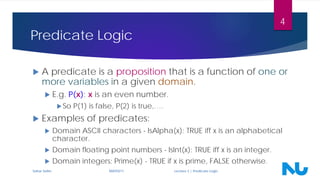
 A predicate is a proposition that is a function of one or
more variables in a given domain.
 E.g. P(x): x is an even number.
So P(1) is false, P(2) is true,….
 Examples of predicates:
 Domain ASCII characters - IsAlpha(x): TRUE iff x is an alphabetical
character.
 Domain floating point numbers - IsInt(x): TRUE iff x is an integer.
 Domain integers: Prime(x) - TRUE if x is prime, FALSE otherwise.
Sahar Selim MATH211 Lecture 3 | Predicate Logic
4
Subjects and Predicates
 In the sentence “The dog is sleeping”:
 The phrase “the dog” denotes the subject - the object or entity that the
sentence is about.
 The phrase “is sleeping” denotes the predicate- a property that is true of
the subject.
 In predicate logic, a predicate is modeled as a function P( )
from objects to propositions.
 P(x) = “x is sleeping” (where x is any object).
Sahar Selim MATH211 Lecture 3 | Predicate Logic
5
More About Predicates
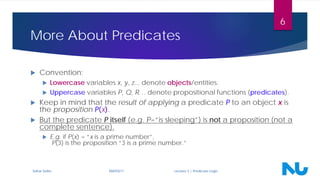
 Convention:
 Lowercase variables x, y, z... denote objects/entities.
 Uppercase variables P, Q, R… denote propositional functions (predicates).
 Keep in mind that the result of applying a predicate P to an object x is
the proposition P(x).
 But the predicate P itself (e.g. P=“is sleeping”) is not a proposition (not a
complete sentence).
 E.g. if P(x) = “x is a prime number”,
P(3) is the proposition “3 is a prime number.”
Sahar Selim MATH211 Lecture 3 | Predicate Logic
6
Example
Let Q(x, y) denote the statement “x = y + 3”
What are the truth values of the propositions
Q(1, 2) and Q(3, 0)?
 When the variables in a propositional function are
assigned values, the resulting statement becomes a
proposition with a certain truth value.
Sahar Selim MATH211 Lecture 3 | Predicate Logic
7
Propositional Functions
 Predicate logic generalizes the grammatical notion of
a predicate to also include propositional functions of
any number of arguments, each of which may take
any grammatical role that a noun can take.
 E.g. let P(x,y,z) = “x gave y the grade z”, then
If x=“Mike”, y=“Mary”, z=“A”,
then P(x,y,z) = “Mike gave Mary the grade A.”
Sahar Selim MATH211 Lecture 3 | Predicate Logic
8
Quantifiers
Sahar Selim MATH211 Lecture 3 | Predicate Logic
9
Quantifiers
 In English, the words all, some, many, none, and few are
used in quantifications.
 There is another important way, called quantification, to
create a proposition from a propositional function.
 Quantification expresses the extent to which a predicate is true
over a range of elements.
 It describes the values of a variable that make the predicate true.
E.g. ∃x P(x)
 Domain or universe: range of values of a variable
Sahar Selim MATH211 Lecture 3 | Predicate Logic
10
Universe of Discourse (U.D.s)
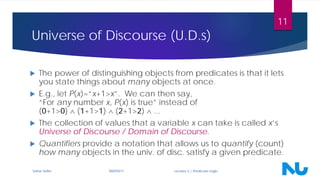
 The power of distinguishing objects from predicates is that it lets
you state things about many objects at once.
 E.g., let P(x)=“x+1>x”. We can then say,
“For any number x, P(x) is true” instead of
(0+1>0) ∧ (1+1>1) ∧ (2+1>2) ∧ ...
 The collection of values that a variable x can take is called x’s
Universe of Discourse / Domain of Discourse.
 Quantifiers provide a notation that allows us to quantify (count)
how many objects in the univ. of disc. satisfy a given predicate.
Sahar Selim MATH211 Lecture 3 | Predicate Logic
11
Two Popular Quantifiers
1. Universal: ∀x P(x) – “P(x) for all x in the domain”
2. Existential: ∃x P(x) – “P(x) for some x in the domain” or “there exists
x (that is, 1 or more) such that P(x) is TRUE”.
 Either is meaningless if the domain is not known/specified.
 Examples (domain real numbers)
 ∀ x (x2 >= 0)
 ∃ x (x >1)
 (∀x>1) (x2 > x) – quantifier with restricted domain
Sahar Selim MATH211 Lecture 3 | Predicate Logic
12
The Universal Quantifier ∀
 Example:
Let the u.d. of x be parking spaces at Cairo University.
Let P(x) be the predicate “x is full.”
Then the universal quantification of P(x), ∀x P(x), is the proposition:
 “All parking spaces at CU are full.”
 i.e., “Every parking space at CU is full.”
 i.e., “For each parking space at CU, that space is full.”
Sahar Selim MATH211 Lecture 3 | Predicate Logic
13
The Existential Quantifier ∃
 Example:
Let the u.d. of x be parking spaces at CU.
Let P(x) be the predicate “x is full.”
Then the existential quantification of P(x), ∃x P(x), is the proposition:
 “Some parking space at CU is full.”
 “There is a parking space at CU that is full.”
 “At least one parking space at CU is full.”
Sahar Selim MATH211 Lecture 3 | Predicate Logic
14
Example
 P(x) denote a predicate in the domain U = {1, 2, 3}
∀x P(x) ⇔ P(1) ∧ P(2) ∧ P(3)
∃x P(x) ⇔ P(1) ˅ P(2) ˅ P(3)
Sahar Selim MATH211 Lecture 3 | Predicate Logic
15
Truth of Quantifiers
Sahar Selim MATH211 Lecture 3 | Predicate Logic
16
Using Quantifiers
Domain integers:
 Using implications:
The cube of all negative integers is negative.
∀x (x < 0) →(x3 < 0)
 Expressing sums:
n
∀n (Σ i = n(n+1)/2)
i=1
Sahar Selim MATH211 Lecture 3 | Predicate Logic
17
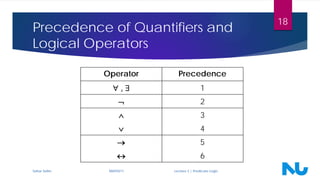
Precedence of Quantifiers and
Logical Operators
Operator Precedence
∀ , ∃ 1
¬ 2
∧ 3
∨ 4
→ 5
↔ 6
Sahar Selim MATH211 Lecture 3 | Predicate Logic
18
Precedence of Quantifiers
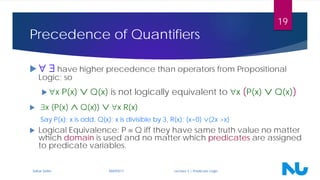
 ∀ ∃ have higher precedence than operators from Propositional
Logic; so
 ∀x P(x) ∨ Q(x) is not logically equivalent to ∀x (P(x) ∨ Q(x))
 ∃x (P(x) ∧ Q(x)) ∨ ∀x R(x)
Say P(x): x is odd, Q(x): x is divisible by 3, R(x): (x=0) ∨(2x >x)
 Logical Equivalence: P ≡ Q iff they have same truth value no matter
which domain is used and no matter which predicates are assigned
to predicate variables.
Sahar Selim MATH211 Lecture 3 | Predicate Logic
19
Free and Bound Variables
 An expression like P(x) is said to have a free variable x (meaning,
x is undefined).
 A quantifier (either ∀ or ∃) operates on an expression having one
or more free variables, and binds one or more of those variables,
to produce an expression having one or more bound variables.
Sahar Selim MATH211 Lecture 3 | Predicate Logic
20
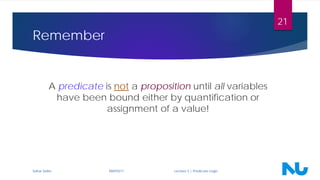
Remember
A predicate is not a proposition until all variables
have been bound either by quantification or
assignment of a value!
Sahar Selim MATH211 Lecture 3 | Predicate Logic
21
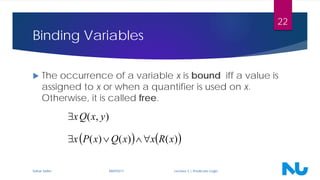
Binding Variables
 The occurrence of a variable x is bound iff a value is
assigned to x or when a quantifier is used on x.
Otherwise, it is called free.
Sahar Selim MATH211 Lecture 3 | Predicate Logic
22
)
,
( y
x
Q
x
∃
( ) ( )
)
(
)
(
)
( x
R
x
x
Q
x
P
x ∀
∧
∨
∃
Example of Binding
 P(x,y) has 2 free variables, x and y.
 ∀x P(x,y) has 1 free variable, and one bound variable.
[Which is which?]
 “P(x), where x=3” is another way to bind x.
 An expression with zero free variables is an actual proposition.
 An expression with one or more free variables is still only a
predicate: ∀x P(x,y)
y x
Sahar Selim MATH211 Lecture 3 | Predicate Logic
23
Examples
 Let U = Z, the integers = {. . . -2, -1, 0 , 1, 2, 3, . . .}
 P(x): x > 0 is the predicate. It has no truth value until the variable x is bound.
 Examples of propositions where x is assigned a value:
 P(-3) is false,
 P(0) is false,
 P(3) is true.
 The collection of integers for which P(x) is true are the positive
integers.
Sahar Selim MATH211 Lecture 3 | Predicate Logic
24
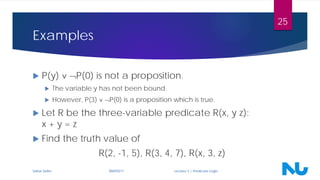
Examples
 P(y) ˅ ¬P(0) is not a proposition.
 The variable y has not been bound.
 However, P(3) ˅ ¬P(0) is a proposition which is true.
 Let R be the three-variable predicate R(x, y z):
x + y = z
 Find the truth value of
R(2, -1, 5), R(3, 4, 7), R(x, 3, z)
Sahar Selim MATH211 Lecture 3 | Predicate Logic
25
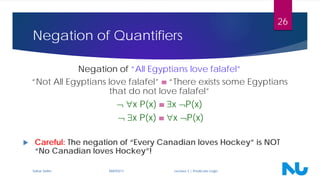
Negation of Quantifiers
Negation of “All Egyptians love falafel”
“Not All Egyptians love falafel” ≡ “There exists some Egyptians
that do not love falafel”
¬ ∀x P(x) ≡ ∃x ¬P(x)
¬ ∃x P(x) ≡ ∀x ¬P(x)
 Careful: The negation of “Every Canadian loves Hockey” is NOT
“No Canadian loves Hockey”!
Sahar Selim MATH211 Lecture 3 | Predicate Logic
26
Negation of Quantifiers
 Distributing a negation operator across a quantifier
changes a universal to an existential and vice versa.
¬(∀x P(x)) ⇔ ¬(P(x1) ∧ P(x2) ∧ … ∧ P(xn))
⇔ ¬P(x1) ˅ ¬P(x2) ˅ … ˅ ¬P(xn)
⇔ ∃x ¬P(x)
Sahar Selim MATH211 Lecture 3 | Predicate Logic
27
De Morgan’s Laws for Quantifiers
Sahar Selim MATH211 Lecture 3 | Predicate Logic
28
Example
 What are the negations of the statements “There is an honest
politician” and “All Americans eat cheeseburgers”?
Solution:
 H(x) denote “x is honest.”
 “There is an honest politician” is represented by ∃xH(x), where
the domain consists of all politicians.
 Negation of this statement is ¬∃xH(x) ≡ ∀x¬ H(x).
Sahar Selim MATH211 Lecture 3 | Predicate Logic
29
Example
 Let C(x) denote “x eats cheeseburgers.”
 Then “All Americans eat cheeseburgers” is represented by
∀xC(x), where the domain consists of all Americans.
 The negation of this statement is ¬∀xC(x), which is equivalent to
∃x¬C(x).
 This negation can be expressed in several different ways,
including “Some American does not eat cheeseburgers” and
“There is an American who does not eat cheeseburgers.”
Sahar Selim MATH211 Lecture 3 | Predicate Logic
30
1.5 Nested Quantifiers
Sahar Selim MATH211 Lecture 3 | Predicate Logic
33
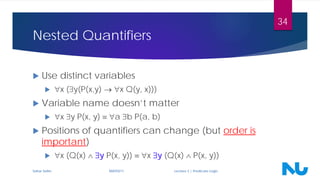
Nested Quantifiers
 Use distinct variables
 ∀x (∃y(P(x,y) → ∀x Q(y, x)))
 Variable name doesn’t matter
 ∀x ∃y P(x, y) ≡ ∀a ∃b P(a, b)
 Positions of quantifiers can change (but order is
important)
 ∀x (Q(x) ∧ ∃y P(x, y)) ≡ ∀x ∃y (Q(x) ∧ P(x, y))
Sahar Selim MATH211 Lecture 3 | Predicate Logic
34
Nested Quantifiers
Example: Let the u.d. of x & y be people.
Let L(x,y)=“x likes y” (a predicate with 2 free variables)
Then ∃y L(x,y) = “There is someone whom x likes.” (A predicate with
1 free variable, x)
Then ∀x (∃y L(x,y)) = “Everyone has someone whom they like.”
(A __________ with ___ free variables.)
Sahar Selim MATH211 Lecture 3 | Predicate Logic
35
∀x ∃y (x + y = 0) is true over the integers
 Assume an arbitrary integer x.
 To show that there exists a y that satisfies the requirement of the
predicate, choose y = -x. Clearly y is an integer, and thus is in the
domain.
 So x + y = x + (-x) = x – x = 0.
 Since we assumed nothing about x (other than it is an integer), the
argument holds for any integer x.
 Therefore, the predicate is TRUE.
Nested Quantifiers
Sahar Selim MATH211 Lecture 3 | Predicate Logic
36
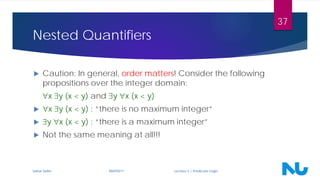
 Caution: In general, order matters! Consider the following
propositions over the integer domain:
∀x ∃y (x < y) and ∃y ∀x (x < y)
 ∀x ∃y (x < y) : “there is no maximum integer”
 ∃y ∀x (x < y) : “there is a maximum integer”
 Not the same meaning at all!!!
Nested Quantifiers
Sahar Selim MATH211 Lecture 3 | Predicate Logic
37
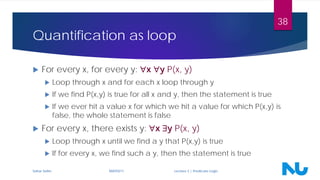
Quantification as loop
 For every x, for every y: ∀x ∀y P(x, y)
 Loop through x and for each x loop through y
 If we find P(x,y) is true for all x and y, then the statement is true
 If we ever hit a value x for which we hit a value for which P(x,y) is
false, the whole statement is false
 For every x, there exists y: ∀x ∃y P(x, y)
 Loop through x until we find a y that P(x,y) is true
 If for every x, we find such a y, then the statement is true
Sahar Selim MATH211 Lecture 3 | Predicate Logic
38
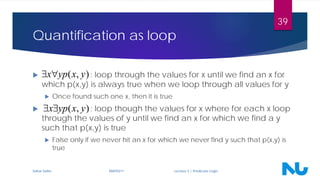
Quantification as loop
 : loop through the values for x until we find an x for
which p(x,y) is always true when we loop through all values for y
 Once found such one x, then it is true
 : loop though the values for x where for each x loop
through the values of y until we find an x for which we find a y
such that p(x,y) is true
 False only if we never hit an x for which we never find y such that p(x,y) is
true
)
,
( y
x
yp
x∀
∃
)
,
( y
x
yp
x∃
∃
Sahar Selim MATH211 Lecture 3 | Predicate Logic
39
The order of quantifiers is important unless all the
quantifiers are universal or all the quantifiers are
existential.
 Let Q(x,y) denote “x + y = 0”. What are the truth values of the
quantifications
∀x ∃y Q(x,y)
∃y ∀x Q(x,y)
Order of quantification
Sahar Selim MATH211 Lecture 3 | Predicate Logic
40
Order of quantification
 Let P(x, y) be the statement “x + y = y + x” and the domain is real
number
∀x∀yP(x, y) ≡ ∀y∀xP(x, y) ?
 The quantification ∀x∀yP(x, y) denotes the proposition “For
all real numbers x, for all real numbers y, x + y = y + x.”
 The statement ∀y∀xP(x, y) says “For all real numbers y, for
all real numbers x, x + y = y + x.”
 Both has the same meaning, and both are true.
Sahar Selim MATH211 Lecture 3 | Predicate Logic
41
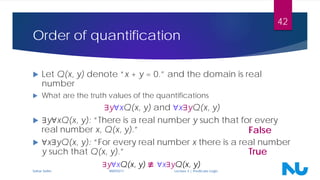
Order of quantification
 Let Q(x, y) denote “x + y = 0.” and the domain is real
number
 What are the truth values of the quantifications
∃y∀xQ(x, y) and ∀x∃yQ(x, y)
 ∃y∀xQ(x, y): “There is a real number y such that for every
real number x, Q(x, y).”
 ∀x∃yQ(x, y): “For every real number x there is a real number
y such that Q(x, y).”
False
True
∃y∀xQ(x, y) ≢ ∀x∃yQ(x, y)
Sahar Selim MATH211 Lecture 3 | Predicate Logic
42
Quantifications of Two Variables
Sahar Selim MATH211 Lecture 3 | Predicate Logic
43
Quantification with more variables
 ∀x∀y∃zQ(x, y, z): “For all real numbers x and for all real numbers y there is a
real number z such that x + y = z,” is true
 ∃z∀x∀yQ(x, y, z): “There is a real number z such that for all real numbers x
and for all real numbers y it is true that x + y = z,” is false, because there is no
value of z that satisfies the equation x + y = z for all values of x and y.
it true?
Is
mean?
it
does
What
:
)
,
,
(
it true?
Is
mean?
it
does
What
:
)
,
,
(
number
real
is
domain
the
and
,
statement
the
be
)
,
,
(
Let
z
y
x
yq
x
z
z
y
x
zq
y
x
z
y
x
z
y
x
q
∀
∀
∃
∃
∀
∀
=
+
The order of the
quantification
here is important
Sahar Selim MATH211 Lecture 3 | Predicate Logic
44
Translating mathematical statements
 “The sum of two positive integers is always positive”
integers
all
of
consists
bles
both varia
for
domain
the
where
))
0
(
)
0
(
)
0
(( >
+
→
>
∧
>
∀
∀ y
x
y
x
y
x
integers
positive
all
of
consists
bles
both varia
for
domain
the
where
)
0
( >
+
∀
∀ y
x
y
x
Sahar Selim MATH211 Lecture 3 | Predicate Logic
45
Example
 “Every real number except zero has a multiplicative inverse”
numbers
real
of
consists
bles
both varia
for
domain
the
where
))
1
(
)
0
(( =
∃
→
≠
∀ xy
y
x
x
Sahar Selim MATH211 Lecture 3 | Predicate Logic
46
∀x∃y ((x≠0)→ (xy=1))
Translating English Sentences into
Logical Expressions
 “If a person is female and is a parent, then this person is someone’s
mother”
 “For every person x, if person x is female and person x is a parent, then
there exists a person y such that person x is the mother of person y.”
 F(x): “x is female,”
 P(x): “x is a parent,”
 M(x, y): “x is the mother of y.”
∀x((F(x) ∧ P(x)) → ∃yM(x, y))
Sahar Selim MATH211 Lecture 3 | Predicate Logic
47
Summary: Predicate Logic
 In this lecture we have learned:
 Predicate logic notation & conventions
 Conversions: predicate logic ↔ clear English
 Meaning of quantifiers, equivalences
 Simple reasoning with quantifiers
Sahar Selim MATH211 Lecture 3 | Predicate Logic
48
49
Sahar Selim MATH211 Lecture 3 | Predicate Logic
Problem 1
 P(x): “x can speak Russian”
 Q(x): “x knows the computer language C++.”
 Express each of these sentences in terms of P(x), Q(x), quantifiers,
and logical connectives.
 The domain for quantifiers consists of all students at your school.
a) There is a student at your school who can speak Russian and who knows
C++.
∃x(P(x) ^ Q(x))
Sahar Selim MATH211 Lecture 3 | Predicate Logic
50
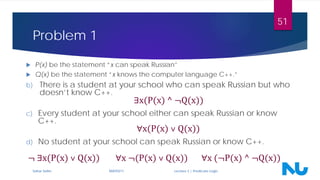
Problem 1
 P(x) be the statement “x can speak Russian”
 Q(x) be the statement “x knows the computer language C++.”
b) There is a student at your school who can speak Russian but who
doesn’t know C++.
c) Every student at your school either can speak Russian or know
C++.
d) No student at your school can speak Russian or know C++.
∃x(P(x) ^ ¬Q(x))
∀x(P(x) ˅ Q(x))
¬ ∃x(P(x) ˅ Q(x)) ∀x ¬(P(x) ˅ Q(x)) ∀x (¬P(x) ^ ¬Q(x))
Sahar Selim MATH211 Lecture 3 | Predicate Logic
51
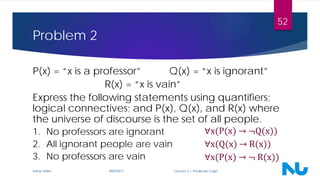
P(x) = “x is a professor” Q(x) = “x is ignorant”
R(x) = “x is vain”
Express the following statements using quantifiers;
logical connectives; and P(x), Q(x), and R(x) where
the universe of discourse is the set of all people.
1. No professors are ignorant
2. All ignorant people are vain
3. No professors are vain
Problem 2
Sahar Selim MATH211 Lecture 3 | Predicate Logic
52
∀x(P(x) → ¬Q(x))
∀x(Q(x) → R(x))
∀x(P(x) → ¬ R(x))
Problem 3: Translating Sentences into
Logical Expressions
 Let L(x,y) be the statement “x loves y”, where the domain for both x and y
consists of all people in the world.
1. Everybody loves Jerry.
2. Everybody loves somebody.
3. There is somebody whom everybody loves.
4. Nobody loves everybody.
5. There is somebody whom Lydia does not love.
6. There is somebody whom no one loves.
7. There is exactly one person whom everybody loves.
8. There are exactly two people whom Lynn loves.
9. Everyone loves himself or herself
10. There is someone who loves no one besides himself or herself
Sahar Selim MATH211 Lecture 3 | Predicate Logic
53
Programming
Task
Implement using any
programming
language
Sahar Selim MATH211 Lecture 3 | Predicate Logic
Programming Task
Let Q(x, y) denote “x + y = 5”
The domain of x and y is the integers {0, 1, 2, 3, 4, 5}.
Implement the code that outputs the truth values of the following
quantifications:
1. ∀x ∀y Q(x, y)
2. ∀x ∃y Q(x, y)
**Display values of variables x and y if the quantification is true.
Sahar Selim MATH211 Lecture 3 | Predicate Logic
55
Thinking of Nested
Quantification as Nested Loops
 To see if ∀x ∀y P(x,y) is true,
 loop through the values of x :
 At each step, loop through the values for y.
 If for some pair of x and y, P(x,y) is false, then ∀x ∀y P(x,y) is false and both
the outer and inner loop terminate.
 ∀x ∀y P(x,y) is true if the outer loop ends after stepping through
each x.
Sahar Selim MATH211 Lecture 3 | Predicate Logic
56
Thinking of Nested
Quantification as Nested Loops
 To see if ∀x ∃y P(x,y) is true,
 loop through the values of x:
 At each step, loop through the values for y.
 The inner loop ends when a pair x and y is found such that P(x,y) is true.
 If no y is found such that P(x,y) is true the outer loop terminates as ∀x ∃y P(x,y) has
been shown to be false.
 ∀x ∃y P(x,y) is true if the outer loop ends after stepping through each x.
 If the domains of the variables are infinite, then this process can not actually
be carried out.
Sahar Selim MATH211 Lecture 3 | Predicate Logic
57
Next Lecture
 Inference Rules
Sahar Selim MATH211 Lecture 3 | Predicate Logic
58
Supplementary Material
 1.4.1 Predicate Logic
Sahar Selim MATH211 Lecture 3 | Predicate Logic
59

Discrete Mathematics: Lecture 2 - Predicate Logic

  • 1.
  • 2.
    Agenda  1.4 Predicatesand Quantifiers  1.5 Nested Quantifiers Sahar Selim MATH211 Lecture 3 | Predicate Logic 2
  • 3.
    1.4 Predicates andQuantifiers Sahar Selim MATH211 Lecture 3 | Predicate Logic 3
  • 4.
    Predicate Logic  Apredicate is a proposition that is a function of one or more variables in a given domain.  E.g. P(x): x is an even number. So P(1) is false, P(2) is true,….  Examples of predicates:  Domain ASCII characters - IsAlpha(x): TRUE iff x is an alphabetical character.  Domain floating point numbers - IsInt(x): TRUE iff x is an integer.  Domain integers: Prime(x) - TRUE if x is prime, FALSE otherwise. Sahar Selim MATH211 Lecture 3 | Predicate Logic 4
  • 5.
    Subjects and Predicates In the sentence “The dog is sleeping”:  The phrase “the dog” denotes the subject - the object or entity that the sentence is about.  The phrase “is sleeping” denotes the predicate- a property that is true of the subject.  In predicate logic, a predicate is modeled as a function P( ) from objects to propositions.  P(x) = “x is sleeping” (where x is any object). Sahar Selim MATH211 Lecture 3 | Predicate Logic 5
  • 6.
    More About Predicates Convention:  Lowercase variables x, y, z... denote objects/entities.  Uppercase variables P, Q, R… denote propositional functions (predicates).  Keep in mind that the result of applying a predicate P to an object x is the proposition P(x).  But the predicate P itself (e.g. P=“is sleeping”) is not a proposition (not a complete sentence).  E.g. if P(x) = “x is a prime number”, P(3) is the proposition “3 is a prime number.” Sahar Selim MATH211 Lecture 3 | Predicate Logic 6
  • 7.
    Example Let Q(x, y)denote the statement “x = y + 3” What are the truth values of the propositions Q(1, 2) and Q(3, 0)?  When the variables in a propositional function are assigned values, the resulting statement becomes a proposition with a certain truth value. Sahar Selim MATH211 Lecture 3 | Predicate Logic 7
  • 8.
    Propositional Functions  Predicatelogic generalizes the grammatical notion of a predicate to also include propositional functions of any number of arguments, each of which may take any grammatical role that a noun can take.  E.g. let P(x,y,z) = “x gave y the grade z”, then If x=“Mike”, y=“Mary”, z=“A”, then P(x,y,z) = “Mike gave Mary the grade A.” Sahar Selim MATH211 Lecture 3 | Predicate Logic 8
  • 9.
    Quantifiers Sahar Selim MATH211Lecture 3 | Predicate Logic 9
  • 10.
    Quantifiers  In English,the words all, some, many, none, and few are used in quantifications.  There is another important way, called quantification, to create a proposition from a propositional function.  Quantification expresses the extent to which a predicate is true over a range of elements.  It describes the values of a variable that make the predicate true. E.g. ∃x P(x)  Domain or universe: range of values of a variable Sahar Selim MATH211 Lecture 3 | Predicate Logic 10
  • 11.
    Universe of Discourse(U.D.s)  The power of distinguishing objects from predicates is that it lets you state things about many objects at once.  E.g., let P(x)=“x+1>x”. We can then say, “For any number x, P(x) is true” instead of (0+1>0) ∧ (1+1>1) ∧ (2+1>2) ∧ ...  The collection of values that a variable x can take is called x’s Universe of Discourse / Domain of Discourse.  Quantifiers provide a notation that allows us to quantify (count) how many objects in the univ. of disc. satisfy a given predicate. Sahar Selim MATH211 Lecture 3 | Predicate Logic 11
  • 12.
    Two Popular Quantifiers 1.Universal: ∀x P(x) – “P(x) for all x in the domain” 2. Existential: ∃x P(x) – “P(x) for some x in the domain” or “there exists x (that is, 1 or more) such that P(x) is TRUE”.  Either is meaningless if the domain is not known/specified.  Examples (domain real numbers)  ∀ x (x2 >= 0)  ∃ x (x >1)  (∀x>1) (x2 > x) – quantifier with restricted domain Sahar Selim MATH211 Lecture 3 | Predicate Logic 12
  • 13.
    The Universal Quantifier∀  Example: Let the u.d. of x be parking spaces at Cairo University. Let P(x) be the predicate “x is full.” Then the universal quantification of P(x), ∀x P(x), is the proposition:  “All parking spaces at CU are full.”  i.e., “Every parking space at CU is full.”  i.e., “For each parking space at CU, that space is full.” Sahar Selim MATH211 Lecture 3 | Predicate Logic 13
  • 14.
    The Existential Quantifier∃  Example: Let the u.d. of x be parking spaces at CU. Let P(x) be the predicate “x is full.” Then the existential quantification of P(x), ∃x P(x), is the proposition:  “Some parking space at CU is full.”  “There is a parking space at CU that is full.”  “At least one parking space at CU is full.” Sahar Selim MATH211 Lecture 3 | Predicate Logic 14
  • 15.
    Example  P(x) denotea predicate in the domain U = {1, 2, 3} ∀x P(x) ⇔ P(1) ∧ P(2) ∧ P(3) ∃x P(x) ⇔ P(1) ˅ P(2) ˅ P(3) Sahar Selim MATH211 Lecture 3 | Predicate Logic 15
  • 16.
    Truth of Quantifiers SaharSelim MATH211 Lecture 3 | Predicate Logic 16
  • 17.
    Using Quantifiers Domain integers: Using implications: The cube of all negative integers is negative. ∀x (x < 0) →(x3 < 0)  Expressing sums: n ∀n (Σ i = n(n+1)/2) i=1 Sahar Selim MATH211 Lecture 3 | Predicate Logic 17
  • 18.
    Precedence of Quantifiersand Logical Operators Operator Precedence ∀ , ∃ 1 ¬ 2 ∧ 3 ∨ 4 → 5 ↔ 6 Sahar Selim MATH211 Lecture 3 | Predicate Logic 18
  • 19.
    Precedence of Quantifiers ∀ ∃ have higher precedence than operators from Propositional Logic; so  ∀x P(x) ∨ Q(x) is not logically equivalent to ∀x (P(x) ∨ Q(x))  ∃x (P(x) ∧ Q(x)) ∨ ∀x R(x) Say P(x): x is odd, Q(x): x is divisible by 3, R(x): (x=0) ∨(2x >x)  Logical Equivalence: P ≡ Q iff they have same truth value no matter which domain is used and no matter which predicates are assigned to predicate variables. Sahar Selim MATH211 Lecture 3 | Predicate Logic 19
  • 20.
    Free and BoundVariables  An expression like P(x) is said to have a free variable x (meaning, x is undefined).  A quantifier (either ∀ or ∃) operates on an expression having one or more free variables, and binds one or more of those variables, to produce an expression having one or more bound variables. Sahar Selim MATH211 Lecture 3 | Predicate Logic 20
  • 21.
    Remember A predicate isnot a proposition until all variables have been bound either by quantification or assignment of a value! Sahar Selim MATH211 Lecture 3 | Predicate Logic 21
  • 22.
    Binding Variables  Theoccurrence of a variable x is bound iff a value is assigned to x or when a quantifier is used on x. Otherwise, it is called free. Sahar Selim MATH211 Lecture 3 | Predicate Logic 22 ) , ( y x Q x ∃ ( ) ( ) ) ( ) ( ) ( x R x x Q x P x ∀ ∧ ∨ ∃
  • 23.
    Example of Binding P(x,y) has 2 free variables, x and y.  ∀x P(x,y) has 1 free variable, and one bound variable. [Which is which?]  “P(x), where x=3” is another way to bind x.  An expression with zero free variables is an actual proposition.  An expression with one or more free variables is still only a predicate: ∀x P(x,y) y x Sahar Selim MATH211 Lecture 3 | Predicate Logic 23
  • 24.
    Examples  Let U= Z, the integers = {. . . -2, -1, 0 , 1, 2, 3, . . .}  P(x): x > 0 is the predicate. It has no truth value until the variable x is bound.  Examples of propositions where x is assigned a value:  P(-3) is false,  P(0) is false,  P(3) is true.  The collection of integers for which P(x) is true are the positive integers. Sahar Selim MATH211 Lecture 3 | Predicate Logic 24
  • 25.
    Examples  P(y) ˅¬P(0) is not a proposition.  The variable y has not been bound.  However, P(3) ˅ ¬P(0) is a proposition which is true.  Let R be the three-variable predicate R(x, y z): x + y = z  Find the truth value of R(2, -1, 5), R(3, 4, 7), R(x, 3, z) Sahar Selim MATH211 Lecture 3 | Predicate Logic 25
  • 26.
    Negation of Quantifiers Negationof “All Egyptians love falafel” “Not All Egyptians love falafel” ≡ “There exists some Egyptians that do not love falafel” ¬ ∀x P(x) ≡ ∃x ¬P(x) ¬ ∃x P(x) ≡ ∀x ¬P(x)  Careful: The negation of “Every Canadian loves Hockey” is NOT “No Canadian loves Hockey”! Sahar Selim MATH211 Lecture 3 | Predicate Logic 26
  • 27.
    Negation of Quantifiers Distributing a negation operator across a quantifier changes a universal to an existential and vice versa. ¬(∀x P(x)) ⇔ ¬(P(x1) ∧ P(x2) ∧ … ∧ P(xn)) ⇔ ¬P(x1) ˅ ¬P(x2) ˅ … ˅ ¬P(xn) ⇔ ∃x ¬P(x) Sahar Selim MATH211 Lecture 3 | Predicate Logic 27
  • 28.
    De Morgan’s Lawsfor Quantifiers Sahar Selim MATH211 Lecture 3 | Predicate Logic 28
  • 29.
    Example  What arethe negations of the statements “There is an honest politician” and “All Americans eat cheeseburgers”? Solution:  H(x) denote “x is honest.”  “There is an honest politician” is represented by ∃xH(x), where the domain consists of all politicians.  Negation of this statement is ¬∃xH(x) ≡ ∀x¬ H(x). Sahar Selim MATH211 Lecture 3 | Predicate Logic 29
  • 30.
    Example  Let C(x)denote “x eats cheeseburgers.”  Then “All Americans eat cheeseburgers” is represented by ∀xC(x), where the domain consists of all Americans.  The negation of this statement is ¬∀xC(x), which is equivalent to ∃x¬C(x).  This negation can be expressed in several different ways, including “Some American does not eat cheeseburgers” and “There is an American who does not eat cheeseburgers.” Sahar Selim MATH211 Lecture 3 | Predicate Logic 30
  • 31.
    1.5 Nested Quantifiers SaharSelim MATH211 Lecture 3 | Predicate Logic 33
  • 32.
    Nested Quantifiers  Usedistinct variables  ∀x (∃y(P(x,y) → ∀x Q(y, x)))  Variable name doesn’t matter  ∀x ∃y P(x, y) ≡ ∀a ∃b P(a, b)  Positions of quantifiers can change (but order is important)  ∀x (Q(x) ∧ ∃y P(x, y)) ≡ ∀x ∃y (Q(x) ∧ P(x, y)) Sahar Selim MATH211 Lecture 3 | Predicate Logic 34
  • 33.
    Nested Quantifiers Example: Letthe u.d. of x & y be people. Let L(x,y)=“x likes y” (a predicate with 2 free variables) Then ∃y L(x,y) = “There is someone whom x likes.” (A predicate with 1 free variable, x) Then ∀x (∃y L(x,y)) = “Everyone has someone whom they like.” (A __________ with ___ free variables.) Sahar Selim MATH211 Lecture 3 | Predicate Logic 35
  • 34.
    ∀x ∃y (x+ y = 0) is true over the integers  Assume an arbitrary integer x.  To show that there exists a y that satisfies the requirement of the predicate, choose y = -x. Clearly y is an integer, and thus is in the domain.  So x + y = x + (-x) = x – x = 0.  Since we assumed nothing about x (other than it is an integer), the argument holds for any integer x.  Therefore, the predicate is TRUE. Nested Quantifiers Sahar Selim MATH211 Lecture 3 | Predicate Logic 36
  • 35.
     Caution: Ingeneral, order matters! Consider the following propositions over the integer domain: ∀x ∃y (x < y) and ∃y ∀x (x < y)  ∀x ∃y (x < y) : “there is no maximum integer”  ∃y ∀x (x < y) : “there is a maximum integer”  Not the same meaning at all!!! Nested Quantifiers Sahar Selim MATH211 Lecture 3 | Predicate Logic 37
  • 36.
    Quantification as loop For every x, for every y: ∀x ∀y P(x, y)  Loop through x and for each x loop through y  If we find P(x,y) is true for all x and y, then the statement is true  If we ever hit a value x for which we hit a value for which P(x,y) is false, the whole statement is false  For every x, there exists y: ∀x ∃y P(x, y)  Loop through x until we find a y that P(x,y) is true  If for every x, we find such a y, then the statement is true Sahar Selim MATH211 Lecture 3 | Predicate Logic 38
  • 37.
    Quantification as loop : loop through the values for x until we find an x for which p(x,y) is always true when we loop through all values for y  Once found such one x, then it is true  : loop though the values for x where for each x loop through the values of y until we find an x for which we find a y such that p(x,y) is true  False only if we never hit an x for which we never find y such that p(x,y) is true ) , ( y x yp x∀ ∃ ) , ( y x yp x∃ ∃ Sahar Selim MATH211 Lecture 3 | Predicate Logic 39
  • 38.
    The order ofquantifiers is important unless all the quantifiers are universal or all the quantifiers are existential.  Let Q(x,y) denote “x + y = 0”. What are the truth values of the quantifications ∀x ∃y Q(x,y) ∃y ∀x Q(x,y) Order of quantification Sahar Selim MATH211 Lecture 3 | Predicate Logic 40
  • 39.
    Order of quantification Let P(x, y) be the statement “x + y = y + x” and the domain is real number ∀x∀yP(x, y) ≡ ∀y∀xP(x, y) ?  The quantification ∀x∀yP(x, y) denotes the proposition “For all real numbers x, for all real numbers y, x + y = y + x.”  The statement ∀y∀xP(x, y) says “For all real numbers y, for all real numbers x, x + y = y + x.”  Both has the same meaning, and both are true. Sahar Selim MATH211 Lecture 3 | Predicate Logic 41
  • 40.
    Order of quantification Let Q(x, y) denote “x + y = 0.” and the domain is real number  What are the truth values of the quantifications ∃y∀xQ(x, y) and ∀x∃yQ(x, y)  ∃y∀xQ(x, y): “There is a real number y such that for every real number x, Q(x, y).”  ∀x∃yQ(x, y): “For every real number x there is a real number y such that Q(x, y).” False True ∃y∀xQ(x, y) ≢ ∀x∃yQ(x, y) Sahar Selim MATH211 Lecture 3 | Predicate Logic 42
  • 41.
    Quantifications of TwoVariables Sahar Selim MATH211 Lecture 3 | Predicate Logic 43
  • 42.
    Quantification with morevariables  ∀x∀y∃zQ(x, y, z): “For all real numbers x and for all real numbers y there is a real number z such that x + y = z,” is true  ∃z∀x∀yQ(x, y, z): “There is a real number z such that for all real numbers x and for all real numbers y it is true that x + y = z,” is false, because there is no value of z that satisfies the equation x + y = z for all values of x and y. it true? Is mean? it does What : ) , , ( it true? Is mean? it does What : ) , , ( number real is domain the and , statement the be ) , , ( Let z y x yq x z z y x zq y x z y x z y x q ∀ ∀ ∃ ∃ ∀ ∀ = + The order of the quantification here is important Sahar Selim MATH211 Lecture 3 | Predicate Logic 44
  • 43.
    Translating mathematical statements “The sum of two positive integers is always positive” integers all of consists bles both varia for domain the where )) 0 ( ) 0 ( ) 0 (( > + → > ∧ > ∀ ∀ y x y x y x integers positive all of consists bles both varia for domain the where ) 0 ( > + ∀ ∀ y x y x Sahar Selim MATH211 Lecture 3 | Predicate Logic 45
  • 44.
    Example  “Every realnumber except zero has a multiplicative inverse” numbers real of consists bles both varia for domain the where )) 1 ( ) 0 (( = ∃ → ≠ ∀ xy y x x Sahar Selim MATH211 Lecture 3 | Predicate Logic 46 ∀x∃y ((x≠0)→ (xy=1))
  • 45.
    Translating English Sentencesinto Logical Expressions  “If a person is female and is a parent, then this person is someone’s mother”  “For every person x, if person x is female and person x is a parent, then there exists a person y such that person x is the mother of person y.”  F(x): “x is female,”  P(x): “x is a parent,”  M(x, y): “x is the mother of y.” ∀x((F(x) ∧ P(x)) → ∃yM(x, y)) Sahar Selim MATH211 Lecture 3 | Predicate Logic 47
  • 46.
    Summary: Predicate Logic In this lecture we have learned:  Predicate logic notation & conventions  Conversions: predicate logic ↔ clear English  Meaning of quantifiers, equivalences  Simple reasoning with quantifiers Sahar Selim MATH211 Lecture 3 | Predicate Logic 48
  • 47.
    49 Sahar Selim MATH211Lecture 3 | Predicate Logic
  • 48.
    Problem 1  P(x):“x can speak Russian”  Q(x): “x knows the computer language C++.”  Express each of these sentences in terms of P(x), Q(x), quantifiers, and logical connectives.  The domain for quantifiers consists of all students at your school. a) There is a student at your school who can speak Russian and who knows C++. ∃x(P(x) ^ Q(x)) Sahar Selim MATH211 Lecture 3 | Predicate Logic 50
  • 49.
    Problem 1  P(x)be the statement “x can speak Russian”  Q(x) be the statement “x knows the computer language C++.” b) There is a student at your school who can speak Russian but who doesn’t know C++. c) Every student at your school either can speak Russian or know C++. d) No student at your school can speak Russian or know C++. ∃x(P(x) ^ ¬Q(x)) ∀x(P(x) ˅ Q(x)) ¬ ∃x(P(x) ˅ Q(x)) ∀x ¬(P(x) ˅ Q(x)) ∀x (¬P(x) ^ ¬Q(x)) Sahar Selim MATH211 Lecture 3 | Predicate Logic 51
  • 50.
    P(x) = “xis a professor” Q(x) = “x is ignorant” R(x) = “x is vain” Express the following statements using quantifiers; logical connectives; and P(x), Q(x), and R(x) where the universe of discourse is the set of all people. 1. No professors are ignorant 2. All ignorant people are vain 3. No professors are vain Problem 2 Sahar Selim MATH211 Lecture 3 | Predicate Logic 52 ∀x(P(x) → ¬Q(x)) ∀x(Q(x) → R(x)) ∀x(P(x) → ¬ R(x))
  • 51.
    Problem 3: TranslatingSentences into Logical Expressions  Let L(x,y) be the statement “x loves y”, where the domain for both x and y consists of all people in the world. 1. Everybody loves Jerry. 2. Everybody loves somebody. 3. There is somebody whom everybody loves. 4. Nobody loves everybody. 5. There is somebody whom Lydia does not love. 6. There is somebody whom no one loves. 7. There is exactly one person whom everybody loves. 8. There are exactly two people whom Lynn loves. 9. Everyone loves himself or herself 10. There is someone who loves no one besides himself or herself Sahar Selim MATH211 Lecture 3 | Predicate Logic 53
  • 52.
    Programming Task Implement using any programming language SaharSelim MATH211 Lecture 3 | Predicate Logic
  • 53.
    Programming Task Let Q(x,y) denote “x + y = 5” The domain of x and y is the integers {0, 1, 2, 3, 4, 5}. Implement the code that outputs the truth values of the following quantifications: 1. ∀x ∀y Q(x, y) 2. ∀x ∃y Q(x, y) **Display values of variables x and y if the quantification is true. Sahar Selim MATH211 Lecture 3 | Predicate Logic 55
  • 54.
    Thinking of Nested Quantificationas Nested Loops  To see if ∀x ∀y P(x,y) is true,  loop through the values of x :  At each step, loop through the values for y.  If for some pair of x and y, P(x,y) is false, then ∀x ∀y P(x,y) is false and both the outer and inner loop terminate.  ∀x ∀y P(x,y) is true if the outer loop ends after stepping through each x. Sahar Selim MATH211 Lecture 3 | Predicate Logic 56
  • 55.
    Thinking of Nested Quantificationas Nested Loops  To see if ∀x ∃y P(x,y) is true,  loop through the values of x:  At each step, loop through the values for y.  The inner loop ends when a pair x and y is found such that P(x,y) is true.  If no y is found such that P(x,y) is true the outer loop terminates as ∀x ∃y P(x,y) has been shown to be false.  ∀x ∃y P(x,y) is true if the outer loop ends after stepping through each x.  If the domains of the variables are infinite, then this process can not actually be carried out. Sahar Selim MATH211 Lecture 3 | Predicate Logic 57
  • 56.
    Next Lecture  InferenceRules Sahar Selim MATH211 Lecture 3 | Predicate Logic 58
  • 57.
    Supplementary Material  1.4.1Predicate Logic Sahar Selim MATH211 Lecture 3 | Predicate Logic 59