Rosen 1.3
Propositional Functions
• Propositional functions (or predicates) are
propositions that contain variables.
• Ex: Let P(x) denote x > 3
• P(x) has no truth value until the variable x is
bound by either
– assigning it a value or by
– quantifying it.
Assignment of values
Let Q(x,y) denote “x + y = 7”.
Each of the following can be determined as T or F.
Q(4,3)
Q(3,2)
Q(4,3)  Q(3,2)
[Q(4,3)  Q(3,2)]
Quantifiers
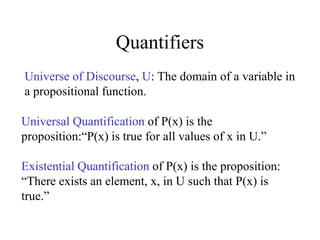
Universe of Discourse, U: The domain of a variable in
a propositional function.
Universal Quantification of P(x) is the
proposition:“P(x) is true for all values of x in U.”
Existential Quantification of P(x) is the proposition:
“There exists an element, x, in U such that P(x) is
true.”
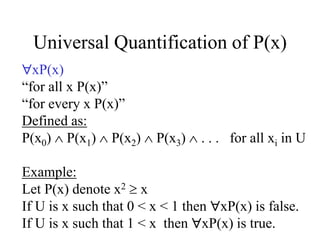
Universal Quantification of P(x)
xP(x)
“for all x P(x)”
“for every x P(x)”
Defined as:
P(x0)  P(x1)  P(x2)  P(x3)  . . . for all xi in U
Example:
Let P(x) denote x2  x
If U is x such that 0 < x < 1 then xP(x) is false.
If U is x such that 1 < x then xP(x) is true.
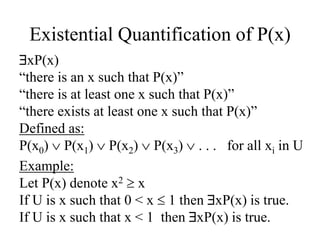
Existential Quantification of P(x)
xP(x)
“there is an x such that P(x)”
“there is at least one x such that P(x)”
“there exists at least one x such that P(x)”
Defined as:
P(x0)  P(x1)  P(x2)  P(x3)  . . . for all xi in U
Example:
Let P(x) denote x2  x
If U is x such that 0 < x  1 then xP(x) is true.
If U is x such that x < 1 then xP(x) is true.
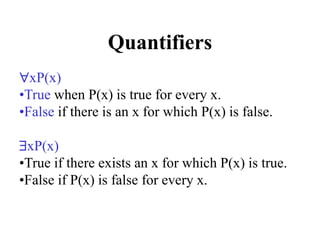
Quantifiers
xP(x)
•True when P(x) is true for every x.
•False if there is an x for which P(x) is false.
xP(x)
•True if there exists an x for which P(x) is true.
•False if P(x) is false for every x.
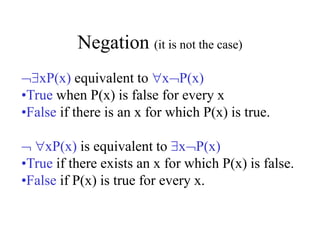
Negation (it is not the case)
xP(x) equivalent to xP(x)
•True when P(x) is false for every x
•False if there is an x for which P(x) is true.
 xP(x) is equivalent to xP(x)
•True if there exists an x for which P(x) is false.
•False if P(x) is true for every x.
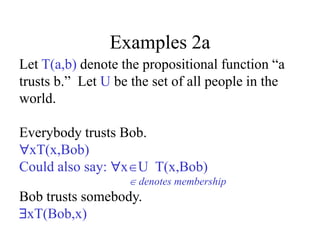
Examples 2a
Let T(a,b) denote the propositional function “a
trusts b.” Let U be the set of all people in the
world.
Everybody trusts Bob.
xT(x,Bob)
Could also say: xU T(x,Bob)
 denotes membership
Bob trusts somebody.
xT(Bob,x)
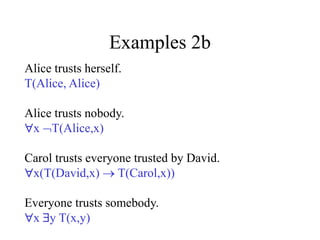
Examples 2b
Alice trusts herself.
T(Alice, Alice)
Alice trusts nobody.
x T(Alice,x)
Carol trusts everyone trusted by David.
x(T(David,x)  T(Carol,x))
Everyone trusts somebody.
x y T(x,y)
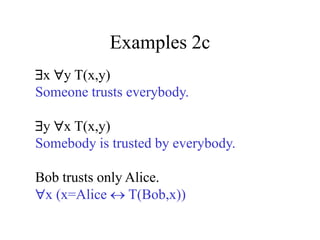
Examples 2c
x y T(x,y)
Someone trusts everybody.
y x T(x,y)
Somebody is trusted by everybody.
Bob trusts only Alice.
x (x=Alice  T(Bob,x))
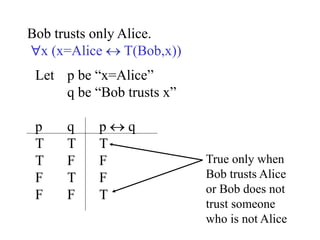
Bob trusts only Alice.
x (x=Alice  T(Bob,x))
Let p be “x=Alice”
q be “Bob trusts x”
p q p  q
T T T
T F F
F T F
F F T
True only when
Bob trusts Alice
or Bob does not
trust someone
who is not Alice
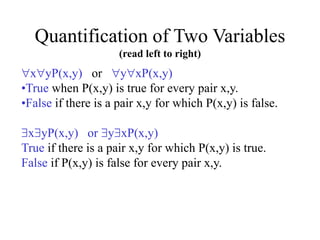
Quantification of Two Variables
(read left to right)
xyP(x,y) or yxP(x,y)
•True when P(x,y) is true for every pair x,y.
•False if there is a pair x,y for which P(x,y) is false.
xyP(x,y) or yxP(x,y)
True if there is a pair x,y for which P(x,y) is true.
False if P(x,y) is false for every pair x,y.
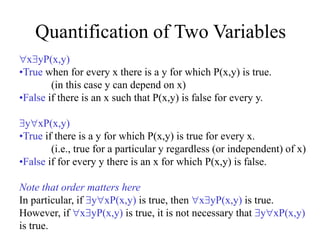
Quantification of Two Variables
xyP(x,y)
•True when for every x there is a y for which P(x,y) is true.
(in this case y can depend on x)
•False if there is an x such that P(x,y) is false for every y.
yxP(x,y)
•True if there is a y for which P(x,y) is true for every x.
(i.e., true for a particular y regardless (or independent) of x)
•False if for every y there is an x for which P(x,y) is false.
Note that order matters here
In particular, if yxP(x,y) is true, then xyP(x,y) is true.
However, if xyP(x,y) is true, it is not necessary that yxP(x,y)
is true.
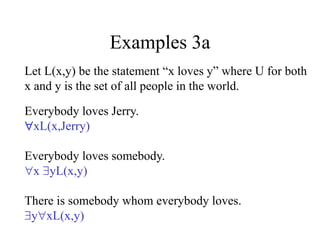
Examples 3a
Let L(x,y) be the statement “x loves y” where U for both
x and y is the set of all people in the world.
Everybody loves Jerry.
xL(x,Jerry)
Everybody loves somebody.
x yL(x,y)
There is somebody whom everybody loves.
yxL(x,y)
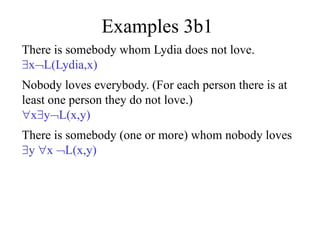
Examples 3b1
There is somebody whom Lydia does not love.
xL(Lydia,x)
Nobody loves everybody. (For each person there is at
least one person they do not love.)
xyL(x,y)
There is somebody (one or more) whom nobody loves
y x L(x,y)
Examples 3b2
There is exactly one person whom everybody loves.
xyL(y,x)?
No. There could be more than one person everybody
loves
x{yL(y,x)  w[(yL(y,w))  w=x]}
If there are, say, two values x1 and x2 (or more) for
which L(y,x) is true, the proposition is false.
x{yL(y,x)  w[(yL(y,w))  w=x]}?
xw[(y L(y,w))  w=x]?
Examples 3c
There are exactly two people whom Lynn loves.
x y{xy  L(Lynn,x)  L(Lynn,y)}?
No.
x y{xy  L(Lynn,x)  L(Lynn,y)  z[L(Lynn,z)
(z=x  z=y)]}
Everyone loves himself or herself.
xL(x,x)
There is someone who loves no one besides himself or
herself.
xy(L(x,y)  x=y)
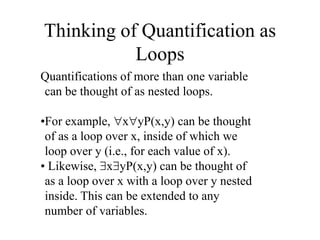
Thinking of Quantification as
Loops
Quantifications of more than one variable
can be thought of as nested loops.
•For example, xyP(x,y) can be thought
of as a loop over x, inside of which we
loop over y (i.e., for each value of x).
• Likewise, xyP(x,y) can be thought of
as a loop over x with a loop over y nested
inside. This can be extended to any
number of variables.
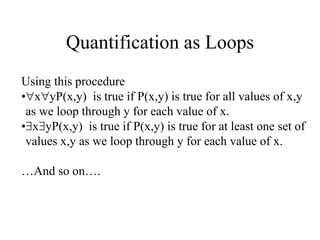
Quantification as Loops
Using this procedure
•xyP(x,y) is true if P(x,y) is true for all values of x,y
as we loop through y for each value of x.
•xyP(x,y) is true if P(x,y) is true for at least one set of
values x,y as we loop through y for each value of x.
…And so on….
Quantification of 3 Variables
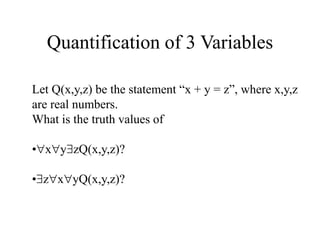
Let Q(x,y,z) be the statement “x + y = z”, where x,y,z
are real numbers.
What is the truth values of
•xyzQ(x,y,z)?
•zxyQ(x,y,z)?
Quantification of 3 Variables
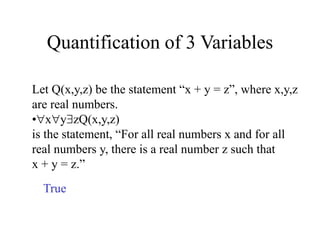
Let Q(x,y,z) be the statement “x + y = z”, where x,y,z
are real numbers.
•xyzQ(x,y,z)
is the statement, “For all real numbers x and for all
real numbers y, there is a real number z such that
x + y = z.”
True
Quantification of 3 Variables
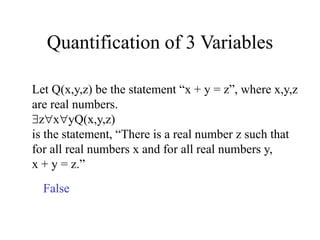
Let Q(x,y,z) be the statement “x + y = z”, where x,y,z
are real numbers.
zxyQ(x,y,z)
is the statement, “There is a real number z such that
for all real numbers x and for all real numbers y,
x + y = z.”
False
Examples 4a
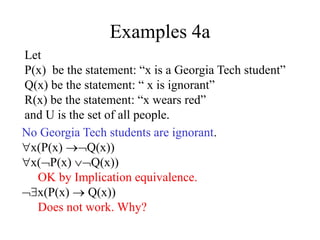
Let
P(x) be the statement: “x is a Georgia Tech student”
Q(x) be the statement: “ x is ignorant”
R(x) be the statement: “x wears red”
and U is the set of all people.
No Georgia Tech students are ignorant.
x(P(x) Q(x))
x(P(x) Q(x))
OK by Implication equivalence.
x(P(x)  Q(x))
Does not work. Why?
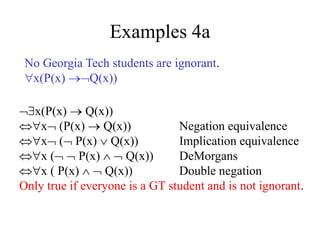
Examples 4a
x(P(x)  Q(x))
x (P(x)  Q(x)) Negation equivalence
x ( P(x)  Q(x)) Implication equivalence
x (  P(x)   Q(x)) DeMorgans
x ( P(x)   Q(x)) Double negation
Only true if everyone is a GT student and is not ignorant.
No Georgia Tech students are ignorant.
x(P(x) Q(x))
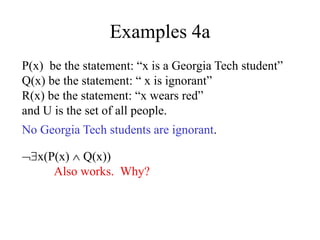
Examples 4a
P(x) be the statement: “x is a Georgia Tech student”
Q(x) be the statement: “ x is ignorant”
R(x) be the statement: “x wears red”
and U is the set of all people.
No Georgia Tech students are ignorant.
x(P(x)  Q(x))
Also works. Why?
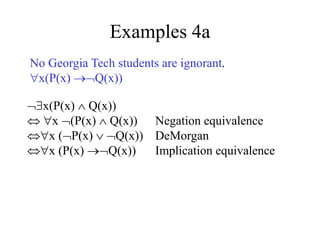
Examples 4a
x(P(x)  Q(x))
 x (P(x)  Q(x)) Negation equivalence
x (P(x)  Q(x)) DeMorgan
x (P(x) Q(x)) Implication equivalence
No Georgia Tech students are ignorant.
x(P(x) Q(x))
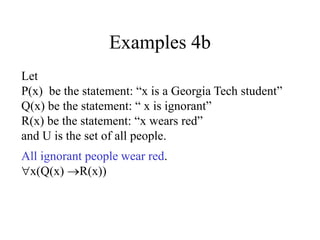
Examples 4b
Let
P(x) be the statement: “x is a Georgia Tech student”
Q(x) be the statement: “ x is ignorant”
R(x) be the statement: “x wears red”
and U is the set of all people.
All ignorant people wear red.
x(Q(x) R(x))
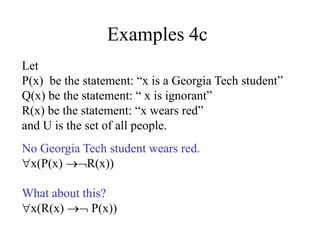
Examples 4c
Let
P(x) be the statement: “x is a Georgia Tech student”
Q(x) be the statement: “ x is ignorant”
R(x) be the statement: “x wears red”
and U is the set of all people.
No Georgia Tech student wears red.
x(P(x) R(x))
What about this?
x(R(x)  P(x))
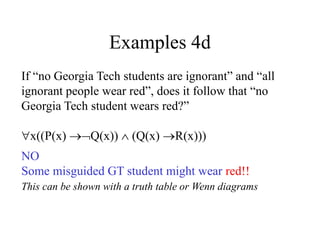
Examples 4d
If “no Georgia Tech students are ignorant” and “all
ignorant people wear red”, does it follow that “no
Georgia Tech student wears red?”
x((P(x) Q(x))  (Q(x) R(x)))
NO
Some misguided GT student might wear red!!
This can be shown with a truth table or Wenn diagrams

X02PredCalculus.ppt

  • 1.
  • 2.
    Propositional Functions • Propositionalfunctions (or predicates) are propositions that contain variables. • Ex: Let P(x) denote x > 3 • P(x) has no truth value until the variable x is bound by either – assigning it a value or by – quantifying it.
  • 3.
    Assignment of values LetQ(x,y) denote “x + y = 7”. Each of the following can be determined as T or F. Q(4,3) Q(3,2) Q(4,3)  Q(3,2) [Q(4,3)  Q(3,2)]
  • 4.
    Quantifiers Universe of Discourse,U: The domain of a variable in a propositional function. Universal Quantification of P(x) is the proposition:“P(x) is true for all values of x in U.” Existential Quantification of P(x) is the proposition: “There exists an element, x, in U such that P(x) is true.”
  • 5.
    Universal Quantification ofP(x) xP(x) “for all x P(x)” “for every x P(x)” Defined as: P(x0)  P(x1)  P(x2)  P(x3)  . . . for all xi in U Example: Let P(x) denote x2  x If U is x such that 0 < x < 1 then xP(x) is false. If U is x such that 1 < x then xP(x) is true.
  • 6.
    Existential Quantification ofP(x) xP(x) “there is an x such that P(x)” “there is at least one x such that P(x)” “there exists at least one x such that P(x)” Defined as: P(x0)  P(x1)  P(x2)  P(x3)  . . . for all xi in U Example: Let P(x) denote x2  x If U is x such that 0 < x  1 then xP(x) is true. If U is x such that x < 1 then xP(x) is true.
  • 7.
    Quantifiers xP(x) •True when P(x)is true for every x. •False if there is an x for which P(x) is false. xP(x) •True if there exists an x for which P(x) is true. •False if P(x) is false for every x.
  • 8.
    Negation (it isnot the case) xP(x) equivalent to xP(x) •True when P(x) is false for every x •False if there is an x for which P(x) is true.  xP(x) is equivalent to xP(x) •True if there exists an x for which P(x) is false. •False if P(x) is true for every x.
  • 9.
    Examples 2a Let T(a,b)denote the propositional function “a trusts b.” Let U be the set of all people in the world. Everybody trusts Bob. xT(x,Bob) Could also say: xU T(x,Bob)  denotes membership Bob trusts somebody. xT(Bob,x)
  • 10.
    Examples 2b Alice trustsherself. T(Alice, Alice) Alice trusts nobody. x T(Alice,x) Carol trusts everyone trusted by David. x(T(David,x)  T(Carol,x)) Everyone trusts somebody. x y T(x,y)
  • 11.
    Examples 2c x yT(x,y) Someone trusts everybody. y x T(x,y) Somebody is trusted by everybody. Bob trusts only Alice. x (x=Alice  T(Bob,x))
  • 12.
    Bob trusts onlyAlice. x (x=Alice  T(Bob,x)) Let p be “x=Alice” q be “Bob trusts x” p q p  q T T T T F F F T F F F T True only when Bob trusts Alice or Bob does not trust someone who is not Alice
  • 13.
    Quantification of TwoVariables (read left to right) xyP(x,y) or yxP(x,y) •True when P(x,y) is true for every pair x,y. •False if there is a pair x,y for which P(x,y) is false. xyP(x,y) or yxP(x,y) True if there is a pair x,y for which P(x,y) is true. False if P(x,y) is false for every pair x,y.
  • 14.
    Quantification of TwoVariables xyP(x,y) •True when for every x there is a y for which P(x,y) is true. (in this case y can depend on x) •False if there is an x such that P(x,y) is false for every y. yxP(x,y) •True if there is a y for which P(x,y) is true for every x. (i.e., true for a particular y regardless (or independent) of x) •False if for every y there is an x for which P(x,y) is false. Note that order matters here In particular, if yxP(x,y) is true, then xyP(x,y) is true. However, if xyP(x,y) is true, it is not necessary that yxP(x,y) is true.
  • 15.
    Examples 3a Let L(x,y)be the statement “x loves y” where U for both x and y is the set of all people in the world. Everybody loves Jerry. xL(x,Jerry) Everybody loves somebody. x yL(x,y) There is somebody whom everybody loves. yxL(x,y)
  • 16.
    Examples 3b1 There issomebody whom Lydia does not love. xL(Lydia,x) Nobody loves everybody. (For each person there is at least one person they do not love.) xyL(x,y) There is somebody (one or more) whom nobody loves y x L(x,y)
  • 17.
    Examples 3b2 There isexactly one person whom everybody loves. xyL(y,x)? No. There could be more than one person everybody loves x{yL(y,x)  w[(yL(y,w))  w=x]} If there are, say, two values x1 and x2 (or more) for which L(y,x) is true, the proposition is false. x{yL(y,x)  w[(yL(y,w))  w=x]}? xw[(y L(y,w))  w=x]?
  • 18.
    Examples 3c There areexactly two people whom Lynn loves. x y{xy  L(Lynn,x)  L(Lynn,y)}? No. x y{xy  L(Lynn,x)  L(Lynn,y)  z[L(Lynn,z) (z=x  z=y)]} Everyone loves himself or herself. xL(x,x) There is someone who loves no one besides himself or herself. xy(L(x,y)  x=y)
  • 19.
    Thinking of Quantificationas Loops Quantifications of more than one variable can be thought of as nested loops. •For example, xyP(x,y) can be thought of as a loop over x, inside of which we loop over y (i.e., for each value of x). • Likewise, xyP(x,y) can be thought of as a loop over x with a loop over y nested inside. This can be extended to any number of variables.
  • 20.
    Quantification as Loops Usingthis procedure •xyP(x,y) is true if P(x,y) is true for all values of x,y as we loop through y for each value of x. •xyP(x,y) is true if P(x,y) is true for at least one set of values x,y as we loop through y for each value of x. …And so on….
  • 21.
    Quantification of 3Variables Let Q(x,y,z) be the statement “x + y = z”, where x,y,z are real numbers. What is the truth values of •xyzQ(x,y,z)? •zxyQ(x,y,z)?
  • 22.
    Quantification of 3Variables Let Q(x,y,z) be the statement “x + y = z”, where x,y,z are real numbers. •xyzQ(x,y,z) is the statement, “For all real numbers x and for all real numbers y, there is a real number z such that x + y = z.” True
  • 23.
    Quantification of 3Variables Let Q(x,y,z) be the statement “x + y = z”, where x,y,z are real numbers. zxyQ(x,y,z) is the statement, “There is a real number z such that for all real numbers x and for all real numbers y, x + y = z.” False
  • 24.
    Examples 4a Let P(x) bethe statement: “x is a Georgia Tech student” Q(x) be the statement: “ x is ignorant” R(x) be the statement: “x wears red” and U is the set of all people. No Georgia Tech students are ignorant. x(P(x) Q(x)) x(P(x) Q(x)) OK by Implication equivalence. x(P(x)  Q(x)) Does not work. Why?
  • 25.
    Examples 4a x(P(x) Q(x)) x (P(x)  Q(x)) Negation equivalence x ( P(x)  Q(x)) Implication equivalence x (  P(x)   Q(x)) DeMorgans x ( P(x)   Q(x)) Double negation Only true if everyone is a GT student and is not ignorant. No Georgia Tech students are ignorant. x(P(x) Q(x))
  • 26.
    Examples 4a P(x) bethe statement: “x is a Georgia Tech student” Q(x) be the statement: “ x is ignorant” R(x) be the statement: “x wears red” and U is the set of all people. No Georgia Tech students are ignorant. x(P(x)  Q(x)) Also works. Why?
  • 27.
    Examples 4a x(P(x) Q(x))  x (P(x)  Q(x)) Negation equivalence x (P(x)  Q(x)) DeMorgan x (P(x) Q(x)) Implication equivalence No Georgia Tech students are ignorant. x(P(x) Q(x))
  • 28.
    Examples 4b Let P(x) bethe statement: “x is a Georgia Tech student” Q(x) be the statement: “ x is ignorant” R(x) be the statement: “x wears red” and U is the set of all people. All ignorant people wear red. x(Q(x) R(x))
  • 29.
    Examples 4c Let P(x) bethe statement: “x is a Georgia Tech student” Q(x) be the statement: “ x is ignorant” R(x) be the statement: “x wears red” and U is the set of all people. No Georgia Tech student wears red. x(P(x) R(x)) What about this? x(R(x)  P(x))
  • 30.
    Examples 4d If “noGeorgia Tech students are ignorant” and “all ignorant people wear red”, does it follow that “no Georgia Tech student wears red?” x((P(x) Q(x))  (Q(x) R(x))) NO Some misguided GT student might wear red!! This can be shown with a truth table or Wenn diagrams