PRECLINICAL DRUG DISCOVERY
& DEVELOPMENT
 Preclinical development encompasses ‘all of the activities that must
take place before a new chemical entity (drug) can be administered
to humans.’
 It spans the gap between drug discovery and clinical testing.
RATIONAL DRUG DESIGN
 Basic research approach to drug discovery.
 Thorough knowledge of biochemical and physiological mechanisms
(responsible for the normal functioning of a particular organ system)
will allow an understanding of any pathophysiology of the same
system.
 Permits drug design that affects the altered target (enzyme, receptor
or cell) and correct the deficiency (pathological state).
 Result: Targeted-screening approaches
• Receptor-oriented drug research; reversible and irreversible enzyme
inhibitors.
• Inhibitors of voltage- and receptor-operated systems, transporter
systems.
• Eg.: Nucleoside analogs (5F, Cytosine arabinoside, 6-MCP) were
synthesized based on the concept that they inhibit nucleic acid
synthesis, causing disruption of cell replication and cell death.
GENERAL SCREENING
 Aim: to find any therapeutically useful property.
 Random screening of a large no. of diverse compounds through > 1
bioassay.
 Invitro (enzymes or binding assays); OR
 Invivo animal model.
TARGETED SCREENING (disease-oriented approach)
 Compounds are tested in bioassays selected to reveal specific
therapeutic activity.
 Eg.: National Cancer Institute – large scale cell-based assays for
potential antitumor agents.
 60 human tumor cell lines from 8 human cancer types (lung, colon,
breast, melanoma, kidney, ovary, brain and leukemia).
 ‘Lead agent’ (agent with disease-specific activity) is subjected to
further tests.
 Computerized programmes also aid in this process.
MOLECULAR MODIFICATION
 A lead structure/agent rarely yields a compound with all properties
needed for full clinical development.
 Compound is modified / optimized to:
• ↑ potency and BA
• ↓ metabolism, toxicity and side effects.
 Lead structure optimization is done by
• Enlightened opportunism
• Unenlightened opportunism
 Enlightened opportunism :
• Combine the important structural features of 2 or more classes of
compounds into 1 molecule to achieve a superior therapeutic agent.
• Eg.: Cisplatin, Carboplatin, Oxiplatin, etc…
 Unenlightened opportunism / ‘Me-too approach’:
• Done at a later stage of development.
• Attempt/s to make a close chemical variation in a therapeutic area
where multiple agents already exist.
• Eg.: Development of tricyclic antidepressants.
CLINICAL OBSERVATIONS
 Physicians observe an ‘apparent side effect’ and may recognize it as
a novel therapeutic effect.
 Egs.:
• Antidepressant activity of Iproniazid (an anti-TB drug).
• Antirheumatic effects of penicillamine
• Anxiolytic property of the neuroleptic Buspirone
DRUG DEVELOPMENT
 A ‘lead molecule’ is made to undergo many tests in vivo (to determine
it’s potency) in the appropriate animal models.
 Results: Oral BA , therapeutic ratio, preliminary data (indicates
whether primary activity resides in the parent molecule or
metabolite), toxicity profile.
 These tests are always designed with a focus on the primary
indication intended.
 Necessary for obtaining the data needed to fulfill the IND regulatory
requirements.
PHARMACOLOGICAL DATA
 Regulatory agencies require the p'cological props. of the
compounds presented in 3 sections:
Primary p’cology
Secondary p’cology
Drug interactions
Primary Pharmacology
 Info. on all pharmacological actions relevant to the proposed
therapeutic use.
Guidelines:
• Establish the mechanism of the principal p’cological action (where
possible).
• Validity of animal models should be established. [Models must be
accepted (through literature / earlier similar studies)].
• Results must be in quantitative terms (dose and time-related; to
be correlated with p’cokinetic and p’codynamic data).
Secondary Pharmacology
 Are effects additional to primary p’cological action.
 More investigations are required if doses producing 2° effects
approach those producing 1° effects.
 In-vitro and in vivo data are required.
Drug Interactions
 Interaction of the drug substance with other compounds, when
relevant to the proposed therapeutic usage should be investigated.
 Interactions with other drugs, food, etc…
TOXICOLOGICAL STUDIES
 Usually carried out in vivo (in mice, rats, dogs or monkeys).
 In-vitro models are now gaining popularity…..
• ↑ed availability of human tissues
• Rapid and functional multiplicity of mammalian drug-metabolizing
enzymes.
 Acute and subacute toxicology studies are initially performed.
Acute, single dose toxicity studies:
 A new drug candidate must be tested in atleast 2 animal species
(usually rats and dogs).
 Route of admn. should be the same as that intended for human use.
 Purpose: to study the adverse effects of the drug and extrapolated
estimate of LD50. Lasts from 1 – 2 weeks
 Male and female animals: 10 – 30 rats and 2 – 4 dogs per gender
and dose;.
Repeated dose toxicity studies: 2 species (one non-rodent) tested and
followed-up for 1, 3 or 6 months.
P’COKINETIC & ADME Studies
 Absorption, t1/2 and metabolism are detected.
 These tests are to exclude those compounds which are poorly
absorbed, rapidly metabolized or eliminated.
 In vivo (usually in mice, rats and dogs).
 In vitro studies are also becoming popular.
 Results….
• Drug candidate’s metabolic profile.
• Species differences in the metabolism of the drug candidate.
• Can get an idea about the enzyme(s) responsible for metabolic
clearance of the drug candidate in humans.
WHY ARE FORMULATION STUDIES IMPORTANT?
 For drugs requiring special routes or methods of administration (egs.:
transdermal, inhalational or topical therapies, timed-release
formulations).
 Eg.: a) Paclitaxel - mitotic inhibitor
- is poorly soluble in standard aqueous I.V. solutions.
- Clinical trials commenced only when oleaginous I.V.
formulation CREMEPHOR EL (polyoxyethylated castor oil) was
formulated.
- Clinically, this caused potential life-threatening anaphylactoid
hypersensitivity reactions.
b) 9-aminocamptothecin(9-AC) – topomerase inhibitor
- Clinical development commenced in 1989. BUT….
- Clinical trials only started in 1993.
- Time required to develop a compatible vehicle was the cause
IN VIVO STUDIES
 Why are mice and rats preferred for targeted studies?
• The sequence of the mouse genome (discovered in 2002) and the
‘almost complete’ genetic code sequence of the rat make them the
best possible candidates.
• Short generation times and modest maintenance costs.
 In vivo cancer studies:
• The selected animal models must suitably demonstrate the drug’s
antitumor efficacy.
• It must be possible to evaluate systemic toxicities in intact organs.
• Animal models must be genetically stable over time.
 Animal models: Spontaneous models
Engineered models
Transplanted tumor models
Spontaneous models
 Sometimes, animals develop diseases similar to humans either
naturally or induced by invasive interventions (treatment w/ drugs,
chemical toxins or radiation).
 Used very successfully in CV research.
 Egs.: Spontaneously Hypertensive Rat (SHR) for CV studies
Engineered models
 Use of genetically-engineered animal models;
 Genetic alterations are performed in the animal models;
 Permits organ and site-specific targeting, better growth rates and
patterns, can obtain better immuno-competent animals;
 Disadvantages:
– High cost of animals;
– Requires commercial license.
– Tumors often develop late in the animal’s life span or even in
the next generation.
Transplanted Tumor Models
 Most widely used these days.
 Involves various systems and techniques to propagate tumor tissues
in different hosts for controlled studies in vivo.
 Rodents are the preferred species.
Allograft transplant models
 Also known as Syngeneic models;
 Tumor tissues are derived from animals with the same genetic
background of the given animal model’s genetic strain.
 The ‘transplant’ is not rejected by the recipient (due to shared genetic
ancestry).
 Researchers then monitor the cancer tissue(s) for growth changes
(shrinkage, metastasis and survival rates)
 Therapeutic interventions (new drugs potency) can be performed.
 Disadv.: The transplanted mouse tissue may not fully represent the
clinical situations observed in human tumors.
Xenograft transplant models
 Involves actual human cancer cells or solid tumors which are
transplanted into the rodent.
 The recipient rodents have impaired immune systems (induced). The
‘transplant’ is not rejected.
The transplant (tumor) can either be…
• Orthotopic: the tumor is placed in the site it would be expected to
arise in humans (human liver cancerous cells are transplanted
into the liver of the rodents)
• Subcutaneous: placed just below the rodents’ skin
 Adv.:
• These studies of the cancerous tissues employ real human cancer
cells; more representative of the properties and mutations in human
cancer cells.
Disadv.: Due to changes in the rodents’ immune system, it may not
mimic the actual clinical situation.
MELD10
Mouse Equivalent LD10 (in mg/m2
) is scaled to MELD10 dose for dogs
by the following formula:
MELD10 in dogs = (Km dog / Km mouse) x MELD10 in mice
Km = surface-to-weight ratio for each species
Km values: 3 (mice);
6 (rats);
20 (dogs);
humans: 25 (children);
37(adults)
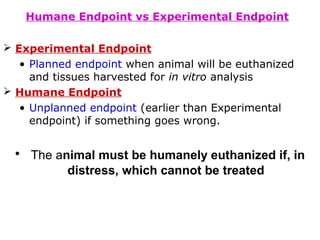
Humane Endpoint vs Experimental Endpoint
 Experimental Endpoint
• Planned endpoint when animal will be euthanized
and tissues harvested for in vitro analysis
 Humane Endpoint
• Unplanned endpoint (earlier than Experimental
endpoint) if something goes wrong.
• The animal must be humanely euthanized if, in
distress, which cannot be treated
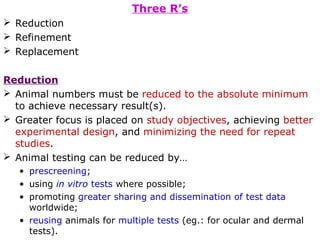
Three R’s
 Reduction
 Refinement
 Replacement
Reduction
 Animal numbers must be reduced to the absolute minimum
to achieve necessary result(s).
 Greater focus is placed on study objectives, achieving better
experimental design, and minimizing the need for repeat
studies.
 Animal testing can be reduced by…
• prescreening;
• using in vitro tests where possible;
• promoting greater sharing and dissemination of test data
worldwide;
• reusing animals for multiple tests (eg.: for ocular and dermal
tests).
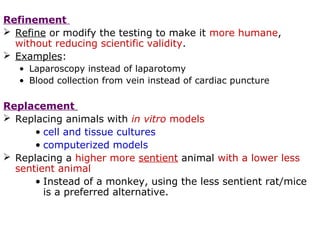
Refinement
 Refine or modify the testing to make it more humane,
without reducing scientific validity.
 Examples:
• Laparoscopy instead of laparotomy
• Blood collection from vein instead of cardiac puncture
Replacement
 Replacing animals with in vitro models
• cell and tissue cultures
• computerized models
 Replacing a higher more sentient animal with a lower less
sentient animal
• Instead of a monkey, using the less sentient rat/mice
is a preferred alternative.
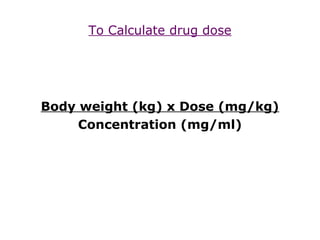
To Calculate drug dose
Body weight (kg) x Dose (mg/kg)
Concentration (mg/ml)
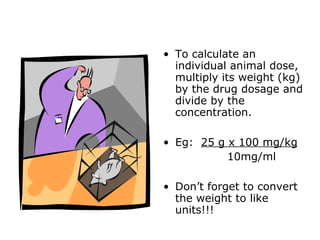
• To calculate an
individual animal dose,
multiply its weight (kg)
by the drug dosage and
divide by the
concentration.
• Eg: 25 g x 100 mg/kg
10mg/ml
• Don’t forget to convert
the weight to like
units!!!
HAZARDS
SPECIES-SPECIFIC CONCERNS
Most rodents, rabbits: Minor concerns
Cats: Toxoplasmosis
Non-human Primates: Herpes-B
Shigella
Tuberculosis
Other zoonotic diseases
THE END

Preclinical drug discovery and development

  • 1.
  • 2.
     Preclinical developmentencompasses ‘all of the activities that must take place before a new chemical entity (drug) can be administered to humans.’  It spans the gap between drug discovery and clinical testing.
  • 3.
    RATIONAL DRUG DESIGN Basic research approach to drug discovery.  Thorough knowledge of biochemical and physiological mechanisms (responsible for the normal functioning of a particular organ system) will allow an understanding of any pathophysiology of the same system.  Permits drug design that affects the altered target (enzyme, receptor or cell) and correct the deficiency (pathological state).  Result: Targeted-screening approaches • Receptor-oriented drug research; reversible and irreversible enzyme inhibitors. • Inhibitors of voltage- and receptor-operated systems, transporter systems. • Eg.: Nucleoside analogs (5F, Cytosine arabinoside, 6-MCP) were synthesized based on the concept that they inhibit nucleic acid synthesis, causing disruption of cell replication and cell death.
  • 4.
    GENERAL SCREENING  Aim:to find any therapeutically useful property.  Random screening of a large no. of diverse compounds through > 1 bioassay.  Invitro (enzymes or binding assays); OR  Invivo animal model. TARGETED SCREENING (disease-oriented approach)  Compounds are tested in bioassays selected to reveal specific therapeutic activity.  Eg.: National Cancer Institute – large scale cell-based assays for potential antitumor agents.  60 human tumor cell lines from 8 human cancer types (lung, colon, breast, melanoma, kidney, ovary, brain and leukemia).  ‘Lead agent’ (agent with disease-specific activity) is subjected to further tests.  Computerized programmes also aid in this process.
  • 5.
    MOLECULAR MODIFICATION  Alead structure/agent rarely yields a compound with all properties needed for full clinical development.  Compound is modified / optimized to: • ↑ potency and BA • ↓ metabolism, toxicity and side effects.  Lead structure optimization is done by • Enlightened opportunism • Unenlightened opportunism  Enlightened opportunism : • Combine the important structural features of 2 or more classes of compounds into 1 molecule to achieve a superior therapeutic agent. • Eg.: Cisplatin, Carboplatin, Oxiplatin, etc…
  • 6.
     Unenlightened opportunism/ ‘Me-too approach’: • Done at a later stage of development. • Attempt/s to make a close chemical variation in a therapeutic area where multiple agents already exist. • Eg.: Development of tricyclic antidepressants.
  • 7.
    CLINICAL OBSERVATIONS  Physiciansobserve an ‘apparent side effect’ and may recognize it as a novel therapeutic effect.  Egs.: • Antidepressant activity of Iproniazid (an anti-TB drug). • Antirheumatic effects of penicillamine • Anxiolytic property of the neuroleptic Buspirone DRUG DEVELOPMENT  A ‘lead molecule’ is made to undergo many tests in vivo (to determine it’s potency) in the appropriate animal models.  Results: Oral BA , therapeutic ratio, preliminary data (indicates whether primary activity resides in the parent molecule or metabolite), toxicity profile.  These tests are always designed with a focus on the primary indication intended.  Necessary for obtaining the data needed to fulfill the IND regulatory requirements.
  • 8.
    PHARMACOLOGICAL DATA  Regulatoryagencies require the p'cological props. of the compounds presented in 3 sections: Primary p’cology Secondary p’cology Drug interactions Primary Pharmacology  Info. on all pharmacological actions relevant to the proposed therapeutic use. Guidelines: • Establish the mechanism of the principal p’cological action (where possible). • Validity of animal models should be established. [Models must be accepted (through literature / earlier similar studies)]. • Results must be in quantitative terms (dose and time-related; to be correlated with p’cokinetic and p’codynamic data).
  • 9.
    Secondary Pharmacology  Areeffects additional to primary p’cological action.  More investigations are required if doses producing 2° effects approach those producing 1° effects.  In-vitro and in vivo data are required. Drug Interactions  Interaction of the drug substance with other compounds, when relevant to the proposed therapeutic usage should be investigated.  Interactions with other drugs, food, etc…
  • 10.
    TOXICOLOGICAL STUDIES  Usuallycarried out in vivo (in mice, rats, dogs or monkeys).  In-vitro models are now gaining popularity….. • ↑ed availability of human tissues • Rapid and functional multiplicity of mammalian drug-metabolizing enzymes.  Acute and subacute toxicology studies are initially performed. Acute, single dose toxicity studies:  A new drug candidate must be tested in atleast 2 animal species (usually rats and dogs).  Route of admn. should be the same as that intended for human use.  Purpose: to study the adverse effects of the drug and extrapolated estimate of LD50. Lasts from 1 – 2 weeks  Male and female animals: 10 – 30 rats and 2 – 4 dogs per gender and dose;. Repeated dose toxicity studies: 2 species (one non-rodent) tested and followed-up for 1, 3 or 6 months.
  • 11.
    P’COKINETIC & ADMEStudies  Absorption, t1/2 and metabolism are detected.  These tests are to exclude those compounds which are poorly absorbed, rapidly metabolized or eliminated.  In vivo (usually in mice, rats and dogs).  In vitro studies are also becoming popular.  Results…. • Drug candidate’s metabolic profile. • Species differences in the metabolism of the drug candidate. • Can get an idea about the enzyme(s) responsible for metabolic clearance of the drug candidate in humans.
  • 13.
    WHY ARE FORMULATIONSTUDIES IMPORTANT?  For drugs requiring special routes or methods of administration (egs.: transdermal, inhalational or topical therapies, timed-release formulations).  Eg.: a) Paclitaxel - mitotic inhibitor - is poorly soluble in standard aqueous I.V. solutions. - Clinical trials commenced only when oleaginous I.V. formulation CREMEPHOR EL (polyoxyethylated castor oil) was formulated. - Clinically, this caused potential life-threatening anaphylactoid hypersensitivity reactions. b) 9-aminocamptothecin(9-AC) – topomerase inhibitor - Clinical development commenced in 1989. BUT…. - Clinical trials only started in 1993. - Time required to develop a compatible vehicle was the cause
  • 14.
    IN VIVO STUDIES Why are mice and rats preferred for targeted studies? • The sequence of the mouse genome (discovered in 2002) and the ‘almost complete’ genetic code sequence of the rat make them the best possible candidates. • Short generation times and modest maintenance costs.  In vivo cancer studies: • The selected animal models must suitably demonstrate the drug’s antitumor efficacy. • It must be possible to evaluate systemic toxicities in intact organs. • Animal models must be genetically stable over time.  Animal models: Spontaneous models Engineered models Transplanted tumor models
  • 15.
    Spontaneous models  Sometimes,animals develop diseases similar to humans either naturally or induced by invasive interventions (treatment w/ drugs, chemical toxins or radiation).  Used very successfully in CV research.  Egs.: Spontaneously Hypertensive Rat (SHR) for CV studies Engineered models  Use of genetically-engineered animal models;  Genetic alterations are performed in the animal models;  Permits organ and site-specific targeting, better growth rates and patterns, can obtain better immuno-competent animals;  Disadvantages: – High cost of animals; – Requires commercial license. – Tumors often develop late in the animal’s life span or even in the next generation.
  • 16.
    Transplanted Tumor Models Most widely used these days.  Involves various systems and techniques to propagate tumor tissues in different hosts for controlled studies in vivo.  Rodents are the preferred species. Allograft transplant models  Also known as Syngeneic models;  Tumor tissues are derived from animals with the same genetic background of the given animal model’s genetic strain.  The ‘transplant’ is not rejected by the recipient (due to shared genetic ancestry).  Researchers then monitor the cancer tissue(s) for growth changes (shrinkage, metastasis and survival rates)  Therapeutic interventions (new drugs potency) can be performed.  Disadv.: The transplanted mouse tissue may not fully represent the clinical situations observed in human tumors.
  • 17.
    Xenograft transplant models Involves actual human cancer cells or solid tumors which are transplanted into the rodent.  The recipient rodents have impaired immune systems (induced). The ‘transplant’ is not rejected. The transplant (tumor) can either be… • Orthotopic: the tumor is placed in the site it would be expected to arise in humans (human liver cancerous cells are transplanted into the liver of the rodents) • Subcutaneous: placed just below the rodents’ skin  Adv.: • These studies of the cancerous tissues employ real human cancer cells; more representative of the properties and mutations in human cancer cells. Disadv.: Due to changes in the rodents’ immune system, it may not mimic the actual clinical situation.
  • 18.
    MELD10 Mouse Equivalent LD10(in mg/m2 ) is scaled to MELD10 dose for dogs by the following formula: MELD10 in dogs = (Km dog / Km mouse) x MELD10 in mice Km = surface-to-weight ratio for each species Km values: 3 (mice); 6 (rats); 20 (dogs); humans: 25 (children); 37(adults)
  • 19.
    Humane Endpoint vsExperimental Endpoint  Experimental Endpoint • Planned endpoint when animal will be euthanized and tissues harvested for in vitro analysis  Humane Endpoint • Unplanned endpoint (earlier than Experimental endpoint) if something goes wrong. • The animal must be humanely euthanized if, in distress, which cannot be treated
  • 20.
    Three R’s  Reduction Refinement  Replacement Reduction  Animal numbers must be reduced to the absolute minimum to achieve necessary result(s).  Greater focus is placed on study objectives, achieving better experimental design, and minimizing the need for repeat studies.  Animal testing can be reduced by… • prescreening; • using in vitro tests where possible; • promoting greater sharing and dissemination of test data worldwide; • reusing animals for multiple tests (eg.: for ocular and dermal tests).
  • 21.
    Refinement  Refine ormodify the testing to make it more humane, without reducing scientific validity.  Examples: • Laparoscopy instead of laparotomy • Blood collection from vein instead of cardiac puncture Replacement  Replacing animals with in vitro models • cell and tissue cultures • computerized models  Replacing a higher more sentient animal with a lower less sentient animal • Instead of a monkey, using the less sentient rat/mice is a preferred alternative.
  • 22.
    To Calculate drugdose Body weight (kg) x Dose (mg/kg) Concentration (mg/ml)
  • 23.
    • To calculatean individual animal dose, multiply its weight (kg) by the drug dosage and divide by the concentration. • Eg: 25 g x 100 mg/kg 10mg/ml • Don’t forget to convert the weight to like units!!!
  • 24.
    HAZARDS SPECIES-SPECIFIC CONCERNS Most rodents,rabbits: Minor concerns Cats: Toxoplasmosis Non-human Primates: Herpes-B Shigella Tuberculosis Other zoonotic diseases
  • 25.