DRUG DISCOVERY
DRUG DISCOVERY

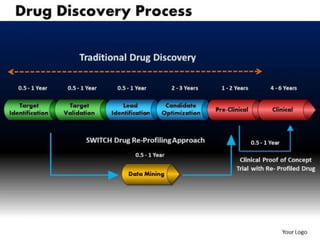
• The processes of new drug discovery and
  development are long, complicated and
  dependent upon the expertise of a wide
  variety of scientific, technical and
  managerial groups.
Why are new drugs needed?
• unmet medical need; new diseases (AIDS, Alzheimer’s;
  obesity); low efficacy (dementia, cancer); side effects
  (antidepressants, antipsychotics)
• downstream health costs; (Alzheimer’s; spinal injury)
• cost of therapy; (Viagra, Interleukins)
• costs to individual/country; (depression)
• sustain industrial activity; pharmaceutical industry
  employs thousands and makes a massive contribution to
  overseas earnings); patent expiry
Approaches to drug discovery
• Historical; cinchona (quinine) & willow barks (aspirin);
  chinese medicine currently.
• Study disease process; breast cancer (tamoxifen);
  Parkinson’s disease (L-dopa)
• Study biochem/physiological pathway; renin/angiotensin
• Develop SAR to natural compound; beta-adrenoceptors
  (propranolol), H2-receptors (cimetidine)
• Design to fit known structurally identified biological site;
  angiotensin-converting enzyme inhibitors
• By chance (serendipity); random screening (HTS);
  penicillin; dimenhydramate; pethidine
• Genomics; identification of receptors; gene therapy;
  recombinant materials
The changed context of drug discovery
         and development
The 1800s: natural sources; limited possibilities; prepared
  by individuals; small scale; not purified, standardised or
  tested; limited administration; no controls; no idea of
  mechanisms.

The 1990s and 2000: synthetic source; unlimited
  possibilities; prepared by companies; massive scale;
  highly purified, standardised and tested; world-wide
  administration; tight legislative control; mechanisms
  partly understood, still understanding.
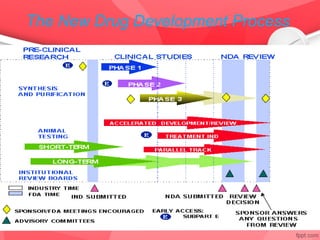
The New Drug Development Process
RRR
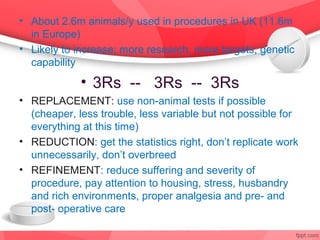
• About 2.6m animals/y used in procedures in UK (11.6m
  in Europe)
• Likely to increase; more research, more targets, genetic
  capability
             • 3Rs -- 3Rs -- 3Rs
• REPLACEMENT: use non-animal tests if possible
  (cheaper, less trouble, less variable but not possible for
  everything at this time)
• REDUCTION: get the statistics right, don’t replicate work
  unnecessarily, don’t overbreed
• REFINEMENT: reduce suffering and severity of
  procedure, pay attention to housing, stress, husbandry
  and rich environments, proper analgesia and pre- and
  post- operative care
There are two types of Research: Basic and
                  Applied
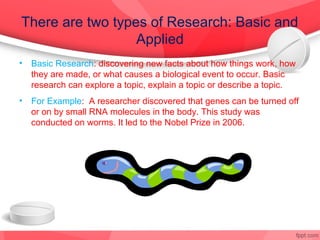
•   Basic Research: discovering new facts about how things work, how
    they are made, or what causes a biological event to occur. Basic
    research can explore a topic, explain a topic or describe a topic.
•   For Example: A researcher discovered that genes can be turned off
    or on by small RNA molecules in the body. This study was
    conducted on worms. It led to the Nobel Prize in 2006.
“Basic” vs. “Applied”
                  Research
• Applied Research: Taking the
  information discovered in basic research
  and investigating how to use it to treat
  and prevent sicknesses.
• Example: A researcher uses the
  information about turning genes off and
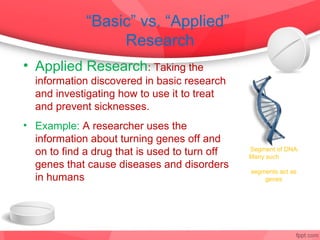
  on to find a drug that is used to turn off   Segment of DNA.
                                               Many such
  genes that cause diseases and disorders
                                               segments act as
  in humans                                        genes
Process of Drug Discovery
•   Target Identification
•   Target Validation
•   Lead Identification
•   Lead Optimization
•   Preclinical Pharmacology and Toxicology
Target Identification
• Identifying targets include
  protein expression, protein
  biochemistry.
• Sequence analysis,
  positional cloning, functional
  cloning.
• Important to determine
  whether the novel targets are
  actually relevant to the
  physiology of the disease.
Target Validation
• Target identified will affect an appropriate biological
  response
• CHEMOGENOMICS;defined as the discovery and
  description of all possible drugs to all possible targets.
• Chemical Genetics; involves the use of chemical probes
  to understand some specific features of biology and can
  be viewed as subset of chemogenomics.
• LIMITATIONS;Compensatory mechanism of the
  organism.
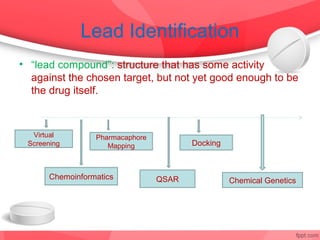
Lead Identification
• “lead compound”: structure that has some activity
  against the chosen target, but not yet good enough to be
  the drug itself.


  Virtual        Pharmacaphore
 Screening          Mapping             Docking


      Chemoinformatics           QSAR             Chemical Genetics
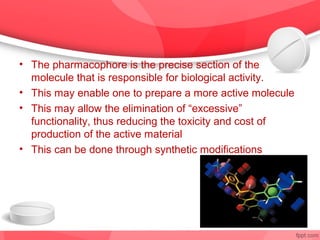
• The pharmacophore is the precise section of the
  molecule that is responsible for biological activity.
• This may enable one to prepare a more active molecule
• This may allow the elimination of “excessive”
  functionality, thus reducing the toxicity and cost of
  production of the active material
• This can be done through synthetic modifications
Lead Optimization
• Once a lead has been discovered, it is
  important to understand precisely which
  structural features are responsible for its
  biological activity.
Pre-Clinical Pharmacology and
                   Toxicology
• TOXICOLOGY
•   Thalidomide was developed by German pharmaceutical company
    Grünenthal. It was sold from 1957 to 1961 in almost 50 countries under at
    least 40 names. Thalidomide was chiefly sold and prescribed during the
    late 1950s and early 1960s to pregnant women, as an antiemetic to combat
    morning sickness and as an aid to help them sleep. Before its release,
    inadequate tests were performed to assess the drug's safety, with
    catastrophic results for the children of women who had taken thalidomide
    during their pregnancies

•   Antiemetic = a medication that helps prevent and control nausea and
    vomiting
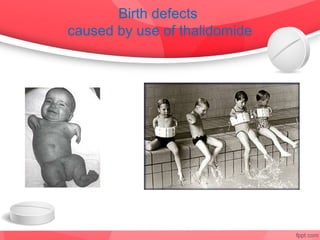
Birth defects
caused by use of thalidomide
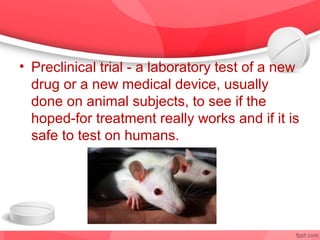
• Preclinical trial - a laboratory test of a new
  drug or a new medical device, usually
  done on animal subjects, to see if the
  hoped-for treatment really works and if it is
  safe to test on humans.
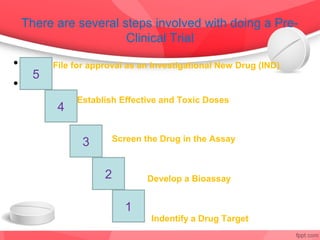
There are several steps involved with doing a Pre-
                       Clinical Trial

•         File for approval as an Investigational New Drug (IND)
      5
•
               Establish Effective and Toxic Doses
           4

                 3      Screen the Drug in the Assay


                      2         Develop a Bioassay


                           1
                                 Indentify a Drug Target
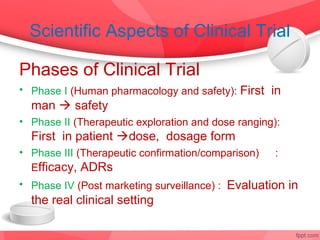
Scientific Aspects of Clinical Trial

Phases of Clinical Trial
• Phase I (Human pharmacology and safety): First in
  man  safety
• Phase II (Therapeutic exploration and dose ranging):
  First in patient dose, dosage form
• Phase III (Therapeutic confirmation/comparison)    :
  Efficacy, ADRs
• Phase IV (Post marketing surveillance) : Evaluation in
  the real clinical setting
Phase I
•     Objectives
    1. To assess a safe & tolerated dose
    2. To see if pharmacokinetics differ much from animal to man
    3. To see if kinetics show proper absorption, bioavailability
    4. To detect effects unrelated to the expected action
    5. To detect any predictable toxicity
–     Inclusion criteria
    –     Healthy volunteers : Uniformity of subjects: age, sex,
          nutritional status [Informed consent a must]
    –     Exception: Patients only for toxic drugs Eg AntiHIV, Anticancer
–     Exclusion criteria
    –     Women of child bearing age, children,
Phase II
•   First in patient [ different from healthy volunteer]
•   Early phase [20 – 200 patients with relevant disease]
     – Therapeutic benefits & ADRs evaluated
     – Establish a dose range to be used in late phase
     – Single blind [Only patient knows] comparison with standard drug
•   Late phase [ 50 – 500]
     – Double blind
     – Compared with a placebo or standard drug
•   Outcomes
     – Assesses efficacy against a defined therapeutic endpoint
     – Detailed P.kinetic & P.dynamic data
     – Establishes a dose & a dosage form for future trials
•   Takes 6 months to 2 years [ 35% success rate
Phase III
•   Large scale, Randomised, Controlled trials
•   Target population: 250 – 1000 patients
•   Performed by Clinicians in the hospital
•   Minimises errors of phases I and II
•   Methods
     – Multicentric  Ensures geographic & ethnic variations
     – Diff patient subgroups Eg pediatric, geriatric, renal impaired
     – Randomised allocation of test drug /placebo / standard drug
     – Double blinded:
     – Cross over design
     – Vigilant recording of all adverse drug reactions
     – Rigorous statistical evaluation of all clinical data
•   Takes a long time: up to 5 years [25% success
Phase IV or Post marketing
                Surveillance
•   No fixed duration / patient population
•   Starts immediately after marketing
•   Report all ADRs
•   Helps to detect
    – rare ADRs
    – Drug interactions
    – Also new uses for drugs [Sometimes called Phase V]
Clinical Trial: Legal & Procedural
                aspects
Elements of a Clinical Trial
• Aim or objective
• Protocol : study design
• Ethics committee clearance
• Regulatory approval whenever required
• Informed consent
• Implementation of protocol
• Collection of data
• Compilation of data, analysis and interpretation
• Report writing
Participating Parties in Clinical Trial
1.  Patient / Healthy volunteer: Subject of the trial
2.  Clinical Pharmacologist, Clinical Investigator & team: [Qualified and
    competent] Conducts the clinical trial; reports all adverse events
3. Institution where trials are held : [Approval required] Provides all
    facilities
4. Ethical Review Board or Institutional Ethical Committee:
     -Supervises and monitors every step;
    – Safeguard the welfare and the rights of the participants
    – 5. Sponsor
    – Pays for all expenses;
    – Appoints competent investigators,
    – Ships all drugs for the trial,
    – Files all papers to legal / regulatory authorities,
6. Regulatory Authorities:
Legal authority on the outcomes of the trial
THANKS

Drug discovery By Neelima Sharma WCC chennai,neelima.sharma60@gmail.com

  • 1.
  • 2.
    DRUG DISCOVERY • Theprocesses of new drug discovery and development are long, complicated and dependent upon the expertise of a wide variety of scientific, technical and managerial groups.
  • 3.
    Why are newdrugs needed? • unmet medical need; new diseases (AIDS, Alzheimer’s; obesity); low efficacy (dementia, cancer); side effects (antidepressants, antipsychotics) • downstream health costs; (Alzheimer’s; spinal injury) • cost of therapy; (Viagra, Interleukins) • costs to individual/country; (depression) • sustain industrial activity; pharmaceutical industry employs thousands and makes a massive contribution to overseas earnings); patent expiry
  • 4.
    Approaches to drugdiscovery • Historical; cinchona (quinine) & willow barks (aspirin); chinese medicine currently. • Study disease process; breast cancer (tamoxifen); Parkinson’s disease (L-dopa) • Study biochem/physiological pathway; renin/angiotensin • Develop SAR to natural compound; beta-adrenoceptors (propranolol), H2-receptors (cimetidine) • Design to fit known structurally identified biological site; angiotensin-converting enzyme inhibitors • By chance (serendipity); random screening (HTS); penicillin; dimenhydramate; pethidine • Genomics; identification of receptors; gene therapy; recombinant materials
  • 5.
    The changed contextof drug discovery and development The 1800s: natural sources; limited possibilities; prepared by individuals; small scale; not purified, standardised or tested; limited administration; no controls; no idea of mechanisms. The 1990s and 2000: synthetic source; unlimited possibilities; prepared by companies; massive scale; highly purified, standardised and tested; world-wide administration; tight legislative control; mechanisms partly understood, still understanding.
  • 7.
    The New DrugDevelopment Process
  • 8.
  • 9.
    • About 2.6manimals/y used in procedures in UK (11.6m in Europe) • Likely to increase; more research, more targets, genetic capability • 3Rs -- 3Rs -- 3Rs • REPLACEMENT: use non-animal tests if possible (cheaper, less trouble, less variable but not possible for everything at this time) • REDUCTION: get the statistics right, don’t replicate work unnecessarily, don’t overbreed • REFINEMENT: reduce suffering and severity of procedure, pay attention to housing, stress, husbandry and rich environments, proper analgesia and pre- and post- operative care
  • 10.
    There are twotypes of Research: Basic and Applied • Basic Research: discovering new facts about how things work, how they are made, or what causes a biological event to occur. Basic research can explore a topic, explain a topic or describe a topic. • For Example: A researcher discovered that genes can be turned off or on by small RNA molecules in the body. This study was conducted on worms. It led to the Nobel Prize in 2006.
  • 11.
    “Basic” vs. “Applied” Research • Applied Research: Taking the information discovered in basic research and investigating how to use it to treat and prevent sicknesses. • Example: A researcher uses the information about turning genes off and on to find a drug that is used to turn off Segment of DNA. Many such genes that cause diseases and disorders segments act as in humans genes
  • 12.
    Process of DrugDiscovery • Target Identification • Target Validation • Lead Identification • Lead Optimization • Preclinical Pharmacology and Toxicology
  • 13.
    Target Identification • Identifyingtargets include protein expression, protein biochemistry. • Sequence analysis, positional cloning, functional cloning. • Important to determine whether the novel targets are actually relevant to the physiology of the disease.
  • 14.
    Target Validation • Targetidentified will affect an appropriate biological response • CHEMOGENOMICS;defined as the discovery and description of all possible drugs to all possible targets. • Chemical Genetics; involves the use of chemical probes to understand some specific features of biology and can be viewed as subset of chemogenomics. • LIMITATIONS;Compensatory mechanism of the organism.
  • 15.
    Lead Identification • “leadcompound”: structure that has some activity against the chosen target, but not yet good enough to be the drug itself. Virtual Pharmacaphore Screening Mapping Docking Chemoinformatics QSAR Chemical Genetics
  • 16.
    • The pharmacophoreis the precise section of the molecule that is responsible for biological activity. • This may enable one to prepare a more active molecule • This may allow the elimination of “excessive” functionality, thus reducing the toxicity and cost of production of the active material • This can be done through synthetic modifications
  • 17.
    Lead Optimization • Oncea lead has been discovered, it is important to understand precisely which structural features are responsible for its biological activity.
  • 18.
    Pre-Clinical Pharmacology and Toxicology • TOXICOLOGY • Thalidomide was developed by German pharmaceutical company Grünenthal. It was sold from 1957 to 1961 in almost 50 countries under at least 40 names. Thalidomide was chiefly sold and prescribed during the late 1950s and early 1960s to pregnant women, as an antiemetic to combat morning sickness and as an aid to help them sleep. Before its release, inadequate tests were performed to assess the drug's safety, with catastrophic results for the children of women who had taken thalidomide during their pregnancies • Antiemetic = a medication that helps prevent and control nausea and vomiting
  • 19.
    Birth defects caused byuse of thalidomide
  • 20.
    • Preclinical trial- a laboratory test of a new drug or a new medical device, usually done on animal subjects, to see if the hoped-for treatment really works and if it is safe to test on humans.
  • 21.
    There are severalsteps involved with doing a Pre- Clinical Trial • File for approval as an Investigational New Drug (IND) 5 • Establish Effective and Toxic Doses 4 3 Screen the Drug in the Assay 2 Develop a Bioassay 1 Indentify a Drug Target
  • 22.
    Scientific Aspects ofClinical Trial Phases of Clinical Trial • Phase I (Human pharmacology and safety): First in man  safety • Phase II (Therapeutic exploration and dose ranging): First in patient dose, dosage form • Phase III (Therapeutic confirmation/comparison) : Efficacy, ADRs • Phase IV (Post marketing surveillance) : Evaluation in the real clinical setting
  • 23.
    Phase I • Objectives 1. To assess a safe & tolerated dose 2. To see if pharmacokinetics differ much from animal to man 3. To see if kinetics show proper absorption, bioavailability 4. To detect effects unrelated to the expected action 5. To detect any predictable toxicity – Inclusion criteria – Healthy volunteers : Uniformity of subjects: age, sex, nutritional status [Informed consent a must] – Exception: Patients only for toxic drugs Eg AntiHIV, Anticancer – Exclusion criteria – Women of child bearing age, children,
  • 24.
    Phase II • First in patient [ different from healthy volunteer] • Early phase [20 – 200 patients with relevant disease] – Therapeutic benefits & ADRs evaluated – Establish a dose range to be used in late phase – Single blind [Only patient knows] comparison with standard drug • Late phase [ 50 – 500] – Double blind – Compared with a placebo or standard drug • Outcomes – Assesses efficacy against a defined therapeutic endpoint – Detailed P.kinetic & P.dynamic data – Establishes a dose & a dosage form for future trials • Takes 6 months to 2 years [ 35% success rate
  • 25.
    Phase III • Large scale, Randomised, Controlled trials • Target population: 250 – 1000 patients • Performed by Clinicians in the hospital • Minimises errors of phases I and II • Methods – Multicentric  Ensures geographic & ethnic variations – Diff patient subgroups Eg pediatric, geriatric, renal impaired – Randomised allocation of test drug /placebo / standard drug – Double blinded: – Cross over design – Vigilant recording of all adverse drug reactions – Rigorous statistical evaluation of all clinical data • Takes a long time: up to 5 years [25% success
  • 26.
    Phase IV orPost marketing Surveillance • No fixed duration / patient population • Starts immediately after marketing • Report all ADRs • Helps to detect – rare ADRs – Drug interactions – Also new uses for drugs [Sometimes called Phase V]
  • 27.
    Clinical Trial: Legal& Procedural aspects Elements of a Clinical Trial • Aim or objective • Protocol : study design • Ethics committee clearance • Regulatory approval whenever required • Informed consent • Implementation of protocol • Collection of data • Compilation of data, analysis and interpretation • Report writing
  • 28.
    Participating Parties inClinical Trial 1. Patient / Healthy volunteer: Subject of the trial 2. Clinical Pharmacologist, Clinical Investigator & team: [Qualified and competent] Conducts the clinical trial; reports all adverse events 3. Institution where trials are held : [Approval required] Provides all facilities 4. Ethical Review Board or Institutional Ethical Committee: -Supervises and monitors every step; – Safeguard the welfare and the rights of the participants – 5. Sponsor – Pays for all expenses; – Appoints competent investigators, – Ships all drugs for the trial, – Files all papers to legal / regulatory authorities, 6. Regulatory Authorities: Legal authority on the outcomes of the trial
  • 29.