Drug
Discovery
 Target Identification And Validation
 Target identification finds a gene or protein (therapeutic agent) that plays
a significant role in disease
 To validate targets, researchers use modern tools and techniques such as
disease association, bioactive molecules, cell-based models, protein
interactions, signaling pathways analysis, functional analysis of genes, in
vitro genetic manipulation, antibodies, and chemical genomics
High Throughput Screening
The initial point can be found by screening a large number of molecules that can interact with
a prospective target after it has been identified and validated.
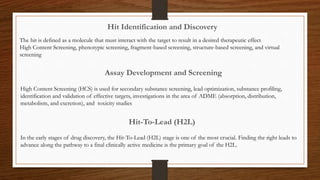
Hit Identification and Discovery
The hit is defined as a molecule that must interact with the target to result in a desired therapeutic effect
High Content Screening, phenotypic screening, fragment-based screening, structure-based screening, and virtual
screening
Assay Development and Screening
High Content Screening (HCS) is used for secondary substance screening, lead optimization, substance profiling,
identification and validation of effective targets, investigations in the area of ADME (absorption, distribution,
metabolism, and excretion), and toxicity studies
Hit-To-Lead (H2L)
In the early stages of drug discovery, the Hit-To-Lead (H2L) stage is one of the most crucial. Finding the right leads to
advance along the pathway to a final clinically active medicine is the primary goal of the H2L.
Lead Optimization
In the lead optimization (LO) process, the lead compounds discovered
are synthesized and modified to improve potency and reduce side
effects
Active Pharmaceutical Ingredients
Active pharmaceutical ingredients (APIs) are biologically active
ingredients in a drug that produce desired effects
Drug Development
Process
6
7
In vivo
In vitro
Pre Clinical
• In vitro is another Latin term meaning “in the
glass.
• Organic cells are transplanted into a testing
vessel that acts as an artificial testing
environment
• Focuses on how a compound interacts at
the cellular level
• In vivo is a Latin term meaning “in the whole
body,”
• It requires active testing on live test subjects.
Today, murine (mice or related rodent) models are
the most common test subjects for early-phase
pharmaceutical and biomedical research.
• Primarily focuses on the pharmacokinetics of a
compound in a living organism with a focus on
drug metabolism, safety, and efficacy
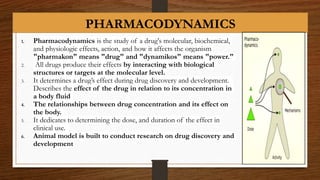
PHARMACODYNAMICS
1. Pharmacodynamics is the study of a drug's molecular, biochemical,
and physiologic effects, action, and how it affects the organism
"pharmakon" means "drug" and "dynamikos" means "power."
2. All drugs produce their effects by interacting with biological
structures or targets at the molecular level.
3. It determines a drug’s effect during drug discovery and development.
Describes the effect of the drug in relation to its concentration in
a body fluid
4. The relationships between drug concentration and its effect on
the body.
5. It dedicates to determining the dose, and duration of the effect in
clinical use.
6. Animal model is built to conduct research on drug discovery and
development
PHARMACOKINETICS
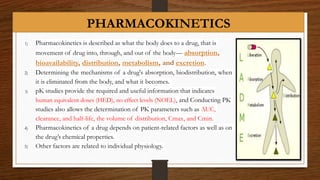
1) Pharmacokinetics is described as what the body does to a drug, that is
movement of drug into, through, and out of the body— absorption,
bioavailability, distribution, metabolism, and excretion.
2) Determining the mechanisms of a drug's absorption, biodistribution, when
it is eliminated from the body, and what it becomes.
3) pK studies provide the required and useful information that indicates
human equivalent doses (HED), no effect levels (NOEL), and Conducting PK
studies also allows the determination of PK parameters such as AUC,
clearance, and half-life, the volume of distribution, Cmax, and Cmin.
4) Pharmacokinetics of a drug depends on patient-related factors as well as on
the drug’s chemical properties.
5) Other factors are related to individual physiology.
● It is a laboratory test of a new drug or a new medical device, usually done on animal
subjects, to see if the treatment really works and if it is safe to test on humans.
● The drugs are tested using animal models and human cells grown in the laboratory
● The main goals of toxicology is to ensure the safety of the drug/vaccine, determine a
starting, and assess the potential toxicity of the product
● Adverse effects are seen
● Range: 1-3 years, Average: 18 months
Toxicology
11
Investigational New Drug (IND)
● Investigational New Drug (IND) program by which a pharmaceutical company obtains
permission to start human clinical trials and to ship an experimental drug across state lines (usually
to clinical investigators) before a marketing application for the drug has been approved.
● FDA Time 30 Days for Safety review (US)
● Central Drugs Standard Control Organization (CDSCO) (INDIA)
● Health Canada (HC)
● European Medicines Agency (EMA)
12
What details should be provided to
IND?
1. The data shows that it is reasonable to begin tests
of a new drug on humans.
2. How, Where and by Whom the new studies will be
conducted
3. Chemical structure of the compound
4. How the compound is manufactured.
5. Toxic effects in animal studies.
13
Clinical Trials
14
Range : 2-10 years , Average : 5 years
Informed Consent Form
● The Patient is provided with a consent form
● A consent form is a signed document that
outlines an individual’s informed consent for a
medical study, clinical trial, or activity.
15
Phase 0(Zero)
16
● In recent years, a new trial phase term has emerged – the so-called
phase 0 (zero) or micro-dosing trials.
● It’s an interim step between pre-clinical research and phase I studies
● Investigators use a very small dose of medication to make sure it isn’t
harmful to humans before they start using it in higher doses for later phases
✔The main goal of this trial is to check the safety of the drug and its
Immunogenicity.
✔It takes up to 1-2 years
17
Phase I
2-12 Volunteers
18
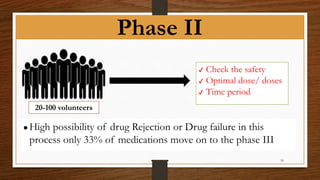
Phase II
● High possibility of drug Rejection or Drug failure in this
process only 33% of medications move on to the phase III
20-100 volunteers
✔ Check the safety
✔ Optimal dose/ doses
✔ Time period
19
Phase III
● In this trial the new drug can be compared with the same drug available on the market.
● Long process and Expensive
1000-3000 volunteers
Safety
Efficacy
Shelf life
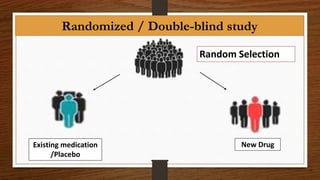
Random Selection
Existing medication
/Placebo
New Drug
Randomized / Double-blind study
20
●This involves randomly choosing some participants to receive the new
medication and others to receive an existing medication/ placebo
●A double-blind study is one in which neither the participants nor the
experimenters know who is receiving a particular treatment.
●A placebo is an inactive substance that looks like a drug(Sugar pills)
21
22
New Drug Application
1. A New Drug Application (NDA) tells the full story about a drug from preclinical
data to Phase 3 trial data in an NDA and must include reports on all studies, data,
and analyses.
2. The purpose of an NDA is to provide the FDA reviewer with adequate data to
ensure the safety and efficacy of the drug, labeling, and manufacturing process
3. Along with clinical results, developers must include:
 Proposed labeling
 Safety updates
 Drug abuse information
 Patent information
 Institutional review board compliance information
 Directions for use
23
Phase IV
● Done after the drug has been marketed
● Post Marketing Surveillance (PMS).
● No fixed duration / patient population
● Studies continue to collect data about effects on various
populations & side effects of long-term use.
● These are primarily observational or non-experimental in
nature.
● Harmful effects discovered may result in a drug being no
longer sold, or restricted to certain uses.
For NDA
1. https://www.fda.gov/drugs/types-applications/new-drug-application-nda

Drug Development Process

  • 1.
  • 2.
     Target IdentificationAnd Validation  Target identification finds a gene or protein (therapeutic agent) that plays a significant role in disease  To validate targets, researchers use modern tools and techniques such as disease association, bioactive molecules, cell-based models, protein interactions, signaling pathways analysis, functional analysis of genes, in vitro genetic manipulation, antibodies, and chemical genomics
  • 3.
    High Throughput Screening Theinitial point can be found by screening a large number of molecules that can interact with a prospective target after it has been identified and validated.
  • 4.
    Hit Identification andDiscovery The hit is defined as a molecule that must interact with the target to result in a desired therapeutic effect High Content Screening, phenotypic screening, fragment-based screening, structure-based screening, and virtual screening Assay Development and Screening High Content Screening (HCS) is used for secondary substance screening, lead optimization, substance profiling, identification and validation of effective targets, investigations in the area of ADME (absorption, distribution, metabolism, and excretion), and toxicity studies Hit-To-Lead (H2L) In the early stages of drug discovery, the Hit-To-Lead (H2L) stage is one of the most crucial. Finding the right leads to advance along the pathway to a final clinically active medicine is the primary goal of the H2L.
  • 5.
    Lead Optimization In thelead optimization (LO) process, the lead compounds discovered are synthesized and modified to improve potency and reduce side effects Active Pharmaceutical Ingredients Active pharmaceutical ingredients (APIs) are biologically active ingredients in a drug that produce desired effects
  • 6.
  • 7.
  • 8.
    In vivo In vitro PreClinical • In vitro is another Latin term meaning “in the glass. • Organic cells are transplanted into a testing vessel that acts as an artificial testing environment • Focuses on how a compound interacts at the cellular level • In vivo is a Latin term meaning “in the whole body,” • It requires active testing on live test subjects. Today, murine (mice or related rodent) models are the most common test subjects for early-phase pharmaceutical and biomedical research. • Primarily focuses on the pharmacokinetics of a compound in a living organism with a focus on drug metabolism, safety, and efficacy
  • 9.
    PHARMACODYNAMICS 1. Pharmacodynamics isthe study of a drug's molecular, biochemical, and physiologic effects, action, and how it affects the organism "pharmakon" means "drug" and "dynamikos" means "power." 2. All drugs produce their effects by interacting with biological structures or targets at the molecular level. 3. It determines a drug’s effect during drug discovery and development. Describes the effect of the drug in relation to its concentration in a body fluid 4. The relationships between drug concentration and its effect on the body. 5. It dedicates to determining the dose, and duration of the effect in clinical use. 6. Animal model is built to conduct research on drug discovery and development
  • 10.
    PHARMACOKINETICS 1) Pharmacokinetics isdescribed as what the body does to a drug, that is movement of drug into, through, and out of the body— absorption, bioavailability, distribution, metabolism, and excretion. 2) Determining the mechanisms of a drug's absorption, biodistribution, when it is eliminated from the body, and what it becomes. 3) pK studies provide the required and useful information that indicates human equivalent doses (HED), no effect levels (NOEL), and Conducting PK studies also allows the determination of PK parameters such as AUC, clearance, and half-life, the volume of distribution, Cmax, and Cmin. 4) Pharmacokinetics of a drug depends on patient-related factors as well as on the drug’s chemical properties. 5) Other factors are related to individual physiology.
  • 11.
    ● It isa laboratory test of a new drug or a new medical device, usually done on animal subjects, to see if the treatment really works and if it is safe to test on humans. ● The drugs are tested using animal models and human cells grown in the laboratory ● The main goals of toxicology is to ensure the safety of the drug/vaccine, determine a starting, and assess the potential toxicity of the product ● Adverse effects are seen ● Range: 1-3 years, Average: 18 months Toxicology 11
  • 12.
    Investigational New Drug(IND) ● Investigational New Drug (IND) program by which a pharmaceutical company obtains permission to start human clinical trials and to ship an experimental drug across state lines (usually to clinical investigators) before a marketing application for the drug has been approved. ● FDA Time 30 Days for Safety review (US) ● Central Drugs Standard Control Organization (CDSCO) (INDIA) ● Health Canada (HC) ● European Medicines Agency (EMA) 12
  • 13.
    What details shouldbe provided to IND? 1. The data shows that it is reasonable to begin tests of a new drug on humans. 2. How, Where and by Whom the new studies will be conducted 3. Chemical structure of the compound 4. How the compound is manufactured. 5. Toxic effects in animal studies. 13
  • 14.
    Clinical Trials 14 Range :2-10 years , Average : 5 years
  • 15.
    Informed Consent Form ●The Patient is provided with a consent form ● A consent form is a signed document that outlines an individual’s informed consent for a medical study, clinical trial, or activity. 15
  • 16.
    Phase 0(Zero) 16 ● Inrecent years, a new trial phase term has emerged – the so-called phase 0 (zero) or micro-dosing trials. ● It’s an interim step between pre-clinical research and phase I studies ● Investigators use a very small dose of medication to make sure it isn’t harmful to humans before they start using it in higher doses for later phases
  • 17.
    ✔The main goalof this trial is to check the safety of the drug and its Immunogenicity. ✔It takes up to 1-2 years 17 Phase I 2-12 Volunteers
  • 18.
    18 Phase II ● Highpossibility of drug Rejection or Drug failure in this process only 33% of medications move on to the phase III 20-100 volunteers ✔ Check the safety ✔ Optimal dose/ doses ✔ Time period
  • 19.
    19 Phase III ● Inthis trial the new drug can be compared with the same drug available on the market. ● Long process and Expensive 1000-3000 volunteers Safety Efficacy Shelf life
  • 20.
    Random Selection Existing medication /Placebo NewDrug Randomized / Double-blind study 20
  • 21.
    ●This involves randomlychoosing some participants to receive the new medication and others to receive an existing medication/ placebo ●A double-blind study is one in which neither the participants nor the experimenters know who is receiving a particular treatment. ●A placebo is an inactive substance that looks like a drug(Sugar pills) 21
  • 22.
    22 New Drug Application 1.A New Drug Application (NDA) tells the full story about a drug from preclinical data to Phase 3 trial data in an NDA and must include reports on all studies, data, and analyses. 2. The purpose of an NDA is to provide the FDA reviewer with adequate data to ensure the safety and efficacy of the drug, labeling, and manufacturing process 3. Along with clinical results, developers must include:  Proposed labeling  Safety updates  Drug abuse information  Patent information  Institutional review board compliance information  Directions for use
  • 23.
    23 Phase IV ● Doneafter the drug has been marketed ● Post Marketing Surveillance (PMS). ● No fixed duration / patient population ● Studies continue to collect data about effects on various populations & side effects of long-term use. ● These are primarily observational or non-experimental in nature. ● Harmful effects discovered may result in a drug being no longer sold, or restricted to certain uses.
  • 24.