OUTLINE
Introduction
PreclinicalResearch
Forms of Preclinical Testing
Objectives of Preclinical Phase
Phases of Preclinical Research
Investigational New Drug (IND)
Species Selection
Ethical Considerations
3.
INTRODUCTION
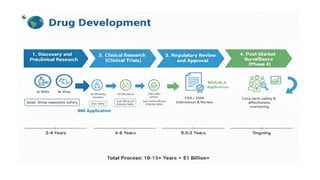
Drug developmentis the comprehensive, multi-stage process of bringing a
new pharmaceutical drug to the market. It is a long, complex, and highly
regulated journey designed to answer two fundamental questions:
Is the drug safe?
Is the drug effective?
This entire process, from initial idea in a lab to a prescription at a
pharmacy, can easily take 10-15 years and cost hundreds of millions,
sometimes billions, of dollars.
5.
PRECLINICAL PHASE
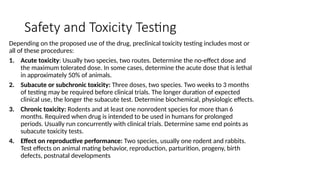
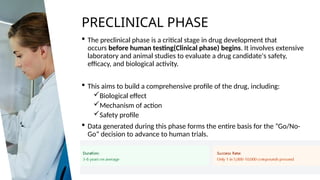
Thepreclinical phase is a critical stage in drug development that
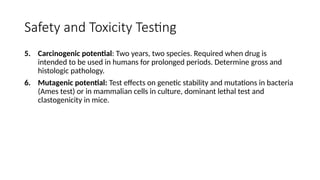
occurs before human testing(Clinical phase) begins. It involves extensive
laboratory and animal studies to evaluate a drug candidate's safety,
efficacy, and biological activity.
This aims to build a comprehensive profile of the drug, including:
Biological effect
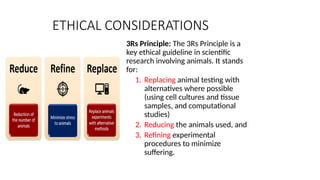
Mechanism of action
Safety profile
Data generated during this phase forms the entire basis for the ”Go/No-
Go” decision to advance to human trials.
6.
FORMS OF PRECLINICAL
TESTING
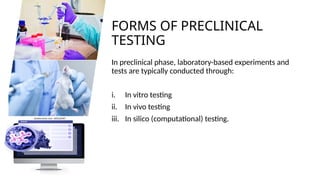
Inpreclinical phase, laboratory-based experiments and
tests are typically conducted through:
i. In vitro testing
ii. In vivo testing
iii. In silico (computational) testing.
7.
In VitroStudies (Latin: "in
glass")
• These are tests performed in a controlled
laboratory environment outside of a living
organism.
• Examples: Using human or animal cell cultures,
isolated tissues, enzymes, or receptor-binding
assays.
• Purpose: To assess a drug's basic biological
activity, potency, and mechanism of action at a
cellular level. They are often used for high-
throughput screening of the candidates identified
in silico.
In Vivo Studies (Latin: "in
the living")
• These are tests performed inside a living
organism, specifically animal models.
• Purpose: To understand how the drug
behaves in a complex, whole-body system.
This is where crucial data on pharmacokinetics
(ADME), overall toxicity, and efficacy in a
disease model is gathered.
• Regulatory requirement: FDA requires testing
in at least two animal species (one rodent, one
non-rodent)
8.
In Silico Studies(Latin: "in silicon")
• These are computational studies performed using computer models and simulations
before or alongside lab testing.
• Examples:
• Molecular Docking
• ADMET Prediction
• PBPK Modeling
• Purpose: To screen vast libraries of compounds, prioritize the most promising candidates,
and fail bad candidates early—saving time, money, and reducing animal use.
9.
OBJECTIVES OF PRECLINICALPHASE
The preclinical phase has four primary objectives that must be met to justify moving to human
trials:
i. Assess Efficacy (Pharmacodynamics): To determine if the drug has the desired therapeutic effect.
ii. Determine Pharmacokinetics (PK): To understand what the body does to the drug (The famously
summarized ADME)
iii. Evaluate Safety (Toxicology): To identify potential risks and toxic effects. This is arguably the most critical
objective for regulatory approval to proceed.
iv. Establish a Safe Starting Dose for Humans: Based on all the toxicity and PK data, researchers extrapolate a
reasonably safe dose to start with in the very first (Phase 1) clinical trial.
v. Assess manufacturing feasibility.
10.
PHASES OF PRECLINICALRESEARCH
Preclinical research is generally divided into four phases:
i. Basic research
ii. Lead compound identification
iii. Lead optimization
iv. Investigational new drug (IND)-enabling studies
11.
Basic Research
Basicresearch comprises any studies conducted by academic institutions,
pharmaceutical companies and biotechnology firms to understand the
underlying biology of a disease and how that disease might be treated.
This is the foundation stage where scientists study the biology of the
disease or condition.
They investigate how the disease works at the cellular and molecular
level.
12.
Basic Research
Thisinclude identifying the biological targets—for example, a
specific protein, enzyme, or receptor that plays a role in the
disease process.
Mostly done in the lab using:
Cell cultures (in vitro)
Animal models (in vivo)
No drug is being tested yet; the goal is understanding the science
behind the disease.
SUMMARY:
Think of this as “studying the enemy before the battle”—you
learn all about the disease before you even start making a drug.
13.
Lead compound identification
Scientists design or find compounds that could interact with the
biological target identified in basic research.
They test thousands of molecules or compounds (sometimes using
high-throughput screening).
Promising molecules (or compounds) are called “hits”, and the best
of these are refined into “lead compounds”.
Candidate nomination happens when the most promising lead
compouds is chosen to move forward for more testing.
14.
Candidate Nominationmeans officially choosing the best potential
drug (or therapy) from all the promising options to move forward into
more advanced testing.
In this process, various factors are considered when selecting the most
promising of these for further development, including;
Potency,
Selectivity,
Pharmacokinetics,
Safety profile and
Potential for formulation.
SUMMARY:
• This is “finding the potential hero”—searching for and picking a drug candidate
that might fight the disease.
Lead compound identification
15.
Lead Optimization
• Thisis the third stage of preclinical research and this is where the chosen lead
compound is chemically modified to improve:
• Efficacy (how well it works)
• Safety (reduce side effects)
• Pharmacokinetics (absorption, distribution, metabolism, elimination)
• Many versions of the lead are made and tested to find the best version.
• Often involves testing in animal models to see how the drug behaves in the body.
• SUMMARY:
• This is “training the hero”—making the drug candidate stronger, safer, and more
effective.
16.
Lead Optimization
Once alead drug candidate is identified, a typical preclinical development
program consists of six major segments:
1. Manufacture of drug substance / active pharmaceutical ingredient
2. Preformulation and formulation (dosage design)
3. Analytical and bioanalytical method development and validation
4. Metabolism and pharmacokinetics
5. Safety and genetic toxicology and safety pharmacology, including
hematology, urine and other analyses
6. Good manufacturing practice (GMP) manufacture and documentation of
the drug product for use in clinical trials
17.
Lead Optimization
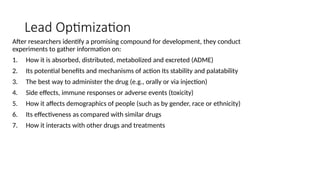
After researchersidentify a promising compound for development, they conduct
experiments to gather information on:
1. How it is absorbed, distributed, metabolized and excreted (ADME)
2. Its potential benefits and mechanisms of action Its stability and palatability
3. The best way to administer the drug (e.g., orally or via injection)
4. Side effects, immune responses or adverse events (toxicity)
5. How it affects demographics of people (such as by gender, race or ethnicity)
6. Its effectiveness as compared with similar drugs
7. How it interacts with other drugs and treatments
18.
Investigational New Drug-Enabling
Studies
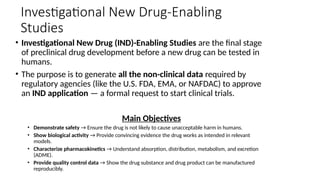
•Investigational New Drug (IND)-Enabling Studies are the final stage
of preclinical drug development before a new drug can be tested in
humans.
• The purpose is to generate all the non-clinical data required by
regulatory agencies (like the U.S. FDA, EMA, or NAFDAC) to approve
an IND application — a formal request to start clinical trials.
Main Objectives
• Demonstrate safety → Ensure the drug is not likely to cause unacceptable harm in humans.
• Show biological activity → Provide convincing evidence the drug works as intended in relevant
models.
• Characterize pharmacokinetics → Understand absorption, distribution, metabolism, and excretion
(ADME).
• Provide quality control data → Show the drug substance and drug product can be manufactured
reproducibly.
19.
The Key ComponentOf Investigational
New Drug-enabling Studies
• The Key Component Of Investigational New Drug-enabling Studies Includes:
• Safety and toxicology studies in animals to find safe dose ranges
• Pharmacology studies to confirm how it works and the effects on vital systems:
Cardiovascular, Respiratory, Central nervous system (behavior, reflexes)
• Pharmacokinetics to study how it moves through the body
• Formulation studies to decide the best way to give the drug (pill, injection,
etc.)
20.
Safety and ToxicityTesting
• The art of drug development consists of
effective assessment and management of
risk versus benefit and not total risk
avoidance. Candidate drugs that survive the
initial screening procedures must be
carefully evaluated for potential risks before
and during clinical testing.
• The goals of preclinical toxicity studies
include identifying potential human
toxicities, designing tests to further define
the toxic mechanisms, and predicting the
most relevant toxicities to be monitored in
clinical trials.
21.
Safety and ToxicityTesting
Depending on the proposed use of the drug, preclinical toxicity testing includes most or
all of these procedures:
1. Acute toxicity: Usually two species, two routes. Determine the no-effect dose and
the maximum tolerated dose. In some cases, determine the acute dose that is lethal
in approximately 50% of animals.
2. Subacute or subchronic toxicity: Three doses, two species. Two weeks to 3 months
of testing may be required before clinical trials. The longer duration of expected
clinical use, the longer the subacute test. Determine biochemical, physiologic effects.
3. Chronic toxicity: Rodents and at least one nonrodent species for more than 6
months. Required when drug is intended to be used in humans for prolonged
periods. Usually run concurrently with clinical trials. Determine same end points as
subacute toxicity tests.
4. Effect on reproductive performance: Two species, usually one rodent and rabbits.
Test effects on animal mating behavior, reproduction, parturition, progeny, birth
defects, postnatal developments
22.
Safety and ToxicityTesting
5. Carcinogenic potential: Two years, two species. Required when drug is
intended to be used in humans for prolonged periods. Determine gross and
histologic pathology.
6. Mutagenic potential: Test effects on genetic stability and mutations in bacteria
(Ames test) or in mammalian cells in culture, dominant lethal test and
clastogenicity in mice.
23.
Safety and ToxicityTesting
In addition, several quantitative estimates are desirable. These include:
The no-effect dose —the maximum dose at which a specified toxic
effect is not seen;
The minimum lethal dose —the smallest dose that is observed to
kill any experimental animal;
The median lethal dose (LD 50) —the dose that kills approximately
50% of the animals. Presently, the LD 50 is estimated from the
smallest number of animals possible.
24.
Investigational New Drug(IND)
Application is then made to the Food and Drug Administration (FDA) as an
Investigational New Drug (IND).
IND must show how the drug:
1. Is manufactured
2. Appears (color, solubility, melting point, particle size, moisture content)
3. Formulated (pills, liquid, etc. and inactive ingredients)
4. Will be analyzed for purity, concentration, stability
5. Will be tested for safety (this will be the basis for allowing first use in humans)
25.
SPECIES SELECTION inIn-Vivo Studies
In drug development, selecting the right animal model is crucial for
predicting a drug’s safety and efficacy in humans. Key criteria include:
1. The animal’s biological relevance and similarity to humans. The animal
model’s pharmacokinetics and pharmacodynamics should be comparable
to humans.
2. Genetic uniformity: Using genetically uniform strains of animals can help
minimize variability in the study results.
• Classic examples of animals used in drug discovery include mice, rats,
rabbits, dogs, and non-human primates.
Mice and rats, in particular, are frequently used due to their small size, short
reproductive cycle, and well-characterized genomes.
26.
ETHICAL CONSIDERATIONS
Ethical considerationsin preclinical drug research and
development focus on ensuring the humane treatment of
animals, maintaining scientific integrity, and preventing
harm to both animals and humans involved in the
research process.
This includes responsible use of animals, transparent and
robust study design, and adherence to regulations like
those from FDA and EMA (European Medicines Agency).
27.
ETHICAL CONSIDERATIONS
3Rs Principle:The 3Rs Principle is a
key ethical guideline in scientific
research involving animals. It stands
for:
1. Replacing animal testing with
alternatives where possible
(using cell cultures and tissue
samples, and computational
studies)
2. Reducing the animals used, and
3. Refining experimental
procedures to minimize
suffering.
28.
Conclusion: The Go/No-GoDecision
• The preclinical phase is an indispensable, non-negotiable stage of
drug development. It filters out thousands of potential compounds
that are either unsafe or ineffective, ensuring that only the most
promising candidates advance to human trials. Its primary function is
to protect the safety of human volunteers in the clinical trials that
follow.
29.
References
Basic & ClinicalPharmacology 12th
Edition (Bertram G. Katzung, Susan
B. Masters, Anthony J. Trevor)
www.en.m.wikipedia.org/wiki/Preclinical_Development
www.ppd.com/
www.fda.gov/patients/drug-development-process
 Most read
 Most read
 Most read