
Molecule to medicine
Dr.Meharban , MSc, Ph.D.
Assistant Professor, Department of Pharmacology
Vydehi Institute of Medical Sciences & Research Centre
PHARMAQUEST-2021
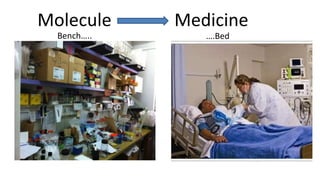
Molecule Medicine
Bench….. ….Bed
Introduction
• The drug discovery and development process (i.e
molecule to medicine)
– Discovery research
– Preclinical testing
– Investigational new drug (IND) applications
– Completed clinical testing before marketing approval from
the FDA.
Introduction
• The overarching goal
– More efficient
– Safer treatments to the patients
– Quickly as possible after a thorough medical evaluation
• Very lengthy, long duration, involves multi discipline
people to bring a medicine from molecules discovery
• Very expensive with lot of uncertainty and failures
Site
Selection
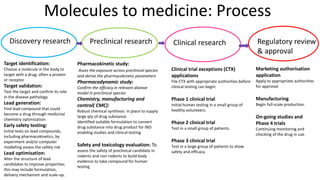
Molecules to medicine: Process
Target identification:
Choose a molecule in the body to
target with a drug; often a protein
or receptor
Target validation:
Test the target and confirm its role
in the disease pathology
Lead generation:
Find lead compound that could
become a drug through medicinal
chemistry optimization
Early safety testing:
Initial tests on lead compounds,
including pharmacokinetics, by
experiment and/or computer
modelling assess the safety risk
Lead optimisation:
Alter the structure of lead
candidates to improve properties;
this may include formulation,
delivery mechanism and scale-up.
Discovery research Preclinical research Clinical research Regulatory review
& approval
Pharmacokinetic study:
Asses the exposure across preclinical species
and derive the pharmacokinetic parameters
Pharmacodynamic study:
Confirm the efficacy in relevant disease
model in preclinical species
Chemistry, manufacturing and
control( CMC):
Robust chemical synthesis in place to supply
large qty of drug substance
Identified suitable formulation to convert
drug substance into drug product for IND
enabling studies and clinical testing
Safety and toxicology evaluation: To
assess the safety of preclinical candidate in
rodents and non rodents to build body
evidence to take compound for human
testing
Clinical trial exceptions (CTX)
applications
File CTX with appropriate authorities before
clinical testing can begin.
Phase 1 clinical trial
Initial human testing in a small group of
healthy volunteers.
Phase 2 clinical trial
Test in a small group of patients.
Phase 3 clinical trial
Test in a large group of patients to show
safety and efficacy.
Marketing authorisation
application
Apply to appropriate authorities
for approval.
Manufacturing
Begin full-scale production.
On-going studies and
Phase 4 trials
Continuing monitoring and
checking of the drug in use.
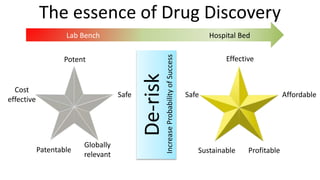
The essence of Drug Discovery
6
Safe
Effective
Affordable
Profitable
Globally
relevant
Sustainable
Cost
effective
Potent
Safe
Patentable
Hospital Bed
Lab Bench
De-risk
Increase
Probability
of
Success
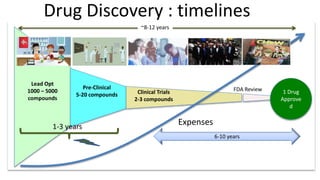
Drug Discovery : timelines
1 Drug
Approve
d
Lead Opt
1000 – 5000
compounds
Pre-Clinical
5-20 compounds Clinical Trials
2-3 compounds
FDA Review
Expenses
~8-12 years
1-3 years
6-10 years
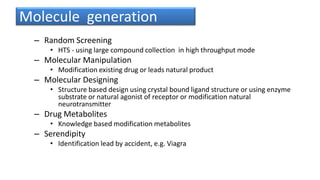
Molecule generation
– Random Screening
• HTS - using large compound collection in high throughput mode
– Molecular Manipulation
• Modification existing drug or leads natural product
– Molecular Designing
• Structure based design using crystal bound ligand structure or using enzyme
substrate or natural agonist of receptor or modification natural
neurotransmitter
– Drug Metabolites
• Knowledge based modification metabolites
– Serendipity
• Identification lead by accident, e.g. Viagra
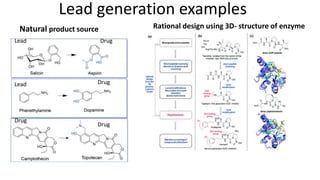
Lead generation examples
Natural product source
Lead Drug
Lead Drug
Drug
Drug
Rational design using 3D- structure of enzyme
Lead optimization- fine tuning of properties
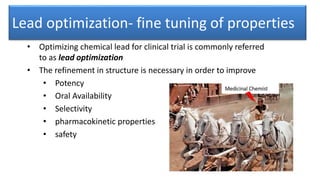
• Optimizing chemical lead for clinical trial is commonly referred
to as lead optimization
• The refinement in structure is necessary in order to improve
• Potency
• Oral Availability
• Selectivity
• pharmacokinetic properties
• safety
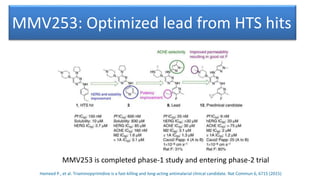
Hameed P., et al. Triaminopyrimidine is a fast-killing and long-acting antimalarial clinical candidate. Nat Commun 6, 6715 (2015)
MMV253: Optimized lead from HTS hits
MMV253 is completed phase-1 study and entering phase-2 trial
In-vitro studies
• Drug affinity: Ability of drug to bind to its biological target (receptor,
enzyme, transport system, etc.)
• Selectivity- Drug should bind to specific receptor site on the cell (eg.
Atenolol)
• Solubility and permeability: Helps to assess the drug absorption
• Metabolism and transporter studies: Asses the metabolic stability and
elimination characteristic of molecules
• Off –target selectivity testing : Screening of molecules against various
secondary pharmacology targets ( Cardiac ion channels, enzymes,
receptor and kinases) to build selectivity and reduce safety risk
In vivo studies
• Its experimentation using a whole, living organism.
• Gives information about,
• Pharmacokinetic profile (rodents and non rodents)
Magnitude of pharmacological effect depends
on drug concentration at its site of action.
• Pharmacodynamic profile
Establishes effectiveness of drug in preclinical animal disease model to
demonstrate proof concept
e.g SCID mice for malaria,
NOD mice- Diabetes,
Syngeneic mice tumor model for Cancer
PMID: 30131376
Safety and toxicity: IND package
Readout and risk assessment
Cardiovascular safety
• Conscious dog telemetry to assess the effect candidate drug on ECG changes, proarrhythmic
and QT prolongation risk
Genetic toxicity
• Ames test to assess and rule out mutagenic potential drug candidate
• in vitro micronucleus to rule out genetic toxicity in vitro under GLP conditions
• in vivo micronucleus and comet test to rule in vivo genotoxic potential drug candidate if it is
found to be positive under in-vitro conditions
General and Organ
toxicity in rodents and
non rodent species
• 14/28-day repeat dosing of compounds in rats and dog to determinate the no observed adverse
effect level(NOAEL) using clinical observations and histopathological findings
• Helps to study toxicokinetic and calculate therapeutic margins for human clinical trials
• Identification monitorable safety risk( Reversible elevation of liver enzymes)
Respiratory toxicity
• To assess the effect of drug candidate on respiration rates and volumes
Central nervous system
toxicity
• To assess the impact of drug candidate on behaviour, sensory / motor responses and body
temperature and associated risk
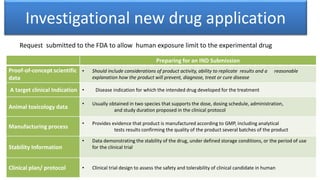
Investigational new drug application
Preparing for an IND Submission
Proof-of-concept scientific
data
• Should include considerations of product activity, ability to replicate results and a reasonable
explanation how the product will prevent, diagnose, treat or cure disease
A target clinical Indication • Disease indication for which the intended drug developed for the treatment
Animal toxicology data
• Usually obtained in two species that supports the dose, dosing schedule, administration,
and study duration proposed in the clinical protocol
Manufacturing process
• Provides evidence that product is manufactured according to GMP, including analytical
tests results confirming the quality of the product several batches of the product
Stability Information
• Data demonstrating the stability of the drug, under defined storage conditions, or the period of use
for the clinical trial
Clinical plan/ protocol • Clinical trial design to assess the safety and tolerability of clinical candidate in human
Request submitted to the FDA to allow human exposure limit to the experimental drug
16
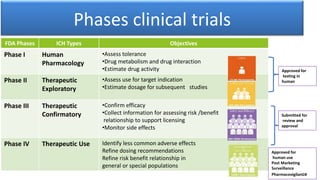
Phases clinical trials
FDA Phases ICH Types Objectives
Phase I Human
Pharmacology
•Assess tolerance
•Drug metabolism and drug interaction
•Estimate drug activity
Phase II Therapeutic
Exploratory
•Assess use for target indication
•Estimate dosage for subsequent studies
Phase III Therapeutic
Confirmatory
•Confirm efficacy
•Collect information for assessing risk /benefit
relationship to support licensing
•Monitor side effects
Phase IV Therapeutic Use Identify less common adverse effects
Refine dosing recommendations
Refine risk benefit relationship in
general or special populations
Approved for
testing in
human
Submitted for
review and
approval
Approved for
human use
Post Marketing
Surveillance
Pharmacovigilance
Pre-IND meeting
IND submission
Pre NDA meeting
NDA Submission
Approval
Stages of FDA Review
Engage regulatory authority (FDA) to seek
opinion on preclinical data package to incorporate into IND
Submission of NDA application post phas-3 outcome
for review and approval for human use
Involve regulatory agency for data review post phase-2b/III to elicit
the response and suggestion for NDA application
Submission of IND package for review, allow human exposure limit
and approval for testing in human
Committee reviews and majority opinion decides approval for
human use
30 day
Molecule to medicine

Molecule to medicine

  • 1.
    Molecule to medicine Dr.Meharban, MSc, Ph.D. Assistant Professor, Department of Pharmacology Vydehi Institute of Medical Sciences & Research Centre PHARMAQUEST-2021
  • 2.
  • 3.
    Introduction • The drugdiscovery and development process (i.e molecule to medicine) – Discovery research – Preclinical testing – Investigational new drug (IND) applications – Completed clinical testing before marketing approval from the FDA.
  • 4.
    Introduction • The overarchinggoal – More efficient – Safer treatments to the patients – Quickly as possible after a thorough medical evaluation • Very lengthy, long duration, involves multi discipline people to bring a medicine from molecules discovery • Very expensive with lot of uncertainty and failures
  • 5.
    Site Selection Molecules to medicine:Process Target identification: Choose a molecule in the body to target with a drug; often a protein or receptor Target validation: Test the target and confirm its role in the disease pathology Lead generation: Find lead compound that could become a drug through medicinal chemistry optimization Early safety testing: Initial tests on lead compounds, including pharmacokinetics, by experiment and/or computer modelling assess the safety risk Lead optimisation: Alter the structure of lead candidates to improve properties; this may include formulation, delivery mechanism and scale-up. Discovery research Preclinical research Clinical research Regulatory review & approval Pharmacokinetic study: Asses the exposure across preclinical species and derive the pharmacokinetic parameters Pharmacodynamic study: Confirm the efficacy in relevant disease model in preclinical species Chemistry, manufacturing and control( CMC): Robust chemical synthesis in place to supply large qty of drug substance Identified suitable formulation to convert drug substance into drug product for IND enabling studies and clinical testing Safety and toxicology evaluation: To assess the safety of preclinical candidate in rodents and non rodents to build body evidence to take compound for human testing Clinical trial exceptions (CTX) applications File CTX with appropriate authorities before clinical testing can begin. Phase 1 clinical trial Initial human testing in a small group of healthy volunteers. Phase 2 clinical trial Test in a small group of patients. Phase 3 clinical trial Test in a large group of patients to show safety and efficacy. Marketing authorisation application Apply to appropriate authorities for approval. Manufacturing Begin full-scale production. On-going studies and Phase 4 trials Continuing monitoring and checking of the drug in use.
  • 6.
    The essence ofDrug Discovery 6 Safe Effective Affordable Profitable Globally relevant Sustainable Cost effective Potent Safe Patentable Hospital Bed Lab Bench De-risk Increase Probability of Success
  • 7.
    Drug Discovery :timelines 1 Drug Approve d Lead Opt 1000 – 5000 compounds Pre-Clinical 5-20 compounds Clinical Trials 2-3 compounds FDA Review Expenses ~8-12 years 1-3 years 6-10 years
  • 8.
    Molecule generation – RandomScreening • HTS - using large compound collection in high throughput mode – Molecular Manipulation • Modification existing drug or leads natural product – Molecular Designing • Structure based design using crystal bound ligand structure or using enzyme substrate or natural agonist of receptor or modification natural neurotransmitter – Drug Metabolites • Knowledge based modification metabolites – Serendipity • Identification lead by accident, e.g. Viagra
  • 9.
    Lead generation examples Naturalproduct source Lead Drug Lead Drug Drug Drug Rational design using 3D- structure of enzyme
  • 10.
    Lead optimization- finetuning of properties • Optimizing chemical lead for clinical trial is commonly referred to as lead optimization • The refinement in structure is necessary in order to improve • Potency • Oral Availability • Selectivity • pharmacokinetic properties • safety
  • 11.
    Hameed P., etal. Triaminopyrimidine is a fast-killing and long-acting antimalarial clinical candidate. Nat Commun 6, 6715 (2015) MMV253: Optimized lead from HTS hits MMV253 is completed phase-1 study and entering phase-2 trial
  • 12.
    In-vitro studies • Drugaffinity: Ability of drug to bind to its biological target (receptor, enzyme, transport system, etc.) • Selectivity- Drug should bind to specific receptor site on the cell (eg. Atenolol) • Solubility and permeability: Helps to assess the drug absorption • Metabolism and transporter studies: Asses the metabolic stability and elimination characteristic of molecules • Off –target selectivity testing : Screening of molecules against various secondary pharmacology targets ( Cardiac ion channels, enzymes, receptor and kinases) to build selectivity and reduce safety risk
  • 13.
    In vivo studies •Its experimentation using a whole, living organism. • Gives information about, • Pharmacokinetic profile (rodents and non rodents) Magnitude of pharmacological effect depends on drug concentration at its site of action. • Pharmacodynamic profile Establishes effectiveness of drug in preclinical animal disease model to demonstrate proof concept e.g SCID mice for malaria, NOD mice- Diabetes, Syngeneic mice tumor model for Cancer PMID: 30131376
  • 14.
    Safety and toxicity:IND package Readout and risk assessment Cardiovascular safety • Conscious dog telemetry to assess the effect candidate drug on ECG changes, proarrhythmic and QT prolongation risk Genetic toxicity • Ames test to assess and rule out mutagenic potential drug candidate • in vitro micronucleus to rule out genetic toxicity in vitro under GLP conditions • in vivo micronucleus and comet test to rule in vivo genotoxic potential drug candidate if it is found to be positive under in-vitro conditions General and Organ toxicity in rodents and non rodent species • 14/28-day repeat dosing of compounds in rats and dog to determinate the no observed adverse effect level(NOAEL) using clinical observations and histopathological findings • Helps to study toxicokinetic and calculate therapeutic margins for human clinical trials • Identification monitorable safety risk( Reversible elevation of liver enzymes) Respiratory toxicity • To assess the effect of drug candidate on respiration rates and volumes Central nervous system toxicity • To assess the impact of drug candidate on behaviour, sensory / motor responses and body temperature and associated risk
  • 15.
    Investigational new drugapplication Preparing for an IND Submission Proof-of-concept scientific data • Should include considerations of product activity, ability to replicate results and a reasonable explanation how the product will prevent, diagnose, treat or cure disease A target clinical Indication • Disease indication for which the intended drug developed for the treatment Animal toxicology data • Usually obtained in two species that supports the dose, dosing schedule, administration, and study duration proposed in the clinical protocol Manufacturing process • Provides evidence that product is manufactured according to GMP, including analytical tests results confirming the quality of the product several batches of the product Stability Information • Data demonstrating the stability of the drug, under defined storage conditions, or the period of use for the clinical trial Clinical plan/ protocol • Clinical trial design to assess the safety and tolerability of clinical candidate in human Request submitted to the FDA to allow human exposure limit to the experimental drug
  • 16.
    16 Phases clinical trials FDAPhases ICH Types Objectives Phase I Human Pharmacology •Assess tolerance •Drug metabolism and drug interaction •Estimate drug activity Phase II Therapeutic Exploratory •Assess use for target indication •Estimate dosage for subsequent studies Phase III Therapeutic Confirmatory •Confirm efficacy •Collect information for assessing risk /benefit relationship to support licensing •Monitor side effects Phase IV Therapeutic Use Identify less common adverse effects Refine dosing recommendations Refine risk benefit relationship in general or special populations Approved for testing in human Submitted for review and approval Approved for human use Post Marketing Surveillance Pharmacovigilance
  • 17.
    Pre-IND meeting IND submission PreNDA meeting NDA Submission Approval Stages of FDA Review Engage regulatory authority (FDA) to seek opinion on preclinical data package to incorporate into IND Submission of NDA application post phas-3 outcome for review and approval for human use Involve regulatory agency for data review post phase-2b/III to elicit the response and suggestion for NDA application Submission of IND package for review, allow human exposure limit and approval for testing in human Committee reviews and majority opinion decides approval for human use 30 day