Kennedy’s
and
Lacey’s
theories.
RG KENNEDY AN EXECUTIVE
ENGINEER OF PUNJAB PWD
CARRIED OUT EXTENSIVE
INVESTIGATIONS ON SOME OF THE
CANAL REACHES IN THE UPPER
BARI DOAB CANAL SYSTEM HE
SELECTED SOME STRAIGHT
REACHES OF THE CANAL SECTION
WHICH HAD NOT POSED ANY
SILTING AND SCOURING PROBLEMS
DURING THE PREVIOUS 30 YEARS.
FROM THE OBSERVATION HE CONCLUDED THAT
THE SILT SUPPORTING POWER IN A CHANNEL
CROSS SECTION WAS MAINLY DEPENDENT UPON
THE GENERATION OF THE EDDIES RISING TO THE
SURFACE.THESE EDDIES ARE GENERATED DUE TO
THE FRICTION OF THE FLOWING WATWR WITH THE
CHANNEL SURFACE.THE VERTICAL COMPONENT
OF THESE EDDIES TRY TO MOVE THE SEDIMENT
UP WHILE WEIGHT OF THE SEDIMENT TRIES TO
BRING IT DOWN.SO IF THE VEL IS SUFFICIENT TO
GENERATE EDDIES SO AS TO KEEP THE
SEDIMENT JUST IN SUSPENSION SILTING WILL BE
AVOIDED BASED ON THIS COCEPT HE DEFINED
CRITICAL VELOCITY.
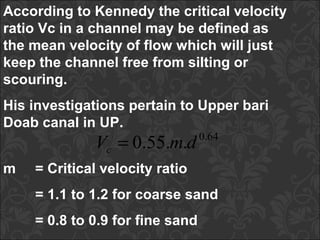
According to Kennedy the critical velocity
ratio Vc in a channel may be defined as
the mean velocity of flow which will just
keep the channel free from silting or
scouring.
His investigations pertain to Upper bari
Doab canal in UP.
64.0
..55.0 dmVc =
m = Critical velocity ratio
= 1.1 to 1.2 for coarse sand
= 0.8 to 0.9 for fine sand
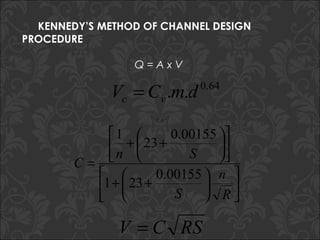
KENNEDY’S METHOD OF CHANNEL DESIGN
PROCEDURE
Q = A x V
=V












++












++
=
R
n
S
Sn
C
00155.0
231
00155.0
23
1
RSCV =
64.0
.. dmCV vc =
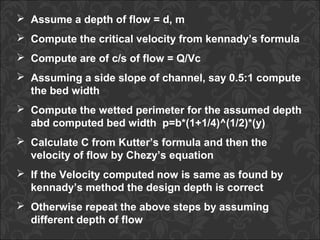
 Assume a depth of flow = d, m
 Compute the critical velocity from kennady’s formula
 Compute are of c/s of flow = Q/Vc
 Assuming a side slope of channel, say 0.5:1 compute
the bed width
 Compute the wetted perimeter for the assumed depth
abd computed bed width p=b*(1+1/4)^(1/2)*(y)
 Calculate C from Kutter’s formula and then the
velocity of flow by Chezy’s equation
 If the Velocity computed now is same as found by
kennady’s method the design depth is correct
 Otherwise repeat the above steps by assuming
different depth of flow
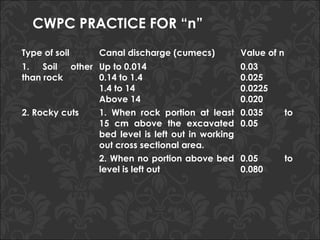
CWPC PRACTICE FOR “n”
Type of soil Canal discharge (cumecs) Value of n
1. Soil other
than rock
Up to 0.014
0.14 to 1.4
1.4 to 14
Above 14
0.03
0.025
0.0225
0.020
2. Rocky cuts 1. When rock portion at least
15 cm above the excavated
bed level is left out in working
out cross sectional area.
0.035 to
0.05
2. When no portion above bed
level is left out
0.05 to
0.080
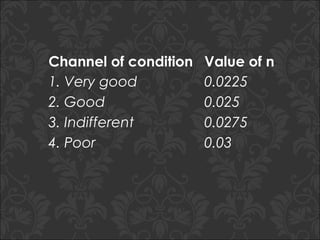
Channel of condition Value of n
1. Very good 0.0225
2. Good 0.025
3. Indifferent 0.0275
4. Poor 0.03
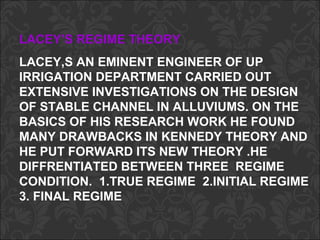
LACEY’S REGIME THEORY
LACEY,S AN EMINENT ENGINEER OF UP
IRRIGATION DEPARTMENT CARRIED OUT
EXTENSIVE INVESTIGATIONS ON THE DESIGN
OF STABLE CHANNEL IN ALLUVIUMS. ON THE
BASICS OF HIS RESEARCH WORK HE FOUND
MANY DRAWBACKS IN KENNEDY THEORY AND
HE PUT FORWARD ITS NEW THEORY .HE
DIFFRENTIATED BETWEEN THREE REGIME
CONDITION. 1.TRUE REGIME 2.INITIAL REGIME
3. FINAL REGIME
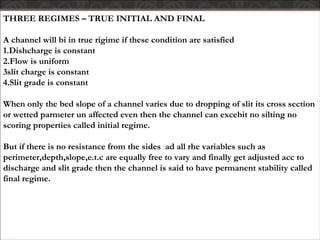
THREE REGIMES – TRUE INITIAL AND FINAL
A channel will bi in true rigime if these condition are satisfied
1.Dishcharge is constant
2.Flow is uniform
3slit charge is constant
4.Slit grade is constant
When only the bed slope of a channel varies due to dropping of slit its cross section
or wetted parmeter un affected even then the channel can excebit no silting no
scoring properties called initial regime.
But if there is no resistance from the sides ad all rhe variables such as
perimeter,depth,slope,e.t.c are equally free to vary and finally get adjusted acc to
discharge and slit grade then the channel is said to have permanent stability called
final regime.
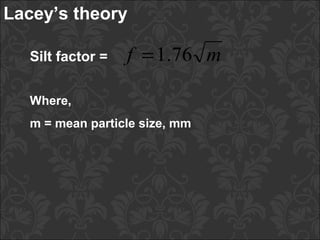
Silt factor = mf 76.1=
Where,
m = mean particle size, mm
Lacey’s theory
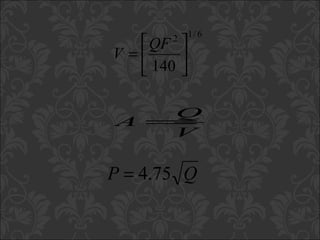
6/12
140






=
QF
V
V
Q
A =
QP 75.4=






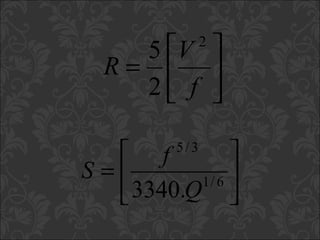
=
f
V
R
2
2
5






= 6/1
3/5
.3340 Q
f
S
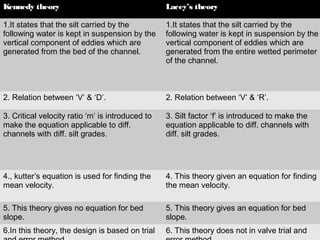
Kennedy theory Lacey’s theory
1.It states that the silt carried by the
following water is kept in suspension by the
vertical component of eddies which are
generated from the bed of the channel.
1.It states that the silt carried by the
following water is kept in suspension by the
vertical component of eddies which are
generated from the entire wetted perimeter
of the channel.
2. Relation between ‘V’ & ‘D’. 2. Relation between ‘V’ & ‘R’.
3. Critical velocity ratio ‘m’ is introduced to
make the equation applicable to diff.
channels with diff. silt grades.
3. Silt factor ‘f’ is introduced to make the
equation applicable to diff. channels with
diff. silt grades.
4., kutter’s equation is used for finding the
mean velocity.
4. This theory given an equation for finding
the mean velocity.
5. This theory gives no equation for bed
slope.
5. This theory gives an equation for bed
slope.
6.In this theory, the design is based on trial 6. This theory does not in valve trial and
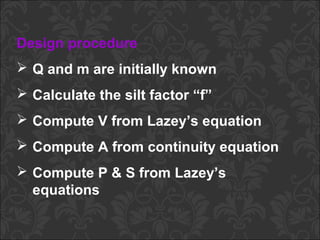
Design procedure
 Q and m are initially known
 Calculate the silt factor “f”
 Compute V from Lazey’s equation
 Compute A from continuity equation
 Compute P & S from Lazey’s
equations
Kennedy's and laccy's theory

Kennedy's and laccy's theory

  • 1.
  • 2.
    RG KENNEDY ANEXECUTIVE ENGINEER OF PUNJAB PWD CARRIED OUT EXTENSIVE INVESTIGATIONS ON SOME OF THE CANAL REACHES IN THE UPPER BARI DOAB CANAL SYSTEM HE SELECTED SOME STRAIGHT REACHES OF THE CANAL SECTION WHICH HAD NOT POSED ANY SILTING AND SCOURING PROBLEMS DURING THE PREVIOUS 30 YEARS.
  • 3.
    FROM THE OBSERVATIONHE CONCLUDED THAT THE SILT SUPPORTING POWER IN A CHANNEL CROSS SECTION WAS MAINLY DEPENDENT UPON THE GENERATION OF THE EDDIES RISING TO THE SURFACE.THESE EDDIES ARE GENERATED DUE TO THE FRICTION OF THE FLOWING WATWR WITH THE CHANNEL SURFACE.THE VERTICAL COMPONENT OF THESE EDDIES TRY TO MOVE THE SEDIMENT UP WHILE WEIGHT OF THE SEDIMENT TRIES TO BRING IT DOWN.SO IF THE VEL IS SUFFICIENT TO GENERATE EDDIES SO AS TO KEEP THE SEDIMENT JUST IN SUSPENSION SILTING WILL BE AVOIDED BASED ON THIS COCEPT HE DEFINED CRITICAL VELOCITY.
  • 4.
    According to Kennedythe critical velocity ratio Vc in a channel may be defined as the mean velocity of flow which will just keep the channel free from silting or scouring. His investigations pertain to Upper bari Doab canal in UP. 64.0 ..55.0 dmVc = m = Critical velocity ratio = 1.1 to 1.2 for coarse sand = 0.8 to 0.9 for fine sand
  • 5.
    KENNEDY’S METHOD OFCHANNEL DESIGN PROCEDURE Q = A x V =V             ++             ++ = R n S Sn C 00155.0 231 00155.0 23 1 RSCV = 64.0 .. dmCV vc =
  • 6.
     Assume adepth of flow = d, m  Compute the critical velocity from kennady’s formula  Compute are of c/s of flow = Q/Vc  Assuming a side slope of channel, say 0.5:1 compute the bed width  Compute the wetted perimeter for the assumed depth abd computed bed width p=b*(1+1/4)^(1/2)*(y)  Calculate C from Kutter’s formula and then the velocity of flow by Chezy’s equation  If the Velocity computed now is same as found by kennady’s method the design depth is correct  Otherwise repeat the above steps by assuming different depth of flow
  • 7.
    CWPC PRACTICE FOR“n” Type of soil Canal discharge (cumecs) Value of n 1. Soil other than rock Up to 0.014 0.14 to 1.4 1.4 to 14 Above 14 0.03 0.025 0.0225 0.020 2. Rocky cuts 1. When rock portion at least 15 cm above the excavated bed level is left out in working out cross sectional area. 0.035 to 0.05 2. When no portion above bed level is left out 0.05 to 0.080
  • 8.
    Channel of conditionValue of n 1. Very good 0.0225 2. Good 0.025 3. Indifferent 0.0275 4. Poor 0.03
  • 9.
    LACEY’S REGIME THEORY LACEY,SAN EMINENT ENGINEER OF UP IRRIGATION DEPARTMENT CARRIED OUT EXTENSIVE INVESTIGATIONS ON THE DESIGN OF STABLE CHANNEL IN ALLUVIUMS. ON THE BASICS OF HIS RESEARCH WORK HE FOUND MANY DRAWBACKS IN KENNEDY THEORY AND HE PUT FORWARD ITS NEW THEORY .HE DIFFRENTIATED BETWEEN THREE REGIME CONDITION. 1.TRUE REGIME 2.INITIAL REGIME 3. FINAL REGIME
  • 10.
    THREE REGIMES –TRUE INITIAL AND FINAL A channel will bi in true rigime if these condition are satisfied 1.Dishcharge is constant 2.Flow is uniform 3slit charge is constant 4.Slit grade is constant When only the bed slope of a channel varies due to dropping of slit its cross section or wetted parmeter un affected even then the channel can excebit no silting no scoring properties called initial regime. But if there is no resistance from the sides ad all rhe variables such as perimeter,depth,slope,e.t.c are equally free to vary and finally get adjusted acc to discharge and slit grade then the channel is said to have permanent stability called final regime.
  • 11.
    Silt factor =mf 76.1= Where, m = mean particle size, mm Lacey’s theory
  • 12.
  • 13.
  • 14.
    Kennedy theory Lacey’stheory 1.It states that the silt carried by the following water is kept in suspension by the vertical component of eddies which are generated from the bed of the channel. 1.It states that the silt carried by the following water is kept in suspension by the vertical component of eddies which are generated from the entire wetted perimeter of the channel. 2. Relation between ‘V’ & ‘D’. 2. Relation between ‘V’ & ‘R’. 3. Critical velocity ratio ‘m’ is introduced to make the equation applicable to diff. channels with diff. silt grades. 3. Silt factor ‘f’ is introduced to make the equation applicable to diff. channels with diff. silt grades. 4., kutter’s equation is used for finding the mean velocity. 4. This theory given an equation for finding the mean velocity. 5. This theory gives no equation for bed slope. 5. This theory gives an equation for bed slope. 6.In this theory, the design is based on trial 6. This theory does not in valve trial and
  • 15.
    Design procedure  Qand m are initially known  Calculate the silt factor “f”  Compute V from Lazey’s equation  Compute A from continuity equation  Compute P & S from Lazey’s equations