Pre-Operative Nursing
Care
PRE OPERATIVE PHASE
Preoperative: begins with the decision to perform
surgery and continues until the client has reached the
operating area.
1. Pre-operative Assessment
2. Obtaining Informed Consent
3. PreoperativeTeaching
4. Physical Preparation Of Patient
5. Psychological Preparation Of Patient
:
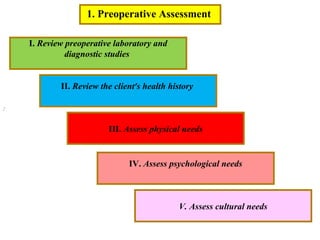
1. Preoperative Assessment
I. Review preoperative laboratory and
diagnostic studies
II. Review the client’s health history
III. Assess physical needs
IV. Assess psychological needs
V. Assess cultural needs
I. Review preoperative laboratory and diagnostic studies:
•Complete blood count.
•Blood type and cross match.
•Serum electrolytes.
•Urinalysis.
•Chest X-rays.
•Electrocardiogram.
•Other tests related to procedure or client’s medical condition, such
as: prothrombin time, partial thromboplastin time, blood urea
nitrogen, creatinine, and other radiographic studies.
II. Review the client’s health history:
•History of present illness and reason for surgery
•Past medical history
•Medical conditions (acute and chronic)
•Previous hospitalization and surgeries
•History of any past problem with anesthesia
•Allergies
•Present medications
•Substance use: alcohol, tobacco, drugs
•Review of system
III. Assess physical needs:
•Ability to communicate
•Vital signs
•Level of consciousness
Confusion
Drowsiness
Unresponsiveness
•Weight and height
•Ability to move/ ambulate
•Level of exercise
•Prostheses
•Circulatory status
IV. Assess psychological needs:
•Emotional state
•Level of understanding of surgical procedure, preoperative and
postoperative instruction
•Coping strategies
•Support system
V. Assess cultural needs:
•Language-need for interpreter
2. OBTAINING INFORMED CONSENT
 Before surgery, the client must sign a surgical consent form or
operative permit.
 Clients must sign a consent form for any procedure that requires
anesthesia and has risks of complications.
 If an adult client is confused, unconscious, a family member or
guardian must sign the consent form.
 If the client is younger than 18 years of age, a parent or legal
guardian must sign the consent form.
 In an emergency, the surgeon may have to operate without
consent, health care personnel, however, makes every effort to
obtain consent by telephone, or fax.
 Each nurse must be familiar with agency policies and state laws
regarding surgical consent forms.
 Clients must sign the consent form before receiving any
preoperative sedatives.
 The nurse is responsible for ensuring that all necessary parties
have signed the consent form and that it is in the client’s chart
before the client goes to the operating room (OR).
 Teaching clients about their surgical procedure
and expectations before and after surgery is best
done during the preoperative period.
 Clients are more alert and free of pain at this
time.
 Information in a preoperative teaching plan
varies with the type of surgery and the length of
the hospitalization.
 Preoperative medication.
 Post operative pain control.
 Discussion of the frequency of assessing vital signs and
use of monitoring equipment.
 Explanation and demonstration
 Deep breathing and coughing exercises,
 Use of incentive spirometry,
 How to support the incision for breathing exercises and
moving,
 Position changes
 Feet and leg exercises.
 Postoperative IV lines and tubings ex: NG tube
Preoperative preparation includes the following areas:
1. Nutrition and fluids
2. Elimination
3. Hygiene
4. Medications
5. Sleep
6. Care of valuables
7. Prostheses
8. Special orders
9. Surgical skin preparation
10. Safety protocols
11.Vital signs
12.Anti embolic stockings
 1. Nutrition and Fluids:
 Adequate hydration and nutrition promote
healing.
 Usually “NPO after midnight” followed because it
anesthetics depress gastrointestinal functioning
and there was a danger the client would vomit and
aspirate during the administration of a general
anesthetic.
 The current guidelines allow for:
I. The consumption of clear liquids up to 2 hours
II. The consumption of breast milk 4 hours before
surgery
III. A light breakfast (e.g., formula, milk, light meal
such as tea and toast) 6 hours before the
procedure
IV. A heavier meal 8 hours before surgery.
2. Bowel and bladder Elimination:
 Enemas may be ordered if bowel surgery is
planned.
 The enemas help prevent contamination of the
surgical area (during surgery) by feces.
 Prior to surgery an indwelling Foley catheter may
be ordered to ensure that the bladder remains
empty.
 This helps prevent injury to the bladder,
particularly during pelvic surgery.
3. Hygiene:
 In some settings, clients are asked to bathe or
shower the evening or morning of surgery (or
both).
 The purpose of hygienic measures is to reduce the
risk of wound infection by reducing the amount of
bacteria on the client’s skin.
 The client’s nails should be trimmed and free
of polish, and all cosmetics should be
removed so that the nail beds, skin, and lips
are visible when circulation is assessed during
the perioperative phases
4. Pre operative Medications:
 preoperative medications are given to the client
prior to going to the operating room.
 Commonly used preoperative medications
includes:
• Antiemetics
• Anticholinergics
• Sedatives
• Antibiotics
5. Sleep:
 Nurses should do everything to help the
client sleep the night before surgery. Often a
sedative is ordered. EG: ALPRAZOLAM
 Adequate sleep helps the client manage the
stress of surgery and helps healing.
6. Care of valuables:
 Valuables such as jewelry and money should be
sent home with the client’s family or significant
other.
 If valuables/money cannot be sent home, they
need to be labeled and placed in a locked storage
area per the agency’s policy.
7.Care of Prostheses:
• All prostheses (artificial body parts) such as
partial or complete dentures, contact lenses,
artificial eyes, and artificial limbs and
eyeglasses, wigs, and false eyelashes must be
removed before surgery.
8. Special Orders.
 The nurse checks the surgeon’s orders for
special requirements (e.g., the insertion of a
nasogastric tube prior to surgery, the
administration of medications, such as
insulin, or the application of antiemboli
stockings).
9. Skin Preparation.
 The surgical site is cleansed with an
antimicrobial to remove soil and reduce the
resident microbial count to sub pathogenic
levels
 REMOVE THE HAIR at the site of surgery
10. Safety Protocols:
INCLUDES:
 Identifying the patient and surgery to be
performed
 Surgical site marking
11.Vital Signs:
In the preoperative phase the nurse assesses and
documents vital signs for baseline data.
The nurse reports any abnormal findings, such as
elevated blood pressure or elevated temperature
12. Antiemboli Stockings:
 Antiemboli (elastic) stockings are firm elastic
hose that compress the veins of the legs and
thereby facilitate the return of venous blood
to the heart.
 Careful preoperative teaching can reduce fear and
anxiety of the clients.
Nursing Diagnosis
• Anxiety related to results of surgery and
postoperative pain.
• Knowledge deficit related to preoperative
procedures and postoperative expectations.
Preoperative care

Preoperative care

  • 1.
  • 3.
    PRE OPERATIVE PHASE Preoperative:begins with the decision to perform surgery and continues until the client has reached the operating area.
  • 4.
    1. Pre-operative Assessment 2.Obtaining Informed Consent 3. PreoperativeTeaching 4. Physical Preparation Of Patient 5. Psychological Preparation Of Patient
  • 5.
    : 1. Preoperative Assessment I.Review preoperative laboratory and diagnostic studies II. Review the client’s health history III. Assess physical needs IV. Assess psychological needs V. Assess cultural needs
  • 6.
    I. Review preoperativelaboratory and diagnostic studies: •Complete blood count. •Blood type and cross match. •Serum electrolytes. •Urinalysis. •Chest X-rays. •Electrocardiogram. •Other tests related to procedure or client’s medical condition, such as: prothrombin time, partial thromboplastin time, blood urea nitrogen, creatinine, and other radiographic studies.
  • 7.
    II. Review theclient’s health history: •History of present illness and reason for surgery •Past medical history •Medical conditions (acute and chronic) •Previous hospitalization and surgeries •History of any past problem with anesthesia •Allergies •Present medications •Substance use: alcohol, tobacco, drugs •Review of system
  • 8.
    III. Assess physicalneeds: •Ability to communicate •Vital signs •Level of consciousness Confusion Drowsiness Unresponsiveness •Weight and height •Ability to move/ ambulate •Level of exercise •Prostheses •Circulatory status
  • 9.
    IV. Assess psychologicalneeds: •Emotional state •Level of understanding of surgical procedure, preoperative and postoperative instruction •Coping strategies •Support system V. Assess cultural needs: •Language-need for interpreter
  • 10.
    2. OBTAINING INFORMEDCONSENT  Before surgery, the client must sign a surgical consent form or operative permit.  Clients must sign a consent form for any procedure that requires anesthesia and has risks of complications.  If an adult client is confused, unconscious, a family member or guardian must sign the consent form.  If the client is younger than 18 years of age, a parent or legal guardian must sign the consent form.  In an emergency, the surgeon may have to operate without consent, health care personnel, however, makes every effort to obtain consent by telephone, or fax.  Each nurse must be familiar with agency policies and state laws regarding surgical consent forms.  Clients must sign the consent form before receiving any preoperative sedatives.  The nurse is responsible for ensuring that all necessary parties have signed the consent form and that it is in the client’s chart before the client goes to the operating room (OR).
  • 11.
     Teaching clientsabout their surgical procedure and expectations before and after surgery is best done during the preoperative period.  Clients are more alert and free of pain at this time.  Information in a preoperative teaching plan varies with the type of surgery and the length of the hospitalization.
  • 12.
     Preoperative medication. Post operative pain control.  Discussion of the frequency of assessing vital signs and use of monitoring equipment.  Explanation and demonstration  Deep breathing and coughing exercises,  Use of incentive spirometry,  How to support the incision for breathing exercises and moving,  Position changes  Feet and leg exercises.  Postoperative IV lines and tubings ex: NG tube
  • 13.
    Preoperative preparation includesthe following areas: 1. Nutrition and fluids 2. Elimination 3. Hygiene 4. Medications 5. Sleep 6. Care of valuables 7. Prostheses 8. Special orders 9. Surgical skin preparation 10. Safety protocols 11.Vital signs 12.Anti embolic stockings
  • 14.
     1. Nutritionand Fluids:  Adequate hydration and nutrition promote healing.  Usually “NPO after midnight” followed because it anesthetics depress gastrointestinal functioning and there was a danger the client would vomit and aspirate during the administration of a general anesthetic.
  • 15.
     The currentguidelines allow for: I. The consumption of clear liquids up to 2 hours II. The consumption of breast milk 4 hours before surgery III. A light breakfast (e.g., formula, milk, light meal such as tea and toast) 6 hours before the procedure IV. A heavier meal 8 hours before surgery.
  • 16.
    2. Bowel andbladder Elimination:  Enemas may be ordered if bowel surgery is planned.  The enemas help prevent contamination of the surgical area (during surgery) by feces.  Prior to surgery an indwelling Foley catheter may be ordered to ensure that the bladder remains empty.  This helps prevent injury to the bladder, particularly during pelvic surgery.
  • 17.
    3. Hygiene:  Insome settings, clients are asked to bathe or shower the evening or morning of surgery (or both).  The purpose of hygienic measures is to reduce the risk of wound infection by reducing the amount of bacteria on the client’s skin.
  • 18.
     The client’snails should be trimmed and free of polish, and all cosmetics should be removed so that the nail beds, skin, and lips are visible when circulation is assessed during the perioperative phases
  • 19.
    4. Pre operativeMedications:  preoperative medications are given to the client prior to going to the operating room.  Commonly used preoperative medications includes: • Antiemetics • Anticholinergics • Sedatives • Antibiotics
  • 20.
    5. Sleep:  Nursesshould do everything to help the client sleep the night before surgery. Often a sedative is ordered. EG: ALPRAZOLAM  Adequate sleep helps the client manage the stress of surgery and helps healing.
  • 21.
    6. Care ofvaluables:  Valuables such as jewelry and money should be sent home with the client’s family or significant other.  If valuables/money cannot be sent home, they need to be labeled and placed in a locked storage area per the agency’s policy.
  • 22.
    7.Care of Prostheses: •All prostheses (artificial body parts) such as partial or complete dentures, contact lenses, artificial eyes, and artificial limbs and eyeglasses, wigs, and false eyelashes must be removed before surgery.
  • 23.
    8. Special Orders. The nurse checks the surgeon’s orders for special requirements (e.g., the insertion of a nasogastric tube prior to surgery, the administration of medications, such as insulin, or the application of antiemboli stockings).
  • 24.
    9. Skin Preparation. The surgical site is cleansed with an antimicrobial to remove soil and reduce the resident microbial count to sub pathogenic levels  REMOVE THE HAIR at the site of surgery
  • 25.
    10. Safety Protocols: INCLUDES: Identifying the patient and surgery to be performed  Surgical site marking
  • 26.
    11.Vital Signs: In thepreoperative phase the nurse assesses and documents vital signs for baseline data. The nurse reports any abnormal findings, such as elevated blood pressure or elevated temperature
  • 27.
    12. Antiemboli Stockings: Antiemboli (elastic) stockings are firm elastic hose that compress the veins of the legs and thereby facilitate the return of venous blood to the heart.
  • 28.
     Careful preoperativeteaching can reduce fear and anxiety of the clients.
  • 30.
    Nursing Diagnosis • Anxietyrelated to results of surgery and postoperative pain. • Knowledge deficit related to preoperative procedures and postoperative expectations.