Trissa Borgschulte, PhD
Head of Cell Line Development and Engineering
Process Solutions Upstream R&D
Applications in Therapeutic Protein Expression Systems
NOT FOR U.S. AND CANADA AUDIENCE
2
Outline
Biomarker Discovery Background
ZFN Genome Editing Technology
Glutamine Synthetase Cell Line Engineering
Glycoengineering
Targeted Gene Integration
Webinar: Cell Line Engineering
3
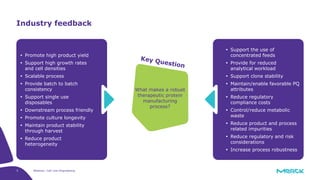
Industry feedback
Webinar: Cell Line Engineering
 Support the use of
concentrated feeds
 Provide for reduced
analytical workload
 Support clone stability
 Maintain/enable favorable PQ
attributes
 Reduce regulatory
compliance costs
 Control/reduce metabolic
waste
 Reduce product and process
related impurities
 Reduce regulatory and risk
considerations
 Increase process robustness
 Promote high product yield
 Support high growth rates
and cell densities
 Scalable process
 Provide batch to batch
consistency
 Support single use
disposables
 Downstream process friendly
 Promote culture longevity
 Maintain product stability
through harvest
 Reduce product
heterogeneity
What makes a robust
therapeutic protein
manufacturing
process?
4
Webinar: Cell Line Engineering
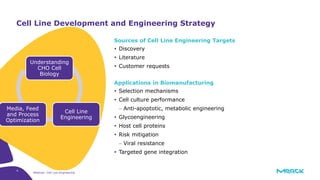
Cell Line Development and Engineering Strategy
Sources of Cell Line Engineering Targets
 Discovery
 Literature
 Customer requests
Applications in Biomanufacturing
 Selection mechanisms
 Cell culture performance
 Anti-apoptotic, metabolic engineering
 Glycoengineering
 Host cell proteins
 Risk mitigation
 Viral resistance
 Targeted gene integration
Understanding
CHO Cell
Biology
Cell Line
Engineering
Media, Feed
and Process
Optimization
5 Webinar: Cell Line Engineering
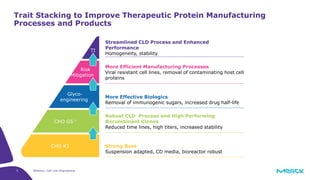
Trait Stacking to Improve Therapeutic Protein Manufacturing
Processes and Products
TI
Streamlined CLD Process and Enhanced
Performance
Homogeneity, stability
More Effective Biologics
Removal of immunogenic sugars, increased drug half-life
Robust CLD Process and High Performing
Recombinant Clones
Reduced time lines, high titers, increased stability
More Efficient Manufacturing Processes
Viral resistant cell lines, removal of contaminating host cell
proteins
Strong Base
Suspension adapted, CD media, bioreactor robust
Glyco-
engineering
Risk
Mitigation
CHO GS-/-
CHO K1
6 Webinar: Cell Line Engineering
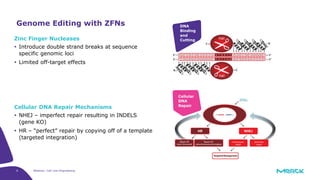
Genome Editing with ZFNs
Zinc Finger Nucleases
 Introduce double strand breaks at sequence
specific genomic loci
 Limited off-target effects
Cellular DNA Repair Mechanisms
 NHEJ – imperfect repair resulting in INDELS
(gene KO)
 HR – “perfect” repair by copying off of a template
(targeted integration)
Cellular
DNA
Repair
DNA
Binding
and
Cutting
7 Webinar: Cell Line Engineering
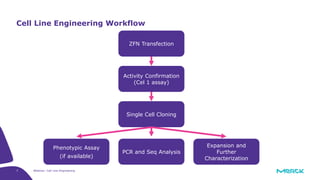
Cell Line Engineering Workflow
ZFN Transfection
Activity Confirmation
(Cel 1 assay)
Single Cell Cloning
Expansion and
Further
Characterization
PCR and Seq Analysis
Phenotypic Assay
(if available)
8 Webinar: Cell Line Engineering
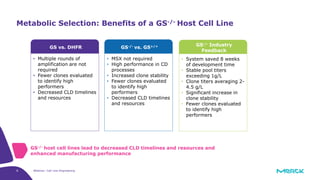
Metabolic Selection: Benefits of a GS-/- Host Cell Line
GS-/- host cell lines lead to decreased CLD timelines and resources and
enhanced manufacturing performance
• Multiple rounds of
amplification are not
required
• Fewer clones evaluated
to identify high
performers
• Decreased CLD timelines
and resources
GS vs. DHFR
• MSX not required
• High performance in CD
processes
• Increased clone stability
• Fewer clones evaluated
to identify high
performers
• Decreased CLD timelines
and resources
GS-/- vs. GS+/+
• System saved 8 weeks
of development time
• Stable pool titers
exceeding 1g/L
• Clone titers averaging 2-
4.5 g/L
• Significant increase in
clone stability
• Fewer clones evaluated
to identify high
performers
GS-/- Industry
Feedback
9 Webinar: Cell Line Engineering
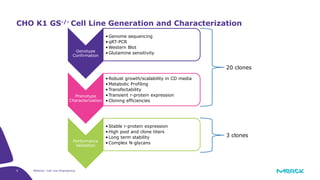
CHO K1 GS-/- Cell Line Generation and Characterization
Genotype
Confirmation
•Genome sequencing
•qRT-PCR
•Western Blot
•Glutamine sensitivity
Phenotype
Characterization
•Robust growth/scalability in CD media
•Metabolic Profiling
•Transfectability
•Transient r-protein expression
•Cloning efficiencies
Performance
Validation
•Stable r-protein expression
•High pool and clone titers
•Long term stability
•Complex N-glycans
20 clones
3 clones
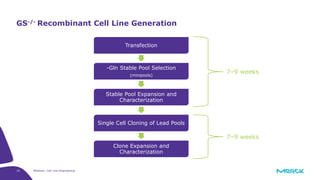
Transfection
-Gln Stable Pool Selection
(minipools)
Stable Pool Expansion and
Characterization
Single Cell Cloning of Lead Pools
Clone Expansion and
Characterization
10 Webinar: Cell Line Engineering
GS-/- Recombinant Cell Line Generation
7–9 weeks
7–9 weeks
11 Webinar: Cell Line Engineering
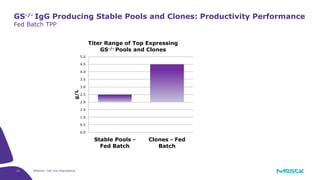
GS-/- IgG Producing Stable Pools and Clones: Productivity Performance
Fed Batch TPP
0.0
0.5
1.0
1.5
2.0
2.5
3.0
3.5
4.0
4.5
5.0
Stable Pools -
Fed Batch
Clones - Fed
Batch
g/L
Titer Range of Top Expressing
GS-/- Pools and Clones
12 Webinar: Cell Line Engineering
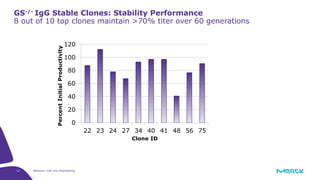
GS-/- IgG Stable Clones: Stability Performance
8 out of 10 top clones maintain >70% titer over 60 generations
13 Webinar: Cell Line Engineering
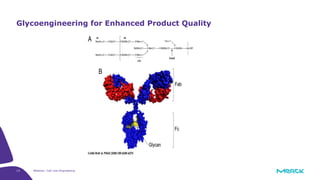
Glycoengineering for Enhanced Product Quality
14 Webinar: Cell Line Engineering
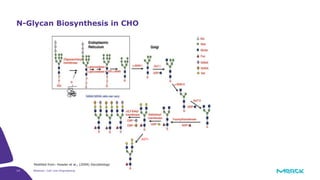
N-Glycan Biosynthesis in CHO
Modified from: Hossler et al., (2009) Glycobiology
GGTA
15 Webinar: Cell Line Engineering
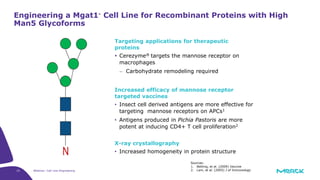
Engineering a Mgat1- Cell Line for Recombinant Proteins with High
Man5 Glycoforms
Sources:
1. Betting, et al. (2009) Vaccine
2. Lam, et al. (2005) J of Immunology
Targeting applications for therapeutic
proteins
 Cerezyme® targets the mannose receptor on
macrophages
 Carbohydrate remodeling required
Increased efficacy of mannose receptor
targeted vaccines
• Insect cell derived antigens are more effective for
targeting mannose receptors on APCs1
• Antigens produced in Pichia Pastoris are more
potent at inducing CD4+ T cell proliferation2
X-ray crystallography
• Increased homogeneity in protein structure
16 Webinar: Cell Line Engineering
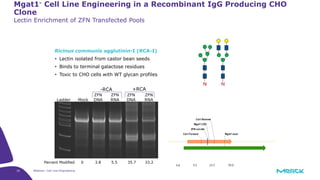
Mgat1- Cell Line Engineering in a Recombinant IgG Producing CHO
Clone
Lectin Enrichment of ZFN Transfected Pools
Ricinus communis agglutinin-I (RCA-I)
 Lectin isolated from castor bean seeds
 Binds to terminal galactose residues
 Toxic to CHO cells with WT glycan profiles
Ladder Mock
ZFN
DNA
ZFN
RNA
ZFN
RNA
ZFN
DNA
Percent Modified 0 3.8 5.5 35.7 33.2
-RCA +RCA
17 Webinar: Cell Line Engineering
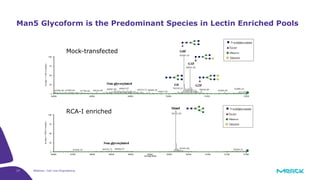
Man5 Glycoform is the Predominant Species in Lectin Enriched Pools
Mock-transfected
RCA-I enriched
18 Webinar: Cell Line Engineering
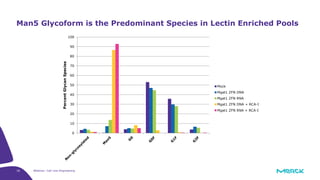
Man5 Glycoform is the Predominant Species in Lectin Enriched Pools
0
10
20
30
40
50
60
70
80
90
100
PercentGlycanSpecies
Mock
Mgat1 ZFN DNA
Mgat1 ZFN RNA
Mgat1 ZFN DNA + RCA-I
Mgat1 ZFN RNA + RCA-I
19 Webinar: Cell Line Engineering
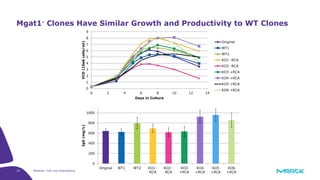
Mgat1- Clones Have Similar Growth and Productivity to WT Clones
0
1
2
3
4
5
6
7
8
9
0 2 4 6 8 10 12 14
VCD(10e6cells/ml)
Days in Culture
Original
WT1
WT2
KO1 -RCA
KO2 -RCA
KO3 +RCA
KO4 +RCA
KO5 +RCA
KO6 +RCA
0
200
400
600
800
1000
Original WT1 WT2 KO1 -
RCA
KO2 -
RCA
KO3
+RCA
KO4
+RCA
KO5
+RCA
KO6
+RCA
IgG(mg/L)
20 Webinar: Cell Line Engineering
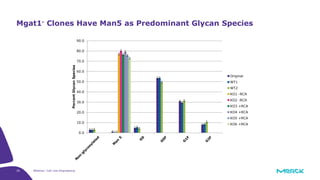
Mgat1- Clones Have Man5 as Predominant Glycan Species
0.0
10.0
20.0
30.0
40.0
50.0
60.0
70.0
80.0
90.0
PercentGlycanSpecies
Original
WT1
WT2
KO1 -RCA
KO2 -RCA
KO3 +RCA
KO4 +RCA
KO5 +RCA
KO6 +RCA
21 Webinar: Cell Line Engineering
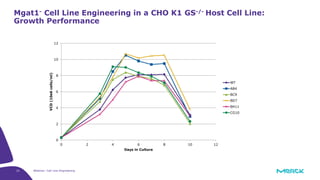
Mgat1- Cell Line Engineering in a CHO K1 GS-/- Host Cell Line:
Growth Performance
0
2
4
6
8
10
12
0 2 4 6 8 10 12
VCD(10e6cells/ml)
Days in Culture
WT
AB4
BC9
BD7
BH11
CG10
22 Webinar: Cell Line Engineering
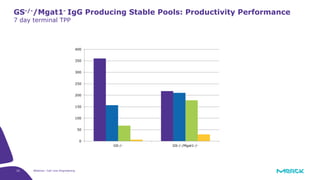
GS-/-/Mgat1- IgG Producing Stable Pools: Productivity Performance
7 day terminal TPP
0
50
100
150
200
250
300
350
400
GS-/- GS-/-/Mgat1-/-
23 Webinar: Cell Line Engineering
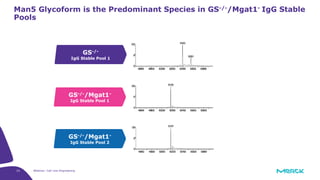
Man5 Glycoform is the Predominant Species in GS-/-/Mgat1- IgG Stable
Pools
GS-/-
IgG Stable Pool 1
GS-/-/Mgat1-
IgG Stable Pool 1
GS-/-/Mgat1-
IgG Stable Pool 2
24 Webinar: Cell Line Engineering
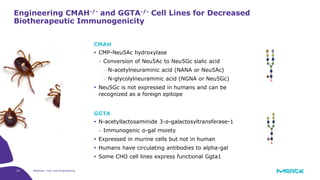
Engineering CMAH-/- and GGTA-/- Cell Lines for Decreased
Biotherapeutic Immunogenicity
CMAH
 CMP-Neu5Ac hydroxylase
 Conversion of Neu5Ac to Neu5Gc sialic acid
 N-acetylneuraminic acid (NANA or Neu5Ac)
 N-glycolylneuraminic acid (NGNA or Neu5Gc)
 Neu5Gc is not expressed in humans and can be
recognized as a foreign epitope
GGTA
 N-acetyllactosaminide 3-α-galactosyltransferase-1
 Immunogenic α-gal moiety
 Expressed in murine cells but not in human
 Humans have circulating antibodies to alpha-gal
 Some CHO cell lines express functional Ggta1
25 Webinar: Cell Line Engineering
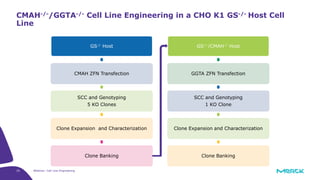
CMAH-/-/GGTA-/- Cell Line Engineering in a CHO K1 GS-/- Host Cell
Line
GS-/- Host
CMAH ZFN Transfection
SCC and Genotyping
5 KO Clones
Clone Expansion and Characterization
Clone Banking
GS-/-/CMAH-/- Host
GGTA ZFN Transfection
SCC and Genotyping
1 KO Clone
Clone Expansion and Characterization
Clone Banking
26 Webinar: Cell Line Engineering
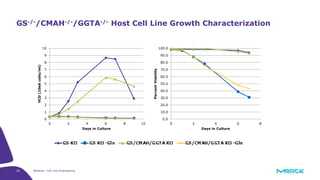
GS-/-/CMAH-/-/GGTA-/- Host Cell Line Growth Characterization
0
1
2
3
4
5
6
7
8
9
10
0 2 4 6 8 10
VCD(10e6cells/ml)
Days in Culture
0.0
10.0
20.0
30.0
40.0
50.0
60.0
70.0
80.0
90.0
100.0
0 2 4 6 8
PercentViability
Days in Culture
27 Webinar: Cell Line Engineering
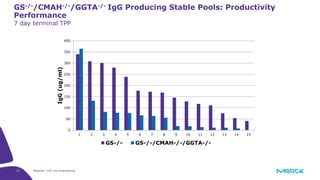
GS-/-/CMAH-/-/GGTA-/- IgG Producing Stable Pools: Productivity
Performance
7 day terminal TPP
0
50
100
150
200
250
300
350
400
1 2 3 4 5 6 7 8 9 10 11 12 13 14 15
IgG(ug/ml)
GS-/- GS-/-/CMAH-/-/GGTA-/-
28 Webinar: Cell Line Engineering
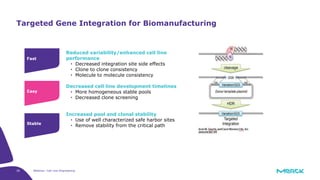
Targeted Gene Integration for Biomanufacturing
Reduced variability/enhanced cell line
performance
• Decreased integration site side effects
• Clone to clone consistency
• Molecule to molecule consistency
Decreased cell line development timelines
• More homogeneous stable pools
• Decreased clone screening
Increased pool and clonal stability
• Use of well characterized safe harbor sites
• Remove stability from the critical path
29 Webinar: Cell Line Engineering
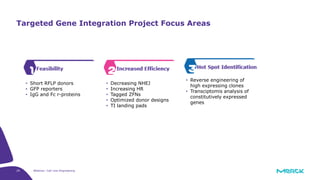
Targeted Gene Integration Project Focus Areas
321
• Short RFLP donors
• GFP reporters
• IgG and Fc r-proteins
• Decreasing NHEJ
• Increasing HR
• Tagged ZFNs
• Optimized donor designs
• TI landing pads
• Reverse engineering of
high expressing clones
• Transciptomis analysis of
constitutively expressed
genes
Increased EfficiencyFeasibility Hot Spot Identification
30 Webinar: Cell Line Engineering
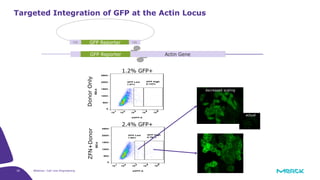
Targeted Integration of GFP at the Actin Locus
DonorOnlyZFN+Donor
1.2% GFP+
2.4% GFP+
decreased scaling
actual
GFP Reporter HAHA
Actin GeneGFP Reporter Actin Gene
31 Webinar: Cell Line Engineering
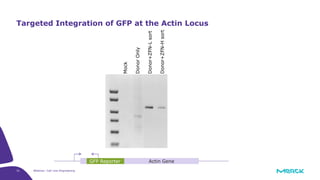
Targeted Integration of GFP at the Actin Locus
Mock
DonorOnly
Donor+ZFN-Lsort
Donor+ZFN-HsortGFP Reporter Actin Gene
32 Webinar: Cell Line Engineering
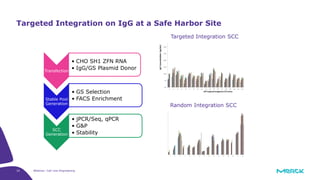
Targeted Integration on IgG at a Safe Harbor Site
Transfection
• CHO SH1 ZFN RNA
• IgG/GS Plasmid Donor
Stable Pool
Generation
• GS Selection
• FACS Enrichment
SCC
Generation
• jPCR/Seq, qPCR
• G&P
• Stability
Targeted Integration SCC
Random Integration SCC
33 Webinar: Cell Line Engineering
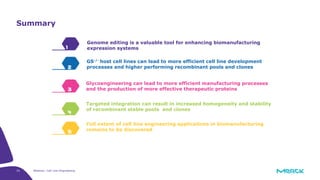
Summary
4
3
2
1
Genome editing is a valuable tool for enhancing biomanufacturing
expression systems
GS-/- host cell lines can lead to more efficient cell line development
processes and higher performing recombinant pools and clones
Glycoengineering can lead to more efficient manufacturing processes
and the production of more effective therapeutic proteins
Targeted integration can result in increased homogeneity and stability
of recombinant stable pools and clones
5
Full extent of cell line engineering applications in biomanufacturing
remains to be discovered
Questions?
34
Erika Holroyd
Product Manager, Cell Line
Development and Engineering
CHOZN® Program
erika.holroyd@sial.com
CONTACT
Trissa Borgschulte, PhD
Head of Cell Line Development and Engineering
CHOZN® Program | Process Solutions Upstream R&D
trissa.borgschulte@sial.com
Contact

Delivering More Efficient Therapeutic Protein Expression Systems Through Cell Line Engineering Applications

  • 1.
    Trissa Borgschulte, PhD Headof Cell Line Development and Engineering Process Solutions Upstream R&D Applications in Therapeutic Protein Expression Systems NOT FOR U.S. AND CANADA AUDIENCE
  • 2.
    2 Outline Biomarker Discovery Background ZFNGenome Editing Technology Glutamine Synthetase Cell Line Engineering Glycoengineering Targeted Gene Integration Webinar: Cell Line Engineering
  • 3.
    3 Industry feedback Webinar: CellLine Engineering  Support the use of concentrated feeds  Provide for reduced analytical workload  Support clone stability  Maintain/enable favorable PQ attributes  Reduce regulatory compliance costs  Control/reduce metabolic waste  Reduce product and process related impurities  Reduce regulatory and risk considerations  Increase process robustness  Promote high product yield  Support high growth rates and cell densities  Scalable process  Provide batch to batch consistency  Support single use disposables  Downstream process friendly  Promote culture longevity  Maintain product stability through harvest  Reduce product heterogeneity What makes a robust therapeutic protein manufacturing process?
  • 4.
    4 Webinar: Cell LineEngineering Cell Line Development and Engineering Strategy Sources of Cell Line Engineering Targets  Discovery  Literature  Customer requests Applications in Biomanufacturing  Selection mechanisms  Cell culture performance  Anti-apoptotic, metabolic engineering  Glycoengineering  Host cell proteins  Risk mitigation  Viral resistance  Targeted gene integration Understanding CHO Cell Biology Cell Line Engineering Media, Feed and Process Optimization
  • 5.
    5 Webinar: CellLine Engineering Trait Stacking to Improve Therapeutic Protein Manufacturing Processes and Products TI Streamlined CLD Process and Enhanced Performance Homogeneity, stability More Effective Biologics Removal of immunogenic sugars, increased drug half-life Robust CLD Process and High Performing Recombinant Clones Reduced time lines, high titers, increased stability More Efficient Manufacturing Processes Viral resistant cell lines, removal of contaminating host cell proteins Strong Base Suspension adapted, CD media, bioreactor robust Glyco- engineering Risk Mitigation CHO GS-/- CHO K1
  • 6.
    6 Webinar: CellLine Engineering Genome Editing with ZFNs Zinc Finger Nucleases  Introduce double strand breaks at sequence specific genomic loci  Limited off-target effects Cellular DNA Repair Mechanisms  NHEJ – imperfect repair resulting in INDELS (gene KO)  HR – “perfect” repair by copying off of a template (targeted integration) Cellular DNA Repair DNA Binding and Cutting
  • 7.
    7 Webinar: CellLine Engineering Cell Line Engineering Workflow ZFN Transfection Activity Confirmation (Cel 1 assay) Single Cell Cloning Expansion and Further Characterization PCR and Seq Analysis Phenotypic Assay (if available)
  • 8.
    8 Webinar: CellLine Engineering Metabolic Selection: Benefits of a GS-/- Host Cell Line GS-/- host cell lines lead to decreased CLD timelines and resources and enhanced manufacturing performance • Multiple rounds of amplification are not required • Fewer clones evaluated to identify high performers • Decreased CLD timelines and resources GS vs. DHFR • MSX not required • High performance in CD processes • Increased clone stability • Fewer clones evaluated to identify high performers • Decreased CLD timelines and resources GS-/- vs. GS+/+ • System saved 8 weeks of development time • Stable pool titers exceeding 1g/L • Clone titers averaging 2- 4.5 g/L • Significant increase in clone stability • Fewer clones evaluated to identify high performers GS-/- Industry Feedback
  • 9.
    9 Webinar: CellLine Engineering CHO K1 GS-/- Cell Line Generation and Characterization Genotype Confirmation •Genome sequencing •qRT-PCR •Western Blot •Glutamine sensitivity Phenotype Characterization •Robust growth/scalability in CD media •Metabolic Profiling •Transfectability •Transient r-protein expression •Cloning efficiencies Performance Validation •Stable r-protein expression •High pool and clone titers •Long term stability •Complex N-glycans 20 clones 3 clones
  • 10.
    Transfection -Gln Stable PoolSelection (minipools) Stable Pool Expansion and Characterization Single Cell Cloning of Lead Pools Clone Expansion and Characterization 10 Webinar: Cell Line Engineering GS-/- Recombinant Cell Line Generation 7–9 weeks 7–9 weeks
  • 11.
    11 Webinar: CellLine Engineering GS-/- IgG Producing Stable Pools and Clones: Productivity Performance Fed Batch TPP 0.0 0.5 1.0 1.5 2.0 2.5 3.0 3.5 4.0 4.5 5.0 Stable Pools - Fed Batch Clones - Fed Batch g/L Titer Range of Top Expressing GS-/- Pools and Clones
  • 12.
    12 Webinar: CellLine Engineering GS-/- IgG Stable Clones: Stability Performance 8 out of 10 top clones maintain >70% titer over 60 generations
  • 13.
    13 Webinar: CellLine Engineering Glycoengineering for Enhanced Product Quality
  • 14.
    14 Webinar: CellLine Engineering N-Glycan Biosynthesis in CHO Modified from: Hossler et al., (2009) Glycobiology GGTA
  • 15.
    15 Webinar: CellLine Engineering Engineering a Mgat1- Cell Line for Recombinant Proteins with High Man5 Glycoforms Sources: 1. Betting, et al. (2009) Vaccine 2. Lam, et al. (2005) J of Immunology Targeting applications for therapeutic proteins  Cerezyme® targets the mannose receptor on macrophages  Carbohydrate remodeling required Increased efficacy of mannose receptor targeted vaccines • Insect cell derived antigens are more effective for targeting mannose receptors on APCs1 • Antigens produced in Pichia Pastoris are more potent at inducing CD4+ T cell proliferation2 X-ray crystallography • Increased homogeneity in protein structure
  • 16.
    16 Webinar: CellLine Engineering Mgat1- Cell Line Engineering in a Recombinant IgG Producing CHO Clone Lectin Enrichment of ZFN Transfected Pools Ricinus communis agglutinin-I (RCA-I)  Lectin isolated from castor bean seeds  Binds to terminal galactose residues  Toxic to CHO cells with WT glycan profiles Ladder Mock ZFN DNA ZFN RNA ZFN RNA ZFN DNA Percent Modified 0 3.8 5.5 35.7 33.2 -RCA +RCA
  • 17.
    17 Webinar: CellLine Engineering Man5 Glycoform is the Predominant Species in Lectin Enriched Pools Mock-transfected RCA-I enriched
  • 18.
    18 Webinar: CellLine Engineering Man5 Glycoform is the Predominant Species in Lectin Enriched Pools 0 10 20 30 40 50 60 70 80 90 100 PercentGlycanSpecies Mock Mgat1 ZFN DNA Mgat1 ZFN RNA Mgat1 ZFN DNA + RCA-I Mgat1 ZFN RNA + RCA-I
  • 19.
    19 Webinar: CellLine Engineering Mgat1- Clones Have Similar Growth and Productivity to WT Clones 0 1 2 3 4 5 6 7 8 9 0 2 4 6 8 10 12 14 VCD(10e6cells/ml) Days in Culture Original WT1 WT2 KO1 -RCA KO2 -RCA KO3 +RCA KO4 +RCA KO5 +RCA KO6 +RCA 0 200 400 600 800 1000 Original WT1 WT2 KO1 - RCA KO2 - RCA KO3 +RCA KO4 +RCA KO5 +RCA KO6 +RCA IgG(mg/L)
  • 20.
    20 Webinar: CellLine Engineering Mgat1- Clones Have Man5 as Predominant Glycan Species 0.0 10.0 20.0 30.0 40.0 50.0 60.0 70.0 80.0 90.0 PercentGlycanSpecies Original WT1 WT2 KO1 -RCA KO2 -RCA KO3 +RCA KO4 +RCA KO5 +RCA KO6 +RCA
  • 21.
    21 Webinar: CellLine Engineering Mgat1- Cell Line Engineering in a CHO K1 GS-/- Host Cell Line: Growth Performance 0 2 4 6 8 10 12 0 2 4 6 8 10 12 VCD(10e6cells/ml) Days in Culture WT AB4 BC9 BD7 BH11 CG10
  • 22.
    22 Webinar: CellLine Engineering GS-/-/Mgat1- IgG Producing Stable Pools: Productivity Performance 7 day terminal TPP 0 50 100 150 200 250 300 350 400 GS-/- GS-/-/Mgat1-/-
  • 23.
    23 Webinar: CellLine Engineering Man5 Glycoform is the Predominant Species in GS-/-/Mgat1- IgG Stable Pools GS-/- IgG Stable Pool 1 GS-/-/Mgat1- IgG Stable Pool 1 GS-/-/Mgat1- IgG Stable Pool 2
  • 24.
    24 Webinar: CellLine Engineering Engineering CMAH-/- and GGTA-/- Cell Lines for Decreased Biotherapeutic Immunogenicity CMAH  CMP-Neu5Ac hydroxylase  Conversion of Neu5Ac to Neu5Gc sialic acid  N-acetylneuraminic acid (NANA or Neu5Ac)  N-glycolylneuraminic acid (NGNA or Neu5Gc)  Neu5Gc is not expressed in humans and can be recognized as a foreign epitope GGTA  N-acetyllactosaminide 3-α-galactosyltransferase-1  Immunogenic α-gal moiety  Expressed in murine cells but not in human  Humans have circulating antibodies to alpha-gal  Some CHO cell lines express functional Ggta1
  • 25.
    25 Webinar: CellLine Engineering CMAH-/-/GGTA-/- Cell Line Engineering in a CHO K1 GS-/- Host Cell Line GS-/- Host CMAH ZFN Transfection SCC and Genotyping 5 KO Clones Clone Expansion and Characterization Clone Banking GS-/-/CMAH-/- Host GGTA ZFN Transfection SCC and Genotyping 1 KO Clone Clone Expansion and Characterization Clone Banking
  • 26.
    26 Webinar: CellLine Engineering GS-/-/CMAH-/-/GGTA-/- Host Cell Line Growth Characterization 0 1 2 3 4 5 6 7 8 9 10 0 2 4 6 8 10 VCD(10e6cells/ml) Days in Culture 0.0 10.0 20.0 30.0 40.0 50.0 60.0 70.0 80.0 90.0 100.0 0 2 4 6 8 PercentViability Days in Culture
  • 27.
    27 Webinar: CellLine Engineering GS-/-/CMAH-/-/GGTA-/- IgG Producing Stable Pools: Productivity Performance 7 day terminal TPP 0 50 100 150 200 250 300 350 400 1 2 3 4 5 6 7 8 9 10 11 12 13 14 15 IgG(ug/ml) GS-/- GS-/-/CMAH-/-/GGTA-/-
  • 28.
    28 Webinar: CellLine Engineering Targeted Gene Integration for Biomanufacturing Reduced variability/enhanced cell line performance • Decreased integration site side effects • Clone to clone consistency • Molecule to molecule consistency Decreased cell line development timelines • More homogeneous stable pools • Decreased clone screening Increased pool and clonal stability • Use of well characterized safe harbor sites • Remove stability from the critical path
  • 29.
    29 Webinar: CellLine Engineering Targeted Gene Integration Project Focus Areas 321 • Short RFLP donors • GFP reporters • IgG and Fc r-proteins • Decreasing NHEJ • Increasing HR • Tagged ZFNs • Optimized donor designs • TI landing pads • Reverse engineering of high expressing clones • Transciptomis analysis of constitutively expressed genes Increased EfficiencyFeasibility Hot Spot Identification
  • 30.
    30 Webinar: CellLine Engineering Targeted Integration of GFP at the Actin Locus DonorOnlyZFN+Donor 1.2% GFP+ 2.4% GFP+ decreased scaling actual GFP Reporter HAHA Actin GeneGFP Reporter Actin Gene
  • 31.
    31 Webinar: CellLine Engineering Targeted Integration of GFP at the Actin Locus Mock DonorOnly Donor+ZFN-Lsort Donor+ZFN-HsortGFP Reporter Actin Gene
  • 32.
    32 Webinar: CellLine Engineering Targeted Integration on IgG at a Safe Harbor Site Transfection • CHO SH1 ZFN RNA • IgG/GS Plasmid Donor Stable Pool Generation • GS Selection • FACS Enrichment SCC Generation • jPCR/Seq, qPCR • G&P • Stability Targeted Integration SCC Random Integration SCC
  • 33.
    33 Webinar: CellLine Engineering Summary 4 3 2 1 Genome editing is a valuable tool for enhancing biomanufacturing expression systems GS-/- host cell lines can lead to more efficient cell line development processes and higher performing recombinant pools and clones Glycoengineering can lead to more efficient manufacturing processes and the production of more effective therapeutic proteins Targeted integration can result in increased homogeneity and stability of recombinant stable pools and clones 5 Full extent of cell line engineering applications in biomanufacturing remains to be discovered
  • 34.
  • 35.
    Erika Holroyd Product Manager,Cell Line Development and Engineering CHOZN® Program erika.holroyd@sial.com CONTACT Trissa Borgschulte, PhD Head of Cell Line Development and Engineering CHOZN® Program | Process Solutions Upstream R&D trissa.borgschulte@sial.com Contact