The Pragmatism in Education
Subject: Philo. Psycho-Sociological Foundation of Education
Professor: Dr. Luzminda G. Machete
Masterands: Niña H. Lupar
March Desiree S. Diola
Date: January 13, 2018
What is Philosophy of Education?
All teachers have a personal
philosophy that colors the way
they teach
Engaging in philosophy helps
clarify what they do or intend to
do, justify or explain why they do
what they do in a logical,
systematic manner
2
3
4
What is Pragmatism?
It is:
a method for evaluating intellectual
problems, and
a theory about the kinds of
knowledge we are capable of
acquiring.
5
Pragmatism
An American philosophy from
the 19th
century.
3 key thinkers:
William James
 Charles Sanders Peirce
 John Dewey
6
William James (1842-1910)
trained first as a medical doctor, then a
psychologist
finally became a philosopher and the chief
advocate of Pragmatism
What is the point of theorizing? What
difference does it make? Why is it
important to bother with the mind
games of theorists?
7
The Starting Point:
Before determining if any
given philosophical claim is
true, James thought it first
necessary to determine the
“cash-value” of the claim.
8
Pragmatism
“By their fruits, ye shall know them.”
Pragmatism encourages people to find
processes that work in order to achieve
their desired ends…
•Action-oriented
•experientially grounded.
9
Pragmatism
A theory is true if it works.
claims about absolute and
objective truth are meaningless
since they can never be proven
by experience.
10
Pragmatic Truth
truth isn’t something an idea
“has” -- it is something that
happens to an idea.
11
Pragmatic Truth
Before you discover whether
an idea, theory, or belief
works, it is neither true nor
false.
12
Pragmatic Truth
In other words, truth is not
something static and
unchangeable -- it grows and
develops with time.
13
Pragmatism and Ethics
For the pragmatist there is no
“fixed” world to be revealed by
experience;
there is only a continuous quest
to find workable solutions to
life’s problems.
14
Pragmatism and Ethics
The way to discover what is
morally right or wrong is the
same as when seeking truth: a
good action is one that works to
solve a given problem.
15
John Dewey’s Philosophy
Education starts with the needs and interests of the
child
allows the child to participate in planning her
course of study, employ project method or group
learning and depend heavily on experiential
learning
Children are active, organic beings…needing both
freedom and responsibility
Ideas are not separate from social conditions,
philosophy has a responsibility to society
16
Major Beliefs
Pragmatism is the practical approach to
problems.
Greek word “Pragma” which means activity
or the work done.
Pragmatists believe that reality is constantly
changing and that we learn best through
applying our experiences and thoughts to
problems, as they arise.
17
Philosophy on Curriculum
CONTENT
Only activities, experiences and
subjects should be included in the
curriculum which are useful to the needs
of the student and also meet the future
expectations of their adult life.
18
Philosophy on Curriculum
CONTENT
It condemns the principle of cramming
and encourages original thinking and
freedom to develop social and purposeful
attitude.
19
Philosophy on Curriculum
INSTRUCTION AND LEARNING EXPERIENCES
School of philosophy favors the project
method and consider it active and
dynamic.
Child learn through their own activities
and experiences.
20
Philosophy on Curriculum
INSTRUCTION AND LEARNING EXPERIENCES
The teacher only guides and
suggests whenever a student needs
help.
They believe learning by doing.
21
Philosophy’s Key Terms
Purpose of Education
No specific aim of education can
be predetermined which holds true
and good to all children at all times,
places and situations.
22
Philosophy’s Key Terms
Purpose of Education
The goal is to help guide child
according to his or her natural interest,
aptitude and capacities in the field of
academic activities that they grow up and
develop ways to successfully achieving a
happier life.
23
Dewey’s Role for the Teacher
Not the authoritarian but the facilitator…
encourages, offers suggestions, questions
and helps plan and implement courses of
study…has command of several disciplines
Inquiry method, problem solving, integrated
curriculum.
24
Roles
Teacher
Teacher knows students interest and
understanding regarding the conditions of
changing society
The teacher puts problems in front of
students which are interesting and students are
expected to solve it.
25
Roles
Administrators
Pragmatism believes in social discipline
based on child’s interest, activities and sense
of social responsibility. It condemns enforced
discipline.
26
Roles
Students
Learners should apply their knowledge to
real situations through experimental inquiry.
This prepares students for citizenship, daily
living, and future careers.
27
Roles
Schools
Schools philosophy is having students gain
real experiences of actual life which develop
social sense and sense of duty towards society
and the nation.
It is not only a sense of education but a
sense of community.
Preparing students to be better citizens.
28
Pragmatism Aligning with Curriculum
Curriculum As Experiences
All about what experiences the students will
have.
Education as continues reconstruction of
experience.
Education as growth.
Education as a social process.
29
In A Nutshell …
Philosophy and Values of Pragmatism
There is no absolute and unchanging truth,
but rather, truth is what works.
Only those things that are experienced or
observed are real.
To pragmatists: truth reality, reality
goodness and badness are all relative terms.
They are proved by man’s own experiences.
30
In A Nutshell …
Pragmatism Influences on Curriculum
The key characteristics of pragmatism in
education is to apply personal or realistic
experiences to a subject to make it more
relatable.
The curriculum should incorporate the
necessary activities, vocation and
experiences.
Preparing students for adult life through
group activities centered around hands on
exploration. 31
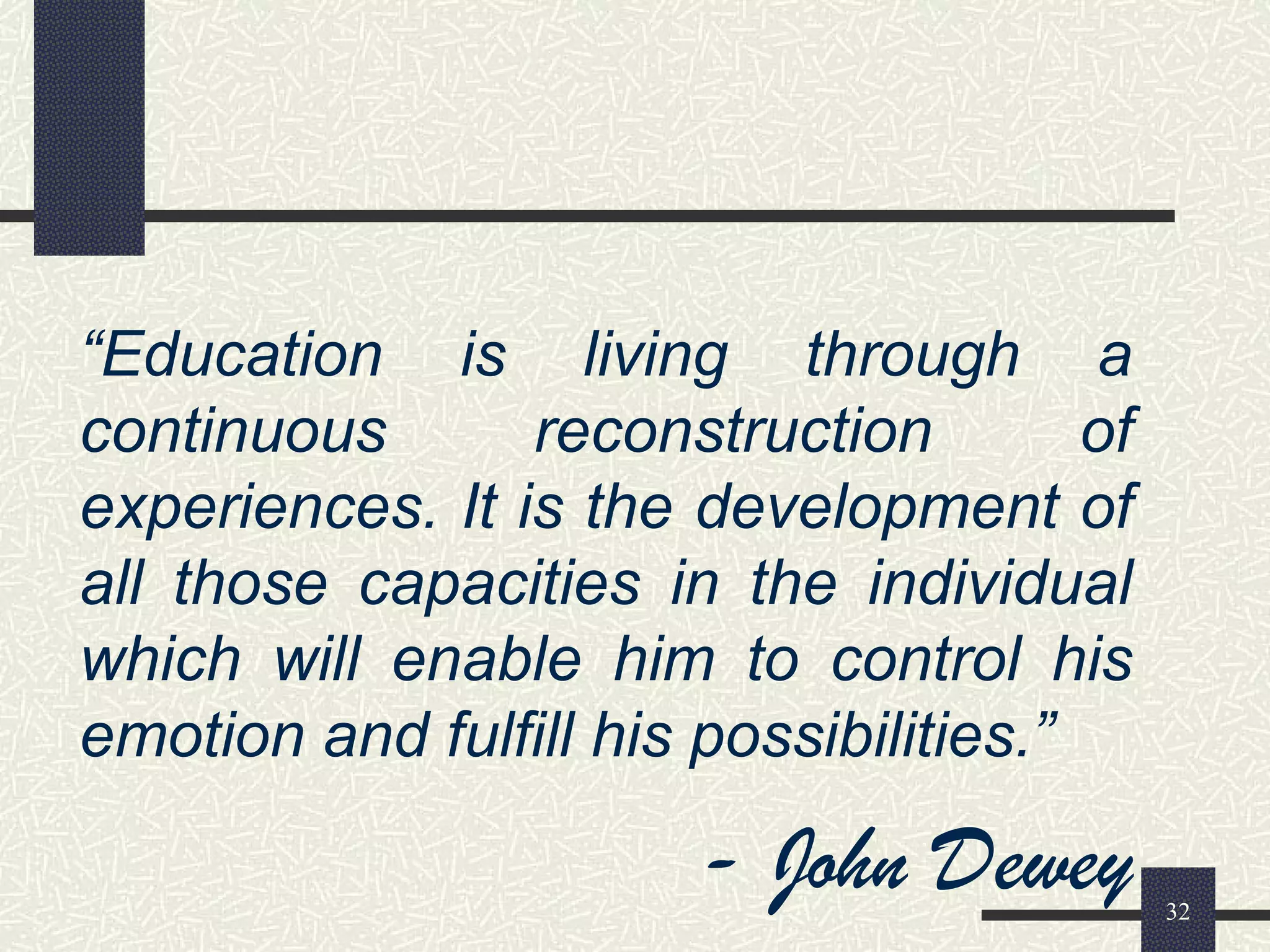
“Education is living through a
continuous reconstruction of
experiences. It is the development of
all those capacities in the individual
which will enable him to control his
emotion and fulfill his possibilities.”
- John Dewey 32
33
Sources
Popkin, R.H. and Stroll, A.
Philosophy Made Simple.
New York, Doubleday, 1993.
See chapter 1.
34
35
--Marsu
and
Ninja 

Pragmatism in Education

  • 1.
    The Pragmatism inEducation Subject: Philo. Psycho-Sociological Foundation of Education Professor: Dr. Luzminda G. Machete Masterands: Niña H. Lupar March Desiree S. Diola Date: January 13, 2018
  • 2.
    What is Philosophyof Education? All teachers have a personal philosophy that colors the way they teach Engaging in philosophy helps clarify what they do or intend to do, justify or explain why they do what they do in a logical, systematic manner 2
  • 3.
  • 4.
  • 5.
    What is Pragmatism? Itis: a method for evaluating intellectual problems, and a theory about the kinds of knowledge we are capable of acquiring. 5
  • 6.
    Pragmatism An American philosophyfrom the 19th century. 3 key thinkers: William James  Charles Sanders Peirce  John Dewey 6
  • 7.
    William James (1842-1910) trainedfirst as a medical doctor, then a psychologist finally became a philosopher and the chief advocate of Pragmatism What is the point of theorizing? What difference does it make? Why is it important to bother with the mind games of theorists? 7
  • 8.
    The Starting Point: Beforedetermining if any given philosophical claim is true, James thought it first necessary to determine the “cash-value” of the claim. 8
  • 9.
    Pragmatism “By their fruits,ye shall know them.” Pragmatism encourages people to find processes that work in order to achieve their desired ends… •Action-oriented •experientially grounded. 9
  • 10.
    Pragmatism A theory istrue if it works. claims about absolute and objective truth are meaningless since they can never be proven by experience. 10
  • 11.
    Pragmatic Truth truth isn’tsomething an idea “has” -- it is something that happens to an idea. 11
  • 12.
    Pragmatic Truth Before youdiscover whether an idea, theory, or belief works, it is neither true nor false. 12
  • 13.
    Pragmatic Truth In otherwords, truth is not something static and unchangeable -- it grows and develops with time. 13
  • 14.
    Pragmatism and Ethics Forthe pragmatist there is no “fixed” world to be revealed by experience; there is only a continuous quest to find workable solutions to life’s problems. 14
  • 15.
    Pragmatism and Ethics Theway to discover what is morally right or wrong is the same as when seeking truth: a good action is one that works to solve a given problem. 15
  • 16.
    John Dewey’s Philosophy Educationstarts with the needs and interests of the child allows the child to participate in planning her course of study, employ project method or group learning and depend heavily on experiential learning Children are active, organic beings…needing both freedom and responsibility Ideas are not separate from social conditions, philosophy has a responsibility to society 16
  • 17.
    Major Beliefs Pragmatism isthe practical approach to problems. Greek word “Pragma” which means activity or the work done. Pragmatists believe that reality is constantly changing and that we learn best through applying our experiences and thoughts to problems, as they arise. 17
  • 18.
    Philosophy on Curriculum CONTENT Onlyactivities, experiences and subjects should be included in the curriculum which are useful to the needs of the student and also meet the future expectations of their adult life. 18
  • 19.
    Philosophy on Curriculum CONTENT Itcondemns the principle of cramming and encourages original thinking and freedom to develop social and purposeful attitude. 19
  • 20.
    Philosophy on Curriculum INSTRUCTIONAND LEARNING EXPERIENCES School of philosophy favors the project method and consider it active and dynamic. Child learn through their own activities and experiences. 20
  • 21.
    Philosophy on Curriculum INSTRUCTIONAND LEARNING EXPERIENCES The teacher only guides and suggests whenever a student needs help. They believe learning by doing. 21
  • 22.
    Philosophy’s Key Terms Purposeof Education No specific aim of education can be predetermined which holds true and good to all children at all times, places and situations. 22
  • 23.
    Philosophy’s Key Terms Purposeof Education The goal is to help guide child according to his or her natural interest, aptitude and capacities in the field of academic activities that they grow up and develop ways to successfully achieving a happier life. 23
  • 24.
    Dewey’s Role forthe Teacher Not the authoritarian but the facilitator… encourages, offers suggestions, questions and helps plan and implement courses of study…has command of several disciplines Inquiry method, problem solving, integrated curriculum. 24
  • 25.
    Roles Teacher Teacher knows studentsinterest and understanding regarding the conditions of changing society The teacher puts problems in front of students which are interesting and students are expected to solve it. 25
  • 26.
    Roles Administrators Pragmatism believes insocial discipline based on child’s interest, activities and sense of social responsibility. It condemns enforced discipline. 26
  • 27.
    Roles Students Learners should applytheir knowledge to real situations through experimental inquiry. This prepares students for citizenship, daily living, and future careers. 27
  • 28.
    Roles Schools Schools philosophy ishaving students gain real experiences of actual life which develop social sense and sense of duty towards society and the nation. It is not only a sense of education but a sense of community. Preparing students to be better citizens. 28
  • 29.
    Pragmatism Aligning withCurriculum Curriculum As Experiences All about what experiences the students will have. Education as continues reconstruction of experience. Education as growth. Education as a social process. 29
  • 30.
    In A Nutshell… Philosophy and Values of Pragmatism There is no absolute and unchanging truth, but rather, truth is what works. Only those things that are experienced or observed are real. To pragmatists: truth reality, reality goodness and badness are all relative terms. They are proved by man’s own experiences. 30
  • 31.
    In A Nutshell… Pragmatism Influences on Curriculum The key characteristics of pragmatism in education is to apply personal or realistic experiences to a subject to make it more relatable. The curriculum should incorporate the necessary activities, vocation and experiences. Preparing students for adult life through group activities centered around hands on exploration. 31
  • 32.
    “Education is livingthrough a continuous reconstruction of experiences. It is the development of all those capacities in the individual which will enable him to control his emotion and fulfill his possibilities.” - John Dewey 32
  • 33.
  • 34.
    Sources Popkin, R.H. andStroll, A. Philosophy Made Simple. New York, Doubleday, 1993. See chapter 1. 34
  • 35.