PRAGMATISM
WHAT IS PRAGMATISM:
 The term pragmatism drives its origin from a
greek word meaning to work.
 pragmatism is an American philosophy from
the early 20 century.
PRAGMATISM AS A PHILOSOPHICAL
MOVEMENT
 A philosophical movement first givenn
systematic expression and consist of varying
but associated theories, originally developed
by Charles Sender peirce and William James
and later taken up and transferred by John
Dewey.
 pragmatism emphasizes the practical
function of knowledge.
MAIN PROPONENTS OF PRAGMATISM
 Charles Sanders Peirce
 William James
 John Dewey
CHARLES SANDERS ON
PRAGMATISM
 Charles Sanders an American philosopher,
logician, mathematician and scientist.
 C.S, who coined the term pragmatism saw it as a
more technique to help us find solutions than a
philosophy or solutions to problems.
WILLIAM JAMES ON PRAGMATISM
 William James is the most famous philosopher of
pragmatism and He is the first educator to offer a
psychology course in the United States.
 James was one of the leading thinkers of the late
nineteenth century and is considered the father of
American philosophy.
 pragmatism was about value and morality; the purpose
of philosophy was to understand what had value to us
and why James argued that ideas and beliefs have
value to us
JOHN DEWEY ON PRAGMATISM
 An American philosopher and educator who was a leading
exponent of philosophical pragmatism and rejected
traditional methods of teaching by rotein favour of a broad
base system of practical experience.
 John Dewey is the father of modern experimental
education.
 John Dewey attempted to combine both peirce and James's
philosophies of pragmatism.
 An early proponents of progressive education maintained
that schools should reflect the life of the society.According
to Dewey;
 "Education is not preparation for life; Education is life
itself.J.Dewey (1859 )"
PRAGMATISM AND EDUCATIVE PROCESS
 "Pragmatism is an educational philosophy
that says that education should be about life
and growth.John Dewey (1894)"
AIMS OF EDUCATION
 The aim of education is more and more growth and
creation of new values one can create values through
activities and experience.
 Aims of education given by John Dewey in his
democracy and education;
☆ Natural development
☆ Development of social efficiency
FORMS OF PRAGMATISM
 Biological pragmatism
 Human pragmatism
 Experimental pragmatism
FORMS OF PRAGMATISM
 Biological pragmatism:
 According to this the capacity of a
human being is valuable and important which enables him to
adjust with the environmental or makes him to change his
environment according to his needs and requirements.
 Humanistic pragmatism:
 This type of pragmatism is
particularly found in social science.According to it the
satisfaction of human nature is the criterion of utility.
 Experimental pragmatism:
 Modern science is based upon
experimental method.. The pragmatism use this criterion of truth
in every field of life. The human problems can be solved only
through experiment
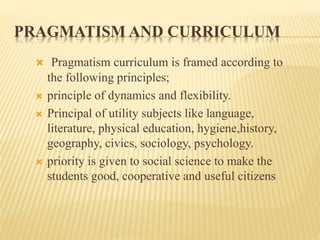
PRAGMATISM AND CURRICULUM
 Pragmatism curriculum is framed according to
the following principles;
 principle of dynamics and flexibility.
 Principal of utility subjects like language,
literature, physical education, hygiene,history,
geography, civics, sociology, psychology.
 priority is given to social science to make the
students good, cooperative and useful citizens
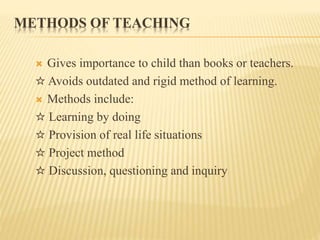
METHODS OF TEACHING
 Gives importance to child than books or teachers.
☆ Avoids outdated and rigid method of learning.
 Methods include:
☆ Learning by doing
☆ Provision of real life situations
☆ Project method
☆ Discussion, questioning and inquiry
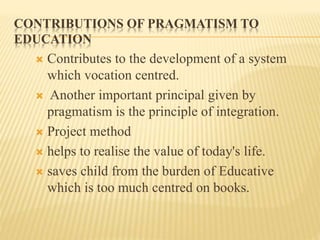
CONTRIBUTIONS OF PRAGMATISM TO
EDUCATION
 Contributes to the development of a system
which vocation centred.
 Another important principal given by
pragmatism is the principle of integration.
 Project method
 helps to realise the value of today's life.
 saves child from the burden of Educative
which is too much centred on books.
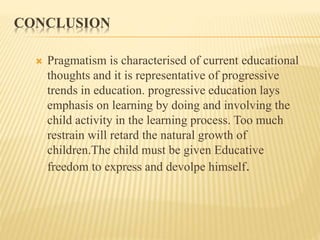
CONCLUSION
 Pragmatism is characterised of current educational
thoughts and it is representative of progressive
trends in education. progressive education lays
emphasis on learning by doing and involving the
child activity in the learning process. Too much
restrain will retard the natural growth of
children.The child must be given Educative
freedom to express and devolpe himself.

Pragmatism philosophy

  • 1.
  • 2.
    WHAT IS PRAGMATISM: The term pragmatism drives its origin from a greek word meaning to work.  pragmatism is an American philosophy from the early 20 century.
  • 3.
    PRAGMATISM AS APHILOSOPHICAL MOVEMENT  A philosophical movement first givenn systematic expression and consist of varying but associated theories, originally developed by Charles Sender peirce and William James and later taken up and transferred by John Dewey.  pragmatism emphasizes the practical function of knowledge.
  • 4.
    MAIN PROPONENTS OFPRAGMATISM  Charles Sanders Peirce  William James  John Dewey
  • 5.
    CHARLES SANDERS ON PRAGMATISM Charles Sanders an American philosopher, logician, mathematician and scientist.  C.S, who coined the term pragmatism saw it as a more technique to help us find solutions than a philosophy or solutions to problems.
  • 6.
    WILLIAM JAMES ONPRAGMATISM  William James is the most famous philosopher of pragmatism and He is the first educator to offer a psychology course in the United States.  James was one of the leading thinkers of the late nineteenth century and is considered the father of American philosophy.  pragmatism was about value and morality; the purpose of philosophy was to understand what had value to us and why James argued that ideas and beliefs have value to us
  • 7.
    JOHN DEWEY ONPRAGMATISM  An American philosopher and educator who was a leading exponent of philosophical pragmatism and rejected traditional methods of teaching by rotein favour of a broad base system of practical experience.  John Dewey is the father of modern experimental education.  John Dewey attempted to combine both peirce and James's philosophies of pragmatism.  An early proponents of progressive education maintained that schools should reflect the life of the society.According to Dewey;  "Education is not preparation for life; Education is life itself.J.Dewey (1859 )"
  • 8.
    PRAGMATISM AND EDUCATIVEPROCESS  "Pragmatism is an educational philosophy that says that education should be about life and growth.John Dewey (1894)"
  • 9.
    AIMS OF EDUCATION The aim of education is more and more growth and creation of new values one can create values through activities and experience.  Aims of education given by John Dewey in his democracy and education; ☆ Natural development ☆ Development of social efficiency
  • 10.
    FORMS OF PRAGMATISM Biological pragmatism  Human pragmatism  Experimental pragmatism
  • 11.
    FORMS OF PRAGMATISM Biological pragmatism:  According to this the capacity of a human being is valuable and important which enables him to adjust with the environmental or makes him to change his environment according to his needs and requirements.  Humanistic pragmatism:  This type of pragmatism is particularly found in social science.According to it the satisfaction of human nature is the criterion of utility.  Experimental pragmatism:  Modern science is based upon experimental method.. The pragmatism use this criterion of truth in every field of life. The human problems can be solved only through experiment
  • 12.
    PRAGMATISM AND CURRICULUM Pragmatism curriculum is framed according to the following principles;  principle of dynamics and flexibility.  Principal of utility subjects like language, literature, physical education, hygiene,history, geography, civics, sociology, psychology.  priority is given to social science to make the students good, cooperative and useful citizens
  • 13.
    METHODS OF TEACHING Gives importance to child than books or teachers. ☆ Avoids outdated and rigid method of learning.  Methods include: ☆ Learning by doing ☆ Provision of real life situations ☆ Project method ☆ Discussion, questioning and inquiry
  • 14.
    CONTRIBUTIONS OF PRAGMATISMTO EDUCATION  Contributes to the development of a system which vocation centred.  Another important principal given by pragmatism is the principle of integration.  Project method  helps to realise the value of today's life.  saves child from the burden of Educative which is too much centred on books.
  • 15.
    CONCLUSION  Pragmatism ischaracterised of current educational thoughts and it is representative of progressive trends in education. progressive education lays emphasis on learning by doing and involving the child activity in the learning process. Too much restrain will retard the natural growth of children.The child must be given Educative freedom to express and devolpe himself.