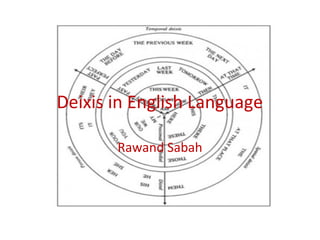
Deixis in English Language
Rawand Sabah
Deixis and Distance
• Deictic/deixis: refers to words and expressions
whose references rely on context and the
orientation of the speaker in space and time:
e.g., I, yesterday, there, this cat.
• Diexis can also be defined as features that
relate language to context or they encode the
speech event.
Diexis include
• a-demonstratives
• b- personal pronouns
• c- tense
• d-time and place
• e-titles and proper names (titles like; captain,
Dr.)
There are three types of deictic usage:
• a-Gestural symbols (usage), here, the deictic expression is
• accompanied by gestures (nod, gaze, shake)
• e.g You and you but not you get out.
• ( by pointing hands, this is the gestural usage of deictic expressions)
• e.g. push the box, not now, now. (by gestural usages)
• e.g. Not this one that one ( by hands can be understood only)
• b- Symbolic usage: here the reference is made to the context available to the
speaker, e.g.:
• 1-This city is nice.
• 2-The government is popular.
• The reference in No. 1 is the city in which the speaker lives is nice and in No.2 the
government that rules his country is popular, this is called symbolic usage.
• c-Non-deictic: means this makes no reference to a particular person or particular
place. They stand for everybody and every place.
• e.g. You can never tell what sex they are. ( You, here means nobody)
Types of Deixis
• Deictic expressions fall into a number of classes:
• - Person deixisɪ : The use of terms to refer to persons
whose reference relies entirely on context: e.g., pronouns
such as: I, he, you, and expressions such as this child.
• A-Person deixis: they encode the role of participants in the
speech events (situations).
• B-Person deixis is marked by: A- personal pronouns B-titles
C-proper nouns D-kinship terms (cousin, aunt)
• C-Pronouns are variable: They don’t refer to a particular
entity on all occasions: He killed him.
• They don’t refer to ( he) every time, they are variable,
depend on context. (He) can stand for a president, member
of parliament, or normal people.
• C-Pronominal system generally exhibit a three-way distinctions: the
speaker ( first person), the hearer (second person), and others ( third
person)
• D-There are occasions when speaker (s) addresses more than one hearer
at time. The Hearer may be direct addressee or an indirect addressee. In
direct means ( ratified hearer).
• Direct hearer is any one that the speakers intends to recognize the
utterance. The ratified hearer is any other person hearing the utterance.
He may be a bystander or an over hearer.
• The teacher: anyone who leaves last close the door.
• There are two types of hearers
• Teacher addresses hearers
• All students are hearers. (ratified)
• One who leaves last is direct hearer.
• E-Kinship terms: titles, proper names can be
used either to address somebody ( in
grammar we call them vocatives) or for
reference ( mentioning).
• Please, close the door Henry. ( Henry:
addressing, vocative)
• Henry was present at the meeting. ( Henry:
mentioning)
• : Place Deixisɪɪ
• Place deixis: The use of terms to refer to places whose reference relies
entirely on context: e.g., here, there, behind, next door.
• A -They encode locations relative to the participants in a speech event
(situation)
• B -English grammaticalised a two-way distinctions:
• Proximal: this, here, these or distal (distance/remote): that, those, there
• This proximal here and that distal there
• C-There are two types of place deixis: A- pure place deictic expressions:
here, there B- motion verbs with built-in deitic features
• -Come here: comes from one direction to another, there is a move
towards a speaker
• -Go there: there is a move from a speaker
• -Take the book: take it away from speaker
• -Bring the book: movement towards speaker
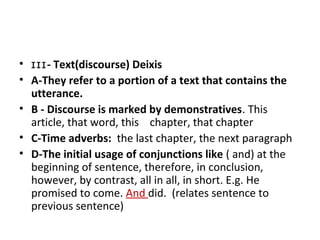
• - Text(discourse) Deixisɪɪɪ
• A-They refer to a portion of a text that contains the
utterance.
• B - Discourse is marked by demonstratives. This
article, that word, this chapter, that chapter
• C-Time adverbs: the last chapter, the next paragraph
• D-The initial usage of conjunctions like ( and) at the
beginning of sentence, therefore, in conclusion,
however, by contrast, all in all, in short. E.g. He
promised to come. And did. (relates sentence to
previous sentence)
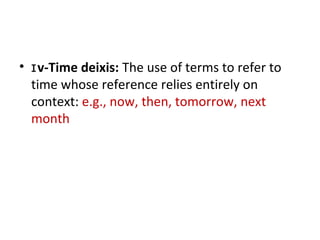
• v-Time deixis:ɪ The use of terms to refer to
time whose reference relies entirely on
context: e.g., now, then, tomorrow, next
month
• A- They encode points, spans, or intervals on
a time axis, relating the time of utterance to
the time of event (time of utterance and
event)
• e.g.I am leaving now. Here the time of
utterance and the time of event are identical
• e.g. He went home yesterday.
• The time of utterance is now but the time of
event is yesterday (passed)
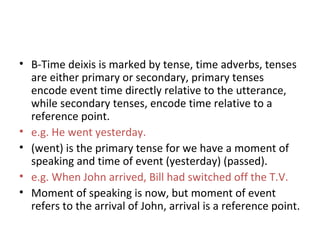
• B-Time deixis is marked by tense, time adverbs, tenses
are either primary or secondary, primary tenses
encode event time directly relative to the utterance,
while secondary tenses, encode time relative to a
reference point.
• e.g. He went yesterday.
• (went) is the primary tense for we have a moment of
speaking and time of event (yesterday) (passed).
• e.g. When John arrived, Bill had switched off the T.V.
• Moment of speaking is now, but moment of event
refers to the arrival of John, arrival is a reference point.
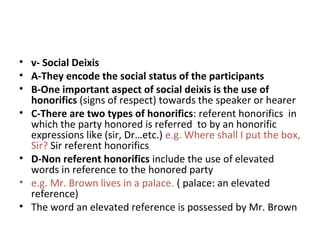
• v- Social Deixis
• A-They encode the social status of the participants
• B-One important aspect of social deixis is the use of
honorifics (signs of respect) towards the speaker or hearer
• C-There are two types of honorifics: referent honorifics in
which the party honored is referred to by an honorific
expressions like (sir, Dr…etc.) e.g. Where shall I put the box,
Sir? Sir referent honorifics
• D-Non referent honorifics include the use of elevated
words in reference to the honored party
• e.g. Mr. Brown lives in a palace. ( palace: an elevated
reference)
• The word an elevated reference is possessed by Mr. Brown
• E-Common type of honorifics includes: honorary titles with
names)
• Mr. henry, Dr. henry, major, professor, kinship terms, signs
of respect
• F-Another aspect of social deixis is politeness. The more
indirect a request, the more polite it is.
• Close the door ( impolite)
• I want you close the door (more polite than No.1 but it is
still impolite)
• Will you please, close the door? ( more polite than No. 1
and 2)
• Would you/could you close the door? (most polite
Refrences
• Grice, H. Paul 1989. Studies in the ways of
words. ???
• Grundy, Peter 1995. Doing pragmatics. London:
Edward Arnold.
• Jucker, Andreas H. (ed.) 1996. Historical
pragmatics. Amsterdam: Benjamins.
• Kasher, Asa 1997. Pragmatics. 6 Vols. London:
Routledge.
• Leech, Geoffrey 1983. Principles of pragmatics.
London: Longmans.
Thank You

pragmatics/ deixes

  • 1.
    Deixis in EnglishLanguage Rawand Sabah
  • 3.
    Deixis and Distance •Deictic/deixis: refers to words and expressions whose references rely on context and the orientation of the speaker in space and time: e.g., I, yesterday, there, this cat. • Diexis can also be defined as features that relate language to context or they encode the speech event.
  • 4.
    Diexis include • a-demonstratives •b- personal pronouns • c- tense • d-time and place • e-titles and proper names (titles like; captain, Dr.)
  • 5.
    There are threetypes of deictic usage: • a-Gestural symbols (usage), here, the deictic expression is • accompanied by gestures (nod, gaze, shake) • e.g You and you but not you get out. • ( by pointing hands, this is the gestural usage of deictic expressions) • e.g. push the box, not now, now. (by gestural usages) • e.g. Not this one that one ( by hands can be understood only) • b- Symbolic usage: here the reference is made to the context available to the speaker, e.g.: • 1-This city is nice. • 2-The government is popular. • The reference in No. 1 is the city in which the speaker lives is nice and in No.2 the government that rules his country is popular, this is called symbolic usage. • c-Non-deictic: means this makes no reference to a particular person or particular place. They stand for everybody and every place. • e.g. You can never tell what sex they are. ( You, here means nobody)
  • 6.
    Types of Deixis •Deictic expressions fall into a number of classes: • - Person deixisɪ : The use of terms to refer to persons whose reference relies entirely on context: e.g., pronouns such as: I, he, you, and expressions such as this child. • A-Person deixis: they encode the role of participants in the speech events (situations). • B-Person deixis is marked by: A- personal pronouns B-titles C-proper nouns D-kinship terms (cousin, aunt) • C-Pronouns are variable: They don’t refer to a particular entity on all occasions: He killed him. • They don’t refer to ( he) every time, they are variable, depend on context. (He) can stand for a president, member of parliament, or normal people.
  • 7.
    • C-Pronominal systemgenerally exhibit a three-way distinctions: the speaker ( first person), the hearer (second person), and others ( third person) • D-There are occasions when speaker (s) addresses more than one hearer at time. The Hearer may be direct addressee or an indirect addressee. In direct means ( ratified hearer). • Direct hearer is any one that the speakers intends to recognize the utterance. The ratified hearer is any other person hearing the utterance. He may be a bystander or an over hearer. • The teacher: anyone who leaves last close the door. • There are two types of hearers • Teacher addresses hearers • All students are hearers. (ratified) • One who leaves last is direct hearer.
  • 8.
    • E-Kinship terms:titles, proper names can be used either to address somebody ( in grammar we call them vocatives) or for reference ( mentioning). • Please, close the door Henry. ( Henry: addressing, vocative) • Henry was present at the meeting. ( Henry: mentioning)
  • 9.
    • : PlaceDeixisɪɪ • Place deixis: The use of terms to refer to places whose reference relies entirely on context: e.g., here, there, behind, next door. • A -They encode locations relative to the participants in a speech event (situation) • B -English grammaticalised a two-way distinctions: • Proximal: this, here, these or distal (distance/remote): that, those, there • This proximal here and that distal there • C-There are two types of place deixis: A- pure place deictic expressions: here, there B- motion verbs with built-in deitic features • -Come here: comes from one direction to another, there is a move towards a speaker • -Go there: there is a move from a speaker • -Take the book: take it away from speaker • -Bring the book: movement towards speaker
  • 10.
    • - Text(discourse)Deixisɪɪɪ • A-They refer to a portion of a text that contains the utterance. • B - Discourse is marked by demonstratives. This article, that word, this chapter, that chapter • C-Time adverbs: the last chapter, the next paragraph • D-The initial usage of conjunctions like ( and) at the beginning of sentence, therefore, in conclusion, however, by contrast, all in all, in short. E.g. He promised to come. And did. (relates sentence to previous sentence)
  • 11.
    • v-Time deixis:ɪThe use of terms to refer to time whose reference relies entirely on context: e.g., now, then, tomorrow, next month
  • 12.
    • A- Theyencode points, spans, or intervals on a time axis, relating the time of utterance to the time of event (time of utterance and event) • e.g.I am leaving now. Here the time of utterance and the time of event are identical • e.g. He went home yesterday. • The time of utterance is now but the time of event is yesterday (passed)
  • 13.
    • B-Time deixisis marked by tense, time adverbs, tenses are either primary or secondary, primary tenses encode event time directly relative to the utterance, while secondary tenses, encode time relative to a reference point. • e.g. He went yesterday. • (went) is the primary tense for we have a moment of speaking and time of event (yesterday) (passed). • e.g. When John arrived, Bill had switched off the T.V. • Moment of speaking is now, but moment of event refers to the arrival of John, arrival is a reference point.
  • 14.
    • v- SocialDeixis • A-They encode the social status of the participants • B-One important aspect of social deixis is the use of honorifics (signs of respect) towards the speaker or hearer • C-There are two types of honorifics: referent honorifics in which the party honored is referred to by an honorific expressions like (sir, Dr…etc.) e.g. Where shall I put the box, Sir? Sir referent honorifics • D-Non referent honorifics include the use of elevated words in reference to the honored party • e.g. Mr. Brown lives in a palace. ( palace: an elevated reference) • The word an elevated reference is possessed by Mr. Brown
  • 15.
    • E-Common typeof honorifics includes: honorary titles with names) • Mr. henry, Dr. henry, major, professor, kinship terms, signs of respect • F-Another aspect of social deixis is politeness. The more indirect a request, the more polite it is. • Close the door ( impolite) • I want you close the door (more polite than No.1 but it is still impolite) • Will you please, close the door? ( more polite than No. 1 and 2) • Would you/could you close the door? (most polite
  • 16.
    Refrences • Grice, H.Paul 1989. Studies in the ways of words. ??? • Grundy, Peter 1995. Doing pragmatics. London: Edward Arnold. • Jucker, Andreas H. (ed.) 1996. Historical pragmatics. Amsterdam: Benjamins. • Kasher, Asa 1997. Pragmatics. 6 Vols. London: Routledge. • Leech, Geoffrey 1983. Principles of pragmatics. London: Longmans.
  • 17.