TESTING, ASSESSMENT, AND EVALUATION
IN TEACHING (II)
ASSESSMENT
ASSESSMENT
Assessment is a broad term that includes testing
• Rowntree (1977): assessment in education can be thought of
as occurring whenever one person, in some kind of interaction,
direct or indirect, with another, is conscious of obtaining and
interpreting information about the knowledge and
understanding of abilities and attitudes of that other person. To
some extent or another, it is an attempt to know the person.
• Erwin, in Brown and Knight, (1994): Assessment is a
systematic basis for making inference about the learning and
development of students… the process of defining, selecting,
designing, collecting, analyzing, interpreting, and using the
information to increase students' learning and development.
• Brown (2003, p.4): it is an ongoing process that encompasses
a much broader domain. To do an assessment, a teacher should
consider many aspects in determining the final scores of the
students. In addition to the mid-semester and final semester
scores, the teacher should also pay attention to the students`
participation, motivation, presentation, performance, paper,
portfolio, presence, homework, etc.
---- It is a process of gathering information to monitor progress
and make educational decisions if necessary. An assessment
may include a test, but also includes methods such as
observations, interviews, behavior monitoring, etc.
Is assessment synonymous with testing?
• No, it is not.
• Assessment is a more encompassing term than testing. It is the
process of gathering, interpreting, and sometimes recording
and using information about students' responses to an
educational task to provide the next learning step.
Does the assessment include testing?
• Yes, it does.
• Testing is a particular kind of assessment that focuses on
eliciting a specific sample of performance.
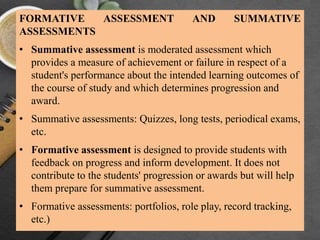
FORMATIVE ASSESSMENT AND SUMMATIVE
ASSESSMENTS
• Summative assessment is moderated assessment which
provides a measure of achievement or failure in respect of a
student's performance about the intended learning outcomes of
the course of study and which determines progression and
award.
• Summative assessments: Quizzes, long tests, periodical exams,
etc.
• Formative assessment is designed to provide students with
feedback on progress and inform development. It does not
contribute to the students' progression or awards but will help
them prepare for summative assessment.
• Formative assessments: portfolios, role play, record tracking,
etc.)
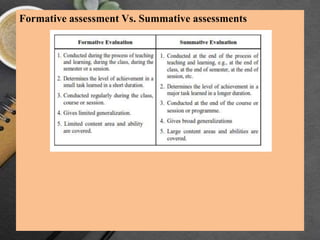
Formative assessment Vs. Summative assessments
References & Recommended Reading
• Brown, H.D. (1994). Principles of Language Learning and
Teaching. New Jersey: Prentice-Hall.
• Doff, A. (1988). Teach English. Glasgow: Cambridge
University Press.
• Rosset, E. (1998). Fill in the Gaps. Brno: Didaktis.
• Scrivener, J. (1998). Learning Teaching. Oxford: Macmillan.
• Ur, P. (1991). A Course in Language Teaching. Cambridge:
Cambridge University Press.

ASSESSMENT: TESTING, ASSESSMENT, AND EVALUATION IN TEACHING (II)

  • 1.
    TESTING, ASSESSMENT, ANDEVALUATION IN TEACHING (II) ASSESSMENT
  • 2.
    ASSESSMENT Assessment is abroad term that includes testing • Rowntree (1977): assessment in education can be thought of as occurring whenever one person, in some kind of interaction, direct or indirect, with another, is conscious of obtaining and interpreting information about the knowledge and understanding of abilities and attitudes of that other person. To some extent or another, it is an attempt to know the person. • Erwin, in Brown and Knight, (1994): Assessment is a systematic basis for making inference about the learning and development of students… the process of defining, selecting, designing, collecting, analyzing, interpreting, and using the information to increase students' learning and development.
  • 3.
    • Brown (2003,p.4): it is an ongoing process that encompasses a much broader domain. To do an assessment, a teacher should consider many aspects in determining the final scores of the students. In addition to the mid-semester and final semester scores, the teacher should also pay attention to the students` participation, motivation, presentation, performance, paper, portfolio, presence, homework, etc. ---- It is a process of gathering information to monitor progress and make educational decisions if necessary. An assessment may include a test, but also includes methods such as observations, interviews, behavior monitoring, etc.
  • 4.
    Is assessment synonymouswith testing? • No, it is not. • Assessment is a more encompassing term than testing. It is the process of gathering, interpreting, and sometimes recording and using information about students' responses to an educational task to provide the next learning step. Does the assessment include testing? • Yes, it does. • Testing is a particular kind of assessment that focuses on eliciting a specific sample of performance.
  • 5.
    FORMATIVE ASSESSMENT ANDSUMMATIVE ASSESSMENTS • Summative assessment is moderated assessment which provides a measure of achievement or failure in respect of a student's performance about the intended learning outcomes of the course of study and which determines progression and award. • Summative assessments: Quizzes, long tests, periodical exams, etc. • Formative assessment is designed to provide students with feedback on progress and inform development. It does not contribute to the students' progression or awards but will help them prepare for summative assessment. • Formative assessments: portfolios, role play, record tracking, etc.)
  • 6.
    Formative assessment Vs.Summative assessments
  • 7.
    References & RecommendedReading • Brown, H.D. (1994). Principles of Language Learning and Teaching. New Jersey: Prentice-Hall. • Doff, A. (1988). Teach English. Glasgow: Cambridge University Press. • Rosset, E. (1998). Fill in the Gaps. Brno: Didaktis. • Scrivener, J. (1998). Learning Teaching. Oxford: Macmillan. • Ur, P. (1991). A Course in Language Teaching. Cambridge: Cambridge University Press.