ASSESSING SPEAKING
COMPREHENSION
ASSESSMENT
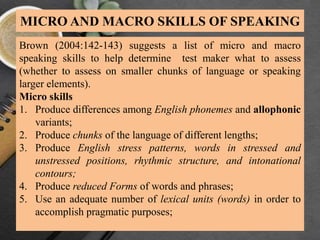
MICRO AND MACRO SKILLS OF SPEAKING
Brown (2004:142-143) suggests a list of micro and macro
speaking skills to help determine test maker what to assess
(whether to assess on smaller chunks of language or speaking
larger elements).
Micro skills
1. Produce differences among English phonemes and allophonic
variants;
2. Produce chunks of the language of different lengths;
3. Produce English stress patterns, words in stressed and
unstressed positions, rhythmic structure, and intonational
contours;
4. Produce reduced Forms of words and phrases;
5. Use an adequate number of lexical units (words) in order to
accomplish pragmatic purposes;
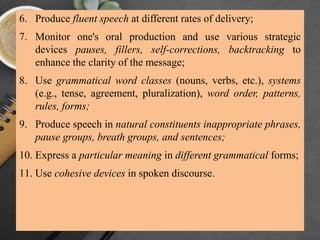
6. Produce fluent speech at different rates of delivery;
7. Monitor one's oral production and use various strategic
devices pauses, fillers, self-corrections, backtracking to
enhance the clarity of the message;
8. Use grammatical word classes (nouns, verbs, etc.), systems
(e.g., tense, agreement, pluralization), word order, patterns,
rules, forms;
9. Produce speech in natural constituents inappropriate phrases,
pause groups, breath groups, and sentences;
10. Express a particular meaning in different grammatical forms;
11. Use cohesive devices in spoken discourse.
Macro skills
1. Appropriately accomplish communicative functions according
to situations, participants, and goals;
2. Use appropriate styles, registers, implicature, redundancies,
pragmatic conventions, conversation rules, floor keeping,
yielding, interrupting, and other sociolinguistic features in
face-to-face conversations;
3. Convey links and connections between events
and communicate such relations as focal and peripheral ideas,
events and feelings, new information, and given information,
generalization, and exemplification.
4. Convey facial features, kinesics, body language, and other
nonverbal cues along with verbal language;
5. Develop and use a battery of speaking strategies, such as
emphasizing keywords, rephrasing, providing a context for
interpreting the meaning of words, appealing for help, and
accurately assessing how well your interlocutor understands
you.
TYPES OF SPEAKING ASSESSMENT TASKS
Brown (2004:141) provides 5 types of Assessment Tasks.
Imitative:
• Repeating a small stretch of language and focused on
pronunciation. The test maker considers using this type of
assessment if she/he is not interested in the test taker's
competence in understanding and conveying meaning or
getting involved in an interactive conversation. The
competence assessed is that of purely phonetic, prosodic,
lexical, and grammatical (pronunciation).
Intensive
Reading Aloud
Heaton (1988, p.89) and Hughes (1989, p.110), reading aloud
may not be appropriate because of the difference in processing
written input from that of spoken one. However, a check on
stress-pattern, rhythm, and pronunciation alone may be
conducted using reading aloud.
Directed Response Task (e.g., response to a recorded speech)
One of the most popular Tasks of speaking for its practicality and
mass lab-use, despite its mechanical and non-communicative
nature, DRT is beneficial to elicit a specific grammatical form or
a transformation of a sentence that requires minimal processing
(micro-skills 1-5, 8 & 10) (Brown, 2004, p.147).
Sentence/Dialogue Completion
• Heaton (1988, p.92), this type may provide an illogical flow of
conversation, given that the sentence or dialogue completion is
done in the lab (which is usually administered).
• Therefore, this type will probably be beneficial only for
assessing test taker's micro skill of providing the right chunks
of language and other pronunciation features.
Translation
• Interpreting, as Hughes (1989, p.108) describes, may involve
the test-proctor acting as a native speaker of test taker's first
language and the test taker interpreting the utterance into
English.
• It is believed that because Speaking is the negotiation of
intended meaning (O'Malley, 1996, p.59), interpreting-game
can measure test-taker competence in conveying his message
into the target language (Brown, 2004, p.159).
Limited picture-cued Task (including simple sequence)
• Pictures are most convenient to elicit descriptions (Hughes,
1989, p.107). In addition to describing comparison, the order
of events, positions, and location, more detailed picture may
be used to elicit test taker’s competence in telling a plan,
directions, and even opinions (Brown, 2004, p.151-158).
Responsive: Small dialogue, response to spoken prompt (simple
greeting, request & comments).
Question and Answer
• Questions at responsive level tend to be referential -as opposed
to intensive, display question- (Brown, 2004, p.159).
• The referential question requires test takers to produce
meaningful language in response. Such questions may require
an open-ended response or a counter-question directed to the
interviewer (Brown, 2004, p.160).
Giving Instruction and Direction
• Test takers have elicited their performance in describing a
how-to description. A five to six sentence response may
be sufficient to be required either from an impromptu question
or a minute planning before the instruction (Brown, 2004, p.
161).
Paraphrasing
• Oral Paraphrasing can have written or oral input, with the
latter being more preferable. A paraphrase is a speaking
assessment should be conducted with caution because test
taker's competence may be mistakenly judged by their short-
term memory and listening comprehension instead of their
speaking production.
Interactive (broader dialogue on Transactional and
Interactional Conversation)
Interview
• Interviews can be face-to-face, one-on-one, or two-on-one,
each with its advantage and disadvantage. A two-on-one
interview may save time and scheduling and provide authentic
interaction between two test-takers, although it poses a risk of
one test taker dominating the other.
Drama-like Task
• O’ Malley (1996:85) divides drama-like Tasks into three sub-
types: improvisations, role play, and simulation.
• The difference between each is respectively the preparation
and scripting.
• Improvisation gives the test-takers minimal opportunity to
prepare the situation and may incite creativity in using the
language.
• Roleplay provides a slightly longer time, and test-takers can
prepare what to say, although scripting is highly unlikely.
• Simulation (including debate) requires planning and decision-
making. Simulation may involve real-world socio-drama,
which is the pinnacle of speaking competence.
Discussions and Conversations
Discussions and Conversations (Brown, 2004, p.175) provide
somewhat similar difficulties in terms of predictability of the
response hence consistency of the scoring to that of the interview
and drama-like tasks. Test makers seem to choose this type of
Task as an informal assessment to elicit and observe test taker’s
performance in:
• starting, maintaining and ending a topic;
• getting attention, interrupting and controlling;
• clarifying, questioning and Paraphrasing;
• signaling for comprehension (e.g., nodding);
• using appropriate intonation patterns;
• using kinesics, eye contact, and body language;
• being polite, being formal and other sociolinguistic situation.
Games
• Some examples of games which Brown (2004, p.175-176)
mentions (Tinker toy, crossword puzzle, information gap,
predetermined direction map) can all fall in the umbrella of
information-gap activities.
• O’Malley (1996:81), explain that an information gap is an
activity where one student is provided information that another
(e.g., his pair) does not know but need to.
• An information gap activity involves collecting complete
information to restructure a building, sequence a picture into
order, or simply find the differences between two pictures. To
score an information gap activity, O'Malley (1996:83) suggests
a test maker consider the speaker’s “accuracy and clarity of the
description as well as on the reconstruction.”
Extensive (monologue)
• The following are monologues that take a long stretch of the
language and require extensive (multi-skills) preparations. The
terms are self-explanatory, and some may possess some
characteristics with some types previously explained only with
a longer and broader scope of language use.
Speech (Oral Presentation or oral report)
• It is commonly practiced to present a report, paper, or design
in a school setting. An oral presentation can be used to assess a
verbal skill holistically or analytically. However, it is best used
for an intermediate or advanced English level, focusing on
content and delivery (Brown, 2004, p.179).
Picture-cued Story Telling
• The use of a picture or a series of pictures is to make it into a
stimulus for longer story or description; a six-picture sequence
with enough details in the settings and character will be
sufficient to test, among others, vocabulary, time relatives, past
tense irregular verbs and even fluency in general (Brown,
2004, p.181).
Retelling a Story, News Event
• Unlike Paraphrasing, retelling a story takes the longer stretch
of discourse with different, preferably narrative, genre. The
focus is usually on the meaningfulness of the relationship of
events within the story, fluency and interaction to the audience
(Brown, 2004, p.182).
Translation (Extended Prose)
• In this type of task, a longer text, preferably in written form, is
presented in the test taker’s native languages to be studied
before interpreting the text with ease in the actual testing.
• The text can cover a dialogue, procedure, complicated
directions, synopsis, or a play script. Caution should be made
concerning this type of Task because this particular type
requires a skill not intended for every speaker of a language.
• Therefore, if this type is to be used a degree of confidence
should be made sure (as in thecae whether the test takers are in
pursuit of a bachelor degree!) (Brown, 2004, p.182).
References and Recommended Reading
• Brown, H. D. (2004). Language Assessment: Principles and
Classroom Practices. White Plains, NY: Pearson Education.
• Heaton, J. B. (1988). Writing English Language Tests (New
Edition). London: Longman.
• Hughes, A. (1989). Testing for Language Teachers.
Cambridge: Cambridge University Press.
• O'Malley, J. M., & Pierce, L. V. (1996). Authentic Assessment
for English Language Learner: Practical Approaches for
Teachers. White Plains, NY: Addison Wesley.
•

ASSESSMENT: SPEAKING COMPREHENSION ASSESSMENT

  • 1.
  • 2.
    MICRO AND MACROSKILLS OF SPEAKING Brown (2004:142-143) suggests a list of micro and macro speaking skills to help determine test maker what to assess (whether to assess on smaller chunks of language or speaking larger elements). Micro skills 1. Produce differences among English phonemes and allophonic variants; 2. Produce chunks of the language of different lengths; 3. Produce English stress patterns, words in stressed and unstressed positions, rhythmic structure, and intonational contours; 4. Produce reduced Forms of words and phrases; 5. Use an adequate number of lexical units (words) in order to accomplish pragmatic purposes;
  • 3.
    6. Produce fluentspeech at different rates of delivery; 7. Monitor one's oral production and use various strategic devices pauses, fillers, self-corrections, backtracking to enhance the clarity of the message; 8. Use grammatical word classes (nouns, verbs, etc.), systems (e.g., tense, agreement, pluralization), word order, patterns, rules, forms; 9. Produce speech in natural constituents inappropriate phrases, pause groups, breath groups, and sentences; 10. Express a particular meaning in different grammatical forms; 11. Use cohesive devices in spoken discourse.
  • 4.
    Macro skills 1. Appropriatelyaccomplish communicative functions according to situations, participants, and goals; 2. Use appropriate styles, registers, implicature, redundancies, pragmatic conventions, conversation rules, floor keeping, yielding, interrupting, and other sociolinguistic features in face-to-face conversations; 3. Convey links and connections between events and communicate such relations as focal and peripheral ideas, events and feelings, new information, and given information, generalization, and exemplification.
  • 5.
    4. Convey facialfeatures, kinesics, body language, and other nonverbal cues along with verbal language; 5. Develop and use a battery of speaking strategies, such as emphasizing keywords, rephrasing, providing a context for interpreting the meaning of words, appealing for help, and accurately assessing how well your interlocutor understands you.
  • 6.
    TYPES OF SPEAKINGASSESSMENT TASKS Brown (2004:141) provides 5 types of Assessment Tasks. Imitative: • Repeating a small stretch of language and focused on pronunciation. The test maker considers using this type of assessment if she/he is not interested in the test taker's competence in understanding and conveying meaning or getting involved in an interactive conversation. The competence assessed is that of purely phonetic, prosodic, lexical, and grammatical (pronunciation).
  • 7.
    Intensive Reading Aloud Heaton (1988,p.89) and Hughes (1989, p.110), reading aloud may not be appropriate because of the difference in processing written input from that of spoken one. However, a check on stress-pattern, rhythm, and pronunciation alone may be conducted using reading aloud. Directed Response Task (e.g., response to a recorded speech) One of the most popular Tasks of speaking for its practicality and mass lab-use, despite its mechanical and non-communicative nature, DRT is beneficial to elicit a specific grammatical form or a transformation of a sentence that requires minimal processing (micro-skills 1-5, 8 & 10) (Brown, 2004, p.147).
  • 8.
    Sentence/Dialogue Completion • Heaton(1988, p.92), this type may provide an illogical flow of conversation, given that the sentence or dialogue completion is done in the lab (which is usually administered). • Therefore, this type will probably be beneficial only for assessing test taker's micro skill of providing the right chunks of language and other pronunciation features.
  • 9.
    Translation • Interpreting, asHughes (1989, p.108) describes, may involve the test-proctor acting as a native speaker of test taker's first language and the test taker interpreting the utterance into English. • It is believed that because Speaking is the negotiation of intended meaning (O'Malley, 1996, p.59), interpreting-game can measure test-taker competence in conveying his message into the target language (Brown, 2004, p.159). Limited picture-cued Task (including simple sequence) • Pictures are most convenient to elicit descriptions (Hughes, 1989, p.107). In addition to describing comparison, the order of events, positions, and location, more detailed picture may be used to elicit test taker’s competence in telling a plan, directions, and even opinions (Brown, 2004, p.151-158).
  • 10.
    Responsive: Small dialogue,response to spoken prompt (simple greeting, request & comments). Question and Answer • Questions at responsive level tend to be referential -as opposed to intensive, display question- (Brown, 2004, p.159). • The referential question requires test takers to produce meaningful language in response. Such questions may require an open-ended response or a counter-question directed to the interviewer (Brown, 2004, p.160). Giving Instruction and Direction • Test takers have elicited their performance in describing a how-to description. A five to six sentence response may be sufficient to be required either from an impromptu question or a minute planning before the instruction (Brown, 2004, p. 161).
  • 11.
    Paraphrasing • Oral Paraphrasingcan have written or oral input, with the latter being more preferable. A paraphrase is a speaking assessment should be conducted with caution because test taker's competence may be mistakenly judged by their short- term memory and listening comprehension instead of their speaking production. Interactive (broader dialogue on Transactional and Interactional Conversation) Interview • Interviews can be face-to-face, one-on-one, or two-on-one, each with its advantage and disadvantage. A two-on-one interview may save time and scheduling and provide authentic interaction between two test-takers, although it poses a risk of one test taker dominating the other.
  • 12.
    Drama-like Task • O’Malley (1996:85) divides drama-like Tasks into three sub- types: improvisations, role play, and simulation. • The difference between each is respectively the preparation and scripting. • Improvisation gives the test-takers minimal opportunity to prepare the situation and may incite creativity in using the language. • Roleplay provides a slightly longer time, and test-takers can prepare what to say, although scripting is highly unlikely. • Simulation (including debate) requires planning and decision- making. Simulation may involve real-world socio-drama, which is the pinnacle of speaking competence.
  • 13.
    Discussions and Conversations Discussionsand Conversations (Brown, 2004, p.175) provide somewhat similar difficulties in terms of predictability of the response hence consistency of the scoring to that of the interview and drama-like tasks. Test makers seem to choose this type of Task as an informal assessment to elicit and observe test taker’s performance in: • starting, maintaining and ending a topic; • getting attention, interrupting and controlling; • clarifying, questioning and Paraphrasing; • signaling for comprehension (e.g., nodding); • using appropriate intonation patterns; • using kinesics, eye contact, and body language; • being polite, being formal and other sociolinguistic situation.
  • 14.
    Games • Some examplesof games which Brown (2004, p.175-176) mentions (Tinker toy, crossword puzzle, information gap, predetermined direction map) can all fall in the umbrella of information-gap activities. • O’Malley (1996:81), explain that an information gap is an activity where one student is provided information that another (e.g., his pair) does not know but need to. • An information gap activity involves collecting complete information to restructure a building, sequence a picture into order, or simply find the differences between two pictures. To score an information gap activity, O'Malley (1996:83) suggests a test maker consider the speaker’s “accuracy and clarity of the description as well as on the reconstruction.”
  • 15.
    Extensive (monologue) • Thefollowing are monologues that take a long stretch of the language and require extensive (multi-skills) preparations. The terms are self-explanatory, and some may possess some characteristics with some types previously explained only with a longer and broader scope of language use. Speech (Oral Presentation or oral report) • It is commonly practiced to present a report, paper, or design in a school setting. An oral presentation can be used to assess a verbal skill holistically or analytically. However, it is best used for an intermediate or advanced English level, focusing on content and delivery (Brown, 2004, p.179).
  • 16.
    Picture-cued Story Telling •The use of a picture or a series of pictures is to make it into a stimulus for longer story or description; a six-picture sequence with enough details in the settings and character will be sufficient to test, among others, vocabulary, time relatives, past tense irregular verbs and even fluency in general (Brown, 2004, p.181). Retelling a Story, News Event • Unlike Paraphrasing, retelling a story takes the longer stretch of discourse with different, preferably narrative, genre. The focus is usually on the meaningfulness of the relationship of events within the story, fluency and interaction to the audience (Brown, 2004, p.182).
  • 17.
    Translation (Extended Prose) •In this type of task, a longer text, preferably in written form, is presented in the test taker’s native languages to be studied before interpreting the text with ease in the actual testing. • The text can cover a dialogue, procedure, complicated directions, synopsis, or a play script. Caution should be made concerning this type of Task because this particular type requires a skill not intended for every speaker of a language. • Therefore, if this type is to be used a degree of confidence should be made sure (as in thecae whether the test takers are in pursuit of a bachelor degree!) (Brown, 2004, p.182).
  • 18.
    References and RecommendedReading • Brown, H. D. (2004). Language Assessment: Principles and Classroom Practices. White Plains, NY: Pearson Education. • Heaton, J. B. (1988). Writing English Language Tests (New Edition). London: Longman. • Hughes, A. (1989). Testing for Language Teachers. Cambridge: Cambridge University Press. • O'Malley, J. M., & Pierce, L. V. (1996). Authentic Assessment for English Language Learner: Practical Approaches for Teachers. White Plains, NY: Addison Wesley. •