DEIXIS
DEFINITION OF DEIXIS
“Deixis is the relationship between language and context which is reflected in the
structures of languages themselves. Diexis concerns ways in which the interpretation of
utterances depends on the analysis of that context of utterance” (Stephen C. Levinson)
“Deixis is a technical term for one of the most basic things we do with utterances which
means ‘pointing’ via language; it is usually called deictic expression or indexicals.”
(George Yule)
Deixis is any word that cannot be interpreted without reference to physical context: the
speakers, addressee, time, and place of utterance.
3.
The importanceof deitic information for the interpretation of utterances is
perhaps best illustrated by what happens when such information is lacking
(fillmore,1975:38-9)
4.
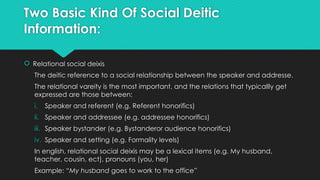
Example:
Finding thefollowing notice on someone’s office door:
“I’ll be back in an our”
In this example we don’t know when it was written, we cannot know when the
writer will return
Or imagine that the lights go out as harry has just begun saying:
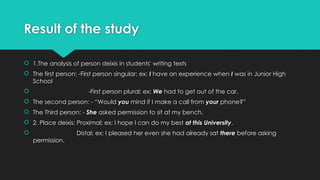
“listen, I’m not disagreeing with you but with you, and not about this but about
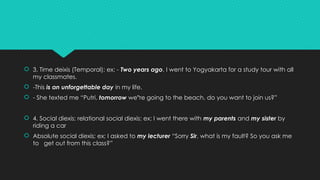
this”
In these examples above cannot be said to be deixis if the speakers and
addressees differ in interpretation of context. So to speak, for use face-to-face
interaction or use gesture.
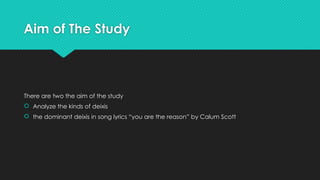
(Stephen C. Levinson)
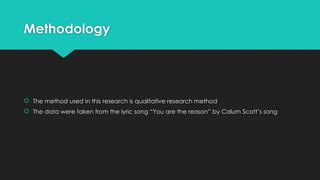
5.
Philosophical Approach
Deixis =indexical expressions = indexicals
how truth-conditional-semantics deals with the certain natural language expressions
Deitic expressions depend on the speaker and the addresse sharing the same
context, they have their most basic uses in face to face spoken interaction.
(Stephen C. Levinson)
6.
Example:
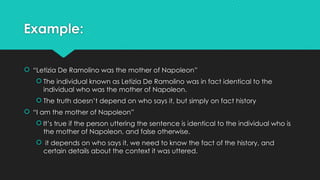
“Letizia DeRamolino was the mother of Napoleon”
The individual known as Letizia De Ramolino was in fact identical to the
individual who was the mother of Napoleon.
The truth doesn’t depend on who says it, but simply on fact history
“I am the mother of Napoleon”
It’s true if the person uttering the sentence is identical to the individual who is
the mother of Napoleon, and false otherwise.
it depends on who says it, we need to know the fact of the history, and
certain details about the context it was uttered.
7.
Descriptive Approaches
Giventhe undoubted importance of deixis to philosophical, psychological and
linguistic approaches to analysis of language
8.
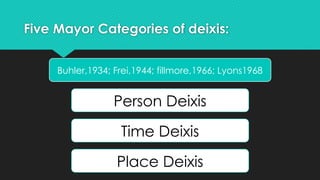
Five Mayor Categoriesof deixis:
Buhler,1934; Frei,1944; fillmore,1966; Lyons1968
Person Deixis
Time Deixis
Place Deixis
9.
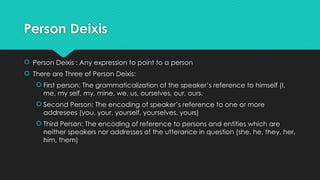
Person Deixis
PersonDeixis : Any expression to point to a person
There are Three of Person Deixis:
First person: The grammaticalization of the speaker’s reference to himself (I,
me, my self, my, mine, we, us, ourselves, our, ours.
Second Person: The encoding of speaker’s reference to one or more
addresees (you, your, yourself, yourselves, yours)
Third Person: The encoding of reference to persons and entities which are
neither speakers nor addresses of the utterance in question (she, he, they, her,
him, them)
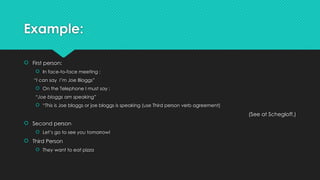
10.
Example:
First person:
In face-to-face meeting :
“I can say I’m Joe Bloggs”
On the Telephone I must say :
“Joe bloggs am speaking”
“This is Joe bloggs or joe bloggs is speaking (use Third person verb agreement)
(See at Schegloff,)
Second person
Let’s go to see you tomorrow!
Third Person
They want to eat pizza
11.
Time Deixis
TimeDeixis is Any expression used to point to a time ( tonight, last week,
yesterday, before, after, now, then, soon)
Exampe:
Pul the trigger now!
I will see you on thursday
12.
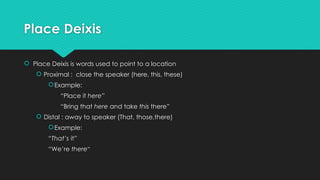
Place Deixis
PlaceDeixis is words used to point to a location
Proximal : close the speaker (here, this, these)
Example:
“Place it here”
“Bring that here and take this there”
Distal : away to speaker (That, those,there)
Example:
“That’s it”
“We’re there”
13.
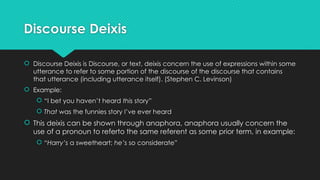
Discourse Deixis
DiscourseDeixis is Discourse, or text, deixis concern the use of expressions within some
utterance to refer to some portion of the discourse of the discourse that contains
that utterance (including utterance itself). (Stephen C. Levinson)
Example:
“I bet you haven’t heard this story”
That was the funnies story I’ve ever heard
This deixis can be shown through anaphora, anaphora usually concern the
use of a pronoun to referto the same referent as some prior term, in example:
“Harry’s a sweetheart; he’s so considerate”
14.
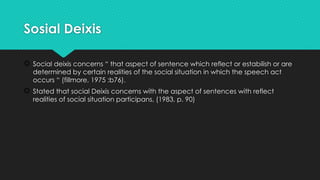
Sosial Deixis
Socialdeixis concerns “ that aspect of sentence which reflect or estabilish or are
determined by certain realities of the social situation in which the speech act
occurs “ (fillmore, 1975 :b76).
Stated that social Deixis concerns with the aspect of sentences with reflect
realities of social situation participans, (1983, p. 90)
15.
Two Basic KindOf Social Deitic
Information:
Relational social deixis
The deitic reference to a social relationship between the speaker and addresse.
The relational vareity is the most important, and the relations that typicallly get
expressed are those between:
i. Speaker and referent (e.g. Referent honorifics)
ii. Speaker and addressee (e.g. addressee honorifics)
iii. Speaker bystander (e.g. Bystanderor audience honorifics)
iv. Speaker and setting (e,g. Formality levels)
In english, relational social deixis may be a lexical items (e.g. My husband,
teacher, cousin, ect), pronouns (you, her)
Example: “My husband goes to work to the office”
16.
Absolute socialdeixis is a deitic reference usually expressed in certain forms of
address which will include no comparison of the ranking of the speaker and
addresse here will be only a simple referenceto the absolute status of the
addresse
For example: your higness, Mr. President, your majesty
17.
The Realization ofDeixis in Students’
Writing
Aim of the study
Methodology
Participant
Result of the study
Aim of thestudy
Finding out the realization of Deixis in students writing text
‟
explain the difficulties faced by the students and teacher roles to overcome the students
20.
Participant of theStudy
15 students of the second semester that have passed on the subjects of writing 1
21.
Result of thestudy
1.The analysis of person deixis in students' writing texts
The first person: -First person singular; ex; I have an experience when I was in Junior High
School
-First person plural; ex; We had to get out of the car.
The second person: - “Would you mind if I make a call from your phone?”
The Third person: - She asked permission to sit at my bench.
2. Place deixis; Proximal; ex; I hope I can do my best at this University.
Distal; ex; I pleased her even she had already sat there before asking
permission.
22.
3. Timedeixis (Temporal); ex; - Two years ago, I went to Yogyakarta for a study tour with all
my classmates.
-This is an unforgettable day in my life.
- She texted me “Putri, tomorrow we re going to the beach, do you want to join us?”
‟
4. Social diexis; relational social diexis; ex; I went there with my parents and my sister by
riding a car
Absolute social diexis; ex; I asked to my lecturer “Sorry Sir, what is my fault? So you ask me
to get out from this class?”
23.
5. DiscourseDeixis; -Demonstrative; -My best friend supported me in that situation.
- This is an unforgettable day in my life
-Discourse marker; -It was like a nightmare but it was a real disaster in
this town
24.
Students’ Difficulties inUsing Deixis
-Students’ difficulties in using time diexis
- Students’ difficulties in using discourse diexis
Teachers’ Role to Overcome Students Difficulties
-Discussion activity in the classroom
-Direct discussion among teacher and students
-Lecturer feedback
25.
The realization ofdeixis in song lyric in
Calum Scott “You Are The Reason”
Aim of research
Methodology
Analysis Data
Result
26.
Aim of TheStudy
There are two the aim of the study
Analyze the kinds of deixis
the dominant deixis in song lyrics “you are the reason” by Calum Scott
27.
Methodology
The methodused in this research is qualitative research method
The data were taken from the lyric song “You are the reason” by Calum Scott’s song
28.
Technique of DataAnalysis
The researcher uses two steps in data collecting.
listening technique by listen the song several times,
The researcher uses taking notes technique to find out the kinds of deixis by use the data card
that was prepared before.
29.
Result of theresearch
The researcher found
46 deixis in the Person deixis
13 Place deixis
8 time deixis
30.
Based onthe lyric song “You are the reason” by Calum Scott, the kinds of deixis are found
in that lyric, they are: person deixis, Place deixis, time deixis.
The dominant deixis in the lyric song “You are the reason” by Calum Scottis person Deixis.