Things to Recall:
1.Qualitative vs. Quantitative
2.Characteristics of
Quantitative Research
3.Kinds of Quantitative
Research
4.Importance
Quarter 1 - Module 2
Lesson 1:
Designing a Research
Topic
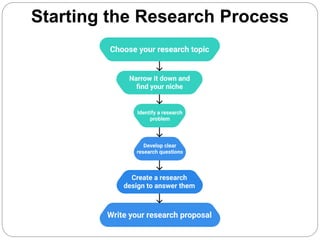
Starting the Research Process
Lesson 1:
DESIGNING A RESEARCH
TOPIC
Research topic- is an intellectual
stimulus calling for an answer in
the form of scientific inquiry.
DESIGNING A RESEARCH
TOPIC
Steps in Developing Research
Topic:
1. Choose a broad topic
-age and health
-discipline and academic
achievement
Steps in Developing Research Topic:
1. Choose a broad topic
-motivation to learn during the
pandemic
-parents and students during
the pandemic
-Youtube videos in student
learning
-self-learning modules
Steps in Developing Research
Topic:
2. Do preliminary
research
-journals
-articles
-reference list
Steps in Developing Research
Topic:
3. Define the problem
-problems
-questions
-debates
-contradictions
Steps in Developing Research
Topic:
4. Refine the question
-requirements
-time to complete
-difficulty
-availability of data on
DESIGNING A RESEARCH
TOPIC
Sources of Research Topics:
1. Observations
2. Existing problems
3. Existing needs
4. Fields of interest
Sources of Research Topics:
5. Issues performance or
efficiency
6. Processes that could be
improved
7. Areas of concern among
people
8. Difficulties faced by specific
Lesson 1:
DESIGNING A RESEARCH TOPIC
Criteria in Selecting a Research Topic:
(1)It should be something new of different
from what has already been written
about.
(2)It should be significant to the field of
study or discipline
(3)It must necessarily arouse intellectual
curiosity
Lesson 1:
DESIGNING A RESEARCH TOPIC
Criteria in Selecting a Research Topic:
5. It should be carried within a limited
period of time.
6. It should consider the training and
personal qualifications of the researcher.
7. It should consider the availability of data
involved in the study and the methods and
techniques to be employed in gathering
Lesson 1:
DESIGNING A RESEARCH TOPIC
Criteria in Selecting a Research Topic:
8. It should consider the availability of
effective instruments for gathering the data
and their treatment.
9. It should consider the financial capacity
of the researchers to support the project.
Quarter 1 - Module 2
Lesson 2:
Research Title
Lesson 2:
RESEARCH TITLE
Basic Guidelines in Making Research Title:
(1) Use an accurate description of the subject
and scope of the study instead of using
general terms.
(2) Do not use abbreviations except for
commonly known ones like DNA and ICT.
(3) Do not include words like “The study of,”
“analysis of,” “an investigation of” or similar
construction as these would only lengthen
Lesson 2:
RESEARCH TITLE
Basic Guidelines in Making Research
Title:
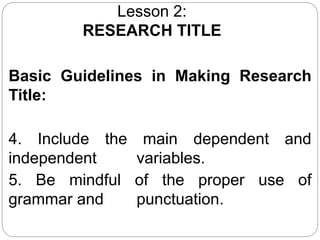
4. Include the main dependent and
independent variables.
5. Be mindful of the proper use of
grammar and punctuation.
Lesson 2:
RESEARCH TITLE
Basic Guidelines in Making Research Title:
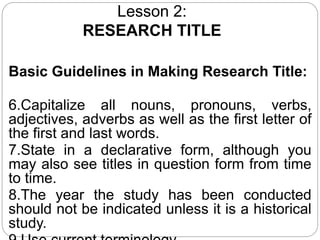
6.Capitalize all nouns, pronouns, verbs,
adjectives, adverbs as well as the first letter of
the first and last words.
7.State in a declarative form, although you
may also see titles in question form from time
to time.
8.The year the study has been conducted
should not be indicated unless it is a historical
study.
Lesson 2:
RESEARCH TITLE
Basic Guidelines in Making Research Title:
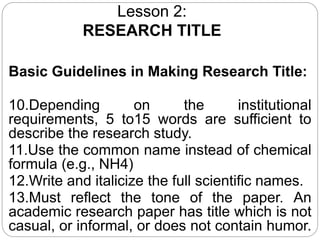
10.Depending on the institutional
requirements, 5 to15 words are sufficient to
describe the research study.
11.Use the common name instead of chemical
formula (e.g., NH4)
12.Write and italicize the full scientific names.
13.Must reflect the tone of the paper. An
academic research paper has title which is not
casual, or informal, or does not contain humor.
Lesson 2:
RESEARCH TITLE
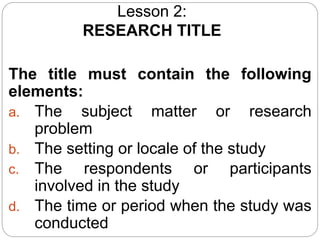
The title must contain the following
elements:
a. The subject matter or research
problem
b. The setting or locale of the study
c. The respondents or participants
involved in the study
d. The time or period when the study was
conducted
Lesson 2:
RESEARCH TITLE
Characteristics of a Good Research
Title:
a. A title should give readers information
about the contents of the research
b. Choose a title that is a phrase rather
than a complete sentence
c. Use no punctuation at the end of the
title
d. Do not underline the title of the
Lesson 2:
RESEARCH TITLE
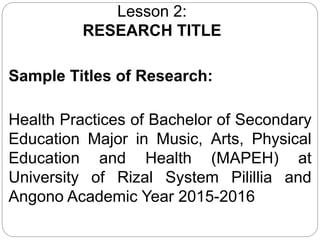
Sample Titles of Research:
Health Practices of Bachelor of Secondary
Education Major in Music, Arts, Physical
Education and Health (MAPEH) at
University of Rizal System Pilillia and
Angono Academic Year 2015-2016
Lesson 2:
RESEARCH TITLE
Sample Titles of Research:
Level of Acceptability of Worksheets for
Film-Clippings by the Teachers of English
in University of Antique, Academic Year
2015-2016
Lesson 2:
RESEARCH TITLE
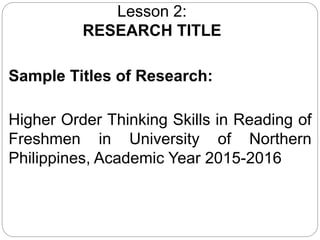
Sample Titles of Research:
Higher Order Thinking Skills in Reading of
Freshmen in University of Northern
Philippines, Academic Year 2015-2016
Comments
and
Questions
Practical Research 2 - Research Topic.pptx

Practical Research 2 - Research Topic.pptx

  • 2.
    Things to Recall: 1.Qualitativevs. Quantitative 2.Characteristics of Quantitative Research 3.Kinds of Quantitative Research 4.Importance
  • 3.
    Quarter 1 -Module 2 Lesson 1: Designing a Research Topic
  • 4.
  • 5.
    Lesson 1: DESIGNING ARESEARCH TOPIC Research topic- is an intellectual stimulus calling for an answer in the form of scientific inquiry.
  • 6.
    DESIGNING A RESEARCH TOPIC Stepsin Developing Research Topic: 1. Choose a broad topic -age and health -discipline and academic achievement
  • 7.
    Steps in DevelopingResearch Topic: 1. Choose a broad topic -motivation to learn during the pandemic -parents and students during the pandemic -Youtube videos in student learning -self-learning modules
  • 8.
    Steps in DevelopingResearch Topic: 2. Do preliminary research -journals -articles -reference list
  • 9.
    Steps in DevelopingResearch Topic: 3. Define the problem -problems -questions -debates -contradictions
  • 10.
    Steps in DevelopingResearch Topic: 4. Refine the question -requirements -time to complete -difficulty -availability of data on
  • 11.
    DESIGNING A RESEARCH TOPIC Sourcesof Research Topics: 1. Observations 2. Existing problems 3. Existing needs 4. Fields of interest
  • 12.
    Sources of ResearchTopics: 5. Issues performance or efficiency 6. Processes that could be improved 7. Areas of concern among people 8. Difficulties faced by specific
  • 14.
    Lesson 1: DESIGNING ARESEARCH TOPIC Criteria in Selecting a Research Topic: (1)It should be something new of different from what has already been written about. (2)It should be significant to the field of study or discipline (3)It must necessarily arouse intellectual curiosity
  • 15.
    Lesson 1: DESIGNING ARESEARCH TOPIC Criteria in Selecting a Research Topic: 5. It should be carried within a limited period of time. 6. It should consider the training and personal qualifications of the researcher. 7. It should consider the availability of data involved in the study and the methods and techniques to be employed in gathering
  • 16.
    Lesson 1: DESIGNING ARESEARCH TOPIC Criteria in Selecting a Research Topic: 8. It should consider the availability of effective instruments for gathering the data and their treatment. 9. It should consider the financial capacity of the researchers to support the project.
  • 18.
    Quarter 1 -Module 2 Lesson 2: Research Title
  • 19.
    Lesson 2: RESEARCH TITLE BasicGuidelines in Making Research Title: (1) Use an accurate description of the subject and scope of the study instead of using general terms. (2) Do not use abbreviations except for commonly known ones like DNA and ICT. (3) Do not include words like “The study of,” “analysis of,” “an investigation of” or similar construction as these would only lengthen
  • 20.
    Lesson 2: RESEARCH TITLE BasicGuidelines in Making Research Title: 4. Include the main dependent and independent variables. 5. Be mindful of the proper use of grammar and punctuation.
  • 21.
    Lesson 2: RESEARCH TITLE BasicGuidelines in Making Research Title: 6.Capitalize all nouns, pronouns, verbs, adjectives, adverbs as well as the first letter of the first and last words. 7.State in a declarative form, although you may also see titles in question form from time to time. 8.The year the study has been conducted should not be indicated unless it is a historical study.
  • 22.
    Lesson 2: RESEARCH TITLE BasicGuidelines in Making Research Title: 10.Depending on the institutional requirements, 5 to15 words are sufficient to describe the research study. 11.Use the common name instead of chemical formula (e.g., NH4) 12.Write and italicize the full scientific names. 13.Must reflect the tone of the paper. An academic research paper has title which is not casual, or informal, or does not contain humor.
  • 23.
    Lesson 2: RESEARCH TITLE Thetitle must contain the following elements: a. The subject matter or research problem b. The setting or locale of the study c. The respondents or participants involved in the study d. The time or period when the study was conducted
  • 24.
    Lesson 2: RESEARCH TITLE Characteristicsof a Good Research Title: a. A title should give readers information about the contents of the research b. Choose a title that is a phrase rather than a complete sentence c. Use no punctuation at the end of the title d. Do not underline the title of the
  • 25.
    Lesson 2: RESEARCH TITLE SampleTitles of Research: Health Practices of Bachelor of Secondary Education Major in Music, Arts, Physical Education and Health (MAPEH) at University of Rizal System Pilillia and Angono Academic Year 2015-2016
  • 26.
    Lesson 2: RESEARCH TITLE SampleTitles of Research: Level of Acceptability of Worksheets for Film-Clippings by the Teachers of English in University of Antique, Academic Year 2015-2016
  • 27.
    Lesson 2: RESEARCH TITLE SampleTitles of Research: Higher Order Thinking Skills in Reading of Freshmen in University of Northern Philippines, Academic Year 2015-2016
  • 28.