Literature Review Workshop
                  Prof. Dr. Khalid Mahmood
   Department of Library and Information Science
                         University of the Punjab
                              Lahore, PAKISTAN


                                                    1
Workshop agenda
   Literature review – What and why
   Searching and finding print and online sources
   Evaluating sources for relevance and reliability
   Reading critically
   Analyzing and synthesizing findings
   Writing and presenting literature review
   Citing sources in text and reference list /
    bibliography
   Avoiding plagiarism

                                                       2
Training methods
 Lectures  / presentations based on secondary
  information
 Question-answer / short assignments during
  lectures
 Sharing of trainer’s personal experiences

 Discussion on research projects of
  participants


                                                 3
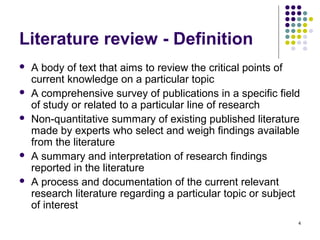
Literature review - Definition
   A body of text that aims to review the critical points of
    current knowledge on a particular topic
   A comprehensive survey of publications in a specific field
    of study or related to a particular line of research
   Non-quantitative summary of existing published literature
    made by experts who select and weigh findings available
    from the literature
   A summary and interpretation of research findings
    reported in the literature
   A process and documentation of the current relevant
    research literature regarding a particular topic or subject
    of interest
                                                              4
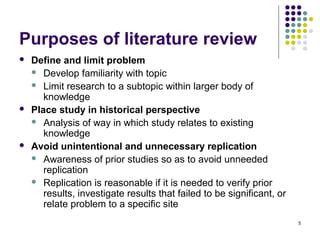
Purposes of literature review
   Define and limit problem
     Develop familiarity with topic
     Limit research to a subtopic within larger body of
       knowledge
   Place study in historical perspective
     Analysis of way in which study relates to existing
       knowledge
   Avoid unintentional and unnecessary replication
     Awareness of prior studies so as to avoid unneeded
       replication
     Replication is reasonable if it is needed to verify prior
       results, investigate results that failed to be significant, or
       relate problem to a specific site
                                                                        5
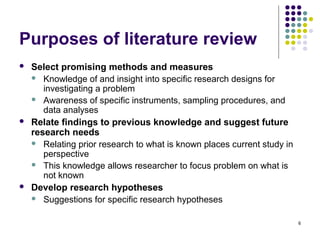
Purposes of literature review
   Select promising methods and measures
     Knowledge of and insight into specific research designs for
       investigating a problem
     Awareness of specific instruments, sampling procedures, and
       data analyses
   Relate findings to previous knowledge and suggest future
    research needs
     Relating prior research to what is known places current study in
       perspective
     This knowledge allows researcher to focus problem on what is
       not known
   Develop research hypotheses
     Suggestions for specific research hypotheses


                                                                         6
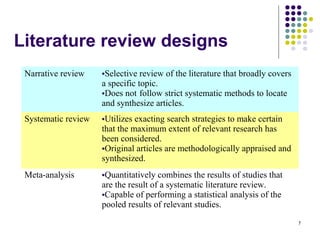
Literature review designs
 Narrative review    •Selective  review of the literature that broadly covers
                     a specific topic.
                     •Does not follow strict systematic methods to locate
                     and synthesize articles.
 Systematic review   •Utilizes exacting search strategies to make certain
                     that the maximum extent of relevant research has
                     been considered.
                     •Original articles are methodologically appraised and
                     synthesized.
 Meta-analysis       •Quantitatively  combines the results of studies that
                     are the result of a systematic literature review.
                     •Capable of performing a statistical analysis of the
                     pooled results of relevant studies.
                                                                                7
When we need to do a
literature review
 At   the beginning of the research project
   Proposal
   Chapter   2, 1 & 3

 Constantly   update during the research

 When writing the discussion and conclusion
 chapters

                                               8
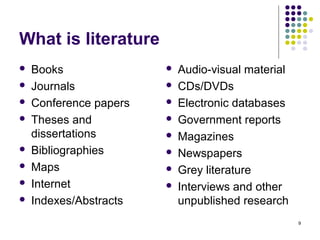
What is literature
   Books                  Audio-visual material
   Journals               CDs/DVDs
   Conference papers      Electronic databases
   Theses and             Government reports
    dissertations          Magazines
   Bibliographies         Newspapers
   Maps                   Grey literature
   Internet               Interviews and other
   Indexes/Abstracts       unpublished research
                                                    9
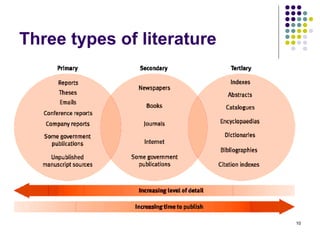
Three types of literature


                            10

1 literature review workshop-khalid

  • 1.
    Literature Review Workshop Prof. Dr. Khalid Mahmood Department of Library and Information Science University of the Punjab Lahore, PAKISTAN 1
  • 2.
    Workshop agenda  Literature review – What and why  Searching and finding print and online sources  Evaluating sources for relevance and reliability  Reading critically  Analyzing and synthesizing findings  Writing and presenting literature review  Citing sources in text and reference list / bibliography  Avoiding plagiarism 2
  • 3.
    Training methods  Lectures / presentations based on secondary information  Question-answer / short assignments during lectures  Sharing of trainer’s personal experiences  Discussion on research projects of participants 3
  • 4.
    Literature review -Definition  A body of text that aims to review the critical points of current knowledge on a particular topic  A comprehensive survey of publications in a specific field of study or related to a particular line of research  Non-quantitative summary of existing published literature made by experts who select and weigh findings available from the literature  A summary and interpretation of research findings reported in the literature  A process and documentation of the current relevant research literature regarding a particular topic or subject of interest 4
  • 5.
    Purposes of literaturereview  Define and limit problem  Develop familiarity with topic  Limit research to a subtopic within larger body of knowledge  Place study in historical perspective  Analysis of way in which study relates to existing knowledge  Avoid unintentional and unnecessary replication  Awareness of prior studies so as to avoid unneeded replication  Replication is reasonable if it is needed to verify prior results, investigate results that failed to be significant, or relate problem to a specific site 5
  • 6.
    Purposes of literaturereview  Select promising methods and measures  Knowledge of and insight into specific research designs for investigating a problem  Awareness of specific instruments, sampling procedures, and data analyses  Relate findings to previous knowledge and suggest future research needs  Relating prior research to what is known places current study in perspective  This knowledge allows researcher to focus problem on what is not known  Develop research hypotheses  Suggestions for specific research hypotheses 6
  • 7.
    Literature review designs Narrative review •Selective review of the literature that broadly covers a specific topic. •Does not follow strict systematic methods to locate and synthesize articles. Systematic review •Utilizes exacting search strategies to make certain that the maximum extent of relevant research has been considered. •Original articles are methodologically appraised and synthesized. Meta-analysis •Quantitatively combines the results of studies that are the result of a systematic literature review. •Capable of performing a statistical analysis of the pooled results of relevant studies. 7
  • 8.
    When we needto do a literature review  At the beginning of the research project  Proposal  Chapter 2, 1 & 3  Constantly update during the research  When writing the discussion and conclusion chapters 8
  • 9.
    What is literature  Books  Audio-visual material  Journals  CDs/DVDs  Conference papers  Electronic databases  Theses and  Government reports dissertations  Magazines  Bibliographies  Newspapers  Maps  Grey literature  Internet  Interviews and other  Indexes/Abstracts unpublished research 9
  • 10.
    Three types ofliterature 10