CONTRACEPTION
Associate Prof Dr
Hanifullah Khan
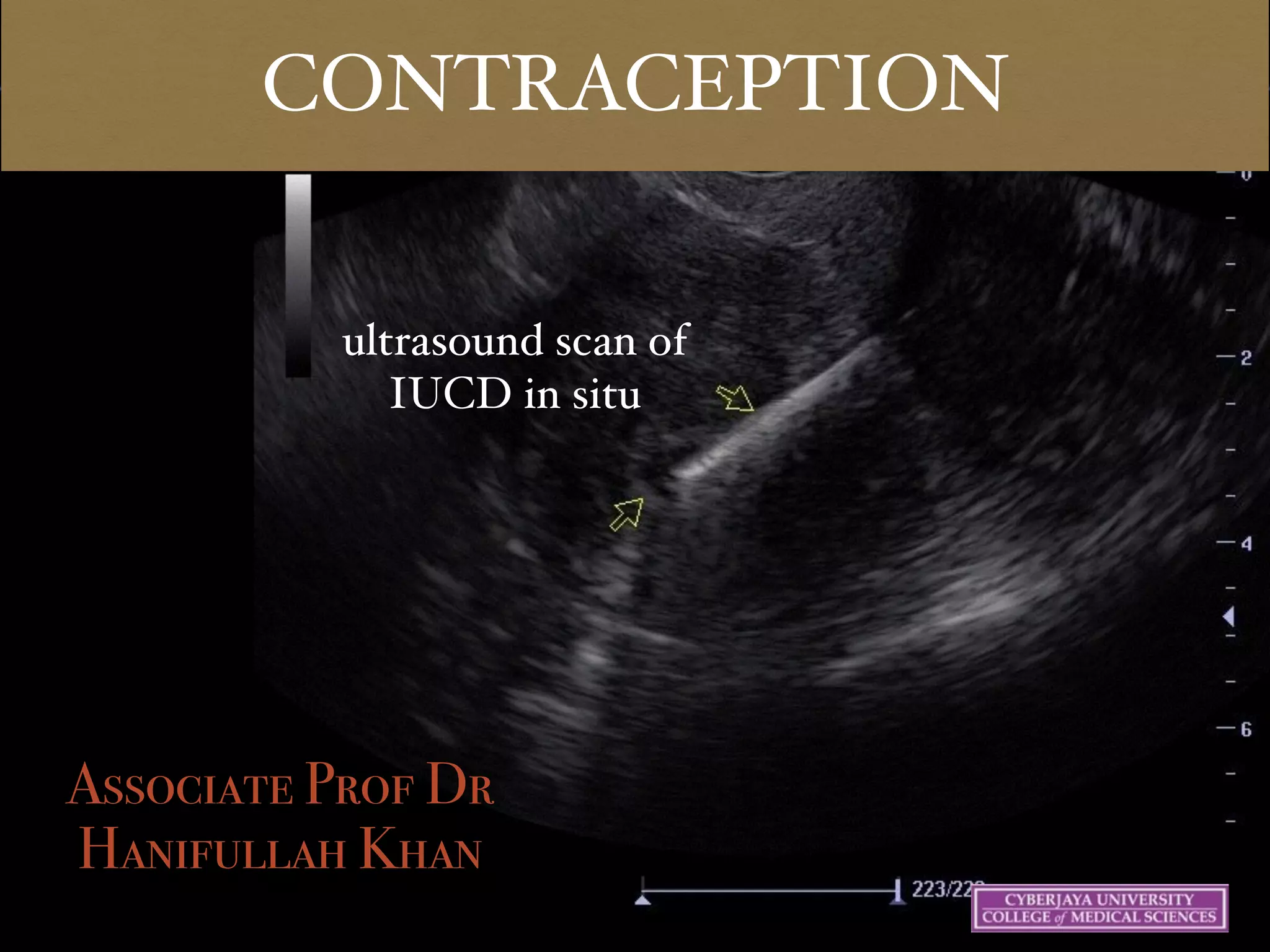
ultrasound scan of
IUCD in situ
Objectives
Understand the definition, classification & terminology
Understand the reason for contraception
Know the advantages & side-effects
Know the proper use of each method
To be able to advise on the use
19 May 07 3
Introduction
Definition – any method used to prevent
pregnancy
• Allows to choose
whether & when to
have a child
19 May 07 4
Reproduction
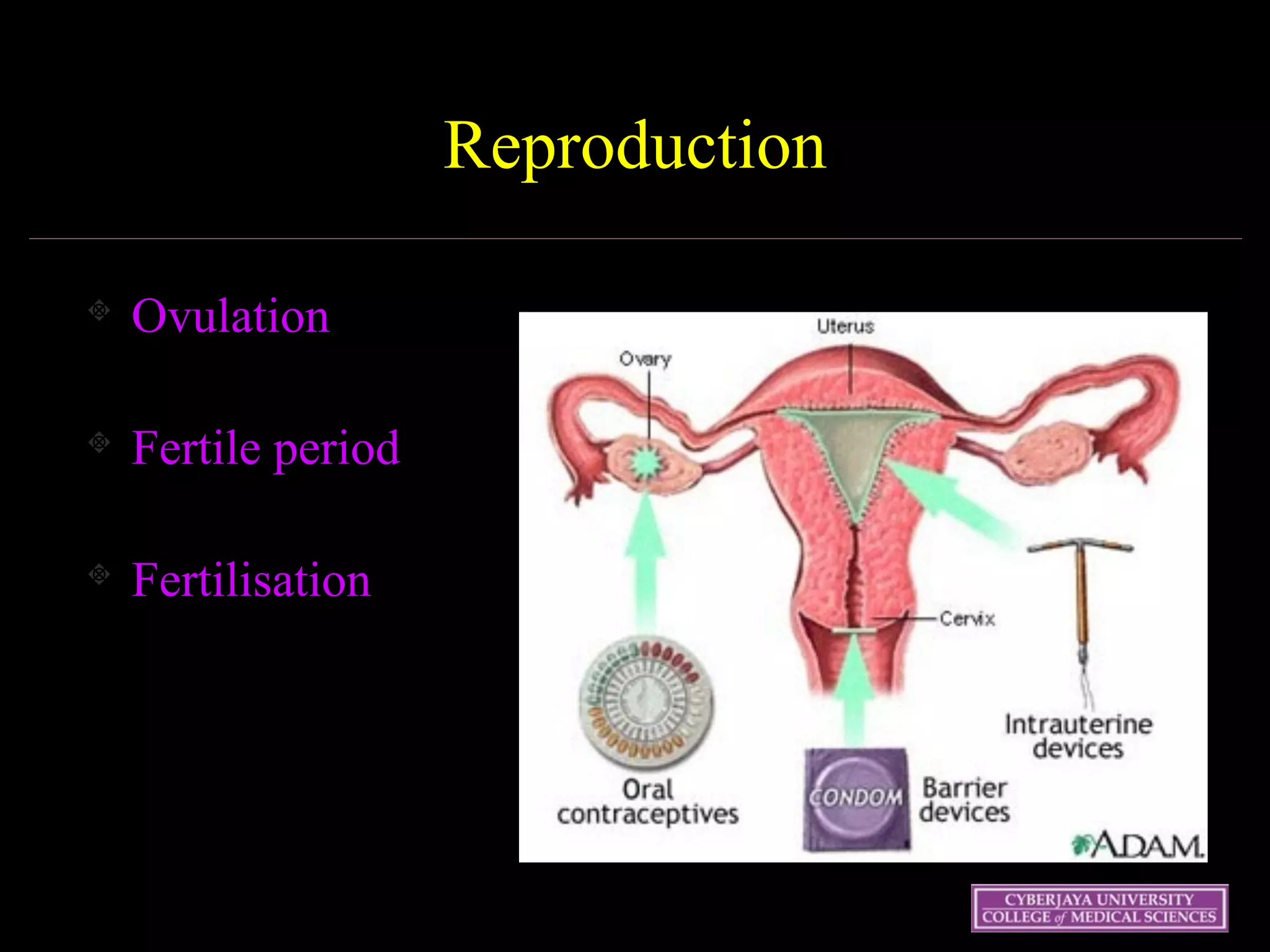
Ovulation
Fertile period
Fertilisation
!
7 June 2006 8
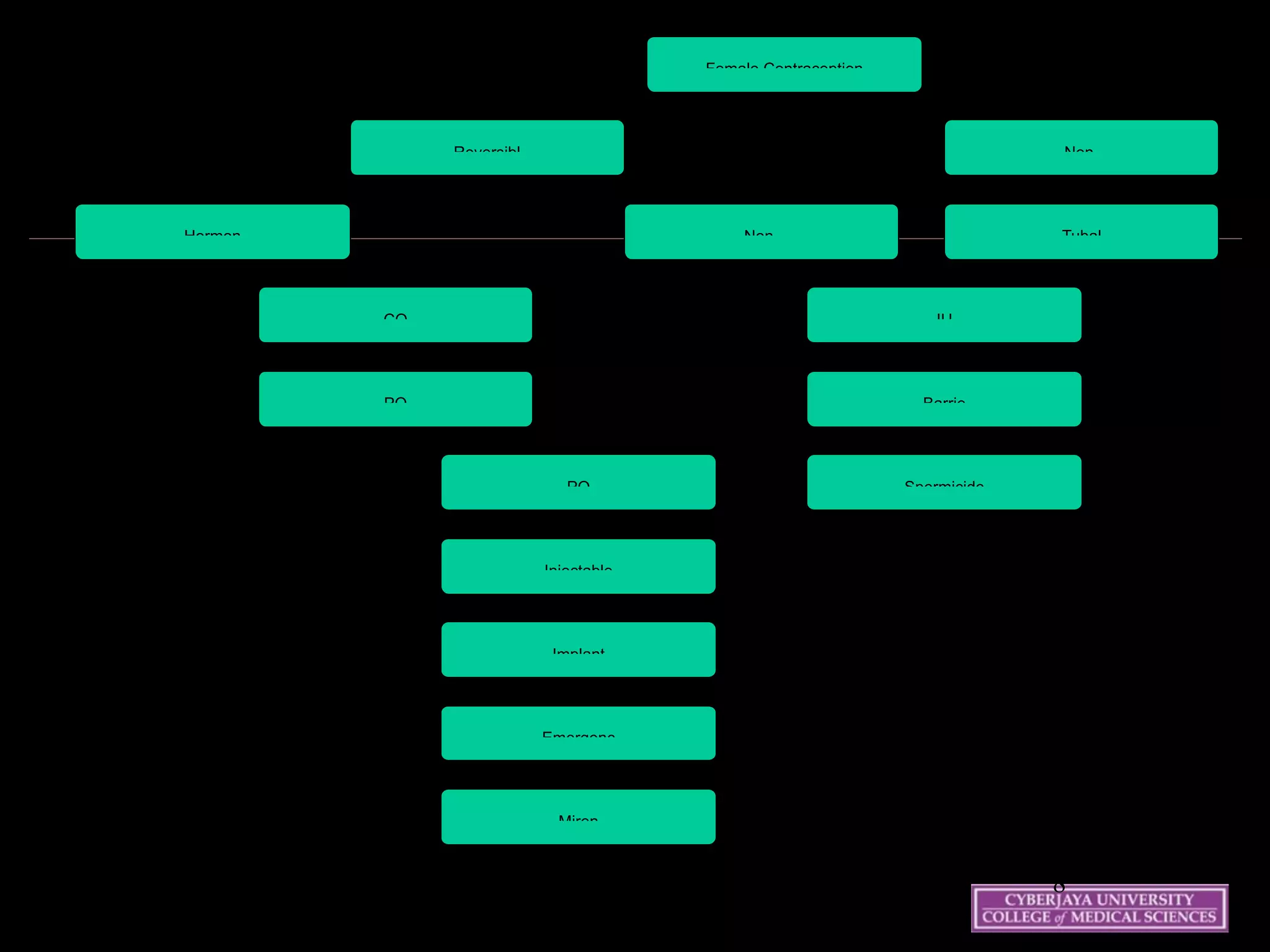
Female Contraception
Reversibl Non-
Hormon Non-
CO
PO
IU
Barrie
Spermicide
Tubal
PO
Injectable
Implant
Emergenc
Miren
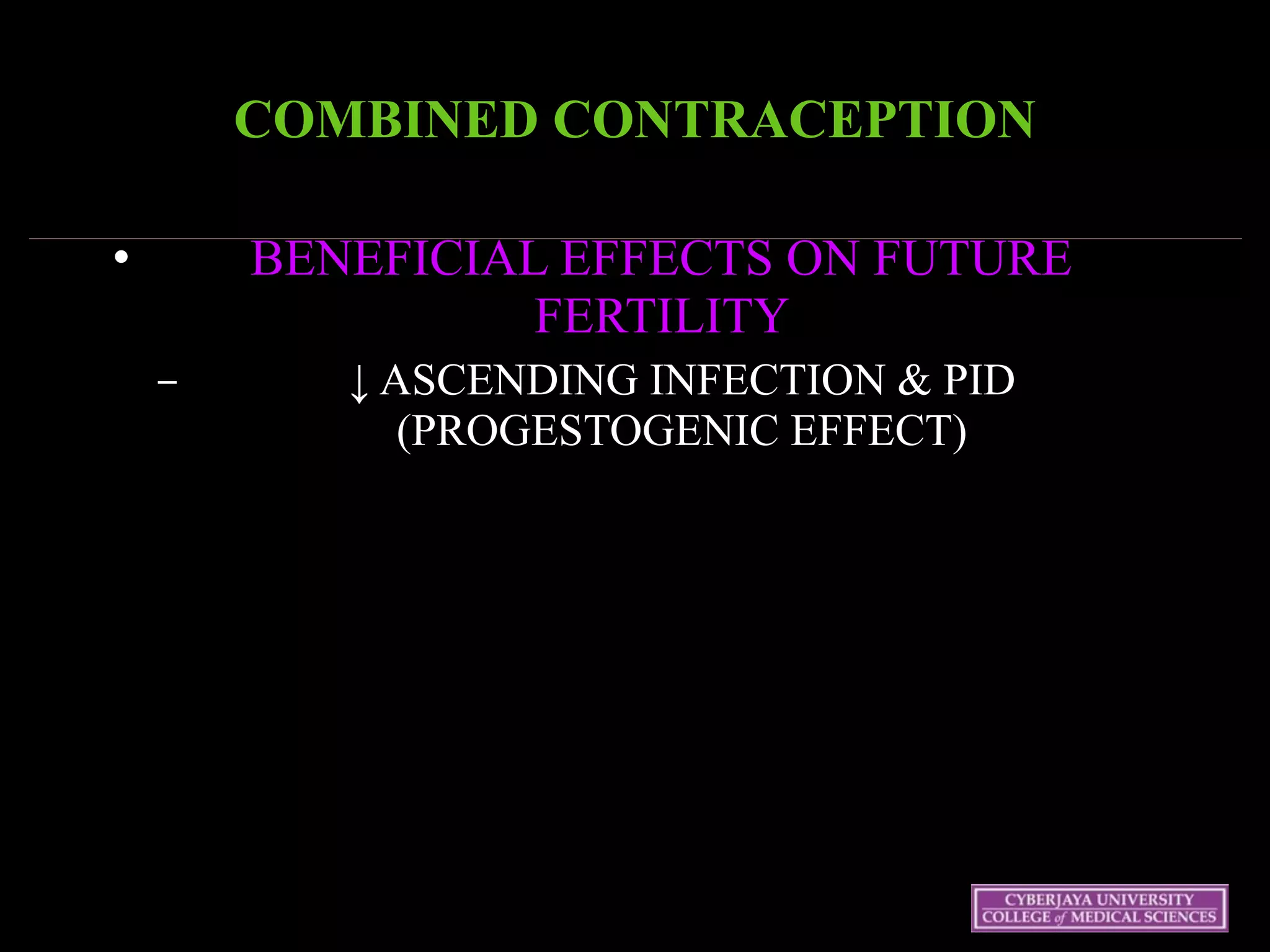
COMBINED CONTRACEPTION

• BENEFICIAL EFFECTS ON FUTURE
FERTILITY
– ↓ ASCENDING INFECTION & PID
(PROGESTOGENIC EFFECT)
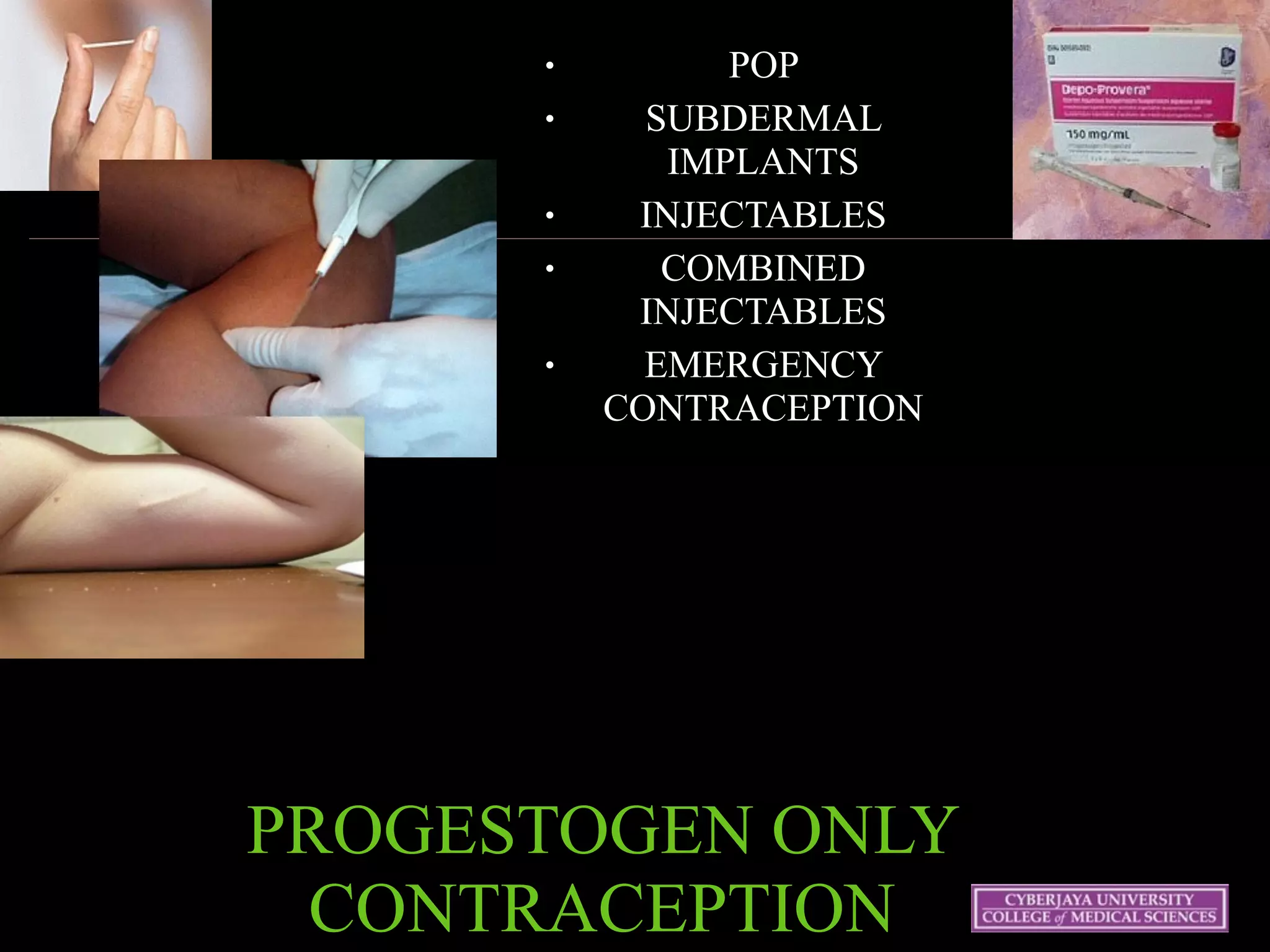
PROGESTOGEN ONLY
CONTRACEPTION
● POP
● SUBDERMAL
IMPLANTS
● INJECTABLES
● COMBINED
INJECTABLES
● EMERGENCY
CONTRACEPTION
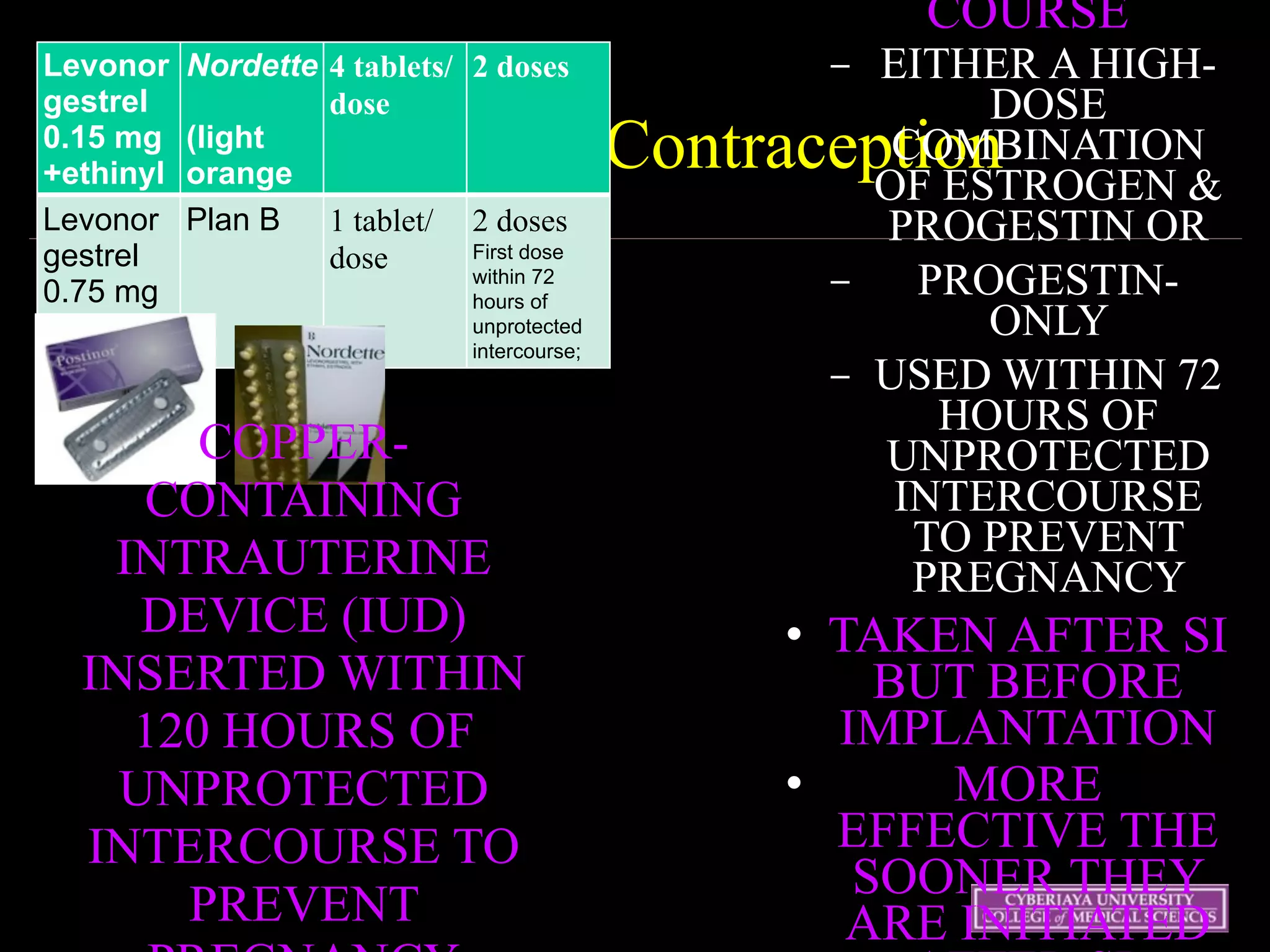
Emergency Contraception
Levonor
gestrel
0.15 mg
+ethinyl
estradio
Nordette
(light
orange
tablets)
4 tablets/
dose
2 doses
Levonor
gestrel
0.75 mg
Plan B 1 tablet/
dose
2 doses
First dose
within 72
hours of
unprotected
intercourse;
second dose
• COPPER-
CONTAINING
INTRAUTERINE
DEVICE (IUD)
INSERTED WITHIN
120 HOURS OF
UNPROTECTED
INTERCOURSE TO
PREVENT
COURSE
– EITHER A HIGH-
DOSE
COMBINATION
OF ESTROGEN &
PROGESTIN OR
– PROGESTIN-
ONLY
– USED WITHIN 72
HOURS OF
UNPROTECTED
INTERCOURSE
TO PREVENT
PREGNANCY
• TAKEN AFTER SI
BUT BEFORE
IMPLANTATION
• MORE
EFFECTIVE THE
SOONER THEY
ARE INITIATED
Wednesday 15 October
2003 25
NATURAL METHODS
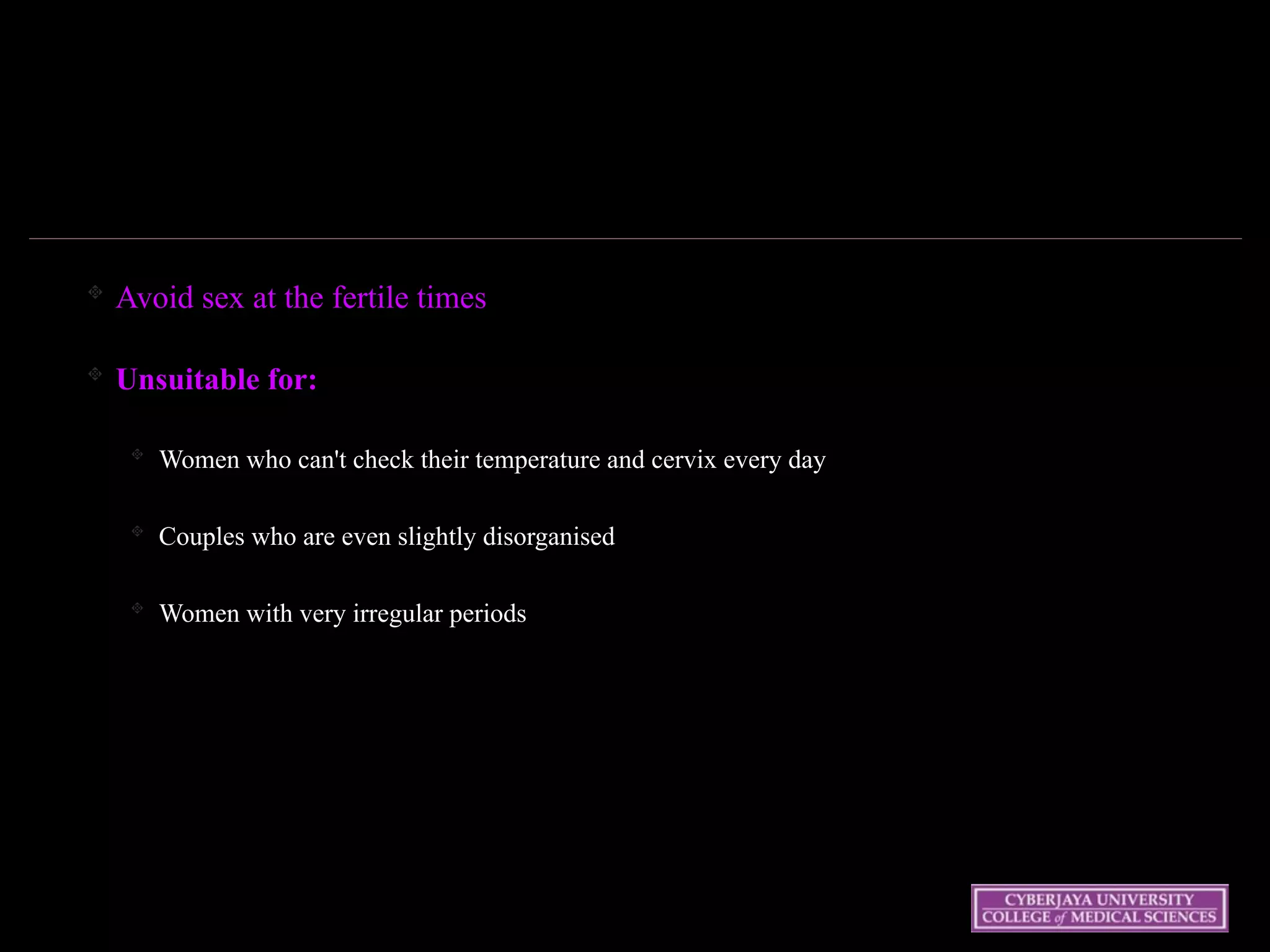
Avoid sex at the fertile times
Unsuitable for:
Women who can't check their temperature and cervix every day
Couples who are even slightly disorganised
Women with very irregular periods
!
!
Wednesday 15 October
2003 28
Methods
Coitus Interruptus
Rhythm Method
Calendar
BBT
Cervical Mucous (Ovulation)
Symptothermal
Ovulation Predictor Kits
Abstinence
Lactational Amenorrhoea Method
Wednesday 15 October
2003 38
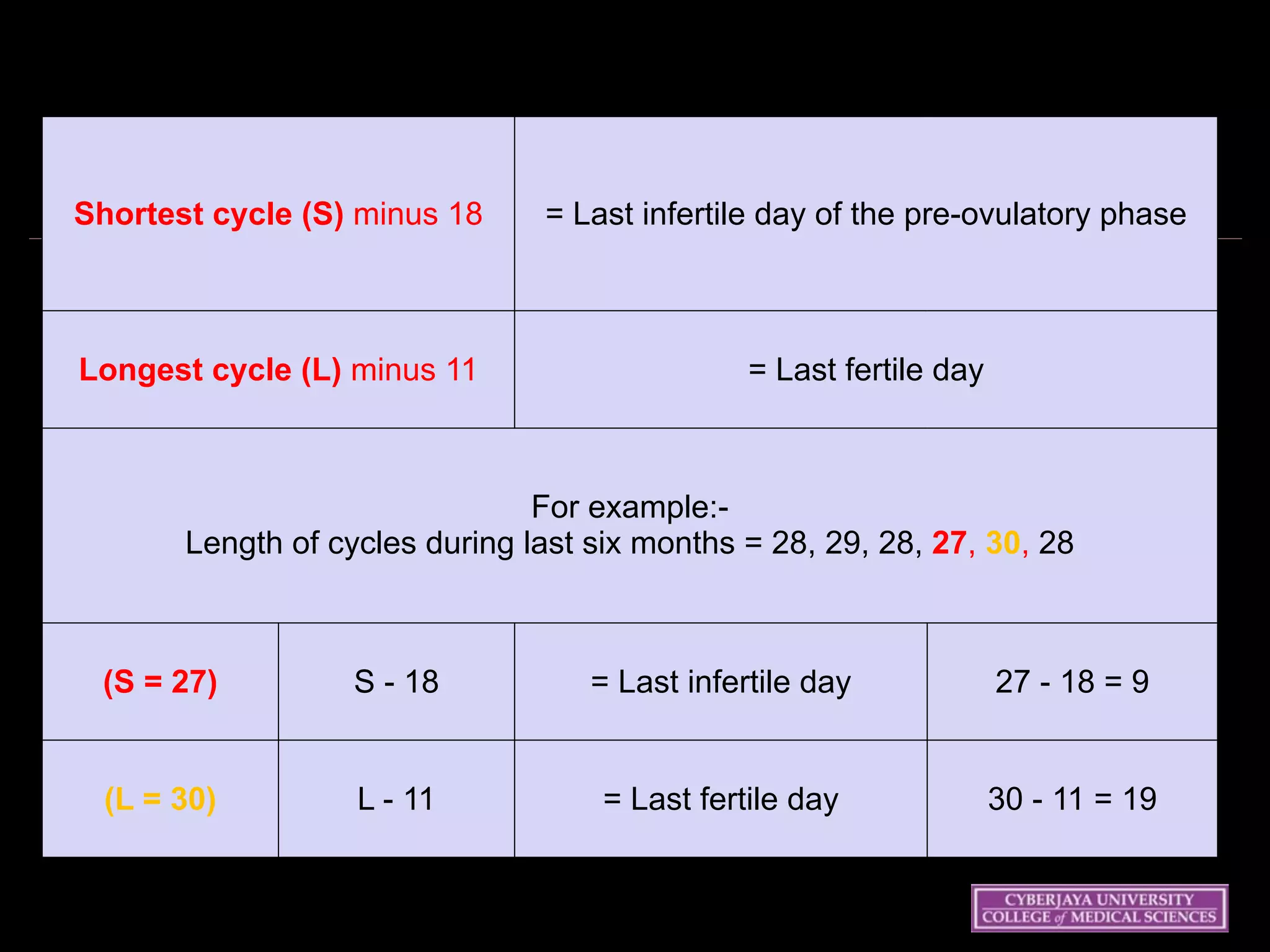
Shortest cycle (S) minus 18 = Last infertile day of the pre-ovulatory phase
Longest cycle (L) minus 11 = Last fertile day
For example:-
Length of cycles during last six months = 28, 29, 28, 27, 30, 28
(S = 27) S - 18 = Last infertile day 27 - 18 = 9
(L = 30) L - 11 = Last fertile day 30 - 11 = 19
Wednesday 15 October
2003
39
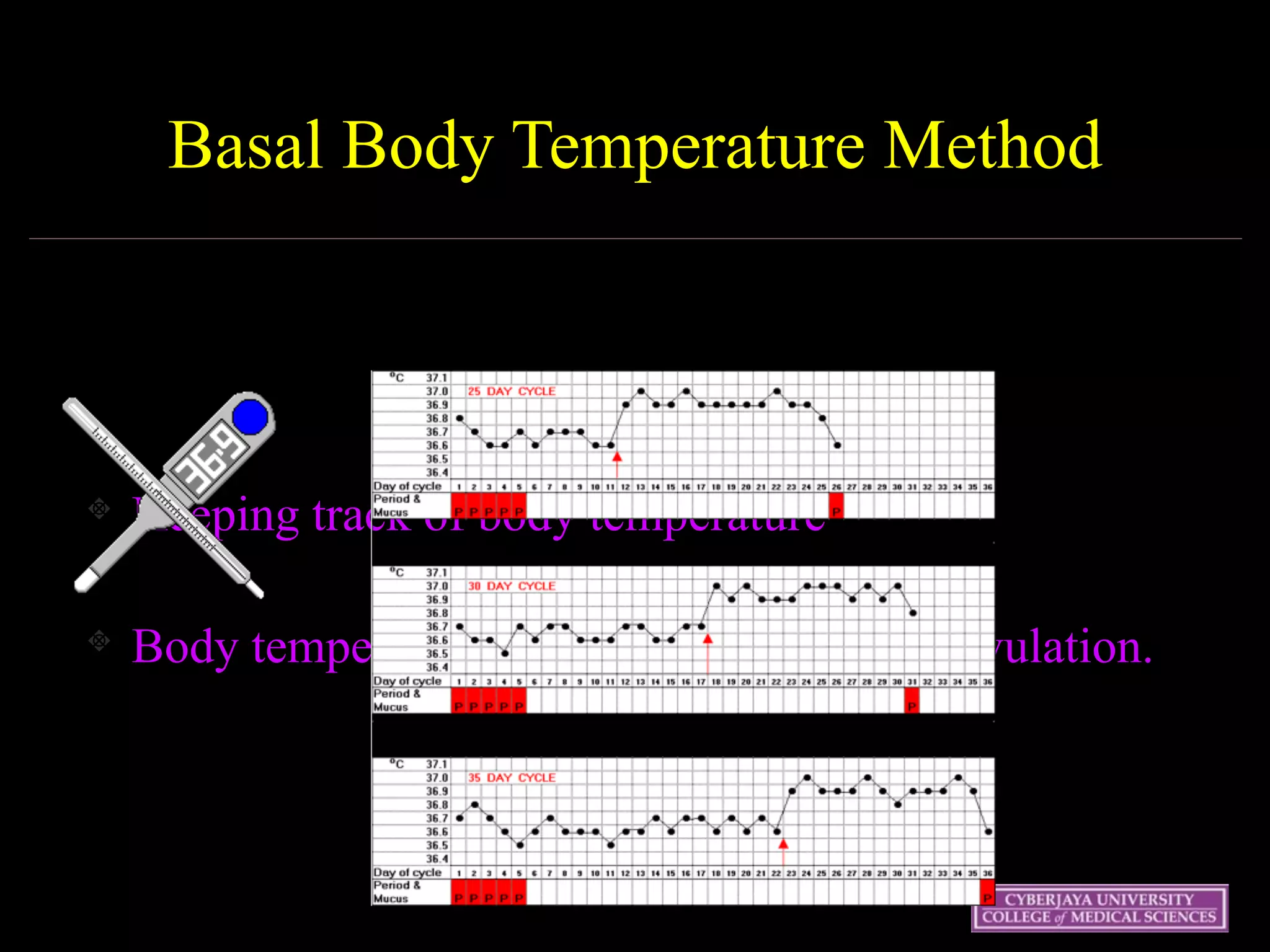
Basal Body Temperature Method
Keeping track of body temperature
Body temperature rises two days prior to ovulation.
Wednesday 15 October
2003 42
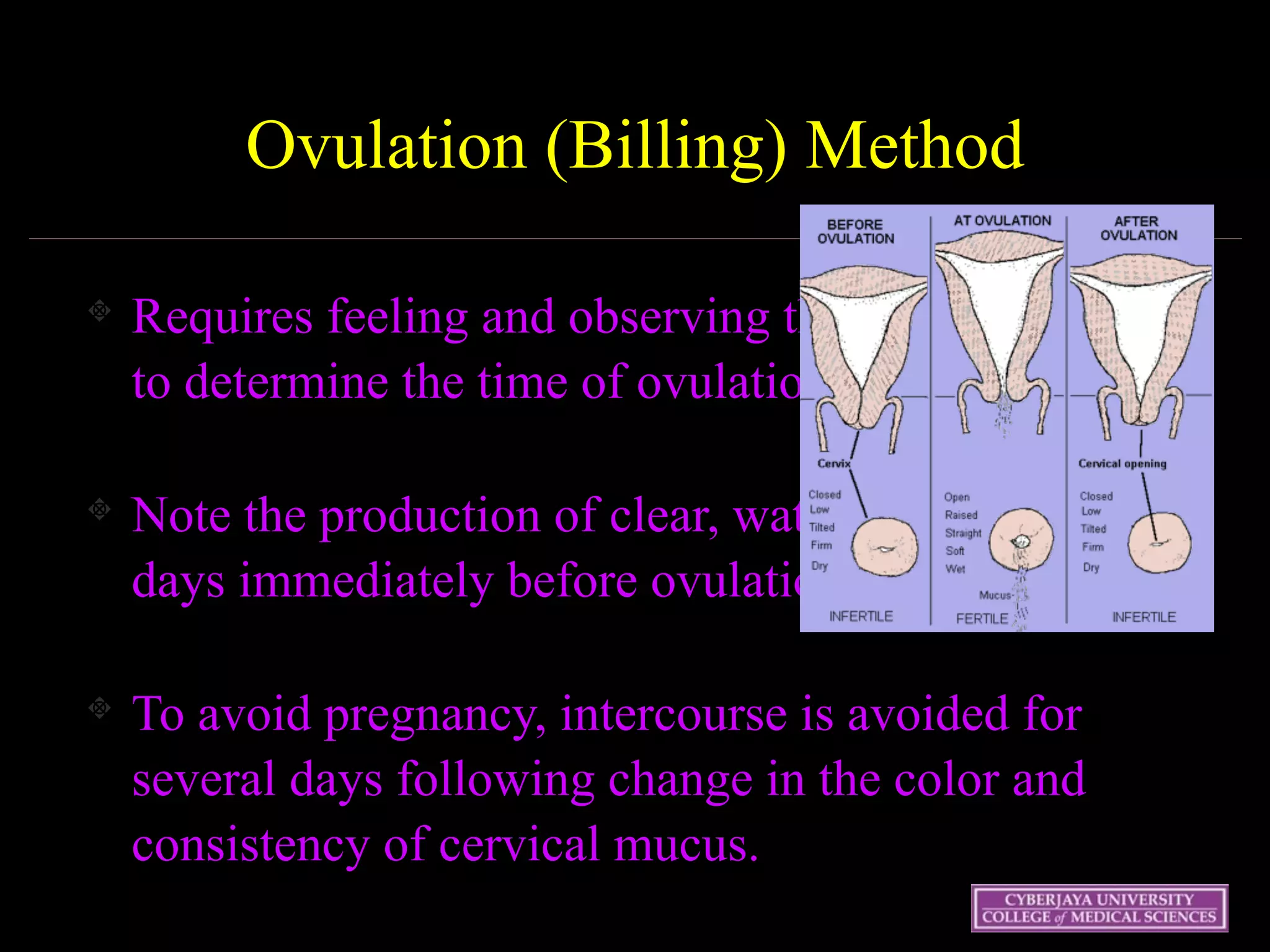
Ovulation (Billing) Method
Requires feeling and observing the cervical mucus
to determine the time of ovulation.
Note the production of clear, watery mucus in the
days immediately before ovulation
To avoid pregnancy, intercourse is avoided for
several days following change in the color and
consistency of cervical mucus.
Wednesday 15 October
2003 45
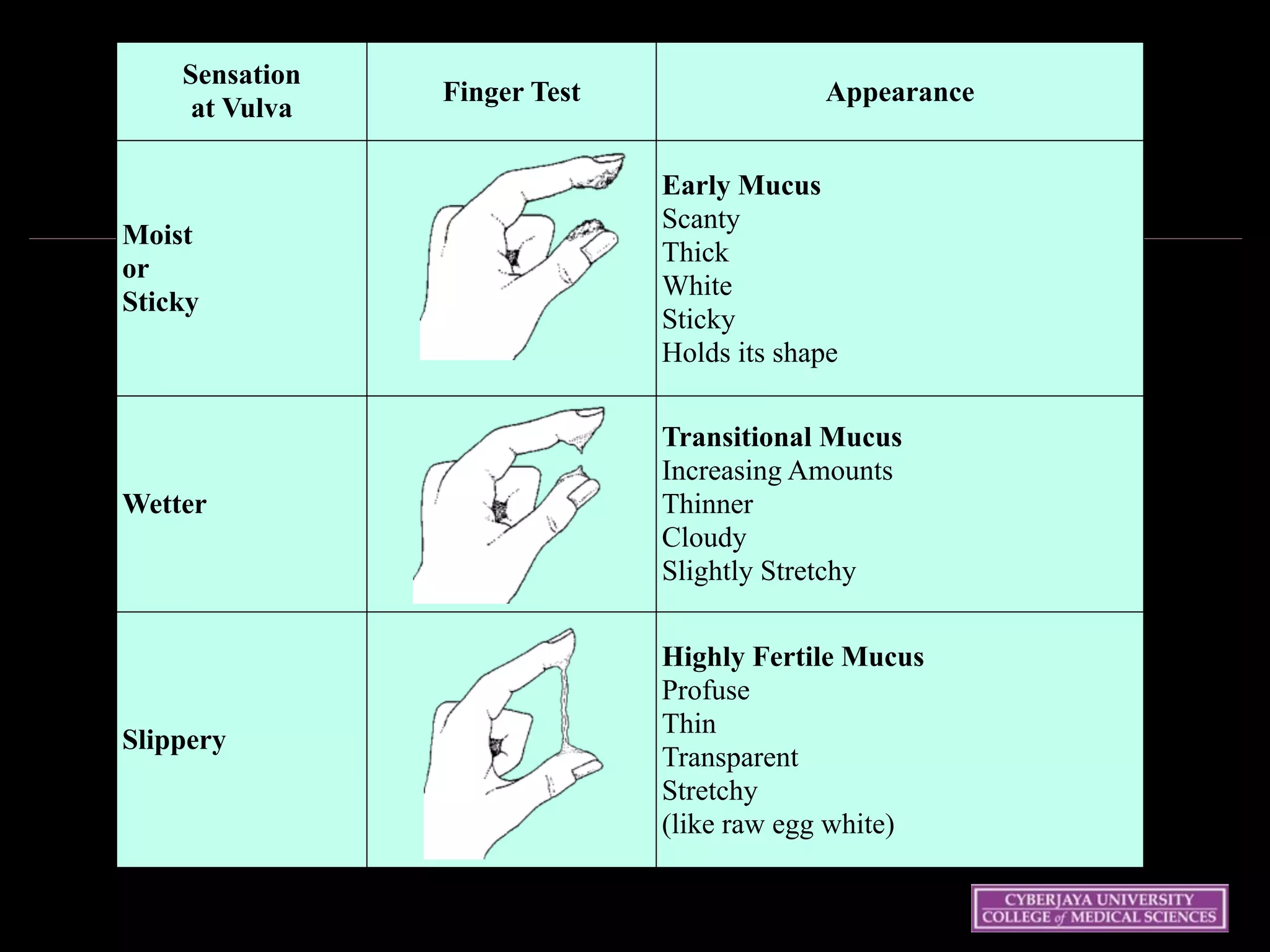
Sensation

at Vulva
Finger Test Appearance
Moist

or

Sticky
Early Mucus

Scanty

Thick

White

Sticky

Holds its shape
Wetter
Transitional Mucus

Increasing Amounts

Thinner

Cloudy

Slightly Stretchy
Slippery
Highly Fertile Mucus

Profuse

Thin

Transparent

Stretchy

(like raw egg white)
Wednesday 15 October
2003
46
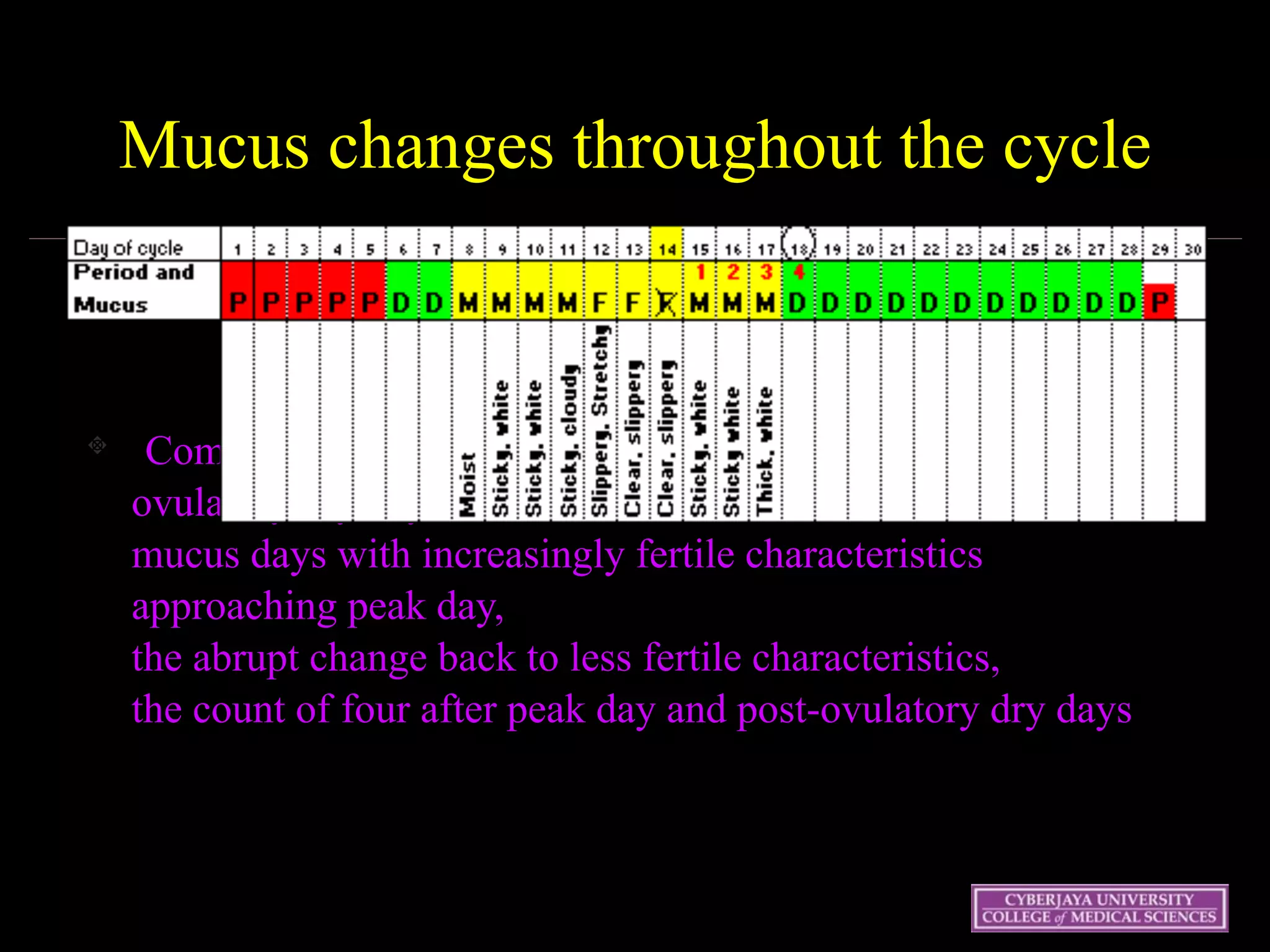
Mucus changes throughout the cycle
Complete cycle showing typical pattern of menstruation, pre-
ovulatory dry days, 

mucus days with increasingly fertile characteristics
approaching peak day, 

the abrupt change back to less fertile characteristics, 

the count of four after peak day and post-ovulatory dry days
Wednesday 15 October
2003
48
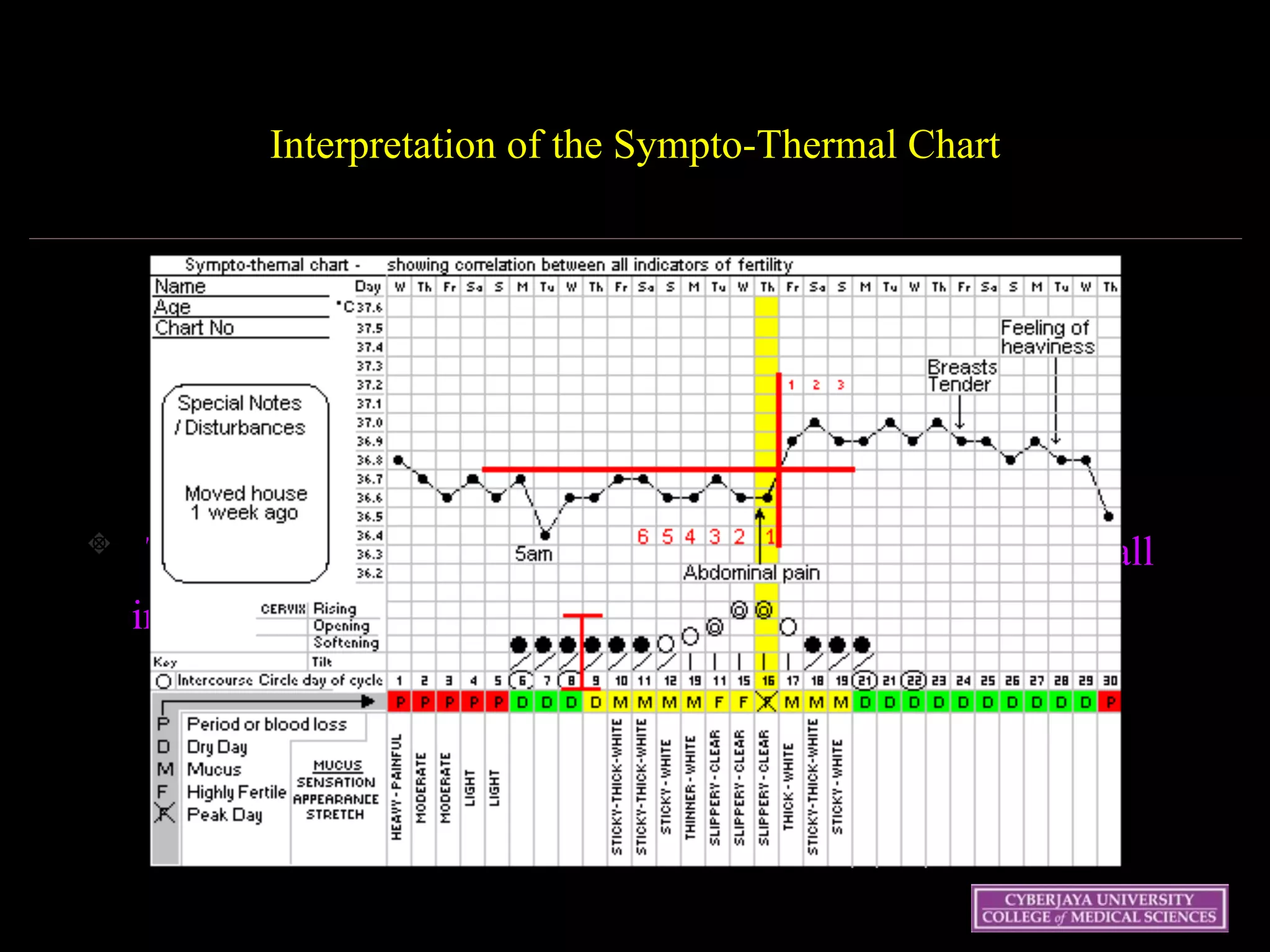
Interpretation of the Sympto-Thermal Chart
This sympto-thermal chart shows the correlation between all
indicators of fertility
Wednesday 15 October
2003 49
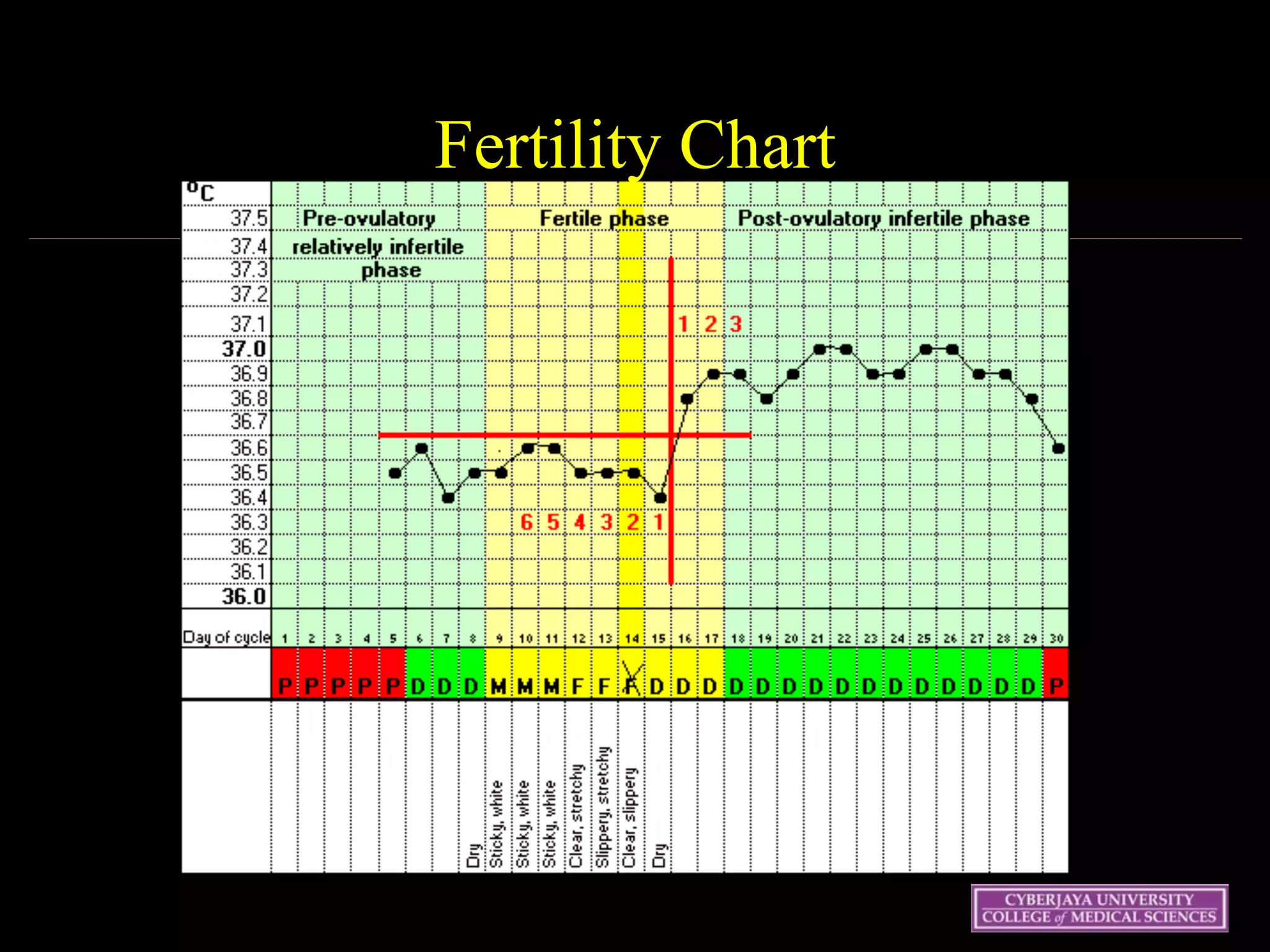
Fertility Chart
Wednesday 15 October
2003
50
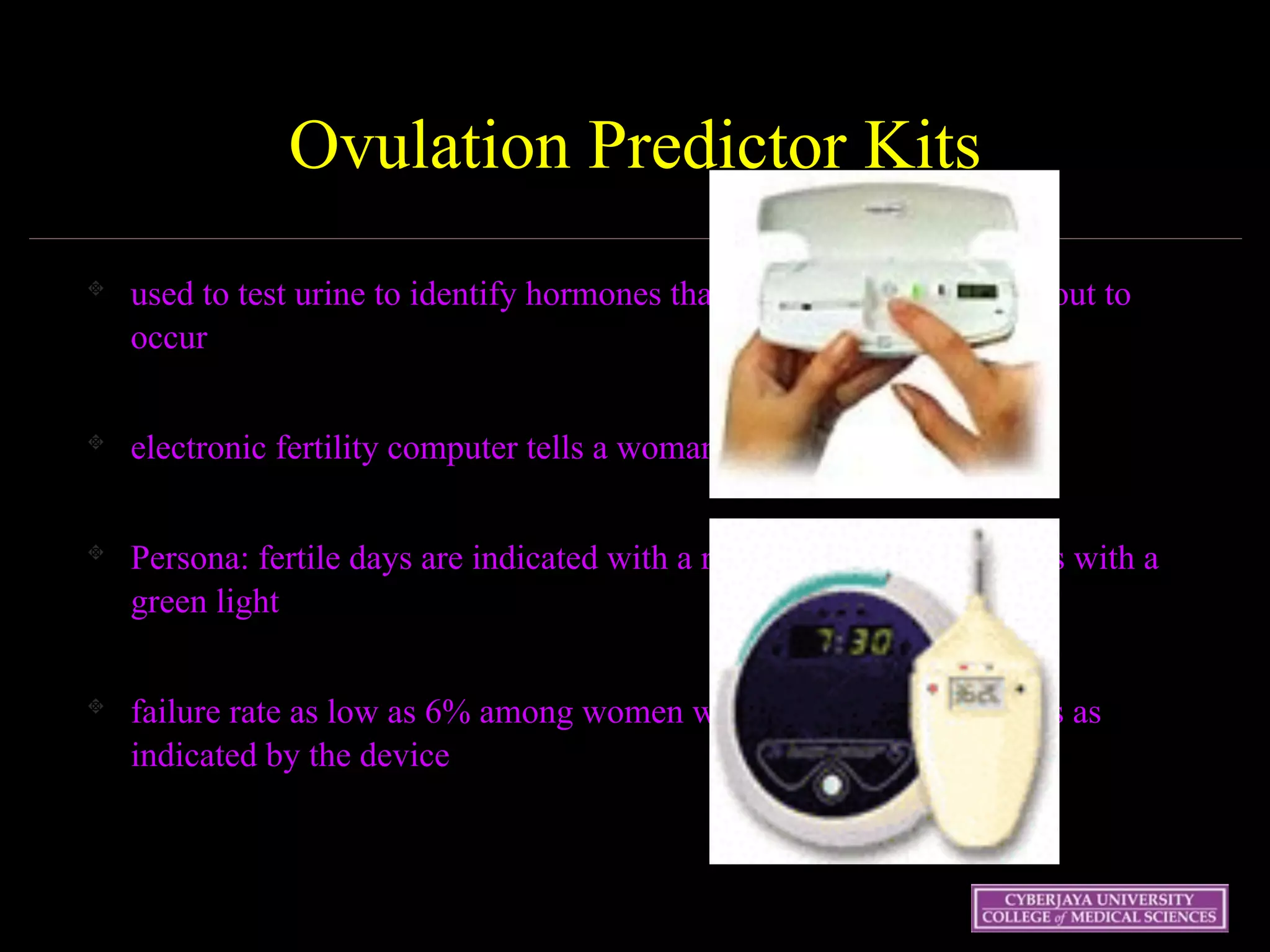
Ovulation Predictor Kits
used to test urine to identify hormones that indicate ovulation is about to
occur
electronic fertility computer tells a woman which days she is fertile
Persona: fertile days are indicated with a red light and infertile days with a
green light
failure rate as low as 6% among women who abstain on fertile days as
indicated by the device
Wednesday 15 October
2003 57
LAM
Conditions to be fulfilled
Fully BF
No periods
Recommended up to 6 months - the longer LAM is used, the
more likely it is that ovulation will precede the first menses
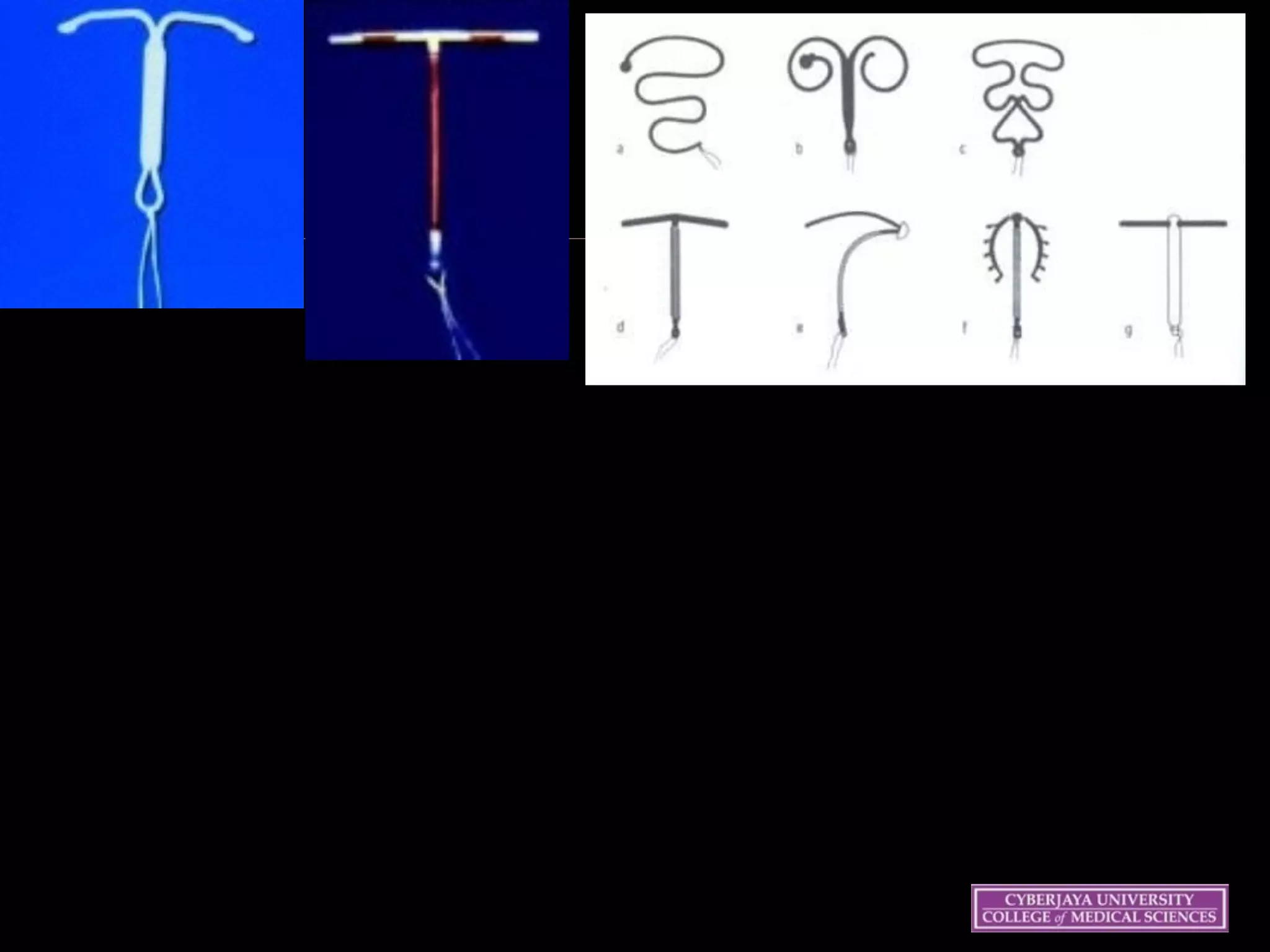
INTRAUTERINE DEVICES
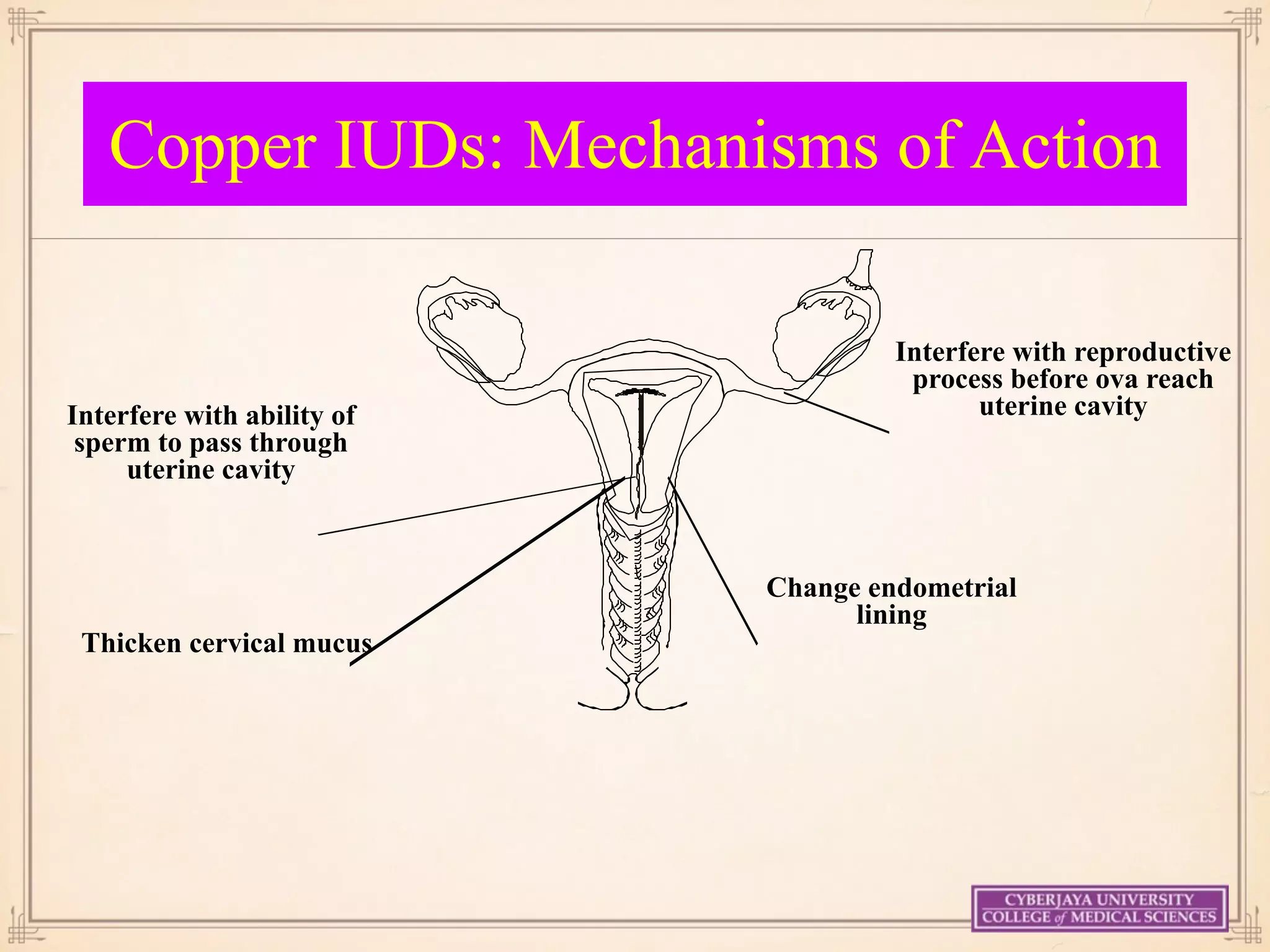
Copper IUDs: Mechanisms of Action
Interfere with reproductive
process before ova reach
uterine cavity
Thicken cervical mucus
Interfere with ability of
sperm to pass through
uterine cavity
Change endometrial
lining
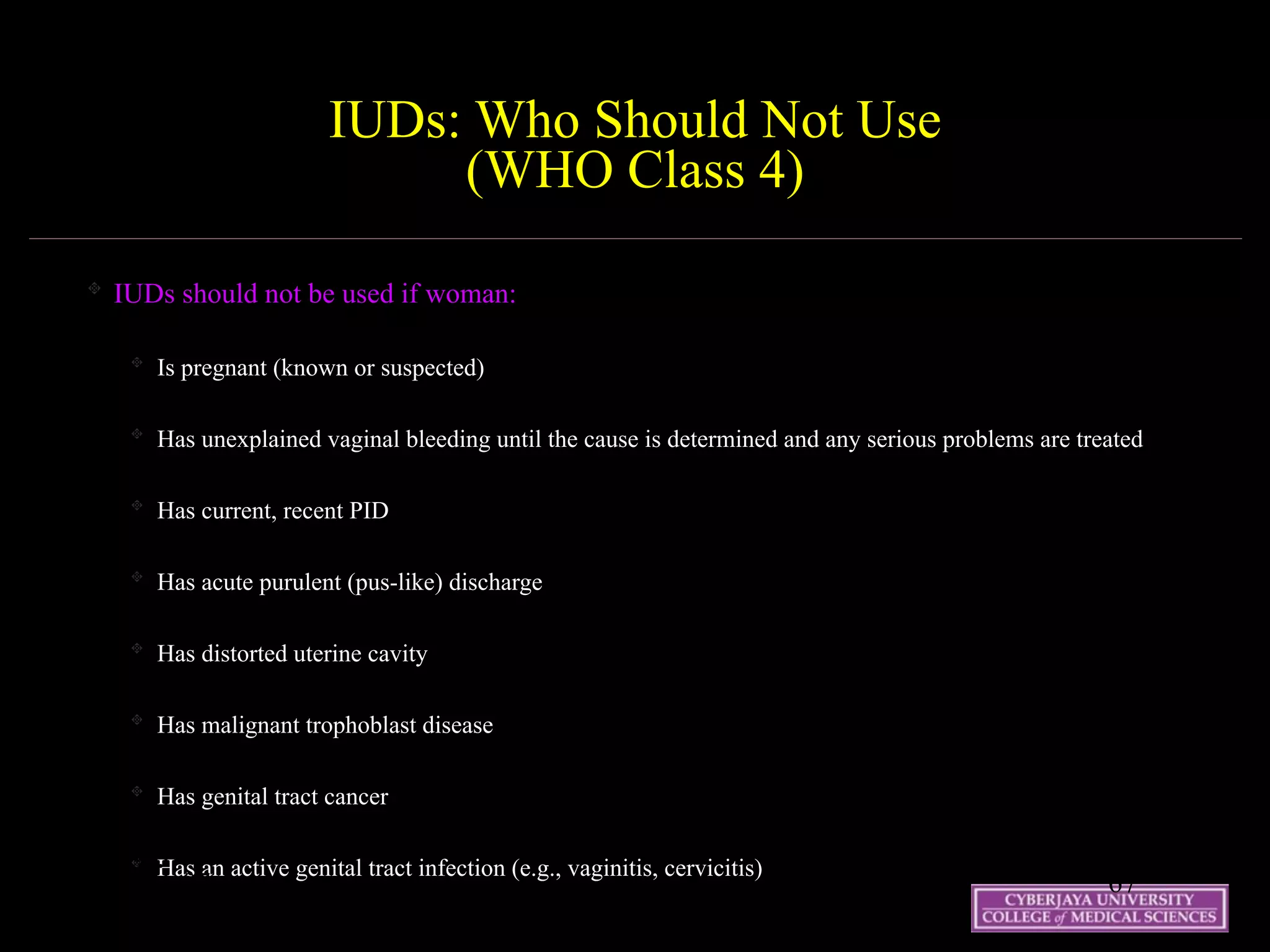
IUDs: Who Should Not Use 

(WHO Class 4)
IUDs should not be used if woman:
Is pregnant (known or suspected)
Has unexplained vaginal bleeding until the cause is determined and any serious problems are treated
Has current, recent PID
Has acute purulent (pus-like) discharge
Has distorted uterine cavity
Has malignant trophoblast disease
Has genital tract cancer
Has an active genital tract infection (e.g., vaginitis, cervicitis)
19 May 07 67
rce: WHO 1996.
19 May 07 68
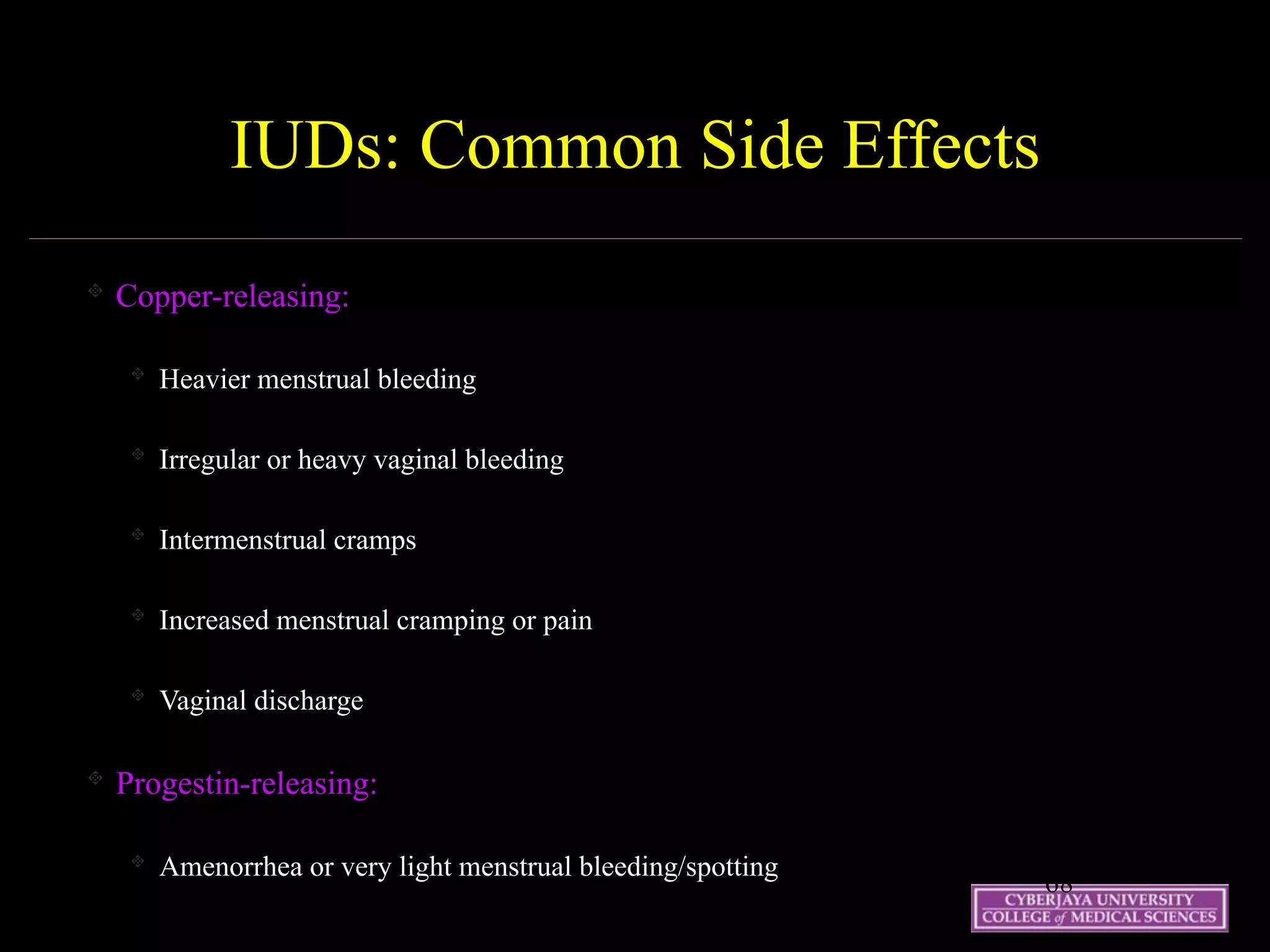
IUDs: Common Side Effects
Copper-releasing:
Heavier menstrual bleeding
Irregular or heavy vaginal bleeding
Intermenstrual cramps
Increased menstrual cramping or pain
Vaginal discharge
Progestin-releasing:
Amenorrhea or very light menstrual bleeding/spotting
19 May 07 69
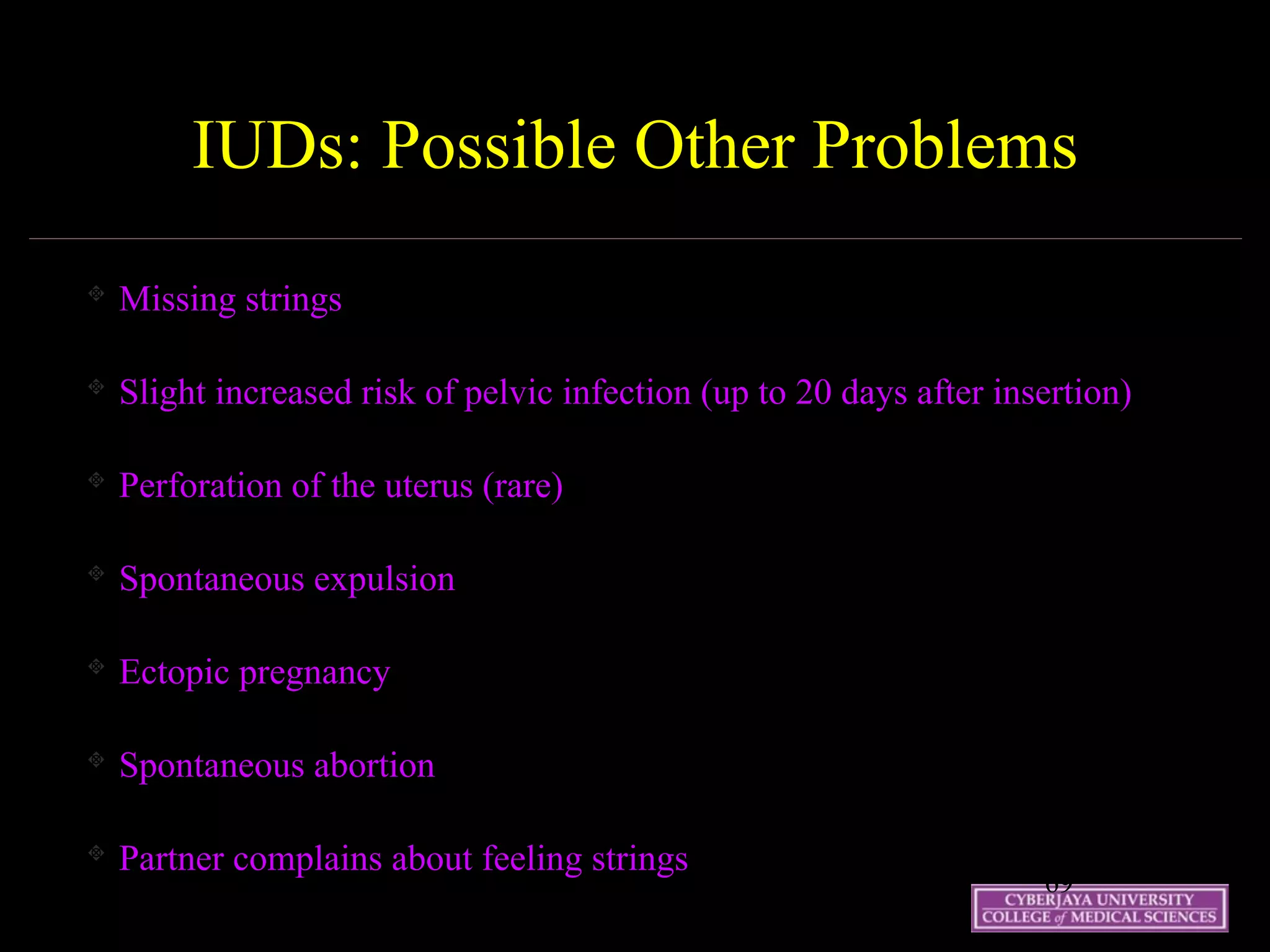
IUDs: Possible Other Problems
Missing strings
Slight increased risk of pelvic infection (up to 20 days after insertion)
Perforation of the uterus (rare)
Spontaneous expulsion
Ectopic pregnancy
Spontaneous abortion
Partner complains about feeling strings
19 May 07 79
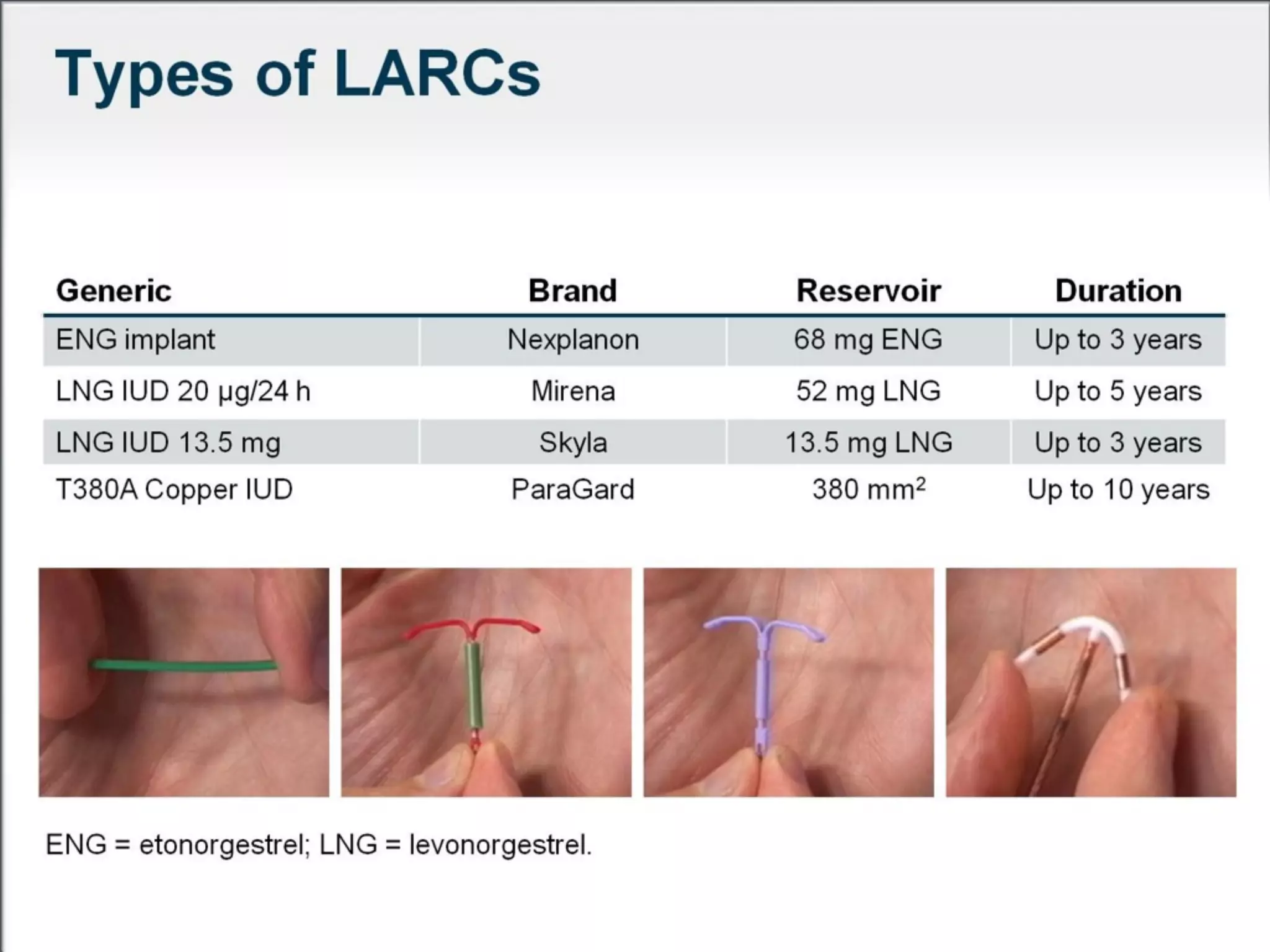
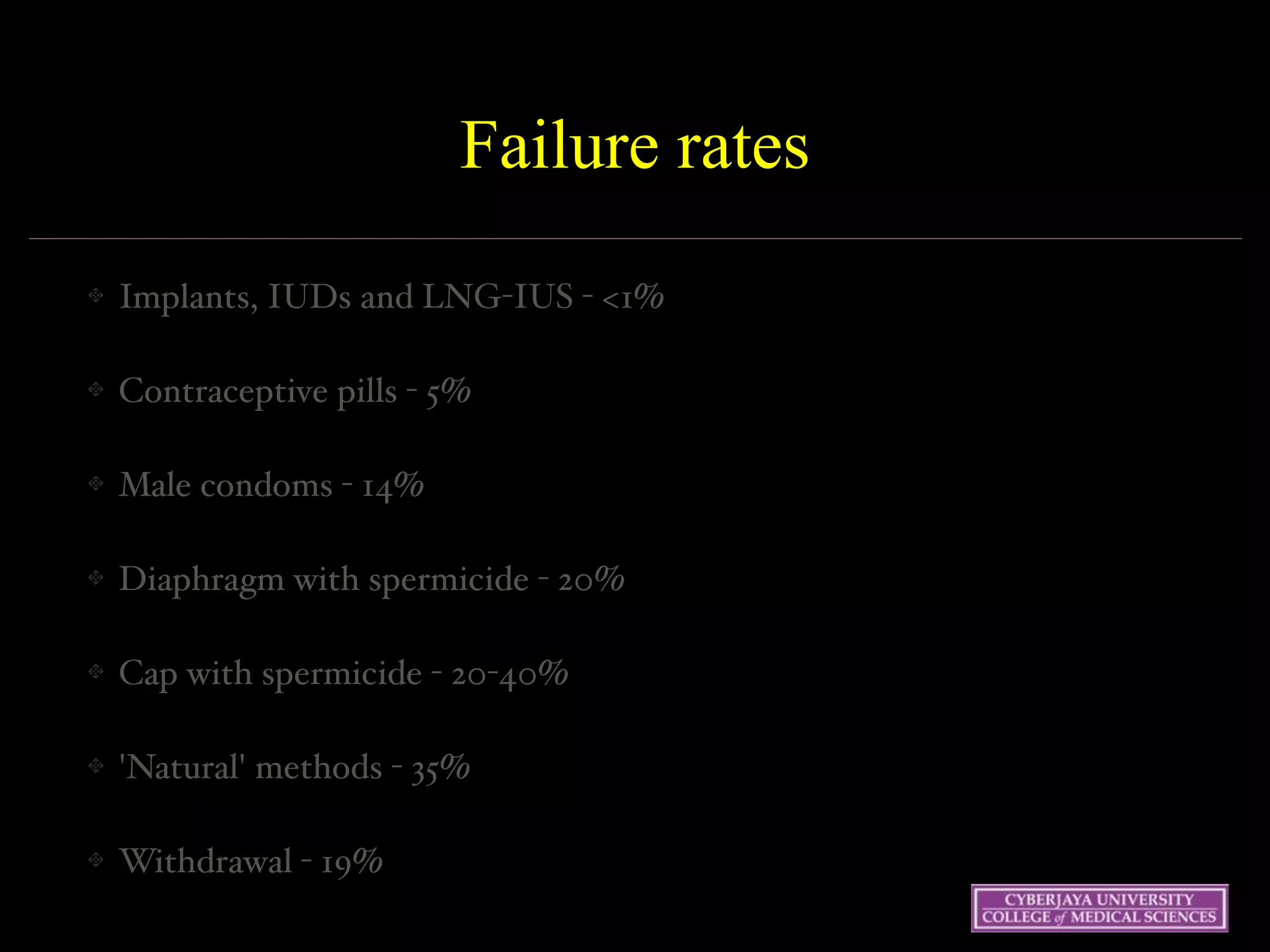
Failure rates
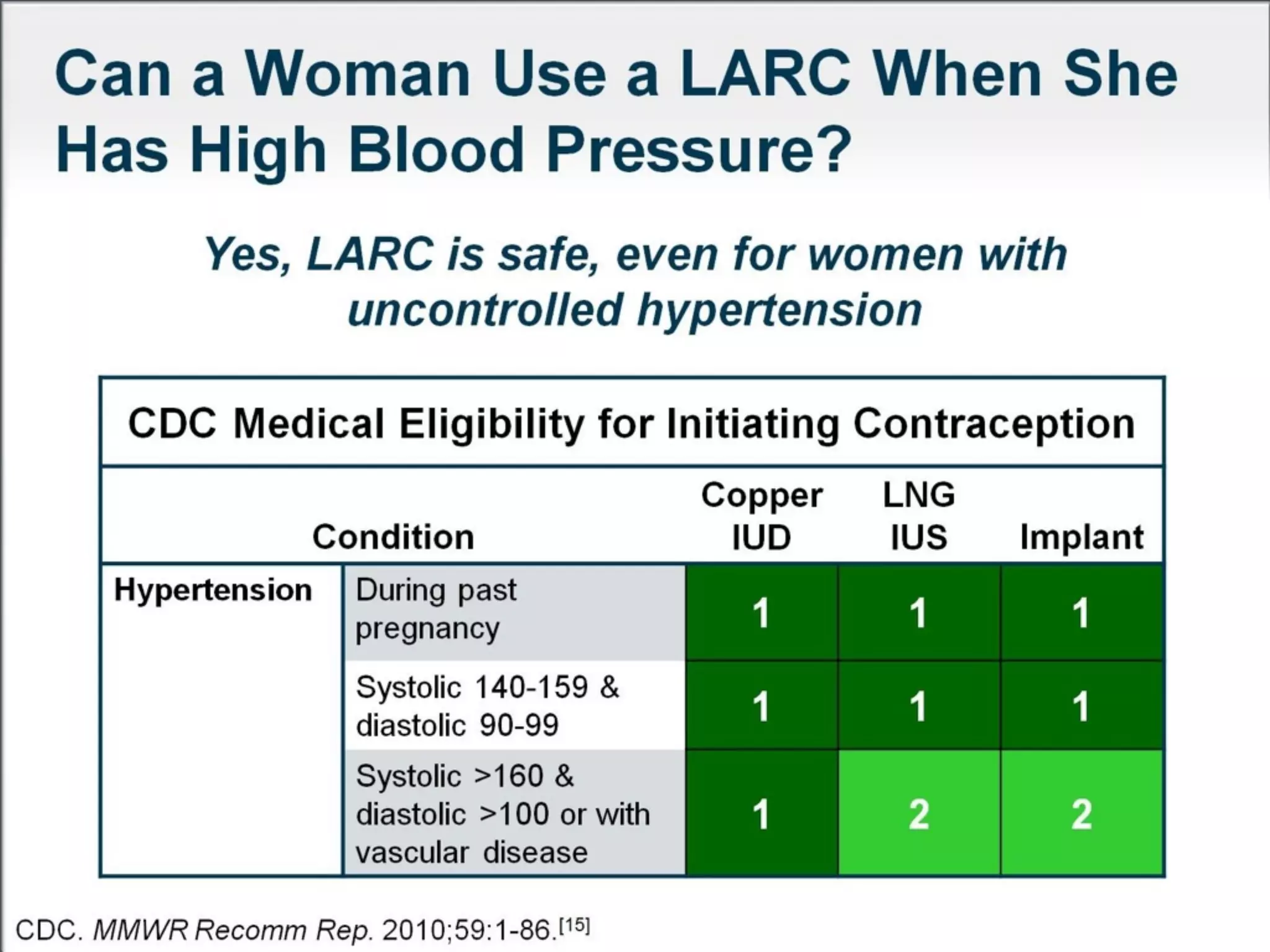
Implants, IUDs and LNG-IUS - <1% #
Contraceptive pills - 5% #
Male condoms - 14% #
Diaphragm with spermicide - 20% #
Cap with spermicide - 20-40% #
'Natural' methods - 35% #
Withdrawal - 19%
KEY POINTS
Contraception provides an effective means to plan a family
Many methods are available -
suitability has to be decided based on a proper history & examination
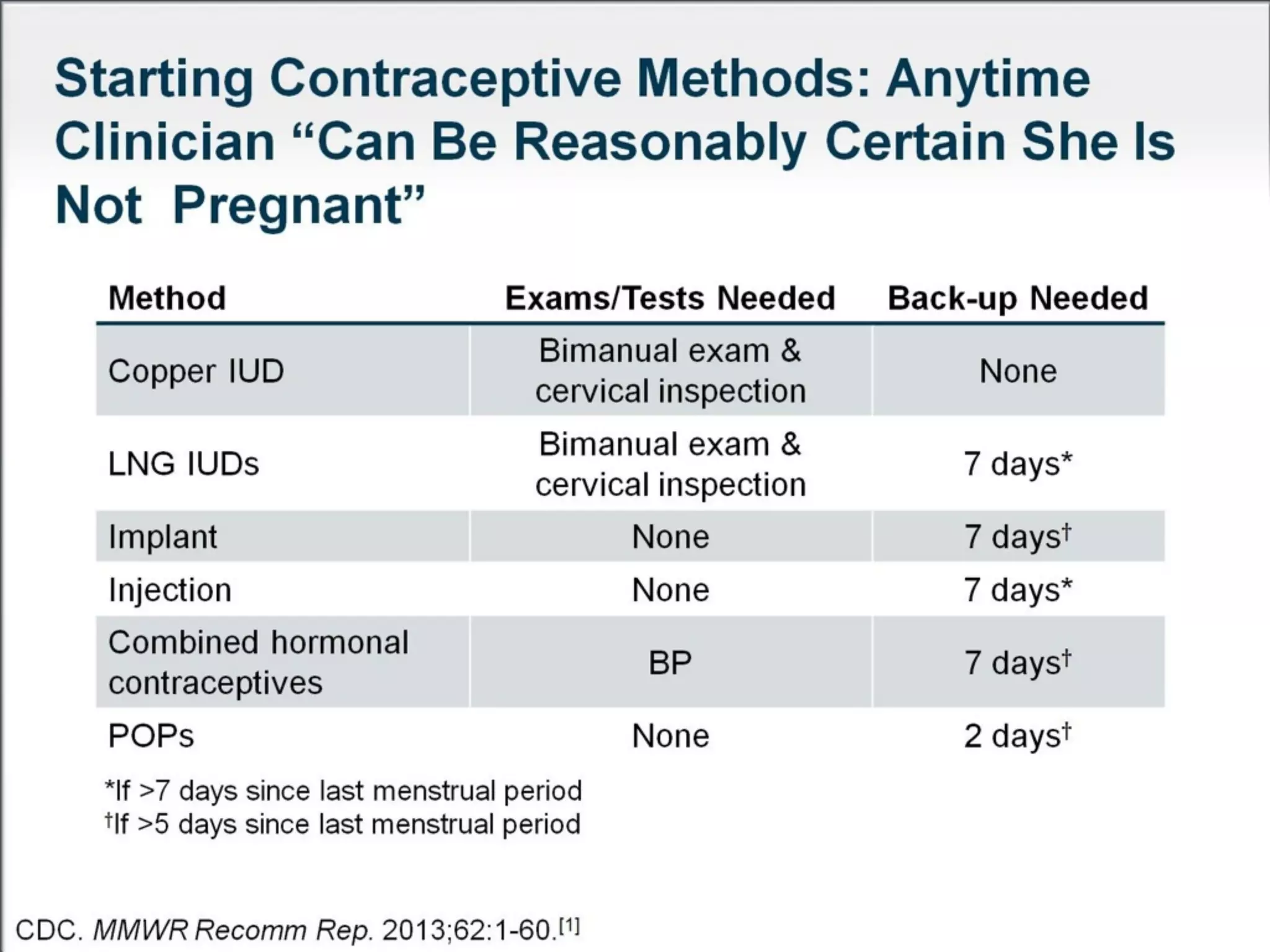
Pregnancy should be ruled out first
You should know the advantages & side effects
Contraception also provides non-contraceptive benefits
Further reading
Cleland et al. Family Planning as a cost saving
preventive health service. NEJM April 20, 2011.
Trussell J. Update on the cost effectiveness of
contraceptives in the United States. Contraception
2010;82:391.
!
CONTRACEPTION OVERVIEW

CONTRACEPTION OVERVIEW

  • 1.
    CONTRACEPTION Associate Prof Dr HanifullahKhan ultrasound scan of IUCD in situ
  • 2.
    Objectives Understand the definition,classification & terminology Understand the reason for contraception Know the advantages & side-effects Know the proper use of each method To be able to advise on the use
  • 3.
    19 May 073 Introduction Definition – any method used to prevent pregnancy • Allows to choose whether & when to have a child
  • 4.
    19 May 074 Reproduction Ovulation Fertile period Fertilisation !
  • 6.
    7 June 20068 Female Contraception Reversibl Non- Hormon Non- CO PO IU Barrie Spermicide Tubal PO Injectable Implant Emergenc Miren
  • 7.
    COMBINED CONTRACEPTION
 • BENEFICIALEFFECTS ON FUTURE FERTILITY – ↓ ASCENDING INFECTION & PID (PROGESTOGENIC EFFECT)
  • 8.
    PROGESTOGEN ONLY CONTRACEPTION ● POP ●SUBDERMAL IMPLANTS ● INJECTABLES ● COMBINED INJECTABLES ● EMERGENCY CONTRACEPTION
  • 11.
    Emergency Contraception Levonor gestrel 0.15 mg +ethinyl estradio Nordette (light orange tablets) 4tablets/ dose 2 doses Levonor gestrel 0.75 mg Plan B 1 tablet/ dose 2 doses First dose within 72 hours of unprotected intercourse; second dose • COPPER- CONTAINING INTRAUTERINE DEVICE (IUD) INSERTED WITHIN 120 HOURS OF UNPROTECTED INTERCOURSE TO PREVENT COURSE – EITHER A HIGH- DOSE COMBINATION OF ESTROGEN & PROGESTIN OR – PROGESTIN- ONLY – USED WITHIN 72 HOURS OF UNPROTECTED INTERCOURSE TO PREVENT PREGNANCY • TAKEN AFTER SI BUT BEFORE IMPLANTATION • MORE EFFECTIVE THE SOONER THEY ARE INITIATED
  • 12.
    Wednesday 15 October 200325 NATURAL METHODS Avoid sex at the fertile times Unsuitable for: Women who can't check their temperature and cervix every day Couples who are even slightly disorganised Women with very irregular periods ! !
  • 13.
    Wednesday 15 October 200328 Methods Coitus Interruptus Rhythm Method Calendar BBT Cervical Mucous (Ovulation) Symptothermal Ovulation Predictor Kits Abstinence Lactational Amenorrhoea Method
  • 14.
    Wednesday 15 October 200338 Shortest cycle (S) minus 18 = Last infertile day of the pre-ovulatory phase Longest cycle (L) minus 11 = Last fertile day For example:- Length of cycles during last six months = 28, 29, 28, 27, 30, 28 (S = 27) S - 18 = Last infertile day 27 - 18 = 9 (L = 30) L - 11 = Last fertile day 30 - 11 = 19
  • 15.
    Wednesday 15 October 2003 39 BasalBody Temperature Method Keeping track of body temperature Body temperature rises two days prior to ovulation.
  • 16.
    Wednesday 15 October 200342 Ovulation (Billing) Method Requires feeling and observing the cervical mucus to determine the time of ovulation. Note the production of clear, watery mucus in the days immediately before ovulation To avoid pregnancy, intercourse is avoided for several days following change in the color and consistency of cervical mucus.
  • 17.
    Wednesday 15 October 200345 Sensation
 at Vulva Finger Test Appearance Moist
 or
 Sticky Early Mucus
 Scanty
 Thick
 White
 Sticky
 Holds its shape Wetter Transitional Mucus
 Increasing Amounts
 Thinner
 Cloudy
 Slightly Stretchy Slippery Highly Fertile Mucus
 Profuse
 Thin
 Transparent
 Stretchy
 (like raw egg white)
  • 18.
    Wednesday 15 October 2003 46 Mucuschanges throughout the cycle Complete cycle showing typical pattern of menstruation, pre- ovulatory dry days, 
 mucus days with increasingly fertile characteristics approaching peak day, 
 the abrupt change back to less fertile characteristics, 
 the count of four after peak day and post-ovulatory dry days
  • 19.
    Wednesday 15 October 2003 48 Interpretationof the Sympto-Thermal Chart This sympto-thermal chart shows the correlation between all indicators of fertility
  • 20.
    Wednesday 15 October 200349 Fertility Chart
  • 21.
    Wednesday 15 October 2003 50 OvulationPredictor Kits used to test urine to identify hormones that indicate ovulation is about to occur electronic fertility computer tells a woman which days she is fertile Persona: fertile days are indicated with a red light and infertile days with a green light failure rate as low as 6% among women who abstain on fertile days as indicated by the device
  • 22.
    Wednesday 15 October 200357 LAM Conditions to be fulfilled Fully BF No periods Recommended up to 6 months - the longer LAM is used, the more likely it is that ovulation will precede the first menses
  • 23.
  • 24.
    Copper IUDs: Mechanismsof Action Interfere with reproductive process before ova reach uterine cavity Thicken cervical mucus Interfere with ability of sperm to pass through uterine cavity Change endometrial lining
  • 25.
    IUDs: Who ShouldNot Use 
 (WHO Class 4) IUDs should not be used if woman: Is pregnant (known or suspected) Has unexplained vaginal bleeding until the cause is determined and any serious problems are treated Has current, recent PID Has acute purulent (pus-like) discharge Has distorted uterine cavity Has malignant trophoblast disease Has genital tract cancer Has an active genital tract infection (e.g., vaginitis, cervicitis) 19 May 07 67 rce: WHO 1996.
  • 26.
    19 May 0768 IUDs: Common Side Effects Copper-releasing: Heavier menstrual bleeding Irregular or heavy vaginal bleeding Intermenstrual cramps Increased menstrual cramping or pain Vaginal discharge Progestin-releasing: Amenorrhea or very light menstrual bleeding/spotting
  • 27.
    19 May 0769 IUDs: Possible Other Problems Missing strings Slight increased risk of pelvic infection (up to 20 days after insertion) Perforation of the uterus (rare) Spontaneous expulsion Ectopic pregnancy Spontaneous abortion Partner complains about feeling strings
  • 28.
    19 May 0779 Failure rates Implants, IUDs and LNG-IUS - <1% # Contraceptive pills - 5% # Male condoms - 14% # Diaphragm with spermicide - 20% # Cap with spermicide - 20-40% # 'Natural' methods - 35% # Withdrawal - 19%
  • 30.
    KEY POINTS Contraception providesan effective means to plan a family Many methods are available - suitability has to be decided based on a proper history & examination Pregnancy should be ruled out first You should know the advantages & side effects Contraception also provides non-contraceptive benefits
  • 31.
    Further reading Cleland etal. Family Planning as a cost saving preventive health service. NEJM April 20, 2011. Trussell J. Update on the cost effectiveness of contraceptives in the United States. Contraception 2010;82:391. !