PARTOGRAPH
NAZOMBE
PARTOGRAPH
A partograph is a graphical record of the
observations made of a woman in labour
HISTORY OF PARTOGRAM
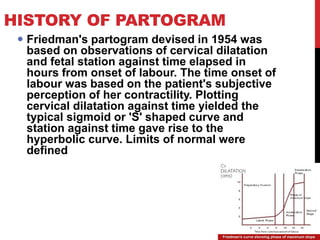
 Friedman's partogram devised in 1954 was
based on observations of cervical dilatation
and fetal station against time elapsed in
hours from onset of labour. The time onset of
labour was based on the patient's subjective
perception of her contractility. Plotting
cervical dilatation against time yielded the
typical sigmoid or 'S' shaped curve and
station against time gave rise to the
hyperbolic curve. Limits of normal were
defined
PHILPOTT AND CASTLE
in 1972 introduced the concept of "ALERT" and "ACTION"
lines. The aim of this study was to fulfill the needs of
paramedical personnel practising obstetrics in Rhodesian
African primigravidae. The alert line represented the mean
rate of progress of the slowest 10% of patients in the African
population whom they served. Alert line was drawn at a slope
of 1 centimetre/hr for nulliparous women starting at zero time
i.e. time of admission . Action line drawn four hours to the
right of the alert line showing that if the patient has crossed
the alert line active management should be instituted within 4
hours, enabling the transfer of the patient to a specialised
tertiary care centre.
STUDD'S LABOUR STENCILS
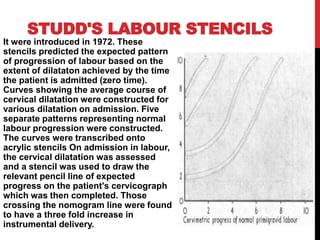
It were introduced in 1972. These
stencils predicted the expected pattern
of progression of labour based on the
extent of dilataton achieved by the time
the patient is admitted (zero time).
Curves showing the average course of
cervical dilatation were constructed for
various dilatation on admission. Five
separate patterns representing normal
labour progression were constructed.
The curves were transcribed onto
acrylic stencils On admission in labour,
the cervical dilatation was assessed
and a stencil was used to draw the
relevant pencil line of expected
progress on the patient's cervicograph
which was then completed. Those
crossing the nomogram line were found
to have a three fold increase in
instrumental delivery.
WHO PARTOGRAPH
OBJECTIVES
1. Early detection of abnormal progress of a labour
2. prevention of prolonged labour
3. Recognize cephalopelvic disproportion long before
obstructed labour
4. Assist in early decision on transfer , augmentation , or
termination of labour
5. Increase the quality and regularity of all observations of
mother and fetus
6. Early recognition of maternal or fetal problems
The partograph can be highly effective in reducing
complications from prolonged labor for the mother
(postpartum hemorrhage, sepsis, uterine rupture and its
sequelae) and for the newborn (death, anoxia, infections,
etc.).
PARTOGRAPH FUNCTION
The partograph is designed for use in all maternity settings ,
but has a different level of function at different levels of
health care:
In health center, the partograph’s critical function is
to give early warning if labour is likely to be prolonged and
to indicate that the woman should be transferred to hospital
(ALERT LINE FUNCTION )
In hospital settings, moving to the right of alert line serves as
a warning for extra vigilance , but the action line is the critical
point at which specific management decisions must be made
Other observations on the progress of labour are also
recorded on the partograph and are essential features in
management of labour
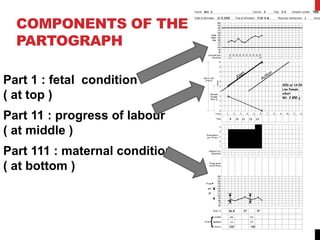
COMPONENTS OF THE
PARTOGRAPH
Part 1 : fetal condition
( at top )
Part 11 : progress of labour
( at middle )
Part 111 : maternal condition
( at bottom )
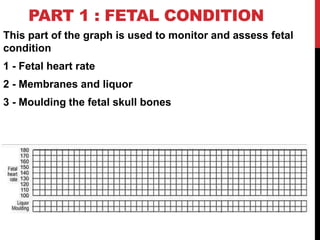
PART 1 : FETAL CONDITION
This part of the graph is used to monitor and assess fetal
condition
1 - Fetal heart rate
2 - Membranes and liquor
3 - Moulding the fetal skull bones
FETAL HEART RATE
Basal fetal heart rate? The baseline rate is best determined
over a period of 5–10 minutes
< 160 beats/min =tachycardia
> 120 beats/min = bradycardia
Decelerations? yes/no
Relation to contractions?
 Early
 Variable
 Late – -----Auscultation - return to baseline
> 30 sec  contraction
----- Electronic monitoring (CTG)
peak and trough
 > 30 sec
MEMBRANES AND LIQUOR
 Intact membranes ………………...I
 Ruptured membranes + clear liquor ….C
 Ruptured membranes + meconium-
stained liquor …M
 Ruptured membranes + blood – stained
liquor …………...B
 Ruptured membranes + absent
liquor…………....A
Record the abbreviations in the box
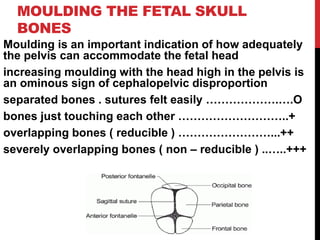
MOULDING THE FETAL SKULL
BONES
Moulding is an important indication of how adequately
the pelvis can accommodate the fetal head
increasing moulding with the head high in the pelvis is
an ominous sign of cephalopelvic disproportion
separated bones . sutures felt easily ……………….….O
bones just touching each other ………………………..+
overlapping bones ( reducible ) ……………………...++
severely overlapping bones ( non – reducible ) ..…..+++
PART11 – PROGRESS OF
LABOUR
Cervical dilatation
Descent of the fetal head
Fetal position
Uterine contractions
this section of the partograph has as its central feature:
a graph of cervical dilatation against time
LATENT PHASE :
it starts from onset of labour until the cervix
reaches 4 cm diltation
once 4 cm diltation is reached , labour enters the
active phase
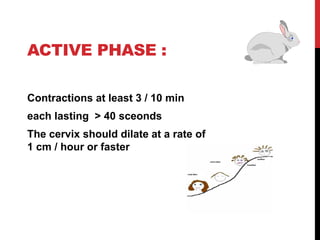
ACTIVE PHASE :
Contractions at least 3 / 10 min
each lasting < 40 sceonds
The cervix should dilate at a rate of
1 cm / hour or faster
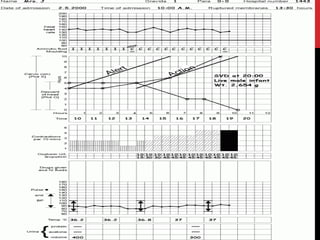
ALERT LINE ( HEALTH FACILITY
LINE )
The alert line drawn from 4 cm dilatation represents the rate
of dilatation of 1 cm / hour
Moving to the right of the alert line means referral to hospital
for extra vigilance
ACTION LINE ( HOSPITAL LINE )
The action line is drawn 4 hour to the right of the alert line
and parallel to it
This is the critical line at which specific management
decisions must be made at the hospital
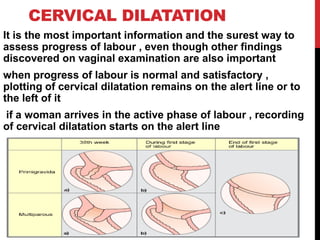
CERVICAL DILATATION
It is the most important information and the surest way to
assess progress of labour , even though other findings
discovered on vaginal examination are also important
when progress of labour is normal and satisfactory ,
plotting of cervical dilatation remains on the alert line or to
the left of it
if a woman arrives in the active phase of labour , recording
of cervical dilatation starts on the alert line
DESCENT OF THE
FETAL HEAD
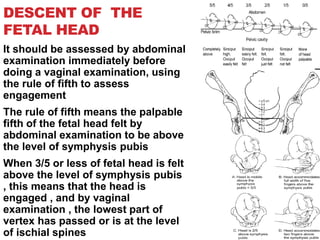
It should be assessed by abdominal
examination immediately before
doing a vaginal examination, using
the rule of fifth to assess
engagement
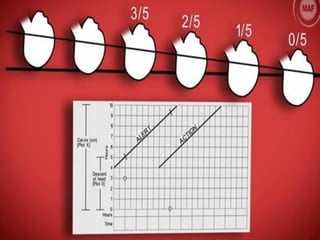
The rule of fifth means the palpable
fifth of the fetal head felt by
abdominal examination to be above
the level of symphysis pubis
When 3/5 or less of fetal head is felt
above the level of symphysis pubis
, this means that the head is
engaged , and by vaginal
examination , the lowest part of
vertex has passed or is at the level
of ischial spines
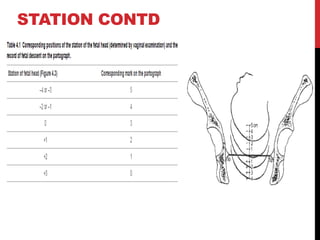
ASSESSING DESCENT OF THE FETAL HEAD BY
VAGINAL EXAMINATION;
0 STATION IS AT THE LEVEL OF THE ISCHIAL
SPINE (SP).
FLOATING HEAD , -3 STATION : PLOT O AT 5 (ON
PARTOGRAPH)
-2 , -1 STATION: PLOT O AT 4
0 STATION: PLOT O AT 3
+1 STATION: PLOT O AT 2
+2 STATION: PLOT O AT 1
BELOW +2: PLOT O AT 0
STATION CONTD
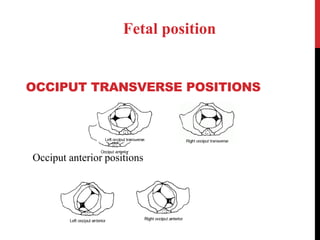
OCCIPUT TRANSVERSE POSITIONS
Occiput anterior positions
Fetal position
UTERINE CONTRACTIONS
 Observations of the contractions are made every half-
hour in the active phase
 Frequency how often are they felt ?
 Assessed by number of contractions in a 10 minutes
period
 Duration how long do they last ?
 Measured in seconds from the time the contraction is first
felt abdominally , to the time the contraction phases off
 Each square represents one contraction
ASSESSMENT OF
UTERINE
CONTRACTIONS:
1. Manual assessment
2. Cardiotocography
The above methods measure the frequency and duration of
contractions
This method will measure the intensity in addition to
frequency and duration
PALPATE NUMBER OF CONTRACTION
IN TEN MINUTES AND DURATION OF
EACH CONTRACTION IN SECONDS
Less than 20 seconds:
Between 20 and 40 seconds:
More than 40 seconds:
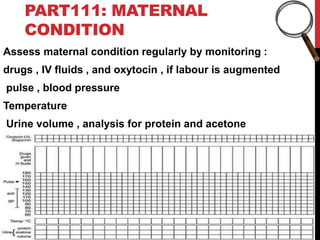
PART111: MATERNAL
CONDITION
Assess maternal condition regularly by monitoring :
drugs , IV fluids , and oxytocin , if labour is augmented
pulse , blood pressure
Temperature
Urine volume , analysis for protein and acetone
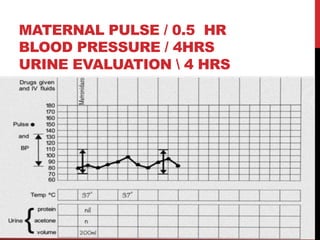
MATERNAL PULSE / 0.5 HR
BLOOD PRESSURE / 4HRS
URINE EVALUATION  4 HRS
MANAGEMENT OF LABOUR
USING THE PARTOGRAPH
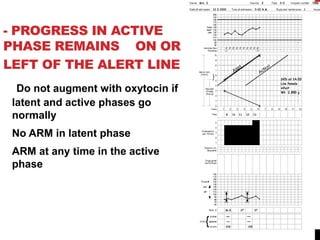
- PROGRESS IN ACTIVE
PHASE REMAINS ON OR
LEFT OF THE ALERT LINE
Do not augment with oxytocin if
latent and active phases go
normally
No ARM in latent phase
ARM at any time in the active
phase
BETWEEN ALERT AND ACTION LINES
In health center , the women must be transferred to
a hospital with facilities for cesarean section ,
unless the cervix is almost fully dilated
Observe labor progress for short period before
transfer
Continue routine observations
ARM may be performed if membranes are still
intact
AT OR BEYOND ACTION LINE
 Conduct full medical assessment
 Consider intravenous infusion / bladder catheterization /
analgesia
 Options
 Deliver by cesarean section if there is fetal distress or
obstructed labor
 Augment with oxytocin by intravenous infusion if there are
no contraindications
ABNORMAL PROGRESS OF
LABOUR
NICE concludes that a 4-hour action line should be used as the use
of shorter intervals ‘increases interventions without any benefit to
mother or baby’. Using a definition of up to 4 cm as the end of the
latent phase, NICE goes on to define the diagnosis of delay as
‘cervical dilatation of less than 2 cm in 4 hours for first labours or
cervical dilatation of less than 2 cm in 4 hours or a slowing in the
progress of labour for second or subsequent labours’.
One of the main functions of the partograph is to detect early
deviation from normal progress of labor
MOVING TO THE
RIGHT OF ALERT LINE
 This means warning
 Transfer the woman from health center to
hospital
 Reaching the action line
 This means possible danger
 Decision needed on future management (usually
by obstetrician or resident )
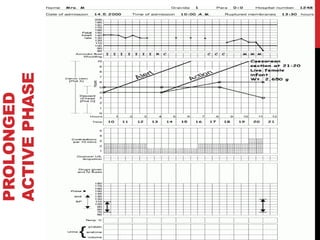
PROLONGED
ACTIVE
PHASE
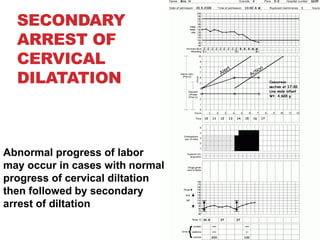
SECONDARY
ARREST OF
CERVICAL
DILATATION
Abnormal progress of labor
may occur in cases with normal
progress of cervical diltation
then followed by secondary
arrest of diltation
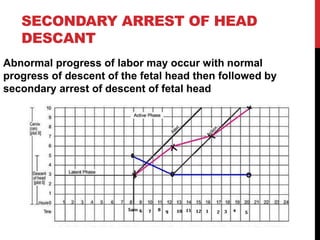
SECONDARY ARREST OF HEAD
DESCANT
Abnormal progress of labor may occur with normal
progress of descent of the fetal head then followed by
secondary arrest of descent of fetal head
PRECIPITATE LABOUR
- Maximum slope of dilatation of 5 cm/hr or more
THE PARTOGRAPH IN THE
MANAGEMENT OF LABOR
FOLLOWING CESAREAN SECTION-
(TOLAC).
In women undergoing a trial of labor following
cesarean section, the partographic zone 2-3 h after
the alert line represents a time of high risk of scar
rupture. An action line in this time zone would
probably help reduce the rupture rate without an
unacceptable increase in the rate of cesarean
section
THANK YOU

UNDERSTANDING THE PARTOGRAPH FOR LABOR MANAGEMENT

  • 1.
  • 2.
    PARTOGRAPH A partograph isa graphical record of the observations made of a woman in labour
  • 3.
    HISTORY OF PARTOGRAM Friedman's partogram devised in 1954 was based on observations of cervical dilatation and fetal station against time elapsed in hours from onset of labour. The time onset of labour was based on the patient's subjective perception of her contractility. Plotting cervical dilatation against time yielded the typical sigmoid or 'S' shaped curve and station against time gave rise to the hyperbolic curve. Limits of normal were defined
  • 4.
    PHILPOTT AND CASTLE in1972 introduced the concept of "ALERT" and "ACTION" lines. The aim of this study was to fulfill the needs of paramedical personnel practising obstetrics in Rhodesian African primigravidae. The alert line represented the mean rate of progress of the slowest 10% of patients in the African population whom they served. Alert line was drawn at a slope of 1 centimetre/hr for nulliparous women starting at zero time i.e. time of admission . Action line drawn four hours to the right of the alert line showing that if the patient has crossed the alert line active management should be instituted within 4 hours, enabling the transfer of the patient to a specialised tertiary care centre.
  • 5.
    STUDD'S LABOUR STENCILS Itwere introduced in 1972. These stencils predicted the expected pattern of progression of labour based on the extent of dilataton achieved by the time the patient is admitted (zero time). Curves showing the average course of cervical dilatation were constructed for various dilatation on admission. Five separate patterns representing normal labour progression were constructed. The curves were transcribed onto acrylic stencils On admission in labour, the cervical dilatation was assessed and a stencil was used to draw the relevant pencil line of expected progress on the patient's cervicograph which was then completed. Those crossing the nomogram line were found to have a three fold increase in instrumental delivery.
  • 6.
  • 7.
    OBJECTIVES 1. Early detectionof abnormal progress of a labour 2. prevention of prolonged labour 3. Recognize cephalopelvic disproportion long before obstructed labour 4. Assist in early decision on transfer , augmentation , or termination of labour 5. Increase the quality and regularity of all observations of mother and fetus 6. Early recognition of maternal or fetal problems The partograph can be highly effective in reducing complications from prolonged labor for the mother (postpartum hemorrhage, sepsis, uterine rupture and its sequelae) and for the newborn (death, anoxia, infections, etc.).
  • 8.
    PARTOGRAPH FUNCTION The partographis designed for use in all maternity settings , but has a different level of function at different levels of health care: In health center, the partograph’s critical function is to give early warning if labour is likely to be prolonged and to indicate that the woman should be transferred to hospital (ALERT LINE FUNCTION ) In hospital settings, moving to the right of alert line serves as a warning for extra vigilance , but the action line is the critical point at which specific management decisions must be made Other observations on the progress of labour are also recorded on the partograph and are essential features in management of labour
  • 9.
    COMPONENTS OF THE PARTOGRAPH Part1 : fetal condition ( at top ) Part 11 : progress of labour ( at middle ) Part 111 : maternal condition ( at bottom )
  • 10.
    PART 1 :FETAL CONDITION This part of the graph is used to monitor and assess fetal condition 1 - Fetal heart rate 2 - Membranes and liquor 3 - Moulding the fetal skull bones
  • 11.
    FETAL HEART RATE Basalfetal heart rate? The baseline rate is best determined over a period of 5–10 minutes < 160 beats/min =tachycardia > 120 beats/min = bradycardia Decelerations? yes/no Relation to contractions?  Early  Variable  Late – -----Auscultation - return to baseline > 30 sec  contraction ----- Electronic monitoring (CTG) peak and trough  > 30 sec
  • 12.
    MEMBRANES AND LIQUOR Intact membranes ………………...I  Ruptured membranes + clear liquor ….C  Ruptured membranes + meconium- stained liquor …M  Ruptured membranes + blood – stained liquor …………...B  Ruptured membranes + absent liquor…………....A Record the abbreviations in the box
  • 13.
    MOULDING THE FETALSKULL BONES Moulding is an important indication of how adequately the pelvis can accommodate the fetal head increasing moulding with the head high in the pelvis is an ominous sign of cephalopelvic disproportion separated bones . sutures felt easily ……………….….O bones just touching each other ………………………..+ overlapping bones ( reducible ) ……………………...++ severely overlapping bones ( non – reducible ) ..…..+++
  • 15.
    PART11 – PROGRESSOF LABOUR Cervical dilatation Descent of the fetal head Fetal position Uterine contractions this section of the partograph has as its central feature: a graph of cervical dilatation against time
  • 16.
    LATENT PHASE : itstarts from onset of labour until the cervix reaches 4 cm diltation once 4 cm diltation is reached , labour enters the active phase
  • 17.
    ACTIVE PHASE : Contractionsat least 3 / 10 min each lasting < 40 sceonds The cervix should dilate at a rate of 1 cm / hour or faster
  • 18.
    ALERT LINE (HEALTH FACILITY LINE ) The alert line drawn from 4 cm dilatation represents the rate of dilatation of 1 cm / hour Moving to the right of the alert line means referral to hospital for extra vigilance
  • 19.
    ACTION LINE (HOSPITAL LINE ) The action line is drawn 4 hour to the right of the alert line and parallel to it This is the critical line at which specific management decisions must be made at the hospital
  • 20.
    CERVICAL DILATATION It isthe most important information and the surest way to assess progress of labour , even though other findings discovered on vaginal examination are also important when progress of labour is normal and satisfactory , plotting of cervical dilatation remains on the alert line or to the left of it if a woman arrives in the active phase of labour , recording of cervical dilatation starts on the alert line
  • 21.
    DESCENT OF THE FETALHEAD It should be assessed by abdominal examination immediately before doing a vaginal examination, using the rule of fifth to assess engagement The rule of fifth means the palpable fifth of the fetal head felt by abdominal examination to be above the level of symphysis pubis When 3/5 or less of fetal head is felt above the level of symphysis pubis , this means that the head is engaged , and by vaginal examination , the lowest part of vertex has passed or is at the level of ischial spines
  • 22.
    ASSESSING DESCENT OFTHE FETAL HEAD BY VAGINAL EXAMINATION; 0 STATION IS AT THE LEVEL OF THE ISCHIAL SPINE (SP). FLOATING HEAD , -3 STATION : PLOT O AT 5 (ON PARTOGRAPH) -2 , -1 STATION: PLOT O AT 4 0 STATION: PLOT O AT 3 +1 STATION: PLOT O AT 2 +2 STATION: PLOT O AT 1 BELOW +2: PLOT O AT 0
  • 23.
  • 25.
    OCCIPUT TRANSVERSE POSITIONS Occiputanterior positions Fetal position
  • 26.
    UTERINE CONTRACTIONS  Observationsof the contractions are made every half- hour in the active phase  Frequency how often are they felt ?  Assessed by number of contractions in a 10 minutes period  Duration how long do they last ?  Measured in seconds from the time the contraction is first felt abdominally , to the time the contraction phases off  Each square represents one contraction
  • 27.
    ASSESSMENT OF UTERINE CONTRACTIONS: 1. Manualassessment 2. Cardiotocography The above methods measure the frequency and duration of contractions This method will measure the intensity in addition to frequency and duration
  • 28.
    PALPATE NUMBER OFCONTRACTION IN TEN MINUTES AND DURATION OF EACH CONTRACTION IN SECONDS Less than 20 seconds: Between 20 and 40 seconds: More than 40 seconds:
  • 29.
    PART111: MATERNAL CONDITION Assess maternalcondition regularly by monitoring : drugs , IV fluids , and oxytocin , if labour is augmented pulse , blood pressure Temperature Urine volume , analysis for protein and acetone
  • 30.
    MATERNAL PULSE /0.5 HR BLOOD PRESSURE / 4HRS URINE EVALUATION 4 HRS
  • 31.
  • 32.
    - PROGRESS INACTIVE PHASE REMAINS ON OR LEFT OF THE ALERT LINE Do not augment with oxytocin if latent and active phases go normally No ARM in latent phase ARM at any time in the active phase
  • 33.
    BETWEEN ALERT ANDACTION LINES In health center , the women must be transferred to a hospital with facilities for cesarean section , unless the cervix is almost fully dilated Observe labor progress for short period before transfer Continue routine observations ARM may be performed if membranes are still intact
  • 35.
    AT OR BEYONDACTION LINE  Conduct full medical assessment  Consider intravenous infusion / bladder catheterization / analgesia  Options  Deliver by cesarean section if there is fetal distress or obstructed labor  Augment with oxytocin by intravenous infusion if there are no contraindications
  • 36.
  • 37.
    NICE concludes thata 4-hour action line should be used as the use of shorter intervals ‘increases interventions without any benefit to mother or baby’. Using a definition of up to 4 cm as the end of the latent phase, NICE goes on to define the diagnosis of delay as ‘cervical dilatation of less than 2 cm in 4 hours for first labours or cervical dilatation of less than 2 cm in 4 hours or a slowing in the progress of labour for second or subsequent labours’.
  • 38.
    One of themain functions of the partograph is to detect early deviation from normal progress of labor
  • 39.
    MOVING TO THE RIGHTOF ALERT LINE  This means warning  Transfer the woman from health center to hospital  Reaching the action line  This means possible danger  Decision needed on future management (usually by obstetrician or resident )
  • 40.
  • 41.
    SECONDARY ARREST OF CERVICAL DILATATION Abnormal progressof labor may occur in cases with normal progress of cervical diltation then followed by secondary arrest of diltation
  • 42.
    SECONDARY ARREST OFHEAD DESCANT Abnormal progress of labor may occur with normal progress of descent of the fetal head then followed by secondary arrest of descent of fetal head
  • 43.
    PRECIPITATE LABOUR - Maximumslope of dilatation of 5 cm/hr or more
  • 44.
    THE PARTOGRAPH INTHE MANAGEMENT OF LABOR FOLLOWING CESAREAN SECTION- (TOLAC). In women undergoing a trial of labor following cesarean section, the partographic zone 2-3 h after the alert line represents a time of high risk of scar rupture. An action line in this time zone would probably help reduce the rupture rate without an unacceptable increase in the rate of cesarean section
  • 45.